Carátula del artículo
SOCIAL AND ORGANIZATIONAL PSYCHOLOGY
Validity evidences regarding the Authentic Leadership Inventory
Evidências de validade do Inventário de Liderança Autêntica
 Vladimir Pinto NOVAES
Universidade Salgado de Oliveira, Brasil
Maria Cristina FERREIRA
Universidade Salgado de Oliveira, Brasil
Larissa Maria David GABARDO-MARTINS
Universidade Salgado de Oliveira, Brasil
Estudos de Psicologia (Campinas), vol. 36, e180058, 2019
Programa de Pós-Graduação em Psicologia, Pontifícia Universidade Católica de Campinas
Received: 25 May 2018
Revised document received: 08 May 2019
Accepted: 11 July 2019
Funding
Funding source: Aperfeiçoamento de Pessoal de Nível Superior
Contract number: 88882.365878/2019-01
Funding statement: Support: Coordenação de Aperfeiçoamento de Pessoal de Nível Superior (Process nº 88882.365878/2019-01).
Global competition, economic uncertainties and rapid technological change have led organizations to make their activities increasingly profitable and to attract and retain better performing employees in order to become more efficient in an increasingly competitive marketplace (Cummings & Worley, 2014). Such changes eventually lead to disruptions and changes in managerial philosophy, thus turning leadership into a key factor for organizational success, since such a structure tends to directly influence employees’ well-being and performance (Avolio, Wernsing, & Gardner, 2017).
More recently several leadership styles have been addressed in the Organizational Psychology and Work literature, such as transformational leadership (Fonseca & Porto, 2013), enabling leadership (Lacerenza, Reyes, Marlow, Joseph, & Salas, 2017), benevolent leadership (Erkutlu & Chafra, 2016), virtuous leadership (Palanski, Cullen, Gentry, & Nichols, 2015), ethical leadership (Zhu, He, Trevino, Chao, & Wang, 2015) and authentic leadership (Rego, Sousa, Marques, & Cunha, 2014). Among them, authentic leadership is the object of the present investigation. This type of leadership refers to a pattern of behaviors based on positive psychological capacities and on an ethical and moral climate (Avolio et al., 2017). It therefore consists of a style that makes leaders act in accordance with their true values, beliefs and strengths and at the same time help followers do the same in order to build an environment of trust and respect in the labor scenario (Wong & Laschinger, 2013).
According to Avolio, Gardner, Walumbwa, Luthans, and May (2004), authentic leadership is characterized by four behaviors: (i) balanced processing, (ii) internalized moral perspective, (iii) relational transparency and (iv) self-awareness. Balanced processing refers to the fact that the leader objectively analyses all relevant data before making decisions. The internalized moral perspective is characterized by the leader being guided by moral values and internal norms that direct his/her actions, even if such values are against the group, the organization or social pressures. Relational transparency is about the leader presenting an authentic “I” (as opposed to a false or distorted “I”) to the others. Finally, self-consciousness is associated with the leader’s process achieving a deeper understanding of himself as regards his/her strengths and weaknesses (Avolio et al., 2017). In short, the authentic leadership theory proposes that authentic leaders present strong moral convictions and actions based on deeply rooted values, even under pressure (Walumbwa, P. Wang, Wang, Schaubroeck, & Avolio, 2014).
In order to develop a measure for the evaluation of authentic leadership, Walumbwa, Avolio, Gardner, Wernsing, and Peterson (2008) proposed the Authentic Leadership Questionnaire (ALQ), composed of sixteen items distributed in four factors (balanced processing, internalized moral perspective, relational transparency and self-awareness). The validity evidence gathered so far for this instrument shows that it has presented adequate psychometric characteristics in North American, Chinese, Kenyan (Walumbwa et al., 2008), Spanish (Moriano, Molero, & Mangin, 2011), Brazilian (Cervo, Mónico, dos Santos, Hutz, & Pais, 2016) and Polish (Panczyk, Jaworski, Iwanow, Cieślak, & Gotlib, 2019) samples, among others.
It should be noted, though, that this instrument is protected by copyrights, which implies that all the material must be purchased in order to be used in research or diagnoses about authentic leadership. This makes it difficult to use the ALQ by investigators and professionals with interests in this subject. In addition, there is the fact that the ALQ validation process was based only on the subjective judgments of a small number of doctoral students and other subject matter experts (Neider & Schriesheim, 2011).
In order to overcome these limitations, Neider and Schriesheim (2011) developed the Authentic Leadership Inventory (ALI), which is based on the same theory adopted by Walumbwa et al. (2008), but is open to all scholars with an interest in authentic leadership. The initial version of the scale consisted of 16 items, to be answered in five-point Likert type scales, and distributed in the same four dimensions of the ALQ, namely: balanced processing (4 items), internalized moral perspective (4 items), relational transparency (4 items) and self-awareness (4 items). In each dimension, two of the items provided as examples in the article by Walumbwa et al. (2008) were used, with aim at ensuring maximum convergence and fidelity with the authors’ conceptualizations.
This initial version was submitted for review to 40 undergraduate students and 32 Master Business Administration (MBA) students who answered the scale items. The subsequent analyses showed that items 1 (self-knowledge) and 6 (relational transparency) should be withdrawn from the instrument, because they have high loads in more than one factor. This process led to the maintenance of 14 items in the initial version of the scale (Neider & Schriesheim, 2011).
The instrument was then applied to a sample of 499 undergraduate students from a university in the United States at two different times (one week before the 2008 presidential elections and two days after the elections). Participants also answered the transformational leadership scale (22 items), sociodemographic questions, and one question about how the respondent would vote in the elections – (John McCain or Barack Obama) – (Neider & Schriesheim, 2011).
In order to verify the discriminant validity between the six dimensions of the transformational leadership scale and the four dimensions of authentic leadership, confirmatory factor analyses were performed testing five different models: (a) single factor model; (b) two correlated factors model; (c) second-order factor model; (d) two second order factors model; and (e) 10 correlated factors model. The comparison of the fit indexes obtained in each of the samples, separated by voting intention, showed that, in both samples, the model of four first order factors with a second order factor was the model that presented the best fit indexes in both samples (McCain’s sample: c2 = 1648.12, p < 0.001, c2/gl = 584, CFI = 0.92, RMSEA = 0.061; Obama’s sample: c2 = 1,763.99, p < 0.001, c2/gl = 584, CFI = 0.91, RMSEA = 0.069), which supported the discriminant validity between the two scales adopted in the study (Neider & Schriesheim, 2011).
Finally, a third study, with 228 US students, was carried out to evaluate the convergent validity of the scale. The data obtained in the regression analysis showed that: (i) the balanced processing presented positive and significant relationships with the general satisfaction (β = 0.23, p < 0.001) and satisfaction with the supervisor (β = 0.27, p < 0.001); (ii) the internalized moral perspective presented positive and significant connections with satisfaction with the supervisor (β = 0.25, p < 0.01) and with the organizational commitment (β = 0.29, p < 0.05); (iii) relational transparency obtained a positive and significant relationship with the satisfaction with the supervisor (β = 0.20, p < 0.01); (iv) self-consciousness obtained a positive and significant connection with satisfaction with the supervisor (β = 0.22, p < 0.001). These results provided empirical and theoretical support for the construct’s validity of the Authentic Leadership Inventory (Neider & Schriesheim, 2011).
National surveys of authentic leadership are still scarce. Thus, the search of the national databases (PePSIC; SciELO), carried out in April 2019, using as descriptor “authentic leadership”, indicated the presence of only three studies on the subject (Cervo et al., 2016; Carvalho, Cunha, Balsanelli, & Bernardes, 2016; Sobral & Gimba, 2012), all of which used the ALQ (Walumbwa et al., 2008), but a search in PsycINFO during the same period with the descriptor “authentic leadership” returned a total of 141 international papers on the subject in the last 5 years. For some time, the ALQ (Walumbwa et al., 2008) was the most used instrument for the evaluation of authentic leadership in those publications; however after the introduction of the ALI (Neider & Schriesheim, 2011), it may be observed that foreign authors have been adopting both instruments for the evaluation of authentic leadership.
These figures show the relevance that has been conferred to the authentic leadership subject in the international literature, motivated mainly by the fact that authentic leaders foster processes of internalized regulation among their followers. In other words, followers of authentic leaders tend to be internally controlled to do what should be done and to maintain their self-esteem or mitigate threats to that self-esteem, which leads employees to develop a high degree of performance, learning, satisfaction, and well-being at work (Rahimnia & Sharifirad, 2015).
However, in spite of such relevance, the national literature on authentic leadership is still incipient. In addition, the only instrument so far, with evidence of validity for the evaluation of the construct in the Brazilian reality is the ALQ (Walumbwa et al., 2008), which can only be widely used with the payment of copyrights. In view of these considerations, the present investigation had as general objective to adapt and gather initial evidence of validity of internal structure, of invariance according to gender and relationship with external variables of the Authentic Leadership Inventory (Neider & Schriesheim, 2011), in Brazilian samples, by verifying their associations with positively correlated constructs. To reach this aim, the correlations of the scale with measures of transformational leadership, job satisfaction, work engagement, and affective organizational commitment were assessed.
Transformational leadership refers to the style of the leader who, through his/her managerial behaviors, transforms his/her followers and inspires them to reach their expectations, inducing them to achieve moral maturity for going beyond their own interests, for the sake of their group or organization (Walumbwa et al., 2014). Considering that authentic leadership also has behavioral components that aim to encourage followers to act in accordance with their morals and values in order to achieve their goals (Neider & Schriesheim, 2011), one would expect that authentic leadership present a moderately positive correlation with transformational leadership (H1).
On the other hand, job satisfaction refers to the affective orientation that an individual develops towards his work, that is, to a global feeling about work (Peng et al., 2016). Therefore, one would expect the authentic leader to play an intrinsic motivational role with his subordinates, leading them to experience a greater positive affective-emotional involvement with their work (Wong & Laschinger, 2013), which would result in a moderate positive association between authentic leadership and job satisfaction (H2).
Work engagement refers to an affective-motivational state of work-related well-being, expressed as feelings of vigor, dedication, and absorption (Bakker, Demerouti, & Sang-Vergel, 2014). Considering that authentic leaders encourage their subordinates to produce more integration and motivation with their work and with their organization (Wong & Laschinger, 2013), one would then expect a moderate positive association between authentic leadership and work engagement (H3).
Finally, affective organizational commitment refers to an affective emotional attachment of the employee to the organization for which he/she works, which is based on identification and involvement with this organization (Meyer & Allen, 1991). Thus, it would be expected that the implementation of authentic leadership would tend to lead subordinates to a greater emotional involvement with their organization (Neider & Schriesheim, 2011), which would result in a moderate positive association between authentic leadership and affective organizational commitment (H4).
Method
Participants
The sample was selected for convenience and the only inclusion criterion was that the person had been in the labor market for at least one year. The sample was composed of 548 workers from public and private organizations, from the municipalities of Niterói and Rio de Janeiro, who voluntarily agreed to participate in the investigation. The majority of the participants included male individual (51.5%) with age ranging from 18 to 67 years (M = 39.09; SD = 11.02). As for marital status, 49.5% were married and 35.9% were single, while the other participants (14.6%) were separated or widowed. With regard to education, 73% had complete higher education, 20.3% had incomplete higher education and 6.7%, complete secondary and/or technical education. The working time of the participants in their current organization ranged from 1 to 35 years (M = 8.47, SD = 9.22), while total work time ranged from 1 to 40 years (M = 17.53, SD = 10.78). Regarding the function performed, 40.7% belonged to the administrative level, 27.2% performed different functions and 32.1% worked as supervisors or managers. With regard to income, 40.5% were paid more than six minimum wage amount, with 34.1% receiving between three and five minimum wage amount and the other participants (25.4%) receiving between one and three minimum wage. Finally, with regard to the economy sector of the participants, 58.2% worked in the private sector, while the others worked in the public sector.
Instruments
The Authentic Leadership Inventory (Neider & Schriesheim, 2011) was used for the assessment of authentic leadership. It includes 14 items, to be answered in five-point Likert-type scales, varying from total disagreement (1) to total agreement (5). The scale is subdivided into three items for self-knowledge (e.g.: my leader accurately describes how others see his/her skills); three items for relational transparency (e.g.: my leader clearly states what he/she wants to say); four items for the internalized moral perspective (e.g.: my leader shows consistency with his/her beliefs and actions); and four items for balanced processing (for example: my leader asks for ideas that challenge his/her basic beliefs). The translation of the scale items from English to Portuguese was performed using the translation-retranslation technique (Hambleton, 1994). In this framework, initially the items were translated into Portuguese and retranslated into English by independent bilingual professional translators, after which the two versions were compared by an organizational psychologist, and the Portuguese scale was worked out (Borsa, Damásio, & Bandeira, 2012). The internal consistency coefficients in the original scale study, calculated by the Cronbach’s Alpha coefficient, ranged from 0.64 to 0.72.
Transformational leadership was measured by a reduced version of the scale developed for this purpose in the Transformational Leadership Inventory (Podsakoff, MacKenzie, Moorman, & Fetter, 1990), adapted to the Brazilian scenario by Fonseca and Porto (2013). This scale is one-dimensional and includes 19 items, to be answered on a five-point Likert-type scale, ranging from never (1) to frequently (5). Example: My leader or immediate supervisor seeks new opportunities for his unit. The internal consistency of the scale in the present study was equal to 0.93.
In the assessment of job satisfaction, the scale developed by Silva and Ferreira (2009) was used. It is composed of five items, to be answered in five-point Liker-type scales, ranging from totally disagree (1) to fully agree (5). Example: I am satisfied with my current job. In the present study, the scale internal consistency coefficient, calculated by the Cronbach’s Alpha coefficient, was equal to 0.92.
In the measurement of work engagement, the reduced version of the Utrecht Work Engagement Scale (UWES), developed by Schaufeli and Bakker (2003) and adapted to Brazilian samples by Ferreira et al. (2016) was used. It is composed of nine items (for example: in my job, I feel full of energy), with a seven-point Likert-type response, ranging from never (0) to always (6). The scale internal consistency coefficient, calculated by the Cronbach’s alpha coefficient, was equal to 0.94.
Finally, the organizational affective commitment was evaluated by the Meyer and Allen (1991) Affective Organizational Engagement Scale, validated in Brazilian samples by Ferreira et al. (2002). The scale is uni-factorial and is composed of six items, to be answered in a five-point Likert-type scale, ranging from totally disagree (1) to fully agree (5). Example: I feel the problems of the organization for which I work as if they were mine. In this investigation, the accuracy coefficient of this scale was equal to 0.92. It should be noted that all the instruments were used with their original response scales, i.e., no standardization in the response scales was adopted.
Procedures
Data were collected on the Google Drive platform, through an online questionnaire that contained all the investigation tools. Upon accessing the link to the questionnaire, participants were informed about the study’s objectives and about the confidentiality of the information to be provided, and that participation was voluntary. The system would not accept blank answers and, at the end, the participant forwarded the completed questionnaire through a link intended for this purpose and received a message of thanks.
In order to verify the internal structure of the Authentic Leadership Inventory, the Confirmatory Factor Analysis was carried out by means of the Structural Equation Modeling using the software “R” and the Weighted Least Squares Means and Variance Adjusted (WLSMV) estimation method. The following fit indexes were used: chi-square (tests the probability of the theoretical model fit in the data; the higher the value of X2 the worse the adjustment); Root Mean Square Error of Approximation ([RMSEA] – should be below 0.08, accepting values up to 0.10); Tucker-Lewis Index and Comparative Fit Index ([TLI and CFI] – should be above 0.90, preferably above 0.95) (Brown, 2015).
Gender invariance was tested with multi-group invariance analysis, using the “R” software and the no-Tools package (Jorgensen, 2016). The configural (M1), metric (M2), scalar (M3) and residual (M4) invariance were evaluated. For this purpose, the increases in ΔCFI were analyzed and values below 0.01 were considered as invariants (Damásio, 2013).
The internal consistency of the instrument was verified using the Cronbach’s Alpha coefficient. The relationship of the scale with external variables was investigated through correlations (Pearson’s r) between the global scores of the instrument and the global scores of the measures associated thereto. In the evaluation of these correlations magnitude, the criteria established by Miles and Shevlin (2001) that classify the correlations as low (0.10 to 0.29), moderate (0.30 to 0.49) and high (above 0.50) were adopted.
Results
Structural Equation Modeling
With view at investigating the internal structure of the scale, the Confirmatory Factor Analysis (CFA) procedures were adopted to test the degree of adjustment of the Authentic Leadership Inventory theoretical model to the empirical data collected. Three different models were tested: (i) four independent factors; (ii) four independent factors with a second order factor, and (iii) single factor model. The comparison of the fit indexes of adjustment obtained in each of the models showed that the four first-order factors with a second-order factor model was the one that presented the best fit indexes (c2= 88.07, p < 0.001; c2/gl = 73; TLI = 0.99, CFI = 0.99; RMSEA = 0.02) (Table 1).
Table 1
Authentic Leadership Scale fit indices in confirmatory factor analysis
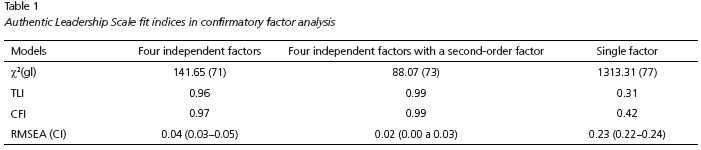
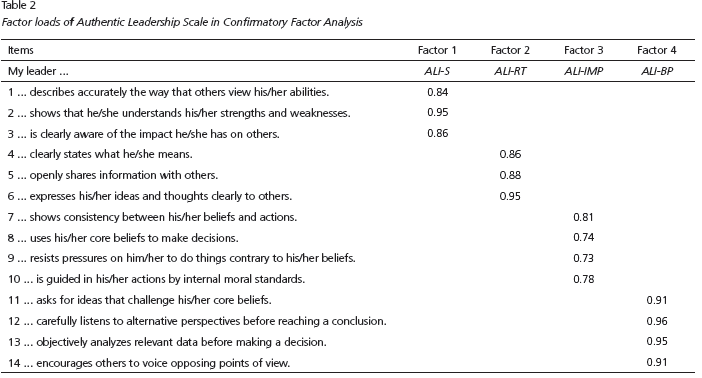
Table 2 presents the items and standardized factor loads obtained in the four dimensions of the scale, and it is possible to observe that all of them were significant and different from zero (p < 0.001). In summary, the Brazilian version of the Authentic Leadership Inventory fully reproduced the structure of the original instrument, being composed of 14 items, distributed as follows: balanced processing (four items); internalized moral perspective (four items); relational transparency (three items); self-awareness (three items). The internal consistency of the scale, calculated using the Cronbach’s alpha coefficient, was 0.91 for self-awareness, 0.92 for relational transparency, 0.85 for internalized moral perspective, 0.96 for the balanced processing factor, and 0.81 for the general factor (authentic leadership).
Table 2
Factor loads of Authentic Leadership Scale in Confirmatory Factor Analysis
In order to verify the invariance of the parameters of the items among the groups formed according to gender, multi-groups analyses were performed. The results indicated that, for the four models tested (M1 = 0.979, M2 = 0.975, M3 = 0.974, M4 = 0.974), there were no CFI variations greater than 0.01. Such results indicate the equivalence of the measure for both males and females.
Relationship with External Variables
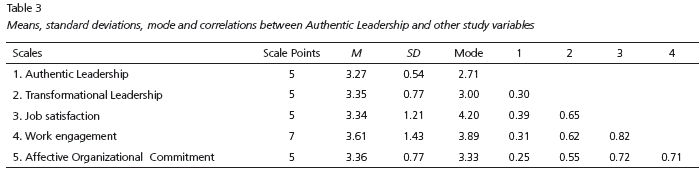
Table 3 presents the means, standard deviations, mode and correlations between the different scales adopted in the study. As predicted, authentic leadership presented a moderate positive correlation with the transformational leadership scale (r = 0.39, p < 0.001), which confirmed hypothesis 1. Also as expected, authentic leadership presented a moderate positive correlation with the job satisfaction scale (r = 0.30, p < 0.001) and with the scale of work engagement (r = 0.31, p < 0.001), thus confirming hypotheses 2 and 3, respectively. Finally, authentic leadership presented a low positive correlation with the measure of affective organizational commitment (r = 0.25, p < 0.001), which prevented confirmation of hypothesis 4.
Table 3
Means, standard deviations, mode and correlations between Authentic Leadership and other study variables
Discussion
This work aimed at investigating the initial validity evidence of the internal structure, the convergent and internal consistency of the Authentic Leadership Inventory (Neider & Schriesheim, 2011) in Brazilian samples. After the confirmatory analysis, it was observed that the best fit model was that of the four first-order factors (balanced processing, internalized moral perspective, relational transparency and self-awareness) with a second order factor (authentic leadership). These results confirm the original Neider and Schriesheim (2011) model of the Authentic Leadership Inventory, also composed of these four first order factors, with a second order factor. They also converge with the authentic leadership model of Avolio et al. (2004), which also characterizes this construct from these four behaviors. The internal consistency index of the total scale, calculated using the Cronbach’s alpha coefficient, was also satisfactory (α = 0.81), and was consistent with what was found in the original scale study, where consistency indexes were obtained ranging from 0.74 to 0.85.
With regard to the convergent validity of the scale, it was possible to verify that the Authentic Leadership Inventory presented a moderate positive correlation with the transformational leadership, thus confirming Hypothesis 1. The data obtained here are in agreement with other studies that also obtained a positive correlation between authentic leadership and transformational leadership (Neider & Schriesheim, 2011; Walumbwa et al., 2008), in a demonstration that those who are led, when encouraged by the leaders to act in accordance with their morals and values, are consequently also encouraged to go beyond their own interests, for the benefit of the organization or of their working group (Neider & Schriesheim, 2011).
Authentic leadership also showed a moderate positive correlation with job satisfaction, confirming Hypothesis 2 of the present study. Such data confirm previous results (Neider & Schriesheim, 2011; Rego et al., 2014; Walumbwa et al., 2008; Wong & Laschinger, 2013) in which positive correlations between authentic leadership and job satisfaction were also found. In addition, they offer evidence that authentic leadership causes positive repercussions in the individual, by directly impacting his/her work well-being, through his/her job satisfaction (Rahimnia & Sharifirad, 2015).
Regarding engagement at work, the Authentic Leadership Inventory presented a moderate positive correlation with such construct, confirming Hypothesis 3 of the present study. This finding is in the direction of earlier studies which have also shown the positive effects of authentic leadership on work engagement (Walumbwa et al., 2014), demonstrating that the leaders who encourage their subordinates to follow their own beliefs and forces tend to increase employee’s motivation and their integration with the organization (Rahimnia & Sharifirad, 2015).
The Authentic Leadership Inventory also showed a low positive correlation with the scale of affective organizational commitment, which prevented confirmation of Hypothesis 4. These data confirm previous results (Neider & Schriesheim, 2011; Peus, Wesche, Streicher, Braun, & Frey , 2012; Walumbwa et al., 2008) on the existence of positive correlations between authentic leadership and organizational commitment. However, the correlation obtained in the present study was low, indicating that authentic leadership does not exert much influence of the affective organizational behavior, which may be due to the fact that such behavior has as reference the organization, while engagement and satisfaction have as reference the job itself. It is thus possible that the effects of authentic leadership are more related to positive psychological conditions with focus on work rather than on the organization.
In summary, the Authentic Leadership Inventory presented initial evidence of internal structure validity, convergent and internal consistency in Brazilian samples. However, the present study also reveals limitations. First, the cross-sectional nature of the investigation prevents the establishment of causal relationships between variables. A second limitation is due to the fact that all the participants in this investigation originate from the municipalities of Niterói and Rio de Janeiro, and that most of them had complete college education, which is why the conclusions obtained so far should be extended with caution to other types of samples. In addition, this study was based exclusively on self-report measures, which usually present problems associated with common method variance.
With regard to future investigations, it would be interesting to seek additional validity evidence on scale invariance by comparing its internal structure in specific occupational groups. Other studies could deepen the nomological network of the authentic leadership construct, with respect to some of its antecedents and consequents. Such surveys should be preferably longitudinal, which would allow a deeper understanding of such relationships. In any case, the initial evidence of validity now obtained, recommends the future use of the Authentic Leadership Inventory in Brazilian investigations aimed at evaluating the impact of this leadership style on work well-being.
References
Avolio, B. J., Gardner, W. L., Walumbwa, F. O., Luthans, F., & May, D. R. (2004). Unlocking the mask: A look at the process by which authentic leaders impact follower attitudes and behaviors. The Leadership Quarterly, 15(6), 801-823. http://dx.doi.org/10.1016/j.leaqua.2004.09.003
Avolio, B. J., Wernsing, T., & Gardner, W. L. (2017). Revisiting the development and validation of the authentic leadership questionnaire: Analytical clarifications. Journal of Management, 44(2), 399-411. http://dx.doi.org/10.1177/0149206317739960
Bakker, A. B., Demerouti, E., & Sanz-Vergel, A. I. (2014). Burnout and work engagement: The JD-R approach. Annual Review of Organizational Psychology and Organizational Behavior, 1(1), 389-411. http://dx.doi.org/10.1146/annurev-orgpsych-031413-091235
Borsa, J. C., Damásio, B. F., & Bandeira, D. R. (2012). Adaptação e validação de instrumentos psicológicos entre culturas: algumas considerações. Paidéia, 22(53), 423-432. http://dx.doi.org/10.1590/1982-43272253201314
Brown, T. A. (2015). Confirmatory factor analysis for applied research. New York: The Guilford Press.
Carvalho, A. G. F., Cunha, I. C. K. O., Balsanelli, A. P., & Bernardes, A. (2016). Liderança autêntica e perfil pessoal e profissional de enfermeiros. Acta Paulista de Enfermagem, 29(6), 618-625. http://dx.doi.org/10.1590/1982-0194201600087
Cervo, C. S., Mónico, L. S. M., dos Santos, N. R., Hutz, C. S., & Pais, L. (2016). Authentic Leadership Questionnaire: Invariance between samples of Brazilian and Portuguese employees. Psicologia: Reflexão e Crítica, 29(1), 29-40. http://dx.doi.org/10.1186/s41155-016-0046-4
Cummings, T. G., & Worley, C. G. (2014). Organization development and change. Mason, Ohio: Thomson/South-Western.
Damásio, B. F. (2013). Contribuições da análise fatorial confirmatória multigrupo (AFCMG) na avaliação de invariância de instrumentos psicométricos. Psico-USF, 18(2), 211-220.
Erkutlu, H., & Chafra, J. (2016). Benevolent leadership and psychological well-being: The moderating effects of psychological safety and psychological contract breach. Leadership & Organization Development Journal, 37(3), 369-386. http://dx.doi.org/10.1108/LODJ-07-2014-0129
Ferreira, M. C., Assmar, E. M., Braga, L. L., Souto, S. O., Rocha, P. M., & Lamastra, G. P. (2002). Adaptação brasileira de uma escala tridimensional para avaliação do comprometimento organizacional. Anais do I Congresso Brasileiro Psicologia: Ciência e Profissão, São Paulo. Recuperado em julho 3, 2018, de http://www.cienciaeprofissao.com.br/congre/downloads.asp
Ferreira, M. C., Valentini, F., Damásio, B. F., Mourão, L., Porto, J. B., Chinelato, R. S. C., ... Pereira, M. M. (2016). Evidências adicionais de validade da UWES-9 em amostras brasileiras. Estudos de Psicologia, 21(4), 435-445. http://dx.doi.org/10.5935/1678-4669.20160042
Fonseca, A. M. O., & Porto, J. B. (2013). Validação fatorial de escala de atitudes frente a estilos de liderança. Avaliação Psicológica, 12(2), 157-166.
Hambleton, R. K. (1994). Guidelines for adapting educational and psychological tests: A progress report. European Journal of Psychological Assessment, 10(3), 229-244.
Jorgensen, P. C. (2016). Software testing: A craftsman’s approach. Florida: CRC Press.
Lacerenza, C. N., Reyes, D. L., Marlow, S. L., Joseph, D. L., & Salas, E. (2017). Leadership training design, delivery, and implementation: A meta-analysis. Journal of Applied Psychology, 102(12), 1686-1718. http://dx.doi.org/10.1037/apl0000241
Meyer, J. P., & Allen, N. J. (1991). A three-component conceptualization of organizational commitment. Human Resources Management Review, 1(1), 61-89. http://dx.doi.org/10.1016/1053-4822(91)90011-Z
Miles, J., & Shevlin, M. (2001). Applying regression and correlation: A guide for students and researchers. London: Sage Publications.
Moriano, J. A., Molero, F., & Mangin, J. P. L. (2011). Liderazgo auténtico: Concepto y validación del cuestionario ALQ en España. Psicothema, 23(2), 336-341.
Neider, L. L., & Schriesheim, C. A. (2011). The Authentic Leadership Inventory (ALI): Development and empirical tests. The Leadership Quarterly, 22(6), 1146-1164. http://dx.doi.org/10.1016/j.leaqua.2011.09.008
Palanski, M. E., Cullen, K. L., Gentry, W. A., & Nichols, C. M. (2015). Virtuous leadership: Exploring the effects of leader courage and behavioral integrity on leader performance and image. Journal of Business Ethics, 132(2), 297-310.
Panczyk, M., Jaworski, M., Iwanow, L., Cie?lak, I., & Gotlib, J. (2019). Psychometric properties of Authentic Leadership Self-Assessment Questionnaire in a population-based sample of Polish nurses. Journal of Advanced Nursing, 75, 692-703. http://dx.doi.org/10.1111/jan.13922
Peng, J., Li, D., Zhang, Z., Tian, Y., Miao, D., Xiao, W., & Zhang, J. (2016). How can core self-evaluations influence job burnout? The key roles of organizational commitment and job satisfaction. Journal of Health Psychology, 21(1), 50-59. http://dx.doi.org/10.1177/1359105314521478
Peus, C., Wesche, J. S., Streicher, B., Braun, S., & Frey, D. (2012). Authentic leadership: An empirical test of its antecedents, consequences and mediating mechanisms. Journal of Business Ethics, 107(3), 331-348.
Podsakoff, P. M., MacKenzie, S. B., Moorman, R. H., & Fetter, R. (1990). Transformational leader behaviors and their effects on followers’ trust in leader, satisfaction, and organizational citizenship behaviors. The Leadership Quarterly, 1(2), 107-142. http://dx.doi.org/10.1016/1048-9843(90)90009-7
Rahimnia, F., & Sharifirad, M. S. (2015). Authentic leadership and employee well-being: The mediating role of attachment insecurity. Journal of Business Ethics, 132(2), 363-377.
Rego, A., Sousa, F., Marques, C., & Cunha, M. P. (2014). Hope and positive affect mediating the authentic leadership and creativity relationship. Journal of Business Research, 67(2), 200-210. http://dx.doi.org/10.1016/j.jbusres.2012.10.003
Schaufeli, W. B., & Bakker, A. B. (2003). UWES: Utrecht Work Engagement Scale: Test Manual. Utrecht University, Retrieved June 1, 2017, from http://www.wilmarschaufeli.nl/publications/Schaufeli/Tests/UWES_P_S_9.pdf
Silva, A. P. C., & Ferreira, M. C. (2009). Escala de Satisfação Geral no Trabalho. Anais do IV Congresso Brasileiro de Avaliação Psicológica, Campinas.
Sobral, F. J. B. A., & Gimba, R. F. (2012). As prioridades axiológicas do líder autêntico: um estudo sobre valores e liderança. Revista de Administração Mackenzie, 13(3), 96-121.
Walumbwa, F. O., Avolio, B. J., Gardner, W. L., Wernsing, T. S., & Peterson, S. J. (2008). Authentic leadership: Development and validation of a theory-based measure. Journal of management, 34(1), 89-126. http://dx.doi.org/10.1177/0149206307308913
Walumbwa, F. O., Wang, P., Wang, H., Schaubroeck, J., & Avolio, B. J. (2014). Psychological processes linking authentic leadership to follower behaviors: Retraction. The Leadership Quarterly, 25(5), 1071-1072. http://dx.doi.org/10.1016/j.leaqua.2014.07.004
Wong, C. A., & Laschinger, H. K. S. (2013). Authentic leadership, performance, and job satisfaction: The mediating role of empowerment. Journal of Advanced Nursing, 69(4), 947-959. http://dx.doi.org/10.1111/j.1365-2648.2012.06089.x
Zhu, W., He, H., Trevino, L. K., Chao, M. M., & Wang, W. (2015). Ethical leadership and follower voice and performance: The role of follower identifications and entity morality beliefs. The Leadership Quarterly, 26(5), 702-718. http://dx.doi.org/10.1016/j.leaqua.2015.01.004
Notes
Como citar este artigo/How to cite this article
Support: Coordenação de Aperfeiçoamento de Pessoal de Nível Superior (Process nº 88882.365878/2019-01).
Author notes
Contributors
All the authors equally contributed to the drawing of the manuscript.
Correspondência para/Correspondence to: V.P. NOVAES. E-mail: vladimir_novaes@hotmail.com.
