ABSTRACT
Introduction: Infective endocarditis is a disease that progresses with morbidity and
mortality, afecting 3-10 out of 100,000 people per year. We conducted this
study to review the early outcomes of surgical treatment of infective
endocarditis.
Methods: In this retrospective study, 122 patients who underwent cardiac surgery for
infective endocarditis in our clinic between November 2009 and December 2020
were evaluated. Patients were divided into two groups according to
in-hospital mortality. Demographic, echocardiographic, laboratory,
operative, and postoperative data of the groups were compared.
Results: Between November 3, 2009, and December 7, 2020, 122 patients were operated
for infective endocarditis in our hospital. Emergency surgery was performed
in nine (7.3%) patients. In-hospital mortality occurred in 23 (18.9%)
patients, and 99 (81.1%) patients were discharged. In-hospital mortality was
related with older age, presence of periannular abscess, New York Heart
Association class 3 or 4 symptoms, low albumin level, high alanine
aminotransferase level, and longer cross-clamping time
(P<0.05 for all).
Conclusion: The presence of paravalvular abscess was the most important prognostic factor
in patients operated for infective endocarditis.
Keywords: Endocarditis, Thoracic Surgery, Mortality, Abscess, Alanine Transaminase, Hospital Mortality.
Carátula del artículo
Early Mortality Predictors in İnfective Endocarditis Patients: A
Single-Center Surgical Experience
Çiğdem Tel Üstünışık
Istanbul University, Turkey
 Zihni Mert Duman
Cizre State Hospital, Turkey
Barış Timur
Istanbul Dr. Siyami Ersek Thoracic and
Cardiovascular Surgery Training and Research Hospital, Turkey
Timuçin Aksu
Istanbul Mehmet Akif Ersoy Thoracic and
Cardiovascular Surgery Training and Research Hospital, Turkey
Taner İyigün
Istanbul Mehmet Akif Ersoy Thoracic and
Cardiovascular Surgery Training and Research Hospital, Turkey
Safa Göde
Istanbul Mehmet Akif Ersoy Thoracic and
Cardiovascular Surgery Training and Research Hospital, Turkey
Muhammed Bayram
Istanbul Mehmet Akif Ersoy Thoracic and
Cardiovascular Surgery Training and Research Hospital, Turkey
Vedat Erentuğ
Istanbul Mehmet Akif Ersoy Thoracic and
Cardiovascular Surgery Training and Research Hospital, Turkey
Brazilian Journal of Cardiovascular Surgery, vol. 37, no. 6, pp. 829-835, 2022
Sociedade Brasileira de Cirurgia Cardiovascular
Received: 21 December 2021
Accepted: 20 March 2022
INTRODUCTION
Infective endocarditis (IE) is a disease that progresses with morbidity and
mortality, afecting 3-10 out of 100,000 people per year[1]. Despite early diagnosis and surgical
interventions, hospital mortality was 17.1% in the European Infective Endocarditis
(or EUROENDO) study published in 2019[2]. Surgical intervention in patients with IE is required because
of heart failure, uncontrollable infection, and prevention of embolism. Almost half
of IE patients undergo heart surgery during hospitalization[3].
We conducted this study to review the early outcomes of surgical treatment of IE and
to explain the impact of demographic, clinical, echocardiographic, and
intraoperative parameters on in-hospital mortality and morbidity of IE patients
after surgical treatment.
METHODS
In this retrospective case-control study, patients who underwent cardiac surgery for
IE in our clinic between November 2009 and December 2020 were evaluated. During this
period, a total of 122 patients were operated for IE in our clinic. Their baseline
demographic data, echocardiographic data, performance status, laboratory data,
operative data, and postoperative status were comprehensively collected. Blood
cultures were taken from all patients at the time of admission. Empirical
broad-spectrum antibiotics were administered to patients with no known recent blood
culture results. Then, specific treatment was arranged according to hemoculture and
antibiogram results. Routine laboratory tests and blood, valves, and vegetations
cultures were performed during hospitalization and treatment. Transesophageal
echocardiography was performed after transthoracic echocardiography in all patients
to determine surgical strategy. Surgical procedures for IE were performed using
conventional cardiopulmonary bypass. All infected tissue was resected, and a
physiological or anatomical surgical reconstruction was performed.
We defined emergency surgery as an operation with a refractory cardiac problem, which
will not respond to any treatment other than cardiac surgery, and where there should
be no delay in operative intervention. Hospital mortality was defined as mortality
occurring within 30 days postoperatively or without discharge. This study was
approved by the local ethics committee of our hospital (2018-23) and complies with
the standards of the Declaration of Helsinki and current ethical guidelines.
Statistical Analysis
Statistical analyses were per formed using the IBM Corp. Released 2015, IBM SPSS
Statistics for Windows, version 23.0, Armonk, NY: IBM Corp. Continuous variables
are expressed as mean ± standard deviation and categorical data as proportions
throughout the manuscript. Categorical variables were compared using the χ2 test
or Fisher’s exact test, and independent continuous variables were compared by
the unpaired Student’s t-test or Kruskal-Wallis test as
appropriate. Logistic regression analysis was performed to determine the
predictors of in-hospital mortality. P-value < 0.05 was
considered statistically significant.
RESULTS
Between November 3, 2009, and December 7, 2020, 175 patients were hospitalized for IE
in our clinic, and 122 (69.7%) patients were operated. Of the operated patients, 84
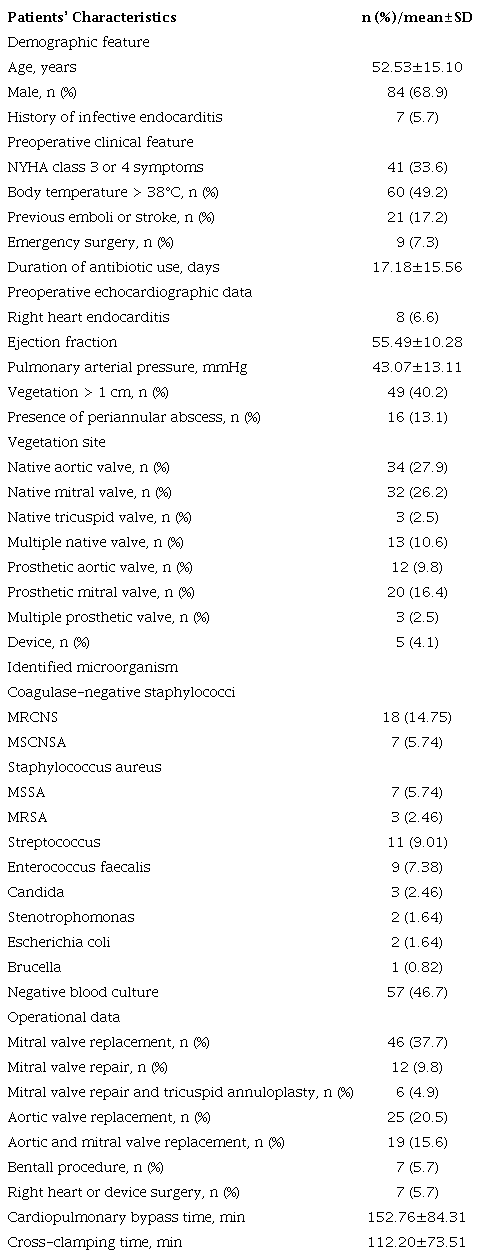
were male (68.9%) and their mean age was 52.53±15.10 years. There were seven (5.4)
patients with a history of IE. Clinical features of the patients were as follows:
New York Heart Association (NYHA) Functional Classification class 3 or 4 dyspnea
(33.6%), fever exceeding 38°C (49.2%), and history of arterial embolism or stroke
(17.2%). Emergency surgery was performed in nine (7.3%) patients. Coagulase-negative
staphylococci were the most common pathogens causing IE in 25 patients —
methicillin-resistant coagulase-negative staphylococci in 18 (14.75%),
methicillin-sensitive coagulase-negative staphylococci in seven (5,74%) —, followed
by streptococci in 11 (9.01%), Staphylococcus aureus in 10
(methicillin-sensitive S. aureus in seven [5.74%],
methicillin-resistant S. aureus in three [2.46%]),
Enterococcus faecalis in nine (7.38%), Candida
in three (2.46%), Escherichia coli and
Stenotrophomonas in two (1.64%), and Brucella
in one (0.82%) patient. Blood cultures were negative in 73 patients (48.4%) (Table 1).
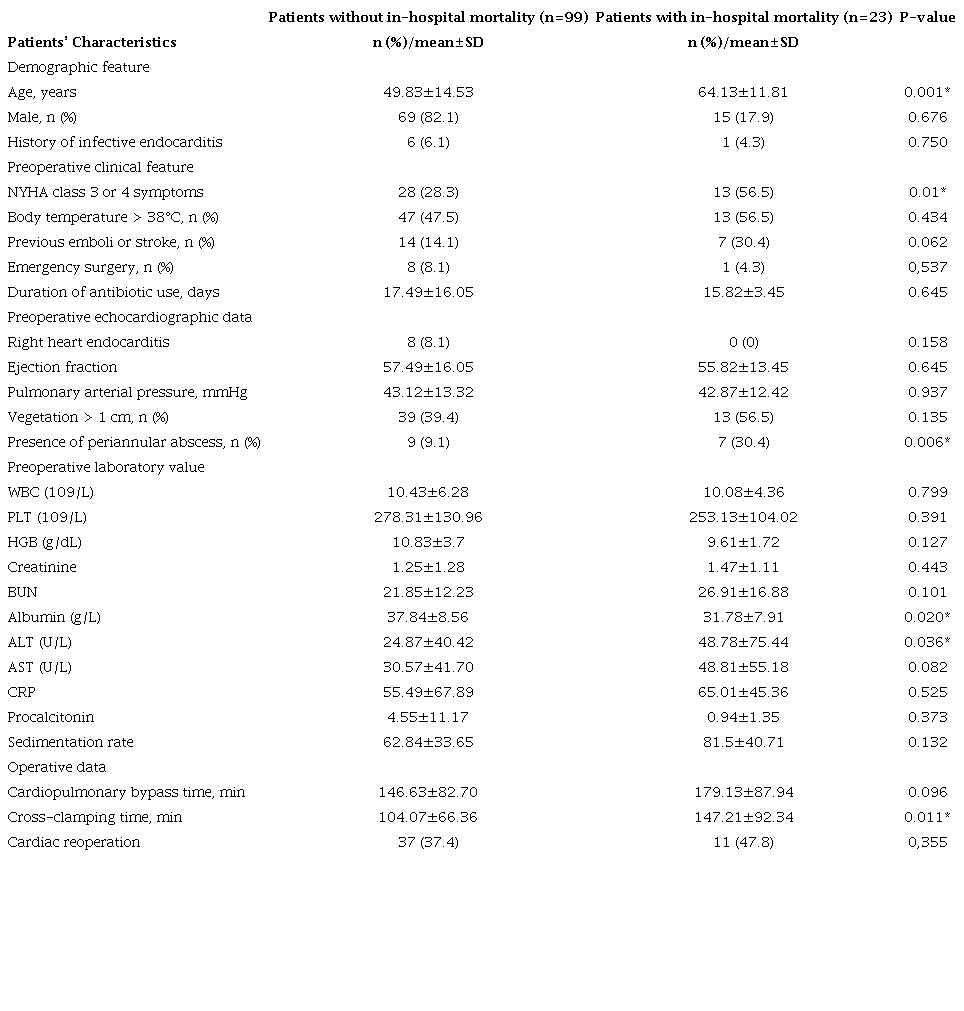
In-hospital mortality occurred in 23 (18.9%) patients, and 99 (81.1%) patients were
discharged. Demographic, preoperative laboratory, and clinical characteristics of
patients with and without in-hospital mortality were compared (Table 2). In-hospital mortality was related
with older age, presence of periannular abscess, NYHA class 3 or 4 symptoms, low
albumin level, high alanine aminotransferase (ALT) level, and longer cross-clamping
time (P<0.05 for all).
Table 1
Demographics and clinical characteristics of all infective endocarditis
patients.
 MRCNS=methicillin-resistant coagulase-negative staphylococci;
MRSA=methicillin-resistant Staphylococcus aureus;
MSCNS=methicillin-sensitive coagulase-negative staphylococci;
MSSA=methicillin-sensitive Staphylococcus aureus;
NYHA=New York Heart Association; SD=standard deviation
MRCNS=methicillin-resistant coagulase-negative staphylococci;
MRSA=methicillin-resistant Staphylococcus aureus;
MSCNS=methicillin-sensitive coagulase-negative staphylococci;
MSSA=methicillin-sensitive Staphylococcus aureus;
NYHA=New York Heart Association; SD=standard deviation
Table 2
Comparison of demographic, preoperative laboratory, and clinical
characteristics between patients with in-hospital mortality and patients
without in-hospital mortality.
 *P<0.05 is considered as significant. ALT=alanine aminotransferase; AST=aspartate aminotransferase; BUN=blood
urea nitrogen; CRP=C-reactive protein; HGB=haemoglobin; NYHA=New York
Heart Association; PLT=platelet; SD=standard deviation; WBC=white blood
cell
*P<0.05 is considered as significant. ALT=alanine aminotransferase; AST=aspartate aminotransferase; BUN=blood
urea nitrogen; CRP=C-reactive protein; HGB=haemoglobin; NYHA=New York
Heart Association; PLT=platelet; SD=standard deviation; WBC=white blood
cell
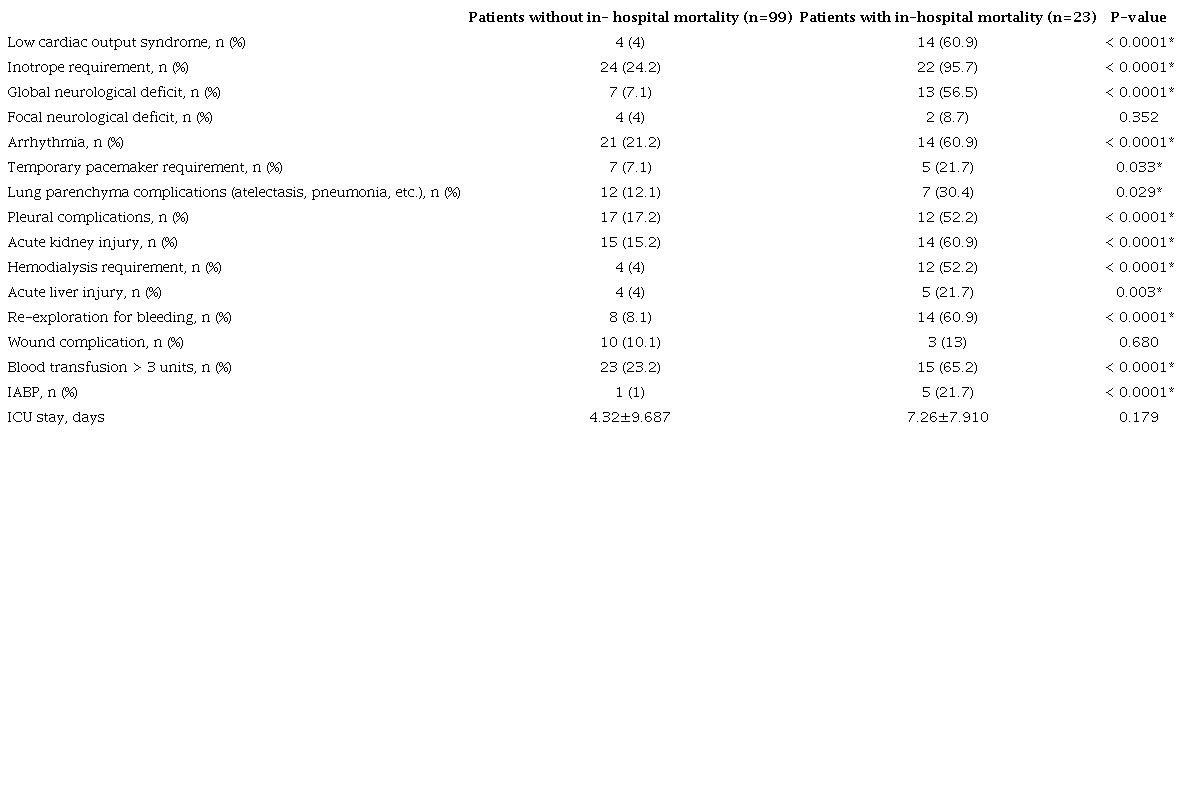
Except for wound complication and focal neurological deficit, other complications
were higher in the group of patients with in-hospital mortality. But there was no
statistically significant diference between the two groups in terms of intensive
care unit stay (Table 3). Postoperative
mesenteric hemorrhage was seen in one patient. Tracheostomy was performed in one
patient due to prolonged hospitalization. Nine patients were rehospitalized due to
pleural or wound complications.
Table 3
Comparison of postoperative complications between patients with
in-hospital mortality and those without in-hospital mortality.
 *P<0.05 is considered as significant.
IABP=intra-aortic balloon pump; ICU=intensive care unit
*P<0.05 is considered as significant.
IABP=intra-aortic balloon pump; ICU=intensive care unit
Univariate and multivariate analyses were performed to identify independent risk
factors related to in-hospital mortality. Univariate variables with
P<0.05 were included in the multivariate analysis. Table 4 shows that older age, NYHA class 3-4
symptoms, and presence of periannular abscess were independently associated with
in-hospital mortality after IE surgery in the multivariate analysis.
Table 4
Univariate and multivariate analyses for risk factors related to
in-hospital mortality.
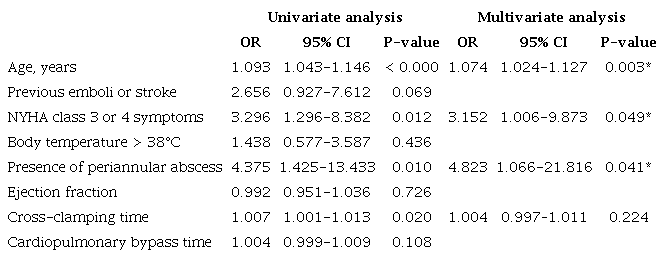 *P<0.05 is considered as significant. CI=confidence
interval; NYHA=New York Heart Association; OR=odds ratio
*P<0.05 is considered as significant. CI=confidence
interval; NYHA=New York Heart Association; OR=odds ratio
DISCUSSION
The epidemiology of IE has changed significantly over the past three
decades[4]. Mean age of the
patients in our study was 52.53 years; compared to developed countries, patients
with IE were mostly young[5,6]. The male rate was found to be
68.9%, which is consistent with male prevailing in the literature[7]. In our study, 7.3% of the patients
were operated under emergency conditions. The duration of antibiotic use before the
operation was 17.18 days in all patients.
In our cohort, 67.3% of the patients were operated for native valve endocarditis and
32.7% for prosthetic valve or cardiac device endocarditis. These data are similar to
the International Collaboration on Endocarditis (or ICE) data published in
2009[8]. The most common
pathogen in our study was staphylococci, similar to the literature[9]. The reason for the high culture
negativity in our study may be the patients referred to our hospital. It can be
explained by the negative blood culture taken from patients diagnosed with IE in
another hospital and started on antibiotic therapy[10].
In-hospital mortality rate was 18.9%, close to the two large international
registries[2,8].
As shown in our study, mortality was higher in elderly patients with IE. The high
incidences of IE in the elderly and its clinical and echocardiographic features have
been emphasized in many studies[11,
12, 13].
No significant relationship was found between vegetation length > 1 cm and
in-hospital mortality. However, there are many studies in the literature showing a
relationship between vegetation size, in-hospital mortality, and embolic
events[14]. In our study,
we found a relationship between periannular abscess and in-hospital mortality. The
presence of periannular abscess increased four times in-hospital mortality. Radical
debridement of abscess cavities is an essential procedure in cardiac surgery and is
important in active IE. In most cases, reconstruction using a pericardial patch is
required to close the abscess cavity[15]. Necessary aggressive surgical treatment results in high
complication and mortality rates. In the in-hospital mortality group, the serum
albumin level was found to be low in the preoperative period. Hypoalbuminemia
increases mortality as it is associated with malnutrition and frailty[16].
Limitations
The limitations of this study were the small number of patients, the review of
short-term results, and the fact that it was a retrospective study. The study
ofered the opportunity to evaluate surgically treated IE patients from a single
referral tertiary care center.
CONCLUSION
Although in-hospital mortality was related with older age, presence of periannular
abscess, NYHA class 3 or 4 symptoms, low albumin level, high ALT level, and longer
cross-clamping time in univariate analysis, multivariate analysis showed that the
presence of paravalvular abscess was the most important prognostic factor in
patients operated for IE.
REFERENCES
Cahill TJ, Prendergast BD. Infective endocarditis. Lancet.
2016;387(10021):882-93. doi:10.1016/S0140-6736(15)00067-7.
Habib G, Erba PA, Iung B, Donal E, Cosyns B, Laroche C, et al.
Clinical presentation, aetiology and outcome of infective endocarditis. Results
of the ESC-EORP EURO-ENDO (European infective endocarditis) registry: a
prospective cohort study. Eur Heart J. 2019;40(39):3222-32. Erratum in: Eur
Heart J. 2020;41(22):2091. doi:10.1093/eurheartj/ehz620.
Habib G, Lancellotti P, Antunes MJ, Bongiorni MG, Casalta J P, Del
Zotti F, et al. 2015 ESC guidelines for the management of infective
endocarditis: the task force for the management of infective endocarditis of the
European society of cardiology (ESC). Endorsed by: European association for
cardio-thoracic surgery (EACTS), the European association of nuclear medicine
(EANM). Eur Heart J. 2015;36(44):3075-128.
doi:10.1093/eurheartj/ehv319.
Garg P, Ko DT, Bray Jenkyn KM, Li L, Sharif SZ. Infective
endocarditis hospitalizations and antibiotic prophylaxis rates before and after
the 2007 American heart association guideline revision. Circulation.
2019;140(3):170-80. doi:10.1161/CIRCULATIONAHA.118.037657.
Papakonstantinou PE, Samonis G, Andrianaki AM, Christofaki M,
Dimopoulou D, Papadakis J, et al. Epidemiology, microbiological and clinical
features, treatment, and outcomes of infective endocarditis in Crete, Greece.
Infect Chemother. 2018;50(1):21-8. doi:10.3947/ic.2018.50.1.21.
Ahtela E, Oksi J, Porela P, Ekström T, Rautava P, Kytö V. Trends in
occurrence and 30-day mortality of infective endocarditis in adults:
population-based registry study in Finland. BMJ Open. 2019;9(4):e026811.
doi:10.1136/bmjopen-2018-026811.
Chirillo F. New approach to managing infective endocarditis. Trends
Cardiovasc Med. 2021;31(5):277-86.
doi:10.1016/j.tcm.2020.04.008.
Murdoch DR, Corey GR, Hoen B, Miró JM, Fowler VG Jr, Bayer AS, et
al. Clinical presentation, etiology, and outcome of infective endocarditis in
the 21st century: the international collaboration on endocarditis-prospective
cohort study. Arch Intern Med. 2009;169(5):463-73.
doi:10.1001/archinternmed.2008.603.
Bor DH, Woolhandler S, Nardin R, Brusch J, Himmelstein DU. Infective
endocarditis in the U.S., 1998-2009: a nationwide study. PLoS One.
2013;8(3):e60033. doi:10.1371/journal.pone.0060033.
Subbaraju P, Rai S, Morakhia J, Midha G, Kamath A, Saravu K.
Clinical - microbiological characterization and risk factors of mortality in
infective endocarditis from a tertiary care academic hospital in Southern India.
Indian Heart J. 2018;70(2):259-65.
doi:10.1016/j.ihj.2017.08.007.
Ramírez-Duque N, García-Cabrera E, Ivanova-Georgieva R, Noureddine
M, Lomas JM, Hidalgo-Tenorio C, et al. Surgical treatment for infective
endocarditis in elderly patients. J Infect. 2011;63(2):131-8.
doi:10.1016/j.jinf.2011.05.021.
López J, Revilla A, Vilacosta I, Sevilla T, Villacorta E, Sarriá C,
et al. Age-dependent profile of left-sided infective endocarditis: a 3-center
experience. Circulation. 2010;121(7):892-7.
doi:10.1161/CIRCULATIONAHA.109.877365.
Remadi J P, Nadji G, Goissen T, Zomvuama NA, Sorel C, Tribouilloy C.
Infective endocarditis in elderly patients: clinical characteristics and
outcome. Eur J Cardiothorac Surg. 2009;35(1):123-9.
doi:10.1016/j.ejcts.2008.08.033.
Mohananey D, Mohadjer A, Pettersson G, Navia J, Gordon S, Shrestha
N, et al. Association of vegetation size with embolic risk in patients with
infective endocarditis: a systematic review and meta-analysis. JAMA Intern Med.
2018;178(4):502-10. doi:10.1001/jamainternmed.2017.8653.
Croon SI, Angkasuwan A, van Straten AH, Khamooshian A, Elenbaas TW,
Soliman-Hamad MA. Surgical treatment and long-term outcome of aortic valve
endocarditis with periannular abscess. Neth Heart J. 2020;28(6):345-53.
doi:10.1007/s12471-020-01409-x.
Karas PL, Goh SL, Dhital K. Is low serum albumin associated with
postoperative complications in patients undergoing cardiac surgery? Interact
Cardiovasc Thorac Surg. 2015;21(6):777-86.
doi:10.1093/icvts/ivv247.
Notes
Notes
This study was carried out at the Department of Cardiovascular Surgery, Istanbul
Mehmet Akif Ersoy Thoracic and Cardiovascular Surgery Training and Research
Hospital, Istanbul, Turkey.
No financial support.
Conflict of interest declaration
No conflict of interest.
Author notes
Correspondence Address: Zihni Mert Dumanhttps://orcid.org/0000-0002-3628-8080 Cizre State Hospital Sur
District, Banecırf Locality, Devlet hastanesi garaj, Cizre, Şırnak, Turkey Zip
Code: 73200 E-mail: dumanzihnimert@gmail.com

