Artigo Original
A study on the educational results obtained by municipalities of Paraíba in the years 2011, 2013 and 20151,2
Um estudo sobre os resultados educacionais obtidos dos municípios da Paraíba nos anos de 2011, 2013 e 2015
Un estudio de los resultados académicos obtenidos por municipios de Paraíba en los años 2011, 2013 y 2015
A study on the educational results obtained by municipalities of Paraíba in the years 2011, 2013 and 20151,2
Ensaio: Avaliação e Políticas Públicas em Educação, vol. 26, no. 100, pp. 1038-10057, 2018
Fundação CESGRANRIO
Received: 26 October 2017
Accepted: 07 June 2018
Abstract: Education is a crucial factor in the behavior and development of a society. For this reason, it is important to analyze the dynamics of the public sector in the provision of education services. Within this context, the present study aims to analyze the efficiency of the municipal expenses of Paraíba in terms of its basic elementary education. To this end, a stochastic frontier model was used, taking as a result the scores obtained in the Index of Development of Basic Education (IDEB) in the years 2011, 2013, and 2015. The results demonstrated that all indicators are statistically accepted and that the variables “age-grade distortion,” “higher education teachers,” and “number of computers per student” were consistent with the literature. Expenditure has a negative effect on educational performance, suggesting that municipalities in Paraíba are inefficient in allocating resources.
Keywords: Paraíba, Municipalities, Education, Efficiency.
Resumo: A educação é um fator crucial no comportamento e desenvolvimento de uma sociedade. Por esse motivo, é importante analisar a dinâmica do setor público na prestação de serviços de educação. Dentro deste contexto, o presente estudo tem como objetivo analisar a eficiência das despesas municipais da Paraíba em termos de ensino fundamental básico. Para tanto, utilizou-se um modelo de fronteira estocástica, tendo como resultado as pontuações obtidas no Índice de Desenvolvimento da Educação Básica (IDEB) nos anos de 2011, 2013 e 2015. Os resultados demonstraram que todos os indicadores são estatisticamente aceitos e que as variáveis “distorção idade-série”, “professores do ensino superior” e “número de computadores por aluno” foram consistentes com a literatura. As despesas têm um efeito negativo no desempenho educacional, sugerindo que os municípios da Paraíba são ineficientes na alocação de recursos.
Palavras chave: Paraíba, Municípios, Educação, Eficiência.
Resumen: La educación es un factor crucial en el comportamiento y el desarrollo de una sociedad. Por esta razón, es importante analizar la dinámica del sector público en la provisión de servicios educativos. En este contexto, el presente estudio tiene como objetivo analizar la eficiencia de los gastos municipales de Paraíba en términos de su educación primaria básica. Para ello, se utilizó un modelo de frontera estocástica, tomando como resultado los puntajes obtenidos en el Índice de Desarrollo de la Educación Básica (IDEB) en los años 2011, 2013 y 2015. Los resultados demostraron que todos los indicadores son estadísticamente aceptados y que las variables “distorsión por edad”, “maestros de educación superior” y “cantidad de computadoras por estudiante” fueron consistentes con la literatura. El gasto tiene un efecto negativo en el rendimiento educativo, lo que sugiere que los municipios de Paraíba son ineficientes en la asignación de recursos.
Palabras clave: Paraíba, Municipios, Educación, Eficiencia.
1 Introduction
The economics of education are considered by all currents of economic thought and social development to be a fundamental factor in generating positive impacts in various sectors of society, ranging from classical thought on productivity to behavioral issues, both of which generate positive externalities.
It is believed that an improvement in education may result in an improvement in future income as well as individual improvements in health, social cohesion, and crime reduction. It may also decrease the likelihood of pregnancy in adolescence, among other factors. Therefore, as well as contributing to the increase in productivity, education has come to be considered a mechanism for reducing inequality and breaking vicious cycles.
What hinders the public sector from intervening in education are market failures in the efficient delivery of goods that have externalities of consumption. In addition, public intervention aims to ensure education for society, since the market provides education in accordance with purchasing power and poor families often do not have access to private sector education. Starting from the private sector principles of efficiency and maximization of wellness, the public sector needs to provide goods and services in a way that maximizes the well-being of society.
Farrell (1957) affirmed that efficiency is determined by the maximum number of products obtained from a set of inputs. According to Hanushek (2008), peripheral countries do not have a good structural capacity to deliver effective levels of education. However, if the problem of school dropout continues to be a factor of concern, it is not sufficient that education simply be efficient. The decision to evade the school or not results from the negative impacts of family income. Hanushek (2008) criticized the majority of empirical studies for using the variable “years of study” to define quality of education because none of these studies observed that the main factors in quality of education stem from the activities conducted at school. The author thus concluded that a high quality school system could generate improvements in cognitive abilities. Hanushek and Woessmann (2008) pointed out that there is a dramatic difference in educational level between developed and developing countries and school level is a major factor affecting the growth of productivity.
In relation to the effectiveness of policies, Hanushek (2002) noted that the policies of school extension do not always result in better outcomes as they do not promote necessary changes in the institutional structure. In other words, an increase in public spending will only generate positive results if administrative measures are taken to improve efficiency, by, for example, decreasing class sizes, improving faculty qualifications, encouraging a taste for reading, etc.
The international literature differs in respect of the impact of infrastructure on students’ performance. Papers like Coleman (1966) and Hanushek (2003) have pointed out that a student’s family background has a greater impact on the academic performance of students from the USA, than the inputs. However, Heyneman and Loxley (1983), based on a sample of 29 countries from Africa, Asia, Latin America, and the Middle East, concluded that the inputs of students and teachers provide better results in students from developing countries, while the impacts are smaller for developed countries. In the case of developing countries, school inputs are significant due to the great variability in the resources available in schools. Research conducted by Soares (2004), Franco and Bonamino (2005), Franco et al. (2007), and Gazólis (2007) also reported a positive effect on the learners proficiency with respect to teachers’ skills.
In the case of Brazil, the historical factors presented by Furtado (1964) in his book Formação Econômica do Brasil clearly demonstrate that Brazil’s economic problems began with the coming of the Portuguese to the Americas. Ribeiro (1996), in his book O Povo Brasileiro, depicts the intermingling of races that occurred during Brazil’s colonial period, highlighting the emergence of major inequalities and economic growth based on the concentration of income. In other words, due to their tragic historical process of development and high concentration of wealth, economic growth did not greatly impact on the fight against poverty, and Brazil continues to face many delays in comparison to European or American countries, particularly with regard to education.
Efficiency of expenditure has been evaluated internationally by authors such as Gupta, Verhoeven and Tiongson (2002), Afonso and Aubyn (2005), Qutb (2016), and Afonso, Schuknecht, and Tanzi (2005) in respect of various different countries. Meanwhile, national papers such as those by Zoghbi et al. (2009) and de Carvalho and de Sousa (2014) seek to measure the efficiency of Brazilian states and municipalities, respectively.
Among recent studies, in his Institute of Applied Economic Research (IPEA) article, Moreira (2017) expressed the purpose of estimating the economic efficiency of municipalities’ education in elementary education. Using data from the Brazil test for the years 2007, 2009, 2011, and 2013, he sought to highlight the importance of decentralized management and to evaluate the educational quality of municipalities. In dealing with public data, the author applied filters to adjust non-matching between primary sources and adjustment of missing data. These filters eliminated the profile of the family and the typical school family from the analysis of student and school performance. The results demonstrated that students’ disapproval at school has a negative correlation with students’ performance, that some municipalities are more efficient than others, and, finally, that an increase in efficiency may imply cost reductions ranging from 3% to 30%, depending on the degree of efficiency increase.
Regarding historical aspects and the need for improved educational provisions, the following consideration arises: what is the level of educational quality in Paraíba municipalities? It is important that society in general be informed about the importance of public policies, that they seek their rights and make good use of these policies. Based on the need to measure the quality of the education system and to assess changes in this system, this study aims to analyze the efficiency of municipal expenditure on education in Paraíba in the years 2011, 2013, and 2015. Specifically, it will describe how Paraíba behaves in terms of educational indicators, and a model of technical efficiency of elementary education in the municipalities of Paraíba will be submitted.
From an economic perspective, it is impractical to design a society that is distant from good educational principles. Therefore, this discussion is of use, since education serves as the basis for the construction of a more socially just society. The results are expected to serve as the basis for the society of Paraíba and thus allow administrators of public and private schools to improve their decisions.
In section 2, the indicators of education in Paraíba are presented; in section 3, the results are discussed; and finally, the concluding considerations are presented in section 4.
2 Recent data on education in Paraíba
Table 1, shows the proportion of some items of basic infrastructure in municipal schools in the Federation Units (UFs) of Brazil, in 2015. The results clarify that, in school matters, Paraíba’s situation is precarious in comparison with other northeastern states and the average in Brazil. Paraíba’s values are only similar to the Brazilian average in terms of the number of computer laboratories. Regarding the number of schools with libraries, only a quarter of the schools in Paraíba have a library or place for reading, which implies low incentives for reading.
| Brazil and UFs | Computers | Library | Court | Computer Lab | Internet |
|---|---|---|---|---|---|
| Brazil | 70.5 | 33.8 | 21.7 | 34.6 | 50.6 |
| Rondônia | 82.7 | 32.7 | 25.0 | 28.0 | 59.8 |
| Acre | 36.6 | 11.8 | 3.9 | 15.8 | 19.1 |
| Amazonas | 32.2 | 13.5 | 4.9 | 15.8 | 15.5 |
| Roraima | 51.0 | 24.5 | 14.5 | 22.0 | 24.5 |
| Pará | 44.2 | 20.0 | 14.7 | 20.8 | 20.2 |
| Amapá | 57.7 | 26.0 | 6.8 | 28.7 | 23.6 |
| Tocantins | 80.9 | 31.2 | 15.9 | 37.3 | 55.5 |
| Maranhão | 41.1 | 12.0 | 4.9 | 19.2 | 18.5 |
| Piauí | 56.4 | 16.3 | 9.3 | 24.1 | 27.2 |
| Ceará | 84.3 | 49.5 | 26.7 | 53.9 | 55.8 |
| Rio Grande do Norte | 71.4 | 35.4 | 10.3 | 37.4 | 45.9 |
| Paraíba | 64.1 | 25.2 | 9.4 | 34.6 | 34.2 |
| Pernambuco | 61.1 | 30.8 | 10.4 | 27.2 | 35.6 |
| Alagoas | 66.6 | 29.5 | 10.4 | 37.8 | 39.4 |
| Sergipe | 65.1 | 18.6 | 9.5 | 27.3 | 39.5 |
| Bahia | 61.2 | 21.7 | 11.3 | 27.6 | 35.7 |
| Minas Gerais | 78.5 | 49.4 | 32.7 | 38.1 | 61.4 |
| Espírito Santo | 79.7 | 39.1 | 27.0 | 36.9 | 62.3 |
| Rio de Janeiro | 96.8 | 68.9 | 37.3 | 56.1 | 79.7 |
| São Paulo | 94.7 | 41.8 | 38.5 | 42.9 | 86.5 |
| Paraná | 95.0 | 47.1 | 40.9 | 44.7 | 85.0 |
| Santa Catarina | 90.6 | 43.2 | 32.6 | 38.3 | 82.5 |
| Rio Grande do Sul | 95.7 | 66.1 | 42.3 | 52.5 | 79.0 |
| Mato Grosso do Sul | 97.7 | 39.3 | 47.2 | 53.5 | 89.1 |
| Mato Grosso | 85.5 | 31.9 | 31.7 | 43.7 | 71.5 |
| Goiás | 94.7 | 43.4 | 30.2 | 51.6 | 79.1 |
While over 90% of schools in São Paulo, Rio de Janeiro, Santa Catarina, Rio Grande do Sul, Paraná, and Goiás have computers for students, in Paraíba and most of the northeastern states, the average rate is only 60%, which is lower than the national average. The data demonstrate a clear asymmetry between central-southern regions and the north-northeast of the country.
Graph 1 shows a significant growth in the number of teachers with higher education (increasing from 69% to 79% in Paraíba between 2011 and 2015). The tendency of Paraíba follows the national trend, at times exceeding the national average, but at other times falling below it. However, the results demonstrate that the goal of having 100% of teachers with higher education is still far from reach.
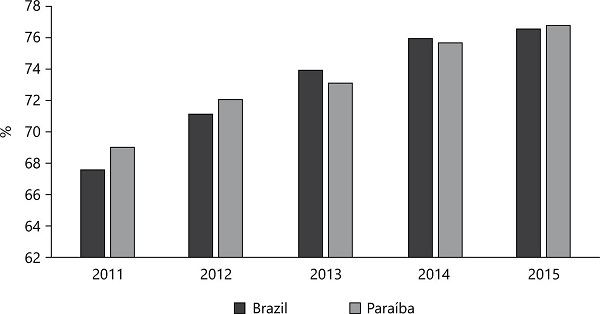
Graph 1
Percentage of teachers with higher education in schools of Paraíba and Brazil: 2011 to 2015.
Source: Prepared by the authors from the INEP database (2015).
According to Jepsen and Rivkin (2002), a better education is directly linked to the level of teacher knowledge. Teachers with higher education generate very significant differences in student learning, because they have the expertise to efficiently handle teaching resources and have the best knowledge to pass on information.
The data in Graph 2 demonstrate that the average number of students per class3 declined in this period. The data of the School Census of Basic Education demonstrate that this reduction occurred as the number of enrollments decreased more rapidly than the number of classes (see variation in the second column of Graph 2). According to the data, the change was negative (or below 1).
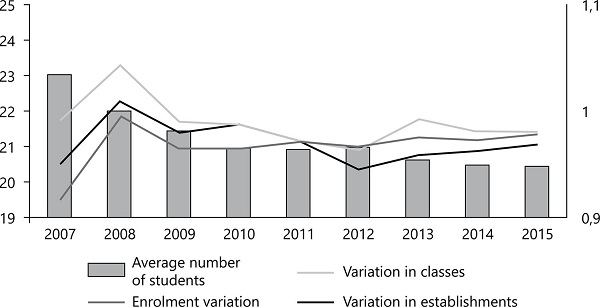
Graph 2
Average number of students per class and the percentage of variation in classes, tuition, and establishments in schools in Paraíba, 2007 to 2015.
Source: Prepared by the authors from the INEP database (2015).
The result can be viewed as negative as fewer people are enrolling but can be viewed as positive in relation to income, as smaller class sizes mean that the faculty face fewer problems sharing knowledge with everyone (DYNARSKI; HYMAN; SCHANZENBACH, 2013). For this reason, the lack (or poor employment) of public investment in the creation of new groups (given an increase of enrolment) and improving teachers’ qualifications can reduce the efficiency of schools.
Another factor that may explain the fall in variations is the birth rate of Paraíba: according to data from the National Household Sample Survey (PNAD), published by the Brazilian Institute of Geography and Statistics (IBGE), the school age population between 5 and 14 years has been decreasing over time. In 2007, the population in this age group represented 19.39% of the total population, while in 2015, it represented 15.85%.
2.1 Municipal expenditure on education and the IDEB
The results presented by the National Treasury Secretariat (STN) demonstrate that the expenditure on education recorded by municipalities of Paraíba in the year 2005 was approximately R$ 600 million, while the expenditure in 2015 totaled R$ 2.24 billion, thus comprising a nominal growth of 273%.
Chirinéa and Brandão (2015) sought to discuss the quality of basic education through the Basic Education Development Index. The importance of this indicator lies in making students improve their performance, and schools have established goals on this basis. Thus, the indicator aims to encourage students and schools to seek better results through the Education Development Plan (PDE) and the Plan of Goals Commitment for All Education.
In order to analyze the indicator, Pontes and Soares (2015), using a longitudinal linear hierarchical model, aimed to measure the results of the Brazil Test and the Mineiro System for the Evaluation of Basic Education (Simave) for Portuguese and Mathematics in public schools in Minas Gerais as well as the results accrued by meeting the goals of the Index of Development of Basic Education (IDEB). Their results were very volatile, particularly in small schools, but also in medium and large schools. High volatility may compromise school performance monitoring as well as school cases that set performance targets. Thus, the author believes that it is necessary to establish goals that are not built solely on the final results.
From the results provided by the National Institute of Educational Studies and Research Anísio Teixeira (INEP), the municipalities of Paraíba demonstrated an average IDEB score of 2.6 in 2005, with the total enrolment in the education network at 664,271 students. In 2015, the average grade in IDEB was 4.3, with 506,651 students registered in local public schools.
According to Figure 1, the municipalities that had higher tuition expenses are concentrated in the interior of the state and in Borborema. Despite the concentration of higher expenses in the interior, most expenses, particularly along the coast of Paraíba, fell within the median.
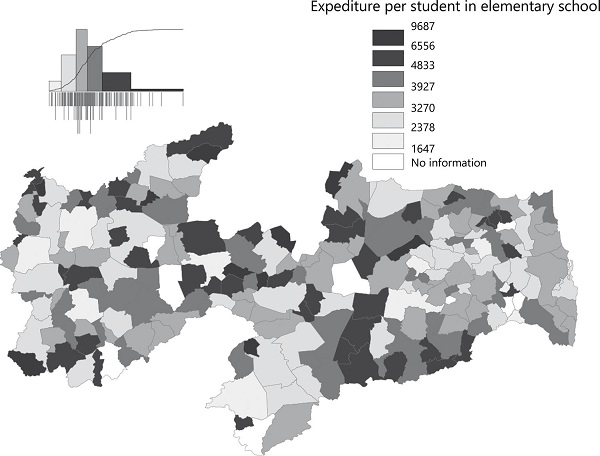
Figure 1
Map of spending per pupil in the municipalities of Paraíba, 2015.
Source: Prepared by the authors using the software Philcarto, based on data from the STN (2015).
As observed below, of the 10 municipalities with greater expenses, only São José do Brejo do Cruz, Frei Martino, and São José do Sabugi appear among the 100 municipalities with greater IDEB Index for basic education. Moreover, apart from Quixabá and Mato Grosso, the same pertains for lower secondary education. However, none of these municipalities are ranked among the top 10 scores of the IDEB. From the point of view of efficiency, it was to be expected that municipalities with higher educational expenses would present the best results. However, the data demonstrate that there must be other factors that directly impact on the results obtained.
As seen in the ranking shown in Chart 1, the data presented demonstrate that the 10 municipalities with the highest costs per student do not present the best results. According to Zoghbi et al. (2009), the best educational outcomes are not necessarily reflected in municipalities with the highest expenses.
| Ranking: Spend per student | Municipality | Ranking: IDEB Index for Basic Education | Ranking: IDEB Index for Lower Secondary Education |
|---|---|---|---|
| 1º | Joca Claudino | 152º | 135º |
| 2º | Quixabá | Without note | 80º |
| 3º | São José do Brejo do Cruz | 61º | 23º |
| 4º | Areia de Baraúnas | Without note | 138º |
| 5º | Mato Grosso | 129º | 61º |
| 6º | Frei Martinho | 28º | 33º |
| 7º | Algodão in Jandaíra | 117º | 143º |
| 8º | Santa Inês | 166º | Without note |
| 9º | Amparo | 137º | 37º |
| 10º | São José do Sabugi | 34º | 11º |
Moreover, according to data from the STN, majority of municipalities spend most of their education revenue on elementary education (on average approximately 91.8%), while the municipality that spent least was Riachão do Poço at only 40.5%.
Between 2011 and 2015, the IDEB Index for basic education for the municipalities of the interior demonstrated a significant improvement (Figure 2). Although this is not an indication of efficiency, the high expenditure is considered relevant to these improvements. Regarding the meso-region of the coast of Paraíba, the IDEB in basic education did not demonstrate a significant improvement. In general terms, in 2011, most municipalities had an IDEB of between 2.1 and 3. In 2015, most municipalities fell between 4.1 and 4.9.
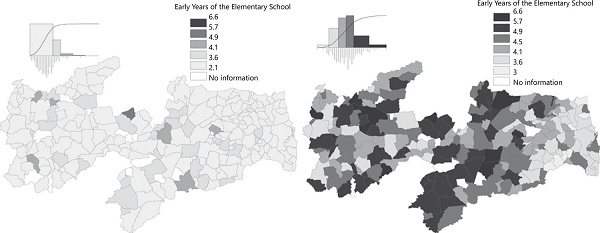
Figure 2
Map of the municipalities of Paraíba for IDEB Index in basic education, 2011 and 2015.
Source: Prepared by the authors using the software Philcarto, based on data from the INEP (2015).
Figure 3 shows the IDEB results in lower secondary education for 2011 and 2015. Here, the same result can be observed: the interior regions of the state improved more significantly, despite having spent extravagantly.
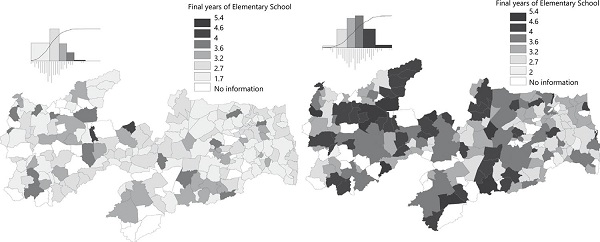
Figure 3
Map of the municipalities of Paraíba for IDEB Index in lower secondary education, 2011 and 2015.
Source: Prepared by the authors using the software Philcarto, based on data from the INEP (2015).
3 Empirical analysis
Using data from the school census, coordinated and provided by INEP, it is possible to access the main basic information on education in Brazil. Chart 2 shows the description of the variables used in this study, for the years 2011, 2013, and 2015.
| Variable | Description | Source | Unit |
|---|---|---|---|
| Public spending | Number of expenses related to education | STN/INEP | Reais |
| Age-grade distortion | Number of students aged outside the standard range | INEP | Percentage |
| Teachers with higher education | Number of teachers with university degrees | INEP | Percentage |
| Number of computers | Number of computers designed for students | INEP | Unity |
| IDEB | Index of Development of Basic Education | INEP | Unity |
The empirical strategy of a linear model for the stochastic frontier, with the aim of measuring the efficiency of the municipalities of Paraíba, tracks the performance of those municipalities in respect of IDEB. The model can be described as follows:
Where IDEBit is the product (output); β represents the vectors (IE1) of inputs to be estimated; i represents the municipalities; t represents the variation in time; Vit ~ N (0,σν2) represents the component of random error; and Uit ~ N + (µ,σ2) represents that the end of random error is not noticeable in relation to the expiry of technical inefficiency.
Researchers like Fryer Junior (2016) have been identifying the causalities of educational practices, in order to directly and indirectly analyze and measure educational technology and thus to improve factors such as teachers, classrooms, libraries, computer equipment, etc.
Public spending on education aims at measuring the cost of education to the public sector. Guryan (2003) asserted that increases in public spending and investment per student generate further efficiency gains in the public sector.
Moreira (2013) found that a high distortion is caused by school dropout and school repetition, both of which negatively impact a school’s educational performance. In both cases, the literature affirms that the causes of dropout and repetition are related to family background (COLEMAN, 1966). Regarding teachers with higher education, Jepsen and Rivkin (2002) claimed that educators and learners grow together in the educational process. For this reason, an increase in the number of teachers is, theoretically, an educational improvement. Lastly, Gomes and Regis (2012) noted that infrastructure and educational resources represent the physical materials and textbooks that schools have, and may include buildings, rooms, equipment, textbooks, and computers, among other things.
In their respective dissertations, Lira (2017) and Teixeira (2017) highlighted the importance and sought to measure the results of the IDEB for Brazil between 2005 and 2015. Lira (2017) analyzed the impact of the IDEB on elementary school education in Brazil, separating it into basic education and lower secondary education. Through the Markov Process, Lira pointed out that Brazilian schools mostly obtained better grades, suggesting that the motivational factors of the IDEB generated positive impacts so that students achieved better results. The results, however, did not seek to highlight what factors result in these improvements.
Teixeira (2017) sought to analyze the impacts of public policies on education and their results. As a way of measuring quality, the author used the IDEB as a proxy for the state high school network for Brazil’s major regions and federation units. This was achieved by analyzing the expenditure incurred in high school related to the number of students enrolled in comparison with the IDEB grade obtained. Using Cohen’s correlation analysis, the author realized that the results were negative in some states, which was contrary to hypotheses of the theory. For other states, there was a medium or low proportion of positive effect. The results did not demonstrate a total correlation, indicating that other factors may result in educational improvement; thus, these factors should be identified and analyzed.
In this study, we use the number of computers in schools as a proxy for infrastructure. This is because computers are considered essential to the functioning of the school and students’ good performance. According to de Oliveira, Libâneo and Toschi. (2017), structural aspects are expected to be appropriate and sufficient to ensure the highest level of pedagogical work and to encourage lifelong learning.
Chart 3 shows the expected causes of variables used in the model on the performance of public spending education:
| Variable | Expected | Variable Type | Based on the literature | Sources |
|---|---|---|---|---|
| Public spending (In the subfunction elementary school) | + | Continuous | Guryan (2003) | STN/INEP |
| Age-grade distortion | - | Continuous | Moreira (2013) | INEP |
| Teachers with higher education | + | Continuous | Dynarski et al. (2013) and Jepsen and Rivkin (2002) | INEP |
| Number of computers | + | Continuous | Oliveira et al. (2017) | INEP |
The econometric exercise aims to test the efficiency of public spending on education in cities in the state of Paraíba (PB) for the years 2011, 2013, and 2015. We used the functional form of Cobb-Douglas, which presented a good fit for the model. That said, Table 2 presents the results obtained in the estimation of the model of stochastic frontier, in the form of a logarithm. The results demonstrate that the Wald test and the value of Gamma accepted that the hypothesis is suitable (enabling the participation of the component “inefficient” to be measured).
| Size = 468 | Nº of groups = 156 | |||
|---|---|---|---|---|
| Ln-likelihood = 364.0322 | Wald chi2(5) = 82.19 | |||
| Prob> chi2 = 0.0000 | ||||
| ln_ideb | Coef. | ln_ideb | Coef. | ln_ideb |
| Ln_distortion | -0,09414 | 0,023250 | -4,05 | 0.00 |
| Ln_teachers | 0,07259 | 0,017023 | 4,26 | 0.00 |
| Ln_computers | 0,02203 | 0,005476 | 4,02 | 0.00 |
| Ln_spent_education | -0,01372 | 0,133724 | -1,77 | 0,07 |
| Constant | 2,11224 | 0,252402 | 8,37 | 0.00 |
| /Lnsigma2 | -3,88856 | 0,094719 | -41,05 | 0.00 |
| Gamma | 0,82864 | 0,162861 | 5,09 | 0.00 |
From a statistical point of view, it is clear that all indicators were accepted at a 5% level of significance, except for expenditure on education, which was significant at 10%. From the theoretical point of view, the age-grade distortion, the number of teachers with higher education, and the number of computers for students were consistent with the theory presented, while spending in the public sector received a signal opposite to that presented in the theory. However, there are other discussions within the theoretical pattern, such as that of Zoghbi et al. (2009). Their study highlighted the importance of public spending, but claimed that such expenditure is not efficient in most cases.
More specifically, it is possible to affirm that the results for Paraíba’s municipalities demonstrated that a 1% increase in age-grade distortion and public spending outcome in decreases of 0.09% and 0.01%, respectively, in respect of the IDEB. Otherwise, an increase of 1% was found in the number of teachers with higher education and in the number of computers in schools, resulting in increases of 0.07% and 0.02%, respectively, to the results of the observed IDEB.
Figure 44 below shows that the municipalities with a lower level of technical efficiency are situated in the meso-region of the coast of Paraíba. Despite the negative signal for public expenditure, Figure 1 and Figure 4 show that some municipalities with high expenditure in education have succeeded in achieving a good score on efficiency. However, in almost all cases, municipalities that have spent a great deal on education were only in the median of the results (efficiency values between 0.66 and 0.70).
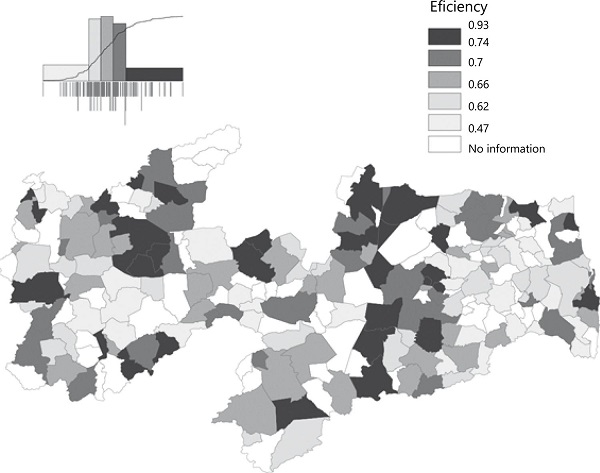
Figure 4
Map of the municipalities of Paraíba in agreement with the results obtained in the model of technical efficiency.
Source: Prepared by the authors using the software Philcarto, based on data from INEP (2015).
According to the results, the municipalities of Areia, Gurinhém, Pedro Régis, Capim, Itabaiana, Imaculada, and Remígio were considered the worst in terms of public sector efficiency in relation to education, while the municipalities of Várzea, Barra de São Miguel, São Bentinho, Cabaceiras, and Pombal were considered the most efficient municipalities.
4 Final considerations
The present study sought to analyze the efficiency of public spending on education, with the municipalities of Paraíba as the object of study. At this stage, in addition to public spending, the effect of explanatory variables (based on the literature) on educational performance was tested.
From the statistical point of view, all the indicators were significant for the years 2011, 2013, and 2015. The positive results found for the number of teachers with higher education, and the number of computers designated for students by schools (a proxy for infrastructure) and the negative results for age-grade distortion, were in accordance with the previous literature. However, the negative results obtained for public educational expenditure were not consistent with expectations.
Hanushek (2008) has previously stated that for educational investment to be transparent to student learning, it is necessary that all people involved in the educational process (both inside and outside the school environment) offer incentives to improve student performance.
Although these results are still preliminary, it is possible to make some conjectures. Among these, we highlight:
- 1. The strong growth of municipal public spending is not associated with improvements in educational performance, suggesting wastage (or inefficiency) in the application of resources;
- 2. The important roles of infrastructure and teacher qualification are also observed. This result can help in guiding the application of resources;
- 3. The results described in Figure 4 suggest (although it is not addressed here) a neighborhood effect. Addressing these overflow effects opens the door to a debate around consortium-led educational policies between municipalities.
Given the importance of the theme (since education was considered as a basis for economic policy and for the development of society), it is recommended that more research be conducted on the subject with the aim of proposing policy improvements. The results demonstrate that although the educational results of Brazil and Paraíba have improved, municipalities must become more efficient in educational provision, not only through the involvement and participation of the public sector, but of various segments of society (all related to educational programs).
REFERENCES
AFONSO, A.; AUBYN, M. S. Non-parametric approaches to education and health efficiency in OECD countries. Journal of Applied Economics, v. 8, n. 2, p. 227-46, Nov. 2005.
AFONSO, A.; SCHUKNECHT, L.; TANZI, V. Public sector efficiency: an international comparison. Public Choice, v. 123, n. 3-4, p. 321-47, 2005. https://doi.org/10.1007/s11127-005-7165-2
CARVALHO, L. D. B.; SOUSA, M. D. C. S. Eficiência das escolas públicas urbanas das regiões nordeste e sudeste do Brasil: uma abordagem em três estágios. Estudos Econômicos, São Paulo, v. 44, n. 4, p. 649-84, Oct./Dec. 2014. https://doi.org/10.1590/S0101-41612014000400001
CHIRINÉA, A. M.; BRANDÃO, C. F. O IDEB como política de regulação do estado e legitimação da qualidade: em busca de significados. Ensaio: Avaliação e Políticas Públicas em Educação, v. 23, n. 87, p. 461-84, 2015. https://doi.org/10.1590/S0104-40362015000100019
COLEMAN, J. S. et al. Equality of educational opportunity. 1966. Available at: <https://files.eric.ed.gov/fulltext/ED012275.pdf>. Accessed on: 20 Jan. 2018.
DYNARSKI, S.; HYMAN, J.; SCHANZENBACH, D. W. Experimental evidence on the effect of childhood investments on postsecondary attainment and degree completion. Journal of Policy Analysis and Management, v. 32, n. 4, p. 692-717, 2013. https://doi.org/10.3386/w17533
FARRELL, M. J. The measurement of productive efficiency. Journal of the Royal Statistical Society, v. 120, n. 3, p. 253-90, 1957.
FRANCO, C. et al. Qualidade e eqüidade em educação: reconsiderando o significado de “fatores intra-escolares”. Ensaio: Avaliação e Políticas Públicas em Educação, v. 15, n. 55, p. 277-98, Apr./June 2007. https://doi.org/10.1590/S0104-40362007000200007
FRANCO, C.; BONAMINO, A. A pesquisa sobre características de escolas eficazes no Brasil: breve revisão dos principais achados e alguns problemas em aberto. Educação On-line, v. 1, 2005.
FRYER JUNIOR, R. The production of human capital in developed countries: evidence from 196 randomized field experiments. Cambridge: NBER, 2016. (Working Paper, n. 2213). Available at: <http://www.nber.org/papers/w22130.pdf>. Accessed on:. 2018 Jan 28.
FURTADO, C. Formação econômica do Brasil. São Paulo: Nacional, 1964.
GAZÓLIS, L. Livro didático e aprendizado de leitura no início do Ensino Fundamental. 2007. 135 f. Dissertação (Mestrado em Educação) — Programa de Pós-Graduação em Educação, Pontifícia Universidade Católica do Rio de Janeiro, Rio de Janeiro, 2007.
GOMES, A.; REGIS, A. Desempenho e infraestrutura: mapeamento das escolas públicas da região metropolitana do Rio de Janeiro. In: CONGRESSO IBERO-AMERICANO DE POLÍTICA E ADMINISTRAÇÃO DA EDUCAÇÃO, 2012. Available from: <http://www.anpae.org.br/iberoamericano2012/Trabalhos/AdaildaGomesDeOliveira_res_int_GT1.pdf>. Accessed on: 2017 Mar. 30.
GUPTA, S.; VERHOEVEN, M.; TIONGSON, E. R. The effectiveness of government spending on education and health care in developing and transition economies. European Journal of Political Economy, v. 18, n. 4, p. 717-37, 2002. https://doi.org/10.1016/S0176-2680(02)00116-7
GURYAN, J. Does money matter? Regression-discontinuity estimates from education finance reform in Massachusetts. Cambridge: National Bureau of Economic Research, 2003. (NBER Working Paper, v. 8269)
HANUSHEK, E. A. Education production functions.. Basingstoke: Palgrave Macmillan, 2008.
HANUSHEK, E. A. Publicly provided education. Handbook of Public Economics, v. 4, p. 2045-41, 2002.
HANUSHEK, E. A. The failure of input-based schooling policies. The Economic Journal, v. 113, n. 485, p. F64-98 Feb. 2003.
HANUSHEK, E.; WOESSMANN, L. The role of cognitive skills in economic development. Journal of Economic Literature, v. 46, n. 3, p. 607-68, 2008.
HEYNEMAN, S. P.; LOXLEY, W. A. The effect of primary-school quality on academic achievement across twenty-nine high- and low-income countries. American Journal of Sociology, v. 88, n. 6, p. 1162-94, May 1983.
INSTITUTO BRASILEIRO DE GEOGRAFIA E ESTATÍSTICA – IBGE. Rio de Janeiro. Available at: <http://www.ibge.gov.br/>. Accessed on: 11 Feb. 2017.
INSTITUTO NACIONAL DE ESTUDOS E PESQUISAS EDUCACIONAIS ANÍSIO TEIXEIRA - INEP. Brasília, DF, 2015. Available at: <http://portal.inep.gov.br/>. Accessed on: 20 Jan. 2017.
JEPSEN, C.; RIVKIN, S. G. Class size reduction, teacher quality, and academic achievement in California public elementary schools. San Francisco: Public Policy Institute of California, 2002.
LIRA, M. C. M. O impacto do IDEB na qualidade da educação básica pública no Brasil: uma avaliação a partir do processo de Markov. 17 f. Dissertação (Mestrado Profissional em Gestão Pública) — Universidade de Brasília, Brasília, DF, 2017.
MOREIRA, A. R. B. Eficiência do gasto da educação fundamental municipal. Brasília, DF: IPEA, 2017. (Texto para Discussão, 2308). Available from: <http://www.ipea.gov.br/portal/images/stories/PDFs/TDs/td_2308.pdf>. Accessed on: 2018 Feb. 10.
MOREIRA, C. Distorção idade-série na educação básica. JusBrasil. 2013. Available from: <http://cmoreira2.jusbrasil.com.br/artigos/111821615/distorcaoidade-serie-na-educacao-basica>. Accessed on: 2018 Feb. 10.
OLIVEIRA, J. F.; LIBÂNEO, J. C.; TOSCHI, M. S. Educação escolar: políticas, estrutura e organização. Cortez Editora, 2017.
PONTES, L. A. F.; SOARES, T. M. Volatilidade dos resultados de proficiência e seu impacto sobre as metas do IDEB nas escolas públicas de Minas Gerais. Reuniões da ABAVE, n. 8, p. 203-20, 2015.
QUTB, R. M. Analyzing the external and internal efficiency considerations in public subsidization of education in Egypt. Journal of Economics and Sustainable Development, v. 7, n. 12, 2016.
RIBEIRO, D. O povo Brasileiro; a formação e o sentido do Brasil. São Paulo: Companhia das Letras, 1996.
SECRETARIA DO TESOURO NACIONAL – STN. Brasília, DF, 2015. Available at: <http://www.tesouro.fazenda.gov.br/>. Accessed on: 11 Feb. 2017.
SOARES, J. F. O efeito da escola no desempenho cognitivo de seus alunos. REICE. Revista Iberoamericana sobre Calidad, Eficacia y Cambio en Educación, v. 2, n. 2, p. 83-104, 2004.
STATACORP. Stata statistical software: release 13. College Station, TX: StataCorp LP, 2013.
TEIXEIRA, I. P. C. O impacto das despesas com educação, na rede estadual de ensino médio, no Índice de Desenvolvimento da Educação Básica-IDEB, no período de 2006 a 2015. 83 f.. Dissertação (Mestrado Profissional em Gestão Pública) — Universidade de Brasília, Brasília, DF, 2017.
ZOGHBI, A. C. P. et al. Mensurando o desempenho e a eficiência dos gastos estaduais em educação fundamental e média. Estudos Econômicos (São Paulo), v. 39, n. 4, p. 785-809, 2009. https://doi.org/10.1590/S0101-41612009000400004
Notes
Author notes
Pedro Jorge Holanda Alves: Mestrando em Economia pelo Programa de Pós-graduação em Programa de Pós-graduação em Economia da Universidade Federal da Paraíba (PPGE-UFPB). Contato: pedrojorge_holanda@hotmail.com
Jevuks Matheus de Araújo: Doutor em Economia. Professor Adjunto do Programa de Pós-graduação em Programa de Pós-graduação em Economia da Universidade Federal da Paraíba (PPGE-UFPB). Contato: jevuks@gmail.com