Articles
Patterns of Perpetration and Perceptions of Teen Dating Violence
Padrões de Perpetração e Percepções de Violência nas Relações Afetivo-Sexuais na Adolescência
Modelos de Perpetración y Percepciones de Violencia en las Relaciones Afectivo-Sexuales en la Adolescencia
 Jeane Lessinger Borges
Jaqueline Portella Giordani
Bruna Wendt
Clarissa Marcela Trentini
Débora Dalbosco Dell’Aglio
Jeane Lessinger Borges
Jaqueline Portella Giordani
Bruna Wendt
Clarissa Marcela Trentini
Débora Dalbosco Dell’Aglio
Patterns of Perpetration and Perceptions of Teen Dating Violence
Psico-USF, vol. 25, no. 2, pp. 235-245, 2020
Universidade de São Francisco, Programa de Pós-Graduação Stricto Sensu em Psicologia
Received: 05 March 2018
Accepted: 18 February 2019
Abstract: This study investigated patterns of perpetration and perceptions of teen dating violence (TDV) in a sample of 428 adolescents characterized as perpetrators (62.4% female, M=16.73 years of age, SD=1.20) from the metropolitan region of Porto Alegre, state of Rio Grande do Sul (RS), Brazil. There was also a comparison group of 132 non-perpetrators (51.5% female, M=16.54 years of age, SD=1.19). The research instruments were a sociodemographic questionnaire, 15 items about the perception of TDV and the Conflict in Adolescent Dating Relationships Inventory (CADRI). We found a rate of 76.43% for the perpetration of some type of TDV and the most frequent was verbal/emotional violence (91.1%). The data showed that adolescents (perpetrators and non-perpetrators) have difficulty recognizing abusive behaviors, legitimizing the use of violence in their romantic relationships. Considering dating violence is a predictor of adult marital violence, the need to raise awareness of the phenomenon and the possibility of preventing TDV is discussed in this study.
Keywords: teen dating violence, adolescence, acceptance of dating violence.
Resumo: Este estudo investigou padrões de perpetração e percepções de violência nas relações afetivo-sexuais na adolescência (VRASA), em uma amostra de 428 adolescentes caracterizados como perpetradores (62,4% sexo feminino, M = 16,73 anos; DP = 1,20), da região metropolitana de Porto Alegre/RS. Foi adotado um grupo de comparação, composto por 132 adolescentes não perpetradores (51,5% sexo feminino, M = 16,54 anos; DP = 1,19). Os instrumentos utilizados foram questionário sociodemográfico, itens sobre percepção de VRASA e o Inventário de Conflitos nas Relações de Namoro na Adolescência. Foi observada uma taxa de 76,43% para perpetração de algum tipo de VRASA, sendo a mais frequente a violência verbal/emocional (91,1%). Os dados mostram que adolescentes perpetradores e não perpetradores têm dificuldade em reconhecer comportamentos abusivos, legitimando o uso da violência em suas relações amorosas. Considerando que a violência no namoro é preditora da violência conjugal adulta, discute-se a necessidade de uma maior visibilidade do fenômeno, assim como possibilidades de prevenção de VRASA.
Palavras-chave: violência no namoro, adolescência, legitimação da violência.
Resumen: Este estudio investigó los modelos de perpetración y percepciones de violencia en las relaciones afectivo-sexuales en la adolescencia (VRASA), en una muestra de 428 adolescentes caracterizados como perpetradores (62,4% sexo femenino, M = 16,73 años, DP = 1,20), de la región metropolitana de Porto Alegre/RS. Fue adoptado un grupo para comparación, compuesto por 132 adolescentes no perpetradores (51,5% sexo femenino, M = 16,54 años, DP = 1,19). Los instrumentos utilizados fueron cuestionario sociodemográfico, ítems sobre percepción de VRASA y el Inventario de Conflictos en las Relaciones de Enamorar en la Adolescencia). Fue observada una tasa de 76,43% para la perpetración de algún tipo de VRASA, siendo la más frecuente la violencia verbal/emocional (91,1%). Los datos muestran que adolescentes perpetradores y no perpetradores tienen dificultad en reconocer comportamientos abusivos, legitimando el uso de la violencia en sus relaciones amorosas. Considerando que la violencia en el noviazgo es predictora de la violencia conyugal adulta, se discute la necesidad de una mayor visibilidad del fenómeno así como posibilidades de prevención de VRASA.
Palabras clave: violencia en el noviazgo, adolescencia, legitimación de la violencia.
Introduction
In the midst of discovering sexuality, adolescents and young adults may encounter situations of conflict in their romantic relationships, including psychological, physical and sexual violence, as well as the overlap of different types of violence (Murta, Santos, Martins, & Oliveira, 2013). According to the Centers for Disease Control and Prevention (CDC, Division of Violence Prevention, USA, 2014), dating violence is a type of violence perpetrated by an intimate partner, which may involve situations of physical, sexual or psychological violence. According to Mulford and Blachman-Demner (2013), teen dating violence includes a variety of abusive behaviors and stalking among preadolescents, adolescents, and young adults in a context of (current or past) romantic or dating relationships.
Teen dating violence (TDV) was reported by 67.4% of female adolescents and 57.1% of male adolescents aged 13 to 19 in the United States (Bonomi, Anderson, Nemeth, Rivara, & Buettner, 2013). In Italy, a study with high school adolescents showed that 43.7% of female adolescents and 34.8% of male adolescents experienced some type of intimate partner violence. Female adolescents experienced significantly more psychological and sexual violence in comparison to male adolescents (Romito, Beltramini, & Escribà-Agüir, 2013). With regard to the patterns of perpetration, male adolescents tend to have higher rates of sexual violence perpetration (Wincentak, Connoly, & Card, 2016), while female adolescents tend to perpetrate more physical violence (Barreira, Lima, Bigras, Njaine, & Assis, 2014; Marasca & Falcke, 2015). A study with Portuguese youth aged 13 to 29 showed that 30% of adolescents reported having committed some type of violence against their partner in the year prior to the survey. There was a significant difference in TDV perpetration in current relationships by sex, and physical and psychological offense were more commonly admitted by female adolescents (Caridade, 2011).
Age and educational level are sociodemographic variables that also seem to influence adolescents’ understanding of TDV. Caridade (2011) states that older individuals with more advanced levels of education are more aware of what abusive behaviors consist of, and are less tolerable to TDV. On the other hand, younger individuals hold more conservative attitudes, tending to blame the victims for suffering violence.
It is important to emphasize that despite this high incidence, the TDV phenomenon is still invisible, as adolescents have difficulty recognizing signs of violence in their romantic relationships (Ayala et al., 2014; Love & Richards, 2013). Psychological violence is the most common type of abusive behavior found in adolescent and young adult relationships, but they still find it difficult to recognize it as a form of violence (Coker et al., 2014; Flake, Barros, Schraiber, & Menezes, 2013). Caridade (2011) notes that young people tend to minimize the occurrence of violent dynamics and interpret such acts as an expression of “true love”. Such myths and beliefs end up legitimizing or excusing the abuser and abusive behaviors.
The acceptance of violence as normative behavior in romantic relationships tends to be a risk for the perpetration of TDV (Karlsson, Temple, Weston, & Le, 2016; Kaura & Lohman, 2007; Temple et al., 2016). In a longitudinal study of male adolescents in the United States (Reyes, Foshee, Niolon, Reidy, & Hall, 2016), researchers found the relationship between normative beliefs about violence, traditional gender models and legitimation of physical violence in dating relationships. Another study with Portuguese youth indicated that perpetrators legitimize physical and emotional violence more than non-perpetrators (Caridade, 2011).
It is clear that TDV is part of a larger context of violence in which historical and social issues of gender promoted by the patriarchal system are perpetuated (Minayo, Assis, & Njaine, 2011). Gender stereotypes are largely associated with intimate violence (Murta, Del Prette, & Del Prette, 2010). Individuals who hold traditional views about gender roles and the social value assigned to women and men are more likely to adopt or legitimize aggressive behavior in conflict resolution. A study carried out in the state of Pernambuco (Brazil) revealed that young adults in relationships perceived dating violence as being associated with physical violence (Nascimento & Cordeiro, 2011). However, the same participants had difficulty recognizing that prohibiting, controlling, and restricting their partner’s independence, as well as cursing and hitting as forms of violence. Thus, not allowing their partner to leave the house and having friends of the opposite sex, controlling what their partner wears, making excessive phone calls and tampering with their partner’s cell phone without their authorization were not considered forms of violence, but rather forms of play (Nascimento & Cordeiro, 2011). The use of insults or name-calling by adolescents is not considered a form of violence, but rather a type of language typical of adolescence in which cursing is seen as a social marker of belonging (Zanello & Flor, 2015).
It is worth noting that in the Brazilian context, although there is a high rate of dating violence perpetration and teen “hookups” (Oliveira, Assis, Njaine & Oliveira, 2011), few studies have investigated the perception and legitimizing attitudes of violence as a risk factor for TDV perpetration. Considering these factors, this exploratory, cross-sectional and descriptive study sought to meet three objectives: 1) to describe the patterns of TDV perpetration in a sample of high school adolescents to show its prevalence; 2) to investigate the perception of these young people about different forms of violence (considering adolescents have difficulty recognizing signs of violence in their romantic relationships); and 3) to understand the difference in perceptions of violence by sex, age group, and between perpetrators and non-perpetrators of TDV.
Method
Participants
A total of 560 high school students aged 14 to 19 from public and private schools in Porto Alegre and metropolitan region participated in the study. This age group was chosen as the United Nations Children’s Fund (UNICEF, 2011) considers adolescence between the ages of 10 and 19, and also because according to data from the Ministry of Health (Barbosa & Koyama, 2008), the average age of first sexual intercourse is 14.9 in Brazil. Thus, by selecting high school students, there is a greater likelihood of adolescents who have experienced romantic involvement. There were two groups: 1) TDV perpetrators and 2) a comparison group consisting of non-perpetrators, as described below.
Perpetrator group
From the general sample, 428 adolescents (76.43%) were characterized as perpetrators of some type of TDV. The mean age was 16.73 (SD=1.20). Of these perpetrators, 267 were female (62.4%, M=16.60, SD=1.18) and 161 cases were male (37.6%, M=16.95, SD=1.20). At the time of the study, 27.2% were “hooking up” with someone and 62.8% were dating. The average length of the current relationship was 13.27 months (SD=13.40), ranging from 15 days to 8 years. Among the male adolescents, 93.5% were in relationships with partners of the opposite sex, while this rate was 92.5% for female adolescents. In terms of family configuration, 51.2% of participants were from nuclear families, 24.8% from single-parent families and 13.3% from blended families.
Comparison group
This group consisted of 132 non-perpetrators, with a mean age of 16.54 (SD=1.19), of whom 68 were female (51.5%, M=16.13, SD=1.16) and 64 were male (48.5%, M=16.97, SD=1.08). At the time of the study, about 40.0% of adolescents were “hooking up” with someone, while 58% were dating. The average length of the current relationship was 8.85 months (SD=10.61), ranging from 15 days to 4 years. All of the male adolescents were in heterosexual relationships and 95.4% of female adolescents were a relationship with a member of the opposite sex. Most participants were from nuclear families (58.3%), followed by single-parent families (29.5%) and blended families (6.1%).
Instruments
• Sociodemographic questionnaire and perceptions about dating violence. A questionnaire was developed by two of the authors (Borges & Dell’Aglio) to evaluate data on sociodemographic profile (age, sex, type of relationship, length of the relationship, type of family of origin, etc.). A question concerning the adolescents’ perception of situations of dating violence was also included (15 items).
• Teen dating violence. The Conflict in Adolescent Dating Relationships Inventory (CADRI, Wolfe, Scott, Reitzel-Jaffe, & Wekerle, 2001; adapted for Brazil by Avanci & Assis, 2011) was used to evaluate the presence and frequency of abusive behaviors in teen dating violence, both in situations where the person is the victim and the perpetrator of violence. The instrument is answered on a four-point Likert scale (0=never to 3=often), which investigates the following categories of teen dating violence: Physical Violence, Verbal/Emotional Violence, Psychological Violence/Threats, Relational Violence, and Sexual Violence. In the study of the version adapted for Brazil (Minayo et al., 2011), Cronbach’s alpha was 0.87 for violence suffered and 0.88 for violence perpetrated. In this study, Cronbach’s alpha ranged from 0.87 for violence perpetrated to 0.90 for violence suffered.
Data collection
Participants were selected from 10 high schools of the cities of Porto Alegre and Novo Hamburgo, state of Rio Grande do Sul. Authorization for the research was requested to the State Department of Education and to the school board. Adolescents were invited to participate in the research voluntarily. The questionnaires were applied to the groups at school.
Data analysis procedures
The data was entered into SPSS for Windows. Statistical calculations were used considering a significance criterion of 0.05. Initially, a descriptive analysis of the sociodemographic data of the sample and the prevalence of TDV perpetration patterns was done. Afterwards, inferential statistical analysis (chi-square, t-test and ANOVA) was carried out, seeking relationships between variables.
A chi-square was performed to verify the relationship between types of violence perpetration and sex. A t-test was carried out to analyze the difference in CADRI scores by sex. The effect size for these averages was calculated (Cohen’s d) (Espírito-Santo & Daniel, 2015). ANOVA with Bonferroni correction test was used to verify differences in patterns of perpetration by age group (14-15, 16-17 and 18-19). The effect size of the ANOVA was indicated by the partial eta-squared.
In relation to the perceptions on TDV, a simple frequency calculation was performed for the different types of violence in the general sample. Then, a chi-square test was performed to verify the relationship between TDV perpetration and perpetrator vs. non-perpetrator group (comparison group). In order to do this, adolescents were placed into two groups: a perpetrator group for those with scores equal to and above one point in the CADRI total perpetration score and a comparison group for those who did not score in the CADRI. Lastly, a chi-square was performed to verify the relationship between perceptions of violence by age group. Thus, the age groups were analyzed based on the formation of three groups: 14-15, 16-17 and 18-19.
Ethical Considerations
This study was approved by the Psychology Ethics Committee of the Universidade Federal do Rio Grande do Sul (Opinion Nº 1.143.563). Parents of adolescents under the age of 18 and adolescents over 18 years of age were asked to sign the Free and Informed Consent Form, and the adolescents were asked to sign the Consent Form.
Results
Patterns of perpetration of teen dating violence
As regards the patterns of TDV perpetration, of all the cases identified (n=428), we found that verbal/emotional violence was the most perpetrated (n=424, 99.1%), followed by sexual violence (n=173, 40.4%). There were 127 adolescents who perpetrated physical violence (29.7%), 107 perpetrated psychological violence/threats (25%) and 52 perpetrated relational violence (12.1%).
An analysis using chi-square was used to verify relationships between sex and types of violence perpetration. The results showed that the perpetration of physical violence was associated with the female sex (32.7% female vs. 19.3% male, χ2 = 9.08, gl=1, p=0.002) and sexual violence was more frequent with males (44.9% male vs. 33.1% female, χ2 = 6.43, gl=1, p=0.011). Table 1 shows the CADRI perpetration scores by sex. Thus, a significant difference was observed in verbal/emotional violence, physical violence, psychological violence/threat scores and the total score. These scores were higher among female adolescents, although the effect size was considered small.

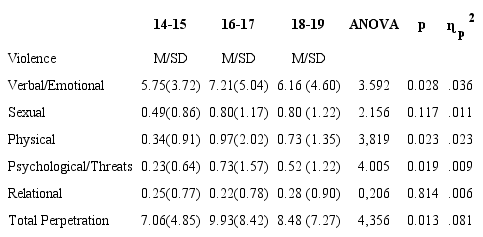
The results showed differences in most perpetration patterns according to the age group, except for relational violence (Table 2). Thus, after Bonferroni’s corrections, we found differences in physical violence scores (p=0.021); psychological violence/threats (p=0.019) and in the CADRI total perpetration score (p= 0.016) between adolescents aged 14-15 and those aged 16-17. In other words, adolescents aged 16-17 perpetrate more violence than those aged 14-15. Thus, there was a greater difference between these two age groups, but not between age groups 16-17 and 18-19, nor between 14-15 and 18-19. There was a moderate effect size for the CADRI total perpetration score.
Perceptions on teen dating violence
Adolescents from both groups agreed that humiliating, threatening and cursing are forms of violence, as well as hitting and forcing sexual intercourse. However, adolescents did not generally recognize that tampering with their partner’s cell phones, controlling their partner’s Facebook account, and calling their partners excessively on the phone are forms of violence associated with control.
Results of the χ2 test showed that perpetrators of TDV have more difficulty recognizing that ‘Not allowing their partner to go out with friends’ is a form of violence (56.1% perpetrator group vs. 42.4% comparison group, χ2 = 7.54, gl=1, p=0.001). On the other hand, more adolescent perpetrators recognize that breaking their partner’s belongings is a form of violence (68.5% perpetrator group vs. 57.6% comparison group, χ2 = 5.31, gl=1, p=0.002). Adolescents found it difficult to perceive certain abusive behaviors as signs of dating violence in the other forms of violence investigated in the study. Thus, there is a legitimation of violence by adolescents in general, regardless of the history of aggression. In relation to psychological violence, it should be noted that some behaviors were not recognized as violence by the perpetrators: ‘Humiliation’ (14%); ‘Cursing or offending’ (16.8%); and ‘Name-calling’ (39%). In the comparison group, these rates were 19.7%, 23.5% and 43.2%, respectively. With regard to the violence perpetrated by the use of technology, approximately 37% of adolescents from both groups considered that ‘Controlling their partner’s Facebook account’ is a form of violence or control.
In relation to sexual violence, more than 10% of adolescents in both groups considered that ‘Forcing their partner to have any kind of sexual relation’ is not a form of violence in an romantic relationship. In other words, more than one in ten adolescents still does not consider sexual violence an act of aggression. Patrimonial violence was also highly disregarded in the perception of the participants. ‘Breaking personal belongings’ was not considered violence by 31.5% of the perpetrator group and by 43.4% of the comparison group; and ‘Tearing their partner’s clothes’ was not considered violence by 25.5% of the perpetrator group and 31.3% of the comparison group. In other words, approximately one in three adolescents did not consider that destroying their partner’s personal belongings is a violent manifestation.
There was a relationship between the perception of violence and sex among the perpetrators of TDV. Female adolescents recognized that ‘Prohibiting their partner from wearing any type of clothing’ (68.8% female vs. 31.2% male, χ2 = 6.73, gl=1, p=0.009); ‘Controlling their partner’s Facebook account’ (55.7% female vs. 44.3% male, χ2 = 4.77, gl=1, p=0.029); and ‘Calling excessively on the phone’ (62.4% female vs. 37.6% male, χ2 = 4.03, gl=1, p=0.045) are intimate forms of violence. No statistically significant differences were found in the other forms of violence. This shows the difficulty in recognizing signs of violence is not related to the perpetrator’s sex, but rather to sociocultural issues. Similarly, there was no relationship between perceptions of dating violence and age group.
Discussion
Adolescence is characterized as a period in which the first romantic experiences occur. These experiences constitute the process of emotional emancipation from one’s parents and the construction of the adult identity (Steinberg, 2002). In addition, this step is important for the construction of beliefs and perceptions about intimacy, gender expectations and myths about romantic relationships, including the normalization of violence (Caridade, 2011). There is a social perception that violence in romantic relationships would be more associated with stable adult marital relationships, as the dating stage is seen as a romantic stage (Soares Lopes, & Njaine, 2013) in which (a priori) there would be no room for the presence of abusive behavior (Diniz & Alves, 2015).
However, the results of this study confirm a high prevalence of violence in adolescent intimate relationships, thus corroborating previous studies in the area (CDC, 2014; Straus, 2004). We found a rate of 76.43% for the perpetration of some type of TDV, which shows that this phenomenon is frequent and requires more awareness and reflection. This result is similar to the high rates of perpetration (86.8%) presented by Oliveira et al., (2011) in a study with Brazilian adolescents aged 15 to 19; and far above those found in countries such as Portugal (30.6%, aged 13-29) (Caridade, 2011) and in Spain (24%, aged 15-19) (Fernández-Fuertes & Fuertes, 2010).
The perpetration of different types of violence was observed, and verbal/emotional violence was the most frequent among young people (91.1%). This result is in line with national studies (90.1%, Brancaglioni & Fonseca, 2016; 83.4%, Minayo et al., 2011) and international studies (96.3%, Fernández-Fuertes & Fuertes, 2010) in which verbal/emotional violence was identified as the most frequent in teen dating relationships.
Teen dating violence perpetration patterns identified in this study appear to be influenced by two sociodemographic variables: sex and age. The results found in terms of sex are in agreement with what has been found in other studies. Young men tend to perpetrate more sexual violence (Brancaglioni & Fonseca, 2016; Wincentak et al., 2016), while female adolescents tend to perpetrate more physical violence (Barreira et al., 2014; Marasca & Falcke, 2015). Teen dating violence may be accentuated by adolescent adherence to traditional gender stereotypes, although apparently their relationships now appear to be more flexible, equal and symmetrical. It is understood that rigid gender roles, sexist beliefs, and macho culture all contribute to dating violence (Murta et al., 2010), as they directly interfere with the way adolescents interpret and resolve their relationship conflicts.
Although the data shows higher rates of physical perpetration by girls, it is worth questioning whether they actually perpetrate violence more than boys, or rather recognize and report these types of aggression more often. Physical violence perpetrated by girls may be self-defense or a response to their partner’s use of coercive tactics (Swan & Snow, 2006). Abusive behaviors of young women may still be associated with feelings of anger and frustration with their partner or relationship, rather than a reaction to the violence they experience (Giordano, Soto, Manning, & Longmore, 2010).
Another hypothesis to consider is the banalization of female aggression, especially by boys who have suffered physical violence by their partner (Oliveira, Assis, Njaine & Pires, 2016). On the one hand, female aggression is disqualified, considered banal, as it does not pose serious physical damage. On the other hand, boys may feel humiliated and do not retaliate because of the social sanction for violence against women. In a research conducted solely with male adolescents from ten Brazilian capitals (n=257), when questioned about dating violence, their first reaction was silence and hesitation (Ceccheto, Oliveira, Njaine, & Minayo, 2016). This shows that it is more difficult for male adolescents to share such experiences.
Age also seems to influence the patterns of perpetration. Adolescents aged 16-17 had higher rates of perpetration of physical and psychological violence/ threats than the 14-15 age group. There was no difference between age groups 16-17 and 18-19. Although adolescents aged 16-17 perpetrate more violence than those aged 14-15, considering all the ages included in the sample (14 to 19 years old), the findings of this study are in line with the findings of Caridade (2011), who concluded that older adolescents tend to perpetrate more physical and emotional violence. A different study indicated a 40% increase in perpetration patterns between adolescence and adulthood (the incidence rate increased from 18.1% to 25.2%) (Johnson, Giordano, Longmore, & Manning, 2014). Thus, it is understood that adolescents experience more intimate relationships (e.g. dating) at the final stage of adolescence, which may justify the greater use of violent tactics in conflict resolution. Many adolescents aged 14-15 have not yet started their sex life. If they have already had some experience, they tend to have less long-lasting stable relationships (e.g. “hooking up”).
Another aspect investigated in this study refers to adolescents’ difficulty in recognizing certain types of abusive behaviors as violence. There was no relationship between the legitimation of violence by sex. Furthermore, most of the abusive behaviors were not significantly associated with the perpetrator group. This shows such difficulty in recognizing forms of TDV may be typical of adolescence and may implicate cultural aspects. Although not the majority, adolescents (perpetrators or not) do not consider attitudes such as ‘humiliating’, ‘cursing or offending’ and ‘name-calling’ types of violence. Thus, these types of aggression are often interpreted by adolescents as “jokes” (Nascimento & Cordeiro, 2011) or less serious violence (Reyes et al., 2016).
In general, adolescents tend to recognize violent acts only when they result in visible harm, which suggests a greater acknowledgement of physical violence compared to other forms of violence (Campos, Torres, & Guimarães, 2016). For instance, studies have shown that verbal violence is trivialized among adolescents and is recognized as a normalized mode of communication (Campos et al., 2016; Giordani, Seffner, & Dell’Aglio, 2017). However, despite not being visible, psychological violence is more frequent and can be even more harmful for victims in the long term than physical violence (Dantas-Berger & Giffin, 2005; Fonseca, Ribeiro, & Barbosa, 2012).
Lastly, it should be noted that violence in intimate relationships among young people is foreseen by Law 11340/2006 (Brasil, 2006), known as the Maria da Penha Law, which provides mechanisms for the protection and prevention of violence against women, even in situations of intimate relationships without cohabitation (e.g. current and past relationships). This law also provides for the protection of the victim, regardless of sexual orientation.
Final considerations
The study aimed to investigate teen dating violence, especially concerning the perceptions of aggressive behaviors and the patterns of perpetration of violence. The results indicated high rates of TDV perpetration among adolescents of the metropolitan region of Porto Alegre (RS). Teen dating violence is a strong predictor of violence between couples in adulthood Beserra et al., 2016; Graves, Sechrist, White, & Paradise, 2005; Oliveira, Assis, Njaine, & Pires, 2014), because such forms of interaction are naturalized very early on. In other words, early dating experiences marked by violence may suggest relationship patterns that will be established in adulthood.
The results indicate that adolescents (both perpetrators and non-perpetrators) have difficulty recognizing abusive behaviors in their romantic relationships, especially those associated with control behaviors (not allowing their partner to go out with friends, controlling their partner’s Facebook account and what they wear, and tampering with their partner’s cell phone). The normalization of violence is commonly observed among young people (Nascimento & Cordeiro, 2011). Thus, interacting and communicating aggressively is often seen as a “joke” or as a language typical of adolescents (Zanello & Flor, 2015). Thus, beliefs and attitudes that normalize violence in intimate relationships promote the occurrence of TDV (Caridade, 2011; Temple et al., 2016).
Thus, we stress the need to give the phenomenon more visibility and invest in prevention programs that consider the multi-faceted nature of violence and offer adolescents spaces for reflection. It is important to not only create awareness so that young people are able perceive the different types of violence, but also to give them tools to adequately handle emotions and conflicts with their partners. Multicomponent programs should be implemented (Murta et al., 2013; Murta et al., 2016) not only to create awareness, but also to develop pro-social skills in adolescents. Competencies such as assertiveness and empathy can promote non-violent strategies of conflict resolution, as well as promote collective discussions about gender violence and sexist beliefs that help in the adaptive management of jealousy and anger (Murta et al., 2013; Murta et al., 2016).
This study has some limitations. Firstly, because it is regarded as a cross-sectional, exploratory and descriptive study, it does not allow the establishment of causal relationships. Current studies have sought to understand the relationship between acceptance of violence with family and individual variables, based on longitudinal designs (Karlsson et al., 2016, Reyes et al., 2015). Also, there may have been some bias in the participants’ profile as it is a convenience-sample study.
We suggest further research to investigate other relationship patterns among adolescents (homosexuals and bisexuals), and evaluate possible differences in TDV behaviors and perceptions. We also recommended qualitative research with the dyads of adolescents with a history of TDV to understand the violent dynamics of relationships.
As for the implications of this study, we suggest that public policies aimed at the prevention of violence perpetrated by the intimate partner may give greater attention to teen dating violence, as they traditionally only emphasize violence in adult relationships. Thus, a look at the specificities of TDV by professionals and society as a whole is necessary.
References
Avanci, J. Q., & Assis, S. G. (2011). Opções metodológicas. In M. S. C. Minayo, S. G. Assis, & K. Njaine (Eds.), Amor e violência: Um paradoxo das relações de namoro e do ‘ficar’ entre jovens brasileiros (pp. 302-314). Rio de Janeiro: Fiocruz.
Ayala, M. L. C., Molleda, C. B., Rodríguez-Franco, L., Galaz, M. F., Ramiro- Sánchez, T., & Diaz, F. J. R. (2014). Unperceived dating violence among Mexican students. International Journal of Clinical and Health Psychology, 14(1), 39-47. doi: 10.1016/S1697-2600(14)70035-3
Barbosa R. M, & Koyama M. A. H. (2008). Comportamento e práticas sexuais de homens e mulheres, Brasil 1998 e 2005. Revista de Saúde Pública, 42(1), 21-33.
Barreira, A., Lima, M., Bigras, M., Njaine, K., & Assis, S. (2014). Direcionalidade da violência física e psicológica no namoro entre adolescentes do Recife, Brasil. Revista Brasileira de Epidemiologia, 17(1), 217-228. doi: 10.1590/1415-790X201400010017
Bonomi, A. E., Anderson, M. L., Nemeth, J., Rivara, F. P., & Buettner, C. (2013). History of dating violence and the association with late adolescent health.BMC Public Health, 13(821). Retrieved from http://www.biomedcentral.com/1471-2458/13/821
Brancaglioni, B. C. A., & Fonseca, R. M. G. S. (2016). Intimate partner violence in adolescence: an analysis of gender and generation. Revista Brasileira de Enfermagem, 69(5), 890-898. doi: 10.1590/0034-7167-2016-0408
Brasil. (2006). Lei Maria da Penha. Lei N.°11.340, de 7 de agosto de 2006.
Campos, P. H. F., Torres, A. R. R., & Guimarães, S. P. (2016). Sistemas de representação e mediação simbólica da violência na escola. Revista Educação e Cultura Contemporânea, 1(2), 109-132.
Caridade, S. (2011). Vivências íntimas violentas: Uma abordagem científica. Portugal/Coimbra: Almedina.
Ceccheto, F., Oliveira, Q. B. M., Njaine, K., & Minayo, M. C. S. (2016). Violências percebidas por homens adolescentes na interação afetivo-sexual em dez capitais brasileiras. Interface, 20(59), 853-864. doi: 10.1590/1807-57622015.0082
Center for Disease Control and Prevention (CDC, Division of Violence Prevention, 2014). Understanding teen dating violence. Retrieved from https://www.cdc.gov/violenceprevention/pdf/teen-dating-violence-factsheet-a.pdf
Coker, A. L., Clear, E. R., Garcia, L. S., Asaolu, I. O., Cook-Craig, P. G., Brancato, C. J., …, Fisher, B. S. (2014). Dating violence victimization and perpetration rates among high school students. Violence Against Women, 20(10), 1220-1238. doi:10.1177/1077801214551289
Dantas-Berger, S. M., & Giffin, K. (2005). A violência nas relações de conjugalidade: invisibilidade e banalização da violência sexual? Cadernos de Saúde Pública, 21(2), 417-425. doi: 10.1590/S0102-311X2005000200008.
Diniz, G. R. S., & Alves, C. O. (2015). Gênero e violência no namoro. In S. G. Murta, J. S. N. F. Bucher-Maluschke (Eds.), Violência no namoro: Estudos, prevenção e psicoterapia (pp. 19-42). Curitiba, PR/Appris.
Espírito-Santo, H., & Daniel, F. (2015). Calcular e apresentar tamanhos do efeito em trabalhos científicos (1): As limitações do p<0,05 na análise de diferenças de médias de dois grupos. Revista Portuguesa de Investigação Comportamental e Social, 1(1), 3-16.
Fernández-Fuertes, A. A., & Fuertes, A. (2010). Physical and psychological aggression in dating relationships of Spanish adolescents: motives and consequences. Child Abuse Neglect, 34(3), 183-191. doi: 10.1016/j.chiabu.2010.01.002.
Flake, T. A., Barros, C., Schraiber, L. B. M., & Menezes, P. R. (2013). Violência por parceiro íntimo entre estudantes de duas universidades do estado de São Paulo, Brasil. Revista Brasileira de Epidemiologia, 16(4), 801-816. doi: 10.1590/S1415-790X2013000400001
Fonseca, D. H., Ribeiro, C. G., & Barbosa, N. S. (2012). Violência doméstica contra a mulher: realidades e representações sociais. Psicologia & Sociedade, 24(2), 307-314. doi: 10.1590/S0102-71822012000200008
Fundo das Nações Unidas par a Infância (UNICEF, 2011). Situação mundial da infância. Adolescência: uma fase de oportunidades. Recuperado do https://www.unicef.org/brazil/pt/br_sowcr11web.pdf
Giordani, J. P., Seffner, F., & Dell’Aglio, D. D. (2017). Violência escolar: percepções de alunos e professores de uma escola pública. Psicologia Escolar e Educacional, 21(1), 103-111. doi: 10.1590/2175-3539/2017/02111092
Giordano, P. C., Soto, D. A., Manning, W. D., & Longmore, M. A. (2010). The characteristics of romantic relationships associated with teen dating violence. Social Science Research, 39, 863-874. doi: 10.1016/j.ssresearch.2010.03.009
Graves, K. N., Sechrist, S. M., White, J. W., & Paradise, M. J. (2005). Intimate partner violence perpetrated by college women within the context of a history of victimization. Psychology of Women Quarterly, 29(3), 278-289.doi: 10.1111/j.1471-6402.2005.00222.x
Johnson, W. L., Giordano, P. C., Longmore, M. A., & Manning, W. D. (2014). Intimate partner violence and depressive symptoms during adolescence and young adulthood. Journal of Health and Social Behavior, 55(1), 39-55. doi: 10.1177/0022146513520430
Karlsson, M. E., Temple, J. R., Weston, R., & Le, V. D. (2016). Witnessing interparental violence and acceptance of dating violence as predictors for teen dating violence victimization. Violence Against Women, 22(5), 625-646. doi: 10.1177/1077801215605920
Kaura, S. A., & Lohman, B. J. (2007). Dating violence victimization, relationship satisfaction, mental health problems, and acceptability of violence: A comparison of men and women. Journal of Family Violence, 22, 367-381. doi: 10.1007/s10896-007-9092-0
Love, S. R., & Richards, T. N. (2013). An exploratory investigation of adolescent intimate partner violence among African American youth: A gendered analysis. Journal of Interpersonal Violence, 28(17), 3342-3366. doi: 10.1177/0886260513496898
Marasca, A. R., & Falcke, D. (2015). Forms of violence in the affective-sexual relationships of adolescents. Interpersona, 9(2), 200-214, doi:10.5964/ijpr.v9i2.176.
Minayo, M. C. S., Assis, S. G., & Njaine, K. (2011). Amor e violência: Um paradoxo das relações de namoro e do “ficar” entre jovens brasileiros. Rio de Janeiro: Fiocruz.
Mulford, C. E., & Blachman-Demner, D. R. (2013).Teen dating violence: Building a research program through collaborative insights. Violence Against Women, 19(6), 756-770. doi: 10.1177/1077801213494705
Murta, S. G., Del Prette, A., & Del Prette, Z. A. P. (2010). Prevenção ao sexismo e ao heterossexismo entre adolescentes: contribuições do treinamento em habilidades de vida e habilidades sociais. Revista de Psicologia da Criança e do Adolescente, 2, 73-86.
Murta, S. G., Moore, R. A., Miranda, A. A. V., Cangussú, E. D. A., Santos, K. B., Bezerra, K. L. T., & Veras, L. G. (2016). Efeitos de um programa de prevenção à violência no namoro. Psico-USF, 21(2), 381-393. doi: 10.1590/1413-82712016210214
Murta, S. G., Santos, B. R. P., Martins, C. P. S., & Oliveira, B. (2013). Prevenção primária à violência no namoro: Uma revisão de literatura. Contextos Clínicos, 6(2), 117-131. doi: 10.4013/ctc.2013.62.05
Nascimento, F. S., & Cordeiro, R. L. M. (2011). Violência no namoro para jovens moradores de Recife. Psicologia & Sociedade, 23(3), 516-525. doi: 10.1590/S0102-71822011000300009
Oliveira, Q. B. M., Assis, S. G., Njaine, K., & Oliveira, R. V. C. (2011). Violência nas relações afetivo-sexuais. In M. C. S. Minayo, S. G. Assis, & K. Njaine (Eds.), Amor e violência: Um paradoxo das relações de namoro e do “ficar” entre jovens brasileiros (pp. 87-139). Rio de Janeiro: Fiocruz.
Oliveira, Q. B. M., Assis, S. G., Njaine, K., & Pires, T. O. (2014). Namoro na adolescência no Brasil: circularidade da violência psicológica nos diferentes contextos relacionais. Ciência & Saúde Coletiva, 19(3), 707-718. doi: 10.1590/1413-81232014193.19052013
Oliveira, Q. B. M., Assis, S. G., Njaine, K., & Pires, T. O. (2016). Violência física perpetrada por ciúmes no namoro de adolescentes: Um recorte de gênero em dez capitais brasileiras. Psicologia: Teoria e Pesquisa, 32(3), 1-12. doi: 10.1590/0102-3772e32323
Reyes, H. L. M., Foshee, V. A., Niolon, P. H., Reidy, D. E., & Hall, J. E. (2016). Gender role attitudes and male adolescent dating violence perpetration: Normative beliefs as moderators. Journal of Youth and Adolescence, 45, 350-360. doi: 10.1007/s10964-015-0278-0
Reyes, H, L. M., Foshee, V. A., Fortson, B. L., Valle, L. A., Breiding, M. J., & Merrick, M. T. (2015). Longitudinal mediators of relations between family violence and adolescent dating aggression perpetration. Journal of Marriage and Family, 77, 1016-1030. doi:10.1111/jomf.12200
Romito, P., Beltramini, L., & Escribà-Agüir, V. (2013). Intimate partner violence and mental health among Italian adolescents: Gender similarities and differences. Violence Against Women, 19(1), 89-106. doi: 10.1177/1077801212475339
Soares, J. S. F., Lopes, M. J. M., & Njaine, K. (2013). Violência nos relacionamentos afetivo-sexuais entre adolescentes de Porto Alegre, Rio Grande do Sul, Brasil: Busca de ajuda e rede de apoio. Cadernos de Saúde Pública, 29(6), 1121-1130. doi: 10.1590/S0102-311X2013000600009
Steinberg, L. (2002). Part I: The Fundamental Changes of Adolescence. In L. Steinberg (Ed.), Adolescence (pp. 19-57). Boston: McGraw-Hill.
Straus, M. A. (2004). Prevalence of violence against dating partners by male and female university students worldwide. Violence Against Women, 10(7), 790-811. doi: 10.1177/1077801204265552
Straus, M. A. (2014). Addressing violence by female partners is vital to prevent or stop violence against women: Evidence from the multisite batterer intervention evaluation. Violence Against Women, 20(7), 889-899.doi: 10.1177/1077801214545932
Swan, S. C., & Snow, D. L. (2006). The development of a theory of women’s use of violence in intimate relationships. Violence Against Women, 12, 1026-1045. doi:10.1177/1077801206293330
Temple, J. R., Choi, H. J., Elmquist, J., Hecht, M., Miller-Day, M., Stuart, G. L., …, Wolford-Clevenger, C. (2016). Psychological abuse, mental health, and acceptance of dating violence among adolescents. Journal of Adolescent Health, 59, 197-202. doi: 10.1016/j.adohealth.2016.03.034
Temple, J. R., Shorey, R. C., Tortolero, S., Wolfe, D. A., & Stuart, G. L. (2013). Importance of attitudes about violence and gender in the relationship between exposure to interparental violence and the perpetration of teen dating violence. Child Abuse & Neglect, 37, 343-352. doi: 10.1016/j.chiabu.2013.02.001
Wincentak, K., Connolly, J., & Card, N. (2017). Teen dating violence: A meta-analytic review of prevalence rates. Psychology of Violence, 7(2), 224-241. doi: 10.1037/a0040194
Wolfe, D. A., Scott, K., Reitzel-Jaffe, D., & Wekerle, C. (2001). Development and validation of the conflict in adolescent dating relationships inventory. Psychological Assessment, 13, 277-293. doi:10.1037/1040-3590.13.2.277
Zanello, V., & Flor, W. (2015). Dos insultos entre adolescentes ao trabalho das relações de gênero na escola. In S. G. Murta, & J. S. N. F. Bucher-Maluschke (Eds.), Violência no namoro: Estudos, prevenção e psicoterapia (pp. 187-202). Curitiba, PR/Appris.
Author notes
Contact: Jeane Lessinger Borges Instituto de Psicologia/UFRGS, Programa de Pós-Graduação em Psicologia Rua Ramiro Barcelos, 2600/115 Porto Alegre-RS CEP: 90035-003