ABSTRACT: This article offers an anthropological examination of the aftermath of the Samarco dam disaster of November 2015. We analyze the widely used metaphor of the wave of mud to track how news, experience, and representation of toxic iron ore tailings water traveled from Bento Rodrigues down the Doce River to the coast. We draw on eyewitness testimonials, on scientific reports, on social media, on documentary films, and on a theatre production. We draw on sociological research conducted by a team at the Brazilian coast. The wave of mud image helps us understand the physical and symbolic effects of this environmental disaster and crime.
KEYWORDS: Environmental crimeEnvironmental crime,wave of mudwave of mud,material and symbolic forcesmaterial and symbolic forces.
RESUMO: O artigo oferece uma análise antropológica do momento posterior ao desastre da Samarco, ocorrido em novembro de 2015. Exploramos a metáfora da onda de lama para seguir notícias, experiências e representações sobre o deslocamento de rejeitos de mineração, ocorrido a partir de Bento Rodrigues, descendo o rio Doce até atingir o oceano. Baseamo-nos em testemunhos oculares, relatórios científicos, notícias, redes sociais, documentários e, ainda, em uma peça de teatro. Igualmente, utilizamos trabalho etnográfico conduzido na costa do Espírito Santo. A imagem da onda de lama permite entender os efeitos físicos e simbólicos desse desastre e crime ambiental.
PALAVRAS-CHAVE: Crime ambiental, onda de lama, forças materiais e simbólicas..
Dossier
A wave of mud: the travel of toxic water, from Bento Rodrigues to the Brazilian Atlantic
Uma onda de lama: viagem de águas tóxicas, de Bento Rodrigues ao Atlântico brasileiro
Instituto de Estudos Brasileiros
Received: 10 December 2017
Accepted: 14 March 2018
On the 5th of November 2015, in the village of Bento Rodrigues, in the municipality of Mariana, in Minas Gerais state, Brazil, an iron ore tailings dam owned by the mining company Samarco Mineração S.A. burst open, sending 62 million cubic meters of muddy waste down the Doce River, killing 19 people in floods and sending toxic brown water flowing toward the Atlantic Ocean, where it arrived two weeks later, contaminating beaches and towns. This environmental disaster, which some commentators named an environmental crime1 committed by the negligent Samarco Company and its business partners, Brazil’s Vale S.A. and Australia’s BHP Billinton Ltda., was the worst spill of its kind in Brazil’s history2. The contamination had a sudden start, but has been an unfolding calamity, poisoning river life, disrupting livelihoods, jamming hydroelectric infrastructure, and polluting Atlantic waters. When the accident first happened, journalistic coverage described people along the river confronting a wave of mud (onda de lama)3. The breach came just as Samarco was being celebrated for its profitability; one commentator offered that the “wave of good news” about the company’s performance had given way to a “sea of mud”4.
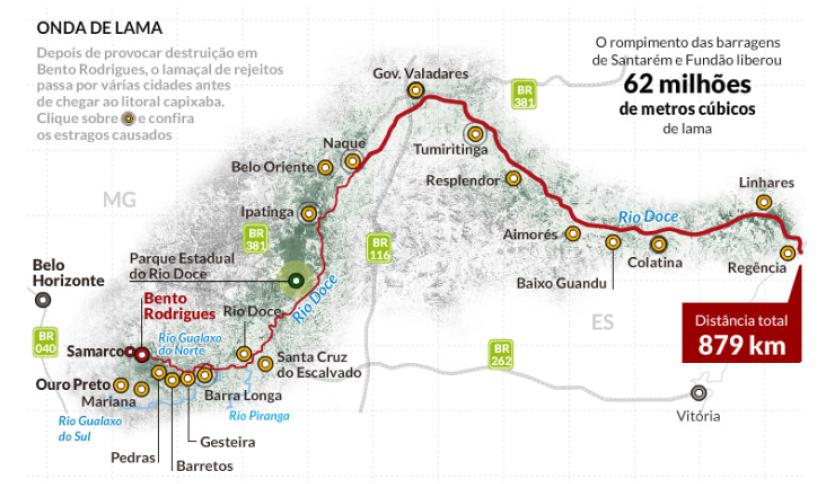
Figure 1
Map of the wave of mud. Reproduced from EQUIPEONB, 2015
In this article, we analyze the figure of the wave of mud. We pay attention to representations of the wave in the news, to a theatre production about the wave and its aftermath, and to a documentary film based on eye- and earwitness testimonials at the wave’s origin point of Bento Rodrigues. We also follow narratives downstream, listening to political and legal discussions and drawing from sociological research conducted by a team from the Universidade Federal do Espírito Santo (UFES). We depend, too, upon ethnographic work one of us5 conducted in an affected community at the Brazilian coast, in the state of Espírito Santo (ES), at Regência Augusta, a site of domestic nature tourism6, a marine conservation project, and surf recreation7. We attend along the way to the materiality of the wave, including its load of lead, arsenic, and mercury.
We read the wave of mud as a material-semiotic8 force in order that we may trace the physical and social journey the mud took between the dam and coast. The wave is both more than a physical description and more than a mere metaphor. More than a physical description because the wave operates as a symbolic figure for a force that moves relentlessly and steadily across space and through time, rapidly reshaping people’s sense of pasts, presents, and futures9. More than a metaphor because the physical propagation of the mud (whether as wave, plume, patch) has delivered ecological disaster as well as animated collective political action and protest10. The wave operates as a vehicle for material-symbolic rupture and contamination, and differently for different constituencies.
How, we ask here, did the figure of the wave matter? What actions and affects did it animate? What stories did it enable? For whom? What discursive and political work did the wave image do to help or hinder understandings of the dam disaster and its sequelae?
We discerned four major genres of wave talk in discussions of the Samarco event and its consequences, genres that manifested along a downstream trajectory in the Doce River watershed. One: the wave image in news, drama, and documentary, used to evoke the sudden inundation the dam burst created. This was the wave as an initiating force of trauma, a force of fast violence11, a wave becoming known, in retrospect, through the past tense, as a social-natural materialization of corporate irresponsibility. Two: the wave image used by officials in an affected municipality, Baixo Guandu, to discuss the propagation of toxins down the Doce River; this was the wave as a present and imminent threat to health and livelihood, a wave of poisonous, deleterious mud/water compromising the living ecological river as well as its hydroelectric infrastructure. Three: the wave (or, sometimes, plume) grappled with as a material-semiotic force by company representatives, federal environmental managers, lawyers, and fishers worried about how the wave of mud-as both form and matter out of place12-would contaminate the future at coastal Regência Augusta. This was the wave as an unwelcome arrival from an inland mining and industrial landscape that many people supposed was distant and segregated from coastal livelihoods. Four: ocean waves not as singular but rather as multiplying evidence of the repeating insult of the original Samarco wave. The wave of mud became an amalgam of contested meanings and materials, appearing as something both separate from and invasive of the river and its delta.
Anthropologists working on environmental questions have recently focused attention on water. A subset has taken interest in rivers. For Hugh Raffles, tributaries of the Amazon such as the Igarapé Guariba are notable for their changing paths, their evanescence-and their often forgotten human-engineered and manipulated histories13. For Anne Rademacher, the riverscapes of Kathmandu are sites of struggle over conservation, heritage, and migrant life14. For David McDermott Hughes, a river like the Limpopo, crossing South Africa, Mozambique, and Zimbabwe, is both a socially located flow of water, but also, for some people (like conservation activists) a site of future potential15. For Kelly Alley, the Ganges and its sacred quality, viewed by visitors as “mother, goddess, purifier, and sustainer of all life,” is simultaneously seen by activists as “affected by urban growth, industrial production, and the practices of citizen and administrative and industrial elites”16. Alley’s work offers a prescient anthropology of toxins travelling into lived environments17.
We contribute here to discussions of rivers-and toxins-with an example from Brazil. The story, we hope, has international relevance, especially in the age of corporate deregulation. The Doce River, we argue, is a place of memory and forgetting, a site of present struggle, a site of future transformation, and a medium of ongoing, even chronic, toxicity.
For people who did not live in Bento Rodrigues or surrounds, news of the wave of mud came through newspapers but also, later, through activist artistic representations. These are examples of our first sort of wave talk: works in which the wave image is mobilized to keep alive in memory the sudden, but long-in-building, disaster of corporate engineering, to prevent the event from being silently erased.
In May 2017, one of us attended a play entitled Hotel Mariana, about the disaster. Staged at Estação Satyros in São Paulo, the play consisted of actors speaking the words of people from Bento Rodrigues who had been interviewed by the director of the play. The play began in quiet darkness-a darkness broken by recorded sound, the recreated noise of the breaking dam and the following, disastrously rushing water. One might think back to an early report on the burst, which gave an account of the sound of the event: “Then there followed a cloud of dust and the fluttering of birds. The villagers realized there was something wrong. In a matter of minutes, screams and horns filled the streets: the wave of mud was approaching”18. With the dam constructed in part of sand and silt (an earthen dam, made using a hydraulic landfill system), which was likely saturated by water over many months19, the sound may also have been of the dam’s “liquefaction”20. In the play, it sounded like the crash of a wave-reminiscent of a dark Biblical story of the creation of a world from water, though bringing destruction rather than creation into being. The sound of the wave resolved into the voices of confused people-a reverse tower of Babel, with the people not the constructors of a collapsing structure, but victims of a corporate construction project gone wrong. Eventually the audience heard from all of the people on the stage. Each actor wore headphones, repeating the words of survivors to whom they were listening (the “Verbatim” mode of theatre). Hotel Mariana offered “intimacy without proximity”21 a replaying of the disaster to make the wave matter to those brought into this virtual witnessing.
Wanting to find out more about the aftermath of the disaster, and the negligence that led to it, one could turn to an interactive, virtual-reality-styled documentary published on YouTube in April 2016, five months after the burst. “River of Mud”, directed by Tadeu Jungle, features images that allow the user to navigate in 360º. A narrator’s voice is interspersed with voices of Bento Rodrigues villagers who remember life before the disaster. The movie allows the user to navigate, using her mouse, images of debris, personal objects, dead animals, and destroyed plants, now covered with muddy orange water.
The documentary shows what is left after the wave has torn over the landscape. Attention centers on sound-that evanescent phenomenon always passing into memory. The viewer/listener hears: (1) a bell (not a siren, which some commentators argue would have saved lives); (2) a priest who remembers the screams of villagers on the day of the breach; (3) a couple who sing a mournful song22 while standing where their house once sat; (4) a teenager singing “Beyond the Blue River,” in a mud-filled church (“beyond the blue river, the streets are golden and crystal, there everything is life, everything is peace, death and crying no more, sadness and pain no more”23); (5) an inconsolable woman crying. The narrator concludes with a demand for a Memorial to Mariana24.
The director later commented that he sought to create a narrative contrasting “sweet” memories (a reference to the river’s name (Doce)) with “the scorched earth.” He hoped with virtual reality to create empathy and anger, declaring that: “my aim is for these criminals to be blamed, to be arrested, and to be held accountable for their crime”25.
Both play and documentary move beyond the simple relay of images, which, on their own, in excess, might produce an anesthetic effect26-or, for the people affected might exacerbate the pain27. The fast violence of the wave is arrested in time, preserving the chaos caused by the event28, a guard against the wave washing over or aiding in the forgetting of the calamity, as river waters sometimes do29. These artistic activist representations make the past a part of the present and of a cautionary future.
In December 2015, researchers from different disciplines at the Federal University of Espírito Santo traveled up the Doce River to visit localities at Espírito Santo that depended on the river’s waters for power, fishing, and leisure30. A report, dated 16 November 2015, provided updates on two Doce River hydroelectric plants: the Baguari dam, in Governador Valadares, and the Aimorés hydroelectric power station, at the border between the states of Minas Gerais (MG) and Espírito Santo (ES). The operation of both plants had been halted, given fears that toxic water could damage turbines or spillways. Regarding Aimorés, the news reported that officials were “monitoring the situation of the arrival of the wave in the Doce River, through the bulletins issued by the Brazilian Geological Survey… and its field team”31.
This team joined the mayor of the municipality of Baixo Guandu, on the border with MG, and interviewed him. Baixo Guandu had drawn the attention of the public, institutional agents, and mining companies because of an occupation that protesters were staging on the rails of the Vitória-Minas Gerais Railroad (through which iron ore is transported between Minas Gerais and the Port of Tubarão, in Vitória, Espírito Santo). The occupation responded to the dam break and the subsequent dispersal of tailings. It was also a response to the mayor making public a laboratory analysis of the waters of the Doce River. A Brazilian news agency reported:
The result of the laboratory analysis of water samples collected from Doce River in Minas pointed to levels above the acceptable concentrations of heavy metals such as mercury, arsenic, iron and lead in the mud that flowed into the river with the disruption of the dams in Mariana (MG). The Mayor of Baixo Guandu (ES) […] confirmed the information. “To give an idea, the quantity of arsenic found in the sample was 2.6394 milligrams, and the acceptable is at maximum 0.01 milligram,” he clarified. […] “We practically found the entire periodic table in the water. I want to see what the president of Vale will do to help all the people,” he said32.
The mayor reported that the municipality had 31,000 inhabitants and survived on an economy based on agriculture, retail, and granite mining. It was also home to 260-270 professional fishermen. “Why does the city exist?” he asked. “Because of the water. We are a river!” Water was life-and politics. The mayor was mindful of avoiding conflicts over water distribution of the sort that had unfolded at Governador Valadares, Minas Gerais, upstream, and Colatina, Espírito Santo, downstream. The present was thus a moment of anticipation: “The mud has not arrived. It is coming to Valadares now. The solid, dense matter is arriving slowly”. This was also true for a worried populace: “Before arriving, the mud generated a wave of rumors.” Wave language mattered here as a material-semiotic relay and organizer of emotion and affect33.
Several solutions had been presented in anticipation of the mud. People considered displacing the mud to a crater or using the floodgates of the Aimorés hydroelectric plant to block the mining tailings. This last possibility was discarded because of the risk of damaging plant equipment. The mayor also recalled how the hydroelectric plant had been created in the first place-that the course of the Doce River had been diverted by 12 km, so that the lake and the powerhouse were in Minas Gerais, and not in Espírito Santo, a position of political subordination that was now having potentially toxic effects: “we are here in the Espírito Santo state, so we are the recipient of the garbage”. The muddy water thus flowed into many histories34. As Franz Krause suggests, drawing upon fieldwork along the Kemi River in Finnish Lapland,
Water does not simply flow; it flows in certain rhythms of varying intensity, tempo and direction negotiated by human labour, infrastructure, the weather and the river bed… Fishing and hydroelectricity production illustrate precisely that flow is about the articulations of different kinds, directions and tempos of movement. Flow is not simply an antithesis to stasis. Flows of particular materials move through, along or past particular other flows, which in turn influence how they flow35.
The wave of mud changed the “intensity, tempo, and direction” of the Doce River’s social-natural flow. Talk of the wave of mud called for thinking about how to manage the unexpected yet inexorable, the artificial and toxic mixing with and poisoning the putatively natural.
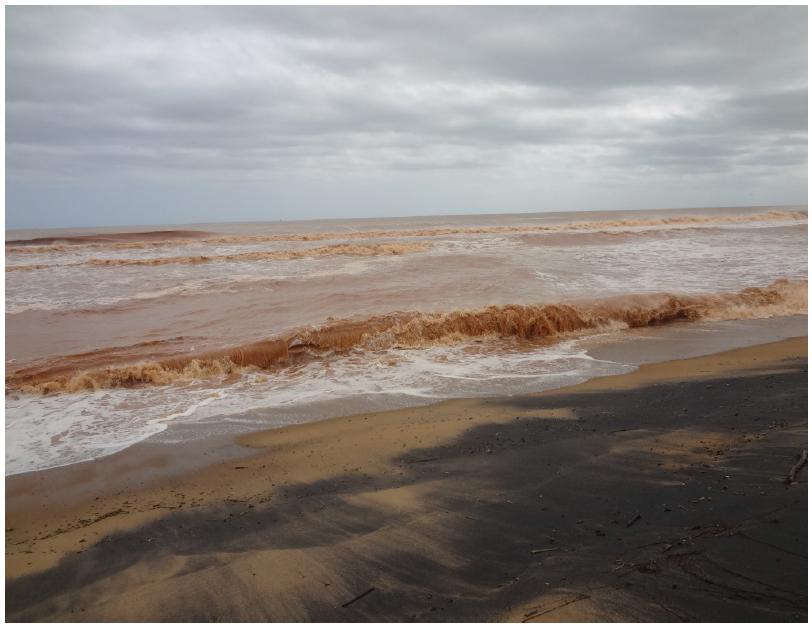
After the dam of Fundão broke, one of us traveled to the village of Regência Augusta, more than six hundred miles down the river, meeting apprehensive citizens who continued their daily activities even as they anxiously anticipated the influx of water. Kids played in the waters of the river, fishers headed out to sea, surfers paddled out to the waves. There was uncertainty, and, in Espírito Santo, legal and administrative measures were taken when the color of the water changed at the mouth of the Doce River. Beaches were closed, and residents were left with water of dubious quality36.
The minister of the Environment downplayed the effects of tailing dispersion in the ocean37. Engineer Paulo Rosnan of the Federal University of Rio de Janeiro also sought to minimize environmentalists’ concerns about the effects of tailings in marine waters: “At sea […] There will be only one very large colored patch that will disperse normally, as the spots that come out of the rivers are dispersed in times of great rains” 38. The company also claimed the waste was not toxic.
But waves of mud eventually did appear at the shore, as one can see in photos from Regência Augusta, which show surf breakers contaminated with iron ore. If, in Hughes’ (2005) account of the Limpopo River, water animates imaginations of virtuous futures (for conservation biodiversity activists), here there were contests between corporate apologists who imagined the wave as a simple “patch dispersing” and others who saw the wave repeating and amplifying its risks, its negative potentials, again and again, reincarnated in brown ocean waves-signs of the travel of inland pollution into coastal ecology.
On 25 November 2015, after the mud reached the ocean, a meeting was held among governmental and military authorities, technicians working for ES state agencies, academics, and residents of the municipalities affected. The governmental authorities were considering strategies of action, focusing on mitigation that might come from financial relationships with Samarco and its partners, representatives of which were present. The majority of participants had institutional links recognized by the government, and, at the same time, it was not a public hearing. Discussions centered on a federal maritime presence in the ship Vital Oliveira, whose purpose was to conduct studies near the mouth of the Doce River, on the presence of “heavy metals and other components” in the water39. The environmental management body of ES presented a matrix of impacts. Some measures undertaken at the time were: removal of animal bodies and their disposal in landfills; establishment of bases of “governance” in affected municipalities; installation of oil spill containment buoys at the mouth of the river; and monitoring of water quality. Local communities viewed these interventions with suspicion. Kane writes that, “coastal infrastructure is the material and symbolic dimension of the state in confrontation with nature”40. And, here, in confrontation, too, with local residents.
During this meeting, one person from the federal environmental agency worried that the two hydroelectric plants, Aimorés and Mascarenhas, were clogging with sediments. Animals killed upstream were sources of concern: “death in the river is very high, tons and tons.” Since the movement of sediments near the coast was monitored daily, the same agent pointed out that an increase in turbidity at the shore had been observed. Researchers in the natural sciences avoided the image of mud, preferring the terminology of a plume of sediments, so also avoiding the wave rhetoric, which emphasized suddenness and unstoppable agency. Staying away from what had become the charged language of mud, describing the substance in more scientifically neutral terms (and neglecting the possibility that the “sediment” contained toxins), effectively naturalized the disaster.
The image of the wave of mud, though, was used in another event focused on the Doce River event, convened by legal professionals. If rivers are natural-cultural sites were people argue over potentials, good and ill41, this meeting might be read as a social drama42. It was held in October 2016, at UFES, and included (1) a public defender; (2) a lawyer; (3) a public prosecutor; and (4) a resident of a fishing village who identified herself as affected by Samarco’s mud.
The public defender emphasized the difficulties of defendants in dealing with human and nonhuman effects of the dam break, linked to the wide territorial extension of what he called environmental damage43. He, along with other legal professionals, social scientists, and affected communities, did not consider official concepts of victimhood and territorial extension satisfactory in addressing the damage44. The lawyer took an accusatory tone45: “We’re not just talking about toxic sludge sweeping to the Atlantic Ocean. We’re talking about the biggest social-environmental crime in the history of this country! We are speaking against a criminal company!”. In this speech, emphasis was given to the ways the Brazilian state, through weak environmental and safety regulatory frames, had enabled and protected transnational corporations devoted to extractivist activities, such as mining and oil exploration46. The wave of mud was materialization and symbol, then, of the problems of Brazil: “I usually say that the Samarco crime has become emblematic because it reveals several Brazils. The first Brazil I see in this mud, killing people, is colonial Brazil.” Other “Brazils” were punctuated in this speech-the “patrimonialist, privatist Brazil,” the “antidemocratic Brazil”, “the Brazil of the hidden negotiations” and, finally, aspirationally, a “Brazil of resistance”. The sweeping toxic sludge carries with it these forces, all at once. There is a larger implication, too, about colonial histories of mining reaching into today’s multinational enterprises.
Coming third at this meeting was a speech by the public prosecutor, following a more academic argumentative line. He defended the necessity of the development of “a legal technology that could give account of documentary measurements being made by the responsible entities.” He also spoke in defense of “rights”. He told a story:
A professor has recently been here at the university offering a new classification of collective litigation. Do you know what he presented as an example? Disputes about irradiated nature. It’s like you throw a rock in a lake and it sends out waves. It’s like that with the dam-those around the dam are hit, the environment, the fauna and the flora, those who live along the river, those who drink the river water, those who live on the river. Everyone is struck.
The analogy here between radiation and a wave suggests that there is an originating cause for the disaster. The wave, in other words, did not happen by itself. As Geertz47 has suggested, “Theory-whether scientific or not-advances primarily thanks to analogy, a kind of understanding that ‘sees’ what is less intelligible through a comparison with the most intelligible”. In this pronouncement, the appeal to analogy made a case not just about the laws of nature, but also about the criminal law that might point to who has responsibility and guilt.
The final pronouncement came from a resident of a fishing village. She spoke about the effects of the mud on human health and on other beings: “So they will dredge the sea? Can they get it out of the sea? And with regard to the contaminated fish... a fish does not have a GPS! You can’t tell it ‘Stay here!’ The fish that is on your table, which you are eating, is contaminated!”. For this resident, the disaster was part of a larger pattern of destroying artisanal fisheries; she associated the dam disruption with previous development projects. She doubted reports about the water conditions that had been produced with Samarco financing: “If I were the company, I would never pay anyone to produce evidence against me! No matter how credible this lab is, I would not believe this lab”.
Haraway has written that “Nobody lives everywhere; everybody lives somewhere. Nothing is connected to everything; everything is connected to something”48. These were precisely the sentiments expressed in the speeches of the lawyer and the resident, making their earthly and watery claims. As Kane49 observes about the politics of rivers, “actors involved in aquatic struggles track back and forth, linking events in hinterlands to cities, making the patterns of exploitation and resistance legible to wider audiences.” These are arguments about riverine potential50. They are also posed in terms of the direction of the flow-or “fluvitory” dimensions; space-making happens in “‘riverbank inhabitants’ engagement with and stories about… [a] river’s flows, especially in fishing, travel and transport”51. Waves and flows have a powerful directionality to them. Here the wave of mud comes from the past to the future, from the corporately controlled inland to the fishing and recreational coast.
During Creado’s fieldwork in Regência Augusta, she took pictures of children’s schoolyard paintings of the Doce River. One showed a pure blue wave colliding with a dirty wave of mud. In the foreground were references to the village, including its lighthouse. In the two inscriptions we read, on the left, “water is the source of life”, and on the right: “this mud is not ours”. Reading from left to right gives existential priority to the blue wave, and to water as life. If a thing comes to be alive when it moves, the wave and the mud have been woven into the imagination of the village and its daily life53. The image refers to the repetitive character of social time and the recurring and never-fully-over disaster and crime of Samarco. The wave of mud has washed into and continues to exist in the waves of the sea.
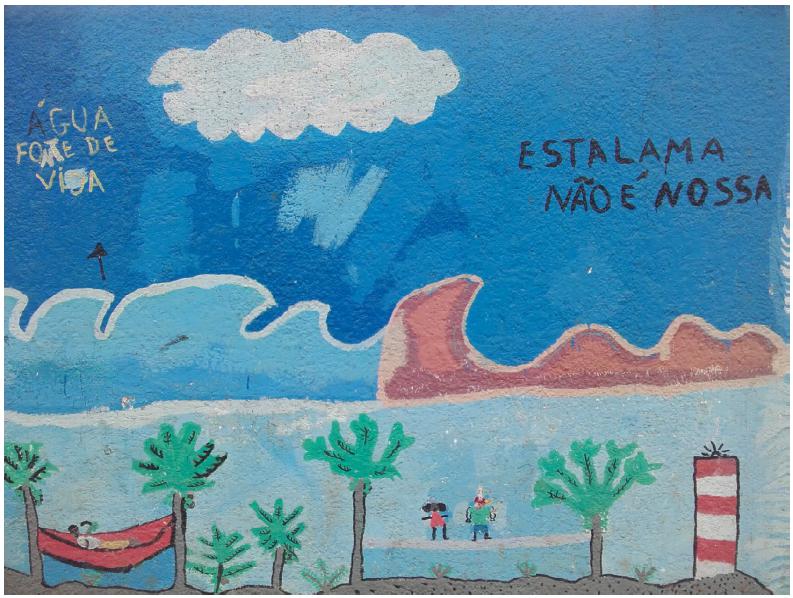
Figure 3
Children’s painting in school of Regência Augusta. Sept. 2017
The negotiations being made to secure an agreement between the two Brazilian states (MG and ES), the companies responsible for the Fundão dam and the governmental agencies responsible for environmental and indigenous protection were neither transparent nor democratic. Neither did these discussions admit questions about the viability of mining as such nor query the politics or beneficiaries of the technocratic language of “risk”. They resulted in an agreement, signed on 2 March 2016, that created the Renova Foundation, meant to implement socioenvironmental and socioeconomic programs to deal with the consequences of the dam disruption54. Renova has as founders Samarco Mineração S.A., Vale S.A. and BHP Billiton Brazil Ltda., the very companies responsible for the disaster (its community advisory board, meanwhile, does not have the power of imperative decisions55). In Portuguese, the name Renova means “Renew our Renewal”-but activists have taken to calling the organization rather “The Crime that Renews Itself”-an association bolstered by their reading of the organization’s logo, a closed circle that loops together companies and leaves out citizens, activists, and environments.
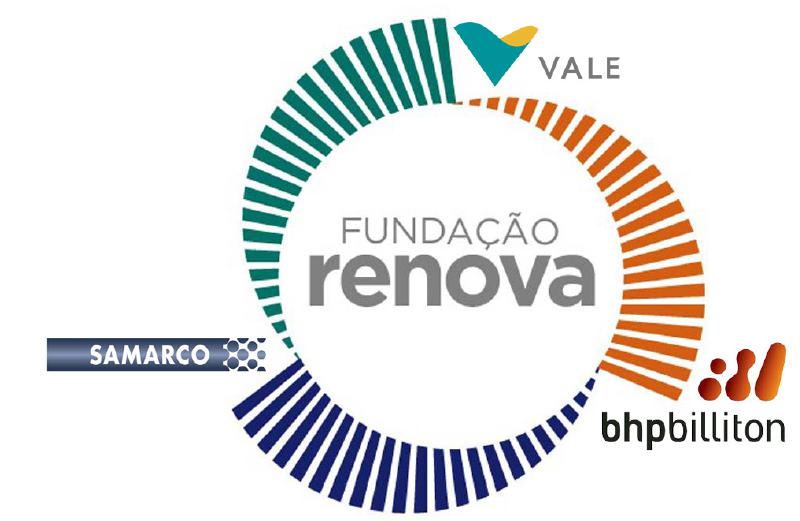
Figure 4
A repurposing of the Renova Foundation logo. Found on Facebook, Oct. 2016.
The circularity of this design evokes the recurring wave, but also the continued, looped presence of toxins, scattered to the sea every time it rains, and/or when the waters of the ocean become turbulent and the mining tailings are brought to the surface; the mining tailings have now been made part of the hydrosocial cycle56.
How did the image of the wave matter in the iterations we have traced here? For residents and activists, the image emphasized the Samarco burst as fast violence, a force out of place, a becoming-physical-organic-poisonous of a corporate mistake. For people at Baixo Guandu, it created a sense of dread and anticipation. For people at Regência Augusta it was about the future and, after it arrived, became a physical-material ghost of a disaster that kept replaying, repeating, re-breaking as contaminated ocean waves. Company bureaucrats and state engineers sought to downplay the disaster, avoiding words like wave and mud, preferring the more putatively neutral and technocratic plume and sediments. Wave talk thus united as well as divided people57. Kane suggests that “Both the researcher-writer and the activist […] must learn how to creatively link the rather technocratic subjects of water management and environmental crime to cultural impulses for change and social justice”58. In examining the rhetorical and political work that the figure of the wave of mud has (and has not) done, we have hoped to offer new ways of thinking about the links between river management, environmental crime, and justice.
Figure 1
Map of the wave of mud. Reproduced from EQUIPEONB, 2015
Figure 3
Children’s painting in school of Regência Augusta. Sept. 2017
Figure 4
A repurposing of the Renova Foundation logo. Found on Facebook, Oct. 2016.
