Review
Adhesion, strengthening and durability issues in the retrofitting of Reinforced Concrete (RC) beams using Carbon Fiber Reinforced Polymer (CFRP) – A Review
Adhesion, strengthening and durability issues in the retrofitting of Reinforced Concrete (RC) beams using Carbon Fiber Reinforced Polymer (CFRP) – A Review
Revista de la Asociación Latinoamericana de Control de Calidad, Patología y Recuperación de la Construcción, vol. 9, no. 2, pp. 130-151, 2019
Asociación Latinoamericana de Control de Calidad, Patología y Recuperación de la Construcción, A. C.

This work is licensed under Creative Commons Attribution-NonCommercial-NoDerivs 4.0 International.
Received: 30 March 2019
Accepted: 22 April 2019
Published: 30 April 2019
Abstract: This paper addresses the mechanics of adhesion, strengthening effect and durability issues of applications of CFRP composite materials in beams. The application of CFRP materials has been widely described, but the main focus has been on overall failure parameters. The first issue is strengthening capability of CFRP reinforcement for concrete beams. The second is the local interface bond stress-slip relationship, that is, the local t-slip. The last issue is the durability of the CFRP sheet/plate, when exposed to a hydro-thermal environment. The role of adhesion and the mechanics of concrete-CFRP adhesion and a sound understanding of the interface between the CFRP and concrete behavior is the key factor for controlling debonding failures in CFRP-strengthened RC beams.
Keywords: carbon fiber composites, resin-concrete interphase, fiber-matrix interphase, retrofitting, adhesion.
Resumen: Este documento aborda la mecánica de la adhesión, el efecto de reforzamiento y la durabilidad de las aplicaciones de materiales compuestos de CFRP en vigas. La aplicación de los materiales de CFRP se ha descrito ampliamente, pero el enfoque principal se ha centrado en los parámetros generales de falla. El primer problema es el fortalecimiento de la capacidad del refuerzo de CFRP para vigas de concreto. El segundo es la relación local tensión-deslizamiento del enlace de la interfaz, es decir, el deslizamiento t local. El último problema es la durabilidad de la hoja/placa de CFRP, cuando se expone a un ambiente hidro-térmico. El papel de la adhesión y la mecánica de la adhesión de concreto-CFRP y una buena comprensión de la interfaz entre el CFRP y el comportamiento del concreto es el factor clave para controlar las fallas de desunión en vigas de CR reforzadas con CFRP.
Palabras clave: compuestos de fibra de carbono, interfase resina-hormigón, interfase de matriz de fibra, reequipamiento, adhesión.
Resumo: Este artigo aborda a mecânica de aderência, o efeito de fortalecimento e a durabilidade de aplicações compostas de composto de CFRP em vigas. A aplicação de materiais CFRP foi descrita extensivamente, mas o foco principal tem sido nos parâmetros gerais de falha. O primeiro problema é fortalecer a capacidade de reforço do CFRP para vigas de concreto. O segundo é o relacionamento local tensão-escorregamento do link de interface, isto é, o escorregamento local deslizamento local t. O último problema é a durabilidade da chapa / chapa CFRP, quando exposta a um ambiente hidrotermal. O papel da adesão e a mecânica da aderência do concreto CFRP e uma boa compreensão da interface entre o CFRP e o comportamento do concreto é o fator chave no controle de falhas de desunião em feixes CR reforçados com CFRP.
Palavras-chave: compósitos de fibra de carbono, interface resina-concreto, interface de matriz de fibra, reequipamento, adesão.
NOMENCLATURE
-
a – shear span
-
bf – width of the layer of CFRP
-
bw– width of the beam
-
bp – width of bonded CFRP plate
-
bc – width of concrete in pull-out experiment
-
Lb – Length of bonded CFRP
-
Le – Effective length of CFRP
-
Tp – thickness of bonded CFRP plate
-
c – height of the block of rectangular compression equivalent of the concrete
-
c1 – factor obtained by calibration of results (equal to 0.64 for CFRP)
-
d – effective beam height
-
d’– centroid position of the compressed reinforcement
-
fc – concrete compression strength
-
fctm – average tensile strength of concrete
-
ffe – effective strength of the CFRPffe – effective strength of the CFRP
-
fs – strength of steel
-
Af – area of reinforcement applied to the beam
-
As – steel area of the tensile reinforcement
-
As’ – steel area of compressed reinforcement
-
Ef – modulus of elasticity of the CFRP
-
Es – modulus of elasticity of steel
-
Fcc – compression resulting
-
L – total beam length
-
P – applied load in the experimental test
-
Ts – tensile component due to the tensile reinforcement
-
α – reduction coefficient due to the propagation of inclined cracks
-
β1 – coefficient that determines the approximation of the resultant compression curve of the concrete to a rectangle according to the recommendations of ACI 440-2R (2008)
-
εbi – strain found in the covering of the tensile reinforcement in the beam before the strengthen
-
εc – concrete strain
-
εcu – concrete ultimate strain
-
εf – carbon fiber strain
-
εfd – limit value of fiber strain to be adopted in the sizing and verification of reinforcement
-
εfe – effective strain in the FRP
-
εfu – ultimate strain observed in the polymer at the moment of failure
-
εs– strain in the tensile reinforcement
-
εs’ – strain in the compressed reinforcement
-
εys – yield strain of the flexural reinforcement
-
Gf – Interfacial fracture energy
-
s – local slip
-
se – elastic component of local slip
-
sf – local slip when bond stress τ reduces to zero
-
s0 – local slip at τmax
-
B1– bond length factor
-
Bw – width ratio factor
-
τ – local bond stress
-
τmax – maximal local bond stress
-
τu – average bond stress
INTRODUCTION
During the last four decades, the development of materials from the theoretical and technological points of view of advanced composite materials have resulted in an expanded use. Their outstanding engineering properties such as high specific strength and stiffness, lower density, high fatigue endurance, high damping and low thermal coefficient (in fiber direction), etc., have resulted in a constant use in the aerospace, marine and automobile industries.
Reinforced concrete structures may be damaged after a few years in service or exposure to aggressive environments, such as marine and/or industrial environments, and are therefore in need of repair. Then, to allow for a load carrying capacity higher than the original design value, the structural members need to be retrofitted. Corrosion is a major cause of deterioration in civil infrastructure, especially steel bridges, with consequences ranging from the progressive weakening of the structural elements due to cracking and loss of cross-section, to sudden collapse. The high strength-to-weight and stiffness-to-weight ratios of composites make them attractive for use in infrastructure rehabilitation. A common repair/retrofitting technique for concrete beams, is to bond a plate to the soffit of the beam. Initially, steel plates were employed and more recently, attention has been directed towards the use of carbon fiber reinforced plastic composites (CFRP) plates, which offer higher strength/weight, and several attractive attributes mentioned before and an improved durability over their steel counterparts. Furthermore, these advanced composites are being considered as a replacement to the conventional steel in reinforced concrete structures due to a continuing decrease of the cost of CFRP materials and the development of synthetic adhesives based on epoxy resins, (Leung, (2001), Swamy et al, (1987), Hamoush (1990), Norris, (1997), Karbhari, et al, (1995), Saadatmanesh, (1997)).
The performance of the CFRP as a reinforcement agent for concrete elements has been studied, from the structural, material, and application method. The flexural strengthening of RC beams using composites can be provided by epoxy bonding of CFRP plate to the portion of the elements subjected to tensile stresses, with fibers parallel to the principal stress direction. If the composite material fibers are placed perpendicular to the cracks, a large increase in strength and stiffness is achieved as compared to situation where fibers are placed oblique to the cracks. Also, strength enhancement for RC beams of approximately 200% is achieved with carbon fiber reinforced polymer composites (CFRP). The flexural performance of strengthened RC beams is affected by several factors such as modulus of elasticity of CFRP and its center of gravity location relative to the neutral axis, width of laminate, length of laminate, amount of main and shear reinforcement, number of CFRP plies, level of loading, lamination configuration, concrete strength and cover, damage and loading condition, etc.
Adhesion of the external CFRP to the concrete substrate is of critical importance for the effectiveness of the reinforcing mechanism, because it means the transfer of stresses between concrete and the FRPC in order to develop a composite action. Several reports can be found in the technical literature studying different aspects that affect the efficiency of the reinforcing of CFRP.
The main objective of this paper is to review the literature (analytical/experimental) of the different parameters that affect the load-transfer mechanisms from the RC element to the CFRP and to discuss the effects of various parameters that affect the durability, especially, parameters related to the adhesive-concrete interface as well as the composite material laminate performance when exposed to hygro-thermal environments. The discussion is kept on a descriptive level and the reader is advised to refer to the cited references for details of parameters and mathematical models.
Parameters such as strength on the average bond strength and the force transfer from the composite plates to the concrete were studied by Chajes, M.J. et al, (1996). They observed two failure mechanisms direct concrete shearing beneath the concrete surface and cohesive-type failure, depending on the type of adhesive and concrete. They also showed that the surface preparation of the concrete can influence the bond strength. Similar studies were conducted by Yoshizawa et al, (1996) who reported that the roughness of the concrete face had an effect on the load bearing capacity of the specimen. Also, when the failure mode of the joint was governed by shearing of the concrete, the ultimate bond strength was proportional to the square root of the concrete strength f'c. They also found that there is an effective bond length for a joint beyond which no further increase in failure load can be achieved.
Linear analysis of the bonded Concrete-CFRP joint
Debonding between concrete and the externally bonded CFRP sheets/strips externally in flexural and shear strengthening cases decreases the strength efficiency of the CFRP materials or causes a deficiency in member ductility (Dai, et al, 2006). The interface bond strength or local stress-slip property has been shown to influence the peak flexural or shear strength of RC members retrofitted using CFRP by means of analytical models (Buyukozturk and Hearing 1998, fib 2001) giving birth to various bond strength, anchorage length and local bond stress-slip models (Chen and Teng 2001). As stated by Lu, et al (2005), an accurate bond-slip model is of fundamental importance in the modeling of FRP-strengthened RC structure. A sound understanding of the behavior of the interface between the CFRP and concrete is the key factor controlling debonding failures in CFRP-strengthened RC structures. Therefore, for the safe and economic design of externally bonded CFRP systems, in this paper we make reference to the analysis presented by De Lorenzis, L. 2001, and mention other models available in technical literature (see Figure 1), (Taljsten B. 1997, Bizindavyi L. 1999, Mander J. B. 1998, Jeffries, J. M. 2004).
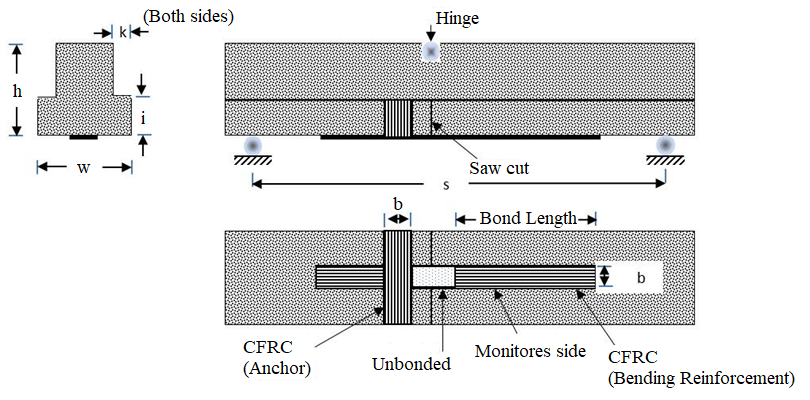
Figure 1
Test specimen showing dimensions of the concrete beam and the position and dimensions of the CFRC bending reinforcing as well as the CFRP anchor. (After De Lorenzis, L. 2001)
(After De Lorenzis, L. 2001)
Considering static equilibrium and compatibility relations of a differential element of sheet of length dx, and assuming a linear elastic behavior of the CFRP sheet and that the stiffness of the concrete is much higher than the stiffness of the composite, that is, negligible strain in the concrete and that the adhesive is subjected to shear forces only, the following differential equation results. At moderate load levels, a linear bond stress-slip behavior can be adopted:
Where s is the slip, τ is the bond stress, x the coordinate along the bonded length of the laminate, t the thickness and E the elastic modulus of the CFRP. At moderate load levels, a linear bond stress-slip behavior can be adopted. A solution of the equation 1 is
Where
The constants C1 and C2 can be determined from the boundary conditions. If the origin of the coordinate x corresponds to the free end of the sheet (x = 0), where no strain exists, and x = l (being l the bonded length) corresponds to the end of the CFRP sheet where the external load is directly applied, the boundary conditions are:
And equations 2a, 2b y 2c become
The slip modulus K can be estimated using a simple shear model as the ratio of the shear modulus of the adhesive and the thickness of the adhesive layer. Also, when CFRP based on sheets instead of plates are used, the slip modulus that is, the ratio of the shear modulus of the FRPC, Gintand the thickness of the interface tint where Gint is the shear modulus of the FRPC sheet-concrete interface and tintis thickness of the interface, can be evaluated as follows: when the composite material is formed in situ, using the wet lay-up technique, the resin system intrinsically serves both as the matrix for the composite and the interlayer between the concrete and the composite, i.e., as the adhesive layer. This layer then is the main medium for the transfer of shear stresses between the composite and the concrete. For the estimation of Gint, the layer of primer must be also considered. Therefore, Gint and tintcan be computed from the thicknesses obtained from scanning electron microscopy and the elastic properties of resin and primer the rule of mixture for the shear modulus:
Where:
Equation 7 can also be used to estimate the shear modulus of the primer. The local τ-slip curves can be obtained from experimental data as follows. The bond stress, τ, can be found by equilibrium of forces, considering also the linear elasticity of the FRPC.
Where εr is the CFRP strain to failure, therefore, the τ(x) diagram can be obtained from the first derivative of the strain vs location diagram multiplied by the elastic modulus E and the thickness.
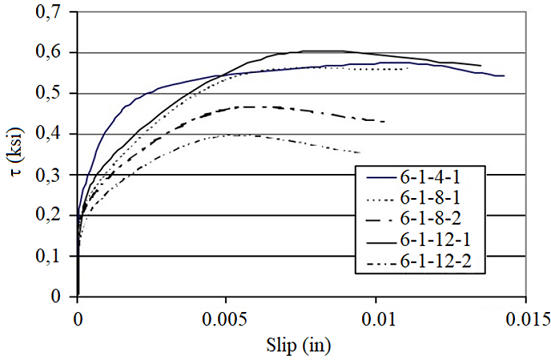
Figure 2
Local τ-slip relationships for specimens with different CFRP bond lengths (4, 8 and 12 in) bonded on the tension side of a concrete beam. Note: 1 in= 25.4 mm; 1 psi= 7.03 kPa
Lorenzis et al (2001)
Figure 2 illustrates some bond stress τ - slip curves obtained from tested specimens at a load level corresponding to imminent peeling. This was identified as the load level at which the strain distribution becomes linear. Typical bond τ–slip curves should consist of an ascending branch with continuous stiffness degradation to the maximum bond stress and a curved descending branch reaching a zero-bond stress at a finite value of slip. While a precise bond–slip model should consist of a curved ascending branch and a curved descending branch, other shapes such as a bilinear model can be used as a good approximation. An accurate bond–slip model should provide close predictions of both the shape and fracture energy (area under the bond–slip curve) of the bond–slip curve. None of the existing bond–slip models provides accurate predictions of both the shape and the interfacial fracture energy as found from tests. The area underneath the τ - slip curve, indicated as Gf, is the fracture energy per unit area of the bonded joint (Lu X.Z. 2005).
In a recent paper, Hamze-Ziabari and Yasalovi, (2017), made a summary of existing equations for the prediction of load transfer between concrete and the effective load transfer length of the CFRP. These equations were derived from either fracture mechanics theoretical considerations or from empirical equations calibrated with experimental datasets or combinations of the two. However, the accuracy of these models seemed to be limited. For the sake of completeness, some of these equations are also reproduced in this review (see table 1):

CFRP strengthening of beams
The observed failure modes of concrete beams reinforced with CFRP sheets have been reported by Teng et al (2001) and further analyzed by Ferreira et al (2018). They reported three typical failure modes: (1) tensile failure of the CFRP when its tensile strength is lower than the applied load; (2) debonding of the reinforcement at the laminate-concrete interphase; and (3) a cohesive failure of the concrete and there is separation of the reinforcement together with a layer of concrete.
The first failure mode is attributed to a brittle mode of failure, but it is evident that the CFRP-concrete bond strength is higher. The second mode of failure is attributed to a lack of anchorage of reinforcement, excessive cracking of the beam or faults in the bonding. Again here, failure of the adhesive bond strength may be cause by normal stresses at the end of the CFRP strip, where a stress singularity is known to exist [Leung, 2001, A.R. Khan et al 2014 and R.A. Hawileh et al 2015].
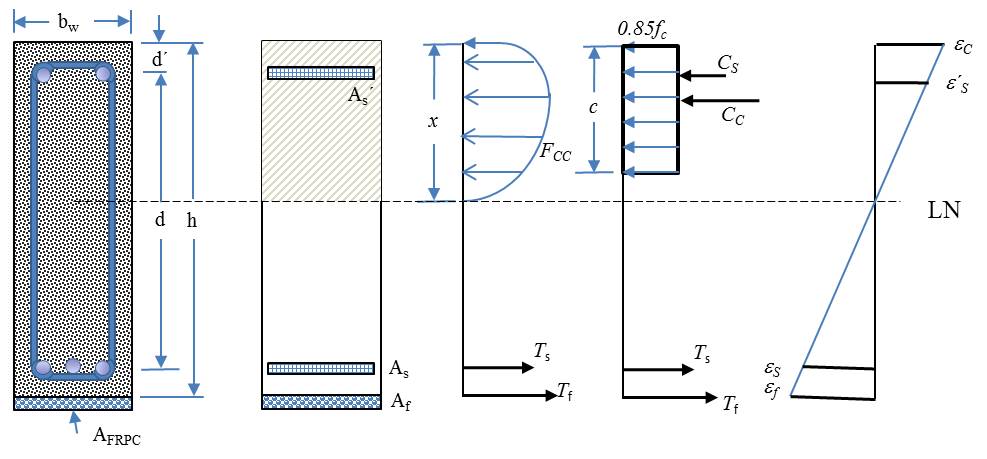
Figure 3
Stress-strain diagram of a steel-reinforced concrete beam strengthened with CFRP
After Ferreira et al 2018
The analysis of the strengthening of a concrete beam with a CFRP layer loaded in bending presented by Ferreira et al (2018) considered that the ratio of the reinforced beam framework is equivalent to the addition on the initial reinforcement ratio with the contribution from the reinforcement (see figure 3).
Where ρ is the ratio of the reinforcement of the beam before strengthening, Af is the area of reinforcement applied to the beam, Efis the modulus of elasticity of the CFRP, Es is the modulus of elasticity of steel, bw and h are the width and height of the beam respectively. The recommendations for the sizing of the CFRP reinforcement according to the American code ACI 440-2R are as follows: The limit value of the fiber strain to be adopted in the sizing and verification of the reinforcement is expressed in terms of the modulus of elasticity of the CFRP, and εfu, the ultimate strain observed in the polymer at the moment of failure and n, the number of layers of CFRP.
The effective strain in the CFRP composite εfe is expressed as a function of the concrete ultimate strain εcu and the strain in the covering of the tensile reinforcement in the beam before the strengthening, εbi and x, the position of the neutral axis.
ffe is the effective strength of the CFRP;
εs' is the strain in the compressed reinforcement and, d’ is the centroid position of the compressed reinforcement.
The strain in the tensile reinforcement, εs, is expressed by:
fs', the strength in the steel of the compressed reinforcement is given as a function of the strain in the compressed reinforcement εs´ and the elastic modulus in the steel;
The strength in the steel of the tensile reinforcement fs is given by
The position of the neutral axis is calculated as follows:
As is the steel area of the tensile reinforcement; As' is the steel area of the compressed reinforcement; β1 is a coefficient that determines the approximation of the resultant compression curve of the concrete to a rectangle, being 0.85 for concrete with fc values lower than 28 MPa, which decreases linearly by 0.05 for each 7 MPa above that limit of tensile strength. The minimum value for such a coefficient, according to ACI 318 (2014), is 0.65.
The conditions at the interface between the composite and concrete require a full understanding from the mechanics point of view. Different epoxy resin formulations or any other adhesive used will result in completely different behavior of the concrete-composite joint. In addition, the geometrical design of the laminate and anchors will also influence the mechanical behavior and consequently, the effectiveness of the reinforcement. Then, as a first step, whenever possible, and depending on the availability of testing equipment, preliminary studies of the adhesion parameters between the composite and concrete are required to determine the lengths of the joints for effective stress transfer needed to achieve the composite's strength capacity.
ENVIRONMENTAL EFFECTS ON THE CFRP-CONCRETE INTERFACE BOND STRENGTH
The interface at the concrete- CFRP has been recognized as the region where the efficiency of the load transfer from the structural element to the CFRP laminate takes place. As stated by Swamy RN et al (1987), the properties of the epoxy adhesive is of paramount importance as they varied considerably with the thickness of the test specimen and the rate of loading. Similarly, the fiber-matrix interphase is regarded as an important region of the composite laminate performance.
This matrix behavior at the concrete-CFRP is of particular interest in advanced composite materials, since its use in structural applications with exposure to the environment, requires that the material meets very strict performance, durability and safety standards. Moisture transport in polymeric systems is related to the availability of "free space" or "free volume" of molecular size in the structure of the polymer, as well as its affinity to water. [M. R. Vanlandingham, et al (1999)]. Such availability of "free spaces" depends on the microstructure, morphology and density of crosslinking, which are functions of the degree of curing, stoichiometry, stiffness of the molecular chains and the cohesive energy density of the polymer. The polymer-water affinity is related to the presence of hydrogen bond sites along the polymer chains that create sites of attractive forces between the water molecules and those of the polymer. Water molecules that are free to move through holes or free volume are known as adsorbed molecules. In the case of the epoxies it is also known that they have a significant free volume, particularly at temperatures 50-150 ° C below the Tg. The epoxy-water affinity is relatively strong because polar hydroxy groups (-OH) are created by the opening of the epoxy group by reaction with primary and secondary amines. Then, in the case of these composites based on carbon fibers and epoxy matrix, those properties that are dominated by the matrix or fiber-matrix interface are degraded by the absorption of moisture while those dominated by fibers are not essentially affected. In particular, the interfacial shear strength, the interlaminar shear strength, and depending on the carbon fiber-epoxy resin laminae stacking sequence in the laminate, the edge effects also become points of possible failure initiation as well as the mode II fracture toughness and the interlaminar toughness. This degradation is attributed to the weakening of the fiber-matrix interphase and to swelling of the matrix and plasticization of the matrix [J. I. Cauich-Cupul, et al (2011) , E. Pérez-Pacheco, et al (2011), S. Wang et al, (2002), L.E. Asp, (1998), M. Todo, et al, (2000), R. Selzer et al, (1995), M. J. Adamson, (1980), D. A. Bond, (2005), M. R. Vanlandingham, et al (1999)]. Moisture absorption can also cause a decrease of the residual stresses produced from the curing thermal gradients and thus, resulting in a decrease of fracture properties. The effects of humidity are considerably aggravated by the temperature and further complicated by the action of mechanical stresses imposed on the material. [J. B. Aguiar, et al (2008)].
Furthermore, these composite materials are exposed to different environmental conditions during their useful life, such as moisture, temperature and ultraviolet radiation and therefore to the possibility of synergistic effects on degradation mechanisms. Hence, there is always a concern for the long-term durability of these materials to be exposed to combined environmental conditions of humidity, temperature and ultraviolet radiation. [Springer, G.S. (ed.) (1984), Ranby, B.and Rabek J. F., (1975)]. Both, ultraviolet radiation and humidity have negative effects mainly on the mechanical properties of the epoxy resin and the fiber-matrix interface and thus affect the integrity of the composite [W. B. Liau, et al, 1998].
The subject of durability of the FRPC strengthening systems, as a whole, has been a major concern in structural rehabilitation applications. Behavior of FRPC strengthened beams subjected to freeze-thaw, wet-dry and temperature cycles or various aqueous solutions prior to loading have been studied by a limited number of researchers (Bank, et al, 1995, Gheorghiu C. et al, 2004, Grace N. F. et al 2005, Wang C. Y , et al, 2004, Xie M., 1995, Katz A., 1999). There has been a fundamental change in the approach to the subject. As opposed to subjecting a specific composite material to an environmental exposure for a specified time period and then performing mechanical tests to obtain “data” for design use, the more recent approach has been to try to develop an integrated chemical and mechanical set of tests that provide an understanding of the mechanisms of degradation within the composite material. These papers combine macromechanical test methods with investigations of changes in material composition together with a scanning electron microscopy to develop models that attempt to explain the change of mechanical properties in terms of the quantitative changes in the chemical nature of the materials and qualitative observation of the degradation phenomenon (Bank and Gentry, 1995).
Buyukozturk O, 1998 and Grace and Singh, 2005, and concluded that the long-term exposure to humidity is the most detrimental factor to the bond strength between CFRP plates and fabrics and RC beams. Beams strengthened with CFRP plates and exposed to 10,000 hours of 100% humidity (at 38 ± 2 °C) experienced an average of 33% reduction in their strength. The onset of delamination was the primary mode of failure for all of the test beams.
The durability of carbon fiber reinforced polymer (CFRP) pretensioned piles driven in tidal waters and an experimental study to assess the likely effect of diurnal/seasonal temperature change on twelve precracked CFRP pretensioned beams designed to fail by rupture of the prestressing rods were kept outdoors in two salt water tanks and simultaneously subjected to wet/dry cycles (simulating tides) and hot/cold cycles (simulating temperature variation), (Aiello, et al, 2001). Durability was assessed from flexure tests conducted periodically over the nearly 3-year exposure period. The results of the tests indicated that durability was largely unaffected, although both bond degradation and reductions in ultimate capacity were observed in some of the exposed specimens. Degradation appeared to be linked to the extent of precracking damage sustained prior to exposure. This suggests that when CFRP pretensioned piles are used, driving stresses should be carefully monitored to minimize damage.
Because of the change in behavior under varying environmental conditions, it can be said that a complete understanding of the effects these materials have on the performance of retrofit systems has not been achieved. In particular, various failure mechanisms that the retrofitted concrete beam can manifest, including the debonding and delamination mechanisms of FRP from the concrete beam, are not well known. More studies are needed to develop a better understanding of the shear capacity of retrofit sections, the effects in the anchorage regions of the FRP laminate, and failure mechanisms of debonding and delamination. Topics of future study should also include effects of material compatibilities and their resistances to degradation through both environmental and load cycles, and the assessment of retrofitted system integrity through the use of nondestructive evaluation [Nakaba 2001].
Strictly speaking, the application of a fiber-reinforced composite laminate layer on the tensile side of the beam, either by bonding a laminate or by forming a composite material in situ, using the epoxy resin and fibers unidirectionally oriented in a textile, a manual lay-up procedure, will result in two interphase, the concrete-resin interphase and the fiber-matrix interphase, as shown in figure 4. Both interphases are susceptible to be affected by exposure to the environment. However, in the technical literature on the subject of RFPC beam retrofitting, there is only reference to the concrete-laminate interphase.
Karbhari and Engineer, 1996, investigated the degradation of the composite-concrete interface after exposure to environmental conditions that include moisture, sea water, freezing and freeze-thaw. In this investigation, the performance of plated beams was considered from aspects related to materials and durability. The effect of five different environmental conditions was studied and they showed that the selection of the appropriate resin system is critical to success and pointed out the dangers of selecting systems with low glass transition temperatures and drastic drops in instantaneous modulus as a function of temperature. Results indicated that degradation occurs primarily at the level of the resin in contact with the concrete, and that due care should be taken of changes in composite stiffness due to moisture exposure and the consequent resin plasticization, as well as due to stiffness increases under cold conditions (Aiello, et al, 2001, Plevris N, 1994, Soudki KA 2000, Wang CY 2004).
J. I. Cauich-Cupul et al, (2011) studied the effect of moisture uptake in the interphase in epoxy-single IM7-carbon fiber composites and showed a detrimental effect on the mechanical properties of the matrix, and this deterioration was attributed to a decrease of its glass transition temperature. Three levels of the IM7 carbon fiber-epoxy interface were studied. The first was the IM7 carbon fiber with the sizing removed, then, the fiber-matrix adhesion level was increased using a silane coupling agent to treat the IM7 fiber surface and third, the IM7 fibers were treated with nitric acid to produce more chemical reaction sites with the silane coupling agent.
The quality of the fiber-matrix interface was assessed using the single fiber fragmentation test and the fiber-fragment length, considered as an indicator of interfacial quality which indicated a continuous deteriorating effect of moisture uptake. That is, a short fiber-fragment length indicated a strong fiber-matrix interphase and a weak (or deteriorated) fiber-matrix interphase was indicated by a long fiber-fragment length (see figure 5). Furthermore, the role of swelling of the matrix because of moisture uptake on the residual stresses is considered to be important when considering the deterioration of interfacial shear properties. The contribution of the radial stresses was seen to decrease rapidly and the mechanical component of the fiber–matrix adhesion also decreased rapidly for higher moisture contents in the matrix and/or interface.
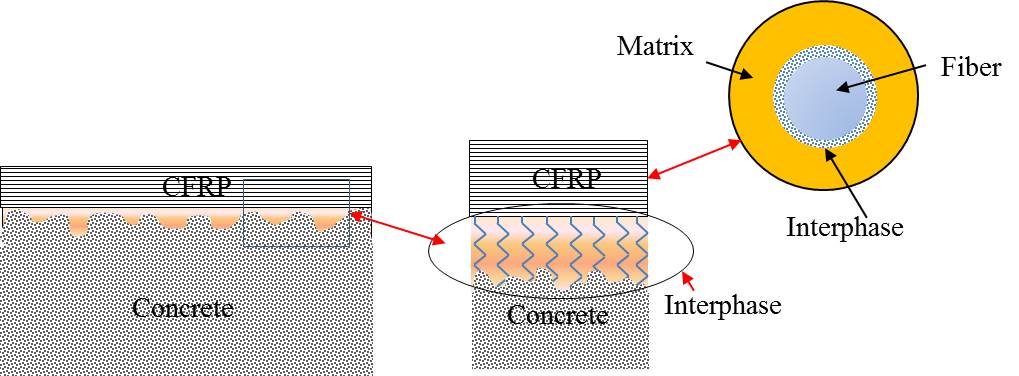
Figure 4
Schematic representation of the formation of dual interphases formed by the use of laminates or fabrics to retrofit steel reinforced concrete beams. One concrete-resin interphase and one fiber-matrix interphase.
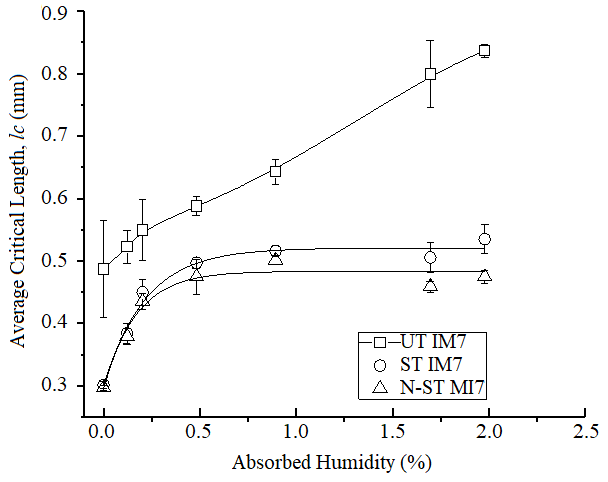
Figure 5
Fiber fragment length a function of matrix-interphase absorbed humidity in the composite, for untreated surface carbon fibers (UT IM7); silane coupling agent treated surface IM7 carbon fibers (ST IM7) and, nitric acid and silane coupling agent treated surface IM7 carbon fibers (N-ST IM7), (J. I. Cauich-Cupul et al, (2011))
Perez-Pacheco, et al (2013) concluded that the microstructure of the interphase played a significant role in the moisture diffusion process in a carbon fiber-epoxy laminate. Figure 6 shows the moisture absorption isotherms for a composite laminate subjected to several relative humidity environments. They also concluded that the effects of absorbed moisture on the interfacial region was detrimental to the interfacial strength between the fiber and the epoxy matrix and thus, to the performance of the composite. The use of 3-glycidoxypropyltrimethoxysilane as a fiber-matrix coupling agent enhanced the fiber-matrix adhesion. The plasticization, swelling stresses and any epoxy degradation because of hydrolysis may have contributed to the matrix failure mechanisms. Plasticization of the epoxy matrix by moisture lead to the change in its glass-transition temperature (Tg) thus affecting the mechanical response of the composite. It was observed that the tensile strength of laminates made with the silane coupling agent showed a decrease but after a moisture uptake of approximately 0.45 %, the tensile strength remained constant. Then, the use of a proper silane coupling agent to enhance adhesion resulted in improved mechanical properties and reduced the dependence of the properties on humidity under tensile loading (see figures 7 and 8).
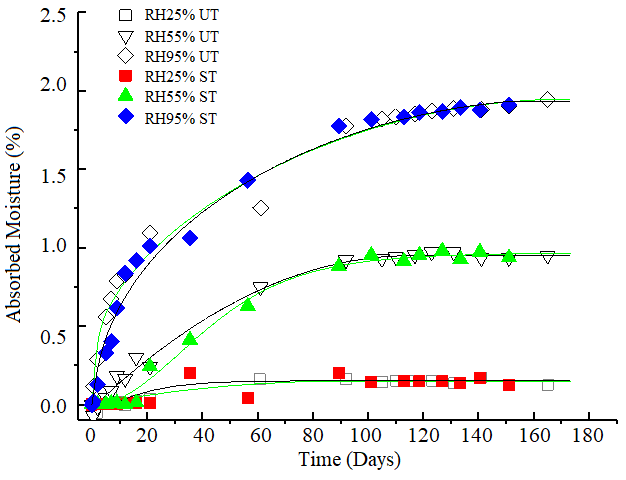
Figure 6
Absorption of moisture in the composite material laminate for different relative humidity environments. Without treatment: (UT) silane surface treatment (ST). RH25% UT, RH55% UT, and RH95% UT, and with silane surface treated fibers RH25% ST, RH55% ST and RH95% ST.
Perez-Pacheco, et al (2013)
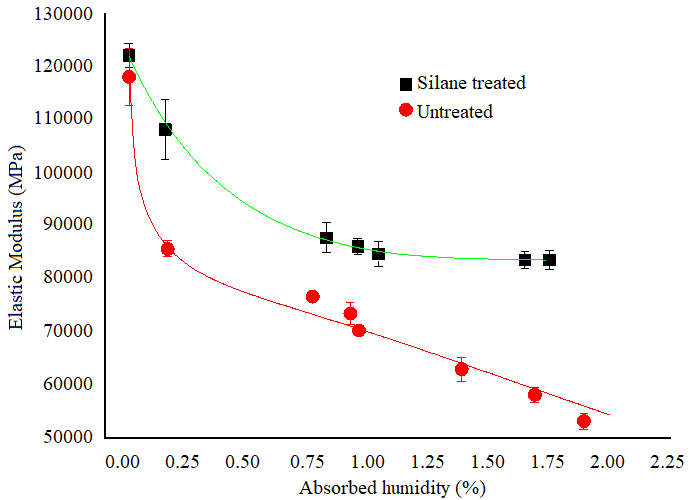
Figure 7
Behavior of the elastic modulus with respect to the moisture absorbed for the composite material with the treated and untreated fiber, respectively.
Perez-Pacheco, et al (2013)
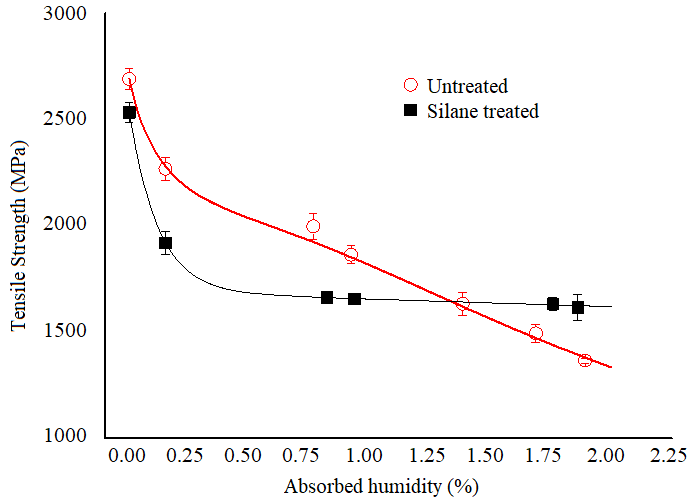
Figure 8
Tensile strength of a CFRP material made on the composite material after suffering hygroscopic degradation, for two different fiber-matrix interface conditions, that is, for treated and untreated fibers, respectively
Perez-Pacheco, et al (2013)
The behavior and potential of combining corrosion protection and FRP patching repair techniques to retrofit corrosion damaged RC beams has been demonstrated by Swamy RN et al, 1999 and Sebastian WM, 2001. They found that this type of arrangement can improve the load carrying capacity of cracked and corroded RC beams and provides the space for coating the corrosion protection materials. They also proposed that the equally spaced U-anchorage strips together with the longitudinal strips form an external reinforcing system for the corroded RC beam constrains the extension of the fiber in the longitudinal direction in the intersection area. Since the strain value is higher at this site, it enables the full usage of the fibrous composite material’s strength. Hence any design that can reduce the stress concentration effect at the intersection area of the longitudinal and U-shaped anchorage strips may help the beam to escape from the premature failure mode of fiber breakage and reach its designed load carrying capacity.
As it can be seen, environmental issues are extremely important when designing a concrete-composite laminate joint for beams retrofitting. All the models described in numeral 2.1 of this paper consider the mechanical properties of the composite laminate, which as seen in figures 7 and 8, decrease as a function of absorbed humidity. Therefore, the composite laminate should be designed with dimensions such as thickness and width, appropriate to the stiffness and strength values, either those properties estimated after being degraded by the absorption of humidity or by including an appropriate safety factor to the composite mechanical properties before exposure to the environment. Another approach would be to provide a protective coating to prevent moisture absorption, especially at the laminate edges.
CONCLUSION
An effective method for strengthening existing concrete beams in bending consists on bonding fiber-reinforced composite laminates on the tension faces of the beams. However, it is often difficult to develop the full composite strength capacity because of premature failure due to delamination and peeling-off of the laminate. Conditions at the interface between the composite and concrete require a full understanding, and preliminary studies of the adhesion parameters between the composite and concrete are required to determine the effective stress transfer lengths needed to achieve the composite's strength capacity. A theoretical analysis for the behavior of such composite-to-concrete bonded joints has also been included in this review. The durability of the composite material-concrete interphase is also very important, especially when the structure is exposed to both thermal and moisture together. In the technical literature, no reference is made to the two interfacial issues, that is, the concrete-polymeric resin interphase and the fiber-matrix interphase in the composite itself. The durability of the composite laminate is shown to be affected by moisture absorption thus resulting in a reduction of both strength and stiffness higher tan 30%.
Supplementary material
Acknowledgements
The authors thank the School of Civil Engineering of Universidad Marista de Mérida for the kind support given to Mr. Poot Cauich and for providing materials for the experimental work.
REFERENCES
Adamson, M. J. (1980), Thermal expansion and swelling of cured epoxy resin used in graphite/epoxy composite materials, Journal of Materials Science, Volume 15, I (7): 1736–1745, DOI: https://doi.org/10.1007/BF00550593
Adhikary, B. B. and Mutsuyoshi, H., (2001). Study on the bond between concrete and externally bonded CFRP sheet, Proceedings of the 5th international symposium on fiber reinforced Concrete structures (FRPCRS-5), Thomas Telford Publishing, 371-378.
Aguiar, J. B., Camoes, A. and Vaz, N. F. (2008), Effect of temperature on RC elements strengthened with CFRP. Materials and Structures 41:1133–1142, DOI: https://doi.org/10.1617/s11527-007-9311-4
Aiello, M. A., Focacci, F., Nanni, A. (2001), Effects of thermal loads on concrete cover of fiber-reinforced polymer reinforced elements: theoretical and experimental analysis. ACI Materials Journal, 98(4):332–339.
Asp, L. E. (1998), The effects of moisture and temperature on the interlaminar delamination toughness of a carbon/epoxy composite. Composites Science and Technology, Vol. 58, (6): 967-977, DOI: https://doi.org/10.1016/S0266-3538(97)00222-4
Bank, L. C., Gentry, T. R., Barkatt, A. (1995), Accelerated test methods to determine the long-term behavior of FRP composite structures: environmental effects. Journal of Reinforced Plastics and Composites, 14(6), 559–587, DOI: https://doi.org/10.1177/073168449501400602
Bizindavyi, L., Neale, K. W. (1999), Transfer lengths and bond strength for composites bonded to concrete. ASCE, Journal of Composites for Construction, 3(4):153–160. DOI: https://doi.org/10.1061/(ASCE)1090-0268(1999)3:4(153)
Bond, D. A. (2005), Moisture Diffusion in a Fiber-reinforced Composite: Part I – Non-Fickian Transport and the Effect of Fiber Spatial Distribution, Journal of Composite Materials, Vol. 39(23): 2113-2141, https://doi.org/10.1177/0021998305052030
Buyukozturk, O., Hearing, B. (1998), Failure behavior of precracked concrete beams retrofitted with FRP. ASCE, Journal of Composites for Construction; 2(3):138–144, DOI: https://doi.org/10.1061/(ASCE)1090-0268(1998)2:3(138)
Buyukozturk, O., Gunes, O., Karaca, E. (2004), Progress on understanding debonding problems in reinforced concrete and steel members strengthened using FRP composites. Construction and Building Materials, 18:9-19, DOI: https://doi.org/10.1016/S0950-0618(03)00094-1
Camli, U. S. and Binici, B. (2007), Strength of carbon fiber reinforced polymers bonded to concrete and masonery. Construction and Building Materials, 21:1431-1446, DOI: https://doi.org/10.1016/j.conbuildmat.2006.07.003
Cauich-Cupul, J. I, Pérez-Pacheco, E., Valadez-González, A., Herrera-Franco, P. J., (2011), Effect of moisture absorption on the micromechanical behavior of carbon fiber/epoxy matrix composites, Journal of Materials Science, 46:6664–6672, DOI: https://doi.org/10.1007/s10853-011-5619-0
Chajes, M. J., Finch, W. W., Januszka, T. F., Thomson, T. A. (1996), Bond and force transfer of composite materials plates bonded to concrete. ACI Structural Journal, 93(2): 208–217.
Chen, F. J., Teng, G, J. (2001), Anchorage strength models for FRP and steel plates bonded to concrete, Journal of Structural Engineering, 127(7): 784-791, DOI: https://doi.org/10.1061/(ASCE)0733-9445(2001)127:7(784)
Cho, J.-R., Park, S. Y., Cho, K., Kim, S. T., Kim, B.-S. (2012) Pull-out test and discrete spring model of fibre-reinforced polymer perfobond rib shear connector, Canadian Journal of Civil Engineering, 39(12): 1311-1320, DOI: https://doi.org/10.1139/cjce-2011-0573
CNR—Italian Research Council, Advisory Committee on Technical Recommendations for Construction (2004), “Guide for the Design and Construction of Externally Bonded FRP Systems for Strengthening Existing Structures. Materials, RC and PC Structures, Masonry Structures
Dai, J. G., Ueda, T. and Sato, Y. (2006), Unified analytical approaches for determining shear bond characteristics of FRP-concrete interfaces through pull-out tests. Journal of Advanced Concrete Technology, 4:133-145, DOI: https://doi.org/10.3151/jact.4.133
De Lorenzis, L., Miller, B., Nanni A. (2001), Bond of fiber-reinforced polymer laminates to concrete. ACI Materials Journal, 98(3): 256-264.
Ferreira, M. P., Oliveira, M. H., Lima Neto, A. F., Tapajós, L. S., Nascimento, A., Freire, M. C. (2018), "Influence of anchorage on flexural strength of beams strengthened with CFRP sheets", Revista ALCONPAT, 9 (1): 30 – 47, DOI: http://dx.doi.org/10.21041/ra.v9i1.269
FIB (2001), Externally bonded FRP reinforcement for RC structures, FIB bulletin 14 Technical Report.
Gheorghiu, C., Labossiere, P., Raiche, A. (2004), Environmental fatigue and static behavior of RC beams strengthened with carbon-fiber reinforced polymer. ASCE, Journal of Composites for Construction, 8(3):211–218, DOI: https://doi.org/10.1061/(ASCE)1090-0268(2004)8:3(211)
Grace, N. F., Sayed, G. A., Soliman, A. K., Saleh, K. R. (1999), Strengthening reinforced concrete beams using fiber reinforced polymer (FRP) laminate. ACI Structural Journal, 96(5):865–874.
Grace N. F., Singh S. B. (2005), Durability evaluation of carbon fiber-reinforced polymer strengthened concrete beams: experimental study and design. ACI Structural Journal, 102(1):40–53.
Hamoush, S. A., Ahmad, S. H. (1990), Static strength tests of steel plate strengthened concrete beams. Materials and Structures; 23:116–125, DOI: https://doi.org/10.1007/BF02472571
Hamze-Ziabari, S. M. and Yasalovi, A. (2017), Predicting bond strength between FRP plates and concrete substrate: Applications of GMDH and MNLR approaches, Journal of Advanced Concrete Technology 15: 644-661, DOI: https://doi.org/10.3151/jact.15.644
Hawileh, R. A., Nawaz, W., Abdalla, J. A., Saqan, E. I. (2015), Effect of flexural CFRP sheets on shear resistance of reinforced concrete beams, Composite Structures 122: 468–476, DOI: https://doi.org/10.1016/j.compstruct.2014.12.010
Japan Concrete Institute JCI. 2003. “Technical report of technical committee on retrofit technology.” Proc., Int. Symp. on the Latest Achievement of Technology and Research on Retrofitting Concrete Structures, Sapporo, Japan
Jeffries, J. M., (2004), Bond behavior of fiber reinforced polymer laminates to concrete subjected to varied surface preparation". Masters Theses. 2498.
Karbhari, V. M., Engineer, M. (1996), Effect of environmental exposure on the external strengthening of concrete with composite–short term bond durability. Journal of Reinforced Plastics and Composites, 15:1194–1216., DOI: https://doi.org/10.1177/073168449601501202
Karbhari, V. M., Shulley, S. B. (1995), Use of composites for rehabilitation of steel structures – determination of bond durability. ASCE, Journal of Materials in Civil Engineering, 7(4):239–245, DOI: https://doi.org/10.1061/(ASCE)0899-1561(1995)7:4(239)
Karbhari, V. M., Zhao, L. (1998), Issues related to composite plating and environmental exposure effects on composite-concrete interface in external strengthening. Composite Structures, 40(3-4):293–304, DOI: https://doi.org/10.1016/S0263-8223(98)00031-2
Katz, A., Berman, N., Bank, L. C. (1999), Effect of high temperatures on bond strength of FRP rebars. ASCE Journal of Composites for Construction, 3(2):73–81, DOI: https://doi.org/10.1061/(ASCE)1090-0268(1999)3:2(73)
Khalifa, A., Gold, W. J., Nanni, A. and Aziz, A. (1998). Contribution of externally bonded FRP to shear capacity of RC members, Journal of Composites and Construction, ASCE, 2(4):195-203, DOI: https://doi.org/10.1061/(ASCE)1090-0268(1998)2:4(195)
Khan, A. R. and Shamsoon, F. (2014), Behaviour of Reinforced Concrete Beams Strengthened by CFRP Wraps with and without End Anchorages, Procedia Engineering 77: 123 – 130, http://doi.org/10.1016/j.proeng.2014.07.011
Leung, C. K. Y. (2001), Delamination failure in concrete beams retrofitted with a bonded plate, Fracture Mechanics of Concrete Structures, ASCE, Journal of Materials in Civil Engineering, Volume 13, Issue 2, DOI: https://doi.org/10.1061/(ASCE)0899-1561(2001)13:2(106)
Liau, W. B., Tseng, F. P. (1998), The effect of long-term ultraviolet light irradiation on polymer matrix composites, Polymer Composites, 19:440-445, DOI: https://doi.org/10.1002/pc.10118
Lim, T.‐Y., Paramasivam, P. and Lee, S.‐L. (1987), Behavior of Reinforced Steel‐Fiber‐Concrete Beams in Flexure. Journal of Structural Engineering; 113-12:2439. http://doi.org/10.1061/(ASCE)0733-9445(1987)113:12(2439)
Lorenzis, L. D., Miller, B., Nanni, A. (2001), Bond of fiber-reinforced polymer laminates to concrete. ACI Materials Journal, 98(3):256–264.
Lu, X. Z., Teng, J. G., Ye, L. P., Jiang, J. J. (2005), Bond–slip models for FRP sheets/plates bonded to concrete, Engineering Structures, 27: 920-937, DOI: https://doi.org/10.1016/j.engstruct.2005.01.014
Lu, X. Z., Ye, L. P., Teng, J. G. and Jiang, J. J. (2005), Meso-scale finite element model for FRP sheets/plates bonded to concrete. Engineering Structures, 27(4): 564-575, DOI: https://doi.org/10.1016/j.engstruct.2004.11.015
Maeda, T., Asano, Y., Sato, Y., Ueda, T. and Kakuta, Y. (1997). A study on bond mechanism of crbon fiber sheet, in Proceedings of 3rd international symposium on nonmetallic (FRP) reinforcement for concrete structures, Sapporo, Japan Concrete Institute, 1:279-285
Mander, J. B., Priestley, M. J. N., Park, R. (1998), Theoretical stress–strain model for confined concrete. ASCE, Journal of Structural Engineering, 114(8):1804–1826, DOI: https://doi.org/10.1061/(ASCE)0733-9445(1988)114:8(1804)
Nakaba, K., Kanakubo, T., Furuta, T., Yoshizawa, H. (2001), Bond behavior between fiber reinforced polymer laminates and concrete. ACI Structural Journal, 98(3):359–367.
Neubauer, U. and Rostasy, F. S. (1997), Design aspects of concrete structures strengthened with externally bonded CFRP plates. Proceedings of seventh international conference on structural faults and repairs, Edinburgh, ECS Publications, 1:109-118.
Norris, T., Saadatmanesh, H., Ehsani, M. R. (1997), Shear and flexural strengthening of R/C beams with carbon fiber sheets. ASCE, Journal of Structural Engineering, 23(7):903–911, DOI: https://doi.org/10.1061/(ASCE)0733-9445(1997)123:7(903)
Pendhari, S. S., Kant, T., Desai, Y. M. (2008), Application of polymer composites in civil construction: A general review. Composite Structures 84:114–124, DOI: https://doi.org/10.1016/j.compstruct.2007.06.007
Pérez-Pacheco, E., Cauich-Cupul, J. I., Valadez-González, A., Herrera-Franco, P. J. (2013), Effect of moisture absorption on the mechanical behavior of carbon fiber/epoxy matrix composites, Journal of Materials Science, 48:1873–1882, DOI: https://doi.org/10.1007/s10853-012-6947-4
Pérez-Pacheco, E., Moreno-Chulim, M. V., Valadez-González, A., Rios-Soberanis, C. R. and Herrera-Franco, P. J., (2011), Effect of the interphase microstructure on the behavior of carbon fiber/epoxy resin model composite in a thermal environment, Journal of Materials Science, 46:4026–4033, DOI: https://doi.org/10.1007/s10853-011-5331-0
Plevris, N., Triantafillou, T. C., (1994), Time-dependent behavior of RC members strengthened with FRP laminates. ASCE, Journal of Structural Engineering, 120(3):1016–1042, DOI: https://doi.org/10.1061/(ASCE)0733-9445(1994)120:3(1016)
Selzer, R. and Friedrich, K. (1995), Infuence of water up-take on interlaminar fracture properties of carbon fibre-reinforced polymer composites. Journal of Materials Science, Vol. 30, No. 2, 334, DOI: https://doi.org/10.1007/BF00354392
Saadatmanesh, H., Tannous, F. E. (1999). Long term behavior of aramid fiber reinforced plastic (AFRP) tendons. ACI Materials Journal, 96(3):297–305.
Sebastian, W. M. (2001), Significance of midspan debonding failure in FRP-plated concrete beams. ASCE, Journal of Structural Engineering, 127(7):792–798, DOI: https://doi.org/10.1061/(ASCE)0733-9445(2001)127:7(792)
Springer, G. S. (1984), Environmental Effects on Composite Materials, Vol. 1, Lancaster, Pennsylvania: Technomic Publishing Company, Inc.
Swamy, R. N., Jones, R., Bloxham, J. W. (1987), Structural behaviour of reinforced concrete beams strengthened by epoxy-bonded steel plates. Structural Engineer, 65(2):59–68.
Swamy, R. N., Mukhopadhyaya, P. (1999), Debonding of carbon-fibre-reinforced polymer plate from concrete beams. Proceedings of the Institution of Civil Engineers - Structures and Buildings, 134:301–317, DOI: https://doi.org/10.1680/istbu.1999.31897
Täljsten, B. (1997), Defining anchor lengths of steel and CFRP plates bonded to concrete. International Journal of Adhesion and Adhesives, 17(4):319–327, DOI: https://doi.org/10.1016/S0143-7496(97)00018-3
Tanaka, T., (1996), Shear resisting mechanism of reinforced concrete beams with CFS as shear reinforcement, Thesis (PhD). Hokkaido University.
Todo, M., Nakamura, T. and Takahashi, K. (2000), Effects of moisture absorption on the dynamic interlaminar fracture toughness of carbon/epoxy composites. Journal of Composite Materials, 34(8): 630–648, DOI: https://doi.org/10.1177/002199830003400801
Van Gemert, D. (1980), Force transfer in epoxy-bonded steel-concrete joints, International Journal of Adhesion and Adhesives, 1, 67-72(1. 996), DOI: https://doi.org/10.1016/0143-7496(80)90060-3
Vanlandingham, M. R., Eduljee, R. F., Gillespie Jr., J. W. (1999), Moisture Diffusion in Epoxy Systems, Journal of Applied Polymer Science, Vol. 71, 787-798, DOI: https://doi.org/10.1002/(SICI)1097-4628(19990131)71:5<787::AID-APP12>3.0.CO;2-A
Vanlandingham, M. R., Eduljee, R. F., Gillespie, J. W. Jr., (1999), Relationships between Stoichiometry, Microstructure, and Properties for Amine-Cured Epoxies, Journal of Applied Polymer Science; 71: 699–712, DOI: https://doi.org/10.1002/(SICI)1097-4628(19990131)71:5<699::AID-APP4>3.0.CO;2-D
Wang, C. Y., Shih, C. C., Hong, S. C., Hwang, W. C. (2004), Rehabilitation of cracked and corroded reinforced concrete beams with fiber-reinforced plastic patches. ASCE, Journal of Composites for Construction, 8(3):219–28, DOI: https://doi.org/10.1061/(ASCE)1090-0268(2004)8:3(219)
Wang, S. and Chung, D. D. L. (2002), Effect of moisture on the interlaminar interface of a carbon fiber polymer-matrix composites, studied by contact electrical resistivity measurement, Composite Interfaces, Vol. 9, No. 5: 453-458, DOI: https://doi.org/10.1163/15685540260256546
Xie, M., Hoa, S. V., Xiao, X. R. (1995), Bonding steel reinforced concrete with composites. Journal of Reinforced Plastics and Composites, 14:949–63, DOI: https://doi.org/10.1177/073168449501400903
Yuan, H., Wu, Z. and Yoshizawa, H. (2001), Theoretical Solutions on Interfacial Stress Transfer of Externally Bonded Steel/Composite Laminates. Doboku Gakkai Ronbunshu, J. Struct. Mech. Earthquake Eng., JSCE, 18 (675): 1-55, DOI: https://doi.org/10.2208/jscej.2001.675_27
Additional information
Cite as: Poot Cauich,
P. J., Martínez-Molina, R., Gamboa Marrufo, J. L., Herrera Franco, P. J. (2019), "Adhesion, strengthening and durability
issues in the retrofitting of Reinforced Concrete (RC) beams using Carbon Fiber
Reinforced Polymer (CFRP) – A Review", Revista
ALCONPAT, 9 (2), pp. 130 – 150, DOI: http://dx.doi.org/10.21041/ra.v9i2.401
Legal Information: Revista ALCONPAT is a quarterly publication by the Asociación Latinoamericana de Control de Calidad,
Patología y Recuperación de la Construcción, Internacional, A.C., Km. 6 antigua
carretera a Progreso, Mérida, Yucatán, 97310, Tel.5219997385893, alconpat.int@gmail.com, Website:
www.alconpat.org
Responsible editor: Pedro
Castro Borges, Ph.D. Reservation of rights for exclusive use
No.04-2013-011717330300-203, and ISSN 2007-6835, both granted by the Instituto
Nacional de Derecho de Autor. Responsible for the last update of this issue,
Informatics Unit ALCONPAT, Elizabeth Sabido Maldonado, Km. 6, antigua carretera a Progreso, Mérida, Yucatán, C.P. 97310.
The views of the authors do
not necessarily reflect the position of the editor.
The total or partial
reproduction of the contents and images of the publication is strictly
prohibited without the previous authorization of ALCONPAT Internacional
A.C.
Any dispute, including the
replies of the authors, will be published in the first issue of 2020 provided
that the information is received before the closing of the third issue of 2019.