Grain-size mineral analysis of verdete rock coarse and fine aggregates and adjustment to two granulometric distribution models
Grain-size mineral analysis of verdete rock coarse and fine aggregates and adjustment to two granulometric distribution models
Eclética Química, vol. 45, núm. 1, pp. 56-64, 2020
Universidade Estadual Paulista Júlio de Mesquita Filho
Recepción: 21 Julio 2019
Aprobación: 17 Septiembre 2019
Publicación: 01 Enero 2020
Abstract: The supremacy of the mineral industry added to the necessity to supply the world market demand justifies the continuous research efforts for optimizing of the activities of mineral resource utilization. In an approach of mineral characterization, a grain-size analysis study of coarse and fine aggregates of verdete rock was presented in this work. The particle size distribution (PSD) of two samples of aggregates with granulometry < 2.36 mm was experimentally obtained using sieving techniques and adjustment to Rosin-Rammler-Bennet (RRB) and Gates-Gaudin-Schuhmann (GGS) granulometric distribution models. Both RRB and GGS models regressed well to the experimental data, presenting correlation coefficient values were extremely close between them approximately 0.99. The PSD results indicated that 65.97% dry aggregates and 67.68% wet aggregates had a particle size with mean diameter > 0.0050 mm; a similar behavior of the grain-size distributions presented by dry and wet aggregates; and a tiny presence of fine particles natural in the analyzed ore sample. The results suggested the suitability of the methodology to predict the grain-size performance the verdete ore beyond to show itself as a contribution to the enriching of the mineral characterization of the studied rock, as a potassium potential source for the mineral processing Brazilian industry.
Keywords: verdete rock, grain-size analysi, particle size distribution, Rosin-Rammler-Bennet model, Gates-Gaudin-Schuhmann model.
1. Introduction
Technological advancements in mineral processing operations suggest that continuous research efforts are required to minimize energy consumption, optimize resource utilization, and acquire products with the desired size distribution. Size reduction is probably one of the most fundamental and energy-intensive operations in the mineral processing industry, consuming up until 4% of the electrical energy generated worldwide. Comminution operations and grinding fineness determination are important processes employed to fracture coarse mineral aggregates and liberate value-added materials. Estimations on energy consumption in mining operations in the USA indicate that 39% is used for beneficiation and processing operations, 75% of which is consumed in comminution1-3.
Grain size may be considered a fundamental physical characteristic property of earth materials, being relevant to their classification and geological origin, as well as for its applications in geotechnics, agricultural engineering, and industrial technology. Moreover, particle size distribution (PSD) influences various activities of resource and energy utilization, and industrial processes, such as the granular materials flow characteristics, flotation and leaching processes, compacting and sintering processes of metallurgical powders, coal combustion process, settling time of cements, among others processes. Particle size can be determined using several techniques, between them sieving, sedimentation, electrozone sensing, microscopy techniques, X-ray attenuation, and laser diffraction4.
Several models and expressions have been developed to describe the PSD of particulate materials3. These models ranging from the normal and log-normal distributions to the Rosin-Rammler-Bennet (RRB) and Gates-Gaudin-Schuhmann (GGS) models. RRB equation is probably the most well-known distribution in the chemical industries, widely used to analyze all types of materials and GGS equation is another uncomplicated popular model used in the metallic ferrous mining industry5. RRB and GGS mathematical models have been widely applied to describe the size distribution of several particles types, such as maize grains2; fenugreek seed5; sorghum bagasse6; copper tailing7; babassu, canola, castor seed and sunflower residual cakes8; particle assemblages9, and several ores, such as quartz and marble3; iron10; uranium11; phosphate12; apatite13; chromite14; among others. Other numerous granulometric distribution models have also been proposed for greater accuracy in estimating the PSDs, but they have limit applications due to their greater mathematical complexity1.
In Brazil, one of the most abundant potassium silicates is regionally known as verdete, a metasedimentary rock formed during the Neoproterozoic era. Verdete is a greenish and banded rock, which has fine granulometry and clay matrix, and it is composed essentially by glauconite, quartz, and kaolinite minerals and potassium feldspars15. According to Santos et al.16, the rock occurs in Serra da Saudade, Alto Paranaíba Region (MG), geologically located in the San Francisco Craton. The municipality of Cedro do Abaeté is known to have reasonable reserves of verdete (57.4 million tons)17. Potassium oxide (K2O) high contents in the verdete rock were reported in the literature15,18-20. According to Silva and Lana21, the Cedro do Abaeté’s verdete may contain until 14% of K2O.
According to the journal Brasil Mineral22, the first mineral project of an industrial processing plant of verdete rock recently was inaugurated in Dores do Indaiá, Minas Gerais State, Brazil. Pioneer in the processing of this potassium rock, the complex of the Kalium Mineração S.A. disposes of a glauconite deposit located in the municipalities of Serra da Saudade and Quartel Geral in Minas Gerais, with total reserves of 218 million tons of ore and an average content of 10.6% K2O. The mining process certified by Intertek predicts an innovative treatment through processing techniques of crushing/grinding; acid cure; aqueous lixiviation; liquid-solid separation; crystallization; thermic decomposition; and sulfuric acid regeneration. The company mining intended the verdete rock use for the potassium salts production, whose processed products may be applicated as potassium fertilizers, for example, seeking to supply part of great demand of the potassium national market23.
However, a few previous scientific studies worked with the verdete rock until recently. So far, stand out researches involving chemical, stratigraphic, petrographic and mineralogical characterizations were performed15,19,24,25, besides other technological studies based on thermal treatment focusing on its reactivity increase20,26 and its metal availability21,27-31. No meaningful previous contributions were found that consistently explored the particle size distribution of verdete rock through grain-size analysis and adjustment to RRB and GGS mathematical models.
In this context, based on the relevance of continuous research efforts in mineral processing studies, as well as on the lack of consistent scientific contributions regarding particle size distribution of the verdete rock through the grain-size property, the present article delineates a new study of grain-size of verdete coarse and fine aggregates. For that, this work strives to describe the particle size distribution of such aggregates using sieving techniques and adjustment to Rosin-Rammler-Bennet (RRB) and Gates-Gaudin-Schuhmann (GGS) granulometric distribution models, with the purpose of providing subsidies to a verdete rock characterization as potassium potential source for the mineral processing Brazilian industry.
2. Experimental
Grain-size analysis of verdete rock was realized at environmental conditions at room temperature (298.15 K) under atmospheric pressure (101,325 Pa). Initially, a representative sample of 20 kg of verdete rock from Cedro do Abaeté in Minas Gerais was properly homogenized and ground in a ball mill (Sew-Eurodrive, model FA37B DRE80S4). The grinding product was passed through a 2.36 mm sieve (8 mesh), getting a sample with granulometry < 2.36 mm. Approximately 2.0 kg of verdete rock were weighed on a balance (Urano, model UDC POP). The sample was subjected to the quartering method of size reduction for homogeneous sampling using a Jones riffle splitter (Gilson Company, model SP-173). In the first step, the quartering method divided the sample into two lots of aggregates of 1.0 kg each. Then, one of the lots was subjected again to riffle splitter for apportioning in two lots of 500 g, and so on; quartering was continued until the obtention of two samples of 250.0 g each (A and B).
Sample A (verdete rock dry aggregates) was directly forwarded grain-size analysis. Sample B (verdete rock wet aggregates) was previously washed before of the granulometric test with deionized water obtained from the purifier Gehaka and dried in a kiln (Infinit, model EMT-200) at 373.15 K by approximately 2 h. The washing procedure exclusively intended to remove possible fine particles natural from the ore. The grain-size analysis consisted of one series montage of granulometric sieves and consecutive vibrating sifting of the sample by 10 min under a frequency of 10 Hz. For that, it was used one kit of seven sieves of Tyler standard screen scale of 4, 8, 28, 35, 48, 100, and 200 mesh (Solotest, model 8X2) and a vibrating sieve shaker (Solotest, model 8X2). Posteriorly, the retained aggregates mass fractions on each sieve were weighed on an analytical balance (Shimadzu, model AW220). Tables 1 and 2 present the grain-size analysis experimental data of dry and wet aggregates of verdete rock.
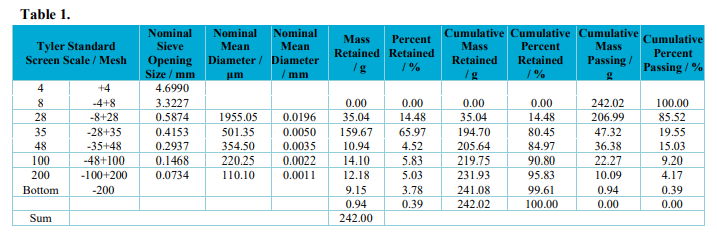

Size parameters – number of particles (N, Eq. 1); arithmetic mean diameter (DA, Eq. 2); volumetric mean diameter (DV, Eq. 3); surface mean diameter (DS, Eq. 4); Sauter mean diameter (DSauter, Eq. 5) – and surface parameters – external surface (S, Eq. 6) and specific surface (S/M, Eq. 7) – of the dry and wet aggregates of verdete rock were measured from experimentally obtained data and presented in Table 3.
 (1)
(1)where: N = Number of particles (units); M =Total retained mass in the grain-size analysis (g); b = factor assuming cubic format particle = 1; ρ = verdete rock density = 2.376 x 10⁻³ g mm-3; xi = retained weight fraction of a group of particles in the grain-size analysis; Di = nominal mean diameter of that group (mm).
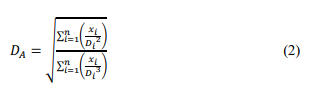 (2)
(2)where: DA = Arithmetic mean diameter (mm); xi = retained weight fraction of a group of particles in the grain-size analysis; Di = nominal mean diameter of that group (mm).
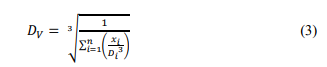 (3)
(3)where: DV = Volumetric mean diameter (mm); xi = retained weight fraction of a group of particles in the grain-size analysis; Di = nominal mean diameter of that group (mm).
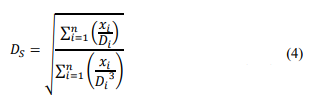 (4)
(4)where: DS = Surface mean diameter (mm); xi = retained weight fraction of a group of particles in the grain-size analysis; Di = nominal mean diameter of that group (mm).
 (5)
(5)where: DSauter = Sauter mean diameter (mm); xi = retained weight fraction of a group of particles in the grain-size analysis; Di = nominal mean diameter of that group (mm).
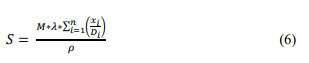 (6)
(6)where: S = External surface (cm2); M = Total retained mass in the grain-size analysis (g); λ = factor assuming cubic format particle = 6; xi = retained weight fraction of a group of particles in the grain-size analysis; Di = nominal mean diameter of that group (cm); ρ = verdete rock density = 2.376 g cm-3.
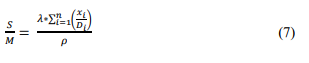 (7)
(7)where: S/M = Specific surface (cm2 g-1); M = Sum retained mass of sieves 28 to 200 mesh (g) λ = factor assuming cubic format particle = 6; xi = retained weight fraction of a group of particles in the grain-size analysis; Di = nominal mean diameter of that group (cm); ρ = verdete rock density = 2.376 g cm-3.

3. Results and Discussion
Particle size distribution study of verdete rock dry and wet aggregates was developed from the mass values of the different particle size obtained in the sieving operations converted to the cumulative and percent mass fractions. Figure 1 shows the granulometric curves of dry and wet aggregates. By assessing the retained fractions percent values against the sieve sizes, it was observed an increase in percentage weight retained of the 28 mesh sieve (0.5874 mm) for 35 mesh sieve (0.4153 mm) and a retained weight meaningful decrease starting of sieve 35, as a response to the decrease of opening size. So that 65.97% of dry aggregates and 67.68% of wet aggregates were retained on 35 size sieve, suggesting a particle size with 0.0050 < mean diameter < 0.0196 mm.
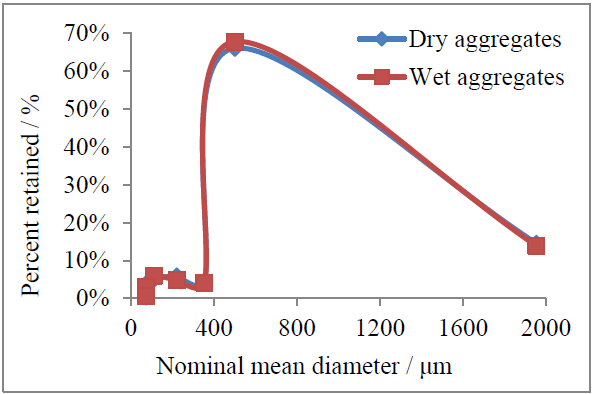
Figure 1.
Granulometric curves of verdete rock dry and wet aggregates.
Figure 2 illustrates the grain-size distribution curves of verdete coarse aggregates and Fig. 3 the grain-size distribution curves of verdete fine aggregates. The evolution of the PSD regarding the nominal sieves opening size revealed a distribution with a profile characterized by a decrease of cumulative percent retained in case of the coarse aggregates and an increase of cumulative percent passing of the fine aggregates along of the sieving operations, as expected. The sieving experiments conducted with the wet aggregates (sample B) was previously washed and posteriorly dried intending to remove possible fine particles natural from the ore. It is relevant to emphasize that these particles cannot be confused with fine aggregates with potassium appreciable contents generated by ore fragmentation processes. As could be seen in Figs. 1, 2 and 3, the granulometric curves of dry and wet aggregates exhibited extremely similar profiles suggesting the hypothesis that the verdete ore mother-sample had not an appreciable amount of natural fine particles sufficient to create a significant differentiation between the granulometric distribution of the A and B samples.
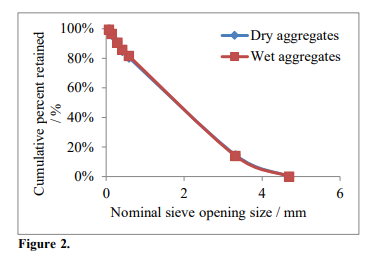
Figure 2.
Grain-size distribution curve of verdete dry and wet coarse aggregates.
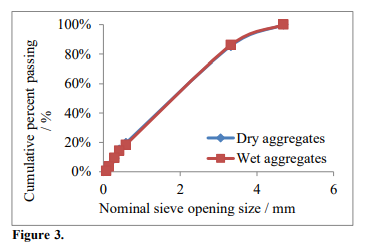
Figure 3.
Grain-size distribution curve of verdete dry and wet fine aggregates.
Table 3 lists size and surface parameters of verdete rock's aggregates calculated as defined in equations earlier (Eqs. 1-7) after grain-size analysis via sieve classification. Obtained results for particles number, external and specific surfaces, and mean-diameters showed two particle-populations, the first one composed by dry aggregates and the second population by wet aggregates, with parameters values very similar. Arithmetic, surface, and volumetric mean-diameters obtained values corroborated a particle mean diameter > 0.0050 mm, as foreseen by granulometric curves results. Sauter mean diameter obtained values expressed a larger mean diameter of the dry particulate matter as compared to the wet particulate matter by taking into account the volume-to-surface area ratio.
Grain-size analysis adjustment of verdete rock aggregates was provided by granulometric distribution models of the Rosin-Rammler-Bennet (RRB) and Gates-Gaudin-Schuhmann (GGS), whose nonlinear and linearized equations were presented in Eqs. 8, 9, 10, and 11, respectively. Table 4 summarizes intrinsic parameters and nonlinear and linear equations of the RRB and GGS models determined from the obtained experimental data and Fig. 4 shows the granulometric distribution curves and the linearized curves of the RRB and GGS models for verdete rock dry and wet aggregates.
 (8)
(8)
 (9)
(9)where: Xi = passing weight fraction of a group of particles in the grain-size analysis; Di = nominal mean diameter of that group (μm); n = uniformity coefficient that stands for the width of PSD; D' = characteristic particle diameter (reflecting the particle size of most particles).
 (10)
(10)
 (11)
(11)where: Xi = passing weight fraction of a group of particles in the grain-size analysis; Di = nominal mean diameter of that group (μm); k = maximum particle diameter of the distribution (size modulus) that locates the distribution in overall size spectrum (μm); m = distribution modulus, that measure the broadness of the size distribution.
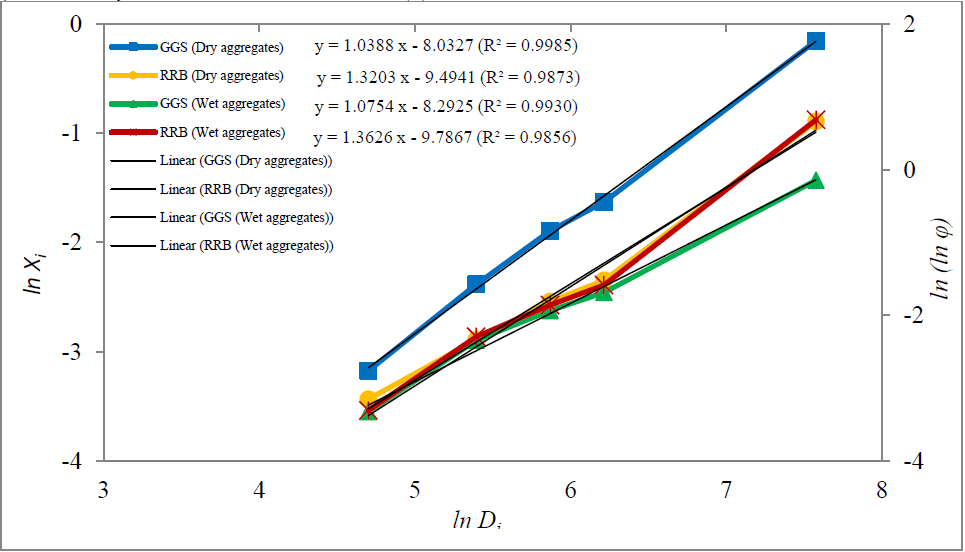
Figure 4.
Linearized curves of the Rosin-Rammler-Bennet (RRB) and Gates-Gaudin-Schuhmann (GGS) mathematical models for verdete rock dry and wet aggregates.
Both RRB and GGS granulometric distribution models regressed well to the experimental PSD data, as can be seen in Table 4. The models accuracy was assessed using the correlation coefficient (R2). The found R2 values were extremely close between them, all circa 0.99, suggesting good quality experimental data. It can be asserted, even if in a tenuous way, that the higher R2 values of GGS model (nearest 1 unit) suggest a slightly more suitable distribution of Gates-Gaudin-Schuhmann model, as compared to Rosin-Rammler-Bennet model, to represent PSD of verdete rock dry and wet aggregates.
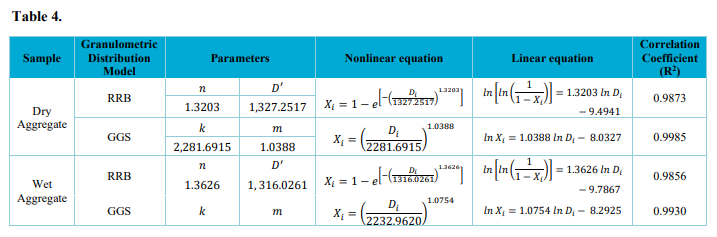
According to Liu et al.32, D' and n parameters of RRB distribution model play a dominant role in the determination of the distribution characteristics, in other words, the PSD of any particle system described by using this model can be distinguished with values of D' and n. Lower values of m parameter of GGS distribution model suggest that more fine aggregates, more large particles (coarse aggregates) and fewer particles in the middle range will be produced33. Comparing the RRB and GGS models parameters obtained for dry and wet aggregates, it was observed a good convergence between the found values, corroborating the hypothesis that the ore mother-sample did not have an amount of fine particles sufficient to create appreciable differentiation between the A and B samples, as foreseen in results obtained by granulometric curves and size and surface parameters.
Due to the lack of studies in the literature dedicated to the description of the particle size distribution of the verdete rock aggregates and its modeling through RRB and GGS models, the work presented here suggests the suitability of the methodology proposed by means of sieving techniques for predicting the grain-size performance the verdete rock beyond enriching its mineral characterization. The developed study could be optimized and enlarged in the purpose to corroborate the described forecasts and to increase of the results representativeness. In this sense, it is recommended to use the method described with other verdete ore granulometry and coming of other mineral reserves, as well as to realize the sieving experiments in triplicate.
4. Conclusions
A grain-size analysis study of verdete rock and adjustments to the Rosin-Rammler-Bennet (RRB) and Gates-Gaudin-Schuhmann (GGS) granulometric distribution models were satisfactorily developed through sieving techniques with sieves of Tyler standard screen scale of 4, 8, 28, 35, 48, 100, and 200 mesh. Both RRB and GGS granulometric models regressed well to the experimental particle size distribution data, presenting correlation coefficient values were extremely close between them approximately 0.99. The PSD results suggested that: 65.97% dry aggregates and 67.68% wet aggregates had a particle size with mean diameter > 0.0050 mm; an extremely similar behavior of the grain-size distributions presented by samples of ore dry and wet aggregates; and a tiny presence of fine particles natural from the analyzed ore sample. The results suggested the suitability of the methodology proposed by work to predict the grain-size performance the verdete ore beyond to show itself as a contribution to the enriching of the mineral characterization of the studied rock, as a potassium potential source for the mineral processing Brazilian industry.
5. References
[1] Ahmed, M. M., A contribution to new measure for evaluation of a particle size distribution, Mineral Processing and Extractive Metallurgy: Transactions of the Institution of Mining and Metallurgy: Section C 116 (4) (2007) 221-230. http://doi.org/10.1179/174328507X198726.
[2] Bolaji, O. T., Awonorin, S. O., Sanni, L. O., Shittu, T. A., Adewumi, J. K., Modeling of particle size distribution and energy consumption of wet milled maize at varying soaking period and method in the production of Ogi, Particulate Science and Technology 37 (1) (2017) 94-102. https://doi.org/10.1080/02726351.2017.1343882.
[3] Petrakis, E., Stamboliadis, E., Komnitsas, K., Evaluation of the relationship between energy input and particle size distribution in comminution with the use of piecewise regression analysis, Particulate Science and Technology 35 (4) (2016) 479-489. https://doi.org/10.1080/02726351.2016.1168894.
[4] Kimura, S., Ito, T., Minagawa, H., Grain-size analysis of fine and coarse non-plastic grains: comparison of different analysis methods, Granular Matter 20 (3) (2018) 1-15. https://doi.org/10.1007/s10035-018-0820-3.
[5] Savitha, HG., Manohar, B., Studies on grinding and extraction of oil from fenugreek (Trigonella foenum-graecum) seed, International Journal of Food Engineering 11 (2) (2015) 275-283. https://doi.org/10.1515/ijfe-2014-0262.
[6] Miranda, M. R., Cardoso, C. R., Ataíde, C. H., Physical and chemical characterization of sorghum bagasse, Materials Science Forum 727-728 (2012) 1683-1688. https://doi.org/10.4028/www.scientific.net/MSF.727-728.1683.
[7] Liu, S., Li, Q., Song, J., Study on the grinding kinetics of copper tailing powder, Powder Technology 330 (2018) 105-113. https://doi.org/10.1016/j.powtec.2018.02.025.
[8] Castro, A. M., Castilho, L. R., Freire, D. M. G., Characterization of babassu, canola, castor seed and sunflower residual cakes for use as raw materials for fermentation processes, Industrial Crops and Products 83 (2016) 140-148. https://doi.org/10.1016/j.indcrop.2015.12.050.
[9] Cho, J., Sohn, H. Y., Effects of particle shape and size distribution on the overall fluid-solid reaction rates of particle assemblages, The Canadian Journal of Chemical Engineering 94 (8) (2016) 1516-1523. https://doi.org/10.1002/cjce.22533.
[10] Singh, M., Kumar, S., Kumar, S., Nandan, G., Gupta, M., Characterization of iron-ore suspension at in-situ conditions, Materials today: proceedings 5 (9) (2018) 17845-17851. https://doi.org/10.1016/j.matpr.2018.06.110.
[11] Kacham, A. R., Suri, A. K., Application of a topochemical reaction model to predict leaching behavior of high carbonate uranium ores in alkaline solutions: an experimental case study, Hydrometallurgy 141 (2014) 67-75. https://doi.org/10.1016/j.hydromet.2013.10.005.
[12] Xiong, Y., Wu, B., Zhu, J., Fan, X., Cai, P., Wen, J., Liu, X., Preparation of magnesium hydroxide from leachate of dolomitic phosphate ore with dilute waste acid from titanium dioxide production, Hydrometallurgy 142 (2014) 137-144. https://doi.org/10.1016/j.hydromet.2013.11.013.
[13] Santana, R. C., Ribeiro, J. A., Santos, M. A., Reis, A. S., Ataíde, C. H., Barrozo, M. A. S., Flotation of fine apatitic ore using microbubbles, Separation and Purification Technology 98 (2012) 402-409. https://doi.org/10.1016/j.seppur.2012.06.014.
[14] Taşdemir, A., Taşdemir, T., Comparative study on PSD models for chromite ores comminuted by different devices. Particle and Particle Systems Characterization 26 (1-2) (2009) 69-79. https://doi.org/10.1002/ppsc.200800035.
[15] Piza, P. A. T., Bertolino, L. C., Silva, A. A. D., Sampaio, J. A., Luz, A. B., Verdete da região de Cedro de Abaeté (MG) como fonte alternativa para potássio, Geociências 30 (3) (2011) 345-356. https://www.periodicos.rc.biblioteca.unesp.br/index.php/geociencias/article/view/5551.
[16] Santos, W. O., Mattiello, E. M., Costa, L. M., Abrahão, W. A. P., Characterization of verdete rock as a potential source of potassium, Revista Ceres 62 (4) (2015) 392-400. https://doi.org/10.1590/0034-737X201562040009.
[17] Santos, W. O., Mattiello, E. M., Vergutz, L., Costa, R. F., Production and evaluation of potassium fertilizers from silicate rock, Journal of Plant Nutrition and Soil Science 179 (4) (2016) 547-556. https://doi.org/10.1002/jpln.201500484.
[18] Guimarães, D., Geologia do Brasil, Departamento Nacional da Produção Mineral, Rio de Janeiro, 1964.
[19] Moreira, D. S., Uhlein, A., Fernandes, M. L. S., Mizusaki, A. M., Galéry, R., Delbem, I. D., Estratigrafia, petrografia e mineralização de potássio em siltitos verdes do grupo Bambuí na região de São Gotardo, Minas Gerais, Geociências 35 (2) (2016) 157-171. http://www.ppegeo.igc.usp.br/index.php/GEOSP/article/view/9016/8281.
[20] Silva, A. A. S., Medeiros, M. E., Sampaio, J. A., Garrido, F. M. S., Verdete de Cedro do Abaeté como fonte de potássio: caracterização, tratamento térmico e reação com CaO, Matéria (Rio de Janeiro) 17 (3) (2012) 1062-1074. https://doi.org/10.1590/S1517-70762012000300004.
[21] Silva, A. A., Lana, R. M. Q., Incubação do verdete com diferentes fontes de ácidos para disponibilização de potássio, cálcio, magnésio do solo, Holos 5 (2015) 73-83. https://doi.org/10.15628/holos.2015.3210.
[22] Revista Brasil Mineral, Potássio: Projeto da Kalium opera em novembro, 2018. http://www.brasilmineral.com.br/noticias/projeto-da-kalium-opera-em-novembro.
[23] Kalium Mineração S.A., Projeto Glauconita, KM Kalium Mineração S.A. (2017) 1-41. https://docplayer.com.br/74701318-Km-kalium-mineracao-s-a-projeto-glauconita.html.
[24] Silva, A. A. S., Medeiros, M. E., Sampaio J. A., Garrido, F. M. S., Caracterização do verdete de Cedro do Abaeté para o desenvolvimento de um material com liberação controlada de potássio, Holos 5 (2012) 42-51. https://doi.org/10.15628/holos.2012.1093.
[25] Lima, O. N. B., Uhlein, A., Britto, W., Estratigrafia do grupo Bambuí na Serra da Saudade e geologia do depósito fosfático de Cedro do Abaeté, Minas Gerais, Revista Brasileira de Geociências 37 (4, suppl.) (2007) 204-215. https://doi.org/10.25249/0375-7536.200737S4204215.
[26] Santos, W. O., Mattiello, E. M., Pacheco, A. A., Vergutz, L., Souza-Filho, L. F. S., Abdala, D. B., Thermal treatment of a potassium-rich metamorphic rock in formation of soluble K forms, International Journal of Mineral Processing 159 (2017) 16-21. https://doi.org/10.1016/j.minpro.2016.12.004.
[27] Eichler, V., Lopes, A. S., Disponibilidade do potássio do Verdete de Abaeté, calcinado com e sem calcário magnesiano, para a cultura do milho (Zea mays L.), em solo de textura argilosa, Ciência e Prática 7 (2) (1983) 136-156.
[28] Leite, P. C., Efeitos de tratamentos térmicos em misturas de verdete de Abaeté, fosfato de Araxá e calcário magnesiano, na disponibilidade de potássio e fósforo. 1985. 146 f. Dissertation (Master’s in Agronomy) - School of Agriculture of Lavras, Lavras, 1985.
[29] Martins, V., Gonçalves, A. S. F., Marchi, G., Guilherme, L. R. G., Martins, E. S., Solubilização de potássio em misturas de verdete e calcário tratadas termoquimicamente, Pesquisa Agropecuária Tropical 45 (1) (2015) 66-72. https://doi.org/10.1590/1983-40632015v4527917.
[30] Pereira, A. C., Carvalho, I. S. B., Rocha, S. D. F., Glauconite-bearing rocks as alternative potassium source for fertilizer by thermal processing with additives, Brazilian Applied Science Review 3 (2) (2019) 1455-1467. https://doi.org/10.34115/basrv3n2-050.
[31] Pereira, A. C., Becheleni, E. M. A., Gomes, M. R. S., Rocha, S. D. F., Fluoride aided potassium extraction from Verdete rock by thermal processing with ferrous sulfate heptahydrate, Brazilian Applied Science Review 3 (2) (2019) 1373-1384. http://www.brjd.com.br/index.php/BASR/article/view/1565.
[32] Liu, S., Li, Q., Xie, G., Li, L., Xiao, H., Effect of grinding time on the particle characteristics of glass powder, Powder Technology 295 (2016) 133-141. https://doi.org/10.1016/j.powtec.2016.03.030.
[33] Lu, P., Jefferson, I. F., Rosenbaum, M. S., Smalley, I. J., Fractal characteristics of loess formation: evidence from laboratory experiments, Engineering Geology 69 (3-4) (2003) 287-293. https://doi.org/10.1016/S0013-7952(02)00287-9.
Notas de autor
madeira.alineamaral@gmail.com