
This work is licensed under Creative Commons Attribution-NoDerivs 4.0 International.
Received: 06 May 2020
Accepted: 16 July 2020
Abstract: By analyzing the automotive sector, this paper discusses the progress of global suppliers and knowledge-intensive local suppliers in the border city of Ciudad Juarez, Mexico, in the adaptation and development of I4.0 technologies. Based on interviews with managers, entrepreneurs and heads of business associations, as well as visits to companies in 2018-19, we seek to identify the strengths of the business ecosystem, which facilitate local companies moving into I4.0, as well as to highlight the weaknesses, which prevent their progress. Our findings show that local firms are active in adapting and developing technologies associated with the I4.0 along different paths, but also at different rates and speeds, especially if subsidiary plants in Mexico are considered, which have followed a peripheral development model.
Keywords: I4.0, automotive sector, Knowledge Intensive Business, Maquila, Business Ecosystem.
Resumen: Al analizar el sector automotriz, este documento discute el progreso de los proveedores globales y locales intensivos en conocimiento en la ciudad fronteriza de Ciudad Juárez, México, en la adaptación y el desarrollo de tecnologías I4.0. Con base en entrevistas con gerentes, empresarios y jefes de asociaciones empresariales, así como visitas a empresas en 2018-19, buscamos identificar las fortalezas del ecosistema empresarial, que facilitan a las empresas locales avanzar a la I4.0, así como destacar las debilidades, que impiden su progreso. Nuestros hallazgos muestran que las empresas locales están activas en la adaptación y el desarrollo de tecnologías asociadas con la I4.0 a partir de diversas estrategias, pero también en diferentes velocidades, lo cual es especialmente interesante si uno considera que las plantas subsidiarias en México han seguido un modelo de desarrollo periférico.
Palabras clave: I4.0, Sector automotriz, Negocios intensivos en conocimiento, Maquila, Ecosistema empresarial.
Introduction
The auto parts maquiladora export industry, with first and second tier global automotive suppliers, has been present in Mexico for more than 30 years, and its allocation in Ciudad Juarez has been prominent (Carrillo & Hinojosa, 2001). During this time, the maquilas have undergone significant internal changes regarding their respective productive segments, the technologies implemented, their organizational systems, and their occupational structures. Even the country of origin of investments has changed in the past decades. The most important transformation, however, has been the arrival of different segments of the value chain, leading to an industrial upgrading process through “generations of maquilas” (Carrillo & Hualde, 1996: Carrillo & Gomis, 2007). This process has been accompanied by the development of new technological and human skills (see Table A.1 in the Appendix).
Externally, backward linkages have also seen a transformation, though to a lesser degree given their small scale. For example, in Ciudad Juarez, local suppliers of low value-added services, such as packaging, have been accompanied by more technology-oriented services such as machine tools and the software industry. Consequently, small and medium Knowledge Intensive Business (KIBs) that provide solutions for automation systems have emerged.
Following Hertog (2000: 505) in this paper KIBs are understood as: “companies or organizations who rely heavily on professional knowledge, i.e. knowledge or expertise related to a specific (technical) discipline or (technical) functional-domain to supply intermediate products and services that are knowledge based'. In this paper we discusses the case of some KIBs that have merged in Ciudad Juarez and that provide services to the automotive sector as part of its evolution to the so-called Industry 4.0 (I4.0).
The I4.0 is becoming evident in various firms in Ciudad Juarez. I4.0 refers to the “real-time digital integration of suppliers, producers, and customers along value chains and business models” (Lichtblau et al., 2015: 10). The forehead mentioned KIBs and the global automotive suppliers are some of the pioneers of adapting such technologies in the region.
In Mexico auto parts maquiladoras, local suppliers, academic, and governmental institutions are endeavoring to understand and adapt to I4.0. As in past significant transformations, companies are adapting at different rates and speeds, and these adaptations are producing hybrid business models; while some EMN –e.g. Bosch-are developing technologies associated to the I4.0 and transferring it to local suppliers, some local suppliers are also developing their own I4.0 technologies with the aim to sell it to EMN. There are also some clusters and hubs that are mediating this relation.
By analyzing the automotive sector in Mexico, and particularly in Ciudad Juarez, this work discusses the progress of leading companies, particularly global suppliers and knowledge-intensive local suppliers into I4.0. Based on a qualitative methodology that applied 10 in-depth interviews with managers, entrepreneurs, business associations, as well as visits to companies in 2018-19, we seek to identify the strengths of the business ecosystem of Ciudad Juarez, which facilitate companies moving into I4.0, as well as to highlight the weaknesses, which prevent their progress.
In this paper we follow Moore’s definition of business ecosystem as an economic community of interacting organizations “[…] whose individual business activities share in some large measure the fate of the whole community” (Moore, 2006: 33). According to Moore, the key to a business ecosystem are leadership companies, since they are “keystone species”, who have a strong influence over the co-evolutionary processes (Moore, 1996). In our case, Multinational Enterprises (MNE) such as Bosch and Delphy-Aptiv-MTC in Ciudad Juarez are the “keystone species”, however, our findings show that in the evolution of the local business ecosystem, some local KIBs are also playing a key role in the migration of the automotive industry into I4.0, since they are providing solutions for automation systems to both, local companies and MNE, therefore we argue that following the ecological metaphor proposed by Moore, those KIBs can be identified as “evolutionary species”. And finally, the clusters, hubs and business organizations that they belong to, can be considered as “host species”.[3]
Each of those “species” have different behaviors and patterns of evolution inside of the business ecosystem -disregarding the kind of “species” they belong to-. That relates with the company trajectory and sometimes event with their country of origin; Bosch is a German company, and Delphi-Aptiv-MTC is an American one. The former belongs to the task force of the so called “Future of Manufacturing” project and the Global Agenda Council on Advanced Manufacturing lunched in the World Economic Forum (WEF) in January 2011, “[p]articipants in the new initiatives included corporate representatives from Volkswagen, Bosch, and Daimler” (Pfeiffer, 2017: 7). Whereas in Ciudad Juárez Bosch is seriously focused on establishing processes based on the Industrial Internet as well as, obviously, on products, Delphi-Aptiv-MTC is more focused on providing its clients with new technologies (connectivity, electrification, diverse mobility and driving autonomy). In other words, the German subsidiary is far more embedded in the promotion and development of I4.0 technologies in Ciudad Juarez than the American supplier.
This paper is structured as follows: First we present the importance of the automotive sector in Mexico, including the auto parts and maquilas. Second, we show the process of industrial upgrading, the formation of clusters and the spillover effect with Small and Medium Enterprises (SMEs) that are intensive in knowledge or KIBs. Third, we describe the research methodology. Fourth, we present the empirical results of interviews with global suppliers and Knowledge Intensive Business (KIBs). Finally, we offer discussion and conclusions.
1. Importance of the automotive sector in Mexico
The automotive industry has existed in Mexico for more than 90 years. This industry is experiencing changes in its growth model approximately every 30 years (Figure 1). It’s incredible dynamism has earned it global recognition and it is currently ranked as the 6th largest producer of vehicles in the world and 6th in auto parts (OICA, 2018). In just fifteen years, its total production almost tripled from 1.5 million units in 2004 to 4.1 million in 2018, while its export levels registered an almost 300% accumulated growth (OICA, 2018).
Similarly, the auto parts industry is also of great economic and social importance. It has maintained the 6th position worldwide since 2016 and accounted for 39.6% of the total value of the automotive industry in Mexico in 2017 (INA, 2018). The auto part industry is more job intensive than final assembly plants or Original Equipment Manufacturers (OEMs): in 2016, it employed approximately 757, 000 workers compared with 108, 143 in assembly plants. Before the COVID-19 crisis it was expected that by 2021, there will be a 15% increase in supplier companies, employing 868,000 people (INA, 2018).
The same may be said of companies. While there were 18 light vehicles and engines OEM productive complexes in Mexico in 2017, there were between 2,400 and 2,600 manufacture plants (INA, 2018), of which 600 were Tier One. Of the companies registered with the National Automotive Industry (INA), 35% were Mexican, 19% American, 18% Japanese, 12% German and 18% from other countries. While auto part plants are located throughout the country, the largest concentration of plants and employment is found in regions such as the Northeast (45.9%), Bajio (29.9%) and the center of the country (13.4%) (INA, 2018).
The export maquiladora industry (henceforth called maquilas) has been an essential element in the growth of the automotive sector. Although various OEMs form part of the Manufacturing, Maquiladora and Export Services Industry Program (IMMEX) registry, they are not considered maquilas for analytic purposes. In other words, all automotive maquilas are considered within the auto parts industry.
The auto parts maquilas began towards the end of the eighties (S.XX) on the northern border of Mexico and since then have followed an evolutionary path (Carrillo & Gomis, 2007), adapting and innovating via the adoption of best practices, certifications and new “hard and soft” technologies, as well as via new functions with greater added value, as will be shown below.
The 2008-09 economic recession is worth highlighting as a milestone in the automotive industry (cf. Figure 2). North American production, for example, fell 32.4%, from 12.9 to 8.7 million vehicles between 2008 and 2009 (OICA, 2018). In response to this drastic reduction, a profound restructuring of production in various manufacturing plants was necessary, mainly those in the United States (Álvarez & Carrillo, 2017). By 2015, Mexican production had recovered, at a better rate than its North American Free Trade Agreement (NAFTA) partners (now USMCA standing for U.S., Mexico and Canada). Within this context, auto parts firms grew 71% between 2007 and 2015. Regions such as Guanajuato and the State of Mexico experienced the greatest growth, while Jalisco and Baja California also achieved high growth rates (Álvarez & Carrillo, 2017).
This restructuring breathed new life into the Mexican automotive sector. Without changing either internal or external conditions in the country (NAFTA rules and salary and work disparities continued unchanged), the industry experienced meteoric growth, as can be seen in Figure 1. That is, low relative salaries and pro-employer unions alone could not explain the new dynamism. Added to these pre-existing factors was, first, the historic formation of technological capacity within firms, with the headquarters themselves being the main source of technological transference (Mortimore, 2000); and secondly, the greater autonomy acquired by subsidiaries due to the professionalization and Mexicanization of management (Dutrenit et al., 2006). Features aimed at increasing added-value improved, and were able to adapt to technological changes, introduce new world standards (the ISO norms) and confront aggressive competition from firms located in other countries, as well as from subsidiaries of the same corporation.
While it is true that the third phase (cf. Figure 1) of investments from multinational firms was motivated by factors such as the search for markets and cheap labor (motives that still prevail), today a large portion of Foreign Direct Investment (FDI) is directed towards the search for highly skilled and knowledge intensive labor (referred to as talent), given the maturity of the industry in countries like Mexico and the dynamism of technological change. As indicated by Guerrieri and Meliciani (2005), knowledge intensive manufacturing sectors and their development in a specific region are intimately associated with their manufacturing structure type. Within this context, it is to be expected that this process will be strengthened by exponential technologies, such as the Industry 4.0, and especially with robotization (Sirkin et al., 2015) and the use of Cyber-Physical Systems (CPS)[4].
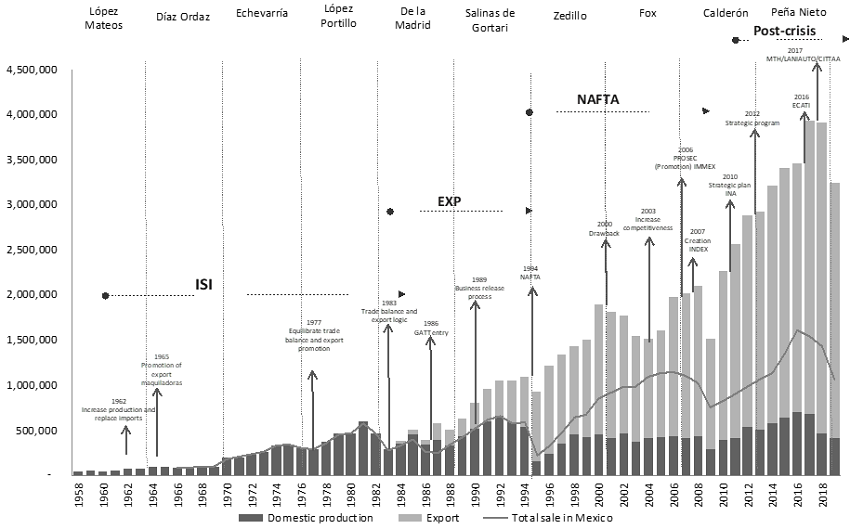
Figure 1
Evolution of the production and sale of automobiles in Mexico according to public policies
Source: Prepared with data from the Mexican Association of the Automotive Industry (AIMA) (Press Bulletin for the month of February 2018), and Banco de información económica the National Institute of Statistics and Geography (INEGI, 2018).
2. Upgrading, clusters and SMEs
In the 90s, the Mexican maquiladoras were considered a form of industrialization. Maquilas operation was based on three main aspects: 1) currency generation (added value), 2) employment (unskilled, intensive labor) and, 3) exports (raw materials and imported components to be assembled or manufactured for later exportation to the United States). This model has mainly been driven by Multinational enterprises (MNEs). However, after various decades of study of the maquilas in Mexico, their evolution can be understood as the arrival of various generations of firms, known as industrial upgrading with a focus on global value chains (Gereffi & Memedovic, 2003). The first generation was established in the 60s and 70s and referred to the intensification of manual labor and simple assembly (“assembled in Mexico”). The second, from the mid-80s to the mid-90s, was based on the rationalization of work (lean production), manufacturing and the adoption of new technologies (automation) (“made in Mexico”). The third generation, from 1995, was based on knowledge intensification and research, development and design activities (“created in Mexico”) (Carrillo & Hualde, 1996; 2002; Carrillo & Ramirez, 1990). Following 9/11 and in 2001, a fourth generation was discussed, based on the conformation of regional corporates (Lara & Carrillo, 2003).
During this process of industrial upgrading, clusters were formed in both traditional and emerging regions (cf. Figure 3) comprised of maquiladora assembly plants and different types of suppliers (of indirect components, such as a machining or plastic injection workshops, and services), as well as support institutions (educational, intermediary and governmental). The manufacturing capacity and the need to reduce lead-time between development and manufacturing meant the transfer of Research and Development (R&D) centers to Mexico. In the case of Ciudad Juarez, the resulting productive and institutional interweaving gave rise to what is currently considered an innovative business ecosystem capable of gradually adopting new technologies, such as Industry 4.0, as will be seen below.
This cluster formation may be an invaluable opportunity for local suppliers to join the globalization windfall. It is evident that the increasing relocation of global suppliers around major assembly plants brings positive externalities (Narula & Dunning, 2010), especially if institutions play a key role (Guzmán-Anaya, 2019). The existence of mega clusters, formed by global suppliers, also brings technology transfer to the region (Dutrenit et al., 2006) through the creation of a greater density of interactions with local economies. In theory, this should result in specific spillover effects that may increase opportunities for local suppliers.
While the service sector is heterogeneous in many ways, its importance as an economic activity has been recognized over the past few decades for its contribution to employment, trade, added value and, given its connection with ICTs, productivity and innovation (OECD, 2000).
Research on the Mexican automotive industry has only recently addressed the topic of technological learning by local SMEs. Learning has intensified based on increased formal training for employees, increased acquisition of machinery and automated equipment (Vallejo & Vallejo 2005), as well as the transition from integrated to modular manufacturing in car seat suppliers. This has meant an increase in the degree of automation, the use of complex machinery, and a wider use of electronic components and synthetic materials (Lara et al., 2003).
Local entrepreneurship linked to the operation of MNEs has been increasingly addressed in the Mexican case. Spin offs have developed by taking advantage of the knowledge and social networks acquired from experience as employees of the MNEs -referring to maquilas on the US-Mexican border town (Carrillo, 2001; 2010;Contreras & Kenney, 2002; Dutrenit & Vera Cruz, 2002; Contreras, Carrillo & Alonso, 2012). These companies have specialized in equipment for production lines, machine shops and automation. More recently a Micheli, Carrillo and Santos (2017) study of 50 KIBs supplying the MNEs found that service suppliers are less vulnerable to market fluctuations (as direct suppliers) as they have a larger client base that is not exclusive to a specific MNE. The KIBs specialized in areas that are not MNEs’ core business, allowing for a higher level of specialized skills, competences and profits. They also have a greater opportunity for capturing value. The authors expect more opportunities for future development due to the increase in the Mexican manufacturing sector. Supporting these results, a large and comprehensive study held at The Northern Border Collage (El College) shows the diffusion of spin offs in the northern part of Mexico (2,000 companies), and a broad process of upgrading, innovation and digitalization, among others (García Maciel, 2018; Robles Chavez, 2018; Contreras et al., 2018).
3. Methodology
In this document, we are interested in exploring in the relationship that exists between MNEs and their service suppliers, given that they form one of the factors for local development from the implantation of global manufacturing firms. In particular, we look at two global automotive suppliers (that form part of IMMEX): Bosch and Delphi-Aptiv-MTC in Juarez; as well as two broker organizations - The Technology Hub and Cluster MACH- and four local KIBs suppliers and servicing maquiladoras (Repinel, Pima, Mecatronix and Simsa).
We follow a qualitative methodology based on 10 in deep interviews with managers, entrepreneurs, business associations, as well as visits to companies in Ciudad Juarez in 2017 and 2018, we sought to identify the innovation and business ecosystem strengths that facilitate companies’ move into I4.0, as well as to point out the weaknesses that prevent their progress.
4. Results
The summarized empirical results of the two global suppliers –Bosch and Delphi-Aptiv– are presented below, together with two broker organizations –innovation and business associations– and the four local KIBs firms analyzed.
4.1. Global Suppliers
Bosch. This global maquiladora has been operating since 1992 in Ciudad Juarez and is aligned with Bosch International’s aim to become the leading user and solutions provider for Industry 4.0. The manufacturing plant employs 5000 workers, of whom 900 are engineers. The plant has a designated I4.0 area charged with achieving this transition. The department is well structured for developing and promoting various projects, among which are: data integration, metrics for all plants, preventative and predicted maintenance systems and interconnectivity of plant processes and equipment based on artificial intelligence. They are in the process of developing a project to improve traceability (with 50 engineers) in all production lines. In the development of I4.0 technology at local level, Bosch has developed some projects with the Technology Hub, and organization presented below.
Delphi-Aptiv-MTC. This technical center began operation in Ciudad Juarez in 1995 employing 800 engineers for the seven corporate Delphi divisions. In 2013, the firm had 45 plants and 3 engineering centers with 54,000 workers, including 2000 engineers. MTC is responsible for the design, development, trial and manufacture of product prototypes that will be used in future connected and autonomous cars. Furthermore, it uses Kaban Box software that has allowed them to exchange serial production for production on demand. Some of the KIBs presented below are local suppliers’ of Delphi-Aptiv-MTC.
4.2. Broker organizations: innovation and business associations
Technology Hub. The Technology Hub (T-HUB) at Ciudad Juarez is spread along 1.8-acre compound. The T-HUB was the only certified business incubator by Mexico’s National Institute for the Entrepreneur (INADEM) at Juarez. T-HUB promotes innovation among Juarez and El Paso MNCs and SMEs. It has different tailor-made programs for the local manufacturing industry, entrepreneurs and companies. T-Hub has a close relation with Bosh I4.0 group and with some of the KIBs presented in the coming section. Therefore we argue its role in the innovation and business ecosystem is to serve as host specie that facilitates the interaction between MNCs and SMEs.
Cluster MACH. In 2017 the Advanced Manufacturing Cluster of the State of Chihuahua (MACH) was born. In 2019 the cluster was formed by 11 KIBs that in total had 622 employees. Their sales amounted to $ 29.45 million dollars annually and they also had $ 20.6 millions of installed capacity. Most of their clients are MNEs in the automotive sector –including Bosch and Delphi-Aptiv-MTC- but also from other sectors and SMEs. In the last two years, most of the KIBs belonging to the cluster MACH have been fully identify with the I4.0 and therefore the cluster it self in identified as well as specialized in I4.0.
MACH cluster data
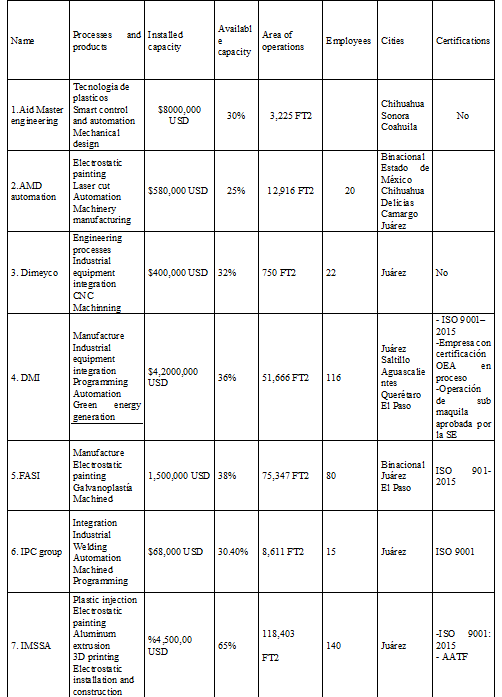
Source: Author´s elaboration using data taken from: https://clustermach.com/datos-mach.
MACH cluster data
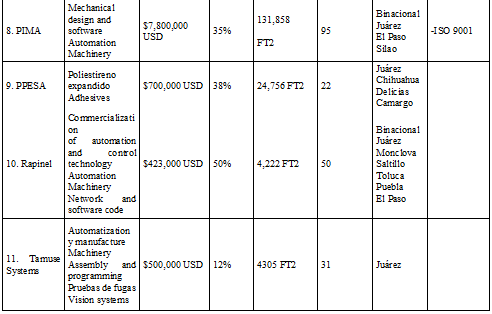
Source: Author´s elaboration using data taken from: https://clustermach.com/datos-mach.
In total 50% of those KIBs are binational which shows the importance that KIBs from Ciudad Juarez and their clients lend to the transnational business ecosystem: practically 50% of its affiliates have offices in the US. In the coming section we present at more detail some of those KIBs.
4.3. The KIBs in Ciudad Juarez
PIMA: Is a Mexican company that was established in the early 21st century in Ciudad Juarez. Focused on the area of innovation, it makes automated production lines and also develops customized software for SMEs and MNEs. Most of its local clients are from the central and northern Mexico, and 100% of its capital is Mexican. Its major clients are Bosch and Continental. With approximately 100 employees, PIMA has grown by 25% every year since 2002. In 2018 PIMA started developing an intelligent warehouse with technology such as autonomous robots and co-bots to produce and move objects along with an automated rack. It is also working with a vision system and laser welding technology. In order to innovate in these sectors, it has a unit of 12-15 engineers that is specialized in developing software and hardware for automation. One of the latest projects they are working on is a production line of electric car gasoline pumps for the automotive industry. The CEO interviewed -who is also the director of cluster MACH- noted that it was partly thanks to the constitution of the cluster that they were able to access information about I4.0, both his company and the rest of the smart SMEs that are part of the cluster. From his perspective, I4.0 in Mexico is still in the "experiment" phase, he considers that it is a kind of laboratory and that there is still a long way to go to reach 50% of the transition. Last but not least its important to point out that PIMA´S CEO is the president of Cluster MACH.
Rapinel Electric: A family firm, it began in 1987 as a distributor of control and automation products for the maquilas. Since 2018, is has specialized in the niche market of automation and electrical energy efficiency solutions. It has 50 employees, of whom 90% are engineers. Its mayor clients are Continental, Jhonson Controls and Delphi-Aptiv-MTC. Their most notable projects are for tracing, development of made-to-order software, and 3D printing for prototypes and molds. It also has a partnership with a Spanish firm for developing modules on big data and machine learning. The firm has recently begun to develop artificial vision and robotized automation projects. The CEO interviewed considered that the new industrial model (I4.0) is a kind of fashion that everyone wants to enter but not all the companies have the capabilities. Therefore, in order to scale into I4.0 one of the Rapinel stakeholders was trained in Germany. That was possible thanks to the support of the Mexican Goverment. Rapinel is an active member of Cluster MACH.
Mecatronix: While it began in 2000 with automation, machining, design and services for other companies, it currently designs, develops and manufactures automated equipment. It employs 23 people (12 engineers, 8 technicians and 9 administrators). Macatronix offers and implements solutions for I4.0 in various areas: process and production digitalization; logistic automation/problem solving tracking; traceability of automated machines (defects or none use capacity) and traceability of all components and parts; augmented reality, facial recognition; additive manufacturing (3D printer y software development); big data, cybersecurity; programmed robots, co-bots and integration to manufacturing; tooling control and smart sequence; design & implementation of automated lines for future models. The CEO of Mecatronix considers that one barrier to the success of KIBs in Mexico is the lack of confidence in locally developed technology for I4.0. However, he also considers that his company is capable of competing at global level in I4.0 projects. Mecatronix had worked in the development of traceability technologies with the Technology Hub and at the time of this research (2018) Bosch was interested in buying one of its developments.
SIMSA: The firm was founded in Ciudad Juarez in 2006. SIMSA develops automatized systems for industry, with broad experience in the automotive sector. It also develops industrial processes, among which are: sub assembly of parts, service stations, production lines and robotics. Regarding I4.0, they work in station tracings and interconnectivity as well as in sequence stickers. The CEO of SIMSA considers that in Mexico will takes a lot of time and effort to achieve a full transition towards I4.0 and, to a large extent, this is because KIBs Mexico most of the time limit their business model to the integration of technology rather than to the development of it.
The four cases of KIBs presented have in common that either they belong to the cluster MACH or they had been working with the Technology Hub in order to develop and taste technologíes associated to the I4.0. All of them are “evolutionary species” that make use of “host species” to grow their capabilites and make deals with “keystone species”.
Discussion and Conclusions
The industry is facing a changing scenario with the transformation of modes of production and ways of doing business, as it transitions into a new industrial phase, I4.0. In Ciudad Juarez German firms such as Bosch and American ones like Delphi-Aptiv-MTC are immersed in the cars of the future and in the Industrial Internet (the smart factory). The cases presented above are clear examples of organizations and firms engaged and active in adapting and developing technologies associated with the I4.0 and acquiring the competitive advantages, which these imply. Without a doubt, firms are not only advancing along different paths, but also at different speeds, especially if one is considering subsidiary plants in Mexico, which have followed a peripheral development model.
Global suppliers such as Bosch and Delphi-Aptiv-MTC stand out for the quantity of financial and human resources they have invested in the development of solutions and implementation of I4.0, and the efforts of these MNEs demonstrate their desire to consolidate as leaders in this new Industrial era. However, in contrast to Delphi-Aptiv-MTC who is more focused on providing its clients with new technologies (connectivity, electrification, diverse mobility and driving autonomy), Bosch is seriously focused on establishing processes based on the Industrial Internet (I4.0) as well as, obviously, on products. Both allocate a percentage of their sales to their R&D areas, and have well-structured departments dedicated to the development of I4.0. In other words, the German subsidiary is far more embedded in I4.0 than the American supplier. No wonder why Bosch has been one of the main promoters of I4.0 since the conceptualization of this new type of industry. However both MNEs can be considered as “keystone species” inside of the Juarez business ecosystem.
Technology Hub and cluster MACH are central actors in empowering the business ecosystem and promoting the new industrial model (I4.0) by facilitating the networking among actors at local, national and transnational level. Therefore we identify those institutions as “host species” in the business ecosystem.
The KIBS presented –PIMA, Repinel Electric, Mechatronics and SIMSA– are also specializing in the integration and development of I4.0 technologies. Given their experience in implementing automated lines for global suppliers, these SMEs are aware of the inevitability of digital change and, even more so, that this offers a great business opportunity. They are thus seeking to strengthen projects of this nature. Their first efforts have focused on the automation of processes through the development or acquisition of artificial intelligence. The four firms are developing tracing systems, artificial vision systems and have additive manufacturing. Although still in the development stages, they are companies betting on I4.0. While the firms studied have different degrees of I4.0 evolution –“evolutionary species”–, the experience of these cases reflects the necessary complementarity between global suppliers and the Mexican KIBs, although we also found that it is an asymmetrical relationship: as “keystone species” Bosh and Delphi-Aptiv-MTC are playing an ambiguous role in the business ecosystem; on one hand they are developing I4.0 technologies and producing knowledge spillovers, on the other hand –as is explained below-, the same companies are retraining the evolution of local KIBs due to unfair finance practices.
In general terms MNEs and KIBs have achieved good results. On one hand, global suppliers have advanced in I4.0 knowledge, structuring and implementation. In terms of results, for example, Bosch has reduced costs, increased efficiency and productivity, and increased control of machines, tools and people. On the other hand, the KIBs have managed to do business, have credibility and compete for large scale projects.
The KIBs have been able to place themselves as knowledge intensive service providers for Tier 1 and Tier 2 companies due to the following characteristics: they are located in the same city, employ highly skilled people (60% or more are engineers and the rest technicians); and have broad maquila and KIBs experience (mainly spin offs). That is, despite being KIBs and family-owned, they have higher profit margins than direct suppliers due to their high specialization (different from the MNE core business), and are less vulnerable to market fluctuations (because many MNE clients belong to different sectors such as autos, medical, aerospace, among others).
-
Competitive in term of cost, quality and capabilities.
-
Flexibility to adapt to any requirement (each company needs something different).
-
Closeness, the know-how of maquilas (in resolving contingencies and the need for fast responses)
-
Synergies. They created their own clusters. For instance, in Juarez there are Automation (350 firms), Artificial Intelligence, Energy and Advanced Manufacturing firms.
Although the KIBs have strong expansion potential, they have significant limitations to their growth. The main obstacles observed are presented on a meso and micro level.
-
Lack of finance: difficulty in filling big orders, need to import most materials, tolls and equipment.
-
Receive payments 3-4 months, and sometimes up to 9 months, after filling order (“we finance the maquila”); this imply “bad practices”.
-
No factoring (loan warranty) in Mexico for SMEs (5% in USA instead)
-
OEM & Tier 1 and 2 generally do not want to access the internet in manufacturing areas due to cyber security concerns (“I want to be more efficient and productive but the HQ policy does not allow me to”; “A more sophistication of the company less open to access to the Internet”).
-
Some managers (Tier 1-2) do not easily accept the introduction of I4.0 as it implies more control and more work, as well as a future replacement risk.
Lastly, the new political context in Mexico is likely to result in more uncertainty rather than in a clear and expected trend, in the form of greater restrictions on accessing financing for MNEs and especially for KIBs, the dissolution of the Mexican Federal Institute (Inadem) that supported SMEs and KIBs, higher wages in the northern border cities and a new law that grants greater union democracy. These new regulations, in addition to Trump´s protectionist measures (in international trade, migration and the border enforcement), have made public policy recommendations more difficult.
Finally, the following conclusions can be drawn. There is an important economic dynamism in the maquilas (MNEs), but also in particular segments of the SMEs such as the KIBs. In addition, a broad diffusion of industrial upgrading at the firm (intra-firm) rather than the inter-firm level was found. Regarding Industry 4.0, the introduction and experimental implementation of I4.0 in global Tier 1-2 companies as well as in KIBs-SMEs, is evident. There is also a net positive impact on the volume of employment (but limited), especially if disruptive technologies are quickly adopted. Thus, in answer to the question posed in the title of this paper: “will the Mexican auto parts maquila be able to transit to Industry 4.0” we would argue that in the case of Ciudad Juarez, yes, however, it will take some time due to the fact that their main role is manufacturing and various obstacles exist on a firm, regional and country level that will not facilitate this process.
References
Álvarez, Lourdes y Jorge Carrillo (2017), “Estrategias de la industria automotriz ante la crisis: relocalización de plantas y modelos de automóviles en 2007, 2011, 2013 y 2015", en Álvarez-Medina, Lourdes. y María González-Marín (coords.), Reestructuración productiva de la industria automotriz en la región del TLCAN, UNAM, México, 2017, (Cap. 3) pp. 65-80.
Carrillo, Jorge y Raúl Hinojosa (2001a), “Cableando el norte de México: la evolución de la industria maquiladora de arneses”, Región y sociedad. Vol. 13. No. 21. Hermosillo. Ene/jun. 2001.
Carrillo, Jorge (2001b), “Maquiladoras de Exportación y la Formación de Empresas Mexicanas exitosas”, en Dussel, E. (coord.), Claroscuros. Integración exitosa de las pequeñas y medianas empresas en México, México, Ed. Jus/Cepal/Canacintra, pp.157-208.
Carrillo, Jorge (2010), “Modelos productivos, el modelo de maquila y multinacionales”, en De la Garza, E. y Neffa, J. (comps.), Trabajo y modelos productivos en América Latina. Argentina, Brasil, Colombia, México y Venezuela luego de las crisis del modo de desarrollo neoliberal, CLACSO, Buenos Aires, pp. 103-133.
Carrillo, Jorge y Alfredo Hualde (1996), “Maquiladoras de tercera generación. El caso de Delphi-General Motors”, Espacios. Revista Venezolana de Gestión Tecnológica, vol 17, núm.3, Caracas, pp.111-134.
Carrillo, Jorge y Alfredo Hualde (2002), “La maquiladora electrónica en Tijuana: hacia un clúster fronterizo”, Revista Mexicana de Sociología, México, 64, 3, julio-septiembre, pp. 125-171.
Carrillo, Jorge y Miguel Ramírez (1990), “Maquiladoras en la Frontera Norte: opinión sobre los Sindicatos”, Frontera Norte, vol.2, núm. 4, julio-diciembre, pp.121-152.
Carrillo, Jorge y Redi Gomis (2007), “¿La maquila evoluciona?, ¿podrá evolucionar en el nuevo contexto?”, en Carrillo, J. y R. Barajas (coords.), en Maquiladoras fronterizas. Evolución y heterogeneidad en los sectores electrónico y automotriz, Ed. Miguel Ángel Porrúa/COLEF, México, pp. 17-49.
Monostori, László CIRP Encyclopedia of Production Engineering. https://link.springer.com/referenceworkentry/10.1007%2F978-3-642-35950-7_16790-1
Cluster de Manufactura Avanzada del Estado de Chihuahua (MACH). Recuperado de https://clustermach.com/datos-mach.
Contreras, Oscar & Martin Kenney (2002). “Global industries and local agents: becoming a world class manager in the Mexico-USA border region”, in Kennedy, P. y Roudometof, V. (Ed.), Communities across borders. Roudledge, London and New York. pp. 129-142.
Contreras, Oscar; Jorge Carrillo & Jorge Alonso (2012). “Local entrepreneurship within global value chains: a case study in the Mexican automotive industry”, World Development, 40(5), pp. 1013-1023.
Contreras, Oscar; Jaime Ólea; Maciel García y Rubith Robles (2018), Formación y escalamiento de Pymes mexicanas intensivas en conocimiento (Reporte de investigación del proyecto). El Colegio de la Frontera Norte, 117 pág.
Hertog, P. (2000): “Knowledge-Intensive Business Services as Co-Producers of Innovation”, International Journal of Innovation Management, 4, 491-528.
Dutrenit, Gabriela & Vera-Cruz, A. (2002), “Rompiendo paradigmas: acumulación de capacidades tecnólogicas en la maquila de exportación”, Innovación y Competitividad, año II, núm. 6, abril-junio.
Dutrenit, Gabriela; Alexandre Vera-Cruz & Ana Arias-Gago (2006), Acumulación de capacidades tecnológicas en subsidiarias de empresas globales en México. El caso de la industria maquiladora de exportación, México, Ed. Miguel Ángel Porrúa/UAM.
García, Maciel (2018), “Empresas tecnológicas en Tijuana y Juárez: Entre las Cadenas Globales de Valor y los Sistemas Regionales de Innovación (1994-2017)”. Tesis doctoral. El Colegio de la Frontera Norte, A.C. México.
Gereffi, Gary y Olga Memedovic (2003). The Global Apparel Value Chain: What Prospects for Upgrading by Developing Countries? United Nations Industrial Development, p. 36, (Available at SSRN: https://ssrn.com/abstract=413820).
Guerrieri, Paolo y Valentina Meliciani (2005), “Technology and international competitiveness: The interdependence between manufacturing and producer services”, Structural Change and Economic Dynamics, Vol. 16, No. 4, pp. 489-502.
Guzmán-Anaya, Leo (2019), “Knowledge transfer in the automotive supply chain development in Mexico”, México y la Cuenca del Pacífico, Vol. 8, núm. 23, mayo-agosto, pp. 93-122.
Industria Nacional de Autopartes (INA) (2018). Diálogo con la industria automotriz 2018-2024. Disponible en: http://www.amia.com.mx/boletin/dlg20182024.pdf (Consultado el 04 de septiembre del 2019)
Lara, Arturo y Jorge Carrillo (2003), "Technological Globalization and Intra-Company Coordination in the Automotive Sector: The Case of Delphi-Mexico", International Journal of Automotive Technology and Management, vol. 3, no. 1, pp. 101-121.
Lara, Arturo; C. Hernández; L.M. Sánchez y D. Villavicencio (2003), “Dilemas de la evolución del cluster maquilador eléctrico-electrónico del norte de México: una exploración”, en Aprendizaje Tecnológico y Escalamiento Industrial: Perspectivas para la Generación de Capacidades Tecnológicas en Empresas Maquiladoras de la Frontera Norte, pp. 1-18, disponible en: http://www.maquiladoras.info.
Lichtblau, Karl; Volker Stich; Roman Bertenrath; Matthias Blum; Martin Bleider; Agnes Millack; Katharina Schmitt; Edgar Schmitz y Moritz Schröter (2015). Industrie 4.0 readiness. Aachen, VDMA’s IMPULS/Stiftung. Frankfurt. Disponible en http://www.impuls-stiftung.de/documents/3581372/4875835/Industrie+4.0+Readniness+IMPULS+Studie+Oktober+2015.pdf/447a6187-9759-4f25-b186-b0f5eac69974
Micheli, Jordy. Carrillo, Jorge., y Santos, S. (2017), "MNEs impacts on Local Development: The Case of Knowledge-Intensive Services in Mexico", in 29th SASE Annual Meeting, Lyon, June 29-July 1o (TH04-04 session).
Mortimore, Michael (2000). “Corporate Strategies for FDI in the Context of Latin America´s New Economic Model”, World Development, 28 (9): 1611-626.
Moore, James (1996). The Death of Competition. Leadership and Strategy in the Age of Business Ecosystems. New York: HarperCollins.
Moore, James (2006). “Business Ecosystems and the view from the firm”, Antitrust Bulleting, Spring 2006, Federal Legal Publications, Inc.
Narula, Rajneessh & John Dunning (2010), “Multinational Enterprises, Development and Globalization: Some Clarifications and a Research Agenda”, Oxford Development Studies, 38: 3, 263 — 28.
Organisation for Economic Cooperation and Development (OECD) (2000), A New Economy? The Changing role of Innovation and Information Technology in growth. Paris.
Organización Internacional de Constructores de Automóviles (OICA). (2018). Estadísticas de producción, disponible en http://oica.oica.net/category/Production Statistics, consultado en 10 de febrero, 2018.
Pfeiffer, Sabine (2017). The Vision of BIndustrie 4.0 in the Making a Case of Future Told, Tamed, and Traded. NanoEthics. 11(1), January, Springer.
Robles, Rubith (2018). Pymes de base tecnológica en la zona metropolitana de Monterrey: entre las cadenas globales de valor y los sistemas regionales de innovación. Tesis de Maestría. El Colegio de la Frontera Norte, A.C. México
Sirkin, Hal; Michael Zinser & Justin Rose (2015). The Robotics Revolution. The next great leap in manufacturing, Boston Consulting Group (BCG), Boston.
Vallejo, Bibiana. & Sandra Vallejo (2005). “Aspectos generales de la automatización industrial del sector farmacéutico”, Revista Colombiana de Ciencias Químico-Farmacéuticas, pp. 47-63.
Appendix
Phases of the Automotive Industry in Mexico
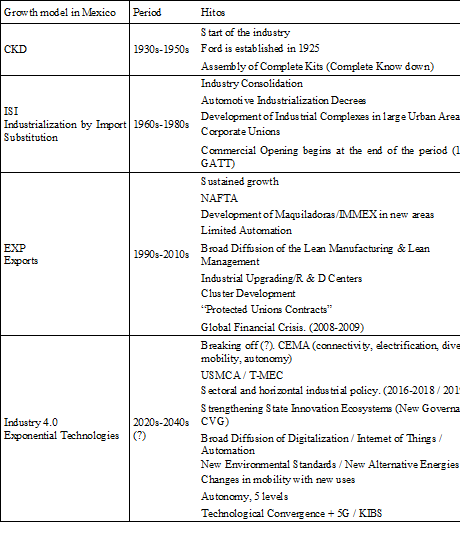
Source: Author´s elaboration
Notes
Author notes
