The role of financial, human and social capital on the entrepreneurial decision of returned migrants in municipalities of the state of Mexico, Mexico
The role of financial, human and social capital on the entrepreneurial decision of returned migrants in municipalities of the state of Mexico, Mexico
Paradigma económico. Revista de economía regional y sectorial, vol. 13, núm. 3, pp. 90-113, 2021
Universidad Autónoma del Estado de México

Esta obra está bajo una Licencia Creative Commons Atribución-SinDerivar 4.0 Internacional.
Recepción: 14/12/2020
Aprobación: 29/04/2021
Abstract: This paper aims to investigate the importance of the financial, human and social capital of returned migrants on the entrepreneurship decision of these returnees. For this end we use data from a survey applied to returned migrants living in urban and rural municipalities of the State of Mexico, which were analyzed using descriptive statistics and estimating a regression regression model. The results show that the main determinant of the entrepreneurship of these returnees is the investment in the construction of houses. Another important determinant is the gender of these returnees.
Keywords: Returned migrants, State of Mexico, Entrepreneurship, Financial capital, human and social capital.
Resumen: Este artículo tiene el objetivo de investigar la importancia del capital financiero, humano y social de los migrantes retornados sobre la deci- sión de emprendimiento de estos retornados. Para este fin utilizamos datos de una encuesta aplicada a migrantes retornados que viven en municipios urbanos y rurales del estado de México, México, que fueron analizados mediante estadística descriptiva y la estimación de un modelo de regresión curvilineal. Los resultados muestran que el principal determinante del emprendimiento de estos retornados es la inversión que realizan en la construcción de casas. Otro determinante importante del emprendimiento es el género de estos retornados.
Palabras clave: Migrantes retornados, Estado de México, emprendimiento, capital financiero, capital humano y social.
Introduction
According to Izquierdo (2011), since 1970 it is increasingly common that world immigration be an installation plan and not a temporary establishment, since in many receiving countries, immigrants no longer make an effort as hard as the previous generations in saving to be able to return to their country of origin and instead try to settle permanently in the destination nation, what have had an impact on their propensity to save and to invest.
On the other hand, according to Tovar and Victoria (2013), the majo- rity of papers that analyze the relation between entrepreneurship and return migration refer to African countries (Tunisia, Morocco, Algeria, Ghana, Cote D’Ivoire, Egypt and Mozambique), and some to European countries (Albania, Norway, Ireland and Hungary), and Latin American ones (Colombia and Mexico) and Asian ones (Pakistan and Turkey).
With regard to the determinants of the entrepreneurial decision of the returned migrants, Newland and Tanaka (2010) mention that the success of entrepreneurship depends on factors such as the economic, cultural, political and institutional environment where they develop; in particular, that there is a strong and stable economy, an adequate stockof human and social capital, an environment of high institutional qualityand easy access to financing; likewise that the cultural perception ofthe entrepreneurship and the government policies are very important toencourage or hinder the creation of small business.
In what corresponds to the type of entrepreneurship of the returned migrants, descriptive studies such as Black et al. (2003) about Ghana mention that many of the respondents were described themselves as directors or managers, or as travel agents, pharmacists, bar owners, designers, cement distributors, beauticians, teachers, owners of appliance stores, electronic technicians, magazine producers, electrical contractors and hairdressers; or Batista et al. (2010) that found that the type of business of who returned to Mozambique concentrated in the retail trade and agriculture and that some of them were engaged in restaurant and industry services; or McCormick and Wahba (2004) that showed that the return migration to Egypt promoted the creation of small family business, specially in urban zones.
In Mexico the relationship between return migration and entre- preneurship has been little studied even though there is the perception that returned migrants are likely to undertake productive projects or microenterprises when returning, and that for studies like Meza (2017) having been able to cross the border and face the difficulties of migra- tion, converts returned migrants in candidates for self-employment (for the least aversion to risk), but what in many cases they require gover- nment support to establish a business and that the federal government did not have until mid-2014 a support plan so that the returned migrants can establish a business.
But nevertheless, a study by El Colegio de Mexico (2018) notes that in our country the data show that 70% of returning migrants men and women who work, they do it in a salaried way (employees, pawns or helpers with payment), as it happens with the non-migrant popu- lation. However, that study also recognizes that self-employment is more frequent among returnees than among non-migrants, although it has been observed a decline in this type of employment during the period from 2000 to 2015 (from 35% to 26%) and a relative increase in formal salaried work among returnees, since one in four of these work as formal salaried employees.
In general, according to Tovar and Victoria (2013) there is certain consensus that the possible determinants of that the returned migrants become entrepreneurs, include the accumulated capital both financial and human or social; the migratory experience (that usually includes the last one); the wage gap between the returned migrants and non- migrants; and other factors as the gender, the ocupation before migra- ting and other.
In this paper we only deal with the role played by financial capital, human capital and social capital on the decision of returned migrants to become entrepreneurs. For this, we rely on data obtained from a survey applied to 334 returned migrants who live in 14 municipalities of the state of Mexico, Mexico and we estimate a regression model.
The paper consists of the introduction, the international and national literature review, the methodology, the results and discussion, and finally the conclusions.
1. Literature review
1.1 Review of the international literature
1.1.1 The financial capital
For authors as Paulson and Towsend (2005) the entrepreneurs have severe problems to access to the credit markets making it difficult their investments in new business or in the improvement of business that already work, as these authors assert for the cases of Thailand and the United States, where two third parts of the startup investments in the small enterprises come from savings and funds from family and friends. This difficulty can be attended in a better way by the homes with migrant or returnee members, as Tovar and Victoria (2013) assure.
For other authors as Kilic et al. (2007), migration is a channel to reduce poverty and to promote growth through the improvement of the positions of the assetts and of the productivity levels of the poor families, either trough remittances or savings or accumulated human capital for migrants; this study refers that returned migrants in Albania face liquidity restrictions, so that the savings accumulated abroad and remittances permit them to spend and to invest in activities that otherwise would be imposible to do without those cash flows. These same authors point that a considerable number of studies that analyze the impact of the return migration on the development proccess in thecountries of origin have produced a virtual consensus about the positiverelation between the return migration and the self-employment, becausethe migration contributes to the relaxation of the credit and assurancerestrictions, encouraging the productive investment.
Among the studies that find a positive relationship between return migration and entrepreneurship are the papers of Ilahi (1999) and Dustmann and Kirchkamp (2002) which used data of returned migrants to Turkey and Pakistan respectively to find that the savings obtained abroad are a critical determinant of the activity at which the returned migrants are dedicated and that when these ones have high savings they opt for self-employment, while those who have low savings levels they opt for salaried employment and that the migrants who waiting to change their occupation to a non-farm self-employment upon his return, save more from their temporary high wage than those do not wait to change their farm employment; the papers of Nicholson (2001, 2002) and Labrianidis and Hatziprokopiou (2006) which give evidence that returned migrants use their savings obtained abroad to finance microenterprises and to buy equipment that increases the productivity of existing activities; and the study of Murphy (2000) which finds that returned migrants to two counties of China are introducing a capitalist dynamics in their communities of origin, using their experiences and resources obtained in their destination cities, to improve local state enterprises, to start their own businesses and make communities of origin more conducive to business.
On the other hand, Woodruf and Zenteno (2002) enhance the importance of the remittances for the development of the urban microenterprisesin their study of 6,000 micro-enterprises in Mexico; Blacket al. (2003) point for Ghana and Cote D’Ivoire that the propensitythat returned migrants have had is to consume domestically and thatwhere the productive investment has happened, this has implied microenterprisesthat contribute very little to the reduction of the poverty,likewise, that migration and return can be seen as mechanisms toprovide the capital for the development of small enterprises, particularlyamong the poorest and less qualified migrants; McCormick and Wahba (2004) found for Egypt that the savings generate a high probabilitythat returned migrant invest in business projects, both farm and nonfarm; Mesnard (2004) also model the migration as a way to overweight the credit restrictions in the presence of capital market failures, andhe shows that most of business projects started by Tunisians returnedmigrants were financed through their savings obtained abroad.
Likewise, Black and Castaldo (2009) point in their study about Ghana and Cote D’Ivoire that the accumulated savings, the reasons for return and the frequency of visits to home are significant factors to explain the decision to undertake a business by migrants. They found that the impact of the savings greater than 5,000 dolars obtained abroad on the decision of entrepreneurship is positive and statiscally significant for these countries; Gubert and Nordman (2011) found for the Arabian Maghreb countries that remittances affect positively the probability of being entrepreneur; Tovar et al. (2018) found that have saved money abroad increases the probability of being entrepreneur for the case of Colombia; Alarcón and Ordóñez (2015) found for Ecuador that the wages obtained abroad (proxy of self-financing and savings capacity) affect positively the probability of being entrepreneur.
1.1.2 The human capital
Mc-Cormick and Wahba (2004) studied two of the determinants of the conversion of returnees into entrepreneurs for the case of Egypt, the human capital and the financial capital. Considering the characteristics of migrants before migration and their experience accumulated abroad, they found that the savings were more important than the acquisition of human capital in the probability to become entrepreneur for the returned illiterate, while the education and the savings were determi- nants for the entrepreneurship of the educated returnees; in terms of human capital transference, Black et al. (2003) note that the returned migrants to Ghana who were self-employed valued notably their job experience acquired abroad, while that very little “employed” or “not employed” reported having won labor experience while were abroad; similarly, Nicholson (2001, 2002), Labriniadis and Kazazi (2006) and Labrianidis and Hatziprokopiou (2006) show evidence that to work abroad is a learning opportunity to improve the migrants abilities, so that back home, replicate the enterprises in which they worked abroad.
Kilic et al (2007) point that the abilities acquired by migrants in the destination countries can be used for their productive use upon his return; Medina and Posso (2009) studied the relation between education and qualification for work levels with the decision to go back homeby Colombian and South-American migrants in the United States, and they pose the hyphothesis that during the period of migration, the repatriatesacquire experience and general and specific competences thatcan contribute to the development of the countries of origin if they areempowered and used in self-employment and entrepreneurship activities. On the other hand, it is usually assumed that the migrants canacquire knowledges and abilities abroad, which after the return they can make available to the countries of origin to enable them for the creationof small business (Tovar and Victoria, 2013); Black and Castaldo (2009) found that have completed their studies before migration impacts thedecision of entrepreneurship in a positive and significant statisticallyway for returned migrants to Ghana and Cote D’Ivoire, while theirstudies done during their migratory stay didn’t influence their entrepreneurship decision; although they watch that their networks, contact sand wider experiences at work may be as much or more important than the money saved and that the work experience acquired abroad is themost significant predictor of the business activity among the respond entreturned migrants.
Gubert and Nordman (2011) found for some countries of the Great Arabian Magreb (Tunisia, Morocco and Algeria), that have received profesional training abroad, have better educational level, have been entrepreneur before the migration, affect positively the probability of entrepreneurship in some of these countries; Alarcón and Ordóñez (2015) found for Ecuador that the demographic characteristics that affect more on the probability of being entrepreneur in that country are the age and the universitary education, likewise, that have been business owner abroad affect positively the probability to be entrepreneur; Tovar et al. (2018) found that the probability that a Colombian returned migrant become entrepreneur is associated with the self-confidence that he has to start a business, the educational level and have done contacts abroad that might be partners or suppliers of their enterprises in Colombia.
1.1.3 The social capital
Some papers that choose the migratory experience as explanatory variable clarify that this include the probability that returned migrants have accumulated savings, acquired abilities and knowledges or built social networks abroad. A study about Pakistan performed by Mansuri (2007), found that return migration has a positive effect on the amount that the households have invested in non-farm enterprises, farm assets(as tractors) and the purchase of land in the last ten years, although theestimated effect is significant only for the investment in enterprises. Other authors as Kilic et al. (2007) appraised the impact of the migratoryexperience on the probability that returned migrants become ownersof non-farm business and they found a positive relation between thesevariables; and Batista et al. (2010) found in four provinces of Mozambique, that the probability to create a business increases in 54 percentwhen a member of the household would had returned and that the effect was greater on the entrepreneurship in the regions with greater migratory experience.
1.2 Review of the national literature
1.2.1 The financial capital
The study of Espinosa-Marquez and González-Ramírez (2016) doing an analysis of interviews applied in the town of Atencingo, located in the municipality of Chietla to the south of the state of Puebla, in the Izúcar Valley, point out that the duration of the migratory period in the country of destination greater than three years facilitated the establis- hment of businesses for returning migrants and the success of them, through remittances sent to relatives and for community activities, which kept returning migrants active and current in the networks of the locality.
Other authors like Papail (2002) in his study on the investment that returned migrants make at the end of their migratory cycle in the United States, also emphasize the importance of remittances to explain the entrepreneurship decision of the returned migrants since remittances are very important to potentiate productive investments, that over time they make it easier for these people to become microentrepreneurs, especially in the central-western area of Mexico; while other authors are skeptical about the theme like Canales (2008) who argues that remittances act as any other work yield, so it is not possible for them to boost growth and economic development very different from salaries and wages paid in the national territory; Yúnez, et al. (2000), who claim that in rural areas remittances are invested in livestock and other liquid ways of saving; and Peláez, et al. (2013), who point out that despite the fact that remittances tend to replace remuneration for work that households stop receiving when some of its members moving abroad, in theshort term a significant part of remittances is destined to saving and thatremittances neither reduce poverty nor help the social mobility, but theyare mostly received for non-poor households; likewise, that receivinghouseholds do not have different spending patterns that non-recipients,that leads them out of poverty.
For its part, Barbosa and Aguirre (2011) investigate schemes from which Mexican second generation migrants1 in the United States, could be interested in making investments in capital and knowledge in the place of origin in the framework of a transgenerational return migration, or from the return of their parents or relatives, without needing to remain definitively in them, in which second generation migrants are incorporated in investment schemes to promote the development of migrant localities.
Some more optimistic authors about the entrepreneurial spirit of returned migrants such as Barbosa and Aguirre (2011) found that migrants returned to the municipality of Santiago Tangamandapio, Michoacan, upon reintegration to their community, normally they finish their agricultural activities and are dedicated to family busi- nesses, diversifying their local productive activities additional to agri- cultural work, such as trade, crafts, saddlery, weaving and embroi- dery of gauges, shawl, socks and cravat, as well as the processing of food; in the case of the municipality of Huandacareo, Michoacán, they found that those who returned definitively, participated in the reconfi- guration of the economic elites and in business multiplication (spas, grocery stores, ironworks, fruit stores, etc.), which had an impact on the economy of the municipality, the employment generation, the change in consumption patterns and the improvement in education of the popu- lation; and in the case of the municipalities of Ameca and Tepatitlán in the state of Jalisco, Acámbaro and Silao in the state of Guanajuato and Tlaltenango and Jerez in the state of Zacatecas, they found that 77% of returnees were sending remittances during their migratory stay in the nineties to their homes, that were primarily intended for family support (alimentation, clothing, rent housing, health, education, transport, etc.),the savings and the purchase of houses or land.
Other authors like Pelaez, et al. (2003), note the close relationship between remittances and the entrepreneurship of migrants and recognize that although the immediate use that households give to remittances is fundamentally savings, that is to say, that are income that in principle are not consumed or invested, which, however, are not reversed either in productive activities, which coincides with what Mendoza and Díaz (2008) found that “most of the families who receive remittances have a female head of household as substitute boss, which indicates that it is about of families divided by the migratory phenomenon where the availability to undertake productive activities is practically nullified by the weight of domestic tasks and the care of the children”. These authors also find that revenues per business are percentageally higher in households who do not receive remittances and that households with remittances are more likely to have business, although most of these are agricultural holdings for self-consumption and the sale of some surplus.
1.2.2 The human capital
Espinosa-Marquez and González-Ramírez (2016) point out that because of his young age the returnees of Atencingo, Puebla, who spent less than three years in the destination country, accumulated more human and social capital, what facilitated them grow quickly in jobs during their migratory experience, especially in the field of food and drink services, although upon his return, the skills acquired at the destination were not served to work in their place of origin; while the returnees who spent more than three years in the destination country claimed to have found utility to the capacities and abilities acquired during the migratory experience and that the undertakings that they carried out, made sense and were successful due to the experience acquired during the migration.
By his side, Barbosa and Aguirre (2011) point out that the migrant not only can contribute capital for local economies, but given his work experience and acquired knowledge, they have accumulated an impor- tant human capital that can lead to technology transfer and favor inno- vation and even the development of technology in the country, as well as new habits and discipline that can positively influence societies on their return; in the same way, Montoya, et al. (2011) found under a qualitative approach that the technical and personal abilities acquiredduring the migratory process improve the confidence of the returnedin what they do and it gives them more clarity about the technical andfinancial supports that they require for their productive activities.
In the same way, among the factors that explain the incidence of entrepreneurship or salaried work among returned migrants in the local labor market are the local context and the possibility of applying acquired human capital as you see right away: a) The greater the lag of the communities of origin, the lower the presence of salaried work among returnees; b) the lower the lag of the communities of origin, the greater the presence of the returnees, both men and women employed formally; c) among the returned women migrants, self-employment in municipalities with greater lag increased from 28.6% to 37.2% between 2000 and 2015; d) the labor strategies of the returnees vary according to their relation to the possibility to transfer skills, not necessarily of formal education, acquired after the migratory experience to the new labor context, what it seems that women do better than men (El Colegio de México, 2018).
The propensity to entrepreneurship of the returnees within the informal sector also manifests in studies like that of Mestries (2013), which found that returning migrants suffer to find stable and remune- rative jobs, so the majority of those who manage to get work on their return (70% of the total), they do it in the informal sector and earn up to a minimum wage, and 80% of them do not have social security (Garduño, 2012).
1.2.3 The social capital
Espinosa-Marquez and González Ramírez (2016) investigated the relationship between the length of the migration period and the decision of entrepreneurship of returning migrants, finding that for those who spent less than three years in the country of destination has been easier to reintegrate in the country of origin, but it’s also been easier for them to save for a new illegal crossing that investing that capital in an individual venture in Mexico; while those who passed in the country of desti- nation more than three years faced more discrimination to reintegrate themselves into the local labor market and they referred having used their savings as economic capital to establish a business or to invest in the agricultural sector of the locality and manifested in all cases to have obtained help for the start of these ventures on behalf of their families,whether they are parents, grandparents, older siblings, parents in lawand brothers in law, besides that for them was extremely complex anddifficult to keep afloat in Mexico a small or micro company so theirknowledge and social networks were very important for their successas entrepreneurs.
In the same way, Barbosa and Aguirre (2011) under the theory of networks postulate that the creation and consolidation of networks of returned migrants in the country of origin can be an influential factor in the return option, as it can count on support groups to ensure a stable stay upon return, even in the option of entrepreneurship.
2. Methodology
The data used in this paper come from 334 in-depth interviews applied to migrants returned from abroad to the state of Mexico, which were located by snowball in rural and urban localities of the following muni- cipalities: Acambay de Ruiz Castañeda, Temascalcingo, Jocotitlán, Morelos, Toluca, Coatepec Harinas, Tejupilco, Zacazonapan, Otzoloapan, Santo Tomás, Tlatlaya, Tecámac, Nopaltepec and Otumba.
The entrepreneurial return migrant was conceived as that person of legal age who was in the United States at least one year for work reasons and who has invested money obtained abroad in small busi- nesses and animals on his return. Although the returnees surveyed do not constitute a random sample due to the nature of the study, the selec- tion of migrants and the implementation of the guide, allow to identify among others the variables that determine the conversion of returned migrants into entrepreneurs. The fieldwork ended in January 2013, for which it was used a guide of interview, with the intention of obtaining information about the migration process, the previous economic and social conditions that they had, the objectives of the migration and how they spent the resources obtained during their migratory stay abroad.
The dependent variable used in the model of this work is the dollars spent on production assets such as small productive businesses and animals. The independent variables of the model are the following: as proxies of financial capital are used the remittances sent monthly to their families and the saving accumulated in dollars; as proxies of human capital are used the studies completed by migrants in the country of origin, Mexico, in the levels of primary school, secondary school,high school and bachelor’s degree, as well as the studies completedby migrants in the destination country, the United States; as proxies ofsocial capital are used the antiquity of first migration and the number oftrips to the United States.
2.1 Econometric model
We try to identify returning migrants who become entrepreneurs, which are those who have invested money obtained abroad in small businesses and animals on his return. The decision to undertake is represented in this paper by a regression model with logarithmic specification for the dependent variable and for the financial capital variables, while the human capital and social capital variables as well as gender were measured by dummy variables in which 1 is yes and 0 is no, which has the following form.Where subscript i indicates.
The variable y is the logarithm of the investment in businesses by the migrant returned measured in thousands of current dollars. a is the intercept of the model, and the explanatory variables are grouped in the blocks of financial capital, human capital and social capital, to which the variable sex was added through a dummy variable with a value of 1 for male and 0 for female.
It should be noted that in the regression model only the variables that showed the highest correlation with investment in businesses of returned migrants were included in table number 2 of correlations. The term ui represents the model error.
(Bi) is the vector of variables of financial capital of the returnedmigrants, what includes: 1) investment made in houses by returnedmigrants, measured in thousands of current dollars and 2) the remittancessent by the returned migrants to their families settled in their community of origin, measured in thousands of current dollars.
(Ci) is the vector of variables of human capital of the returned migrants, what includes 1) studies completed in the United States by the returned migrants during their immigration stay in the United States, and 2) the national work experience of returned migrants, both measured through dummy variables with a value of 1 for yes and 0 for no.
(Di) is the vector of variables of social capital of the returned migrants, was included the number of trips to the United States, which was measured by a dummy variable that adopted the value of 1 for more than one trip and 0 for a single trip.
Table 1 shows the descriptive statistics of the variables previously described. In order to identify characteristics that distinguish between entrepreneurs returnees and non-entrepreneurs returnees, the sample of surveyed returnees was divided into those who made some productive investment on their return (the entrepreneurs), and those who did not make any productive investment on their return (no entrepreneurs).
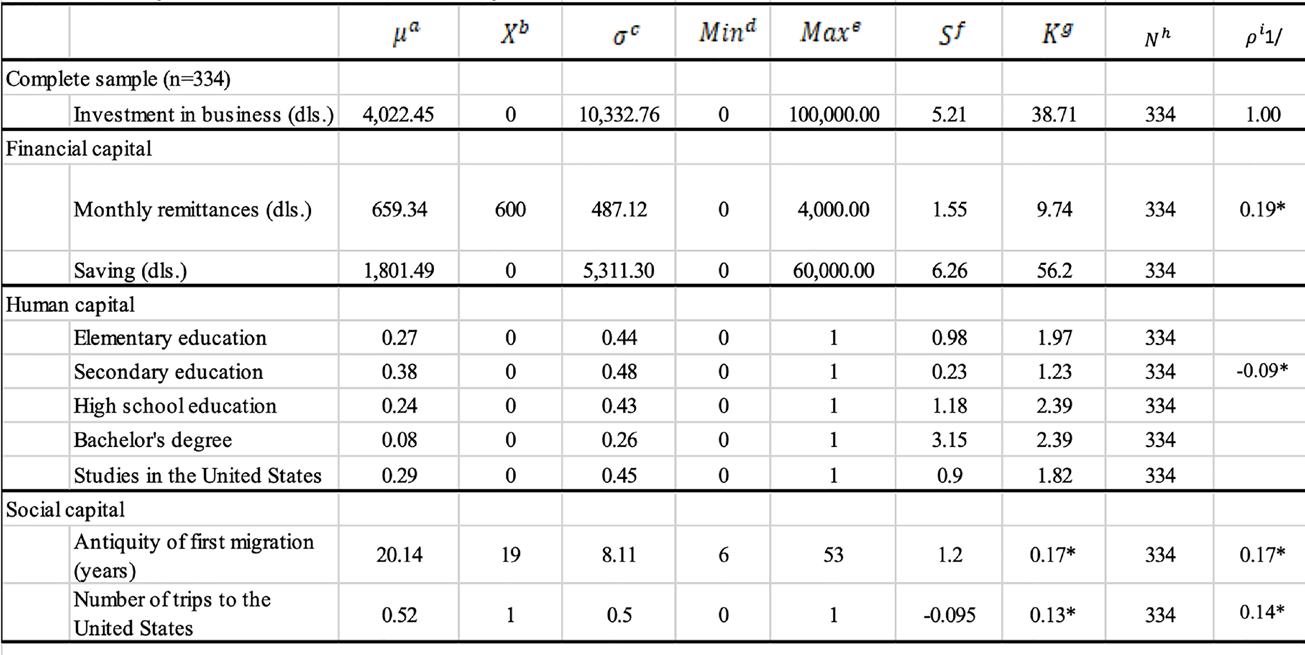
Table 1
Descriptive stadistics of the entire sample
own elaboration on based on data taken from the Table 1 of the paper of Cruz, Salas and Pico (2018).
a = arithmetic mean; b = median; c= standard deviation; d = minium; e= maximun; f= bias; g = Kurtosis;
h = number of observations; i = correction coefficient between the investment in business and each of the remaining variables. 1/All of the correlation coefficents p* have significan values at 95% and are marked with asterisk.
Correlations that are not stadistically significant appearemty.
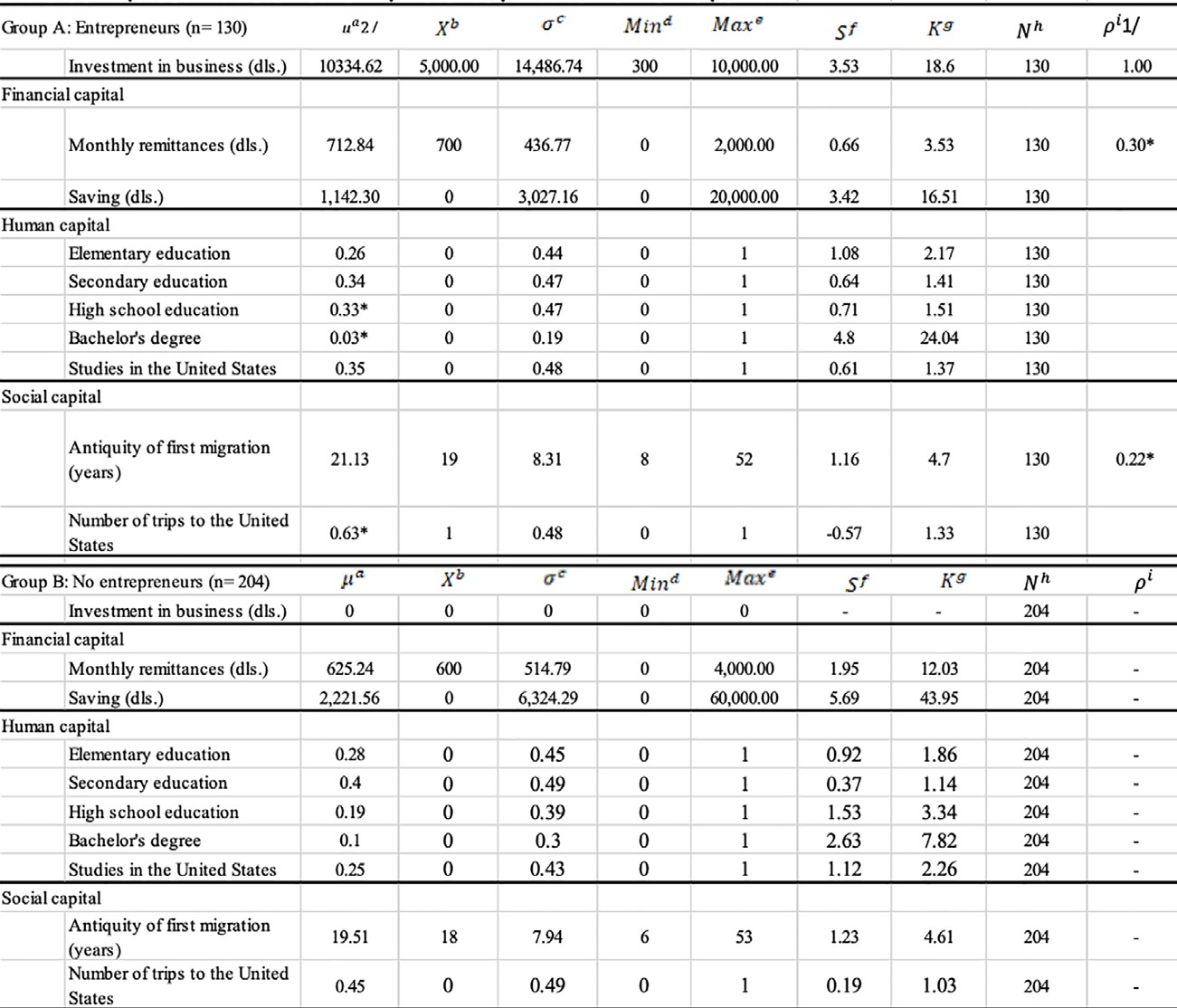
Table 2
Descriptive stadistics of the sub-samples of entrepreneurs and non-entreprenuers
own elaboration on based on data taken from the Table 1 of the paper of Cruz, Salas and Pico (2018).
a = arithmetic mean; b = median; c= standard deviation; d = minium; e= maximun; f= bias; g = Kurtosis; h = number of observations; i = correction coefficient between the investment in business and each
of the remaining variables. 1/All of the correlation coefficents p* have significan values at 95% and are marked with asterisk.
Correlations that are not stadistically significant appearemty.
Source: own elaboration on based on data taken from the Table 1 of the paper of Cruz, Salas and Pico (2018).
3. Results and discussion
3.1 descriptive statistics
Regarding the correlation between the entrepreneurship of returned migrants and the variables of financial, human and social capital for the entire sample, as we see in the last column of Table 1, we find posi- tives and statistically significant correlations only between investment in business and monthly remittances, secondary education, antiquity of first migration, and the number of trips to the United States, while the correlations between investment in business and the rest of variables in our analysis are not significant.
The above implies that only some variables of financial, human and social capital are clearly linearly related to investment in business, so that it is not possible to conclusively identify the factors of financial, human and social capital that are mostly related to investment in smallbusinesses by returned migrants.
On the other hand, in Table 3 a mean difference test was performed for the model variables between the values of the variables of financial, human and social capital of entrepreneurs and the values of the varia- bles of financial, human and social capital of non-entrepreneurs, finding no statistically significant difference between the two data groups for the majority of the variables: remittances, saving, education levels of primary school and secondary school, studies completed in the United States, number of trips to the United States, and years of antiquity from first migration. In contrast, for the variables levels of high school and undergraduate education and the number of the trips to the United States, a statistically significant difference was found, so it can be affirmed that differences between entrepreneurs and non-entrepreneurs are only found in some levels of education and the number of trips to the United States.4
These last results imply that is not possible to conclusively identify the factors of financial, human and social capital that differentiate entre- preneurs from non-entrepreneurs, so that the estimation of a regression is necessary
To build the regression model, first obtained the correlations between the variables included in the analysis, whose results are presented in Table 3. As we see in this table, the values of the correlations between the independent variables of the regression model are relatively low and the high correlations are rather scarce, such as, primary studies with secondary studies with a value of 0.4897, that of secondary with high school with a value of 0.4402, that of seniority of the first migration and the number of trips to the United States with a value of 0.4605 and that of primary education with preparatory education with a value of 0.3469.
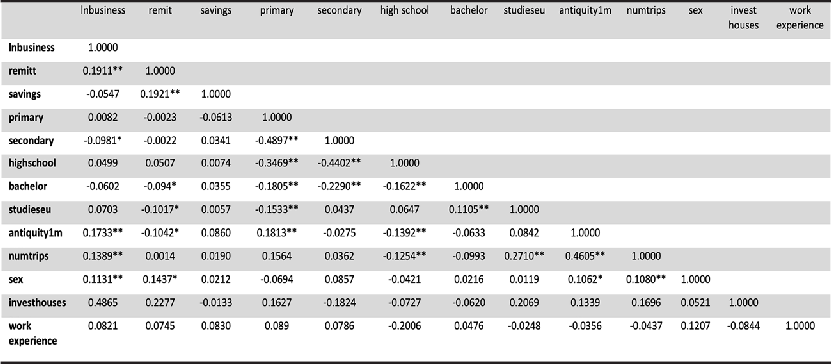
own elaboration based on the survey.Nota: The asterisks indicate that the coefficients are significant at 10% (*), 5% (**) and 1% (***). In all cases, the sample size, N, is 3
3.2 Results of the regression model and discussion.
The results of the estimation of the regression model are presented in the Table 4.
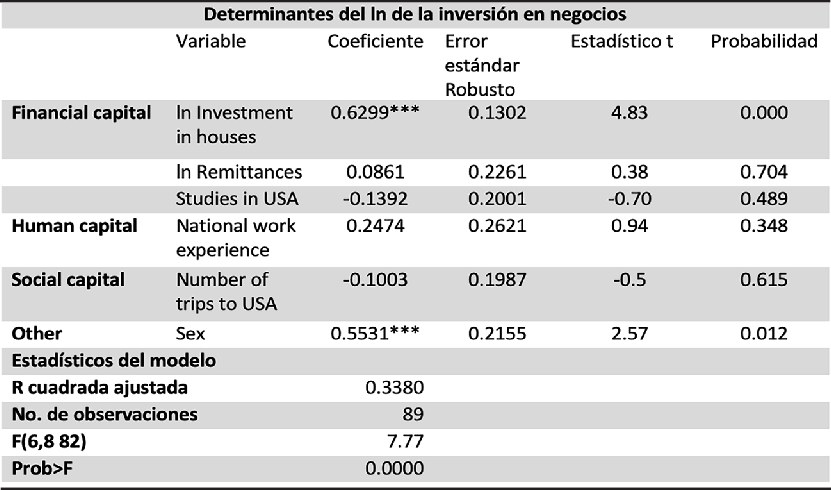
Own elaboration based on data obtained from the surveyNota: The asterisks indicate that the coefficients are significant at 10% (*), 5% (**) and 1% (***). The coefficients presented are standarized.
The goodness of fit measurement of the regression model, adjusted R., indicates that the independent variables of the model together, are able to explain much of the entrepreneurial decision of returned migrants. The R. adjusted, obtained in the model, of 0.33, indicates that the variables included in the model as a whole explain 33 percent of the variations in the variable that represents the amount of investment in business by returned migrants. This value is similar to the goodness of fit obtained in other similar studies for Latin America like the one of Alarcón and Ordóñez (2015) that obtained a value of 0.54 for migrants from Ecuador to Spain, and the one of Cruz et al. (2018) that obtained 0.23 for migrants from the state of Mexico to the United States. Inthe same way, it is similar to the value obtained in studies carried outfor other regions of the world, such as that of Gubert and Nordman(2011), which obtained 0.29, 0.30 and 0.35 for migrants from Algeria,Morocco and Tunisia to Europe, and that of Black and Castaldo (2009) who obtained 0.28 and 0.58 for migrants from Ghana and Cote d'Ivoireto Europe.
Regarding the impact of financial capital on entrepreneurship, we find a positive and statistically significant impact of investment in houses on investment in businesses, with a coefficient of 0.62, indica- ting an elasticity of 0.62, which is an increase of 0.62% in investment in businesses for every 1% increase in home investment. This result is similar to those found for other cultures, such as those of Kilic et al(2007) for migrants from Albania, Ilahi (1999) for migrants from Pakistan, Dustman and Kirchkamp (2002) for migrants from Turkey, Nicholson (2001, 2002) for migrants from Albania, McCormick and Wahba (2004) for migrants from Egypt, and Mesnard (2004) for migrants from Tunisia, although these measure the impact of savings and not precisely that of investment in houses.
On the other hand, the value of the coefficient found for the impact of gender on investment in business, of 0.55, implies that men are 55% more likely than women to start businesses, keeping the other factors constant, a result that contrasts with the one obtained in the similar work by Alarcón and Ordóñez (2015) that did not find the impact of gender for migrants from Ecuador to Spain. But instead, it is similar to the results obtained for migrants from North Africa to Europe, such as those of Gubert and Nordman (2011) for Morocco and Tunisia, in which the probability of entrepreneurship is 25% and 34% lower in women respectively, and those of McCormick and Wahba (2004) whofind for Egypt a 16% higher probability of entrepreneurship in men.
Regarding the impact of the human capital variables on entrepre- neurship, we did not find statistically significant impact of education and work experience on the entrepreneurship of returned migrants, a result that does not agree with those found in the work of Alarcón and Ordóñez (2015), and Tovar et al (2018), who do find a positive impact of education on entrepreneurship for migrants from Ecuador to Spain and from Colombia to the United States, respectively. Likewise, it contrasts with the results of the works by McCormick and Wahba (2004) for migrants from Egypt, Black and Castaldo (2009) for migrants from Ghana and Cote d'Ivoire, and Gubert and Nordman (2011) for Morocco and Tunisia, which find positive impact of education on entrepreneur- ship of returnees from Europe.
Regarding the variable that represents social capital, which is the number of trips to the United States, this also does not present a statistically significant impact on investment in businesses by returned migrants in our research, a result that contrasts with that found in Cruz and Salas (2018) for Mexico, in which the number of trips to the United States has a positive impact on the entrepreneurship of returned migrants.
Conclusions
In the literature we find that financial, human and social capital are important factors to explain the entrepreneurship decision for returned migrants, in particular that have a positive impact on the entrepreneu- rial decision of the returnees.
In the case of the fourteen urban and rural municipalities of the State of Mexico included in our sample, we find that one of the main factors that explain the business investment of the returnees is the investment made by the returnees in the construction and remodeling of houses, which allows them to have the necessary resources to invest in businesses. Likewise, we find that remittances do not have a significant impact on entrepreneurship, perhaps because they are used more for consumption. The explanation for the above is perhaps that in Mexico, as in all countries that send migrants abroad, returned migrants need financial capital to start a business, and emigration allows them to accumulate savings, which in the case of our country, is mainly intended forthe construction and remodeling of houses.
Also, we find that the variables used as proxies of human capital, primary education, secondary education and Bachelor´s degree as well as the education received in the United States and the work experience in Mexico, they have no significant impact on investment in business, which contrasts with the findings of the literature about the positive impact of education on entrepreneurship. This may be due to the fact that Mexican migrants in the United States, mainly those who come from rural communities, have a low educational level, so that when they return, education is not a factor that helps them make entrepreneurial decisions and neither does they are going to be trained in the country of destination to train as entrepreneurs; what it happens with migrants from some countries on the African continent, who have among their motivations to migrate to train as entrepreneurs in Europe and return to start their own business in Africa. On the other hand, it is necessary to recognize that in Mexico the culture of entrepreneurship is scarce, so that investment in businesses by returned migrants is more of a self- employment alternative than a business one, since returned migrants with a higher educational level prefer to seek a salaried employment than one of entrepreneurship.
Likewise, the prevalence of belonging to the male gender on the entrepreneurial decision of returned migrants in our country stands out, similar to what happened in some countries in North Africa and the Middle East; although we must recognize a significant difference, because while in Mexico this may be due to the fact that in Mexico the majority of returned migrants are men, in North Africa and the Middle East, it may be religious and cultural reasons that limit women's entre- preneurial decisions.
Regarding the social capital variables considered in this study, such as the number of trips to the United States, no significant effect was found on the entrepreneurial decision, perhaps because the type of variables included in our work do not agree with the social networks that the returnees keep in their communities of origin, which allow them to establish businesses.
References
Alarcón, Silverio y Jessica Ordóñez (2015). “Ecuador: Retorno migratorio y emprendimiento en Loja”, Revista CEPAL, (117), pp. 69-86. https://repositorio.cepal.org/bitstream/handle/11362/39465/1/REV117_Alarcon-Ordonez.pdf
Barbosa, Perla & Jerjes Aguirre (2011), “Migración de retorno e inversión en México. El caso de los migrantes de segunda generación”, INCEPTUM, Vol. VI, No. 10, Enero-Junio, pp. 95-123.
Batista, Catia; Tara McIndoe-Calder & Pedro C. Vicente (2010), “Reurn Migration, Self-selection and Entrepreneurship”, Oxford Bulletin of Economics and Statistics, Vol. 79, Issue 5, pp. 797-821.
Black, Richard; Russell King & Richmond Tiemoko (2003), “Migration, return and small enterprise development in Ghana: A route out of poverty?”, Working Paper, No. 9. Sussex Centre for Migration Research.
Black, Richard & Adriana Castaldo (2009), “Return Migration and Entrepreneurship in Ghana and Cote D’Ivoire: The Role of Capital Transfers”, Tijdschrift voor Economische en Sociale Geografie, 100(1), 44- 58. Doi:10.1111/j.1467-9663.2009.00504.x file:///C:/Users/Miguel%20 Cruz%20V%C3%A1squez/Downloads/Migration_return_and_small_en- terprise_development_%20(1).pdf
Canales, Alejandro (2008), Vivir del norte, remesas, desarrollo y pobreza en México, Consejo Nacional de Población, México. https://www.researchga-te.net/publication/281720179_Vivir_del_Norte_Remesas_Desarrollo_y_ Pobreza_en_Mexico
Cruz, Miguel; Renato Salas & Beatriz Pico (2018), "Posibles determinantes del emprendimiento de los migrantes retornados en el Estado de México", ponencia presentada en el 15o. Congreso Internacional de Migración, efectuado en la ciudad de Morelia, Michoacán, el 25 y 26 de Octubre de 2018.
Cruz, Miguel & Renato Salas (2018), Algunos casos de emprendimiento de migrantes retornados, en M. Cruz y A. Cuecuecha (comps.), Emprendimiento y Migración de Retorno. Raíces y Horizontes, México, Miguel Ángel Porrúa, El Colegio de Tlaxcala y la Universidad Popular Autónoma del Estado de Puebla.
Dustmann, Christian & Oliver Kirchkamp (2002), “The optimal migration duration and activity choice after remigration”, Journal of Development Economics, vol. 67, número 2, 351-372.
El Colegio de México (2018), Desigualdades en México 2018. 1a. edición, Ciudad de México, México. https://desigualdades.colmex.mx/informe-desigualdades-2018.pdf?fbclid=IwAR3yFs5sRcJwXLFJPjuBZY08YWJRBKvjfz10hBphyju_OuCqflPBaA7wges
Espinosa-Marquez, Araceli & Misael González-Ramírez (2016), “La adaptación social de los migrantes de retorno en la localidad de Atencingo, Puebla, México”. Ciencia UAT, vol. 11 (I), pp. 49-64, Julio-Diciembre. https://www.redalyc.org/pdf/4419/441946945004.pdf
Garduño, Silvia (2012), “Crece retorno de paisanos”, Reforma, sección “Nacional”, 9 de marzo.
Gubert, Flores & Christophe Nordman (2011), “Return Migration and Small Enterprise development in the Maghreb”, in Sonia Plaza and Dilip Ratha (eds.). Diaspora for Development in Africa, The World Bank, Washington, D.C., pp. 103-126. https://www.cbd.int/financial/charity/africa-diasporas.pdf
Gujarati, Damodar (2009), Econometría. Editorial Mc Garw-Hill, México.
Izquierdo, Antonio (2011), “Time of Losses: a False Awareness of the Integration of Inmigrants”, Migraciones Internacionales, vol. 6, núm. 1, enero- junio, Tijuana, México, pp. 145-184. file:///C:/Users/Miguel%20Cruz%20 V%C3%A1squez/Downloads/1063-4577-1-SM.pdf
Kilic, Talip; Gero Carletto; Benjamin Davis & Alberto Zezza (2007), “In- vesting back home: Return migration and business owbership in Al- bania”, The World Bank, Policy Research Working Paper 4366, 59-74. http://documents1.worldbank.org/curated/en/841261468002653974/text/ WPS4366.txt
Labrianidis, Lois & Panos Hatziprokopiou (2006), “The Albanian migration cycle: Migrants tend to return to their country of origin after all”, in Russell King, Nicola Mai and Stephanie Schwandner-Sievers (eds.), The new Albanian migration. Sussex Academic Press, Brighton, U.K. file:///C:/Users/Miguel%20Cruz%20V%C3%A1squez/Downloads/ docl_18313_173483905%20(6).pdf
Labrianidis, Lois & Brikena Kazazi (2006), “Albanian return-migrant from Greece and Italy: The impact upon spatial disparities within Albania”, European Urban and Regional Studies, 13, 1, pp. 59-74. https://www.researchgate.net/publication/249668871_Albanian_Return-Migrants_from_Greece_and_ItalyTheir_Impact_Upon_Spatial_Disparities_Within_Albania
Mansuri, Ghazala (2007), “Does work migration spur investment in origin communities? Entrepreneurship, schooling, and child health in Rural Pakistan”, in Caglar Özden and Maurice Schiff, (eds.), International migration, economic development and policy, The World Bank, Washington, D.C., pp. 99-139.
McCormick, Barry & Jackline Wahba (2004), “Return International Migration and Geographical Inequality. The Case of Egypt”, Journal of African Economies 12 (4): 500-532. DOI: 10.1093/jae/12.4.500.https://www.researchgate.net/publication/5212888_Return_International_Migration_and_Geographical_Inequality_The_Case_of_Egypt
Medina, Carlos & Christian Posso (2009), “Colombian and South-American immigrants in the United States of America: education levels, job qualification and the decision to go back home”, Borradores de Economía, 572.
Mendoza, Jorge Eduardo & Eliseo Díaz (2008), “¿Son las remesas una fuente de ahorro e inversión en México? Un análisis regional del comportamiento de los hogares”. Papeles de POBLACIÓN, Volumen 14, No. 56, pp. 37-65. http://www.scielo.org.mx/scielo.php?script=sci_abstract&pid=S140574252008000200005&lng=es&nrm=iso
Mesnard, Alice (2004), “Temporary Migration and Capital Market Imperfections”, Oxford Economic Papers, Vol. 56, No. 2, pp. 242-262.
Mestries, Francis (2013), “Los migrantes de retorno ante un futuro incierto”. Sociológica, vol. 28, número 78, enero-abril, pp. 171-212. https://www.redalyc.org/pdf/3050/305026407006.pdf
Meza, Liliana (2017), “Migrantes retornados en la ciudad de México: es más fácil irse quer regresar”, en Liliana Meza, Carla Pederzini y Magdalena de la Peña (coords.), Emigración, tránsito y retorno en México, Instituto Tecnológico y de Estudios Superiores de Occidente (ITESO), Guada- lajara, pp. 117- 147. https://rei.iteso.mx/bitstream/handle/11117/5530/ Emigraci%C3%B3n%2C%20tr%C3%A1nsito%20y%20retorno%20a%20M%C3%A9xico.pdf?sequence=4
Montoya, Jaciel; Renato Salas & José Antonio Soberón (2011), “La migración internacional de retorno en el estado de México: oportunidades y retos para el aprovechamiento socio productivo de sus capacidades”, Suma de Negocios, 2(2), 45-62. http://hdl.handle.net/20.500.11799/38990
Newland, Kathleen & Hiroyuki Tanaka (2010), Mobilizing diaspora entrepreneurship for development, Migration Policy Institute, Washington, D.C. https://www.migrationpolicy.org/pubs/diasporas-entrepreneurship.pdf
Nicholson, B. (2001), “From migrant to microentrepreneur: Do it yourself development in Albania”, South-East Europe Review, 39-42.
Nicholson, Beryl (2002), “The wrong end of the telescope: Economic migrants, immigration policy, and how it looks from Albania”, The Political Quarterly 73, 2002, pp. 436-444.
Papail, Jean (2002), De asalariado a empresario: la reinserción laboral de los migrantes internacionales en la región centro-occidente de México. Migraciones Internacionales, julio-diciembre, vol. I, número 003, pp. 79-102. https://www.researchgate.net/publication/28138037_De_Asalariado_a_empresario_la_reinsercion_laboral_de_los_migrantes_internacionales_ en_la_region_centro-occidente_de_Mexico
Paulson, Anna & Robert Towsend (2004), “Entrepreneurship and financial constraints in Thailand”, Journal of Corporate Finance, Volume 10, Issue 2, March, pp. 229-262.
Peláez, Oscar; Julieta Martínez & Roberto García (2013), “El papel de las remesas en los hogares de Chiapas, ¿consumo, inversión o ahorro?, ¿una vía para el desarrollo?”, CIAD, Revista de Estudios Sociales, 287-313. http://www.scielo.org.mx/scielo.php?script=sci_abstract&pid=S018845572013000100012&lng=es&nrm=iso
Rumbaut, Rubén (2006), “Edades, etapas de la vida y cohortes generacionales: un análisis de las dos primeras generaciones de inmigrantes en Estados Unidos de América”, en Alejandro Portes y Josh DeWind (coords.) Repensando las migraciones. Nuevas perspectivas teóricas y empíricas (en línea), Miguel Ángel Porrúa y UAZ, México, pp. 361-409.
Tovar, Luis Miguel; María Teresa Victoria; José Rafael Tovar; Gilberto Troncoso & Fernando Pereira (2018), “Factores asociados a la probabilidad de emprendimiento en migrantes colombianos que retornan a Colombia”, Migraciones Internacionales, Vol. 9, Núm. 3, Enero-Junio.https://migracionesinternacionales.colef.mx/index.php/migracionesinternacionales/ article/view/366/1244
Tovar, Luis Miguel & María Teresa Victoria (2013), “Migración internacional de retorno y emprendimiento: revisión de la literatura”, Revista de Economía Institucional, 15(29), 41-65. file:///C:/Users/Miguel%20Cruz%20 V%C3%A1squez/Downloads/Dialnet-MigracionInternacionalDeRetornoYEmprendimiento-4697585.pdf
Woodruff, Christophe & Rene Zenteno (2002), “Remittances and microenterprises in Mexico”, Working Paper, Department of Economics, University of California, San Diego.
Yúnez, Antonio; Edward Taylor & Javier Becerril (2000), “Los pequeños productores rurales en México: características y análisis de impactos”, en Yúnez, Antonio (comp.), Los pequeños productores rurales en México: las reformas y las opciones, Colegio de México, México.
Ilahi, Nadeem (1999), “Return migration and occupational change”, Review of Development Economics, 3, 170-186.
Notes