Abstract: The objective of this research was to analyze the application of the Theory of Planned Behavior (TPB) in the Entrepreneurial Intention of the returned migrant applying a Systematic Literature Review. The results identified a lack of research focused on the application of the TPB for knowledge of the entrepreneurial intention in the returnee migrant. Finally, no empirical evidence was found related to the application of TPB and Entrepreneurial Intention in returning migrants, so it is recommended that future research be carried out applying TPB in returning migrants, considering that this segment of people reveals highly entrepreneurial characteristics.
Keywords:International MigrationInternational Migration,EntrepreneurshipEntrepreneurship,Creación de nuevas empresasCreación de nuevas empresas,New FirmsNew Firms,<<.
Resumen:
Implicaciones de la teoría del comportamiento planificado en la intención empresarial del migrante retornado
El objetivo de esta investigación fue analizar la aplicación de la Teoría del Comportamiento Planificado (TCP) en la Intención Emprendedora del migrante retornado aplicando una Revisión Sistemática de la Literatura. Los resultados identificaron una falta de investigación centrada en la aplicación de la TCP para el conocimiento de la intención empresarial en el migrante retornado. Finalmente, no se encontró evidencia empírica relacionada con la aplicación del TCP y la intención empresarial en los migrantes retornados, por lo que se recomienda que en el futuro se realicen investigaciones que apliquen el TCP en los migrantes retornados, considerando que este segmento de personas revela características altamente emprendedoras.
Palabras clave: Migración internacional, Emprendimiento, Creación de nuevas empresas.
Implications of the Theory of Planned Behavior in the returned migrant’s entrepreneurial intention
Implicaciones de la teoría del comportamiento planificado en la intención empresarial del migrante retornado
Universidad Autónoma del Estado de México

Esta obra está bajo una Licencia Creative Commons Atribución-SinDerivar 4.0 Internacional.
Recepción: 11 Diciembre 2020
Aprobación: 03 Mayo 2021
Over the last hundred years, Mexico has gained the number-two ranking, after India, of migrants in the world. In this regard, around thirteen million Mexicans live outside of Mexico with most living in the United States.
If in addition to this figure we include second and thirdgeneration Mexicans, the population of people of Mexican Origin in the U.S. rises to 37.5 million (CONAPO & BBVA, 2018).
This immigration phenomenon highlights the effect of the voluntary or involuntary return of Mexicans with foreign-born children that has been escalating since the 2008 and 2009 financial crisis, generating 1.4 million returned and 2.2 million deported between 2009 and 2016. This opens up the likely possibility that this returned-immigrant phenomenon continues increasing.
The above presents a challenge for Mexico inasmuch as it has a limited tradition in terms of welcoming back migrants (CONAPO & BBVA, 2015, 2018).
The increasing number of returned Mexican migrants that return to their place of origin causes that immigration ceases to act as alternative labor in the context of Mexico (García and Del Valle, 2016).
In this respect, immigrants who returned or who were deported from the United States can likely be included in this statistic of the Mexican unemployment rate, which corresponds to 3.3% equivalent to 1.0 million people (INEGI, 2018).
This same phenomenon of an increase in the labor market was observed in the recent economic depression in Greece, which particularly affected the population of Albanian immigrants, stimulating a migratory return that increased the Albanian workforce by 5% in less than four years (Hausmann & Nedelkoska, 2018).
Parallel to the problems of unemployment and returned migrants, entrepreneurship emerges as an alternative that is considered a development strategy (Tapia, 2018).
This is due to the fact that entrepreneurship is the ability to identify an opportunity and the ability to identify, accumulate and control resources (Varela, 2010)
that can materialize in self-employment or in the generation of a company.
Therefore, entrepreneurship is an action, activity or behavior to carry out an individual or group initiative of an economic, social or political nature inside or outside an organization assuming economic and social risks. With this in mind, entrepreneurship attracts the interest of diverse researchers and leaders from developed and developing countries (Da Cruz, 2018, Cataño and Morales, 2015)
with the purpose of generating strategies that can encourage entrepreneurial intention that materializes in selfemployment or that generates new business units, thus contributing to the solution of unemployment problems generated in recent years.
In this context, entrepreneurship acquires an importance that triggers diverse research focused on analyzing how migrants who return to different nations with a high migratory tradition generate or could develop a productive project in their place of origin after their migratory experience.
On the Asian continent, Peng and Du, (2018) analyze the relationships between social capital, the acquisition of resources and entrepreneurial performance of returned, farmer migrants in China, identifying a significant positive effect on a farmer’s entrepreneurial performance by social capital, the strength of the links having the greatest effect.
In the case of Europa Gittins, Lang, & Sass (2015) analyze how the social capital acquired in the destination country as well as the establishment and companies in the place of origin of migrants returning to Central and Eastern Europe influence the spirit of business, organizational human capital, and the internationalization of Small and Medium Enterprises (SMEs), providing a basis for a more in-depth empirical research on the transformative effect of migrant entrepreneurs who return to their place of origin.
On the African continent Batista, Calder and Vicente, (2017) explore the way in which returnees contribute to the creation of new businesses in Mozambique, making a contribution regarding the negative selfselection that is not observable in migration stages.
This results in an underestimation of the effects of return migration on business results.
In Morocco, Hamdouch and Wahba (2015) studied the determinants of business behavior among returned migrants.
Their main findings identify that the migration experience plays a significant role beyond the role played by savings and resources captured by the length of migration.
In this same country with a high migratory tradition, Dokou, Philippart, & Karbouai (2018) analyze and compare the level of potential of the returned migrant entrepreneur and the local entrepreneur, identifying that the level of potential of the returned migrant entrepreneur is higher than that of the local businessman.
On the other hand, in Asia, Paasche (2016) studies from two angles how corruption affects the psychosocial and economic reintegration of the Iraqi Kurds returning from Norway and the United Kingdom; first, from the psychosocial point of view, corruption in these returned migrants undermines the sense of belonging and creates insecurity; second, from an economic point of view, the entrepreneurial spirit hinders and conditions their employability, concluding that corruption is a great challenge for their own reintegration.
In the American continent, Vega (2016) analyzes the strategies carried out by a group of men and women on their return to Ecuador after a migratory period of more than a decade in Spain.
These returned migrants are beneficiaries of the Cucayo subsidy provided by the Ecuadorian State to facilitate their self-employment. A priority identified in the study is to consider the individual and family aspects of the migrant’s experience in the strategies promoted by the National Ministry of Migration of Ecuador to start a business.
Analyzing the same subjects of study of the previous research but from a different approach in Ecuador, Mercier et al. (2016) analyze the factors of reintegration such as: the migratory experience and the characteristics of before and after migration are correlated with the results of migrants upon return, identifying the need to facilitate the integration of returned migrants with foreign education in the Ecuadorian labor market.
Continuing with the same line of research in the same continent, Alarcón and Ordoñez (2015) study the factors related to the decision to undertake ventures started by returned migrants in Loja, Ecuador.
They identified different variables that increase the probability of entrepreneurship such as: entrepreneurial experience during migration, voluntary return, as well as having worked in the agricultural industry and hotel trade in the place of destination.
In Colombia, Tovar et al. (2018) analyze various factors that determine whether or not a Colombian migrant who returns to his country becomes an entrepreneur.
They identified main elements as variables that modify the probability of being an entrepreneur, such as: having reference models and the perception of having the skills and abilities to undertake entrepreneurial activities, having higher education, having savings and establishing contacts with partners or suppliers.
In Mexico, the research scenario in relation to the analysis of the returned migrant, the factors and forms that could trigger an entrepreneurial behavior and / or the generation of a company is very scarce and almost non-existent, only research on the labor insertion of returned migrants has been addressed.
Along this same line of research, Sánchez et al. (2018) study the labor expectations of ex-migrants from central Mexico.
They identify that the search for employment is determined by the perception of information related to employment opportunities, occupational risks, and personal abilities.
The research analyzed above, emphasizes the importance of the migration experience for the labor market insertion and the creation of companies. They analyze this social phenomenon from different perspectives in different contexts with the purpose of identifying the processes of creation and distribution of the acquired knowledge in the migratory experience that favor business creation, economic growth, and employment; In this context, the returnee migrant is considered as a person who acquired knowledge, skills and migration experience during his or her stay in the destination country and often brings financial capital to his or her place of origin.
This segment of people whose strengths are generated by their migratory experience can provide different resources that contribute to local development, introduce innovations, generate employment, or promote new forms of organization (Alarcón and Ordóñez, 2015) in their places of origin.
Two main elements of this research (entrepreneurship and return migrants) have been mentioned and analyzed up to this point. However, it is necessary to introduce a third innovative element in the field of migration analysis, which corresponds to The Theory of Planned Behavior (TPB), developed in 1985 based mainly on the Theory of Reasoned Action; currently, it is one of the most widely used theoretical models in social and behavioral psychology for understanding human behavior. The application of this theory has diversified in the last decades giving it use in different areas of science such as biology, education, medicine, etc. to analyze, understand and modify different behaviors.
In the field of biology, Reid (2016) analyzed the behavior of a group of people regarding the control of a species of bats; in the field of Psychology, it was used to understand the behavior of helping colleagues suffering from depression (Lee, Choi, & Park, 2015) and for predicting the use of bicycles (Milković & Štambuk, 2015); in the medical field, Cheung, Rosenberg, & Vaillancourt (2014) analyzed the factors associated with the use of the IVs, Jiang et al. (2013) investigated behaviors and health habits and Jalambadani, Garmarodi, & Tavousi (2017) studied factors related to sex education.
TPB argues that the considered actions of an individual are preceded by conscious decisions to act in a certain way. These intentions are the result of the attitudes formulated through life experiences.
The personal characteristics and the perceptions extracted from these previous experiences can be found in Ajzen (1991). Azjen’s work is based on the premise that behavior requires a certain amount of planning that can predict the intention to adopt such behavior, and that this behavior is also based on certain beliefs that are important premises that determine attitude, intention and therefore, the behavior of a person.
This theory indicates that the behavior of the individual is prescribed by his or her intentions; This intention that precedes the behavior is influenced by three phases: attitude towards the behavior, subjective norm, and perceived control (see figure 1).
In the first phase, attitude toward behavior is an evaluation that can be favorable or unfavorable by the individual. This phase links the behavior of interests to the expected results.
The subjective probability that the behavior adopted will produce an expected result is seen in this light (Ajzen, 2006).
Second phase: the subjective norm refers to the perceived behavioral expectations of important individuals or groups such as family, friends and are a function of the population and the context (Ajzen, 2006).
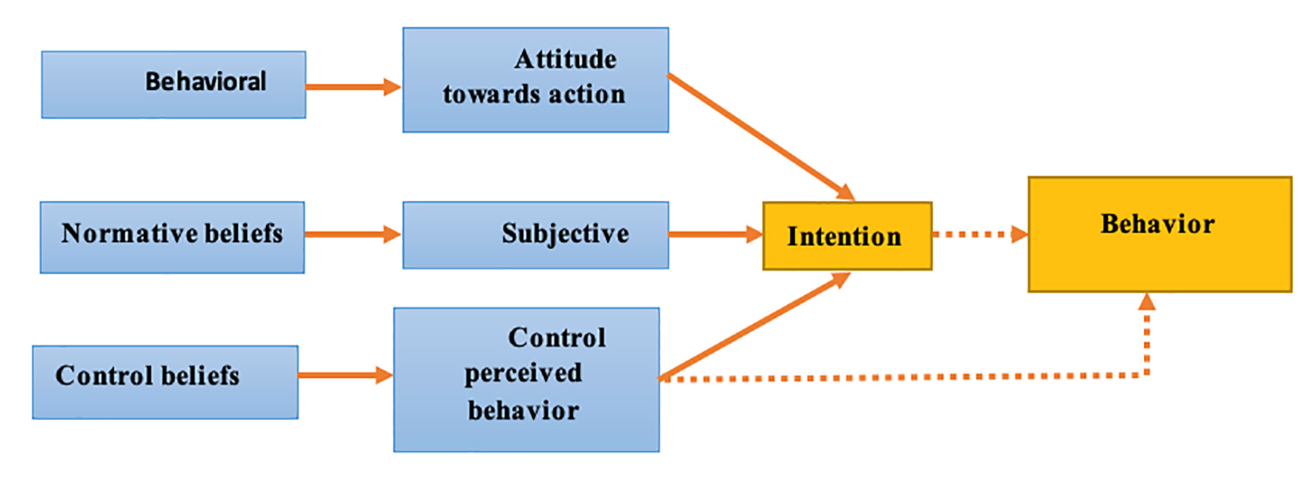
Figure 1
Theory of Planned Behavior
Azjen (1991,2006)
The last phase is Perceived control. This phase is composed of the control beliefs which refer to the perceived presence of factors that can facilitate or impede the performance of a behavior. These control beliefs in combination with the perceived ability of each factor of control determine the control of perceived behavior (Ajzen, 2010).
According to this Theory of Planned Behavior, these three components (attitude, subjective norm, and perceived control) comprise the most relevant information about the determinants of a behavior (Ajzen, 2010).
Much of the research in the world mentioned above emphasize and analyze the importance of the returned migrant, their insertion into the workforce (Becerra, Montes & Meza, 2018; Sánchez et al. 2018), and the creation of businesses (Peng and Du, 2018; Batista, Calder & Vicente, 2017; Dokou, Philippart, & Karbouai, 2018) from different perspectives in different contexts.
However, it becomes necessary to raise a reflective element in the face of a possible bifurcation of entrepreneurship[1]. The first, unfolds in a scenario of cyclical crises of the global economic system, as well as saturation of the labor supply of the formal market; main elements that trigger the research mentioned in previous paragraphs, where entrepreneurship stands as a redeemer of the need and opportunity of the domestic economy, its activity champions as an engine of self-sustainability and projector of the local economy; In this sense, the uncritical introduction of the conception and praxis of entrepreneurship has been very debatable in recent years, since the role of the entrepreneur has been largely consented only as a protagonist of the labor crisis, in a lack of review and critical reflection; although this is not the place to delve into this topic.
The second opens the debate on the role of the entrepreneur within the labor and human endeavor. For the above, it is necessary to reflect on the main purpose promoted by the ideology of entrepreneurship, which is to promote the idea in the subjects of their sovereign quality of decision and action; the particularity of this phenomenon is concentrated in the extent to which the dominated assume as their own the hegemonic ideologies; such subjects are, above all, the labor force that has not been absorbed by the labor market.
Based on the above, governments have found in entrepreneurship the solution to the labor needs and aspirations of a broad segment of society, introducing the motivating anxiety of becoming entrepreneurs themselves, incorporating a profile stimulated by creation, innovation, irrigation and leadership.
In this way, entrepreneurship as an economicmaterial resource, achieves its best effects in self-employment and in obtaining capital, but as a powerful mobilizer of behaviors, its achievement unfolds in the entrepreneur's own configuration of himself; ideology that leaves the weight of its successes or failures on the individual; consequently, hiding the market-government responsibility in the economy; highlighting what, in the discourse of entrepreneurship, is deployed to give identity to the qualification, classicism and modeling to the entrepreneur's profile, establishing the necessary codes to configure the social or personal behavior of the entrepreneur (Charaudeau, 2003); in this context, the construction of this ideological type, harbors the use of certain narrative devices, configured to represent certain categories that tie in with the neoliberal model in its individualistic condition, of rational choice and values.
For the development of this research, entrepreneurship is considered as an action, activity or behavior to carry out an individual or group initiative of economic, social or political type inside or outside an organization, assuming economic and social risks. At the same time, TPB is considered as a model that identifies behavior focused on knowledge, understanding and modification of human behavior and as a tool that should analyze entrepreneurial behavior in the returned emigrant to understand and trigger an entrepreneurial intention in this group of people.
Therefore, this research has the objective of analyzing the application of the Theory of Planned Behavior in the entrepreneurial intention of the returned migrant by applying a systematic review of literature considering the field of knowledge, geographical location of the research, and its objective.
Systematic literature review (SLR) is intended to summarize, compile, critique and synthesize existing research on a thematic area or phenomenon of interest using a search, cataloging, ordering, analysis, critique and synthesis process (Suter, 2013).
For the present article a SLR was carried out (see table 1), based on the methodology proposed by Medina, et al. (2010) and Gómez, et al (2014); which was developed in the following stages: 1) Identifying the field of study; 2) Selecting information sources; 3) Carrying out the search; 4) Managing and debugging the results and 5) Analyzing the results.
The methodology used in this investigation consisted first in the identification of the field of study where the objective of the research was defined, which is focused on analyzing the application of the Theory of Planned Behavior in the entrepreneurial intention of the returned migrant applying a systematic review of literature considering the area of knowledge, geographical location of the research and the purpose for which the research was conducted; the period to be analyzed was then concretized, which was 2012-2018, because six years were considered as a relevant range to analyze the implications that the TPB has had at present.
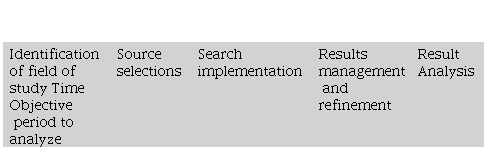
Prepared by the author; supported by the methodology proposed by Medina, et al. (2010) and Gómez, et al (2014)
Subsequently, the sources of information were selected, considering the publications found mainly in different specialized databases in the areas of social and economic-administrative sciences. Once the field of study was identified, the period of time to be analyzed and the sources of information selected, our search performance was established, wherein the criteria to be used and the search method proposed by Medina, et al. Was to be used.
Identifying the most outstanding characteristics for fulfilling the search, the criteria was carried out manually and automatically. The criteria that were followed to establish the manual search method was, first of all, the revision of articles related to keywords (Theory of Planned Behavior, Entrepreneurial Intent, and Returned Migrant); as well as to consider articles related to this research, where subjects such as Entrepreneurship, Entrepreneurial Spirit, Behavior, Motivation and Attitude were contemplated. In addition, literature references that only considered one keyword were excluded. For this research, articles containing the keyword entrepreneurial intent were excluded without being linked to the TPB; that is, investigations that did not match the search conditions specified above.
The criteria that were used to perform the automatic search method were similar to the manual search criteria, converting the search criteria into instructions interpretable by the searchers of the databases termed syntax. The basic operators of the syntax were And, Or and Not. And combined the search terms so that each selected reference contained them all. Or combined the search terms so that the selected references contained at least one of them and finally, Not excluded terms, so that no selected reference could contain them.
For the development of the management and refinement of search results, we proceeded to examine references found in 315 articles. In this sense, the name of the research was reviewed, the key words identified, and the summary of each identified work was reviewed. With this information it was classified in one of the following three categories: 1) Selected: the work is of our interest, 2) False positive: the work has been selected according to the established search strategy, but, in spite of this, it does not correspond the real purpose of the search and is not of our interest; and, 3) Doubtful: it is not clear to the researcher whether the work is of interest or not and considers that it is necessary to perform a more detailed analysis of it for its classification. It should be noted that in the research we had access to in this investigation, we only considered research relevant to our interest. Subsequently, once the search conditions were determined the selected works were exported to a categorical matrix with the intention of having greater flexibility when processing the obtained references.
The SLR that was elaborated in this research ended with the results analysis phase, where a critical analysis was carried out in each of the selected works and exported to the categorical matrix. The following are the analyzed implications: 1) The knowledge area of research application; 2) The approach of the proposed objectives in the scientific research and 3) The geographical Area where the research was carried out. The following section presents the results, which correspond to the last stage of the methodology used in the development of the SLR of this research.
After selecting the established search criteria from the methodology mentioned in the previous section, 50 articles were selected in English and Spanish that fulfilled the search characteristics. The same articles were analyzed considering the implications (Application area, Geographic Area and Objective of research) considered in this research.
The area of application of the selected research can be seen in Table 2. The area where a greater number of investigations are carried out that use the Theory of Planned Behavior as a foundation is the academic one, registering 34%. These investigations are focused on analyzing the intentions and entrepreneurial behavior of university students.
This reinforces the arguments that support the idea that young university students contribute significantly to being involved in decisions of behavior change and entrepreneurial intentions by the type of career they are studying (Maluk, 2014, Rodríguez & Prieto, 2009).
In this same analysis of the application of the TPB by field of knowledge, articles focused on health care issues concentrate the second position with 14%; and very close behind is the commercial area where the TPB is applied to identify behaviors and purchase behaviors of different products with 12%. On the other hand, the rest of the percentage of investigations regarding the TPB applied in other fields of knowledge with the purpose of identifying or modifying different behaviors was minimal. Some of these areas were gender, hygiene, sex education, and the environment.
The results expressed in Table 2 also show the absence of research oriented to the application of the TPB and the Entrepreneurial Intention (EI) directed to the segment of returned migrants. In fact, at the time of carrying out the search, we did not find a single study with these three related keywords. This allows us to identify a new research trend, emphasizing the need to carry out research that links TPB and EI with the Returned Migrant (RM).
Articles grouped by field of knowledge
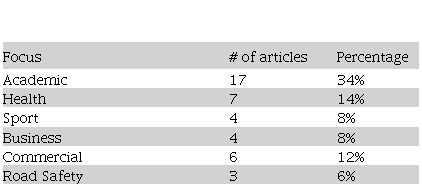
Prepared by the author
Different research investigations throughout the world analyze the RM from different perspectives (Espinoza & González, 2016; Koolhaas, 2016;Alarcón & Ordóñez, 2015; Anguiano, Cruz & Garbey, 2013; Nieto, 2012).
They have shown that these types of people acquire and develop different entrepreneurial skills and behaviors from their migratory experience.
At the time of their return, migrants are shown to possess knowledge, competencies, abilities, and skills that could likely make them important social actors in their place of origin, thus arguing that entrepreneurship emerges as a necessary means of inserting these people in the workforce, where it is expected, according to Whaba and Zenou (2012) that the returnees become entrepreneurs.
This, in turn, reflects the success of a migratory experience in which human capital is accumulated after years of residence in the destination country.
The results found in relation to the geographic area of research development analyzed in this article, were found by means of a segmentation by continent (see table 3). We found that from the total of selected articles, the majority (40%), were researched in countries of the Americas, followed by Europe, which represent 32% of the total number of articles found.
These same geographic regions are those that currently register the largest number of scientific publications that use the TPB to predict or change some behavior in humans in different fields of knowledge (see table 3). It should be noted that the returned migrant is not a subject of study in this research.
With the results of geographical publication found in this research, we could infer the necessity of the Asian continent in the scientific production of research that analyzes the entrepreneurial intention of the low return migrant using the TPB approach.
Articles grouped by continent
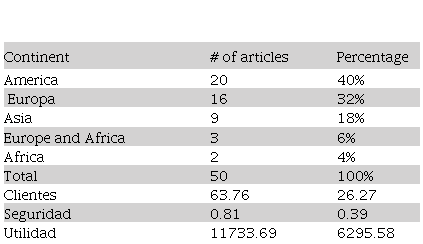
Prepared by the author
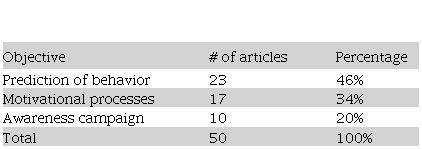
n relation to the results regarding the objective sought in the selected research, three main characteristic features stand out. 46% of the research seeks to predict the behavior, while 34% seeks to know what the motivational processes of the study subjects are, and the thirdparty searches for all kinds of relevant information in order to generate awareness campaigns to prevent diseases or bad habits (see table 4).
Articles objective
Prepared by the author
If the venture is considered an action, activity, or behavior to carry out an individual or group initiative of an economic, social, or political nature, within or outside of an organization where economic and social risks are assumed, then the need to carry out scientific research arises that helps to know and predict the returned migrant’s entrepreneurial conduct, in order to generate awareness campaigns in the returned migrants that can potentiate an entrepreneurial behavior, since according to Azjen (1991), the TPB is based on the premise that the behavior needs a certain amount of planning that can predict the intention of adopting such behavior.
As part of the results identified and described in previous paragraphs, it can be seen that the entrepreneurial subject has been qualified - by its own apologists - as an agent of social change, conceiving entrepreneurship as an incubator of successful actors, which has made invisible its invasive character as a builder of behaviors and attitudes, which responds to an ideological interest, since these ideologies essentially aim at the justification and continuity of market logics and appeal to the legitimization of the hegemonic political status quo (Laclau and Mouffe, 2001).
In this scenario, the entrepreneur has empathized with the idea of modern man and with the flexibilization of labor, but its results do not always point to the particular or common welfare, in this last sense Sennett (2000) emphasizes that the flexibilization of this type of enterprises does not necessarily produce greater grace in profits, since its ideology is not manifested in a reflexive way.
In this sense, entrepreneurship adopts risk as a main characteristic, where its economic units are formed on a flexible economic model and under the parameters of a risk society (these two aspects being reproduced as the normalizing measures for its exercise), leaving behind the institutional securities of the State's stewardship and regulation of employment, economy, welfare and social security, to move to a scenario of uncertainty, which has flexibility and risk as its norm. Thus, risk - in entrepreneurship - is seen as an opportunity and motivation.
The only field where a greater number of researches is developed that uses the Theory of Planned Behavior as a foundation to analyze intentions and entrepreneurial behavior, is the academic field, having university students, mainly from economic administrative fields, as the main subjects of study. In this context, the application of the TPB has great expectations that behavior that can show / modify university students. Nevertheless, it is necessary to mention that it’s possible these students still do not belong to the labor market and do not present / display the necessary maturity that the entrepreneur needs. This is interpreted as a negative attitude towards entrepreneurial intention. For this reason, it prevails that there are entrepreneurship policies that encourage entrepreneurial activity with the intention of reducing fear and uncertainty in order to undertake and encourage entrepreneurial motivation in each of them.
Most of the research that applies TPB were carried out in countries in the Americas (40%), followed by Europe, which represent 32% of the total of the articles found. The application of this TPB focuses on different fields of knowledge by analyzing study subjects that do not correspond to returned migrants.
Three main characteristics stand out in the analyzed research. First and foremost, they seek to predict the behavior of the subject of study. Secondly, they seek to know what the motivational processes are that induce the subject of study to a specific behavior. And, thirdly, they seek all kinds of relevant information to generate awareness campaigns to prevent diseases or bad habits.
On the other hand, the results found did not show empirical evidence related to the application of TPB and IE in returned migrants; therefore, a call is made to conduct multi-, trans-, and inter-disciplinary research that can generate knowledge about entrepreneurial intention in returned migrants in sending countries and in immigrants in receiving countries, considering that this segment of people reveals highly entrepreneurial characteristics Tovar et al. (2018); Mercier et al. (2016); Dokou, Philippart, & Karbouai, (2018); Vega (2016) and Mendoza (2013).
For the above, Fishbein and Ajzen (2010) suggest the following steps to apply TPB to an investigation; First, Defining the Behavior: Before any work can begin, the behavior of interest must be clearly defined in terms of its target, action, context, and time elements; Second, Specifying the Research Population: The population of interest to the investigators also must be clearly defined; third, Formulating Items for Reflective (Direct) Measures: Five to six items are formulated to assess each of the theory’s major constructs, Attitude, subjective norm, perceived behavioral control, and intention. Seven-point bipolar adjective scales are typically employed; fourth, Eliciting Salient Beliefs: A small sample of individuals representative of the research population is used to elicit readily accessible behavioral outcomes, normative referents, and control factors.
Although the participants can be assembled in groups, the elicitation is done individually in a free-response format; fifth, Constructing Sets of Modal Salient Beliefs: A content analysis of the responses to the above questions results in lists of modal salient outcomes, referents, and control factors. These lists are used to construct items to be included in the final questionnaire; sixth, Selecting Reflective (Direct) Items: The pilot questionnaire, in addition to eliciting salient outcomes and experiences, normative referents, and control factors also includes the items that were formulated to obtain direct measures of attitude toward the behavior, subjective norm, and perceived behavioral control. The data obtained are used to select reliable and valid items for use in the final questionnaire. Each set of items designed to directly assess a given construct should have a high degree of internal consistency (e.g., a high alpha coefficient), and the measures of the different constructs should exhibit discriminant validity. To achieve these aims, one or two items may have to be dropped for each construct. Confirmatory factory analysis is one means of evaluating the quality of the scales to be included. Finally, the pilot questionnaire also includes measures of any background factors or other variables the investigator believes may be interest for the behavior under investigation. These could be demographic characteristics (age, gender, ethnicity, level of education, income), personality characteristics (e.g., conscientiousness) or other individual difference variables (e.g., self-esteem, sensation seeking), social structure variables (e.g., rural vs. urban residence), and so forth.
Finally, the role of entrepreneurship as an economic unit is not questioned in this research, but on the contrary, it is analyzed as an essential resource for the economy at various levels, since there is a set of data and information on the benevolences of this force, but in parallel we propose that a critique and review should be made of the part that corresponds to the stereotypes and values that generate behaviors and attitudes around entrepreneurship, since these create adverse circumstances in the sociological, psychological and anthropological categories.
Figure 1
Theory of Planned Behavior
Azjen (1991,2006)
Prepared by the author; supported by the methodology proposed by Medina, et al. (2010) and Gómez, et al (2014)
Articles grouped by field of knowledge
Prepared by the author
Articles grouped by continent
Prepared by the author
Articles objective
Prepared by the author
