When services are offered by small and medium retailers: what is the customer’s perception?
Cuando los pequeños y medianos detallistas ofrecen servicios: ¿cuál es la percepción del cliente?
When services are offered by small and medium retailers: what is the customer’s perception?
Universia Business Review, no. 49, 2016
Portal Universia S.A.
Received: 30 November 2015
Accepted: 09 February 2016
Abstract: The concept of servitization or adding services to the existing product offer has been mainly used in the manufacturing sector but little or no attention has been paid to the application of this concept in the retail sector. The purpose of this exploratory research is to measure the perceptions that customers have towards local small and medium retailers regarding the services they offer. We also want to compare the profile of the customers that consider products and services the most important factor when choosing a retailer compared to the rest of the sample. Our findings show that there are a few differences between customers who would prefer more services compared to customers who state that services are not their priority.
Keywords: Servitization, Servicedominant logic, Customer perception, Small and medium retailers, Survey.
Resumen: El concepto de servitization o añadir servicios a los productos que ya se venden, se ha utilizado principalmente en el sector manufacturero, pero muy poco o nada a la hora de aplicar este concepto en el sector minorista. El propósito de esta investigación es medir cuáles son las percepciones que tienen los clientes hacia los minoristas con respecto a este nuevo concepto. También hemos comparado el perfil de los clientes que tienen en cuenta los productos y servicios como el factor más importante para elegir un minorista con el resto de la muestra. Nuestros resultados muestran que existen algunas diferencias entre los clientes que prefieren más servicios en comparación con cliente para los que los servicios no son su prioridad.
Palabras clave: Servitization, Lógica del servicio dominante, Percepción del cliente, Pequeños y medianos comercios, Encuesta.
1. WHAT IS SERVITIZATION?
According to Vargo and Lusch (2004) we live in the era of services, which means that traditional product-based companies add services to their offers. If this is the case, can we still apply the concepts (such as the marketing mix) that marketers have been using for many years? Would it not imply that marketing strategies of businesses should pay much more attention to principles, theories and practices of services rather than using the previous frameworks for mainly products?
One of the new emerging concepts regarding a new theory for services is “servitization”. Servitization is recognized as the process of creating value by adding services to products (Rada and Vandermerwe, 1988). So far, some companies are used to selling a product, forming a transactional relationship with their customers (“I sell you a product, you pay me, end of the relationship”). But selling services creates a relationship between the company and customer (“I provide you a service, we start a relationship, we keep in touch”).
The growing interest in servitization by scholars, businesses and policy makers is rooted in the belief that a move towards servitization could create additional value for the organizations (Hewitt, 2002; Muller and Doloreaux, 2007; Baines et al., 2007). This new value derives mainly from the relationship created and takes form in terms of a different revenue model, differentiating from competitors, changing how the company is structured and even develops a new business model for the Company.
1.1. Servitization in different sectors
So far, this concept of servitization has been primarily studied in the manufacturing sector and its interest has increased since the mid-1990s. When we look at servitization, it can be taken from distinct researcher communities, such as services marketing, service management, operations management, product-service systems and service science management and engineering, which are contributing to knowledge production in the servitization of manufacturing.
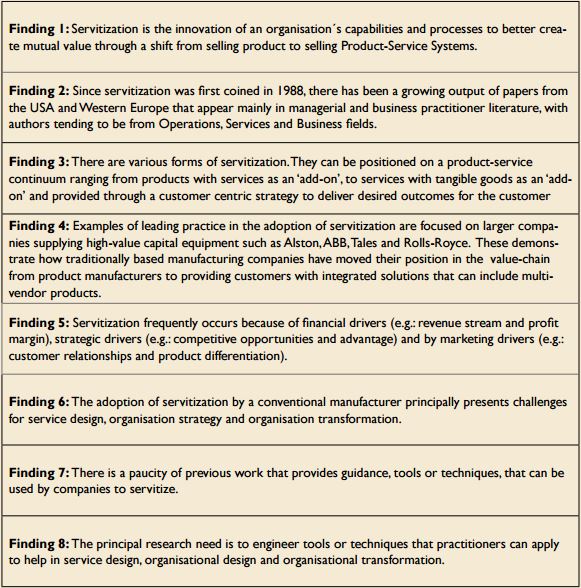
Baines and Lightfood (2013) recently collated the research into servitization, the main findings of which are summarized in the following table: (see Table 1).
Although servitization has been mainly researched in the manufacturing sector, there are other sectors where the concept has been applied. Barnett et al., (2013) analyzed a case study of a complex engineering service and suggested that in order to provide services, a paradigm shift needs to occur.
Another sector researched is local newspaper companies. SánchezMontesinos and Arias (2014) analyzed the relationship that exists between the firm’s and individual’s adaptation to servitization, and the concept of absorptive capacity in this sector. The results of the study show, not surprisingly, that the newspaper companies should improve the relationship with its clients: the reader and the advertiser.
As an example of the need for change in the ways that companies normally operate if they want to profit from servitization, Bustinza et al., (2013) studied the music industry in the UK and discovered that not all the consumers wanted to take part in processes of cocreation to add more value for them. One of the findings showed that the most numerous group of the sample named “Cautious Consumer” that represented 43% of the sample, did not have any interest on the co-created valued, preferring not to be part of the value chain and were interested in a limited number of transactions and information exchanges with the music firms. This conclusion highlights the importance of analyzing consumers’ attitudes and the mechanism to induce them to value co-creation processes of services and, afterwards, design offerings that allow these groups to participate in the buying process in order to increase the revenues of the firm.
2. CAN THE SERVITIZATION CONCEPT BE APPLIED TO SMALL AND MEDIUM RETAILERS?
BS To address our research problem, we have to adapt the definition previously stated for servitization to the retailing context as follows “the innovation of a retailer in its capabilities and processes in order to sell not only products, but products and associated services”.
In a context where the competition is very intense and products are similar, adding services to the existing value proposal could make it more attractive for some clients and differentiate it compared to other competitors. Attracting a higher proportion of customers should be an area to explore in retailing.
So, we propose the following questions: Can the servitization concept be applied to the retailing sector? Can servitization be a framework to increase the competitiveness of retailers? Do all customers want more services?
As mentioned earlier, it could make sense to look for alternative theories to develop a better marketing strategy trying to offer (more) services. As such, if we take the service-dominant logic (S-D logic), Vargo and Lusch (2004) argued that customer value is co-created by the customer and the company. This means that customers appraise the value of goods they purchase in use, and that exchange value determination is always provisional upon later experience. In other words, customers determine what they value-in-use and the marketer can only offer value propositions (Ballantyne and Varey, 2008).
According to Vargo and Lusch (2012), service is the dominant logic for marketing. Service is an interactive process that is valued by the customer. From this perspective service becomes the unifying purpose of any business relationship (Ballentine and Varey, 2008).
Value comes from the ability to act in a manner that is beneficial to a party. Value is subjective and ultimately determined by the beneficiary, who in turn is always a co-creator of the value. It then follows that the consumer is also seen as an operant resource. Operant resources are usually not exhaustible, but rather are scalable, reusable, renewable, and creatable. Therefore, in S-D logic, competition is a matter of knowledge creation and application. It is about the comparative advantage in service provision (Lusch et al., 2007) and retailers are primarily service integrators. In conjunction with their own and other’s knowledge and skills (including those of other value-creation partners) and the knowledge and skills of the consumer, this service-integration function allows the customization of variety (in Goods-Dominant Logic, captured as sorting and assorting functions) and application for maximum benefit (service) to the consumer’s unique situation and uniquely determined value (Lusch et al., 2007).
In particular, retailers are now proposing themselves as suppliers able to simplify customers’ lives, offering value proposition based on one-stop solutions. In so doing, they are acting in a Service-Logic, as the interaction within partners is concerned with solutions and phenomenological events (Lusch et al., 2007).
Other studies analyze the innovation in retailers’ business models (Sorescu et al., 2011) or how a retailer creates value for its clients. Innovative business models are increasingly important in order to create a sustainable competitive advantage in the market. The authors propose that the innovations in business models in retailing are better appreciated as changes in these three areas: 1) in the way activities are organized; 2) the types of activities that are carried out; and 3) the level of participation of the actors involved in these activities.
Although there is important research interest on servitization, some authors comment on the number of clients who are asking for more services. In the case of retailing, this is very important due to a tendency of offering less services such as self-service or low cost and low service offerings (Rosenbloom & Dupuis, 1994). As discussed before, in the music industry four types of customers where identified and two of them, representing 41% of the sample, could be involved in co-creation activities (Bustinza et al. 2013).
In this context, it seemed necessary to analyze a broad sample of customers to better understand the profile of those willing to have more services.
As far as we know there are very few papers devoted to servitization in retailing and so there is a gap to fill in this area. From this perspective, the present study aims at discovering the perceptions that customers have related to small and medium retailers and analyzing the profile of a customer willing to have more services in retailing. So from a broad sample of customers we want to identify those that would like to have more services, and in this subsample explore what kind of service they would desire. Finally, we wish to explore how the active role of the customer could co-create value in the servitization process.
3. CONSUMERS´ PERCEPTION ANALYSIS
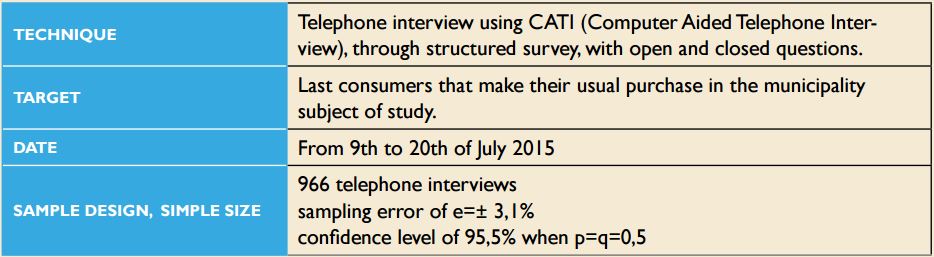
For the purpose of our research, we wanted to compare the customers that give more importance to the services offered in terms of online and offline behavior, demographic profile and expectations to those who do not pay attention to such services. In order to identify these consumers, we designed a question for identifying the most valued attributes when choosing a retailer. We asked customers what they valued the most and we provided seven categories: Price (quality-price relationship), Proximity, Professional Attention, Intangible assets (being trust worthy, or innovative or been in the neighborhood), Offer products and services, Convenient Location and Good Offer (different brands, quality of products).
Not surprisingly, only a small group of customers (5.9%) declared the “offering of Services besides the Products” to be the most important issue when choosing a retailer. So we decided to name them as the “pro-servitization” group from the whole sample and, subsequently we carried out our analysis of this subsample to ascertain a profile of them. We then compared this subgroup with the rest of the sample. Student´s t tests and chi-square tests were conducted to discover if differences in the answers of both subsamples were significant from a statistical point of view.
Source: own elaboration.
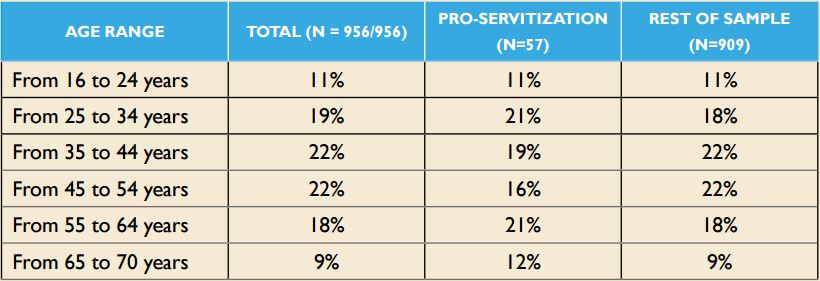
Regarding the mean age of customers, the “pro-servitization” group was 45.9 years old while the rest of the sample was 44.7 years old; the difference was not statistically significant. However it is worth noticing that the “pro-servitization” sample is skewed to younger and older groups compared to the rest of the sample as indicated in Table 3.
Then, we examined if there was any significant difference among both groups, according to the life-cycle criteria. The results are presented in Table 4.
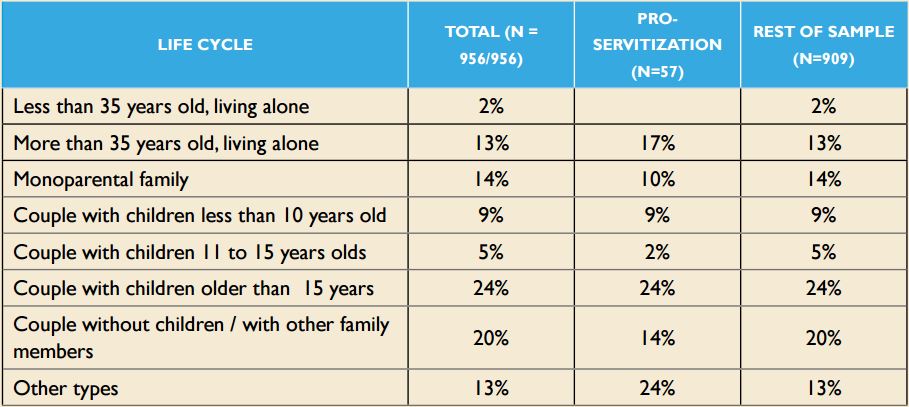
As shown, results do not provide any specific pattern for our “proservitization” group as differences are not statistically significant.
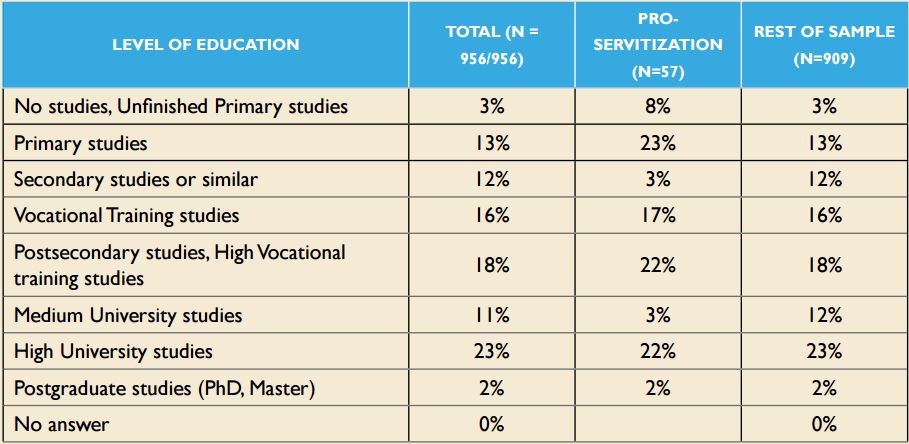
Then, we analysed the “Level of education” of both samples to learn that, although there is no significant difference from the statistical point of view, our “pro-servitization” group seemed to be less educated than the rest as shown in Table 5.
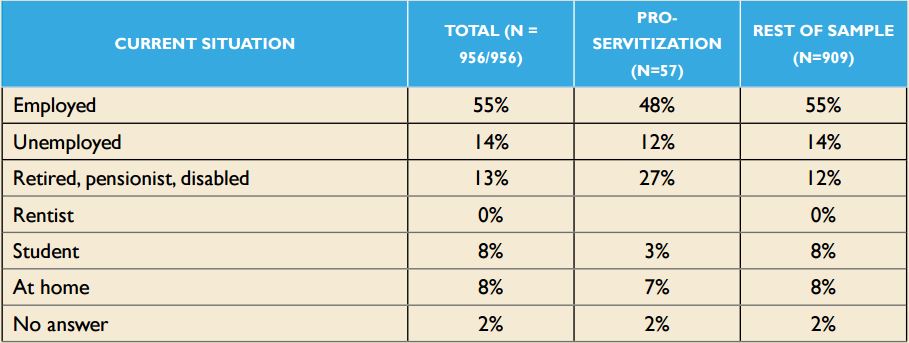
After that, we examined the differences between both samples under the “Current occupation” variable, to reveal that the “pro-servitization” group had more “retired” people than the rest of the sample, although again, differences were not significant. Table 6 shows the distribution for this status.
We paid special attention to digital characteristics such as e-commerce and social network. For example, the e-commerce phenomenon: although our “pro-servitization” subsample seemed to embrace this kind of buying to a greater extent compared to the other group, again, differences were not statistically significant. Answers to this item are summarized in Graphic 1.
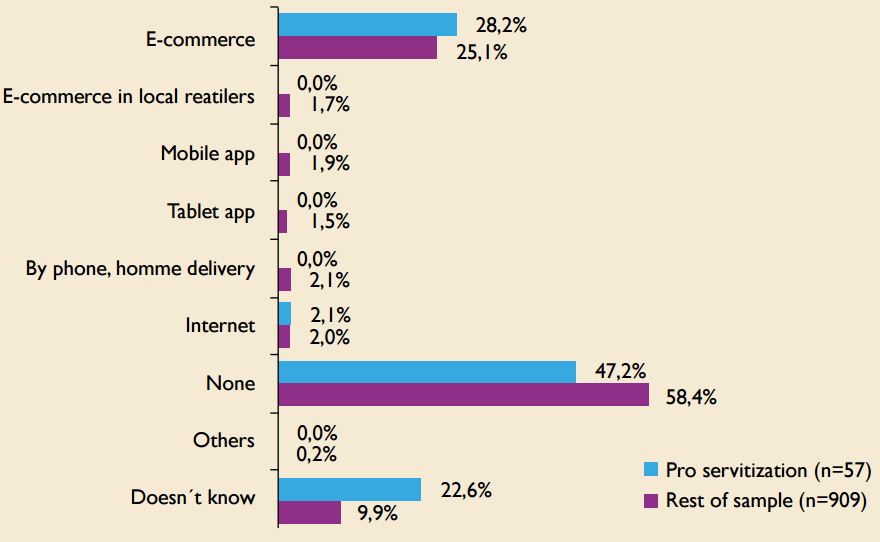
Graphic 1
Distribution of both groups according to “Online behaviour”
Then, we studied the activity of both subsamples in “Social networks”, which showed that the “pro-servitization” group seemed to be more active in social networking, although differences continued to be non significant.
Delving further into “Participation in Social Networks” we studied the ones used by both samples, to discover that there was no significant differences between both subsamples as shown in Graphic 2.
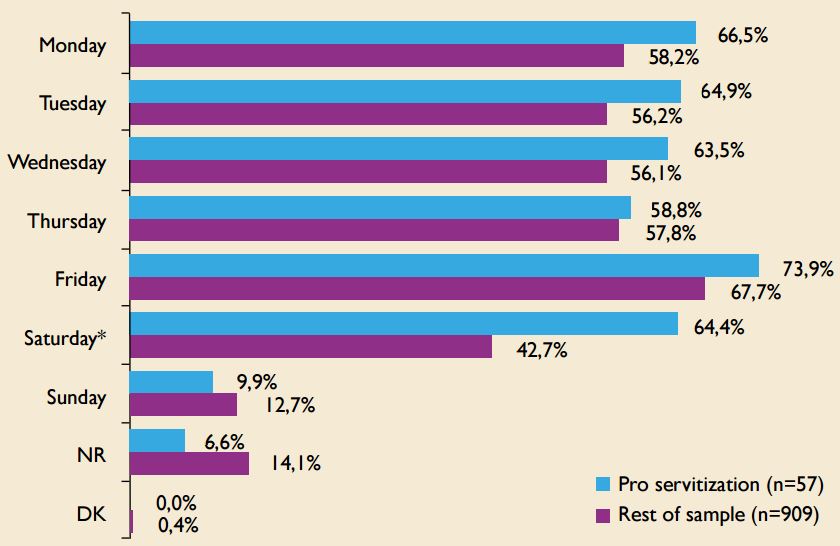
But we found differences in the pattern of purchase. Analysing the main day of purchase of both subgroups, we discover that our “proservitization” subsample seemed to choose all days more than the other, and differences were statistically significant only for Saturdays. Results are summarized in Graphic 3.
Closer examination was used to determine if our “pro-servitization” subsample was more active in a given period of time (Morning, Noon, Afternoon) during each day of the week. The results showed that, differences were statistically significant only on Mondays and Tuesdays, buying less on mornings and more on afternoons in both cases (differences in noon buying were not significant).
We also wanted to know if there was any significant difference in the amount of money spent in their “Last Purchase” in a set of given categories, and although our “pro-servitization” subsample seemed to have spent more in Travelling and in Computers, there was no evidence that the differences were statistically significant for any item.
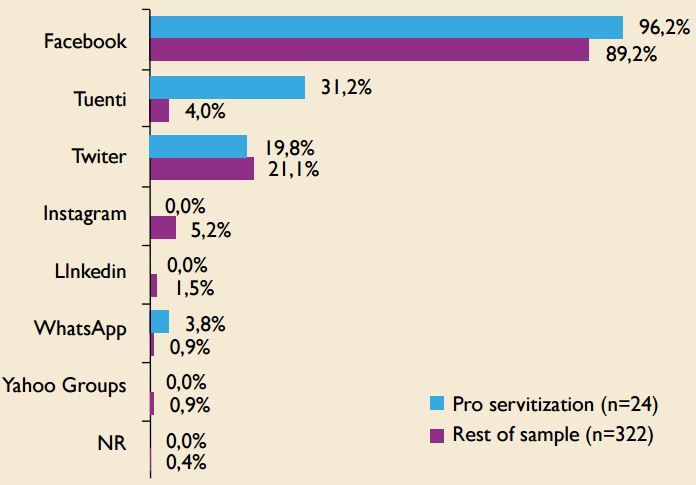
Graphic 2
Use of different “Social-Networks” in both subsamples
Graphic 3
Distribution of according to the main day of purchase
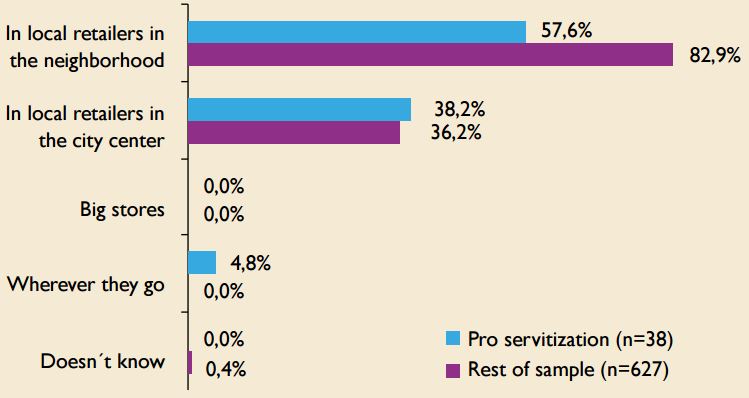
Another aspect we looked at was the type of store in which both subsamples tended to buy from. Differences were statistically significant, showing that our “pro-servitization” group bought in local stores less in the neighborhood and more in the city center. Graphic 4 displays the answers to this item.
Graphic 4
Distribution of both groups according different types of “Local retailers to purchase”
Graphic 5
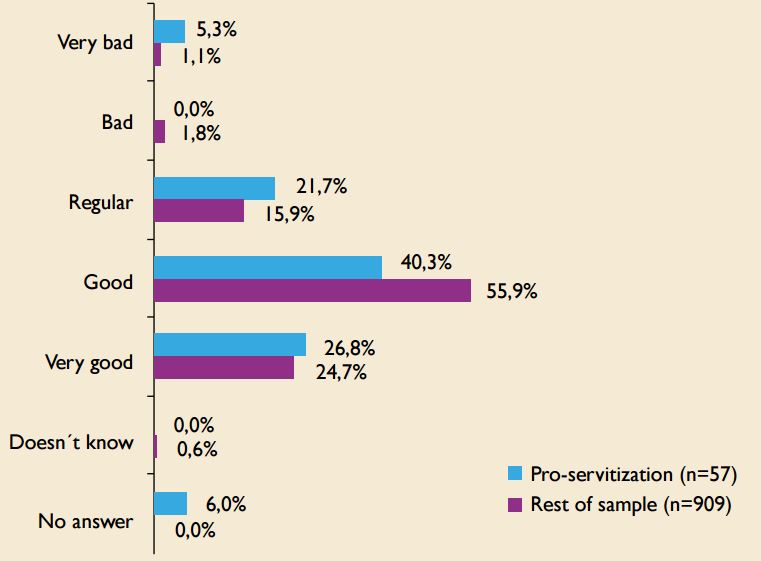
Distributions of both groups on “Perceptions about local retailers”
Then, we analysed the “Perception about the local retailers” that both subsamples had. It seemed that our “pro-servitization” group showed contradictory opinions on this item: either very bad or very good, compared to the rest; but, again, differences were not statistically significant. Results are provided in Graphic 5.
Finally, we studied the “Satisfaction with local retailers” in both subsamples to learn that differences were not statistically significant.
4. CONCLUSIONS AND RECOMMENATIONS TO RETAILER
It seems that the customers of small and medium retailers are not yet interested in the services offered. From our point of view, this result could be a consequence of consumers taking for granted the offering of services in retail, and so, they rarely think about services in a conscious way. But, similarly, it might not be a priority for customers, or they do not know what services could be applied to retail. Therefore the concept of servitization for customers would still be somehow unknown and ”regular” attributes such as price, quality and so on, would continue to be valued the most by consumers.
Nevertheless, when we compare the consumers who value the services offered when they buy a product to the rest of the group, there is no statistical evidence of differences in age, life-cycle, education, job, or use of social networks. However, there are statistical differences regarding their offline purchase behavior, that is, they differ in the day and the time when they make a purchase and the place where they buy from.
This research has yielded some important implications for retailers. Although the concept of servitization does not appear to be of primary concern for the average consumer so far, small and medium retailers should test, as entrepreneurs do, different possibilities in servitization to compete with larger stores. Therefore, the identification of the customer’s perception and the possibility to offer new services in order to increase the value provided could increase the competitiveness of the small and medium retailers. They should therefore try to identify these customers that want to receive more services and identify ways to co-create value with them. At least, in this way they could work with innovators and early adopters to be prepared when the big wave arrives.
Acknowledgements
The authors acknowledge financial support from Diputación Foral de Bizkaia (Spain) for the study titled “El comercio minorista en Bizkaia” that has been the origin of this paper.
References
Baines, T. S., Lightfoot, H. W., Evans, S., Neely, A., Greenough, R., Peppard, J., et al. (2007). State-of-the-art in product-service systems. Proceedings of the Institution of Mechanical Engineers, Part B: Journal of Engineering Manufacture, 221(10), 1543-1552.
Baines, T. S., Lightfoot, H., & Smart, P. (2011). Servitization within manufacturing: Exploring the provision of advanced services and their impact on vertical integration. Journal of Manufacturing Technology Management, 22(7), 947-954.
Baines, T., & Lightfoot, H. (2013). Made to serve; understanding what it takes for a manufacturer to compete through servitization and product-service systems. Hoboken: Wiley,
Ballantyne, D., &Varey, R.J. (2008), article accepted for the special issue on the Service-Dominant Logic of Marketing, Journal of the Academy of Marketing Science (JAMS), 36:1, pp. 11-14.
Barnett, N. J., Parry, G., Saad, M., Newnes, L. B., & Goh, Y. M. (2013). Servitization: Is a paradigm shift in the business model and service enterprise required? Strategic Change, 22(3‐4), 145-156.
F. Bustinza, O., C. Parry, G., & Vendrell-Herrero, F. (2013). Supply and demand chain management: The effect of adding services to product offerings. Supply Chain Management: An International Journal, 18(6), 618-629.
Hewitt, P. (2002). The government’s manufacturing strategy. Secretary of State for Trade and Industry, Westminster, 4.
Lusch, R. F., Vargo, S. L., & O’Brien, M. (2007). Competing through service: Insights from service-dominant logic. Journal of Retailing, 83(1), 5-18.
Muller, E., & Doloreux, D. (2007). The Key Dimensions of Knowledge-Intensive Business Rada, J., & Vandermerwe, S. (1988). Servitization of business: Adding value by adding service. European Management Journal, 6(4), 314-320.
Rosenbloom, B., & Dupuis, M. (1994). Low price, low cost high services, a new paradigm for Global Retailers. The International Journal of Retail.
Sánchez Montesinos, F., & Arias Aranda, D. (2014). La adaptación a la servitización como elemento esencial del futuro de los medios de comunicación de prensa escrita.
Sorescu, A., Frambach, R. T., Singh, J., Rangaswamy, A., & Bridges, C. (2011). Innovations in retail business models. Journal of Retailing, 87, S3-S16.
Vargo, S. L., & Lusch, R. F. (2004). Evolving to a new dominant logic for marketing. Journal of Marketing, 68(1), 1-17.
Vargo, S. L., & Lusch, R. F. (2012). The nature and understanding of value: A service-dominant logic perspective. Review of Marketing Research, 9, 1-12.
Author notes