Performance appraisal and compensation in EFQM recognised organisations: Rhetoric and reality
Evaluación del desempeño y remuneración en organizaciones con reconocimiento EFQM: Retórica y realidad
Performance appraisal and compensation in EFQM recognised organisations: Rhetoric and reality
Universia Business Review, no. 50, 2016
Portal Universia S.A.
Received: 26 October 2015
Accepted: 13 January 2016
Abstract: What type of performance appraisal and compensation systems do quality-driven organisations use? Is there a dominant pattern among these companies? This paper presents the findings of an empirical study conducted on a sample of 180 Spanish organisations that have obtained EFQM recognition. The results, based on cluster analysis and ANOVA, indicate that only one group of organisations use development-oriented systems, and are therefore aligned with approaches recommended in the Quality Management literature. In addition, two other systems are identified, one that evidences inconsistency between performance appraisal and compensation, and another focusing on target achievement.
Keywords: EFQM recognition, excellence, performance appraisal, compensation, cluster analysis.
Resumen: ¿Qué sistemas de evaluación del desempeño y remuneración de sus empleados utilizan las organizaciones que trabajan en un contexto organizativo orientado a la Gestión de la Calidad y la excelencia? ¿Existe un patrón dominante entre estas organizaciones? En este artículo se presentan los resultados de un trabajo empírico realizado sobre una muestra de 180 organizaciones españolas que cuentan con un Reconocimiento a la Excelencia según elesquema de la EFQM. Los resultados, basados en análisis clúster y ANOVA, indican que sóloun grupo de organizaciones utiliza sistemas de evaluación del desempeño y remuneraciónorientados al desarrollo y, por tanto, alineados con lo que desde la literatura sobre Gestiónde la Calidad se propone como un enfoque adecuado. Asimismo, se observan otros tiposde sistemas que presentan una falta de coherencia entre la evaluación del desempeño y laremuneración, o que están centrados en la consecución de objetivos.
Palabras clave: Reconocimiento EFQM, excelencia, evaluación del desempeño, remuneración, análisis clúster.
1. INTRODUCTION
Business Excellence Models (BEM) have been adopted in the last decades to enhance overall results in the medium and long term and promote a sustainable future for organisations (Kim et al., 2010; Sampaio et al., 2012). In most cases, BEM aim to improve performance by applying a set of principles and approaches of Quality Management (QM) and business excellence 3 , and are supported by national bodies as a basis for award programmes (see, for example, the Malcolm Baldrige National Quality Award (MBNQA) or the European Excellence Award from the EFQM).
On the whole, BEM provide a basic structure for the organisation’s management system and guidelines on the type of leadership, process management, or the deployment of strategy. They also suggest implementing human resources practices that improve employees’ attitude and behaviour at work as well as the knowledge and skills needed to implement the “best management practices” that these models embrace (Ooi et al., 2007, Bayo et al., 2011, Escrig and Menezes, 2015). In this regard, scholars (e.g. Simmons et al., 1995; Bayo and Merino, 2001; Wickramasinghe and Anuradha, 2011; Alfalla et al, 2012) consider High Performance Work Practices (HPWP) to be appropriate in the context of a QM initiative in general and the adoption of a BEM in particular. Although there seems to be a broad consensus among QM scholars about the suitability of some HPWP (e.g. extensive selection, training or teamwork structures) to enhance the success of a QM initiative, there is still some controversy over practices concerning performance appraisal and pay for performance. That is, while HPWP include performance appraisal and compensation based on job performance (Huselid, 1995), some QM scholars (e.g. Deming, 1986) consider these practices counterproductive to promoting the attitudes and behaviours needed to foster collaboration and teamwork in the context of a QM initiative. Indeed, Soltani et al. (2004, 2006) and Jiménez and Martínez (2009) argue that the analysis of the features that a performance appraisal system should have remains unresolved in the QM literature. It therefore continues to be a current topic of discussion.
In this context, the purpose of the present study is to provide evidence for Spanish organisations on the characteristics of performance appraisal and compensation practices adopted by organisations that have obtained recognition according to the EFQM model. The research therefore contributes to increasing awareness of the practices related to performance management commonly used in the context of BEM. These practices have not received specific attention in previous studies, which have focused on a more global analysis of human resource management practices. From a management perspective, this paper provides organisations interested in adopting the EFQM model with a description of the most suitable performance management practices to ensure the effectiveness of QM, and explains how these practices are used by Spanish organisations. To this end, the conceptual framework for study is described in the next section; we then present the findings of an empirical study conducted on a simple of organisations that have been awarded an EFQM recognition by the Spanish Club Excelencia en Gestión (Exellence in Management Club).
2. PERFORMANCE APPRAISAL AND COMPENSATION SYSTEMS IN QUALITY-DRIVEN ORGANISATIONS
The EFQM is the most extensively used BEM in Europe, and provides a model of good practices needed to achieve results from the perspective of key stakeholders. The model is based on the premise that excellent results in key stakeholders (customers, people, society, strategy) are achieved through excellence in enablers, that is, having a strong leadership capability and clear strategic direction, developing and improving people, establishing partnerships and processes to deliver value-adding products and services to customers (EFQM, 2012). The EFQM model was developed with close reference to QM constructs, thus enabling analyses of the EFQM model from the broader perspective of the QM literature (e.g. Bou et al. 2009; Escrig and de Menezes, 2015).
Regarding people management, the EFQM model suggests that organisations should encourage employee participation and entrust them with more demanding tasks as a way of achieving their involvement and commitment, both of which are central to the effective adoption of the model. Thus, as Bayo et al. (2011) point out, the human resource management approach embedded in the EFQM model tallies with HPWP. The ‘Leadership’ and ‘People’ EFQM criteria embrace this soft QM orientation, incorporating some practices that allow employees to become involved in continuous improvement and contribute to achieving organisational objectives in a more effective way (Bou et al., 2009; Calvo et al., 2015).
Authors such as Wilkinson et al. (1998), Bayo and Merino (2001), Perdomo et al., (2009) or Prajogo and Cooper (2010) also recognise that human resource practices in the context of QM are consistent with many features of HPWP (Wood and Albanese, 1995; Combs et al., 2006). These practices aim to improve employees’ skills and knowledge and their commitment to the organisation, so that human resources become a source of competitive advantages. HPWP promote job security, broad and generalised training, empowerment; they assess employees based on their performance, and use fair compensation systems or communications systems that disseminate information among all employees. These practices promote a climate of trust, commitment and employee involvement necessary to ensure the success of a QM initiative (Bou and Beltrán, 2005).
However, some scholars such as Carter et al. (2000) or Tarí and Sabater (2006), suggest that some practices within HPWP, especially those concerning performance appraisal and compensation, may be counterproductive in quality-driven organisations. In this regard, it is noteworthy that early works on QM expressed strong opposition to evaluating employees and incentive systems (see, for example, contributions from Deming, 1986 or Bowman, 1994). Following Deming (1986), practices assessing individual performance should be rejected because performance depends on working systems rather than individuals, and evaluating employees using goals that do not depend directly on them could cause employee frustration and demotivation. In addition, Deming (1986) argues against incentive payment systems, claiming that what is important is recognition and non-monetary rewards. In the same vein, following Soltani et al. (2010), if the aim of a QM initiative is to bring processes and systems under control, performance appraisal systems should focus on measurable objectives of the system, rather than on monitoring the performance of individuals. Human resource policies should, therefore, consider and recognise the efforts of cooperation and teamwork rather than individual efforts (Waldman, 1994). This position certainly challenges the idea advocated by proponents of HPWP that employees expect recognition for their efforts and for achieving targets, and if these expectations are not satisfied through positive evaluation or reward, their commitment to the organisation will decline (Levine and Shaw, 2000). Furthermore, as Alfalla et al. (2012) pointed out, compensation based on meeting targets creates an environment where employees feel safe and increases their confidence in the organisation.
Some authors adopt an intermediate position between these two opposing poles. Hence, scholars such as Snape et al. (1995), Wilkinson et al. (1998), or Soltani et al. (2004, 2006) describe the performance appraisal and compensation approach considered to be more compatible with QM ( Table 1 ). Regarding performance appraisal, as processes are not operated by single individuals, these authors suggest establishing a system to keep a balance between individual and group assessment that at the same time aims to recognise improvements in quality. This approach also holds that evaluations should focus on developing skills and providing feedback to employees, which nourishes the continuous improvement process. The compensation practices approach, in turn, emphasises equity among employees, the recognition of group results and the development of skills rather than remuneration based on the achievement of individual goals. The compensation system should also encourage cooperation and teamwork.
This approach to performance appraisal and compensation is also considered in the EFQM model. Thus, among the good management practices of excellent organisations, the ‘People’ criterion considers a performance appraisal system design that takes into account skills development and the achievement of the organisation’s targets, oriented towards helping people to improve their performance and commitment (with a focus on giving feedback), and aligned with the compensation system (EFQM, 2012). In some way the appraisal system is perceived as part of the strategy deployment process, which allows results to be monitored and provides support to individuals and teams for their achievement. A specific sub-criterion concerning rewards and recognition is also included, which is proposed as a tool to promote and enhance people’s involvement and empowerment.
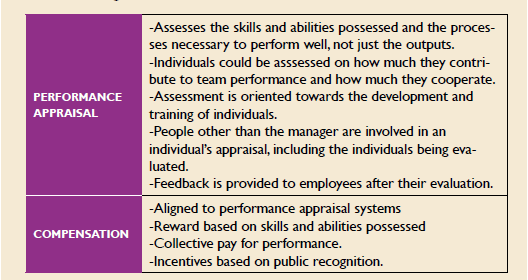
Source: The authors, based on Bowen and Lawler (1992), Snape et al. (1995), Wilkinson et al. (1998), Soltani et al. (2004, 2006), Bou and Beltrán (2005), Jiménez and Martínez (2009), Perdomo et al. (2009), EFQM (2012).
Despite the efforts made to theoretically describe which features of performance appraisal and compensation are most suitable for the demands of a QM initiative, there is no robust evidence on how organisations are approaching such human resource management practices. The purpose of this paper is therefore to analyse how quality-driven organisations are adopting these kinds of practices, and whether or not they are doing so in a uniform way.
3. A STUDY OF ORGANISATIONS WITH EFQM RECOGNITION
The empirical study conducted to achieve the research aim described above was based on a survey of a sample of 180 Spanish organisations that, as of 13 March 2013, had EFQM recognition validated by the CEG 4 . This scheme to recognise level of excellence was launched to encourage organisations to adopt the EFQM Excellence Model and accredits firms at four levels: Committed to Excellence 200+; Recognised for Excellence 300+; Recognised for Excellence 400+; Recognised for Excellence 500+ (for more tan 200, 300, 400 and 500 points, respectively, from a maximum score of 1000 points). This score is arrived at after a thorough process of self-assessment followed by an external assessment in which the organisation’s performance is reviewed in each of the EFQM model criteria, using the results-approach-deployment-assessment and refinement (RADAR) tool (EFQM, 2012). Both assessment processes are carried out by a panel of trained assessors using a scoring guideline based on evidence of actual performance, which involves a thorough analysis of the approaches used in each EFQM criteria, their deployment, the way they are assessed and improved over time, as well as the results attained 5 .
The field work was carried out between September and October, 2013. Table 2 summarises the distribution of organisations taking into account level of Excellence (recognition achieved), the time elapsed since adopting the EFQM model, whether they had ISO 9001 certification, size, and public or private status.
The sample was selected in proportion to the population in each of the excellence levels and represents different economic sectors, the main ones being Health and social services (64 organisations), Education and educational services (57), Public Administration (22) and Associations (13); the various Spanish regions are also represented. Taking into account that there were 462 recognised organisations in Spain, the sample is an adequate representation of the population (a confidence level of 95% implies a sample error of ± 5.71% for the whole sample).
Performance appraisal and compensations were measured by asking the organisations about the degree to which they had adopted various human resource management practices consistent with QM (see Table 1), in accordance with the proposals of Bowen and Lawler (1992) and Wilkinson et al. (1998). The specific practices proposed by Jiménez and Sanz (2013) were used. Questionnaires were sent to the head of human resource management and a 5-point semantic differential scale was used to measure the items. The different types of performance appraisal and compensation practices were identified by means of cluster analysis (using, in two phases, both hierarchical and non-hierarchical clusters [Hair et al., 2010]). Ten of the 180 organisations did not answer all of the questions on appraisal and compensation, so the cluster analysis was performed on the remaining 170 organisations. Table 3 shows the descriptive statistics and correlations between the variables used in this study.
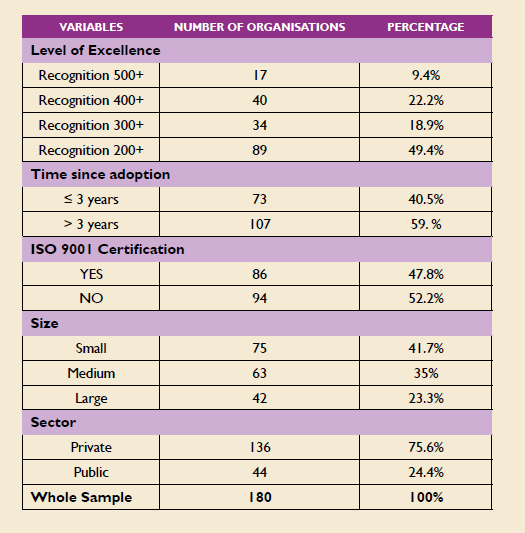
Table 3 shows that the practices analysed are not adopted in the same way by the organisations in the sample. Performance appraisal is mainly carried out periodically (A1) and in order to enhance development (A5). Employees participate in this process, and they are also informed of the results of the evaluation (A6, A7). It is also noteworthy that the performance appraisal process focuses mainly on assessing individual employees’ performance (A3).
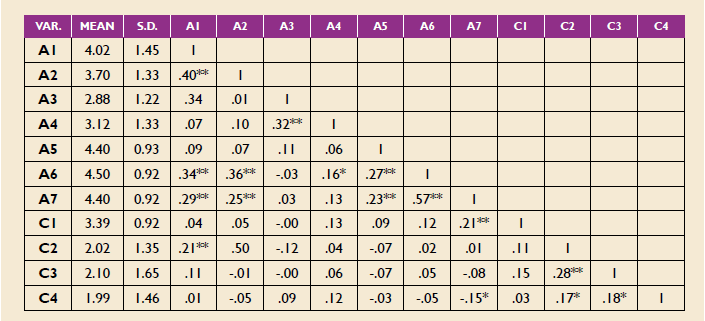
* p<0.05; ** p<0.01
Performance Appraisal
A1. Periodic appraisal
A2. Evaluation of the development of tasks, skills and attitudes, rather than the achievement of objectives
A3. Evaluation of group’s performance
A4. Evaluation of medium- and long-term performance
A5. Evaluation oriented towards performance improvement and personal development
A6. Employees are involved in their assessment
A7. Employees are informed of the results of the evaluation
Compensation
C1. Pay above the market average
C2. Salary determined by the knowledge and skills possessed, rather than the position held
C3. Variable rewards
C4. Employees participate in determining wage components
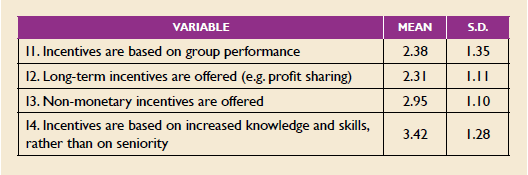
In the compensation systems, the adoption of the variable component is not prominent (C3) and job position (C2) is considered more important. Organisations also seem to reward employees above the market average (C1). Of note is the low employee participation in setting their salary components (C4). If we examine further the types of incentives adopted by organisations that do use variable remuneration (62 organisations), Table 4 shows that they are more oriented to recognising individual performance than group performance (I1), have a more short-term orientation (I2), combine monetary and non-monetary rewards (I3), and take into account both the knowledge and skills of employees, and their seniority in the organisation (I4).
The cluster analysis identified three different groups and provided a description of their main features. The mean values for each variable in each group are reported in Figure 1 .
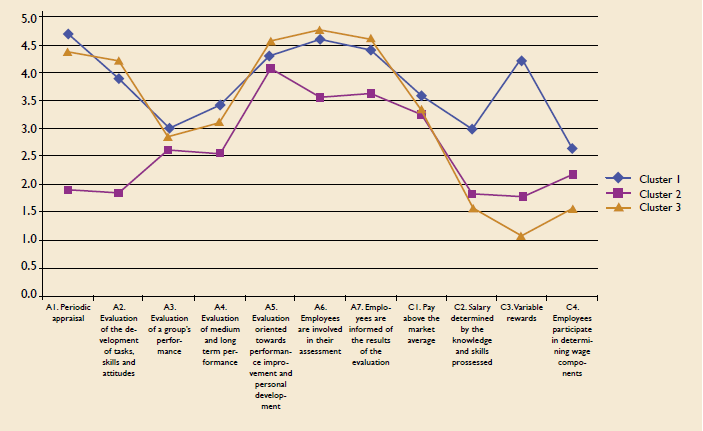
Figure 1.
Representation of mean values in each group
We conducted an analysis of variance (one-way ANOVA) to test for significant differences in the characteristics that define each group. The results indicate that the variables in the three groups are all significantly different, except in the case of evaluation of group performance (A3) and pay above the market average (C1), where no differences between groups were observed. The results of these analyses are shown in Table 5.
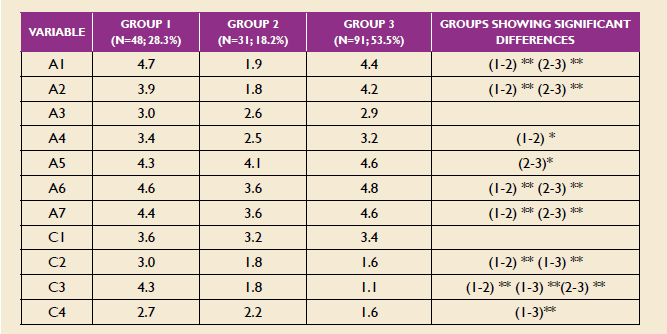
* p<0.05; ** p<0.01. Note: Post-hoc test using the Games-Howell method
Finally, in order to enhance characterisation of the groups, in a second analysis we assessed the existence of differences between them according to a set of classification variables, namely level of excellence achieved, the length of time since adopting the EFQM model, possession of an ISO 9001 certificate, size and sector. Sector differences were analysed according to whether the organisation was from the public or private sector, as well as belonging to the main sectors mentioned above. To reach this purpose, contingency tables and Chi-square test were used. These analyses find no significant differences between groups for any of these classification variables; performance appraisal and compensation systems are therefore not conditioned by any of these variables.
From these results, the three groups obtained based on the performance appraisal and compensation systems they adopt are described in the following paragraphs.
‘Consistent’, development-oriented system (48 organisations). Figure 1 shows that the first group is made up of organisations distinguished mainly by the type of compensation practices used, characterised by the use of variable compensation and consideration of employees’ skills and knowledge to determine the salary.
The variable compensation in this group, as compared to the others, emphasises group performance-based incentives. This type of compensation is aligned with performance appraisal, which takes place by periodically evaluating how employees perform tasks and their attitudes (not just the achievement of objectives). Consistent with this, performance appraisal aims to improve and develop. In general, the system implemented by this group of organisations is aligned with what is considered to be the most appropriate approach (see Table 1) to address performance appraisal and compensation in quality-driven organisations.
Target achievement-focused system (31 organisations). The second group includes organisations that neither perform regular evaluations nor are oriented towards skills assessment, but rather focus on meeting targets. Similarly, salaries are not determined by the skills possessed nor is there variable remuneration. The highest scoring feature in this type of organisation (Figure 1) reveals the purpose of this system to be performance improvement, rather tan control of employees. Hence, given this intention the emphasis is on evaluating and monitoring achievement of targets.
Unbalanced system (91 organisations). The pattern of the performance appraisal system of the third group is similar to the development-oriented system, since it is characterised by regular performance appraisal which encourages the development of skills. However, it differs from the first group in its use of mainly fixed remuneration determined by the job position rather tan the employee’s skills and knowledge, and thus resembles the organisations in the second group. This system can therefore be defined as unbalanced, as the performance appraisal does not appear to be aligned with the compensation system. Such organisations focus their efforts on developing their appraisal systems more than their compensation systems.
4. CONCLUSIONS AND PRACTICAL IMPLICATIONS
This research has identified three different systems in the adoption of performance appraisal and compensation practices in organisations with EFQM recognition. The characteristics of these systems led us to label them Consistent, development-oriented system, Target achievement-focused system and Unbalanced system. Therefore, there appears to be no uniform adoption of performance appraisal and compensation practices among organisations that have EFQM recognition. Only 48 organisations (28%) consider a development-oriented system of performance appraisal and compensation (with the exception of low orientation to evaluating group performance), aligned with what the QM literature (e.g. Wilkinson et al., 1998; Soltani et al, 2004, 2006; Bou and Beltrán, 2005; Jiménez and Martínez, 2009) suggests would be consistent with QM and excellence. Although it is true that 91 other organisations (those belonging to group 3) do seem to opt for a skills-based performance appraisal, this approach is not reflected in their compensation practices. Accordingly, we can conclude that the performance appraisal and compensation systems of only some organisations come close to what is considered to be most appropriate in the field of QM and excellence. These organisations implement development-based performance appraisal, are more likely to use incentives that recognise improvements in employees’ skills and abilities, and involve their employees in the assessment. However, both performance appraisal and compensation are based more on individual results than on group results. These findings tally with those obtained by Soltani et al. (2006) who, in a sample of organisations belonging to the Quality Scotland Foundation, one of the EFQM partners in the UK, also noted that in a quality-oriented context, organisations do not remove performance-based appraisal and compensation systems.
These findings have implications for both organisations adopting BEM and institutions promoting the adoption of these models. This study has shed light on the performance of organisations that have obtained EFQM recognition in terms of their performance appraisal and compensation practices in Spain. As evidenced by Yeung et al. (2003), the analysis of the pattern of adoption of QM practices is an important step in furthering our knowledge about the behaviour of organisations pursuing excellence. Organisations that plan to implement a self-assessment process based on the EFQM model, or wish to apply for EFQM recognition might consider the practices discussed in this article to extend their awareness of the kind of practices that should be encouraged.
The study findings suggest that future research should further explore the characteristics of the human resource management systems used by quality-driven organisations and incorporate other practices such as selection and training. Future lines of research should study the potential consequences of these performance appraisal and compensation systems on employees’ behaviour and attitudes, which will enable a better understanding of the reality of organisations in the path towards excellence.
REFERENCES
Alfalla, R., Marín, J. A., & Medina, C. (2012). Is worker commitment necessary for achieving competitive advantage and customer satisfaction when companies use HRM and TQM practices? Universia Business Review, (36), 64-89.
Bayo, A., & Merino, J. (2001). Quality management and high performance work practices: Do they coexist? International Journal of Production Economics, 73 (3), 251-259.
Bayo, A., Merino, J., Escamilla, S. A., & Selvam, R. M. (2011). The impact of ISO 9000 and EFQM on the use of flexible work practices. International Journal of Production Economics, 130(1), 33-42.
Bou, J.C. & Beltrán, I. (2005). Total Quality Management, High-commitment Human Resource Strategy and Firm Performance: An Empirical Study. Total Quality Management”, 16 (1), 71-86.
Bou, J.C., Escrig, A.B., Roca, V., & Beltrán, I. (2009). An empirical assessment of the EFQM Excellence Model: Evaluation as a TQM framework relative to the MBNQA Model. Journal of Operations Management, 27(1), 1-22.
Bowen, D.E. & Lawler, E.E. (1992). Total Quality-Oriented human Resources Management. Organizational Dynamics, 20 (4), 29-41.
Bowman, J. (1994). At Last, an Alternative to Performance Appraisal: Total Quality Management. Public Administration Review, 54 (2), 129-136.
Carter, J.R., Smeltzer, L.R. & Narasimhan, R. (2000). Human Resource Management within Purchasing Management: Its Relationship to Total Quality Management Success. The Journal of Supply Chain Management: A Global Review of Purchasing and Supply, Spring, 52-62.
Calvo, A., Picón, A., Ruiz, C., & Cauzo, L. (2015). Contextual and mediation analysis between TQM critical factors and organisational results in the EFQM Excellence Model framework. International Journal of Production Research, 53(7), 2186-2201.
Combs, J., Liu, Y., Hall, A., & Ketchen, D. (2006). How much do high-performance work practices matter? A meta-analysis of their effects on organizational performance. Personnel Psychology, 59(3), 501-528.
Deming, E. (1986). Out of the Crisis. Quality, Productivity and Competitive Position. Cambride University Press.
Escrig, A. B., & de Menezes, L. M. (2015). What characterizes leading companies within business excellence models? An analysis of “EFQM Recognized for Excellence” recipients in Spain. International Journal of Production Economics, 169, 362-375.
European Foundation for Quality Management (EFQM) (2012). “EFQM Model for Business Excellence”. Brussels: EFQM.
Ghobadian,A., Gallear, D. & Hopkins, M. (2007). TQM and CSR nexus. International Journal of Quality & Reliability Management, 24 (7), 704-721.
Hair, J., Anderson, R., Black, B.; Babin, B. & Black, W. (2010): Multivariate Data Analysis, Pearson Education, London.
Huselid, M. A. (1995). The impact of human resource management practices on turnover, productivity, and corporate financial performance. Academy of Management Journal, 38, 635-672.
Jiménez, D., & Martínez, M. (2009). The performance effect of HRM and TQM: a study in Spanish organizations. International Journal of Operations & Production Management, 29(12), 1266-1289.
Jiménez, D., & Sanz, R. (2013). Studying the effect of HRM practices on the knowledge management process. Personnel Review, 42(1), 28-49.
Kim, D.Y., Kumar, V., & Murphy, S.A. (2010). European foundation for quality management business excellence model: an integrative review and research agenda. International Journal of Quality & Reliability Management, 27(6), 684-701.
Levine, D.I. & Shaw, K. (2000). The incentives of quality and the quality of incentives. In Cole, R.E & Scott, W.R. (Ed.), The Quality Movement Organization Theory, Sage, Thousand Oaks, C.A., pp. 367-386.
Ooi, K.B.; Bakar, N.A.; Arumugam, V.; Vellapan, L. & Loke, L.K. (2007), “Does TQM influence employees’ job satisfaction? An empirical case analysis”, International Journal of Quality & Reliability Management, 24 (1), 62-77.
Perdomo, J., González, J. & Galende, J.(2009). An analysis of the relationship between total quality management-based human resource management practices and innovation. The International Journal of Human Resource Management, 20 (5), 1191-1218
Prajogo, D. & Cooper, B. (2010). The effect of people-related TQM practices on job satisfaction: a hierarchical model. Production Planning & Control, 21(1), 26-35.
Sampaio, P., Saraiva, P., & Monteiro, A. (2012). A comparison and usage overview of business excellence models. The TQM Journal, 24(2), 181-200.
Simmons, D.E.; Shadur, M.A. & Preston, A.P. (1995). Integrating TQM and HRM. Employee Relations, 17 (3), 75-86.
Snape, E., Wilkinson, A., Marchington, M. & Redman, T. (1995). Managing Human Resources for TQM: possibilities and Pitfalls. Employee Relations,17 (3), 42-51.
Soltani, E., van der Meer, R., Gennard, J. & Williams, M., (2004). Case study: Have TQM organisations adjusted their performance management (appraisal) systems? A study of UKbased TQM-driven organizations. The TQM Magazine, 16 (6), 403-417.
Soltani, E., van der Meer, R.; Williams, M. & Lai, P. (2006). The compatibility of performance appraisal systems with TQM, principles – evidence from current practice. International Journal of Operations & Production Management, 26 (1), 92-112.
Soltani, E., Singh, A., Liao, Y. Y., & Wang, W. Y. (2010). The rhetoric and reality of ‘process control’ in organisational environments with a TQM orientation: The managers’ view. Total Quality Management and Business Excellence, 21(1), 67-77.
Tarí, J.J. & Sabater, V., (2006). Human aspects in a quality management context and their effects on performance. International Journal of Human Resource Management, 17 (3), 484-503.
Waldman, D.A. (1994). The Contributions of Total Quality Management to a Theory of Work Performance. Academy of Management Review, 19 (3), 510-536.
Wickramasinghe, V. & Anuradha, G. (2011). High-involvement work practices, quality results, and the role of HR function: an exploratory study of manufacturing firms in Sri Lanka. The TQM Journal , 23 (5), 516-530.
Wilkinson, A., Redman, T., Snape, E., & Marchington, M. (1998). Managing with Total Quality Management. Theory and Practice. McMillan Business, Hong-Kong.
Wood, S. & Albanese, M.T. (1995). Can We Speak of a High Commitment Management on the Shop Floor? Journal of Management Studies, 32 (2), 215-247.
Yeung, A.C.L., Chan, L.Y., & Lee, T.S. (2003). An empirical taxonomy for quality management systems: a study of the Hong Kong electronics industry, Journal of Operations Management, 21(1), 45-62.
Notes
Author notes