NETWORKS OF NON-PROFIT ORGANIZATIONS AND POWER RELATIONS
 Raphaela Amaoka Bernardino amaoka.raphaela@gmail.com
Pedro Paulo de Souza Conte pedropsconte@gmail.com
Ivan de Souza Dutra ivandutra@uel.br
Carlos Eduardo de Lima carloseduardodelima@gmail.com
Raphaela Amaoka Bernardino amaoka.raphaela@gmail.com
Pedro Paulo de Souza Conte pedropsconte@gmail.com
Ivan de Souza Dutra ivandutra@uel.br
Carlos Eduardo de Lima carloseduardodelima@gmail.com
NETWORKS OF NON-PROFIT ORGANIZATIONS AND POWER RELATIONS
Revista Pensamento Contemporâneo em Administração, vol. 15, núm. 4, pp. 1-22, 2021
Universidade Federal Fluminense
Recepción: 09 Agosto 2021
Aprobación: 22 Noviembre 2021
Abstract: This study aims to understand how the power relations of central actors in a social network of non-profit organizations in Londrina - PR influence access to resources. In methodological terms, the research was adopted with a quantitative and qualitative approach, and data collection was carried out through a survey, interviews, and document analysis. The findings show that most central organizations have and exchange scarce resources with other third sector organizations because they have supervisory attributes and credibility. Thus, it was possible to highlight the impact of the two categories of centrality, intensity, and proximity, on the ability to mediate local resources.
Keywords: Network, Non-Profit organizations, Power Relations, Centrality.
Resumo: Este estudo tem o objetivo de compreender como as relações de poder de atores centrais de uma rede social de organizações sem fins lucrativos em Londrina - PR influenciam no acesso à recursos. Em termos metodológicos, adotou-se a pesquisa de abordagem quantitativa e qualitativa, e a coleta de dados foi feita por meio de survey, entrevistas e análise documental. Os achados mostram que as organizações mais centrais possuem e trocam recursos escassos com outras organizações do terceiro setor por possuírem atributos de fiscalização e credibilidade. Assim, pode-se comprovar o impacto das duas categorias de centralidade, a intensidade e a proximidade, na capacidade de mediar recursos locais.
Palavras-chave: Redes, Organizações sem fins Lucrativos, Relações de Poder, Centralidade.
Introduction
The economic crises caused severe impacts on social life, with direct consequences of these events were the intensification of social inequality, poverty, hunger, environmental degradation, and even the weakening of human values such as cooperation and solidarity (Beck, 2011; Lima & Amâncio-Vieira, 2017). Therefore, one answer to this challenge was the emergence of Nonprofit Organizations with the most varied objectives. When well-articulated with the other actors of society, Nonprofit Organizations are the essential pillar for a process of managing the resources needed to meet their needs.
In Brazil, Conte's study (2017) brought 246 NPOs in Londrina, Brazil, in which he found a good articulation between the various actors (public sector, cooperatives, nonprofit organizations, and civil society) when they stood out with regard to urban development focused on sustainable issues, presenting projects recognized at national and international levels. Thus, the society of the new millennium has been organized into networks of organizational, inter-organizational and social movement relations (Castells, 2009) - as observed in Londrina - so that they achieve common goals more efficiently and establishes relationships and connections with the most diverse spheres (public and private) (Scherer-Warren, 2006; Gohn, 2011).
For this work the unit of analysis was established by the relations among the nonprofit organizations of the city with emphasis on the three types of centralities identified by Conte (2017) in his quantitative work. Thus, in order to deepen in the respective network, through qualitative research in particular, the aim was to understand how the Power Relations among the most central actors in a Social Network of Nonprofit Organizations influence access to resources. Thus, two organizations that were confirmed to have taken positions of degree centrality and proximity centrality were investigated in order to understand how such positions, through their power relations, interfere in the relations among the other actors and direct the strategies of access to resources.
Social Networks in this paper refers to a group of people, or organizations that are united through social relations, qualified according to strength or as the content of these relations (Kirschbaum, 2019; Granovetter, Castilla, Hwang & Granovetter, 2000). So, for the specific purpose of this study, network is a set of relationships established among organizations, thus forming a network of institutional relationships, and is also used as an analytical resource. The research adopted a network of organizational relationships mapped by Conte (2017) as an empirical object of analysis, emphasizing that the focus is on the relationships established among actors and not specifically on the actor and their corresponding characteristics.
In addition, it is important to highlight that the centrality in the Social Network structure is one of its main features that assumes actors with power. Centrality can locate prominent or “key” actors in a network. For this reason, another theoretical approach adopted was that of Emerson's Power and Dependency Relations (1962), which starts from the principle that power is a property of the social relationship, not a quality of the actor (Emerson, 1962). This approach also points out that there is a relationship between power and social exchange (Cook, Cheshire & Gerbasi, 2006). Thus, such principles establish a close relationship with the Theory of Social Networks.
The article is organized as follows. First, in the next section, we present the theoretical background by discussing the analysis of social networks. Next, we discuss the presence of power in dependency relationships. The methodological procedures are then presented, followed by the analysis, interpretations and discussion. Finally, we present our concluding remarks.
Theoretical positioning
Analysis of Social Networks and the centrality of actors as power
Social Network Analysis (SNA) takes into consideration the structure and quality of social relationships, aiming at identifying their possible causes and effects. Therefore, according to Tichy, Tushman & Fombum (1979), the applicability of network analysis can provide insights to various areas. Organizational levels, studies of communication, power and political processes under a perspective of analysis of social networks can be benefited and enriched. Therefore, the concept of social network used in this paper refers to a set of specific relationships whose characteristics can be used to understand and analyze social behavior, as well as to try to identify the causes and effects of the formation of this social structure or the pattern of these relationships (Tichy, Tushman & Fombum, 1979; Scott, 2001; Mitchell, 1969).
SNA studies the structure based on the notion that the characteristics of the social ties that the actors establish create relevant consequences for them. Thus, SNA is based on the principle that standards are important aspects of people or social organizations, in which it is believed that from a network perspective, the way in which a person or social organization is established is directly related to how these actors are connected to a larger social network/structure. Also, the author believes that the success or failure of societies and organizations is closely linked to the pattern of their internal structure (Zhang, 2010).
Indeed, according to Zhang (2010), human networks emerge from actions and relationships between individuals and organizations, which in turn, have consequences for them. So, networks develop as the actors interact and relate to each other, thus producing larger structures beyond their perceptions, but that in fact exist. Therefore, such networks are constantly generated affecting and transforming the organizations from where they emerged (Zhang, 2010).
Centrality can be considered one of the most important structural qualities in the SNA and is directly related to the degree of connections in a network. According to Borgatti (2009, p. 894) centrality can be considered "a family of properties of knots related to the structural importance or prominence of a knot in the network". Thus, both the speed and efficiency in solving a network's problems, as well as the satisfaction and perception of the network in relation to the leadership, power, or popularity of prominent actors (Freeman, 1979).
Thus, measures of centrality can identify the prominent actors, or “key” of a network. That is, it is possible to identify actors who have a strong relationship with other actors (Zhang, 2010) This way, having a favored position means that an actor can get better bargains in exchanges, have greater influence, and that the actor will be a focus of deference and attention of those in less favored positions (Hanneman & Riddl, 2005).
Therefore, power or centrality establishes privileged positions to actors in their networks of relationships. According to Hanneman & Riddl (2005), this position can be the result of three basic aspects of a network: high level of connections, high proximity and high interest. Therefore, SNA identifies the power of actors, and this power is not a consequence of a personal quality of the actor but, the result of their relations with other actors, that is, social structures may have high or low levels of power due to the different patterns of ties that are established among the actors of this structure (Hanneman & Riddl, 2005). According to Zhang (2010), the main forms of centrality measures are: (1) degree centrality, and (2) proximity centrality.
First, in order to understand the degree centrality, it is necessary to understand that an actor's degree corresponds to the number of direct connections, and the degree centrality refers to the sum of all other actors that are directly connected to the ego”, the greater the number of ties established or broken with an actor, the greater their centrality and popularity (Zhang, 2010). For Hanneman & Riddl (2005) actors with many connections can have an advantage in a network, being able to collaborate in facilitating to supply their needs, being able to have access to more resources of the network due to their many relationships.
In a directed network, it is possible to distinguish the type of centrality from the degree of connections established or broken. Therefore, if an actor has many ties, they possibly have a prestigious position within this network and can be named as a prominent actor, as many other actors look for him because of his importance. As for actors who have a high degree of broken connections, they can make many exchanges of resources or information, and may be considered very influential actors (Hanneman & Riddl, 2005).
The proximity centrality, according to Hanneman & Riddl (2005) takes into account an actor's immediate ties, that is, considering only neighboring ties, disregarding any other actors that have indirect connections, thus, if a knot or actor is close to everyone else in the network, a distance of no more than one, so it is not independent of anyone else in the network. Proximity measures independence or efficiency (Zhang, 2010).
The presence of power in dependency relationships
The analysis of social power has also had contributions from Emerson (1962) through dependency relations. His study became the basis for the development of many others in contemporary social psychology, which are also supported by the study of George Homans and Peter Blau for the development of the Social Exchange Theory in sociology. To this end, both for Blau (1964) and for Emerson (1962) there is a clear and evident relationship between power and social exchange, that is, the fact that some actors have a greater capacity to control and manage resources considered more important than others, generating an inequality of exchange in actions of subjugation by the least powerful, providing the basis for the formation of inequalities of power in relations of resource dependence (Cook, Cheshire & Gerbasi, 2006).
Emerson's Theory of Power and Dependency Relations (1962) points out that although such a theory is more closely linked to small group research, it also applies to the analysis of more complex community relations. In addition, the author makes it clear that in order to make his conceptions potentially as comprehensive as possible, one must consider a person or group as the actor, that is, one can analyze a person-person, group-person, or group-group relationship.
One of the premises of this theory is that "power is a property of the social relationship and not a quality of the actor" (Emerson, 1962, p. 32). Thus, attention is focused on the characteristics of the relationship among the actors, with the least possible attention on the specific characteristics of the actors, that is, the people or groups involved in the relationships.
For Emerson (1962) in general, social relations happen through reciprocal connections and mutual dependence among the actors. According to the author, in the context of mutual dependence that power appears. In the author's words, “power lies implicitly in the dependence on the other” (Emerson, 1962, p. 32). Thus, actor A depends on actor B if the accomplishment of their goals can be facilitated by appropriate actions on the part of actor B. With this, it is essential for each actor to be able to control or influence the conduct of the other, being able to grant or deny, facilitate or hinder the achievement of the other actor's goal. Thus, the power of control and influence is in controlling things that the other actor values, which can be resources such as oil to ego support, this will depend on the relationship concerned.
To that end, in addition to considering the quality of the relationships to understand the resources, Hardy & Clegg (2001, p. 266) reinforce that the context of these relationships must be considered, because according to the authors “as different things become resources in different contexts”, it is not possible to identify all the resources involved in a relationship, as these resources are the basis of power. They can range from information, technical expertise, credibility, position and reputation, access to high-ranking members, control of money or any other important resource for the organization's survival, rewards or sanctions depending on the context. Likewise, Pfeffer and Salancik (1978, p. 43) claim that "exchanges may involve monetary or physical resources, information or social legitimacy". Tichy, Tushman and Fombrun (1979) also on the same subject, categorize exchanges using affection, influence or power, information or resources and services.
Considering this thesis, it is clear that the analysis starts from a dyad and requires simultaneously considering the power of A over B, as well as the power of B over A. Thus, according to Casciaro and Piskorski (2005), this combined approach of dependence on resources produces two different dimensions of power: first, an asymmetry of power and then a mutual dependence. Therefore, the strength of the most powerful actor over the least powerful actor is evident, as well as to capture the existence of bilateral dependencies in the dyad, regardless of whether the dependencies of the two actors are balanced or unbalanced (Casciaro & Piskorski, 2005).
Therefore, it can be stated that inequality and differentiation of the source of power are features that emerge from the process of social exchange. And the different natures of relevant resources among actors result in interdependent relationships and, therefore, there is a need for exchange. In addition, they provide a basis for the analysis of different results of exchanges and different levels of power among the actors connected by the exchange (Cook; Cheshire; Gerbasi & 2006).
Although, Emerson initially focused on the dyadic exchange relationship, in his 1972 and 1976 studies the author begins to consider that such relationships are immersed in a network of exchange opportunities with other actors (in addition to the dyad). Therefore, the “social structure of exchange opportunities formed the basis for Emerson's structural theory of power (Cook; Cheshire; Gerbasi & 2006). Thus, according to Cook, Cheshire and Gerbasi (2006) the structure of available exchange opportunities incorporated in the networks is one of the main determinants of power.
According to Emerson, networks are created by resource exchange relationships in which the actors are linked to the extent that an exchange in one relationship affects or is affected by the nature of the exchange that occurs or may occur in another relationship (Cook; Cheshire; Gerbasi & 2006). So, the connection between the structure of the networks and the distribution of power in it became the subsidy for research in the tradition of social exchange, at first, with the study of Cook and Emerson (1978).
Regarding dependency relationships, actor A's dependence on actor B is proportional to actor A's motivational investment in goals that are mediated by actor B, that is, A's dependence will be equal to the motivational investment which he credits to actor B in helping to achieve his goals. In addition, such dependence is inversely proportional when there is a possibility that such goals are achieved outside this dyadic relationship (AB), that is, the dependence of actor A on actor B is reduced as he finds opportunities in other authors in reaching their goals (Emerson, 1962).
When “objectives and goals” are discussed here, the broader meanings for words are considered, and may refer to gratifications that can be consciously and deliberately chosen, as well as rewards unconsciously obtained through the relationships established. Therefore, finding the availability of these objectives and goals outside the dyadic relationship results in alternative ways to achieve these objectives and, consequently, other relationships (Emerson, 1962). Thus, it appears that the power of actor A over actor B is based on the dependence of B on A, that is, the alternatives found in other relationships reduce the power of powerful authors in the network, and increase their relationships and magnitude.
Methodological Procedures
This article used quantitative and qualitative approach through the intrinsic and descriptive case study strategy. It is intrinsic because reflects the fact that the phenomenon is the object of the research itself. Thus, the researchers' options aimed at knowing a particular case in depth, without the need for theoretical development (Stake, 2005). Its descriptive aspect comes from the fact that it presents a detailed account of a social phenomenon whose configuration, structure, activities, changes in time and relationship with other phenomena seek to illustrate the complexity of the situation and the aspects involved in it (Godoy, 2006).
Data collection and analysis of quantitative stage
The unit of analysis is formed by a network of Non-Profit Organizations, mapped by Conte (2017) whose objective was to analyze the social network relationship characteristics existing among organizations with common sustainability objectives in the city of Londrina - Brazil (Figure 1).
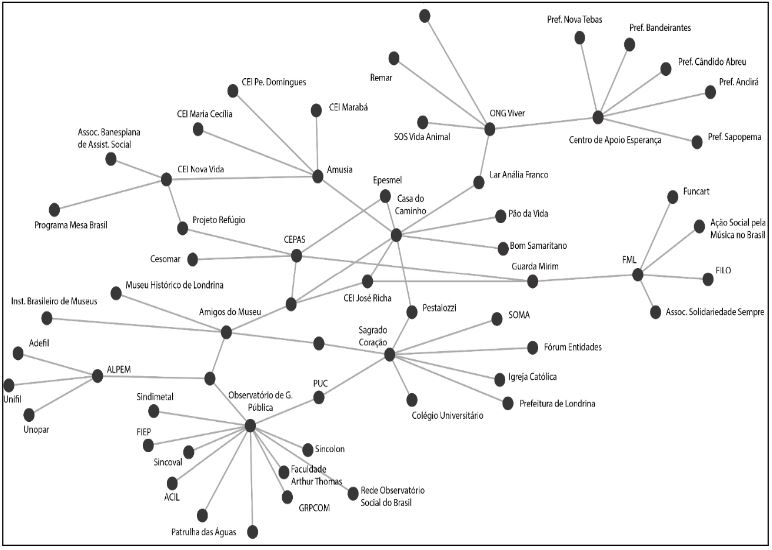
Figure 1-
Network of Non-profit Organizations in Londrina
Source: Conte (2017, p. 67).
All 206 public utility entities based in the city of Londrina (Paraná) were sent a digital questionnaire (ALEP, 2013) and 26 provided answers about their relationships with other entities. In this research, a tie between two actors was considered an exchange of power/influence, information, resources or services (Tichy, Tushman & Fombrun, 1979).
Since the possible frontiers of the network were not known, researcher adopted a snowball survey proposal, a form of non-probabilistic sampling (Hair Jr. et al., 2005; Wasserman & Faust, 1994)[1]. Then, using sociometry, this network was analyzed with the aid of the UCINET® software (Bogatti; Everett & Freeman, 2002) so that the values of network density, closeness centrality, betweeness centrality and eigenvector centrality (Scott, 2001; Wasserman & Faust, 1994) – Step 1.
Participants were also asked to describe, using a graduation scale, how their objectives are oriented to each of the dimensions of sustainability proposed by Sachs (2002): social, cultural, ecological, environmental, territorial, economic, political and international politics – Step 2.
The graduation scale contained the options: "no relationship", "little relationship", "medium relationship" and "much relationship". Four degrees were adopted to avoid central responses and to obtain more distinct decisions (Gil, 2009), since the objective was to identify actors whose sustainability objectives were related to the definitions presented by Sachs (2002). By enabling the research participants, themselves, to present their understandings of “sustainability”, a slightly more subjective dimension is added to the research, even if in quantifiable data. This is in line with the precepts indicated by Seghezzo (2009), when he affirms that there is not, and there should not be, a single definition of sustainability.
Finally, the research compared the findings in Step 1 with those in Step 2, to analyze if common sustainability objectives would have any influence in the network structure.
Data collection and analysis of qualitative stage
The data collection of this qualitative stage occurred in two phases that were named as Knowledge and Deepening stages, respectively: stage 1: A pre-collection of data was made through survey of documents which helped to know better the organizations pointed as central by SNA (Social Network Analysis. This stage happened in November and December – 2018; Stage 2 (Deepening): This second stage included conducting interviews and gathering more documents in order to deepen the knowledge acquired at the first stage. Thus, leading and restricting the sources of information for the analysis of categories presented during the theoretical survey and for the research problem. This stage happened in January and December 2019.
Data collection was subsidized in the triangulation with semi-structured interviews, and document analysis. Document analysis was made to gather information that allowed a better analysis of the investigated problem, such as documents that describe the history of organizations, articles published on the Internet to identify the main activities and practices and texts published in the media that explain the mission, vision and values of the organizations.
Second data collection instrument adopted was the interview, which had a semi-structured script that allowed flexibility in creating and ordering the questions. The interviews lasts approximately 40 minutes on average and were conducted with members of nine organizations: presidents, managers or founders. The organizations, their activities and how they were represented in the research are shown in table 1.
| Organization | Role and definition of the organization | Representation |
| Observatório de Gestão Pública | It is an independent institution whose main goal is to exercise social control and monitor public spending. | CDO |
| Patrulha das Águas | A non-governmental organization that promotes environmental conservation and sustainable development actions in Londrina | DO1 |
| Júnior Chamber International Londrina | It is an international organization based in Londrina. Formed by volunteers, JCI develops action in search of the empowerment of society and individuals so that they can make their own positive changes. | OD2 |
| Hospital do Câncer de Londrina | It is a philanthropic hospital, non-profit and specialized in cancer treatment. The entity is a reference for more than 220 cities. | CCO |
| Associação de Amigos do Museu Histórico | It is a group of citizens who dedicate part of their time to volunteer work for the benefit of the city's historical heritage. | CO1 |
| Centro Esperança por Amor Social (CEPAS) | The CEPAS NGO provides social and educational services for three hundred children and teenagers from 06 to 14 years old. Fundraising comes directly from partnerships and voluntary donations, in addition to a subsidy from the city hall. | CO2 |
| Casa do Caminho | The non-profit organization Casa do Caminho aims to promote free education, promote culture and social assistance for children. | OCD |
| Lar Anália Franco | He is a non-profit association that works with state justice. The organization houses 48 children and teenagers from 0 to 18 years old in the shelter system. It is usually a temporary home for families with legal problems. | OB1 |
| Casa do Bom Samaritano | Philanthropic institution that works to serve the homeless population of the city of Londrina and region, aiming at social insertion. | OB2 |
And for its analysis the thematic analysis was chosen. Regarding the selection criteria of actors, from the mapped network (Conte, 2017), the first criterion was centrality - degree centrality (Degree), and proximity centrality (Closeness) and the second was actors who are linked to these, therefore, it assumes the reciprocity of relations, allowing the analysis of the power relations of the central organizations through their relations of dependence with the others of their clique.
Findings
Degree Centrality
In this measure, the Observatório de Gestão Pública stood out with 12 connections; the Association of the Community of Sacred Hearts (a local charity institution) with 8 connections and Casa do Caminho with 8 connections (Conte, 2017). Therefore, the organization chosen in this classification of centrality was the Observatorio de Gestão Pública (central organization degree - COD), and in order to analyze its power relationship through the dependency relationship, the other organization chosen - for major proximity to sustainable objectives and convenience - at their respective click were the Patrulha das Águas – an environmental protection organization - (organization degree 1- DO1).
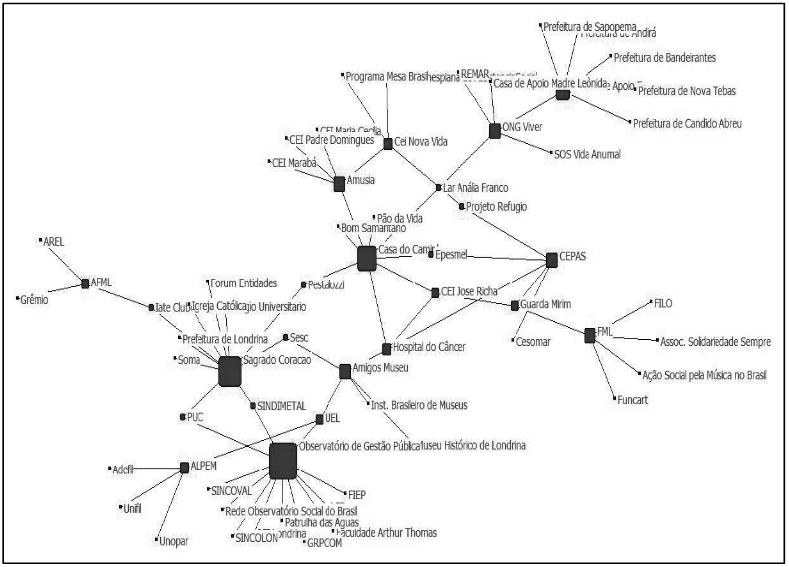
Figure 2 -
Degree Centrality.
Source: Conte (2017, p. 80)
In addition, based on an analysis of the direction of their relationships, such centrality refers to actors who can gain some advantages (Hanneman & Riddl, 2005). According to the relations analyzed here, it was possible to identify that it has many ties that make it a prominent and influential actor in this group of organizations, as well as having a prestigious position because the other actors in the network look for it due to its relevance, which in this case, is related to activities that are linked to inspection and emancipation, as will be explored below.
The organization started its activities in mid-2009 with a group of residents of Londrina who met to discuss the relevance of controlling public spending in a preventive way, so they started working in favor of the appropriate use of public resources through propositional and preventive social control (Observatório de Gestão Publica de Londrina, 2021). In this context in which an actor presents as main objective to control and monitor the activities of another actor, it is noteworthy that the third sector, as an organized civil society, arises in an attempt to improve the public space, as well as to rescue concepts of solidarity and citizenship (Falconer, 1999). Today, the CDO focuses on the following activities:
In addition, based on an analysis of the direction of their relationships, such centrality refers to actors who can gain some advantages (Hanneman & Riddl, 2005). According to the relations analyzed here, it was possible to identify that it has many ties that make it a prominent and influential actor in this group of organizations, as well as having a prestigious position because the other actors in the network look for it due to its relevance, which in this case, is related to activities that are linked to inspection and emancipation, as will be explored below.
The organization started its activities in mid-2009 with a group of residents of Londrina who met to discuss the relevance of controlling public spending in a preventive way, so they started working in favor of the appropriate use of public resources through propositional and preventive social control (Observatório de Gestão Publica de Londrina, 2020). In this context in which an actor presents as main objective to control and monitor the activities of another actor, it is noteworthy that the third sector, as an organized civil society, arises in an attempt to improve the public space, as well as to rescue concepts of solidarity and citizenship (Falconer, 1999). Today, the CDO focuses on the following activities:
Monitoring Bids; Supervision of contracts; Debates of plans for the city; Participation in Projects such as "Compra Londrina" (Londrina Purchasing); Creator and participant of the Transparency Council (CDO President).
As an example of such activities, in an article published on May 29, 2017 on the institution's website, “Monitoring of the school buses contract” was published and it was carried out on May 16, 2017, in the district of Lerroville and the institution states that based on what was observed during monitoring, the Observatory team will prepare a report, presenting the inconsistencies, and will forward it to the Municipal Departments of Education and Public Management.
In addition to this situation, another article published on June 13, 2017 says: the Observatory of Public Management of Londrina participates in a meeting with the (State Department of Public Prosecution (MPE). In this meeting of June 2, 2017, representatives of the MPE and the State University of Londrina started to debate a project of the MPE initiative that provides for clear and simple accessibility to a lot of information about the cities of the State of Paraná, information on budget, health situation, education, crime and socioeconomic data that are extremely relevant for both the administrator and the population.
The DO1 of this group of organizations is an Association for Environmental Protection and Eco Sport. The entity was founded around 1990 when the founder and creator of the institution, in contact with an environmental preservation NGO. Thus, this institution presents activities aimed at sport and leisure and simultaneously works with reporting and pointing out irregularities that occur in the ecological area of the city, mainly in the rivers.
Therefore, due to the various activities on inspection and emancipation developed by both organizations analyzed, it was observed that they fulfill their function of “State inspectors” within the society, as described by Luzio-dos-Santos (2014) when pointing out the new sociability and emancipatory organizations as third sector organizations designed to inspect not only the State, but also the market and civil society itself, striving for greater transparency and ethics not only in relations, but also in the actions that are performed by each social actor. This is more evident when analyzing the statements of their Presidents:
We began to monitor the absence of Riparian Forest, dead animals, predatory fishing, and we saw a niche; [...] denouncing pollution, industries and regular’s sewer leak. (OD1 Founder).
We always try to be ethical, we never attack people, we attack attitudes, we attack actions [...]; and today, we supervise contracts, debates, plans for the city, monitor contracts and bids [...]. ( CDO President).
Given the circumstances, it is clear that the enforcement feature is important so that both can achieve their organizational goals. According to the CDO President, his relationship with the Third Sector is due to the fact that the organization operates in the analysis of public management, so they have a very wide range of activities, and he explains: “you will get call notices for education, health, environment, social assistance, so all areas in connection to public administration”, consequently, ends up having some kind of relationship. To exemplify it better, he states:
[...] as the Patrulha das Águas that does a brilliant job in what they work for. Sometimes they come to us because they have some difficulty with information or some situation like this, whatever is within our jurisdiction, we help them. So there is always this exchange (CDO President).
Based on the above, it was found that there is a dependency relationship between the institutions. And how this relationship happens is best illustrated in the speeches of the Founder of CDO:
In some moments we have already contributed, for example, to go and inspect a service that is being done there in the field, look if the hired company is brushing the bush or even to take demands ‘Oh this is happening! That is happening! There is this problem, this contract, that contract, with Sanepar (water supply company), with the outsourced company 'that is, the Observatory has made interventions that go beyond just the question of the bill, that is, it has acted in some moments as the Observatory of public management (CDO President).
Here, it is understood that the institutions maintain a relationship of exchange of resources and mutual dependence. On one hand, it is observed that the knowledge that is provided so that the CDO can carry out the monitoring activity on specific issues, such as the environment. And on the other hand, DO1 dependence on the CDO to exert pressure on the state, thus, using the CDO's monitoring and enforcement resource.
However, it is noteworthy that DO1 claims that the institutional relationship between organizations is small, the relationship is greater between people, because people from DO1 are part of the CDO:
Take me as na example. I am also the founder of the Observatory, I am one of the founders. [...] as they say, the institutional relationship is still very incipient, it's kind of beginning, because what I have is the relationship of people, mine and other people with the people at the Observatory. And we are participating in the Observatory (FOUNDER OF OD1, 2018).
Indeed, the Founder states that Patrulha das Águas (DO1) “has a proposal that the Observatory (CDO) discusses, and we want the Observatory as our partner in the program". As mentioned before, DO1 has focused on the planning and development of a program called Cidade Mais, and for that, DO1 wants to have a partnership with CDO, and regarding this partnership, the Founder of DO1 explains:
The Observatory is, in our point of view, part of this great transformation program. You cannot transform a city with corruption. So, the Observatory, when supervising, monitoring the allocation of public resources, plays a fundamental role”.
Here, it is more evident that although CDO provides the knowledge resource for DO1, DO1’s emotional investment in CDO is greater than that of CDO, which did not comment on the resource it provides them, only addressed the demands of DO1. When analyzing a relationship of dependence and power, according to Emerson (1962) it is important to identify the emotional investment, since the dependence of DO1 in relation to CDO, for example, will be relatively proportional to the emotional investment that the DO1 has it in CDO, that is, it puts it on the CDO to help carry out its activities.
Indeed, if the dependency relationship can be managed, it is therefore dynamic and unbalanced (Casciaro Piskorski, 2005). On this premise, Emerson (1962) would argue that the DO1 actor's dependence will change when they are presented the opportunity to achieve this same goals outside this relationship (granting the same benefits and resources from another relationship, with another actor).
Regarding balancing operations, it was identified that there is no current attempt by DO1 to balance the relationship of dependence and power. When asked if there are other actors (institutions) that would enable this same type of relationship, and consequently, help in the same way -supervision-, the founder of DO1 answered “no!”. The reduction of emotional investment by DO1 (withdrawal) was not identified, nor an extension of the network.
However, regarding DO1 balance operations, it was found that it seeks to increase its power through the emergence of status. According to Emerson (1962), the emergence of status occurs when the weaker actor seeks to increase its power as it influences the more powerful actor through recognition of status, which can range from prestige to monetary differentials. This is evidenced when the founder of DO1 praises the CDO, and includes it in his project, without stating (at any time) whether this joint participation is feasible and agreed by the CDO.
[...] I participate in meetings (at the Observatory) and we understand that the function that the Observatory performs is a spectacle. We understand that it is an absolutely fundamental institution in Londrina and in any Brazilian city [...] our idea is that how we are going to capture and apply public and community resources, and we want a lot of transparency. In other words, that the Observatory itself monitors and inspects our actions and resources
To recognize that the central organization Degree, which receives many connections within a network of organizational relations of the Third Sector, refers to a Public Management Observatory, which in turn manifests itself in its relations of dependence, exchange of resources such as inspection, monitoring and emancipation. A movement is evident, even if gentle at first, emerging in civil society and promoting changes and transformations of values facing the structures considered hegemonic, such as the State and the Market.
Today, the social control that is exercised by the observatories has reached the participation of civil society both in the promotion and implementation of public policies, as well as in the inspection of actions and results achieved (Beuttenmuller, 2007). Such inspection works as pressure or coercion on the public power, coercion is not always illegitimate, in some cases it is used with the aim of enforcing commonly shared rights (Gambetta, 2000).
To that end, organizations such as observatories are linked to movements created by the civil society, with the aim of promoting social emancipation. (Luzio-dos-Santos 2014). Thus, through inspection and by monitoring resources, they can build bridges to what we call emancipation. Thus collaborating so that civil society, through these resources, puts pressure on the State and shows its capacity to manifest and defend its own interests and rights, opposing to the image of passivity. The essence of this statement is evident in the information on COD’s website: “The exercise of citizenship should not be limited to participation in the elections, but achieve the regular monitoring of acts and activities carried out by the public administration, aiming at its improvement in real time”.
Likewise, according to Doin et al. (2012) the network formed by the Observatories, in addition to fighting corruption, is responsible for engaging civil society in monitoring the “quality of public management, as well as the quality of life in cities”. This is well illustrated in the CDO announcement, when inviting the citizen to participate in the entity: "Dear Londrinense (Londrina residents), be an observer of our city - [...] Help collaborate to improve the services provided by the city hall of our city".
The inspection resource, which is the result of the activity of control of the public power by the citizen, according to Doin et al. (2012), is it constitutes a fundamental public asset for the constitution of a fair and democratic society, [...] allowing the reconstruction of democratic values and the redefinition of political culture". In other words, belonging to a society engaged in determining collective objectives and in the process of formulating more fair and ethical social attitudes and practices, is essential to witness social emancipation. Therefore, the concern when facing the respective analyzed entities is with the resources that they aim to exchange in their relationships (inspection, complaints, emancipation), resources that expose the world as it is today, by “opening the eyes and mouth of civil society”.
Monitoring Bids; Supervision of contracts; Debates of plans for the city; Participation in Projects such as "Compra Londrina" (Londrina Purchasing); Creator and participant of the Transparency Council (CDO President).
As an example of such activities, in an article published on May 29, 2017 on the institution's website, “Monitoring of the school buses contract” was published and it was carried out on May 16, 2017, in the district of Lerroville and the institution states that based on what was observed during monitoring, the Observatory team will prepare a report, presenting the inconsistencies, and will forward it to the Municipal Departments of Education and Public Management.
In addition to this situation, another article published on June 13, 2017 says: the Observatory of Public Management of Londrina participates in a meeting with the (State Department of Public Prosecution (MPE). In this meeting of June 2, 2017, representatives of the MPE and the State University of Londrina started to debate a project of the MPE initiative that provides for clear and simple accessibility to a lot of information about the cities of the State of Paraná, information on budget, health situation, education, crime and socioeconomic data that are extremely relevant for both the administrator and the population.
The DO1 of this group of organizations is an Association for Environmental Protection and Eco Sport. The entity was founded around 1990 when the founder and creator of the institution, in contact with an environmental preservation NGO. Thus, this institution presents activities aimed at sport and leisure and simultaneously works with reporting and pointing out irregularities that occur in the ecological area of the city, mainly in the rivers.
Therefore, due to the various activities on inspection and emancipation developed by both organizations analyzed, it was observed that they fulfill their function of “State inspectors” within the society, as described by Luzio-dos-Santos (2014) when pointing out the new sociability and emancipatory organizations as third sector organizations designed to inspect not only the State, but also the market and civil society itself, striving for greater transparency and ethics not only in relations, but also in the actions that are performed by each social actor. This is more evident when analyzing the statements of their Presidents:
We began to monitor the absence of Riparian Forest, dead animals, predatory fishing, and we saw a niche; [...] denouncing pollution, industries and regulars sewer leak. (OD1 Founder).
We always try to be ethical, we never attack people, we attack attitudes, we attack actions [...]; and today, we supervise contracts, debates, plans for the city, monitor contracts and bids [...]. ( CDO President).
Given the circumstances, it is clear that the enforcement feature is important so that both can achieve their organizational goals. According to the CDO President, his relationship with the Third Sector is due to the fact that the organization operates in the analysis of public management, so they have a very wide range of activities, and he explains: “you will get call notices for education, health, environment, social assistance, so all areas in connection to public administration”, consequently, ends up having some kind of relationship. To exemplify it better, he states:
[...] as the Patrulha das Águas that does a brilliant job in what they work for. Sometimes they come to us because they have some difficulty with information or some situation like this, whatever is within our jurisdiction, we help them. So there is always this exchange (CDO President).
Based on the above, it was found that there is a dependency relationship between the institutions. And how this relationship happens is best illustrated in the speeches of the Founder of CDO:
In some moments we have already contributed, for example, to go and inspect a service that is being done there in the field, look if the hired company is brushing the bush or even to take demands ‘Oh this is happening! That is happening! There is this problem, this contract, that contract, with Sanepar (water supply company), with the outsourced company 'that is, the Observatory has made interventions that go beyond just the question of the bill, that is, it has acted in some moments as the Observatory of public management (CDO President).
Here, it is understood that the institutions maintain a relationship of exchange of resources and mutual dependence. On one hand, it is observed that the knowledge that is provided so that the CDO can carry out the monitoring activity on specific issues, such as the environment. And on the other hand, DO1 dependence on the CDO to exert pressure on the state, thus, using the CDO's monitoring and enforcement resource.
To recognize that the central organization Degree, which receives many connections within a network of organizational relations of the Third Sector, refers to a Public Management Observatory, which in turn manifests itself in its relations of dependence, exchange of resources such as inspection, monitoring and emancipation. A movement is evident, even if gentle at first, emerging in civil society and promoting changes and transformations of values facing the structures considered hegemonic, such as the State and the Market.
Today, the social control that is exercised by the observatories has reached the participation of civil society both in the promotion and implementation of public policies, as well as in the inspection of actions and results achieved (Beuttenmuller, 2007). Such inspection works as pressure or coercion on the public power, coercion is not always illegitimate, in some cases it is used with the aim of enforcing commonly shared rights (Gambetta, 2000).
To that end, organizations such as observatories are linked to movements created by the civil society, with the aim of promoting social emancipation. (Luzio-dos-Santos 2014). Thus, through inspection and by monitoring resources, they can build bridges to what we call emancipation. Thus collaborating so that civil society, through these resources, puts pressure on the State and shows its capacity to manifest and defend its own interests and rights, opposing to the image of passivity. The essence of this statement is evident in the information on COD’s website: “The exercise of citizenship should not be limited to participation in the elections, but achieve the regular monitoring of acts and activities carried out by the public administration, aiming at its improvement in real time”.
Likewise, according to Doin et al. (2012) the network formed by the Observatories, in addition to fighting corruption, is responsible for engaging civil society in monitoring the “quality of public management, as well as the quality of life in cities”. This is well illustrated in the CDO announcement, when inviting the citizen to participate in the entity: "Dear Londrinense (Londrina residents), be an observer of our city - [...] Help collaborate to improve the services provided by the city hall of our city".
The inspection resource, which is the result of the activity of control of the public power by the citizen, according to Doin et al. (2012), is it constitutes a fundamental public asset for the constitution of a fair and democratic society, [...] allowing the reconstruction of democratic values and the redefinition of political culture". In other words, belonging to a society engaged in determining collective objectives and in the process of formulating more fair and ethical social attitudes and practices, is essential to witness social emancipation. Therefore, the concern when facing the respective analyzed entities is with the resources that they aim to exchange in their relationships (inspection, complaints, emancipation), resources that expose the world as it is today, by “opening the eyes and mouth of civil society”.
Closeness Centrality
In this aspect, the Hospital do Cancer, Casa do Caminho and Amigos do Museu were the most representative organizations (Conte, 2017). In this case, in particular, the organization chosen in this centrality classification was the second with the highest degree of centrality, the Hospital do Câncer (closeness central organization - CCO). In order to analyze their power relationship through the dependency relationship, the other two organizations chosen - due to their proximity to sustainable objectives and convenience - in their respective click were Amigos do Museu (closeness organization 1– CO1).
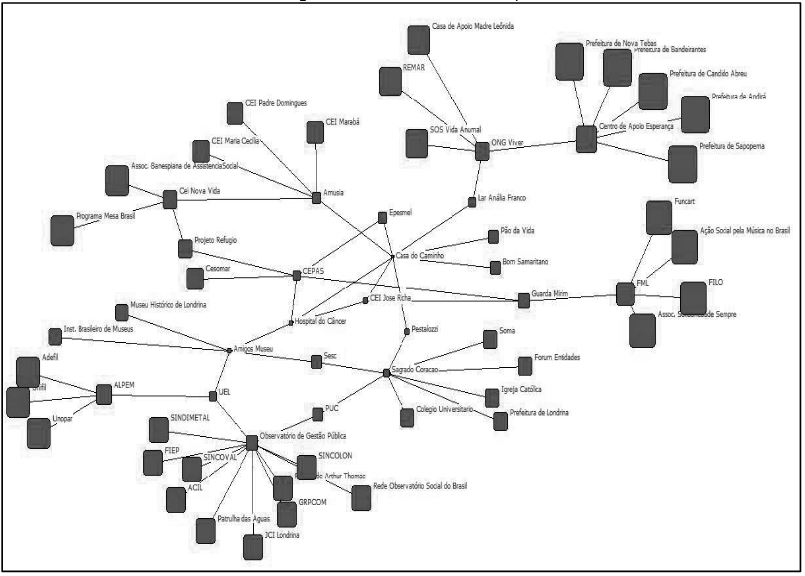
Figure 3 -
Closeness Centrality
Source: Conte (2017, p. 76)
The second type of centrality analyzed was Closeness Centrality which measures the independence or efficiency of an actor (Zhang, 2010). This is because such an actor is close to the other actors and this proximity, when associated with the efficiency of the key actor, makes the solution of problems of other actors in a group of relationships easier. The CCO of this group of institutions is a cancer-fighting hospital, and CO1 refers to an association of people responsible for the conservation and maintenance of the Londrina History Museum. Regarding the main activities developed by the CCO, the Director concludes:
So today it would be the treatment, palliative care and prevention. These would be the three major and largest priorities of the Cancer Hospital (CCO Director).
In addition to these, the Hospital also has an exclusive wing for children, which would provide child care. Besides, the Hospital is a philanthropic entity whose main supporter is SUS (Brazilian Unified Health System Assistance Network). This confirms Carvalho's statement (2013) that the history of health care in Brazil is necessarily related to philanthropy. Even more because of the religious philanthropic nature, the charity, that is, health in Brazil has a history fundamentally grounded in philanthropy, especially in religious philanthropy, this is confirmed, when the Director of the institution claims that the origin of CCO was because the founder has roots, and follows the guidelines and values of the spiritist religion.
As for its relationship with SUS, it is worth mentioning the position that this health system made in the constitution that Health is the right of the Citizen and the duty of the State (Carvalho,2013), that is, the State is responsible for health, not the private non-profit or philanthropic institutions. However, it is worth mentioning that the purpose of the Help and Support organizations is of supplying, or even complementing the demands that the State cannot meet, then, in some cases, some functions of the State’s responsibility are transferred to these entities, as the case analyzed here (Luzio-dos-Santos, 2018). Therefore, it was observed that the CCO refers to a Help and Support Organization, designed to cover gaps left by the State, and offer more specialized and better quality services.
CO1 was created 23 years ago by people and companies interested in “maintaining, preserving, conserving, expanding and disseminating the culture of our region” (President CO1). Today, located in the Old Railway Station of the city, it develops activities and permanent or temporary exhibitions always with “a link with a history, with an ethnicity, with the processes that were developed over the years in Londrina”. Some of the activities listed by the President of the Association are the restoration of a 1901 train, the restoration of the Dutra tailor’s nativity scene. Therefore, CO1 refers to an environmental institution that, according to Gohn (2011), works to preserve history, as well as to restore public space; in the International Classification of Non-Profit Organizations (Salamon & Anheier, 1992), it fits into the group of organizations designed to develop activities related to Culture and Arts.
One of the most important resources identified in the work of CCO was the “credibility” resource. The CCO Director says: "I think one of the main (resources) we have to maintain, and increasingly fight for, is credibility." This statement sustains the relevance that the Director gives to credibility to society as a way of fostering access to resources:
Because in order to function it (the hospital) needs financial resources, as Mr. Nelson Dequech says, 'healing costs money, technology costs money'. However, if you don't have the credibility, if you don't have the transparency, if you don't have the doors open to society, money won't come (CCO Director).
That is, it was evident that the credibility resource identified and articulated by the organization concerned is largely responsible for promoting cooperation and, consequently, access to another resource of another nature, the financial one. Regarding the Power and Dependency Relationships of this group of organizations, the power of the CCO over CO1 can be highlighted. Gambeta (2000, p. 223) affirms this proposition when he claims “Clearly, the higher the level of trust, the greater the probability of cooperation”. In addition, the author explains that selflessness and solidarity, as well as trust and credibility, are considered scarce resources. This is evident in the speech of the Director of the CCO:
to have financial resources to invest in early diagnosis in prevention. We would have to take it one step at a time, the most difficult step has already been taken, which is the credibility with society, which is the most difficult to obtain the financial resource itself (CCO Director).
Thus, the relevance of the credibility resource was observed as a resource capable of promoting cooperation and facilitating access to other resources such as: financial; the human; visibility among others. It is painful, however, necessary for civil society organizations to recognize the relevance of this resource in relation to their activities, the cause alone is not responsible for promoting the resource credibility and, therefore, will directly affect its survival. Organizations in this sector do not naturally legitimize themselves for their purposes, considering that some of them currently use their practices for alleged money laundering.
Initially, the relation of the organizations is through donations, where CO1, as an example given by its president, promoted a second-hand clothing bazaar long ago, and part of the funds went to CCO. When questioned about their trading relationship with CO1, the CCO claims that their dependence on the resources provided by CO1 is minimal, considering that they handle huge amounts of money to fund their activities. This should be taken into account since, according to Emerson (1962), in the relation between actor A's dependence on actor B, one must consider the motivational investment that actor A makes on actor B to achieve its goals, in this case, according to the CCO Director, it is minimal. However, considering the statements of the President of the CO1 and the Director of the CCO, one can see how the exercise of power of the central organization over other organizations occurs, as well as the resource exchanged and demonstrated in relations. After stating that this relationship was built by donations and technical assistance to CCO, the President of CO1 claims:
The Cancer Hospital may not have financial power, but it does have an image power, [...] it is a reference hospital. [...] a respected and highly credible institution (CO1 President)
In this explanation, the President of CO1 states that although the CCO lacks the financial resources, it has the image and social credibility resources. This statement is confirmed in the speeches of the Director of the CCO himself who provides an example that better illustrates the presentation of these resources in their relations with other institutions:
Unimed (The National Confederation of Medical Cooperatives) campaigned for the Cancer Hospital. Unimed collected can seals and sold them to buy wheelchairs. When they reached for entity X or Y, they got 4, 5, 8 wheelchairs. For us, they got over 20 (CCO Director).
Beyond that, the Army Reserve Training campaigned for food at the doors of supermarkets, made on behalf of other institutions, they got two, three, four tons, on our behalf they got 30 tons, a little more. 20 (CCO Director).
There was a bike race, a bike ride for the Hospital. The day before the event they came to me: ‘I tried to do it for entity X, but I couldn't get sponsorship and nobody helped us for them! I had to do it again for you, can I do it for you? Of course you can '20 (CCO Director).
In these speeches it is possible to illustrate how exchange relations occur: financial resource - credibility and visibility (image). CO1 claims that in the relationship established with the CCO, they help them with financial resources. However, in the speech of the CCO Director, it is clear that the credibility and visibility resources that the CCO has directly influence the amount received by the organizations when they use their name. However, when considering the emotional investment that actor B (CO1) has in relation to actor A (CCO), it was observed that it is much greater than the credibility and visibility that it can provide:
The Cancer Hospital may not have financial power, but it has image power [...] it is a reference institution. [...] it is a respected and highly credible institution (President of CO1, 2018).
Although there are other organizations that have similar activities, such as Santa Casa Hospital, Evangélico Hospital (private hospital) and other health-related entities, they do not achieve the credibility and visibility that the CCO has.
It cannot be said that CO1 uses the CCO's credibility resource to raise more resources for the institution, and thus to put it in a position of dependence. But it is worth addressing what Montaño (p. 209, 2008) says about fundraising in the Third Sector, that organizations in this sector often end up “adapting their 'mission' to the donor's 'profile', or make their philosophy so indifferent, flexible, empty that it allows it to negotiate with virtually any 'potential donor'.” Therefore, Third Sector organizations may be adapting their profile and interests and be using the credibility and visibility of others to negotiate with potential donors.
Accordingly, both the statements of the President of the CO1 and the Director of the CCO confirm that the credibility and visibility that is exchanged in CCO relations with the other institutions gives it greater power. And perhaps, what puts it in a central position among the mapped organizations, as claimed by Hanneman and Riddl (2005) that the centrality offers the actor a favored position, being able to have greater influence and be the focus of importance and attention of the other actors that occupy less favored positions.
When questioned about their exchange relationship with CO1, the CCO claims that their dependence on the resources provided by CO1 is minimal, considering that they deal with huge amounts of money to finance their activities. This must be taken into account, since, according to Emerson (1962), in the relationship dependence of actor A in relation to actor B one must consider the motivational investment that actor A makes on actor B to achieve his goals and, in this case, according to the Director of the CCO it is minimal. However, when considering the emotional investment that actor B (CO1) has in relation to actor A (CCO), it was observed that it is much greater in relation to the credibility and visibility that it can provide: “the Cancer Institute may not have financial power, but it has a power of image [...] it is a reference institute. [...] it is a respected and highly credible institution” (President of CO1, 2018). Although there are other organizations that have similar kinds of activities, such as Santa Casa Hospital, Evangélico Hospital and other entities linked to health, these do not reach the credibility and visibility that the CCO has.
According to Emerson (1962), power and its intensity are manifested through the relationship of dependence. Considering that in this relationship: there are exchanges of resources in both directions - financial resources on the one hand, and credibility and visibility resources on the other; that the resources exchanged have different types - concrete resource and abstract resource; and that the CO1 institution has a greater emotional investment in the CCO than the CCO in the CO1, confirms a greater degree of power of the CCO.
Still, it is worth bringing into analysis the relationship between CCO and CO2, the latter being an organization of religious origin that started its activities around 1993 for identifying "a very large social need in the area of professionalization for the labor market”. They realized that the families in the region needed to work found it difficult to find a job. Therefore, at first, the organization offered professional courses such as sewing, metalworking and call center courses. However, with changes in legislation and in the institution, the organization's service began to move a little away from its main objective and began to migrate to assisting children in a social service during the counter shift at school. Today, the institution presents a program called "Sustainable Training" serving children between 6 and 17 years old with proposals consistent with their respective age groups. Such proposals have three guides: citizenship, the right to be and coexistence. Objectives are achieved using methodologies such as: crafts, computers classes, sports, dance and music workshops (guitar, keyboard, flute and choir).
The dependence of CO2 on CCO occurs through donations. The President of CO2 explains:
[...] Hospital do Câncer receives a very large demand for donations of perishable food. They have very good food management there, when they are not perishable, they do their own internal management and naturally they end up enabling internal consumption. So they don't pass on what is not perishable. But there is a consumption period for what is perishable, that is, it either consumed quickly or lost, spoiled. So, at certain moments, more (food than needed) arrives, and the surplus is passed on to us. Also... with the disposal of some material that is no longer useful for the Hospital or when the move to a different property, (they say).
There’s a clear dependence of CO2 in relation to CCO in this relationship. The passage shows that in the case of perishable food, when more donations than needed are received, CCO passes it on to them, in order not to waste the food surplus. This also happens in the situation of old furniture and appliances that are no longer used or are replaced by others, thus providing essential materials for the institutions that are part of the studied network. In this context, it is evident that CO2 is more dependent than CCO in this resource exchange relationship. However, it is noteworthy that, according to Emerson (1962), in order to analyze a power relationship, it is not enough to focus only on the dyad, but also the options that the actor in dependency position has to try to balance its dependency. Actor B's dependence on actor A decreases as actor B finds opportunities to meet their needs or achieve their goals through other actors in the network. (Emerson, 1962)
Therefore, Cook, Cheshire and Gerbasi (2006) argue that the relationships that maintain balanced power refer, essentially, to an egalitarian exchange relationship. Thus, in an unbalanced or unstable relationship of power, actors are usually encouraged to promote balancing operations to maintain or increase their power in terms of exchange. In the case analyzed here, a network extension was verified as one of the balancing operations:
[...] since we’re talking about vegetables, we have other partnerships, like “Mesa Brasil”, a project that is run by SESC. The same materials come from other places [...] We even have a partnership with the CMTU itself, in the event of an apprehensions they also send it to social institutions, [...] for example, at the end of the last year there was an apprehension of strawberries, illegal sale, they make seizures, and we belong to the group of institutions and we have a partnership, so there is a rotation, they send them to us once, and in the next seizure they send them to another institution, and so on (PRESIDENT CO2, 2018) .
In this speech, it is possible to see that the resources exchanged in the relationship established with the CCO are also exchanged in other relationships, with other actors in its own network. This corroborates the preposition of Emerson (1962) that the extension of a power network can also be called an energy network, and is expressed when two or more actors establish dependency relationships, thus forming new relationships. As a result, the power of the central actor over CCO decreases, since it manages to establish more relationships of the same nature, exchanging the same resources, and collaborating to achieve CCO’s goals.
It is also worth mentioning that, according to Emerson (1962), the power of a given actor is proportional to the investment of the most vulnerable actor in the relationship in him,. When CO2’s President states that “[...] in the horticultural part we have partnership in several fronts, even Ceasa. So, on this front, there are several possibilities", it is noticed that, although there’s a dependence from CO2 on CCO (as well as power exerced by CCO over CO2), the degree of CCO’s power is not high, due to the network extension developed by CO2.
Therefore, identifying power through concrete and palpable resource exchange relationships is simpler, as the results can be measured and visualized. However, observing the impact and relevance of abstract resources that appear in a more subtle way becomes more complex, since it is about elements that may have high value for some and not so high for others. Therefore, when considering that the relationships are dynamic and, consequently, power is in constant movement in dependency relationships, not considering the attributes of the actors involved in the relationship becomes difficult, as they become a type of reference in the analysis, giving the researcher some kind of parameter, mainly in cases of relations that involve the exchange of abstract resources.
Final Remarks
Understanding the relationships established in the Third Sector is relevant, since it provides an understanding of how power relations established through central organizations influence the relationships of this network of inter-organizational relationships, as well as directs them to access resources. Thus, this research aimed to understand how the power relations among actors with greater centrality in the NPOs network of Londrina - PR influence the relations among actors and directs the access to resources. At first, the power of the two centrality categories (Degree and Closeness) can be confirmed by Emerson's Theory of Power and Dependency Relations (1962), as advocated by the Networks approach.
The actor Degree (CDO) - which has the largest number of connections in the mapped network - presented its predominance in power relations through the supervision and emancipation resources that it can exchange with other actors. The two actors analyzed present emancipatory elements in their speeches, whatever is possible, make the resource responsible for establishing a greater number of connections with this particular actor in this Third Sector relationship network. Thus, it is clear today that there is a growing concern of the citizens to become more active and participative, as well as to have a voice in society and request their space through more democratic governance, which not only promotes a more democratic society, but also strengthens the movement for sustainability in the political dimension.
The Closeness actor (CCO) - which has the shortest distance between the other actors in the network - expresses its advantage in the relationships established among the other actors through social credibility resources and material management. The social credibility resource which is evidenced in its relationships positively influences not only its own access to resources, but also the access to resources of the organizations that are connected with them. Becoming an important actor in the network and helping to solve the problems of other actors more quickly and efficiently, as advocated by the network approach.
In the studied cases, this happens when other actors in the network turn to CCO to appeal that they make donors give them their donations (financial resources). The power of the Closeness actor is also manifested through the relationships he establishes by managing materials, and providing them to other actors and, consequently, making them more dependent on the central actor. This should not be considered something essentially negative. Even though CCO generates dependency and power relationships for itself, the organization has helped with the sustainability of other organizations in its network. Thus, it can be said that, in the cases we analyzed, the social credibility resource and material administration may be promoting the proximity among the other actors of this network - first because social credibility is an important resource for raising donations and, second, because material management helps other organizations with their own activities. This is also an interesting example of the relevance of the social credibility resource in the survival of organizations.
Therefore, it is important to emphasize the understanding that the central organizations (Degree and Closeness) of this study proved to be more powerful compared to the other organizations in the network - the power of this manifest in the relations of dependence and exchange of resources - directly influencing both the relationships between actors and the access to resources. This is because, the central actors showed to possess and to exchange in their relations resources considered scarce in the Third Sector, or in the network in question, resources such as: inspection, credibility and material management. Therefore, such organizations are sought out by the others in the network so that from established connections - not always strong and frequent, but effective - they are able to articulate resources necessary for the execution of their activities.
The main findings of this research stand out: The presence of a civil society interest - even if subtle - for democratic governance, causing a strengthening of political sustainability, and giving the position of degree centrality to an Emancipatory organization, which is given to the actor that receives the most connections in a network. In addition, there was communication, relationship and exchange of resources among the actors that make up the Third Sector, in order to maintain the purpose for which they were established, that is, there is indeed an organizational, informal, dynamic network among the NPOs of Londrina – Pr. Through Emerson's Theory of Power and Dependency Relations (1962), the power and influence of this power of the central organizations in the relationship established with the other actors, as well as in the direction of their access to resources, was confirmed.
In view of the analyzed case, new items for future debates should be highlighted, such as: The preponderance of the power of central actors using different theoretical approaches to organizational power; The characterization of the actors and their practices that originate or result in power in a more complex network, covering the public, private and third sector (tri-sectorial); The role of agency in the context of power relations between central organizations in an NPO relationship network. In this case, the deepening of the debate on the impact of opportunism and malfeasance in the network, and; Coalition processes from third sector organizations in a context of sustainability.
Finally, broader discussions could be made on the 'value for governance' perspective, assessing power and central actors, results and comparisons. That is, the possibility of peripheric actors on the network repeating practices from central actors to obtain more power and this become more central actors and then redistributing power, consequently expanding or diminishing the network. Future studies will also be suitable for suggesting other types of network governance, whether in the form of autogenesis, federative or induced by external agents.
Notes
[1] Researchers are aware that, as Lin (1999) points out, sampling by indication of names (or generation of names) tends to concentrate the design of the network on the strongest relationships. And Granovetter was clear about the impact that weak ties can have on the network configuration and on the transactions between its actors (Granovetter, 1973).
References
Beck, U. (2011). Sociedade de risco: rumo a uma outra modernidade. São Paulo: Editora 34.
Blau, P. M. (1964). Exchange and power in social life. Transaction Publishers.
Borgatti, S.P., Mehra, A., Brass, D.J. & Labianca, G. (2009).Network analysis in the social sciences. Science, 323 (5916),892-895.
Carvalho, G. (2013). A saúde pública no Brasil. Estudos avançados, 27 (78) 726- 245.
Casciaro, T. & Piskorski, M. J. (2005). Power imbalance, mutual dependence, and constraint absorption: A closer look at resource dependence theory. Administrative science quarterly, 50 (2), 167-199.
Castells, M. (2005). A sociedade em rede (Vol. 3). São Paulo: Paz e terra.
Conte, P. (2017). Redes de relações sociais e a convergência de objetivos de sustentabilidade: estudos em organizações sem fins lucrativos de Londrina - PR. Dissertação (Mestrado em Administração) – Universidade Estadual de Londrina, Londrina.
Cook, K. S., Cheshire, C., & Gerbasi, A. M. (2006). Power, dependence and social exchange. In P. Burke (Ed.), Contemporary social psychological theories.
Doin, G. A.; Dahmer, J.; Schommer, P. C. & Spaniol, E. L. (2012). Mobilização social e coprodução do controle: o que sinalizam os processos de construção da lei da Ficha Limpa e da Rede Observatório Social do Brasil de controle Social. Revista Pensamento & Realidade, 27( 2) 56-79.
Emerson, R. M. 1962). Power-dependence relations. American sociological review, 27(1), 31-41.
Freeman, L. C. (1979). Centrality in networks: I. Conceptual clarification. Social Networks, 1, 215–239.
Godoy, A.S. (2006). Estudo de caso qualitativo In: Godoi, C.K.; Bandeira-De-Mello, R.; Barbosa Da Silva, A. (Org.). Pesquisa qualitativa em estudos organizacionais. São Paulo: Saraiva.
Gohn, M. G. (2011). Movimentos sociais na contemporaneidade. Revista brasileira de Educação, 16 (47).
Gambetta, D. (2000). Can we trust trust. In: Trust: Making and breaking cooperative relations, v. 13, p. 213-237.
Granovetter, M., Castilla, E., Hwang, H., & Granovetter, E. (2000). Social Networks in Silicon Valley. The Silicon Valley Edge, p. 218-247.
Hanneman, R. A.& Riddle, M. (2005). Introduction to Social Network Methods. Califórnia: University of California.
Hardy, C. & Clegg, S. R. (2001). Alguns ousam chamá-lo de poder. Handbook de estudos organizacionais. São Paulo: Atlas.
Kirschbaum, C. (2019). Network analysis: emergence, criticism and recent trends. RAUSP Management Journal, 54, 533-547.
Lima, C. E., & Vieira, S. F. A. (2017). A Institucionalização da Temática da Sustentabilidade no Programa de Pós-Graduação em Administração da Universidade Estadual de Londrina. Revista Pensamento Contemporâneo em Administração, 11(5), 20-36.
Luzio-dos-Santos, L.M. (2014). Socioeconomia: Solidariedade, Economia Social e as Organizações em debate. São Paulo: Atlas.
Mitchell, J. C. (1969). Social networks in urban situations. Manchester: University of Manchester Press.
Montaño, C. (2008). Terceiro setor e questão social: Crítica ao padrão emergente de intervenção social. 5 ed. São Paulo: Cortez.
Observatório de Gestão Pública de Londrina. (2020). Observatório de Gestão Pública de Londrina. Disponível em: < http://observatoriolondrina.org.br/> Acesso em: 13 de Fevereiro de 2021.
Pfeffer, J., & Salancik, G. R. (2003). The external control of organizations: A resource dependence perspective. Stanford University Press.
Salamon, L. & Anheier, H. (1992). Toward an understanding of the international nonprofit sector: the Johns Hopkins Comparative Nonprofit Sector Project. Nonprofit Management and Leadership.
Scherer-Warren, I. (2006). Das mobilizações às redes de movimentos sociais. Sociedade e estado, 21(1), 109-130.
Scott, R. (2001) Social Network Analysis. London: Sage.
Stake, R. E. (2005). Qualitative Case Studies. In N. K. Denzin & Y. S. Lincoln (Eds.), The Sage handbook of qualitative research (p. 443–466). Sage Publications Ltd.
Tichy, N. M.,Tushman, M. L.& Fombrun, C. (1979) Social network analysis for organizations. Academy of Management. The Academy of Management Review, Briarcliff Manor, 4(4), 507-519.
Travaglini, C. (2008) Financial Reporting in European NPOs: is now time for a common framework? International Journal of Not-for-Profit Law, 11(1), 67-74.
Zhang, M. (2010). Social Network Analysis: History, Concepts and Research. In: (ED.), Borko. F. Handbook of Social Network Technologies and Applications. [S.l.]: Springer Science & Business Media.
Notas