MANAGERIAL SKILLS AND LEARNING MODALITIES OF FAMILY BUSINESS MANAGERS
 Vilson Alves da Silva vilsonalvesadm@gmail.com
Jader Cristino de Souza Silva souzajader@gmail.com
Marcos Gilberto Dos-Santos marcosgilberto@ifba.edu.br
Vilson Alves da Silva vilsonalvesadm@gmail.com
Jader Cristino de Souza Silva souzajader@gmail.com
Marcos Gilberto Dos-Santos marcosgilberto@ifba.edu.br
MANAGERIAL SKILLS AND LEARNING MODALITIES OF FAMILY BUSINESS MANAGERS
Revista Pensamento Contemporâneo em Administração, vol. 18, núm. 1, pp. 128-145, 2024
Universidade Federal Fluminense
Recepción: 13 Enero 2023
Aprobación: 26 Enero 2024
Resumo: O estudo busca investigar as modalidades de aprendizagem organizacional que mais influenciam no desenvolvimento das competências gerenciais em empresas familiares. As modalidades de aprendizagem organizacional são agrupadas em duas abordagens: Individual-cognitiva e Socio-prática. Foi utilizada uma abordagem quantitativa e realizada uma pesquisa com 165 gestores. Os resultados indicam que as modalidades de aprendizagem organizacional individual-cognitiva, como o treinamento, não possuem uma relação positiva com o desenvolvimento de competências gerenciais nas empresas familiares estudadas. Contrariamente, os gestores pesquisados desenvolvem suas habilidades gerenciais, exceto as habilidades reflexivas, através de todos os tipos de modalidades socio-práticas, sendo a mentoria particularmente eficaz.
Palavras-chave: Empresas Familiares, Modalidades de Aprendizagem Gerencial, Habilidades Gerenciais.
Abstract: The study aims to investigate which organizational learning modalities have the most influence on the development of managerial competencies in family businesses. The organizational learning modalities are grouped into two approaches: Individual-cognitive and Socio-practical. A quantitative approach was used, and a survey was conducted with 165 managers. The results indicate that individual-cognitive organizational learning modalities, such as training, do not have a positive relationship with the development of managerial competencies in the family businesses studied. On the contrary, the surveyed managers develop their managerial skills, except for reflective skills, through all types of socio-practical modalities, with mentoring being particularly effective.
Keywords: Family Business, Managerial Learning Modalities, Managerial Skills.
Introduction
The family organization has acquired high socioeconomic relevance both locally and worldwide (Kosmidou & Ahuja, 2018, Karam, Machado & Abib, 2019; Lunardi, Hein, & Kroenke, 2020, Alves & Gama, 2020). The importance of family businesses is so significant that research shows, worldwide, 80% of business ventures represent family organizations (Gersick, Davis, Hampton, & Landsberg, 1997; Paiva, Oliveira & Melo, 2008, Alves & Gama, 2020). Bell (2009) indicates that between 80-90% of all private businesses in the United States are administered by the controlling family. It is estimated that 80% of Brazilian private organizations are family members, representing approximately 50% of the Gross Domestic Product (Karam et al., 2019).
Though essential to the global economy, a large percentage of family companies decline because they are not appropriately prepared for the intense competition that has ceased to be local but is now global (Balbinot & Marques, 2009). Given this scenario, it is assumed that organizational learning is a strategic element for maintaining this type of company in the market as well as for raising its levels of competitiveness (Teston & Filippim, 2016). In other words, the literature indicates that companies that include learning as a fundamental organizational practice put themselves ahead of their competitors, innovating and acquiring sustainable procedural and market competitive advantages ( Davel & Oliveira, 2018).
If learning is increasingly important at different levels of the organization, at the management level, its relevance is even greater. After all, managers are most responsible for creating organizational strategies and decision-making, requiring a diverse and complete set of management skills (Campos, Souza-Silva, & Dos-Santos, 2018).
The writings on organizational learning (Alvesson & Karreman, 2001; Gosling & Mintzberg, 2003; Spender, 2004; Souza-Silva, 2009; Dos-Santos, Pereira, Souza-Silva, & Riviera-Castro, 2015; Campos et al., 2018) indicate seven modalities included in the formal and informal learning processes (Correia-Lima et al., 2019), namely: Traditional Training; Reading Texts; Access to Databases and on the Job Training; Mentoring; Communities of Practice and Casual Interactions. Some of these modalities can be present in both processes. Also, the literature indicates seven categories of managerial skills: reflective, technical-operational, analytical-strategic, interpersonal, political, cultural, and contextual (Burgoyne & Stuart, 1976; Gosling & Mintzberg, 2003; Spender, 2004; Dos-Santos et al.; 2015; Campos et al., 2018).
Not many national or international studies (Wenger, 1998; Coetzer, Wallo & Kock, 2019) try to investigate how these skills, so relevant to daily life and managerial challenges, are learned by managers. And investigations that seek to understand how such skills are learned in the specific context of family businesses are even rare (Hoon, Hack, & Kellermanns, 2019).
Thus, the central objective of this research emerges that seeks to investigate which modalities of organizational learning have more influence on the development of managerial skills within the scope of family businesses located in southwestern the state of Bahia (Brazil).
Therefore, the theoretical-analytical contribution of this research lies in verifying which learning modalities, previously mentioned, have a significant impact on the development of managerial skills. Reflecting on the correlations and associations between learning modalities and managerial skills can stimulate new investigations of a qualitative character, for example, on “how” influences occur between these two constructs, analyzing the subtleties of the particular scenario of family businesses. And this in turn can open other paths for other theoretical-empirical analyzes that aim to reflect more effective and transforming processes linked to the development of managers.
To pursue the objective of this research, it was decided to opt for a methodological approach of a quantitative character. The empirical material collected was given through the application of questionnaires to 165 managers of family organizations located in southwestern the state of Bahia (Brazil) and analyzed using structural equation modeling.
Theorical Framework
Family Business
Many authors emphasize the importance of the family business, advocating that they represent the essence of the organizational fabric in contemporary market economies, presenting influence significantly both in emerging countries such as in the developed countries (Sharma, Chrisman, & Gersick 2012; Ratten, Ramadani, Dana, Roy & Ferreira, 2017; Alves & Gama, 2020).
The family organization is a type of business that has very peculiar characteristics, problems, and challenges and cannot be explained by the traditional theory of organizations gaining, in this sense, the status of a complex organization. This complexity occurs, essentially, because the family business is influenced by two logics that can be harmonious or antagonistic: the business and the family. The family logic favors, for example, values such as seniority and feeling while the business is influenced by another matrix of values that are based on assumptions directly linked to competence, experience, effectiveness, and delivery of results (Alves & Gama, 2020). For this investigation, it was adopted the seminal concept of Déry, Dupuis, Hugron, and Émond-Péloquin (1993) presented in their paper called La Varieté des Entreprises Familiales: Construction Théorique et Typologique. For these authors, to be understood by a family firm, a company needs to contemplate, simultaneously, the following adjectives: a) the family must hold ownership over the company, which may be total, majority, or minority; b) the company's strategic management guidelines are influenced by the controlling family; c) the values of the corporate culture are influenced or identified with those of the family; d) the controlling family defines the succession process.
Approaches to Organizational Learning
Looking at the literature review on organizational and managerial learning (Burgoyne & Stuart, 1976; Gherardi, Nicolini, & Odella, 1998; Ferreira & Godoy, 2012; Pederzini, 2019), it was found that the process of development and learning of managers happens, essentially, from two complementary approaches: the cognitive individual and the socio-practical.
Concerning individual cognitive learning, this approach is structured in a schooling and traditional concept of learning. In this sense, the process of transmission of knowledge is marked by unidirectional mechanisms that essentially favor the explicit part of knowledge (Manuti, Pastore, Scardigno, Giancaspro & Morciano, 2015). These authors still advocate that this type of learning takes place, substantially, outside the work environment. As it is based on formal education, this type of managerial learning takes place, most commonly, in training spaces, auditoriums, classrooms, or corporate universities. Thus, the teaching-apprentice is decontextualized from practice, minimizing social interactions as relevant to the transmission process not only of explicit knowledge but also tacit (Polanyi, 1966; Ferreira & Godoy, 2015). The explicit portion of knowledge is transmitted through written or oral language and constitutes a small part of the knowledge in its entirety. In turn, the tacit part corresponds to the largest portion of knowledge, being much more difficult to be transmitted orally or in writing. In other words, it needs a socio-practical context to be transmitted and incorporated by people (Andrews & Smits, 2019). That is why Schön (1983) signals that we know more than what we can transmit through the oral or written word.
Some authors (Antonacopolou, 2000; Eraut, 2011; Manuti et al., 2015) point out that the modalities of the individual cognitive approach to learning are usually characterized by contemplating an organized program, a planned learning structure, the presence of a teacher or trainer and the granting of qualification, and a diploma for those who complete the training credits.
In addition to what occurs in the most traditional conceptions of organizational learning and managerial training, especially in the last two decades, a theoretical field is strengthened that seeks to deepen the understanding of learning from a more socio-practical perspective. The socio-practical approach to managerial learning presupposes the acquisition and development of skills in the work environment through the sharing of everyday experiences that happen from the social interactions that take place in the daily practice of managers. Thus, it is in the professional routine that managers acquire and transmit knowledge, meanings, experiences, dilemmas, and learnings (Gherardi et al., 1998; Pederzini, 2019). In this sense, this conception of learning of managers emerges from a need, intrinsically linked to their routine of managerial activity (Riera-Claret, Sehagún & Selva, 2020).
Thus, the literature is forceful in pointing out that the socio-practical learning of managers has great relevance because - through the sharing of their knowledge - they learn from each other’s explicit and tacit knowledge, as well as reflect on their strategies, organizational processes, and practices. Therefore, they end up will improve their management skills through socio-interactional events. Based on the above, it is clear that managers learn in a diversified manner, both from the individual cognitive approach and from the socio-practical approach. In this sense, it appears that the understanding of the learning process of managers happening only through training and traditional corporate education programs is fragile. It is significant that it also happens through daily management practices and the exchange of experiences in the context of work through learning in action (Ferreira & Godoy, 2015).
Studies developed in the field of organizational and managerial learning (Antonacopoulou, 2000; Dos-Santos, 2014; Oliveira-Neto & Souza-Silva, 2017; Becker & Bish, 2017; Campos et al., 2018) mapped seven learning modalities, namely: traditional training; access to databases; the reading of texts (manuals books, and articles); communities of practice; on the job training; casual interactions and mentoring. All of them will be presented below.
Organizational Learning Modalities
Traditional training is a modality of the individual cognitive approach to managerial learning most commonly used and indeed influenced by formal education (Antonacopoulou, 2000). Thus, if in traditional education, teaching and learning take place in the classroom, schools, institutes, and educational institutions in general; in traditional training, one learns in structured physical spaces for corporate education, such as training rooms, corporate auditoriums, or universities (Manuti et al., 2015; Araújo, Abbad, & Freitas, 2017). Campos et al. (2018) point out that traditional training is markedly inspired by the schooling concept, as well as by the understanding that the learning process resides in the transmission of knowledge towards those who know (instructor, lecturer, teacher) for others who do not have the same knowledge (Antonacopoulou, 2000; Campos et al., 2018). Another characteristic of this type of modality is that it generally favors the explicit dimension of knowledge, ignoring the tacit.
Access to databases is also on the list of individual cognitive modalities. It represents a technological mechanism responsible for archiving, managing, and retrieving information at any time. Therefore, when accessing the databases, the manager comes in contact with information and organizational knowledge of any kind, such as best business practices, professional, managerial, and organizational procedures manuals, among others that were stored at different times in the company's history by several individuals and that, when recovered, will have the power to expand the repertoire of knowledge of those who are accessing such a device (Campos et al., 2018). For Souza-Silva (2009), the database may have limitations. One of them refers to the content of the stored information that can be significantly outdated, if not updated frequently. Also, this technological mechanism stores only the explicit part of knowledge that, as has already been pointed out, represents its smallest portion, since the tacit dimension needs a practical and interactive context to be transmitted and incorporated (Wenger, 1998; Souza-Silva, 2009).
The reading of texts (manuals, books, and articles) is understood as one of the modalities of the managers' individual cognitive and organizational learning perspective as a whole. A text represented by books, manuals, or articles can be understood as a repository of explicit knowledge since it is encoded through conventional signs and codes, contemplated in a specific language. Generally, in it, only a small part of the knowledge (the explicit dimension) is transmitted to the reader who can access it through different means (physical or electronic).
The Community of Practice is a learning modality of the socio-practical approach and constitutes a group of people who come together to develop a specific domain of knowledge linked to practice through the exchange of multiple experiences (Wenger, 1998; Dos-Santos et al., 2015b; Goodwin, 2019). In this sense, three elements characterize a community of practice: domain of knowledge, practice and community. The domain of knowledge is the field of knowledge in which members of a CoP discuss an area of knowledge, valuing learning through the sharing of knowledge, experiences and experiences between them (Souza-Silva & Schommer, 2008; Hoyert & O`Dell, 2019). Practice is the context where knowledge is generated and learned. Finally, the community is a group of individuals who develop more intense ties between them. In other words, as the members of a CoP come together, they intensify trust between them, create a mutual identity, establish a more intimate relationship, thus forming a community. Another important point of a community of practice is that it is not an institutionalized group. It is an informal group created by the voluntary agglutination of its members who perceive value in the exchange of their knowledge and experiences linked to a specific domain of knowledge (Souza-Silva, 2009).
On-the-job training is another mode of learning social practice and is distinguished from traditional (Minton & Lowe, 2019). Traditional training is established only through the transmission of the explicit part of knowledge, as it takes place in decontextualized spaces in the practical-work environment, making it difficult to transfer the tacit part of knowledge. On the other hand, on-the-job training takes place in the work scenario. Thus, learning occurs through action. One learns by looking at the work of the most experienced colleague, exercising observation and sharing knowledge with peers (Deprá, Pereira & Marchi, 2018). Some authors indicate that on-the-job training has been widely used by several organizations as an effective modality of managerial learning since the knowledge learned is significantly connected to the organizational reality (Dos-Santos et al., 2015b; Campos et al., 2018).
Casual interaction, also, represents a modality of managerial learning from a socio-practical perspective. These are unplanned and unscheduled contacts that occur accidentally and informally in the business context itself. These contacts between managers can happen on different occasions, namely: in a conversation over coffee, in a dialogue in the smokehouse, during an interaction at lunchtime, or in any other situation (Pamponent-de-Almeida & Souza-Silva, 2015; Campos et al., 2018). It is in these opportunities that managers take advantage to exchange experiences and share the challenges of managerial problems that they may be facing. Thus, they share advice, resolve each other's doubts, and exchange knowledge strongly connected to their practical realities. In this sense, such opportunities represent a rich bilateral opportunity for the transmission and absorption of knowledge in its entirety: explicit and tacit (Dos-Santos et al., 2015a).
Finally, the last modality of the socio-practical approach to managerial learning is mentoring. In mentoring, a manager with more experience contributes to the training and managerial development of the less experienced one called protégé, disciple, or mentored (Rekha & Ganesh, 2012; Bear, 2018). Mentoring can be formal or informal. It is formal when the organization formalizes this mode as one of its organizational learning practices and assigns formal mentors monitoring of mentees. Oliveira-Neto and Souza-Silva (2017) argue that mentoring is informal when there is a spontaneous attraction between the mentor and the protégé without any involvement of the organization concerning the formalization/institutionalization of this process (Ambrosetti, 2014; Oliveira-Neto & Souza-Silva, 2017). In the relationship with his mentor, mentoring assimilates explicit and tacit knowledge and developing skills, with the backdrop of concrete situations and the practical reality of management. In this way, he acquires a greater range of skills capable of making a decisive contribution to his management training process (Ambrosetti, 2014). The table below summarizes the individual cognitive and socio-practical approaches, their characteristics, and their modalities.
| Characteristics | Individual Cognitive Approach | Socio-practical Approach |
| Knowledge | Knowledge has coded and cognitive character | It is conceived through practice and socio-relational contexts |
| Knowledge transmission | Privileges the explicit dimension of knowledge | Privileges the transmission of knowledge in its dual nature: explicit and tacit |
| Ways of Learning | Learning, usually by reading, listening, or watching | Learning by doing, interacting, and observing actively and interactively |
| Learning Modalities | Traditional Training, reading texts, and database access | Community of Practice, On the Job Training, Casual Interactions, Mentoring |
It is assumed that the process of development and learning of managers occurs, in the long term, from the combination of distinct approaches and modalities. This process configures itself in a hybrid in a multifaceted and diverse way, depending on factors such as the market segment of the organization, the life cycle of the company, the manager's maturity, and other variables.
Managerial Skills
To carry out the objective of this investigation, it is essential to deal with managerial skills. They are necessary skills for the work and challenges of the manager, equipping him to carry out good readings of different business scenarios (internal and external). Such skills contribute to effective decision-making processes of managers that need to be in synergy with the organizational objectives of survival, sustainability, and competitiveness (Gosling & Mintzberg, 2003; Spender, 2004; Dos-Santos, 2014; Laud, Arevalo, & Johnson, 2015). Although there is no consensus on managerial skills, the research of some theorists has similarities, pointing out the following skills of managers: 1) reflective skills; 2) technical-operational; 3) analytical-strategic; 4) interpersonal; 5) politic; 6) cultural and 7) contextual.
Reflective skills have the role of comparing a situation in the present with another situation in the past that the manager has experienced. This exercise promotes rich learning when the professional discovers new and better ways to perform that activity in a context connected to a new practice (Daudelin, 1996). Schön (1983) also says that learning happens by the continuous spirals of the phases of appreciation of the action itself and the re-appreciation of the action. The reflective skills have deep similarities with the idea of the “reflective mindset” advocated by Gosling and Mintzberg (2003). Campos et al. (2018) reveal that reflexive ability helps the manager in his process of self-understanding and self-confidence (Akin, 1994; Leite, 2011). Self-understanding contributes to the manager in understanding his skills and talents, causing a process of confidence in himself (Daudelin, 1996; Bosangit & Demangeot, 2015).
Technical-operational skills concern knowledge related to a given production cycle. A manager has technical-operational skills when he or she dominates specific procedures in a certain area or department he manages (Spender, 2004; Botelho, 2012). Spender (2004) names this specific knowledge as Local Knowledge to translate the particular knowledge of an organization's processes. Therefore, without having the technical-operational skills, the manager will present problems to monitor, control, and verify whether a particular operation is being developed efficiently and whether the programmed result will be achieved (Bündchen, Roseto, & Silva, 2011). Techno-operational management skills are diverse and depend on the type of organization. For example, the technical-operational skills of a civil construction company manager will be different from those of a manager of a bank or a firm in the telecommunications sector (Akin, 1994; Bündchen et al., 2011).
Analytical-strategic skills are made up of two skill sets: analytical and strategic. The analytics enables the manager in his activity to fragment a given organizational problem or challenge to better understand it and thereby expand its resolution potential. The strategic part, on the other hand, allows the manager to think broadly and on a macro level, realizing the connections between the different parts of a problem to find a more coherent and effective answer to it. Dos-Santos (2014) and Campos et al. (2018) suggest that analytical and strategic skills make it possible for professionals to assume management positions, solve delicate and complex organizational challenges, make well-founded decisions, to develop a systemic and complete view of the company or department, and to solve other problems.
Getting along well with team members and leaders is a part of managerial interpersonal skills (Mencl, Wefald, & Ittersum, 2016). These skills relate to the managerial capacity to develop team potential by interacting with them respectfully and gently as well as giving and receiving feedback (Brackett, Rivers & Salovey, 2011) with a view to the emergence of a collaborative mentality (Gosling & Mintzberg, 2003). On this, Dos-Santos (2014), and Botelho (2012) argue that interpersonal skills are relevant to the manager because it assumes an essential role in creating organizational climate satisfaction, building motivation of staff, and increasing the level of commitment of professionals. Such factors are crucial to the achievement of the most challenging organizational purposes.
Political skills refer to the fifth category of managerial skills and include three dimensions: 1) negotiation skills, 2) ability to build contact networks and 3) articulation skills (Dos-Santos, 2014; Campos et al., 2018). The negotiation dimension deals with the manager's ability to influence others, resolve conflicts, solve problems that involve people, capitalizing on the processes of change, innovation, and business competitiveness. The dimension related to building contact networks refers to the need for managers to build relationships with people internally and externally in their organization, intending to promote greater acceptance of their ideas and projects for later implementation. Finally, the articulation dimension refers to the role that the manager has to promote relationships with organizations that are not under his supervision and people who are not under his subordination by interacting successfully with everyone to achieve the goals that his organization seeks (Gosling & Mintzberg, 2003; Spender, 2004; Dos-Santos, 2014; Gansen-Ammann, Meurs, Wihler, & Blickle, 2017).
Cultural skills represent the sixth category of managerial skills. On this, Souza-Silva (2009) says that the organizational culture is a set of beliefs, values, and principles that affect how professionals react and behave in the organizational context (Smircich, 1983). In addition, it contributes to the construction of a sense of identity and the promotion of professional commitment to achieve the company's purposes. Therefore, knowing the culture of the organization to which it is linked, internalizing it, and disseminating it among its team members and peers is an important role for the manager.
Finally, the seventh category of managerial skills refers to contextual skills. They relate to the manager's ability to carry out accurate readings of the micro and macro environment in its different aspects: market, social, economic, political, and cultural, among others. After all, the organization is inserted in a particular context that needs to be taken into account to better relate to each of its elements. Gosling and Mintzberg (1993) suggest that when reading and interpreting the context surrounding the organization, the manager must be able to identify present and future demands from customers, decipher market trends and consider the matrices of threats and opportunities that surround the organization (Botelho, 2012; Laud et al., 2015).
Methodology and procedures
To achieve the objective of this research, a quantitative approach was adopted using two scales to measure managerial skills and organizational learning modalities when applied to family business managers operating in Brazil. The procedures are listed below.
Sample
The questionnaire containing the two scales and the sample characterization questions was sent via email with an electronic form to family business managers. The sample was composed of 165 respondents, 73% male and 72% between 30 and 50 years old. Respondent's education indicates that 58% completed higher education, with Administration being the most representative course with 35%. Regarding the time in the position of manager, 55% of respondents have held it for a period between 5 and 15 years. The respondents' fields of activity mainly included the automotive sector (39%), agribusiness and food (31%), and health (7%). Regarding the life stage of the total family businesses (40 companies) in which the managers work, 75% are in the first generation, 20% are in the second generation and 5% are in the third generation. It is worth noting that, in the first generation, the family business is managed by the owner-founder; in the second generation, the founder was already succeeded by his children and, in the third generation, the management of the family business is under the responsibility of the founder's grandchildren.
Framework
To assess the relationship between organizational learning modalities and managerial skills, these constructs were taken as latent variables and measured using two scales. Organizational learning modalities were measured using the LMS scale (Learnig Modalities Scale), consisting of 21 items and developed by Dos-Santos (2014), having been validated in different contexts, such as trainee programs (Dos-Santos, 2014), junior entrepreneurs (Dos-Santos et al., 2015b), public managers (Brito-de-Jesus et al., 2016) and industrial managers (Campos et al., 2018). The LMS proposal is to assess the frequency of learning modalities on a response scale that varies between never (1) and always (6).
Management skills were measured using the MSS (Management Skills Scale) (Dos-Santos, 2014), consisting of 23 items that assess the seven proposed dimensions and were validated in different audiences, namely: public managers (Brito-de-Jesus, Dos-Santos, Souza-Silva, & Rivera-Castro, 2015) and industrial managers (Campos et al., 2018) among others. In the MSS, an ordinal response scale was used, indicating the respondents' level of agreement with the mastery of skills between strongly disagree (1) and strongly agree (6).
The model proposed in this research adopts the seven managerial skills as first-order latent variables (LV) of the reflexive type. The set of these seven LV is represented by the second-order LV, here called MSk (Managerial Skills). The seven modalities of organizational learning, on the other hand, form reflective constructs grouped into two second-order LVs based on the closest approaches: Individual Cognitive (IC), which combines text reading, access to databases and traditional training, and socio-practical (SP), formed by communities of practice, mentoring, on-the-job training and casual interactions.
The proposed model considers that the development of managerial skills is a consequence of personal and organizational processes experienced from the organizational learning modalities in the two approaches presented.
Statistics Methods
The relationship between organizational learning modalities and managerial skills was evaluated using structural equation modeling with estimation from the Partial Last Square Path Modeling (PLS-SEM) method. This method assesses the relationships between variables from the combination of principal component analysis and ordinary least squares regression using SmartPLS software (Ringle, Wende & Becker, 2015). This statistical technique allows the evaluation of complex models based on the total variance of items to estimate the relationship parameters between latent variables (Hair, Rischer, Sarstedt & Ringle, 2018).
Results
The results of this research are presented in three parts: The evaluation of the LMS Scale formed by two second-order dimensions, containing seven latent variables; the MSS Scale, formed by a second-order construct called Management Skills (MSk), which represents the seven latent first-order variables; and finally, the relationship between organizational learning and managerial skills within family business managers.
| Item | First-order Latent Variables (LVs) | 2-Order LVs | ||||||||
| Train | Tex | Data | CoP | Ment | Tjob | Casu | Cogn | Social | ||
| M1 | 0.732 | 0.208 | 0.187 | 0.200 | 0.276 | 0.181 | 0.214 | 0.490 | 0.311 | |
| M2 | 0.817 | 0.340 | 0.294 | 0.264 | 0.290 | 0.223 | 0.211 | 0.628 | 0.348 | |
| M3 | 0.759 | 0.448 | 0.235 | 0.155 | 0.145 | 0.267 | 0.225 | 0.627 | 0.270 | |
| M4 | 0.264 | 0.681 | 0.262 | 0.110 | 0.150 | 0.172 | 0.178 | 0.514 | 0.213 | |
| M5 | 0.419 | 0.773 | 0.401 | 0.324 | 0.322 | 0.235 | 0.301 | 0.682 | 0.415 | |
| M6 | 0.251 | 0.714 | 0.194 | 0.198 | 0.123 | 0.107 | 0.216 | 0.496 | 0.221 | |
| M7 | 0.088 | 0.223 | 0.707 | 0.218 | 0.139 | 0.113 | 0.005 | 0.448 | 0.165 | |
| M8 | 0.203 | 0.246 | 0.800 | 0.265 | 0.189 | 0.246 | 0.111 | 0.548 | 0.278 | |
| M9 | 0.383 | 0.448 | 0.846 | 0.381 | 0.399 | 0.415 | 0.252 | 0.732 | 0.507 | |
| M10 | 0.132 | 0.158 | 0.236 | 0.754 | 0.235 | 0.252 | 0.274 | 0.229 | 0.503 | |
| M11 | 0.215 | 0.311 | 0.374 | 0.845 | 0.301 | 0.268 | 0.421 | 0.391 | 0.614 | |
| M12 | 0.285 | 0.221 | 0.249 | 0.695 | 0.228 | 0.106 | 0.255 | 0.327 | 0.429 | |
| M13 | 0.338 | 0.279 | 0.330 | 0.320 | 0.884 | 0.326 | 0.334 | 0.411 | 0.701 | |
| M14 | 0.266 | 0.265 | 0.293 | 0.313 | 0.925 | 0.361 | 0.308 | 0.357 | 0.720 | |
| M15 | 0.223 | 0.248 | 0.286 | 0.282 | 0.920 | 0.363 | 0.303 | 0.328 | 0.707 | |
| M16 | 0.285 | 0.168 | 0.303 | 0.248 | 0.304 | 0.841 | 0.208 | 0.331 | 0.542 | |
| M17 | 0.262 | 0.291 | 0.336 | 0.287 | 0.378 | 0.876 | 0.355 | 0.386 | 0.648 | |
| M18 | 0.129 | 0.082 | 0.185 | 0.095 | 0.207 | 0.654 | 0.119 | 0.173 | 0.364 | |
| M19 | 0.354 | 0.249 | 0.098 | 0.333 | 0.350 | 0.303 | 0.722 | 0.302 | 0.591 | |
| M20 | 0.122 | 0.282 | 0.172 | 0.356 | 0.255 | 0.212 | 0.866 | 0.247 | 0.578 | |
| M21 | 0.188 | 0.251 | 0.163 | 0.319 | 0.215 | 0.211 | 0.800 | 0.260 | 0.528 | |
The results shown in Table 2 indicate that the items have factor loadings close to or greater than 0.70 in the first-order latent variables that represent them, in addition to having cross-loads with the other lower latent variables, indicating discriminant validity. In the construction of second-order latent variables using the indicator repetition method (Nitti & Ciavolino, 2014), the nine items that make up the Cognitive LV and the 12 items that make up the Socio-practical LV have higher loads in their respective LVs. The fact that some loads are close to 0.50 is expected because the second-order LV gathers items originating from different first-order LVs.
| First-order LVs | 1 | 2 | 3 | 4 | 5 | 6 | 7 |
| 1 – Traditional Training | 0.770 | ||||||
| 2 – Reading Text | 0.443 | 0.724 | |||||
| 3 – Access to Database | 0.314 | 0.409 | 0.786 | ||||
| 4 – Communities of Practice | 0.268 | 0.305 | 0.380 | 0.767 | |||
| 5 – Mentoring | 0.303 | 0.290 | 0.333 | 0.335 | 0.910 | ||
| 6 – On-the-Job Training | 0.294 | 0.245 | 0.356 | 0.281 | 0.385 | 0.796 | |
| 7 – Casual Interaction | 0.281 | 0.328 | 0.181 | 0.423 | 0.346 | 0.306 | 0.798 |
| Composite reliability | 0.814 | 0.767 | 0.828 | 0.810 | 0.935 | 0.836 | 0.840 |
| Average Variance Extracted (AVE) | 0.593 | 0.524 | 0.618 | 0.589 | 0.827 | 0.634 | 0.637 |
The evaluation of the LMS Scale for the first-order LVs is shown in Tables 2 and 3. For the two second-order LVs, the Individual Cognitive variable presents the composite reliability equal to 0.82, the square root of AVE equal to 0.57, while the Socio-Practice variable presents the composite reliability equal to 0.86, and the square root of AVE equal to 0.59. Finally, the correlation between them is 0.55 (p-value < 0.001) justified by t
he fact that they represent different dimensions of the same construct.
As seen in Table 3, the correlations between the first-order LMS latent variables show significant correlations with each other, with values between 0.18 and 0.44. On the diagonal of the matrix, it can be seen that the values of the square root of the average variance extracted (AVE) are superior to the correlations between the LVs (Fornell & Larcker, 1981). The data presented here allow us to assert that, in the context studied, the LMS scale has convergent, discriminant, and reliable validity.
Table 4 indicates that the MSS Scale has discriminant validity since items H1 to H23 have factor loadings close to or greater than 0.70 in the latent first-order variables that represent them. In addition, the items have cross-loads with the other lower latent variables. The second-order latent variable (MSkill) was formed by all items of the MLSS scale by the indicator repetition method (Nitti and Ciavolino, 2014), with factor loadings between 0.40 and 0.73.
In addition to the results shown in Tables 4 and 5 for the first-order LVs, the second-order LV, MSkill, presents the composite reliability equal to 0.94, the square root of AVE equal to 0.42. As shown in Table 4, the correlations between the first-order latent variables of the MSS show significant correlations with each other, with values between 0.36 and 0.72. On the diagonal of the matrix, it can be seen that the values of the square root of the average variance extracted (AVE) are superior to the correlations between the LVs (Fornell & Larcker, 1981). The data presented here allow us to assert that, in the context studied, the MSS scale has convergent, discriminant, and reliable validity.
These results indicates that both scales (LMS and MSS) can be used to assess the occurrency of modalities of organizational learning and the level of domain of managerial skills in the context of family businesses operating in southeastern Bahia, Brazil. The relationship between the organizational leraning modalities and management skills will be presented bellow.
| Item | First-order Latent Variables (LVs) | 2-order LV | |||||||
| Refl | T-oper | Strat | Interp | Polit | Cult | Cont | MSk | ||
| H1 | 0.792 | 0.305 | 0.400 | 0.353 | 0.278 | 0.370 | 0.359 | 0.482 | |
| H2 | 0.701 | 0.295 | 0.396 | 0.277 | 0.117 | 0.230 | 0.403 | 0.401 | |
| H3 | 0.843 | 0.493 | 0.478 | 0.413 | 0.406 | 0.356 | 0.475 | 0.587 | |
| H4 | 0.409 | 0.771 | 0.415 | 0.483 | 0.385 | 0.500 | 0.402 | 0.592 | |
| H5 | 0.355 | 0.803 | 0.538 | 0.474 | 0.407 | 0.438 | 0.421 | 0.607 | |
| H6 | 0.388 | 0.825 | 0.646 | 0.558 | 0.546 | 0.390 | 0.520 | 0.688 | |
| H7 | 0.446 | 0.545 | 0.829 | 0.586 | 0.518 | 0.488 | 0.556 | 0.710 | |
| H8 | 0.422 | 0.504 | 0.827 | 0.597 | 0.547 | 0.519 | 0.562 | 0.714 | |
| H9 | 0.477 | 0.609 | 0.807 | 0.596 | 0.511 | 0.459 | 0.513 | 0.708 | |
| H10 | 0.317 | 0.502 | 0.588 | 0.834 | 0.560 | 0.530 | 0.555 | 0.716 | |
| H11 | 0.384 | 0.465 | 0.553 | 0.802 | 0.482 | 0.520 | 0.426 | 0.667 | |
| H12 | 0.348 | 0.577 | 0.587 | 0.811 | 0.583 | 0.591 | 0.500 | 0.733 | |
| H13 | 0.427 | 0.512 | 0.620 | 0.808 | 0.535 | 0.492 | 0.502 | 0.711 | |
| H14 | 0.145 | 0.332 | 0.318 | 0.282 | 0.602 | 0.344 | 0.316 | 0.424 | |
| H15 | 0.336 | 0.552 | 0.552 | 0.543 | 0.822 | 0.505 | 0.450 | 0.679 | |
| H16 | 0.310 | 0.415 | 0.523 | 0.553 | 0.768 | 0.503 | 0.554 | 0.658 | |
| H17 | 0.267 | 0.381 | 0.498 | 0.573 | 0.802 | 0.547 | 0.503 | 0.653 | |
| H18 | 0.285 | 0.465 | 0.502 | 0.574 | 0.598 | 0.879 | 0.484 | 0.688 | |
| H19 | 0.415 | 0.450 | 0.476 | 0.488 | 0.427 | 0.820 | 0.436 | 0.626 | |
| H20 | 0.362 | 0.483 | 0.536 | 0.602 | 0.590 | 0.849 | 0.606 | 0.726 | |
| H21 | 0.416 | 0.442 | 0.532 | 0.469 | 0.457 | 0.456 | 0.809 | 0.632 | |
| H22 | 0.480 | 0.444 | 0.581 | 0.579 | 0.568 | 0.596 | 0.823 | 0.723 | |
| H23 | 0.380 | 0.484 | 0.484 | 0.417 | 0.453 | 0.391 | 0.791 | 0.598 | |
| First-order LVs | 1 | 2 | 3 | 4 | 5 | 6 | 7 |
| 1 - Reflective | 0.781 | ||||||
| 2 - Technical-operational | 0.479 | 0.800 | |||||
| 3 - Strategic | 0.546 | 0.673 | 0.821 | ||||
| 4 - Interpersonal | 0.453 | 0.633 | 0.722 | 0.814 | |||
| 5 - Political | 0.362 | 0.563 | 0.640 | 0.665 | 0.754 | ||
| 6 - Cultural | 0.414 | 0.549 | 0.595 | 0.656 | 0.638 | 0.850 | |
| 7 - Contextual | 0.530 | 0.563 | 0.662 | 0.611 | 0.615 | 0.603 | 0.808 |
| Cronbach's alpha | 0.682 | 0.719 | 0.758 | 0.830 | 0.935 | 0.807 | 0.735 |
| Composite reliability | 0.823 | 0.842 | 0.861 | 0.887 | 0.838 | 0.886 | 0.849 |
| Average Variance Extracted (AVE) | 0.610 | 0.640 | 0.674 | 0.662 | 0.568 | 0.722 | 0.652 |
Once the scales under study were validated, Table 6 shows the relationship between the latent variables of the first and second order of the LMS with the first-order variables of the LMS. The relationship between the second order MSS (Cognitive and Social-practice) variables and the second order MSS variable is shown in Figure 1.
| Modalities of Learning | Dimensions of Managerial Skills - MSS | |||||||
| Refl | T-Oper | Strat | Interp | Polit | Cult | Cont | ||
| Training | 0,05(0,06) | 0,06(0,08) | 0,07(0,08) | 0,07(0,08) | 0,06(0,08) | 0,06(0,08) | 0,07(0,08) | |
| Reading text | 0,04(0,09) | 0,06(0,09) | 0,06(0,09) | 0,06(0,09) | 0,05(0,10) | 0,05(0,09) | 0,06(0,10) | |
| Database | 0,05(0,06) | 0,06(0,07) | 0,06(0,07) | 0,07(0,07) | 0,06(0,07) | 0,06(0,07) | 0,07(0,08) | |
| 2-order I. Cognitive | 0,11(0,07) | 0,14(0,08) | 0,16(0,08) | 0,16(0,08) | 0,15(0,09) | 0,15(0,08) | 0,14(0,08) | |
| C. Practice | 0,04(0,07) | 0,05(0,04) | 0,05(0,03) | 0,05(0,03) | 0,06(0,03) | 0,05(0,04) | 0,05(0,04) | |
| Mentoring | 0,06(0,06) | 0,08(0,03) | 0,09(0,02) | 0,09(0,02) | 0,08(0,03) | 0,08(0,03) | 0,08(0,03) | |
| On-the-Job | 0,04(0,06) | 0,05(0,02) | 0,06(0,03) | 0,06(0,03) | 0,05(0,02) | 0,05(0,03) | 0,05(0,03) | |
| Casual | 0,04(0,08) | 0,05(0,04) | 0,06(0,04) | 0,06(0,04) | 0,06(0,04) | 0,05(0,04) | 0,06(0,03) | |
| 2-order S. Practical | 0,13(0,06) | 0,16(0,03) | 0,18(0,02) | 0,19(0,03) | 0,17(0,02) | 0,17(0,03) | 0,18(0,02) | |
The relationships shown in Table 6 and Figure 1 represent the beta estimator of the regressions calculated from structural equation modeling with estimation by the partial least squares method (PLS-SEM). The endogenous variable of the model, MSkill, presents an adjusted R² = 0.11, considered satisfactory for an exploratory study with scales under development (Hair et al, 2018). The VIF values (1.40) for the predictors are within the limits indicative of the absence of collinearity. These parameters indicate that the proposed model presents an acceptable fit of the empirical data, allowing the analysis of the estimated indicators.
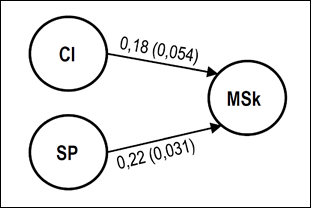
Figure 1
Relation between Individual Cognitive (CI) and Socio-Practical (SP) learning approaches with the development of Managerial Skills (MSk)
Source: elaborated by authors
The significant relationships found between learning modalities of socio-practical approach and managerial skills are numerous and are the main findings of this research. Table 6 shows in bold that individual cognitive modalities do not have significant relationships with the development of managerial skills. The opposite occurs with the modalities arising from the socio-practical approach, which presents significant relationships with six of the seven managerial skills studied. Reflecting this finding more comprehensively, Figure 1 shows that the set of individual cognitive modalities, represented by the second-order latent variable CI, has a non-significant relationship (p-value = 0.054) with the development of the set of managerial skills. In turn, the set of modalities with a socio-practical approach presents a positive and significant relationship (p-value = 0.031) to explain the development of managerial skills.
Discussion
It is important to highlight the validation of the LMS scale from the results contained in Tables 2 and 3 which show convergent, discriminant, and reliable validity. In addition, the MSS scale is similarly validated as can be seen in Tables 4 and 5.
Table 6 represents the synthesis of the results that allows answering the problem of this research that deals with investigating which modalities of organizational learning have more influence on the development of managerial skills within the scope of family businesses located in southwestern the state of Bahia (Brazil).
In other words, this table contains the findings that demonstrate the relationship between the modalities of organizational learning and the skills of managers of family businesses in the aforementioned city. It is well known that when the p-value is greater than 0.05, the statistical literature indicates that it is not significant.
Therefore, all modalities of the individual cognitive approach (Training, Reading Text, Access to Database) do not contribute to the development of managerial skills in the administrators of the studied family organizations, since all modalities have a p-value greater than 0.05. This finding is surprising as previous studies attribute traditional training to an important role in learning in the corporate environment (Araújo, Abbad &Freitas, 2007). In the same vein, Fante et al (2016) showed that traditional training has the same effect as non-traditional training on testing after several weeks.
Comparison with the literature indicates that the environment of family businesses may constitute a context in which traditional training and cognitive modalities are not conducive to the development of managerial skills. In this context, formal learning does not make a significant contribution to managers. In fact, when researching family businesses, Ramos and Helal (2010) identified that activities related to Knowledge Management do not take into account traditional expository training, favoring activities in which interactions occur between those involved.
On the other hand, all learning modalities of the socio-practical approach (Communities of Practice, Mentoring, On-the-Job Training, Casual Interaction) have a positive and significant relationship with managerial skills (Technical-operational, Analytical-strategic, Interpersonal, Political, Cultural, and Contextual). The only managerial skill that presented a p-value greater than 0.05 for all the modalities of socio-practical learning was the Reflective one, denoting that it cannot be guaranteed that it can be developed from the modalities of the socio-practical approach. Thus, this finding indicates that contrary to the individual cognitive approach, the socio-practice is a consistent path to the development of managerial skills in the researched context. Also, engaging in communities of practice, casually interacting with other managers to share knowledge and experiences, engaging in on-the-job training, and enjoying relationships with mentors capable of serving as interlocutors in management challenges represent ways to contribute to the development of managerial skills.
The community of practice, when contextualizing learning in the work environment, tends to privilege both tacit and explicit knowledge (Wenger, 1998; Antonocopoulou, 2000). It is known that the environment of family businesses brings a lot of elements based on the relationship between family members and the founders of the organization, that is, there are many unwritten codes and a lot of learning occurring directly in practice, in the sharing of knowledge (Karan et al., 2019; Kosmidou & Ahuja, 2018). This context, therefore, is conducive to the occurrence of elements of the community of practice, generating learning of managerial skills as shown in the results.
In the same sense, on-the-job training is present in family businesses and contributes to the development of managerial skills. The management role played by members of the second and third generations tends to benefit from learning in work situations. Therefore, the workplace is also the place of learning (Deprá et al., 2018). The results found by this research in the context of family businesses reinforce the importance of this form of learning, which has already proven effective in other contexts such as Junior enterprises (Dos-Santos et al., 2015b) and industry managers (Campos et al., 2018).
Just like the community of practice and on-the-job training, casual interactions also contribute to the learning of managerial skills in the context of family businesses. As an informal modality, casual interactions tend to occur in the work environment itself (Deprá et al., 2018). Unlike formal strategies, casual interactions can occur spontaneously and, if a conducive environment is found, can generate learning (Pamponet-de-Almeida & Souza-Silva, 2015). Family businesses that allow proximity between their members and provide more interactions can benefit from this modality. The results of this research show that casual interactions contribute to the development of managerial skills, with greater intensity in interpersonal, political and contextual skills. In fact, both the relationships between members of a family business and the reading of the operating context can benefit from this type of learning.
Looking in more detail at the results, it is clear that mentoring has stronger estimators, revealing a greater influence on the development of managerial skills, except for the reflective skill. Similarly, Berg and Karlsen (2012) found that mentoring is effective for managers in developing emotional intelligence, empowerment and self-management. As found by Ambrosetti (2014), mentoring can benefit from preparing mentors to contribute more effectively to protégé. Despite this, family businesses can benefit from informal mentoring, in which people approach each other based on personality Affinity (Rekha & Ganesh, 2012). Among managerial skills, mentoring contributes especially to strategic and interpersonal skills. Strategic skill develops the ability to read scenarios and make decisions, and these capabilities can greatly benefit from the presence and monitoring of a more experienced professional. Likewise, interpersonal skills, which involve working well with people, can be better developed through learning from a mentor.
From the point of view of organizational learning approaches, the results indicate that the modalities linked to a more individual and cognitive stance are not related to an increase in managerial skills in the context of family businesses. Conversely, the modalities linked to the socio-practical approach are positively related to the increase in managerial skills and, therefore, contribute to the development of skills.
Conclusion
To achieve the objective of this work, which deals with investigating which modalities of organizational learning have more influence on the development of managerial skills within the scope of family businesses, 165 managers of family organizations located in southwestern the state of Bahia (Brazil) were interviewed.
A quantitative survey was used to assess the relationship between organizational learning modalities and managerial skills. These constructs were taken as latent variables and measured using two scales (OLMS and MSS). Organizational learning modalities were measured using the OLMS scale consisting of 21 items. Managerial skills were measured based on the MSS scale consisting of 23 items. The two scales were validated in previous contexts and with different audiences as explained in detail in the methodological section of this paper.
The relationship between organizational learning modalities and managerial skills was evaluated using structural equation modeling, with an estimation through the Partial Last Square Path Modeling (PLS-SEM) method. The PLS-SEM assesses the relationships between variables through the combination of principal component analysis and ordinary least squares regression using the SmartPLS software (Ringle et al, 2015). This statistical technique enables the evaluation of complex models based on the total variance of items to estimate the relationship parameters between latent variables (Hair et al., 2018).
The main findings of this investigation indicate that the organizational learning modalities of the individual cognitive approach are not positively related to the development of managerial skills in the studied family companies. In other words, traditional training, reading texts, and access to databases had a p-value greater than 0.05, denoting that such methods do not have enough relationship to be considered as developers of managerial skills from the sample research.
The results of the empirical material, on the other hand, indicate that the managers of the researched family businesses develop their managerial skills, except for reflective skills, from all modalities of the socio-practical approach. In other words, the findings ensure that the skills of family business managers are developed based on the conjunction of communities of practice, mentoring, on-the-job training, and casual interactions. More specifically, mentoring proved to be the modality that most contributes to the development of managerial skills except for reflective skills that did not demonstrate a positive relationship with any modality of the socio-practical approach. This implication confirms other studies that attest to the relevance of mentoring as a powerful tool for organizational learning and training managers (Oliveira-Neto & Souza-Silva, 2017; Becker & Bish, 2017).
The findings of this research allow us to reach some relevant implications. The first is a better understanding of organizational learning, demonstrating that it can happen not only through traditional methods, such as training, reading texts, and accessing databases, but more efficiently through interactions and socio-practical learning perspectives.
The second implication reveals that less traditional mechanisms of organizational learning that are based on a more socio-interactionist approach tend to be more effective in the skill development process of family business managers, which represents the core of this research. Such a learning perspective tends to contemplate knowledge in its entirety, that is, in its explicit and tacit dimensions, contrary to the individual cognitive approach that manages to transmit only the explicit nature of knowledge. In-depth, this implication breaks with the generalized idea, popularly accepted and based on a school logic (Estrela, 2003) that the more traditional training a company offers, the more it will have qualified professionals in terms of knowledge (Wenger, 1998; Antonacopoulou, 2000; Souza-Silva, 2009).
The third implication is that, in addition to being more effective in developing the skills of the managers of the investigated family businesses, the socio-practical approach can represent a way that is much less financially costly for firms to develop their organizational learning processes. After all, some authors estimate spending hundreds of billions of dollars on hiring training and other more traditional methods of corporate education around the world (Berg & Karlsen, 2012). In the US - only with traditional training - more than 170 billion dollars are spent each year (Fante et al., 2016). Despite all this investment, traditional training does not always achieve the expected results. On the other hand, communities of practice, casual interactions, on-the-job training, and mentoring that represent modalities of the socio-practical approach can be stimulated in the organizational environment, through significantly smaller investments with more promising and effective results.
Among the limitations of this investigation, it is observed that a non-probabilistic sample was used, giving the present work internal validity since it does not allow the generalization of the results to other organizational contexts. Furthermore, it is also important to highlight the geographic limitation of the research, based on a limited sample of respondents (165) located in southwestern the state of Bahia (Brazil).
The findings of this research pave the way for future work that will shed light on both the quantitative and qualitative approaches. Quantitatively, new works can be initiated, expanding the geographic area and the number of respondents to achieve external validity of the research. On the other hand, finding associations and correlations between the modalities of socio-practical learning and managerial skills can lead to other qualitative research, going deeper into “how” these influences between these two constructs happen. In essence, this study sought to open new paths for future research that seek more effective and transformative strategies for the development of managers in the context of family businesses and in different contexts.
References
Alves, C. A., & Gama, A. P. M. (2020). A performance das empresas familiares: uma perspectiva da influência da família. Rev. Bras. Gest. Neg., 22(1), 163-182.
Alvesson, M., & Kärreman, D. (2001). Odd Couple: Making Sense of the Curious Concept of Knowledge Management. Journal of Management Studies, 38(7), 995-1018.
Ambrosetti, A. (2014) Are you ready to be a mentor? preparing teachers for mentoring pre-service teachers. Australian Journal of Teacher Education, 39(6), 30-42.
Andrews, M., & Smits, S. (2019). Using Tacit Knowledge Exchanges to Improve Teamwork. ISM Journal, 3(1), 15-23.
Antonacopoulou, E. P. (2000). Reconnecting Education, Development and Training Through Learning: A Holographic Perspective. Education & Training, 42(4/5), 255-263.
Araújo, M.C.S.Q., Abbad, G.S., & Freitas, T.R. (2017) Avaliação qualitativa de treinamento. Revista Psicologia Organizações e Trabalho, 17(3),171-179.
Balbinot, Z., & Marques, R. A. (2009). Alianças estratégicas como condicionantes do desenvolvimento da capacidade tecnológica: o caso de cinco empresas do setor eletroeletrônico brasileiro. RAC. Revista de Administração Contemporânea, 13(4), 604-625.
Bear, S. (2018). Enhancing Learning for Participants in Workplace Mentoring Programmes. International Journal of Evidence-Based Coaching and Mentoring, 16(1),35–46, 2018. DOI 10.24384/000462.
Becker, K.; Bish, A. (2017). Management development experiences and expectations: informal vs formal learning, Education + Training, 59 (6), 565-578. https://doi.org/10.1108/ET-08-2016-0134
Bell, M. (2009). Stepping out of the shadow: the leadership qualities of successors in family business., 253p. (Doctoral Thesis). Louisiana State University, Louisiana, United States of America.
Berg, M., & Karlsen, Jan. (2012). An evaluation of management training and coaching. Journal of Workplace Learning. 24, 177-199.
Bosangit, C.; Demangeot, C. (2016). Exploring reflective learning during the extended consumption of life experiences. Journal of Business Research, 69(1), 208-215. https://doi.org/10.1016/j.jbusres.2015.07.033.
Botelho, L. de L.R. Aprendizagem gerencial na mudança em uma organização intensiva em conhecimento. Florianopólis, SC. Tese de Doutorado. Universidade Federal de Santa Catarina, 260 p. 2012.
Brackett, M.A., Rivers, S.E., & Salovey, P. (2011). Emotional intelligence: implications for personal, social, academic, and workplace success. Social and Personality Psychology Compass, 5(1),88-103.
Brito-De-Jesus, K.C., Dos-Santos, M.G., Souza-Silva, J.C. de, & Rivera-Castro, M.A. (2016). Desenvolvimento de competências gerenciais de gestores públicos em instituições federais de educação. Revista Interdisciplinar de Gestão Social - RIGS, 5(1), 37-60. https://doi.org/10.9771/rigs.v5i1.12292
Bündchen, E., Roseto, C.R., & Silva, A.B. da. (2011). Competências gerenciais em ação – o caso do Banco do Brasil. REAd - Revista Eletrônica de Administração, 17(2), 396-423.
Burgoyne, J., & Stuart, R. (1976). The nature, use and acquisition of managerial skills and other attributes. Personnel Review, 5, 19-29.
Campos, R. de A., Souza-Silva, J. C., & Dos-Santos, M. G. (2018). Habilidades gerenciais e modalidades de aprendizagem de gestores industriais. BASE – Revista de Administração e Contabilidade da Unisinos, 15(3), 223-237.
Coetzer, A., Wallo, A., & Kock, H. (2019). The owner-managers role as a facilitator of informal learning in small businesses, Human Resource Development International. 22(5), 420-452.
Correia-Lima, B. C., Loiola, E., Pereira, C. R., Costa, J. S., & Leopoldino, C. B. (2019). The role of organizational support in the relationship between individual and organizational learning, RAM - Revista de Administração Mackenzie, 20(5), 1-29, doi:10.1590/1678-6971/eRAMG190016
Daudelin, M.W. (1996). Learning from experience through reflection. Organizational Dynamics, 24(3), 36-48. https://doi.org/10.1016/S0090-2616(96)90004-2.
Davel, E.P.B.; Oliveira, C.A. (2018). A reflexividade intensiva na aprendizagem Organizacional: uma autoenografia de práticas em uma organização educacional. Revista Organizações e Sociedade - O&S, 25(85), 211-228.
Deprá, V. M., Pereira, D. G., & De Marchi, A. (2018). A Contribuição da Aprendizagem Organizacional Informal para o Desenvolvimento de Competências Gerenciais. Navus - Revista de Gestão e Tecnologia, 8(4), 22-36.
Déry, R., Dupuis, J. P., Hugron, P., & Émond-Péloquin, L. (1993). La varieté des entreprises familiales: construction théorique et typologique. Cahier de Recherche du Groupe de Recherche sur les entreprises familiales, Montreal, 93(8),1-5.
Dos-Santos, M.G. (2014). Aprendizagem organizacional e formação de gestores: um olhar sobre os programas trainees. Salvador, BA. Dissertação de Mestrado. UNIFACS, 159 p.
Dos-Santos, M.G., Brito-De-Jesus, K.C., Souza-Silva, J.C. de, & Rivera-Castro, M.A. (2015). Aprendizagem organizacional e suas modalidades: desenvolvendo a habilidade interpessoal nos programas trainees. R. Adm. FACES Journal, 14(3), 94-113.
Dos-Santos, M. G., Pereira, F. A., Souza-Silva, J.C. de., & Rivera-Castro, M. A., (2015). Aprendizagem socioprática e individual-cognitiva na empresa júnior brasileira. Administração: Ensino e Pesquisa, 16(2), 309-339.
Eraut, M. (2011). Informal learning in the workplace: evidence on the real value of work-based learning. Development and Learning in Organizations, 25(5),8-12.
Fante, R. M., Bucklin, B. R., Diener-Ludwig, L., Sundberg, D. B., & Dickinson, A. M. (2016). A Comparison of Training Methods on the Acquisition of Automotive Product Knowledge. Performance Improvement Quarterly, 29(3), 287-305. doi:10.1002/piq.21223
Ferreira, J.F., & Godoy, A.S. (2015). Processos de aprendizagem: um estudo em três restaurantes de um clube étnico alemão de negócios, gastronomia e cultura. RAM - Revista de Administração Mackenzie, 16(2),15-44.
Fornell, C., & Larcker, D. F. (1981). Evaluating structural equation models with unobservable variables and measurement error. Journal of marketing research, 18(1), 39-50.
Gansen-Ammann, D. N., Meurs, J., Wihler, A., & Blickle, G. (2017). Political skill and manager performance: exponential and asymptotic relationships due to differing levels of enterprising job demands. Group & Organization Management.
Gersick, K. E., Davis, J. A., Hampton, M. M., & Landsberg, I. S. (1997). De geração para geração: ciclos de vida das empresas familiares. São Paulo: Negócio Editora.
Gherardi, S; Nicolini, D; Odella, F. (1998). Toward a social understanding of how people learn in organizations: the notion of situated curriculum. Management Learning, 29(3), 273-297.
Goodwin, K. (2019). Developing self-efficacy and career optimism through participation in communities of practice within Australian creative industries. Australian Journal of Career Development, 28(2),122–131.
Gosling, J., & Mintzberg, H. (2003). The five minds of a manager. Harvard Business Review, 81(11), 54-64.
Hair, J. F., Rischer, J. J., Sarstedt, M. & Rigle, C. M. (2018). When to use and how to report the results of PLS-SEM. European Business Review, 31(1), 2-24.
Hoon, C., Hack, A., & Kellermanns, F. W. (2019). Advancing knowledge on human resource management in family firms: An introduction and integrative framework. German Journal of Human Resource Management, 33(3),147-166.
Hoyert, M.S., & O’Dell, C. D. (2019). Developing Faculty Communities of Practice to Expand the Use of Effective Pedagogical Techniques. Journal of the Scholarship of Teaching and Learning, 19(1), 80-85.
Karam, P. B. S., Machado Filho, C. A. P., & Abib, G. (2019). Conflicts in boards of family firms: a theoretical framework for strategic decision-making. Revista de Administração Contemporânea, 23(6),703-720.
Kosmidou, V., & Ahuja, M. K. (2018). A configurational approach on family firm innovation. Family Business Review, 32(2),154–173.
Laud, R., Arevalo, J., & Johnson, M. (2015). The changing nature of managerial skills, mindsets and roles: Advancing theory and relevancy for contemporary managers. Journal of Management & Organization, 22(4), 435-456. DOI:10.1017/jmo.2015.48.
Leite, I.C.B.V. (2011). O aprendizado da função gerencial por meio da experiência. In: C.S Antonello; A.S. Godoy (eds.), Aprendizagem Organizacional no Brasil. Porto Alegre, Artmed, p.201-224.
Lunardi, M. A. L., Hein, N. & Kroenke, A. (2020). Desempenho econômico das empresas familiares e não familiares na crise de 2012. RACE, Revista de Administração, Contabilidade e Economia, 19(1), 153-172.
Manuti, A., Pastore, S., Scardigno, A. F., Giancaspro, M. L., & Morciano, D. (2015). Formal and informal learning in the workplace: a research review. International Journal of Training and Development, 19(1),1-17.
Mencl, J., Wefald, A. J., & Ittersum, K. W. V. (2016). Transformational leader attributes: interpersonal skills, engagement, and well-being. Leadership & Organization Development Journal, 37(5), 635-657.
Minton, A., & Lowe, J. (2019). How are universities supporting employers to facilitate effective on the job learning for apprentices? Higher Education, Skills and Work-Based Learning, 9(2), 200-210.
Nitti, M., & Ciavolino, E. (2014). A deflated indicators approach for estimating second-order reflective models through PLS-PM: an empirical illustration. Journal of Applied Statistics, 41(10), 2222-2239.
Oliveira-Neto, C. de C., & Souza-Silva, J.C. de. (2017). Aprendizagem, mentoria e cultura organizacional de aprendizagem: o estudo do caso da performance consultoria e auditoria. REAd - Revista Eletrônica de Administração, 23(n. especial), 60-92.
Paiva, K. C. M. de, Oliveira, M. C. de S. M. de, & Melo, M. C. de O. L. (2008). Produção Científica Brasileira Sobre Empresa Familiar – Um Metaestudo de Artigos Publicados em Anais de Eventos da Anpad no Período de 1997-2007. RAM – Revista de Administração Mackenzie, 9(6), 148-173.
Pamponet-de-Almeida, N. C., & de Souza-Silva, J. C. (2015). Aprendizagem organizacional e formação de gestores: como aprendem os gestores em uma indústria do setor petroquímico. REGE-Revista de Gestão, 22(3), 381-402.
Pederzini, G. D. A. (2019). Managerial learning challenges in a complex world. Journal of Work-Applied Management, 11(1),17-29.
Polanyi, M. (1966). The Tacit Dimension. London, Routledge & Kegan Paul, 105p.
Ramos, E. N. P., & Hela, D. H. (2010). A prática da Gestão do conhecimento em uma empresa familiar do ramo varejista em Minas Gerais. Revista de Gestão da Tecnologia e sistemas de Informação. 7(20)433-452. DOI: 10.4301/S1807-17752010000200009
Ratten, V., Ramadani, V., Dana, L.-P., Hoy, F., & Ferreira, J. (2017). Family entrepreneurship and internationalization strategies. Review of International Business and Strategy, 27(2), 150-160.
Rekha, K. N., & Ganesh, M. P. (2012). Do mentors learn by mentoring others? International Journal of Mentoring and Coaching in Education, 1(3), 205-217.
Riera-Claret, C., Sahagún, M.Á., & Selva, C. (2020). Peer and informal learning among hospital doctors: an ethnographic study focused on routines, practices, and relationships. Journal of Workplace Learning, 32(4), 285-301.
Ringle, C. M., Wende, S., & Becker, J. M. (2015). SmartPLS 3. Bönningstedt: SmartPLS GmbH. Retrieved in 2017, August 20, from https://www.smartpls.com.
Schon, D. A. (1983). The reflective practicioner: How professionals think in action. New York: Basic Books.
Sharma, P., Chrisman, J. J., & Gersick, K. E. (2012). 25 Years of Family Business Review: reflections on the past and perspectives for the future. Family Business Review, 25(1), 5-15.
Smircich, L. (1983). Concepts of Culture and Organization Analyses. Administrative Science Quarterly, 28(3), 339-358.
Souza-Silva, J.C. (2009). Condições e desafios ao surgimento de comunidades de prática em organizações. RAE - Revista de Administração de Empresas, 49(2),176-189.
Souza-Silva, J. C., & Schommer, P. C. (2008). A pesquisa em comunidades de prática: panorama atual e perspectivas futuras. Organizações & Sociedade, 15, 105-127.
Spender, J. C. (2004). Knowing, managing, and learning: A dynamic managerial epistemology. In: C. GREY; E. ANTONACOPOULOU (eds.), Essential readings in management learning. London, Sage, p. 107-129.
Teston, S. F., & Filippim, E. S. (2016). Perspectivas e desafios da preparação de sucessores para empresas familiares. Revista de Administração Contemporânea, 20(5), 524-545.