ENTREPRENEURIAL EDUCATION AND EXPERIENTIAL LEARNING: EXPANDING HORIZONS AND PERSPECTIVES
EDUCAÇÃO EMPREENDEDORA E APRENDIZADO EXPERIENCIAL: EXPANDINDO HORIZONTES E PERSPECTIVAS
 Fabiana de Agapito fabiagapito@gmail.com
Andreia de Bem Machado andreiadebem@gmail.com
Gertrudes Aparecida Dandolini gertrudes.dandolini@ufsc.br
Fabiana de Agapito fabiagapito@gmail.com
Andreia de Bem Machado andreiadebem@gmail.com
Gertrudes Aparecida Dandolini gertrudes.dandolini@ufsc.br
ENTREPRENEURIAL EDUCATION AND EXPERIENTIAL LEARNING: EXPANDING HORIZONS AND PERSPECTIVES
Revista Pensamento Contemporâneo em Administração, vol. 18, núm. 3, 2024
Universidade Federal Fluminense
Recepción: 16 Abril 2024
Aprobación: 25 Julio 2024
Abstract: This study aims to enrich the understanding of experiential learning in undergraduate entrepreneurial education by exploring the nature of experiential practices and their interconnections with other learning theories. It fills the gap between entrepreneurial education and the theoretical foundations guiding its practices. An integrative review revealed six categories of experiential practices and identified pragmatic strategies for implementation. The interaction with social, situated, and transformative learning highlights the complexity of teaching entrepreneurship and efforts to harmonize experiential learning with the field, aiming for authentic strategies that boost students' critical professional development.
Keywords: Experiential learning, Entrepreneurial education, Experiential learning cycle, Active learning, Learning theories.
Resumo: Este estudo objetiva enriquecer a compreensão da aprendizagem experiencial na educação empreendedora dos cursos de graduação, explorando a natureza das práticas experienciais e suas interconexões com outras teorias de aprendizagem. Preenche a lacuna entre a educação empreendedora e os alicerces teóricos que guiam suas práticas. Utilizando o método de revisão integrativa, revelou seis categorias de práticas experienciais e identificou estratégias pragmáticas para implementação. A interação com a aprendizagem social, situada e transformadora destaca a complexidade do ensino do empreendedorismo e os esforços para harmonizar a aprendizagem experiencial ao campo, visando estratégias autênticas que impulsionem o desenvolvimento profissional crítico dos estudantes.
Palavras-chave: Aprendizagem experiencial, Educação empreendedora, Ciclo de aprendizagem experiencial, Aprendizagem ativa, Teorias de aprendizagem.
Introduction
Entrepreneurial education (EE) plays a vital role in promoting an entrepreneurial culture, socio-economic development, and innovation across countries (Kumar et al., 2020; Talukder et al., 2024). The structuring of EE becomes crucial in addressing contemporary global challenges, gaining prominence in fostering individual competencies to achieve the Sustainable Development Goals (SDGs) (Nikou et al., 2022; Talukder et al., 2024).
In a dynamic scenario, adopting new educational paradigms emphasizing more autonomous and self-regulated learning processes by students marks EE (Ilonen, 2021; Preedy et al., 2020). In these contexts, the role of the educator evolves from a knowledge provider to a mediator of the teaching-learning process (Kolb & Kolb, 2017).
A key challenge in EE is providing authentic learning sources to undergraduate students, many of whom lack real work experience, to enable the appropriation and development of entrepreneurial knowledge. The effectiveness of learning in entrepreneurship, as discussed in the scientific literature, is amplified when students are engaged in real situations, promoting an active role and critical reflection for the construction of knowledge (Warhuus et al., 2018). Experiential learning (EL) emerges as a recurring theory in EE for combining experience and reflection with the educational processes of entrepreneurship (Bell & Bell, 2020; Chhabra et al., 2021; Thomsen et al., 2021; Warhuus et al., 2018).
Kolb's Experiential Learning Theory (ELT) (1984) proposes that learning occurs not only through cognition but through an integration between thinking, feeling, perceiving, and acting, processes enriched by continuous learning and synergistic interaction between the individual and their environment. For the philosopher John Dewey (1959), an influencer of Kolb, the experiences lived by students, along with their prior knowledge and reflections, are fundamental for learning.
Entrepreneurship, learning, and experience are three words intrinsically interconnected. Entrepreneurship occurs with the practice of action through multifaceted cumulative experiences, reflections, and critical incidents experienced (Pittaway & Thorpe, 2012; Van der Lingen et al., 2020); the experiences and their reflection constitute the basis for developing new knowledge. However, when translating these aspects into the educational domain, although the proliferation of Kolb's ELT (1984) is recurrent in EE (Bell & Bell, 2020; Chhabra et al., 2021), empirical challenges remain (Morris, 2019). These reside in the meaning of experience in this theoretical framework and its application in EE. Treating experience as synonymous with practical activities or learning by doing is limited because, from Kolb's perspective (Kolb & Kolb, 2017), it refers to proposals that effectively activate teaching and learning tasks based on lived experiences, which in turn are related to reflexive processes and conceptual understanding that validate new knowledge.
Despite integrating entrepreneurship and education, EE faces a disconnect with the broader educational field, a gap between practice and educational theory that needs addressing, as Fayolle (2013) and Bell & Bell (2020) observe. Research in this area tends to focus on outcomes and impacts, seeking legitimacy. However, the "black box" of EE pedagogy still requires a more detailed exploration of the educational theories underpinning it (Bell, 2021; Tiberius et al., 2022).
Therefore, this research aims to investigate and deepen the understanding of experiential learning in entrepreneurial education, aiming to provide subsidies for teaching and learning practices in the context of undergraduate courses. The specific objectives are (1) to analyze the experiential practices of EE and their nature, and (2) explore in research how EL interconnects with other learning theories.
It contributes to addressing the theoretical gaps in entrepreneurship teaching-learning (Fayolle, 2013; Kumar et al., 2020) while offering educators new perspectives, thus broadening horizons.
Entrepreneurial Education (EE) and Experiential Learning (EL)
Before we delve into the main discussion of this section, it is essential to clarify the terminology used – entrepreneurial education – given its varied application in the English-language literature, appearing in forms such as entrepreneurial education, entrepreneurship education, and enterprise education (Lackéus, 2015; Samuel Mwasalwiba, 2010). These terms are commonly used interchangeably in academic publications, serving as a generic denomination for similar educational processes (Mwasalwiba, 2010).
Entrepreneurial education is pivotal in developing the skills essential for identifying and creating new business opportunities across various contexts, such as nonprofit organizations, public sectors, and private companies (QAA, 2018). It is a broad concept aimed at benefiting all students by enhancing their employability prospects and integrating business education with entrepreneurial training. Considering its scope, this article adheres to the nomenclature of entrepreneurial education, aligning with the standards of the Quality Assurance Agency for Higher Education (QAA, 2018) and following the procedure adopted by Lackéus (2015).
Entrepreneurship involves gaining knowledge from experience and action (Hunter & Lean, 2018), encompasses understanding the steps to start a new venture and the skills, attitudes, values, and resources necessary to identify and seize opportunities (Cascavilla et al., 2022), whether launching new ventures or intrapreneurship. Entrepreneurial knowledge comprises explicit, declarative, procedural, and tacit components acquired through hands-on experience. Replicating the entrepreneurial context in an educational setting entails real or simulated practice, emphasizing entrepreneurial learning and emotional, social, and situational dimensions (Hahn et al., 2017; Lackéus, 2020; Pittaway & Cope, 2007). Such an approach emphasizes the critical role of experiential learning.
EL is a process of creating meanings that involve significant experiences that, to varying degrees, act as a source of learning, reflexively integrating the student's "inner world" (physical-corporal, intellectual, emotional, and spiritual) with the "external world" of the learning environment (location and spaces within the social, political, cultural context) (Wilson & Beard, 2013). It reflects the constructivist educational paradigm, which recognizes students' prior knowledge and how new knowledge is introduced, organized, and assimilated into existing knowledge (Ilonen, 2021). Experiential theories are the most appropriate platforms (Eisenstein et al., 2021) to respond to calls for active educational approaches that are different from traditional ones, characterized by passivity and objective knowledge (Bell & Bell, 2020).
In this theoretical field, John Dewey — an American philosopher who influenced EL studies (Kolb, 1984) and who, although he did not explicitly use the term — is considered one of the architects of experiential learning (Illeris, 2007). For Dewey (1959), education is a phenomenon that derives directly from life, a process of reconstructing and reorganizing the experiences that will guide the future course.
David Kolb (1984) and his main work, "Experiential Learning: Experience as the Source of Learning and Development," are influenced and inspired, most notably, by John Dewey (experiential education), Kurt Lewin (group dynamics), and Jean Piaget (constructivism). For Kolb (1984, p. 41), EL is a "process by which knowledge is created through the transformation of experience," dependent not only on cognition but on the integrated functioning of thinking, feeling, perceiving, and acting (Kolb & Kolb, 2017). The ELT is based on a philosophical basis that does not consider learning in terms of the results of deposited knowledge or new behaviors acquired through stimuli (Kolb, 1984). All learning becomes relearning, as new knowledge arising from experiences is (re)constructed (Kolb, 1984).
Kolb (1984) outlined the so-called experiential learning cycle (ELC) (Figure 1), made up of four adaptive macro-steps: concrete experience (living), reflective observation (reflecting), abstract conceptualization (thinking), and active experimentation (acting).
The ELC (Figure 1) begins with concrete experience, stemming from an activity, situation or event experienced and which provides the basis for reflection. Reflective observation is followed by abstract conceptualization, a phase in which theory and thoughts are used to create new abstract concepts. In active experimentation, action takes place, at which point the new knowledge is tested and put into practice, and can serve as a guide for new experiments. In this cycle, learning arises from the creative tension between four modes of learning: two dialectical modes of grasping experience (concrete experience - CE and abstract conceptualization - AC) and two dialectical relations of transformation of experience (reflective observation - RO and active experimentation - AE) (Kolb, 1984). Thus, in this model, learning requires diametrically opposed skills from the learner that can be accessed in specific learning situations. Depending on the stage, the learner moves from observer to actor, in an analytical engagement and detachment.

Figure 1.
Kolb’s experiential learning cycle
Source: Adapted from Kolb (1984).
In conclusion, the synergy between EL and EE can provide a solid framework for educational practice (Bell & Bell, 2020). EL can deepen the understanding of EE by involving students in a continuous cycle of action, reflection, conceptualization and experimentation. This combination can contribute to enhancing employability as well as fostering a deep and actionable understanding of entrepreneurship principles in real-world contexts. However, not all experiences lead to learning (Dewey, 1959), so it is necessary to pay attention to the type of experience. And above all, be inspired by entrepreneurial learning to derive practices (Higgins et al., 2019).
Methodological procedures
Integrative literature reviews (ILRs) are studies that review, criticize, and synthesize a topic in an integrated way, generating new perspectives and new knowledge (Torraco, 2016). From the knowledge generated, an IRL enables the formation of new structures and investigation directions, contributing to the empirical and conceptual research of a phenomenon.
In this article, to systematize the ILR and to guarantee quality, transparency, and the possibility of future replication of the research, followed the steps recommended by Whittemore and Knafl (2005), which are: a) identification of the problem; b) search in the literature; c) evaluation of results; d) data analysis; e) writing of the review. For the organization and final report, observed the requirements expressed by Torraco (2016).
In the first stage, the research question is defined as: How does entrepreneurial education apply experiential learning in undergraduate courses in terms of experiential practices and their nature and possible associated learning theories?
The researched databases chosen were Scopus and Web of Science, which have international scientific recognition and are multidisciplinary, and the Eric database, which is supported and specific to the educational area, adapting to the type of study proposed here. There was no distinction between empirical or non-empirical, qualitative or quantitative works, considering one of the desired objectives: to analyze the learning theories involved. The search for data in the databases took place in September 2022 and the database was updated in September 2023. A Boolean search equation was established (Table I) to account for the variety of synonyms and linguistic variations of the main terms. Inclusion and exclusion criteria were also established (Table I). The research included only undergraduate courses, as it is part of a macro study of entrepreneurship education in vocational education.
| Boolean equation for base searches | ||
| (TITLE-ABS-KEY ("experiential learning" OR "experiential education" OR "experiential theory" OR "Learning through experience") AND TITLE-ABS-KEY ("entrepreneurial training" OR "entrepreneurial education" OR "entrepreneurship training" OR "entrepreneurship education" OR "enterprise training" OR "enterprise education" OR "business education")) AND (LIMIT-TO (PUBSTAGE,"final")) AND LIMIT-TO (DOCTYPE,"ar") OR LIMIT-TO (DOCTYPE,"re")) AND (LIMIT-TO (LANGUAGE,"English")) | ||
| Inclusion criteria | Exclusion criteria | |
| a) Peer-reviewed articles b) No chronological delimitation. c) Undergraduate courses. d) Full text. | a) Articles without the search terms in the title, abstract, or keywords. b) Works aimed at the fundamental levels of education and post-graduation. c) Articles not directly related to the theme. d) Articles that are not written in English. | |
The search process resulted in a total of 410 articles (Figure 2). The articles were exported to the Rayyan platform (Ouzzani et al., 2016), which enabled the identification of duplicates (182) and blinds-on reading of the abstracts, title, and keywords. Two researchers performed this step to reduce the risk of bias in the eligibility criteria. Conflicts regarding the decision to include or not were resolved through a consensus meeting; thus, 101 documents were obtained for complete reading (exported to the EndNote bibliographic management software). Next, the data were extracted into a summary matrix in Excel to start the analytical process.
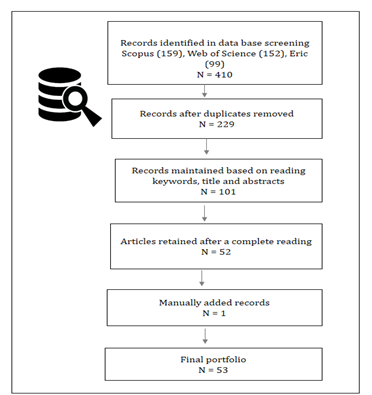
Figure 2.
Flow of procedures
Source: Survey data (2023).
From the analysis of the articles, the following data was extracted: title, year, authors, country of origin of the main author, journal, objective of the study, type of research, method, context, theoretical line of EL, experiential practices (type of practice, focus on entrepreneurship or intrapreneurship, link with the field of professional training) and, as an emerging category, aspects related to the implementation of experiential practices (contextual integration, reflective processes, theoretical foundation, and role of the teacher). Data analysis was carried out, seeking to identify similarities, patterns, and divergences. The writing of the structure of the ILR followed the conceptual organization of Torraco (2016).
The final volume of articles (empirical and theoretical) resulted in 53 documents (Figure 2), with the inclusion of a co-cited article (Morris, 2019). The article by Motta and Galina (2023) came back as a result, as it was listed as early access in 2022.
Of the excluded articles in the complete reading phase (49), 18 documents were not accessible in the chosen databases and parallel searches on Google Scholar and Research Gate, and no response was received from the authors contacted to send the material. The other 13 articles were excluded because they dealt with postgraduate studies, and including them could lead to bias regarding the scope of the research. A total of 18 other studies should have addressed the topic in depth. In eliminating the articles (49) to support the decision, the Bibliometrix software was used to identify the primary authors and co-cited references. With its use, it was seen that the eliminated documents were not on the list of co-cited, understanding that their absence would not compromise the results.
Findings
The results section begins with the presentation of bibliometric data. The analyses conducted to meet the objectives of the article, namely, the experiential practices and their nature, and theories of learning that interconnect with EL are presented subsequently.
Bibliometric Data
The corpus of 53 articles (Table III in the Appendix) analyzed was published in 29 journals, three of which lead with a minimum of five published research: Industry and Higher Education (10), Journal of Small Business and Enterprise Development (7), and Education + Training (5). A total of 139 researchers were involved, and only seven articles have single authorship. In chronological terms, Figure 3 shows that the first publication is from 2004 and that there is a greater concentration of articles (60%) from 2018 to 2022. Although these studies have different origins, the United States (15), United Kingdom (12), England (9), and China (4) stood out with the highest number.
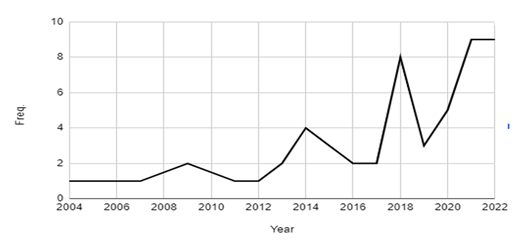
Figure 3.
Number of articles on the topic
Source: Survey data (2023).
Experiential practices
For this analysis, 29 empirical articles that specified the experiential practices under study were considered, as the aim at this stage was to analyze the nature of practices based on EL. For this categorization, the similarities and points of convergence between those practices and the indications found in Kolb's work (1984) were observed. It was checked if the practices were aimed at simulating the process of entrepreneurship – a common focus of teaching in the area (Pittaway & Cope, 2007) – or at actually starting a business, as well as if they directly involved the area of professional training, such as in internship or service-learning programs (Eisenstein et al., 2021). In a systematic review, Motta and Galina's research (2023) identified five categories of experiential practices: Development of a business plan, providing consulting services to companies, Development and implementation of businesses, Development of projects, and did not describe the activity. This research identified six categories: Business competitions and games; Creation of real businesses; Development of projects and activities for third parties; Preparation of business plans and business models; Professional training area integrated and Others. (Table II).
| Categories of Experiential Practices/ Frequency | Experiential Practices/Authors |
| Business competitions and games (7) | Competitions Bell and Bell (2016); Padilla-Angulo et al. (2021); Pittaway and Cope (2007); Thomsen et al. (2021); Wang et al. (2022); Business games Padilla-Angulo et al. (2021); Williams (2015) |
| Creating real businesses (10) | Bell (2015); Bell and Bell (2016); Bell and Bell (2018); Malach and Malach (2014); Mandel and Noyes (2016); Mason and Arshed (2013); Obi et al. (2022); Padilla-Angulo et al. (2021); Simmons (2021); Smith et al. (2022) |
| Development of projects and activities (10) | Solutions for companies/NGOs and consultancies Cooper et al. (2004); Costin et al. (2013); Curtis et al. (2021); Mandel and Noyes (2016); Padilla-Angulo et al. (2021); Ramsgaard and Christensen (2018) Realization of events Bell and Bell (2018); Bell (2015); Chang et al. (2014); Curtis et al. (2021) |
| Preparing of business plans and business models (7) | Abd Ghani and Mohammad (2021); Heinert and Roberts (2012); Krakauer et al. (2017); Obi et al. (2022); Padilla-Angulo et al. (2021); Thomsen et al. (2021); Williams (2015) |
| Integrated professional training area (5) | Service-learning Thomsen et al. (2021) Work-integrated learning and industrial attachment Eisenstein et al. (2021); Mandel and Noyes (2016), Mawonedzo et al. (2020) Participation in student associations Padilla-Angulo et al. (2021) |
| Others (4) | Mandel and Noyes (2016); McAlexander et al. (2009); Obi et al. (2022); Preedy et al. (2020) |
The first category, Business competitions and games can conceive new guises for simulative activities, introducing the emotional component, which, according to Pittaway and Thorpe (2012), integrates entrepreneurial learning and is part of Kolb's ELC (1984). Such activities can involve the entrepreneurship process, adding competitive analysis, business plan, financing, product development, and marketing (Wang et al., 2022) and even precede the creation of real businesses (Thomsen et al., 2021) - a category that will be discussed below.
The second category, Creating real businesses, highlights the experience of creating businesses where students operate for a predetermined period. According to the empirical articles researched, such initiatives are conceived in specific courses or modules on entrepreneurship lasting two semesters (Bell & Bell, 2018; Mason & Arshed, 2013; Padilla-Angulo et al., 2021), with a time of operationalization linked to the content and dynamics of such initiatives. It can also occur through the incubator apparatus, as mentioned in Mandel & Noyes' (2016) research. Executions of this nature develop the student's critical capacity and ability to work with various stakeholders, allowing the understanding of the entrepreneurial process and facilitating the theoretical association (Bell & Bell, 2018). In addition, in academic disciplines, it is possible to apply elements characteristic of incubators, such as networking, mentoring, and small financing, without the need to invest in an extensive permanent infrastructure.
The third category is the Development of projects and activities, which are group activities that involve the teaching-learning methodology per project. These activities can be focused on developing solutions for organizations (Cooper et al., 2004), providing consulting services (Costin et al., 2013), and creating social and fundraising events. They require the student to be a protagonist, learning by doing, and direct or indirect interaction with external audiences, such as established companies (Costin et al., 2013; Ramsgaard & Christensen, 2018), non-profit organizations (Thomsen et al., 2021), nascent entrepreneurs or people from the community who intend to open a business (Costin et al., 2013; Santos et al., 2019).
The fourth category, Preparing business plans and business models, comprises activities that emulate the entrepreneurial process. They are often associated with the categories of already presented Business competitions and games. They can be less expensive options in terms of costs, time, and staff when compared to creating incubators or opening temporary businesses, for example. However, simulations carry difficulties, especially in promoting environments that involve discontinuities, crises or critical events, and issues experienced during an entrepreneur's trajectory (Pittaway & Cope, 2007).
The fifth category, the Integrated professional training area, aggregates service learning or work-integrated learning and participation in students' associations. The term "integrated" was chosen because the authors emphasize the importance of a connection between work and the student's pedagogical monitoring (Mawonedzo et al., 2020). They are practices linked directly or indirectly to the students' work training area, or that insert them into the natural environment of entrepreneurship for learning. Service learning corresponds to the student's performance in organizations or the community, providing services under supervision (Thomsen et al., 2021). Service learning differs from the logic of academic internships (Eisenstein et al., 2021).
While internships focus on the nature of tasks performed by students, aiming at their professional development, service learning provides the action and reflection that take place in an entrepreneurial dynamic, as Eisentein et al. (2012) address. In Work-integrated learning, Eisenstein et al. (2021) report including students in early-stage startups, acting as interns but experiencing the entrepreneurial nature. Mawonedzo et al. (2020) adopt the term "industrial attachment" but report a deficiency in the integration between college-industry, as the offer of activities for students does not maintain a connection with entrepreneurship or the Development of associated skills, focusing on technical, and operational tasks.
The sixth category, Others, was created to include empirical research that did not fit into the previous ones. The article by McAlexander et al. (2009) addresses the Harvey Entrepreneurship Program, at Western State University, which offers a student residence, the Enterprise Residential College. Preedy et al. (2020) address, in their study, various extracurricular activities attended by students, such as networking events, competitions, coaching, socialization events, lectures, and mentoring.
Learning Theories and Entrepreneurial Education
Ramsgaard (2018) argues that a single learning theory only encompasses some aspects of Entrepreneurial Education (EE), highlighting the importance of interaction and diversification. At the intersection of Experiential Learning (EL) and EE, various learning theories emerge in the authors' analyses to elucidate the phenomenon, including Albert Bandura's social learning (Bandura & Walkers, 1963; Higgins & Elliott, 2011; Higgins & Galloway, 2014; Pittaway & Cope, 2007; Preedy et al., 2020), Mezirow's transformative learning (1981) (Arpiainen & Kurczewska, 2017; Bell & Bell, 2020; Kakouris, 2015), and Lave and Wenger's (1991) situated learning (Cooper et al., 2004).
Albert Bandura's social learning theory emphasizes the intricate interaction between personal, behavioral, and environmental influences in shaping human agency (Moreira, 2022). Central to this theory is social modeling, where individuals observe and emulate behaviors demonstrated by others, not necessarily in a mimetic or oppositional manner, as models are dynamic and subject to acceptance or rejection based on their effectiveness (Azzi et al., 2006; Moreira, 2022). This form of learning, also termed vicarious or observational learning, involves individuals learning from the experiences of others (Moreira, 2022).
The distinction between vicarious learning and experiential learning is not always clear, as even in vicarious learning, students mentally engage with others' experiences, integrating them as part of their learning process (Boud, 1994). Furthermore, vicarious learning can be applied as a strategy in EE, as Pittaway and Cope (2007) demonstrated, who simulated environments to provide vicarious and reflective learning experiences through self-selected teams and interactions with mentors. Krakauer et al. (2017) assert that for students without professional experience, vicarious experiences can serve as substitutes for the concrete experience phase of Kolb's (1984) learning cycle (Krakauer et al., 2017).
Social learning is pertinent to developing social capital, an essential aspect of learning development (Preedy et al., 2020). There is a shared understanding that entrepreneurial action is social, relational, and grounded in concrete actions that occur in interaction with others (Higgins & Elliott, 2011; Higgins & Galloway, 2014; Pittaway & Cope, 2007; Preedy et al., 2020), and it is from these connections and their intersubjective processes that learning results.
The second theory observed is transformative learning. Mezirow (1981, p. 190) defines transformative learning as "the process of using a prior interpretation to construe a new or revised interpretation of the meaning of one's experience to guide future actions." This theory underscores the importance of problematization in education, encouraging reflection and critical thinking to sensitize individuals to their reality and possibilities for action. According to Mezirow (1998), critical reflection is a fundamental pillar of transformative learning, entailing the analysis and reformulation of one's perceptions and beliefs. This process facilitates the adoption of diverse perspectives on entrepreneurship, challenging entrenched conceptions and stereotypes and stimulating the exploration of new visions of being entrepreneurial (Higgins et al., 2019; Kakouris, 2015).
This approach stands out not for the quantity of information assimilated but for the profound transformations it provokes in students (Arpiainen & Kurczewska, 2017; Bell & Bell, 2020; Kakouris, 2015). Bell and Bell (2020) emphasize that the essence of transformative learning lies in its ability to change the student, potentially altering their entrepreneurial mindset and identity. Similarly, Arpiainen and Kurczewska (2017) argue that entrepreneurial knowledge arises from practical experiences that foster cognitive, conative, and emotional readiness, which is essential for developing reflective and transformative learning. Kakouris (2015) positions transformative learning at the reflective observation stage of Kolb's (1984) learning cycle, while Bell and Bell (2020) link it to the subsequent phase after the experience within the same model.
Another focus is given to Lave and Wenger's (1991) situated learning theory, which emphasizes the student's engagement with the surrounding environment, where learning emerges from interactions with other people and artifacts. This theory introduces the concept of legitimate peripheral participation, describing how newcomers evolve within a community, moving from the periphery to the center through active engagement. Learning occurs through immersion in social practices, encompassing power dynamics and community legitimacy. As proposed by Lave and Wenger (1991), practice communities are fundamental to educational design, creating a space where participants share knowledge about their practices and experiences. According to Pittaway and Cope (2007), Cooper et al. (2004), and Preedy et al. (2020), students' interaction with these practice communities — which include entrepreneurs, professionals, and mentors — enriches their understanding and performance in entrepreneurial contexts.
The next section discusses the presented results.
Discussion
The analysis of the categories of experiential practices provides important insights into the EE process, especially with regard to the nature of these practices and the factors that influence their configuration, methods, contextual integration, reflective processes and the dynamics of ELC.
Experiential practices have an active character, involving students in situations that go beyond the simple passive absorption of content. They allow immersion in real or simulated contexts that facilitate the development of skills and an entrepreneurial mindset (Bell & Bell, 2020), increased creativity (Kakouris, 2015), identification of opportunities (Costa et al., 2018), generation of entrepreneurial intentions in students (Warhuus et al., 2018), and opportunities to acquire knowledge in social entrepreneurship (Thomsen et al., 2021).
Entrepreneurial action orientation is not restricted to the creation of new businesses. The activity categories Development of projects and activities and Professional training area integrated exemplify actions aimed at developing solutions and solving challenges, which are fundamental for training entrepreneurs and intrapreneurs capable of dealing with society's complex challenges.
The learning dynamics emphasize teamwork. Students learn by observing social models, and it occurs in interaction with their peers, entrepreneurs, professionals, educators and the community, in intra-course or inter-course situations. Multidisciplinary learning environments involving students from different programs help develop entrepreneurial skills (Motta & Galina, 2023).
Experiential practices privilege relationships with the learning context. This relationship with the place supports Morris' (2019) findings on how educators facilitate EL practices and understand the Concrete Experience stage in Kolb's (1984) ELC. Thus, there is evidence that in the application of EE in the CE stage, students are immersed in contextualized learning experiences that involve real problems and emphasize the social aspects of learning in a fluid process over time and space where knowledge becomes provisional.
It has been observed that many of the experiential practices offered are elective and extracurricular activities. These proposals are characterized by their exploratory nature (Padilla-Angulo et al., 2021), the voluntary participation of students and their complementary nature to the programmatic offer (Preedy et al., 2020), strengthening the autonomy of students in choosing their own paths (Preedy et al., 2020; Van der Lingen et al., 2020). Extracurricular activities can promote interdisciplinarity and interaction with the entrepreneurial ecosystem. However, the RO stage in ELC (Kolb, 1984) may become vulnerable without the active support of the educator in students' reflective processes (Preedy et al., 2020). This may indicate that, for their professional development, students need to be prepared for self-application of ELC, including in both non-formal and informal learning environments.
Although the practices offer rich opportunities, without experiencing the four stages of ELC, the potential of EE (Kolb, 1984) can be eluded. The lack of adequate guidance during the reflection phase results in a superficial experience rather than deep learning. Without a theoretical underpinning, the AC stage can become elusive.
Critics of ELT (Boud, 1994; Miettinen, 2000) argue that the RO stage (Kolb, 1984) is insufficient to explore the elements of reflection and has a linear approach that is at odds with reality. The active approach should be combined with individual and collective reflection that includes opportunities to learn from others, from mistakes, from successful or unsuccessful experiences, and from uncertainty and ambiguity (Higgins et al., 2019; Mandel & Noyes, 2016; Pittaway & Thorpe, 2012; Thomsen et al., 2021). Some studies have suggested adaptations in the application of ELC to address the limitations of Kolb's theory. Kakouris (2015) suggests critical instruction to address the problem of impasse in the problem of student disorientation — situations that emanate from personal beliefs with moral, political, and epistemological content, which can cause the RO phase to persist for a long time without reaching AC. Ryder and Downs (2022) recommend using the OODA cycle (Boyd, 1995), which is a four-step iterative process that includes Observation, Orientation, Decision, and Action. Bell and Bell (2020) provide educators with a progressive structure, with steps before, during, and after the experience, that facilitates the development of critical reflection with students.
The active perspective does not disregard a solid theoretical basis, as it is through this anchoring that students make sense of their experiences in a way that transforms them into knowledge (Costa et al., 2018; Warhuus et al., 2018).This is essential for all phases of ELC, especially AC. Lectures, expository activities, seminars, and case studies, although not the main focus, have been mentioned to consider different forms of learning (Ramsgaard & Christensen, 2018), to develop analytical skills, to ensure progressive implementation with students (Bell & Bell, 2020), or as a subsidy for students without CE in entrepreneurship (Krakauer et al., 2017). In addition, lectures are associated with vicarious learning (Krakauer et al., 2017; Pittaway & Cope, 2007), where students learn by observing or imitating other people and the consequences of their behavior. Originally in Kolb's ELT (1984), a lecture can have a concrete character from the moment the student admires and follows the behavior of the teacher or lecturer (Kolb & Kolb, 2017). However, it is also worth noting that, from an ELT perspective, learning takes place when the learner touches the four bases of ELC.
By addressing all the elements and dynamics surrounding EL, teachers play a critical role as facilitators, mediators, coaches, mentors, and challengers, rather than simply lecturers or transmitters of knowledge (Bell & Bell, 2020; Costin et al., 2013). Teaching and learning are student-centered, which requires adapting approaches based on factors such as students’ profiles and interests in entrepreneurship, context, and class size (Bell & Bell, 2020; Costa et al., 2018; Costin et al., 2013), following a constructive alignment (Biggs, 1996). Each experiential approach session should be carefully planned and supervised to provide timely feedback and intervention (Williams, 2015).
In terms of teaching methods, scaffolding activities and reduced conflict environments can be effective, along with teacher sensitivity to student responses and engagement (Bell, 2015; Bell & Bell, 2020; Bell & Liu, 2019). In addition, EL is supported by active methods such as project-based learning (Pittaway & Cope; 2007; Richardson & Hynes, 2008), challenge-based learning (Costin et al., 2013; Mason & Arshed, 2013), and peer learning. Project-based learning is the basis for many of the experiential practices developed. It can involve complex activities over an extended period of time and encourages adaptability, flexibility, and innovation (Richardson & Hynes, 2008). Learning through challenges exploits uncertainties, discontinuities, failures, and mistakes and is aligned with entrepreneurial learning (Costin et al., 2013).
For EE to adapt to the scenario of social transformation, ubiquity, and interavity, it is essential to explore new approaches, including the integration of digital technologies and distance and hybrid teaching methods, as pointed out by Bandera et al. (2018) and Morris and König (2020). These innovations can expand the scope of experiential practices and encourage self-directed learning.
Of the articles analyzed, only the research by Warhuus et al. (2018) has learning assessment as a central theme. According to these authors, experiential approaches bring with them the challenge of feedback and the complexity of identifying what is being assessed, as it may include the student, the process, the goal of the process, or a mixture of these. Other studies address this issue indirectly. Willian (2015) believes that, in games, assessment should shift the focus from performance in dynamics to assessing the learning process itself. However, Pittaway and Cope (2007) suggest that, in simulation activities, academic performance should be linked to actual performance in projects as an analytic measure to increase students' emotional engagement.
The fact is that EL involves subjective knowledge that is created non-linearly and requires effective forms of assessment that cover the full spectrum of student learning. Students' reflective activities can be aggregated as a form of self-assessment and peer assessment, preparing them for future learning situations (Pittaway & Cope, 2007; Ramsgaard & Christensen, 2018; Warhuus et al., 2018). Warhuus et al. (2018) establish four possible assessment and feedback mechanisms: (i) educator-to-student assessment, usually based on cognitive activities (tests, portfolios, reports, presentations); (ii) student-to-student assessment, with reflective moments where students provide feedback to each other and reflect on their learning processes; (iii) educator-to-educator assessment, when more than one teacher is involved in the activity; and (iv) student-to-educator assessment, regarding the teaching itself. This proposed format does not disregard traditional practices, which the authors believe are also necessary to prepare students for higher levels of learning. In addition, the assessments involve all actors in the process, which is beneficial given that in EL everyone is a learner.
When considering the barriers to adopting an EL approach, Motta and Galina (2023) identify two sets of difficulties. The first concerns adaptation to experiential teaching on the part of both the teacher and the student. There may be perceptions of adversity among students, especially with regard to the dynamics of teamwork, which are often not accepted by all members (Bell & Bell, 2018). Mandel and Noyes (2016) identified the difficulty of attracting experienced teachers and mentors as a challenge. Another group of difficulties is resistance to the adoption of experiential practices by educational institutions and barriers to establishing partnerships, financial support for investments in teacher training, and technological equipment (Motta & Galina, 2023; Mandel & Noyes, 2016). Experiential EE initiatives require a resource base and an interdisciplinary vision that go beyond traditional, discipline-based entrepreneurship programs.
Barriers may also exist in existing assessment criteria, low leadership support, cultural expectations, time to plan activities (Bell & Liu; 2019), and the lack of knowledge management about EE. According to Simmons (2021), in entrepreneurship disciplines, when there is a change in faculty, it is difficult to continue programs that have already been proposed, which can be exacerbated by the lack of documentation of projects and their outcomes, suggesting that the lack of institutionalization of experiential practices can hinder their continuity.
Figure 4 summarizes the main points about the nature of experiential practices and highlights the importance of each experiential practice being integrated into the ELC because, as Kolb (1984) postulated, the effectiveness of the learning process depends on the inclusion and execution of each stage.
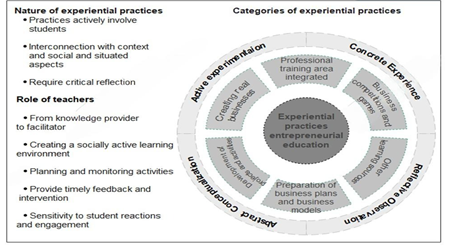
Figure 4.
Nature of experiential practices
Source: Prepared by the authors (2023) based on the researched literature.
Learning theories: expanding horizons and perspectives
Ramsgaard (2018) argues that no single theory is sufficient to address EE, emphasizing the importance of interaction and diversification of approaches. Although the learning theories explored by the authors, such as social learning (Azzi et al., 2006), situated learning (Lave & Wenger, 1991), and transformative learning (Mezirow, 1981), have different epistemological foundations, they share the common point of experience. This connection can be useful in integrating elements of entrepreneurial learning into the implementation of authentic practices for students.
Figure 5 explores the main aspects observed in each learning theory and their relationship with EE practices, based on the research analyzed.
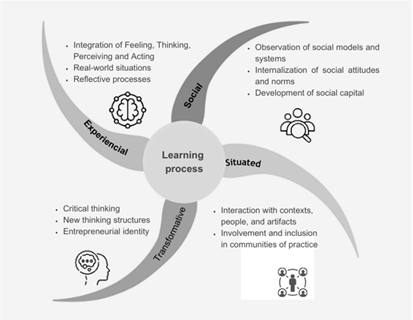
Figure 5.
Learning theories and EE
Source: Prepared by the authors (2023).
There is a shared understanding that entrepreneurial action is social, relational, and based on concrete actions that occur in interaction with others (Higgins & Elliott, 2011; Higgins & Galloway, 2014; Pittaway & Cope, 2007; Preedy et al., 2020), and that learning results from these connections and their intersubjective processes. Social learning focuses on social modeling and observation of other entrepreneurs, professionals, and peers as components of learning. It aligns with constructivist pedagogy by emphasizing active participation and the construction of new understandings through real-life experiences and emotional engagement, highlighting the role of social interactions, networks, and EL in achieving educational outcomes (Hunter & Lean, 2018, Preedy et al., 2020). This brings up a relevant aspect for the design of experiential EE: contextual integration, as it is from this that the richness of interactions and sources of learning emerge.
Situated learning (Lave & Wenger, 1991) emphasizes that learning arises from interaction with the environment and from social participation. The processes of mentoring, coaching, service learning, and participation in incubators and startups can involve or even insert students into a community of practice and are important for educational design (Pittaway & Thorpe, 2012). From the perspective of Higgins and Elliott (2011), the integration of situated learning in EE practice encourages students to develop procedural and contextual knowledge, which includes an understanding of how to apply information in specific environmental contexts. The perspective of situated learning in EE is seen as a contemporary movement away from pre-conceptualizations towards an understanding of how entrepreneurial knowledge and practice occurs (Higgins & Elliot, 2011; Higgins et al., 2019). EL is concerned with the transformation of experience into knowledge, which relates to social and cultural aspects, an important meeting point with situated learning.
The current scenario requires an entrepreneurial profile that is aligned with the challenges of sustainability and complex social problems. It is not only about thinking about students' individual journeys, but also about complex issues that require change and new thinking (Loorbach & Wittmayer, 2023). Teaching approaches should encourage critical self-reflection and challenge stereotypes and entrenched assumptions (Kakouris, 2015). Transformative learning contributes to the formation of new entrepreneurial identities that are more attuned to the needs of society. This theory emphasizes the importance of problematization in education, encouraging critical reflection to make individuals aware of their reality and possible actions, in line with EL. Studies show that transformative learning (Arpiainen & Kurczewska, 2017; Bell & Bell, 2020; Kakouris, 2015) complements the experiential model, transforming experience and reflection into vectors of change in the learner's thinking, leading to new behaviors and reference systems (Bell & Bell, 2020).
Final considerations
This research sought to provide support for the teaching-learning practice of entrepreneurship in undergraduate courses. The analysis of experiential practices positions Entrepreneurial Education as an approach that reflects the multidimensionality of entrepreneurship and its nuances in professional education. As a result, the article proposes a framework for teaching that highlights essential elements for experiential EE. However, the effectiveness of these practices depends on the competence of teachers, institutional support to create an environment that values critical reflection, contextualization, and interdisciplinary integration of entrepreneurship in the curriculum. In addition, it is necessary tolerance of diversity, errors, and unpredictability, which are inherent to constructivist and experiential approaches and to the entrepreneurial process itself.
Although Kolb's theory is widely used, few studies have examined in depth the application of the ELC by educators, particularly in critical reflection processes. The integration of Kolb's (1984) ELC into formal and non-formal learning, especially the reflective aspects, remains a challenge.
By exploring the intersection between EE and other learning theories, this article highlights elements that can enrich experiential practices. The analysis suggests that understanding the social (social modeling), situated (learning through contextual interactions), and transformative aspects is essential for developing educational programs that are more aligned with entrepreneurial learning and contemporary challenges.
This bibliographic research has limitations, such as the choice of databases, keywords, and selection and analysis criteria. However, it seeks to contribute to the teaching-learning processes in entrepreneurship and provide relevant insights for educators and researchers.
Future research could focus on: (1) the assessment of learning, a topic brought to the fore by Warhuus et al. (2018) that needs further exploration; (2) digital learning and Education 4.0 as strategies for EE, especially in the face of digital transformation; (3) the long-term impact of EE on the development of employability, innovation, and entrepreneurial skills; and (4) the adaptation of EE to promote an entrepreneurial culture in developing countries, integrating local cultural, social, and economic factors.
References
Abd Ghani, M. G. A., & Mohammad, N. (2021). The Integration of Logic Model in Business Plan Simulation Approach for Effective Entrepreneurial Learning. Jurnal Pengurusan, 62, 145-157.
Arpiainen, R.L., & Kurczewska, A. (2017). Learning risk-taking and coping with uncertainty through experiential, team-based entrepreneurship education. Industry and Higher Education, 31(3), 143-155.
Azzi, R.G., Bandura, A., & Polydoro, S.A. (2006). Teoria social cognitiva. São Paulo: Artmed.
Bandera, C., Collins, R., & Passerini, K. (2018). Risky business: Experiential learning, information and communications technology, and risk-taking attitudes in entrepreneurship education. The International Journal of Management Education, 6(2), 224-238.
Bandura, A., & Walters, R.H. (1963). Social learning and personality development. Holt Rinehart and Winston: New York.
Bell, H., & Bell, R. (2018). Applying enterprise: Active learning environments for business Higher National Diploma students. Journal of Further and Higher Education, 42(5), 649-661.
Bell, R. (2015). Developing the next generation of entrepreneurs: Giving students the opportunity to gain experience and thrive. International Journal of Management Education, 13(1), 37–47.
Bell, R. (2021). Underpinning the entrepreneurship educator’s toolkit: Conceptualizing the influence of educational philosophies and theory. Entrepreneurship Education, 4(1), 1–18.
Bell, R., & Bell, H. (2016). Replicating the networking, mentoring, and venture creation benefits of entrepreneurship centers on a shoestring: A student-centered approach to entrepreneurship education and venture creation. Industry and Higher Education, 30(5), 334-343.
Bell, R., & Bell, H. (2020). Applying educational theory to develop a framework to support the delivery of experiential entrepreneurship education. Journal of Small Business and Enterprise Development, 27(6), 987–1004.
Bell, R., & Liu, P. (2019). Educator challenges in the development and delivery of constructivist active and experiential entrepreneurship classrooms in Chinese vocational higher education. Journal of Small Business and Enterprise Development, 26(2), 209–227.
Biggs, J. (1996). Enhancing teaching through constructive alignment. Higher Education, 32(3), 347-364.
Boud, D. (1994). Conceptualizing learning from experience: Developing a model for facilitation. In M. Hyams (Ed.), Proceedings of the 35th Adult Education Research Conference (AERC), Knoxville, Tennessee (pp. 49-54).
Boyd, J. (1995). The essence of winning and losing. In C. Spinney, C. Richards, & G. Richards (Eds.), The Essence of Winning and Losing. Project on Government Oversight (Archives).
Cascavilla, I., Hahn, D., & Minola, T. (2022). How you teach matters! An exploratory study on the relationship between teaching models and learning outcomes in entrepreneurship education. Administrative Sciences, 12(1), 1–22.
Chang, J.Y.C., Benamraoui, A., & Rieple, A. (2014). Stimulating learning about social entrepreneurship through income generation projects. International Journal of Entrepreneurial Behavior & Research, 20(5), 417-437.
Chhabra, M., Dana, L.P., Malik, S., & Chaudhary, N.S. (2021). Entrepreneurship education and training in Indian higher education institutions: A suggested framework. Education and Training, 63(7), 1154–1174.
Cooper, S., Bottomley, C., & Gordon, J. (2004). Stepping out of the classroom and up the ladder of learning: An experiential learning approach to entrepreneurship education. Industry and Higher Education, 18(1), 11–22.
Costa, S.F., Santos, S.C., Wach, D., & Caetano, A. (2018). Recognizing opportunities across campus: The effects of cognitive training and entrepreneurial passion on the business opportunity prototype. Journal of Small Business Management, 56(1), 51–75.
Costin, Y., Dodd, S.D., Hynes, B., & Lichrou, M. (2013). From the zoo to the jungle – Narrative pedagogies and enterprise education. Industry and Higher Education, 27(6), 421–432.
Curtis, V., Moon, R., & Penaluna, A. (2021). Active entrepreneurship education and the impact on approaches to learning: Mixed methods evidence from a six-year study into one entrepreneurship educator’s classroom. Industry and Higher Education, 35(4), 443-453.
Dewey, J. (1959). Democracia e educação: introdução à filosofia da educação (3rd ed.). São Paulo: Nacional.
Eisenstein, A., Goh, C., & Istrate, E. (2021). Supervised entrepreneurial work-integrated learning. International Journal of Work-Integrated Learning, 22(3), 413–422.
Fayolle, A. (2013). Personal views on the future of entrepreneurship education. Entrepreneurship & Regional Development, 25(7-8), 692-701.
Hahn, D., Minola, T., Gils, A. Van, & Huybrechts, J. (2017). Entrepreneurial education and learning at universities: exploring multilevel contingencies. Entrepreneurship & Regional Development, 29(9-10), 829-857.
Heinert, S. B., & Roberts, T. G. (2018). A profile of exemplary rural agricultural entrepreneurship education programs. Journal of Agricultural Education, 59(3), 291-308.
Higgins, D., & Elliott, C. (2011). Learning to make sense: what works in entrepreneurial education? Journal of European Industrial Training, 35(4), 345–367.
Higgins, D., & Galloway, L. (2014). Refocusing — building a future for entrepreneurial education and learning. Industry and Higher Education, 28(6), 449–457.
Higgins, D., Refai, D., & Keita, D. (2019). Focus point: the need for alternative insight into the entrepreneurial education paradigm. Journal of Small Business and Entrepreneurship, 31(3), 225–242.
Hunter, L., & Lean, J. (2018). Entrepreneurial learning - a social context perspective: evidence from Kenya and Tanzania. Journal of Small Business and Enterprise Development, 25(4), 609–627.
Illeris, K. (2007). What do we actually mean by experiential learning? Human Resource Development Review, 6(1), 84-95.
Ilonen, S. (2021). Creating an entrepreneurial learning environment for entrepreneurship education in HE: The educator’ s perspective. Industry and Higher Education, 35(4), 518-530.
Kakouris, A. (2015). Entrepreneurship pedagogies in lifelong learning: Emergence of criticality? Learning Culture and Social Interaction, 6, 87–97. https://doi.org/10.1016/j.lcsi.2015.04.004
Kolb, A. Y., & Kolb, D. A. (2017). Experiential learning theory as a guide for experiential educators in higher education. Experiential Learning and Teaching in Higher Education, 1(1), 7–44.
Kolb, D. A. (1984). Experiential learning: Experience as the source of learning and development. Prentice Hall.
Krakauer, P. V. D., Serra, F. A. R., & de Almeida, M. I. R. (2017). Using experiential learning to teach entrepreneurship: a study with Brazilian undergraduate students. International Journal of Educational Management, 31(7), 986–999.
Kumar, S., Mrinalini, N. A., Kumar, R., & Khoa, T. T. (2020). Evolution of entrepreneurship education literature: a future direction for research Sanjay Kumar. Journal for Global Business Advancement, 13(3), 359–381.
Lackéus, M. (2015). Entrepreneurship 360. Entrepreneurship in education: what, why, when, how. Background paper. Paris: OECD.
Lackéus, M. (2020). Comparing the impact of three different experiential approaches to entrepreneurship in education. International Journal of Entrepreneurial Behavior & Research, 26(5), 937–971. https://doi.org/10.1108/IJEBR-04-2018-0236
Lave, J., & Wenger, E. (1991). Situated learning: legitimate peripheral participation. Cambridge University Press.
Loorbach, D. A., & Wittmayer, J. (2024). Transforming universities: Mobilizing research and education for sustainability transitions at Erasmus University Rotterdam, The Netherlands. Sustainability Science, 19(1), 19-33.
Malach, S. E., & Malach, R. L. (2014). Start your own business assignment in the context of experiential entrepreneurship education. Journal of Higher Education Outreach and Engagement, 18(1), 169–186.
Mandel, R., & Noyes, E. (2016). Survey of experiential entrepreneurship education offerings among top undergraduate entrepreneurship programs. Education+ Training, 58(2), 164–178. https://doi.org/10.1108/ET-06-2014-0067
Mason, C., & Arshed, N. (2013). Teaching entrepreneurship to university students through experiential learning: a case study. Industry and Higher Education, 27(6), 449–463. https://doi.org/10.5367/ihe.2013.0180
Mawonedzo, A., Tanga, M., Luggya, S., & Nsubuga, Y. (2020). Implementing strategies of entrepreneurship education in Zimbabwe. Education+ Training, 63(1), 85-100.
McAlexander, J., Nelson, R., & Bates, C. (2009). Developing an entrepreneurial education in a residential college: An exploratory case study. New England Journal of Entrepreneurship, 12(2), 49–62.
Meyer, J. H., & Land, R. (2005). Threshold concepts and troublesome knowledge (2): Epistemological considerations and a conceptual framework for teaching and learning. Higher Education, 49, 373-388.
Mezirow, J. (1981). A critical theory of adult learning and education, Adult Education, 32(1), 3-24.
Mezirow, J. (1998). On critical reflection. Adult Education Quarterly, 48(3), 185-198.
Miettinen, R. (2000). The concept of experiential learning and John Dewey’s theory of reflective thought and action. International Journal of Lifelong Education, 19(1), 54-72.
Moreira, M. A. M. (2022). Learning theories (2nd ed.). LTC, Rio de Janeiro, RJ.
Morris, T. H. (2019). Experiential learning – a systematic review and revision of Kolb’s model. Interactive Learning Environments, 0, 1–14.
Morris, T. H., & König, P. D. (2020). Self-directed experiential learning to meet ever-changing entrepreneurship demands. Education+ Training, 63(1), 23-49.
Motta, F., & Galina, S. V. R. (2023). Experiential learning in entrepreneurship education: A systematic literature review. Teaching and Teacher Education, 121, 103919.
Mwasalwiba, E. S. (2010). Entrepreneurship education: a review of its objectives, teaching methods, and impact indicators. Education+ Training, 52(1).
Nabi, G., Fayolle, A., Krueger, N., & Walmsley, A. (2017). The impact of entrepreneurship education in higher education: A systematic review and research agenda. Academy of Management Learning & Education, 16(2), 277-299.
Nikou, S., Mezei, J., Brush, C., & Wraae, B. (2022). Factors influencing entrepreneurship educators’ pedagogical choices—a configurational approach. Sustainability, 14(19), 12248.
Obi, B., Eze, T. I., & Chibuzo, N. F. (2022). Experiential learning activities in business education for developing 21st-century competencies. Journal of Education for Business, 97(1), 36-42.
Ouzzani, M., Hammady, H., Fedorowicz, Z., & Elmagarmid, A. (2016). Rayyan—a web and mobile app for systematic reviews. Systematic Reviews, 5, 1-10.
Padilla-Angulo, L., Diaz-Pichardo, R., & Leal-Rodriguez, A. L. (2021). Are different entrepreneurship-promotion activities equally effective? An analysis by academic year and gender. International Entrepreneurship and Management Journal, 19(1), 1-25.
Pittaway, L., & Cope, J. (2007). Simulating entrepreneurial learning: Integrating experiential and collaborative approaches to learning. Management Learning, 38(2), 211–233.
Pittaway, L., & Thorpe, R. (2012). A framework for entrepreneurial learning: A tribute to Jason Cope. Entrepreneurship and Regional Development, 24(9), 837–859.
Preedy, S., Jones, P., Maas, G., & Duckett, H. (2020). Examining the perceived value of extracurricular enterprise activities in relation to entrepreneurial learning processes. Journal of Small Business and Enterprise Development, 27(7), 1085–1105.
Quality Assurance Agency For Higher Education [QAA]. (2018). Enterprise and entrepreneurship education: Guidance for UK higher education providers. Gloucester: QAA. Retrieved from https://www.qaa.ac.uk/docs/qaa/about-us/enterprise-and-entrpreneurship-education-2018.pdf?sfvrsn=20e2f581_14
Ramsgaard, M. B. (2018). Experiential learning philosophies of enterprise and entrepreneurship education. Experiential Learning for Entrepreneurship: Theoretical and Practical Perspectives on Enterprise Education, 3-18.
Ramsgaard, M. B., & Christensen, M. E. (2018). Interplay of entrepreneurial learning forms: A case study of experiential learning settings. Innovations in Education and Teaching International, 55(1), 55–64.
Richardson, I., & Hynes, B. (2008). Entrepreneurship education: towards an industry sector approach. Education+ Training, 50(3), 188-198.
Ryder, M., & Downs, C. (2022). Rethinking reflective practice: John Boyd’s OODA loop as an alternative to Kolb. The International Journal of Management Education, 20(3).
Samwel Mwasalwiba, E. (2010). Entrepreneurship education: a review of its objectives, teaching methods, and impact indicators.Education+ training, 52(1), 20-47.
Santos, S. C., Neumeyer, X., & Morris, M. H. (2019). Entrepreneurship education in a poverty context: An empowerment perspective. Journal of Small Business Management, 57, 6–32.
Simmons, M. (2021). Lessons learned by educators and students through experiential entrepreneurship. Industry and Higher Education, 35(4), 454–459.
Smith, K., Rogers-Draycott, M. C., & Bozward, D. (2022). Full curriculum-based venture creation programmes: Current knowledge and research challenges. International Journal of Entrepreneurial Behavior & Research, 28(4), 1106–1127.
Talukder, S. C., Lakner, Z., & Temesi, Á. (2024). Development and State of the Art of Entrepreneurship Education: A Bibliometric Review. Education Sciences, 14(3), 295.
Thomsen, B., Muurlink, O., & Best, T. (2021). Backpack bootstrapping: Social entrepreneurship education through experiential learning. Journal of Social Entrepreneurship, 12(2), 238–264.
Tiberius, V., Weyland, M., & Tiberius, V. (2022). Best of entrepreneurship education? A bibliometric analysis. Journal of Further and Higher Education, 00(00), 1–16.
Torraco, R. J. (2016). Writing integrative literature reviews: Using the past and present to explore the future. Human Resource Development Review, 15(4), 404–428.
Van der Lingen, E., Åmo, B. W., & Pettersen, I. B. (2020). The relationship between entrepreneurial experience and preferred learning styles. Education+ Training, 62(7/8), 863–876.
Wang, J., Guo, Y., Zhang, M. T., Li, N. N., Li, K. X., Li, P., Huang, L. L., & Huang, Y. J. (2022). The impact of entrepreneurship competitions on entrepreneurial competence of Chinese college students. Frontiers in Psychology, 13.
Warhuus, J. P., Blenker, P., & Elmholdt, S. T. (2018). Feedback and assessment in higher-education, practice-based entrepreneurship courses: How can we build legitimacy? Industry and Higher Education, 32(1), 23–32.
Whittemore, R., & Knafl, K. (2005). The integrative review: Updated methodology. Journal of Advanced Nursing, 52(5), 546–553.
Williams, D. (2015). The impact of SimVenture on the development of entrepreneurial skills in management students. Industry and Higher Education, 29(5), 379–395.
Wilson, J. P., & Beard, C. (2013). Experiential learning: A handbook for education, training and coaching. Kogan Page Publishers.