ENTREPRENEURIAL EDUCATION I N HIGH SCHOOL IN BRAZIL: ONTOLOGICAL AND EDUCATIONAL APPROACH
A EDUCAÇÃO EMPREENDEDORA NO ENSINO MÉDIO NO BRASIL: ABORDAGEM ONTOLÓGICA E EDUCACIONAL
 Marise Regina Barbosa Uemura mariseuemura@alumni.usp.br
Rose Mary Almeida Lopes roselopesbr@gmail.com
Liliana Vasconcellos lilianav@usp.br
Marise Regina Barbosa Uemura mariseuemura@alumni.usp.br
Rose Mary Almeida Lopes roselopesbr@gmail.com
Liliana Vasconcellos lilianav@usp.br
ENTREPRENEURIAL EDUCATION I N HIGH SCHOOL IN BRAZIL: ONTOLOGICAL AND EDUCATIONAL APPROACH
Revista Pensamento Contemporâneo em Administração, vol. 18, Esp., 2024
Universidade Federal Fluminense
Recepción: 30 Abril 2023
Aprobación: 06 Diciembre 2023
Abstract: This theoretical-empirical study aims to analyze cases of high school Entrepreneurial Education (EE), from an ontological point of view - examining the levels of meaning "about", "for" and "through" entrepreneurship - and educational - learning objectives, target audience, contents, teaching-learning and assessment methods and results. The analysis of the cases and triangulation of data from the eight initiatives identified two groups - “Business Creation” and “Entrepreneurial Behavior” - that offer a comprehensive overview of possible approaches to EE at the secondary level. The results contribute to educational managers and those responsible for developing curricular guidelines and implementing entrepreneurship in high school.
Keywords: Entrepreneurship Education, High School Education, Secondary Education, Business Creation, Entrepreneurial Behavior.
Resumo: Este estudo teórico-empírico objetiva analisar casos de Educação Empreendedora (EE) no ensino médio, sob o ponto de vista ontológico - examinando-se os níveis de significado "sobre", "para" e "através" do empreendedorismo - e educacional - objetivos de aprendizagem, público-alvo, conteúdos, métodos de ensino-aprendizagem e de avaliação e resultados. A análise dos casos e triangulação dos dados das oito iniciativas identificou dois grupos - “Criação de Negócios” e “Comportamento Empreendedor” - que oferecem um panorama abrangente de abordagens possíveis para a EE no nível médio. Os resultados contribuem para gestores educacionais e responsáveis pela elaboração de diretrizes curriculares e implementação do empreendedorismo no ensino médio.
Palavras-chave: Educação Empreendedora, Ensino Médio, Criação de Negócios, Comportamento Empreendedor.
Introduction
Encouraging entrepreneurship and entrepreneurial culture has advanced in discussions in public and private institutions around the world. The United Nations (UN) included entrepreneurship in the 2030 Agenda for Sustainable Development stating it on education and economic growth goals (UN, 2015). Entrepreneurship contributes to the expansion of jobs and competitiveness, being highlighted in the educational sphere due to the importance of developing in young people, from the school stage, entrepreneurial attitudes and skills (European Commission, 2002; Frese et. al., 2014), and these business skills will result in more wealth for countries (Purwana & Suhud, 2017). Additionally, Sarasvathy and Venkataraman (2011) argue that Entrepreneurship Education (EE) should be treated as an essential part of basic education.
Sreenivasan and Suresh (2023) emphasize the great interest in the topic of EE, which has attracted many studies and evaluations of the literature already produced, gaining space in renowned journals. In the 20-year bibliometric review carried out by them, they tracked 2185 articles indexed in the Scopus database. The authors comment that, over time, theoretical and methodological rigor has strengthened, but it is still clear that there are few EE initiatives in which the approach to EE is clearly revealed. Although the European Union (EU) emphasizes the development of young people's entrepreneurial skills and attitudes, favoring employability, there seems to be more focus on developing knowledge and skills for opening new companies. This approach tends to be more prominent in the United States of America (USA), a country with an entrepreneurial culture, where the increase in interest in the topic is highlighted by Greene et. al. (2015), who point out strong engagement by universities in the expansion of EE, as well as the interest of business incubators and investment funds in new businesses.
In the review by Sreenivasan and Suresh (2023), the absence of references (articles or use of the term) of EE at the secondary education level is striking. Thus, even though Greene et. al. (2015) mention the strong movement of EE in higher education in the USA, it seems that there is still a lot of room for advancement in secondary education in the USA and around the world.
In Brazil, fundamentals of entrepreneurship were included in secondary-level technical professional education programs (MEC, 2013) and, in 2017, entrepreneurship became part of the National Common Curricular Base (NCCB) of the new secondary education, with an implementation period of up to 2022 (MEC, 2017). Such guidelines demonstrate a certain delay by regard to EE initiatives in primary and secondary education cited in academic publications since the early 2000s, such as Pedagogia Empreendedora, Jovem Empreendedor Primeiros Passos and Mini company (Alcantara, Coelho, Forte, & Rocha, 2018; Dolabela & Filion, 2013; Farias, Freitas, & Santos, 2012; Liberato, 2007).
Given the importance of EE in its different approaches in the school context, there is an interest in better understanding those aimed at secondary level students. Considering that the trajectory of this type of teaching is just beginning when it comes to basic education (Marcovitch & Saes, 2020), there is room for research on “the content to be taught, how to teach it and whom to teach it to” (Schaefer & Minello, 2016, p. 78). Although there are already publications that deal with national initiatives, there is a gap in relation to an overview of existing initiatives and their ontological and educational structure, according to the EE model proposed by Fayolle & Gailly (2008). These authors point out the need for all EE initiatives to state, at the ontological level, which meaning of EE is being employed - whether it is the strict or the broad meaning of entrepreneurship (Fayolle & Gailly, 2008; Lackéus, 2015) or which approach from the three ones - "about", "for" and "through" entrepreneurship - they are aligning with (Jamieson, 1984; Moberg, 2014a). These premises will guide the planning of the EE initiative, which should answer 5 key questions: why, for whom, for what results, what content and how to teach them (Fayolle & Gailly, 2008).
Thus, the objective of this research in Brazil aims to analyze cases of EE initiatives, in high school, from an ontological point of view - examining the levels of meaning "about", "for" and "through" entrepreneurship - and educational - learning objectives, target audience, contents, teaching-learning and evaluation methods and results. The aim is to contribute to the mapping of EE cases in high school, indicating the ontological approaches to which they align and the main aspects of their pedagogical projects, in order to expand knowledge and discussion about the different possibilities of inserting EE in secondary education and offer useful information for that educational managers and professionals in the field better structure courses and programs. It is also expected to point out new study opportunities to academics and researchers.
This article comprises the sections: theoretical framework, methodological procedures, presentation of the results and final considerations. The theoretical framework addresses the characteristics of EE, the EE model with the ontological and educational levels, the three EE approaches -"about", "for" and "through", international EE initiatives in secondary education and EE in secondary education in the Brazilian context. Methodological procedures focus on the research approach used and justifications, the types of data collected, the data collection instrument, the analysis categories and how the analysis was developed. When presenting the results, the identified cases are synthetically described and the groups "business creation" and "entrepreneurial behavior" are presented. Final considerations follow.
Theoretical Reference
Next, we focus on characteristics of EE, international EE initiatives in secondary education and initiatives in the Brazilian educational context.
EE Characteristics
EE originated in university business schools. Since Harvard Business School in 1945, the offer of entrepreneurship courses has expanded around the world (Vesper & Gartner, 1997) as well as the discussions by organizations focused on research on the topic (Greene et al., 2015).
Fayolle and Gailly (2008) and Lackéus (2015) point out two perspectives of entrepreneurship that would guide EE: 1. strict - meaning identification of opportunities, business development, self-employment and the creation and growth of enterprises; 2 broad - referring to attitudes of an entrepreneurial person such as autonomy, creativity, initiative and action orientation. Therefore, Fayolle and Gailly (2008) recommend that EE initiatives explicit their conception of entrepreneurship, because this clarity at the ontological level will allow the elements at the educational level to be consistent.
The EE model by Fayolle and Gailly (2008, p.575), shown in figure 1, was partially inspired by Béchard & Grégoire (2005). Fayolle & Gailly (2008) present two levels, ontological and educational. Like Béchard and Grégoire (2005), the authors call for educators to be clear about the ontological level, which involves their key concepts: What is the meaning of entrepreneurial education? In the context of entrepreneurship, what does education mean? And how do you conceive the educator and participant roles? From there, the educational level of the EE initiative is designed.
The educational level (Fayolle & Gailly, 2008, p. 575) is structured according to 5 questions: why - what are the objectives and goals; for whom - who is the target audience; for what results (evaluations); what - contents, theories; and how - methods and pedagogies. Béchard and Grégoire (2005) indicate that the ontological dimensions are translated into this operational level (called educational by Fayolle & Gailly, 2008), so that all implementation of initiatives are consistently linked to the ontological level, with which Mwasalwiba agrees (2010).
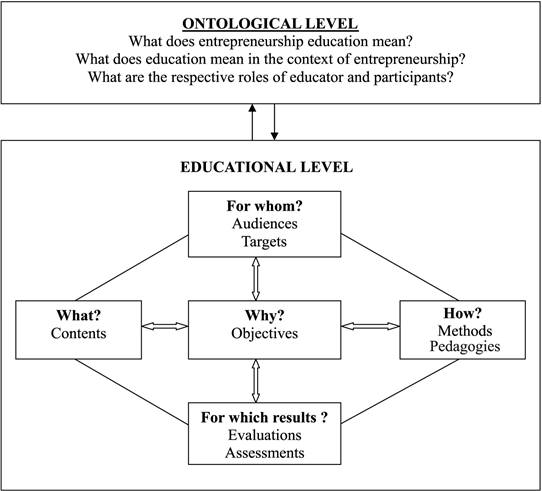
Figure 1.
EE Model by Fayolle & Gailly (2008)
Source: Fayolle & Gailly (2008, p. 572).
Focusing again on the ontological level, the diversity of EE programs and practices (Hoppe, 2016; Mwasalwiba, 2010) has also been categorized according to three approaches, according to the ontological meaning of EE. Several authors propose three categories of EE, initially indicated by Jamieson (1984), and which evolved into education “about”, “for” and “through” entrepreneurship (Hannon, 2005; Hoppe, 2016; Jones & Iredale, 2010; Lackéus, 2015; Moberg, 2014b; O'Connor, 2013). These three EE approaches align with those pointed out by the European Commission (European Commission, 2012), and which result from different emphases in knowledge, skills and attitudes. Thus, it can be said that:
Education "about" entrepreneurship privileges the acquisition of knowledge, corresponding to learning about entrepreneurship. Education "for" entrepreneurship prioritizes the development of entrepreneurial skills, corresponding to learning to become an entrepreneur. Education "through" entrepreneurship privileges the development of attitudes, corresponding to learning to have an entrepreneurial spirit. Importar lista0
Moberg (2014a) uses some of the key questions (educational level) of the Fayolle & Gailly (2008) model to relate to the “about”, “for” and “through” approaches to entrepreneurship. Education “about” entrepreneurship privileges the acquisition of knowledge, presents more theoretical aspects, addresses what entrepreneurship is and what the entrepreneur does; thus, corresponds to the strict meaning of entrepreneurship, and is more common in higher education (Lackéus, 2015; Moberg, Fosse, Hoffman & Junge (2015); Mwasalwiba, 2010). This is a very common approach, in which courses emphasize content, which is developed in a traditional way, based on conceptual bases exposed in articles, texts and books (Kirby, 2007; Lackéus, 2015; QAA, 2018). The learning objective is for the student to learn about concepts, theories, understand and become aware of the phenomenon, and even become interested in this career option.
Education "for" entrepreneurship aims to develop the knowledge and entrepreneurial skills necessary for potential, future, or nascent entrepreneurs (Lackéus, 2015, p. 10), therefore orienting itself towards the entrepreneur's occupation. In this way, educating "for" entrepreneurship focuses on the knowledge and skills that entrepreneurs need in their practice (Kirby, 2007; Lackéus, 2015) and provides the opportunity to reinforce their skills and consider the future (QAA, 2018). Therefore, education "for" entrepreneurship is a mix of theory and practice, with practice being based on theory. Moberg (2014a) points to the intersection between education “about” and “for” entrepreneurship, in terms of content, cognitive entrepreneurial skills and the objective of raising students’ awareness about self-employment as a career possibility (Moberg, 2014a). Furthermore, the “for” approach to entrepreneurship can result in an increase in the level of competence in managing uncertainty and ambiguities, and greater understanding of the application of specific knowledge on the topic.
Moberg (2014a) suggests that the “through” approach is indicated when the objective of EE is to develop creative and proactive students, who apply the knowledge acquired in an innovative way. And Lackéus (2015) highlights that entrepreneurial education “through” aligns with the broad meaning of entrepreneurship, being relevant for all levels of education and for all students. This EE approach is, at the same time, very necessary and challenging, given that it is based on action pedagogy, focusing on experiential learning, demanding pedagogical changes and teacher training (Arruda et. al. 2016, Lopes, 2020). In general, apprentices are encouraged to create, develop skills, and learn about aspects of business, engaging in a real process of entrepreneurial initiative (Lackéus, 2015). It can be integrated into all courses and is normally implemented in an experiential way. However, it is an approach that faces several obstacles and limitations in resources, time, cost, assessment difficulties, understanding and resistance from teachers.
It has been shown that EE involves a wide variety of objectives, and it encompasses much more than preparing individuals to be entrepreneurs (Hytti & O'Gorman, 2004). The relationship between the learning objectives and the course's pedagogical methods is addressed by Blenker et.al. (2011): if the objective is to teach students how to start a business, it is necessary to offer them a set of skills to do so; on the other hand, if the objective is to develop student’s entrepreneurial mindset, it will be necessary to emphasize attitudes and another set of skills. Therefore, the choice of pedagogical methods and techniques depends mainly on the objectives, content, and contextual factors. These choices allow you to identify the implemented EE approach. Fayolle and Gailly (2008) highlight that active, experiential, “learning by doing” pedagogical methods and those that simulate the real world are prioritized in EE approaches “for” and “through” entrepreneurship, as they allow the creation of situations and problems that They mainly develop non-cognitive (socio-emotional) skills. Several authors argue that entrepreneurship needs to be connected with “learning by doing”, highlighting the importance of lived experience (Politis, D., 2005; Israr & Hashim, 2017). Greene et. al (2018) share the current view that EE participants develop skills and knowledge from action-based and interactive learning approaches, increasingly linked to business and the community (Boon, Van der Klink, & Janssen, 2013).
From EE's point of view, it is crucial to focus on the student and that the situation, problem or challenge is as close as possible to the real business or life context, for motivating students in all aspects. However, the importance of reflecting on experience for the development of knowledge is highlighted, especially in conditions of high uncertainty and complex problems (Neck and Greene, 2011).
The active methodologies most frequently used in EE are problem-based learning, project-based learning, design thinking, and learning through games (Filatro & Cavalcanti, 2018; Moran, 2018; Bes et al., 2019).
In short, in problem-based learning, students are faced with a problem, stimulating their curiosity to solve it by applying already known principles or researching solutions, with the teacher as a facilitator. Thus, they actively engage, analyze the problem, help each other think, raise and answer questions, developing thinking skills, creating, defending and evaluating proposed solutions (McCaughan, 2013).
Project-based learning is structured around more complex and significant questions and problems for students, who seek solutions for creating products, processes, systems, or services. Students are challenged to examine, apply knowledge, seek action strategies, confronting uncertainty and risk, developing skills such as collaboration, critical thinking, decision making, self-confidence, creativity, and innovation (Dias & Brantley-Dias, 2017; Mergendoller, 2018; Moran, 2018). Mergendoller (2018) emphasizes that project-based learning follows six criteria: intellectual challenge and achievement, authenticity, public product, collaboration, project management and reflection.
Although design thinking (DT) was created by Herbert A. Simon in 1969, it was under the influence of the IDEO consultancy that, in 2011, it was systematized as a method and practice, arriving in Brazil the following year. In education, (DT) allows students to approach, in working groups, in an innovative way, the resolution of complex problems, making them focus on human needs, seeking to put themselves in the shoes of the people involved, so that they can reach to viable and functional solutions (Filantro & Cavalcanti, 2018; Moran, 2018). DT has been adopted in business courses at the university level and among adolescents to encourage the development of an entrepreneurial mindset (Zupan, Cankar, & Setnikar Cankar, 2018).
Learning through games (Game-Based Learning) is a strategy that integrates the power of games into educational activities. In this way, it engages students in activities that imitate real challenges, in a virtual environment, combining rules with the playful experience. Real subjects from the disciplines are integrated into the game, awakening curiosity and motivation for the activity, stimulating the development of cognitive and socio-emotional skills such as critical thinking and the construction of relationships to achieve the proposed objective or result (Neck and Greene, 2011; Moran, 2018).
In addition to the methodologies already mentioned, other methodologies commonly used in EE are mentoring offered by teachers, entrepreneurs or experts and workshops (Hytti & O'Gorman, 2004). And tools like Canvas (Business Model Canvas) prevails in the field of entrepreneurship (Jackson, Scott, & Schwagler, 2015).
More traditional methods, such as lectures with teachers or guests, visits and tasks, case studies and group discussions enable an understanding of entrepreneurial activity (Mwasalwiba, 2010), and can awaken people to this career option. Typically, traditional methods privilege the acquisition of knowledge, that is, they develop cognitive skills, more aligned with the level of education "about" entrepreneurship (Lopes, 2020).
And finally, the evaluation of results should be considered as important as other elements of the EE initiative (Fayolle & Gailly, 2008), as it refers to the assessment of student learning - specific knowledge, specific skills and tools, classroom participation, and entrepreneurial intention. Nabi, Fayolle, Linan, Krueger and Welmsley (2017) state that only a quarter of the articles they reviewed identified their theoretical framework and Lackéus (2020) emphasizes that the effects of an EE intervention can only be evaluated if, firstly, it is possible to identify and classify the EE approach to which it aligns, and the five aspects of its educational structure.
Fayolle and Gailly (2008) and Fayolle (2018) point out that there is still a lack of studies on the results and effectiveness of EE. Bae, Qian, Miao and Fiet (2014) indicate that in one decade they registered 55 papers with contradictory results. The various authors indicate that existing studies examine the effects of EE on variables such as the intention to undertake, attitudes, and some skills of the participants, such as creativity, self-efficacy, among others.
It is noteworthy that Fayolle and Gailly's (2008) EE model, with the two ontological and educational levels, related to the characterizations of EE approaches by Moberg (2014a) and Lackéus (2015), constitute the categories that will guide, in this research, the analysis of Brazilian cases of EE in high school.
Next, international EE initiatives in secondary education are presented.
International EE initiatives in high school
In 2015, the Kauffman Foundation already noted an increase in EE initiatives in secondary education, as reported by JA Achievement USA: the number of states with guidelines related to EE no secondary education was 42, and the number of states that required this type of education was 18. Greene et al. (2015) highlighted that EE in secondary schools1 was advancing in the USA, with the inclusion, in the national curriculum, of initiatives such as Lemonade Day, in which students practiced entrepreneurship by starting their own businesses.
Some EE initiatives, existing since 1990, are included in a report by the European Commission (2004), highlighting the role of non-profit organizations such as Young Enterprise Europe (more in secondary and higher education, focusing on business creation) and North American Junior Achievement (initially working more in primary schools, introducing the world of business), initiatives that came together in 2002.
More recently, the European Commission's report on EE in schools shows that more than half of European countries allocate investments to this type of teaching (European Commission/EACEA/Eurydice, 2016). For teaching in schools, the European Commission adopts the concept based on entrepreneurship as a key competence, aiming to develop skills and the ability to transform creative ideas into entrepreneurial actions (European Commission/EACEA/Eurydice, 2016). The inclusion of specific knowledge for starting a business, such as economics and business planning, is adopted by the Swedish government for EE in secondary schools (document Swedish Government Office, 2009, cited by Fejes, Nylund & Wallin, 2019). The development of general skills, such as project management and risk management, are also part of the content, as well as creativity and encouragement for students to take responsibility for achieving goals.
It is important to mention that, in some cases, the content and method are confused, as occurs with the creation of companies and the sale of products at school. Moberg (2014a) noted that studies that measured educational outcomes did not distinguish between content and pedagogical methods.
Initially, the cases of EE in high school identified in academic literature were from European countries, with the exception of Israel. However, recently, Sreenivasan and Suresh (2023) found the predominance of authors from Asian countries in publications on EE, mainly from China. So, an effort was made to locate cases from other countries, and two were found: one in Indonesia and the other in South Africa. Figure 2 shows the identified examples.
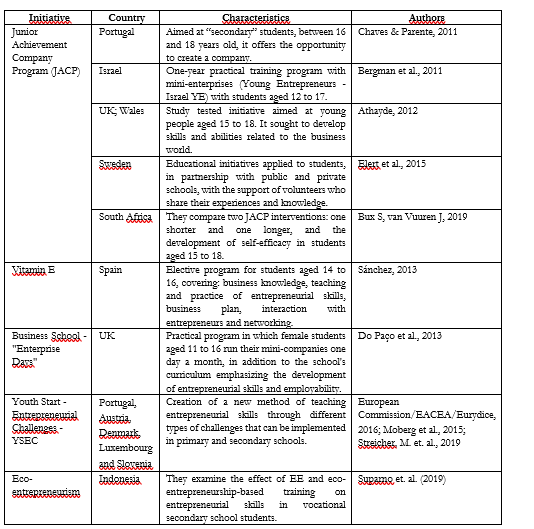
Figure 2.
Examples of international EE initiatives in secondary education.
Source: prepared by the authors.
Several initiatives in European countries and in Israel use the pedagogical methodology of creating a mini company from the Junior Achievement institution, in line with the strict definition of entrepreneurship as the creation of an organization. This is a methodology in which students get involved with the project of creating a mini company for one or two semesters, working from the idea, raising capital and division of shares, development of the prototype, product and processes, division of tasks and functions, being responsible for its operation (production, marketing, sales) until its closure and final balance (European Commission, 2015; Lackéus, 2020). In fact, this methodology is equivalent to project-based learning, suitable for entrepreneurship education initiatives.
The Business School initiative - "Enterprise Days" (UK) appears to be a mix of education "for" and "through" entrepreneurship, as it stimulates the broad development of entrepreneurial skills, favoring employability in today's society, associated with the methodology of creation of the mini-company.
The Youth Start - Entrepreneurial Challenges - YSEC initiatives, in 4 European countries, use EE methodology centered on the EE triad model, challenging students to develop several skills: core to EE, entrepreneurial culture and entrepreneurial civic education (Trio model of Entrepreneurship Education, YSEC). So, the YSEC program seems to align with the “through” approach to entrepreneurship. The initiative developed in Indonesia focuses on entrepreneurial skills, especially focused on eco-entrepreneurship, in vocational secondary schools, and although its authors do not offer further details, it appears to align with the "through" approach to EE.
The following section focuses on EE in high school in the Brazilian context.
EE in high school in the Brazilian school context
In Brazil, based on the National Common Curricular Base (BNCC), entrepreneurship was included in secondary education (MEC, 2017), with its curriculum reformulated and updated in 2018 by the National Education Council (CNE) in the National Curricular Guidelines for Teaching Medium (DCNEM). The technical and professional training began to integrate the new curricular base as one of the training itineraries and entrepreneurship as one of the structuring axes.
Some states have also established a legal basis to include entrepreneurship in their education networks, such as Rio Grande do Sul, with the State Entrepreneurship Policy for technical and high school schools, established by Law No. 12,616, of 2006 and complemented by Law No. 15,410, of 2019. In the state of São Paulo, Law 15,693/2015 was approved and the State EE Plan (PEEE) was drawn up to include entrepreneurship in basic education, fundamental, secondary and technical levels (Marcovitch & Saes, 2020).
The literature points to cases in high school in federal institutes or state technical schools (Gomes & Silva, 2018; Malacarne, Brunstein, & Brito, 2014; Marcovitch & Saes, 2018), and in private schools (Vianna & Bondioli, 2017). Such as: Junior Achievement Brazil developed by the Junior Achievement Program (Alcântara et al., 2018; Machado, Fortes, Lima, & Santos, 2021), Awakening also developed by Sebrae (Liberato, 2007) and Entrepreneurship at School offered by Rede Pitágoras de Ensino and Embraer Institute of Education and Research (Acúrcio, 2005; Morais, 2009) and initiatives derived from the course “Pioneering and Entrepreneurial Education”, developed by professor Jacques Marcovitch, who influenced initiatives in partnership with institutions such as the Paula Souza State Center for Technological Education (Centro Estadual de Educação Tecnológica Paula Souza - CPS, in portuguese), Sebrae, Colleges and NGOs (Marcovitch & Saes, 2018). However, in three cases, the meanings of entrepreneurship and entrepreneurial education that guide them are rarely made clear in these cases, and the educational aspects are also not usually fully informed. It is common to confuse content with pedagogical methods, and these are often popularly referred to for their striking characteristics and greater appeal to the public, and little focus on evaluating results and their impacts. This lack of detail makes it difficult to analyze the consistency of these initiatives and, consequently, to obtain knowledge that facilitates the possibilities of using them for new initiatives or their replication.
The next section describes the methodology adopted for this article.
Methodological procedures
This research has the objective is to analyze cases of EE in high school from an ontological point of view - examining the levels of meaning "about", "for" and "through" entrepreneurship - and educational - learning objectives, target audience, content, teaching-learning, assessment, and results methods. Therefore, this is a study with a qualitative approach, with a descriptive and interpretative character. The qualitative approach is justified, given the nature of the phenomenon studied, which is multifaceted (Godoy, 1995), and this approach allows capturing and analyzing the data in all its nuances. The main purpose of descriptive research is to describe characteristics of the phenomenon and establish possible relationships between variables (Gil, 2008). Due to the complexity of the phenomenon studied, involving several factors, these relationships can be explained and interpreted (Godoi, Bandeira-de-Mello and Silva, 2006) using multiple cases (Yin, 2001). The case methodology applies to contemporary phenomena inserted in the context of real life, in which the limits between the phenomenon and its context are imprecise (Yin, 2001), and is recommended when one intends to understand how the phenomenon occurs, especially if it is complex. The use of multiple cases allows us to examine and delve deeper into the different factors within the cases, as well as the similarities and differences between them (Yin, 2001). Although they suffer from the fragility of generalization, the results of multiple cases allow us to achieve greater understanding and deepen the interpretation of the phenomenon, obtaining knowledge that can be applied and disseminated (Yin, 2001).
To meet the objective of this research the methodological procedures to be used were defined and data collection and analysis followed the planned steps.
Documentary research (secondary data) and interviews (primary data) were adopted for the data collection. The documentary research provided auxiliary information and allowed to confirm the data and evidence collected by other instruments, increasing the reliability of findings through data triangulation (Martins & Theóphilo, 2009). The interviews were standardized, following a guide (Marconi & Lakatos, 2003) with the information to be obtained.
The script used for both document search and semi-structured interviews, was mainly based on the theoretical model presented by Fayolle and Gailly (2008). In addition to the key questions proposed at the educational level of the model, other information was included, based on the literature. Thus, an instrument was structured with the information to be obtained from each initiative in different contexts, to enable the analysis and comparison of the data collected (Figure 3).
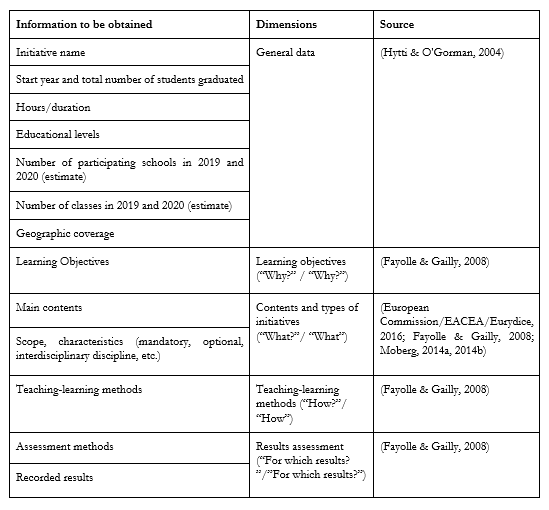
Figure 3.
Structure of the data collection instrument.
Source: prepared by the authors.
For identification of high school EE cases, some criteria were defined by the authors, to allow initiatives structured as disciplines to be obtained, which had a certain continuity (tested more than once), with a workload that allowed better development of the objectives learning and educational proposal:
a) Initiative structured as a specific discipline or applied in a transversal, interdisciplinary way.
b) Minimum workload of 10 hours and minimum duration of 2 months.
c) Clearly defined learning objectives.
d) Methodology applied in at least 2 public or private schools, with two classes trained.
Firstly, a literature review was conducted, to verify cases mentioned in different sources such as books, magazines, articles, reports, websites, etc., searching for public sources (Marconi & Lakatos, 2003). Recommendations from people in the contact network were also used, such as professors and researchers in the field of entrepreneurship. 9 cases were selected, one of them was discarded because the initiative had been discontinued by the institution.
Data collection on EE cases in high school
Data collection began in April/2019, was interrupted in the second half of 2019, and resumed at the beginning of 2020. However, with the suspension of face-to-face classes in schools in the public and private basic education networks in mid-March/ 2020, due to the COVID-19 pandemic, all EE initiatives were impacted. Thus, data collection was completed in some cases in March/2021, with 2019 considered as the base year, including, when possible, data from 2020.
Initially, contact was made by email with the person responsible for the initiative, to present the research and request an interview by phone or online. And, to better understand the characteristics of the initiative, documents were requested for consultation (Figure 4). After data collection, the next step involved validating the information obtained from the person responsible for the case or from the materials consulted, recorded in the form filled out by the researcher (via email). This process, in some cases, took up to six months, depending on the availability of the person responsible for the initiative.
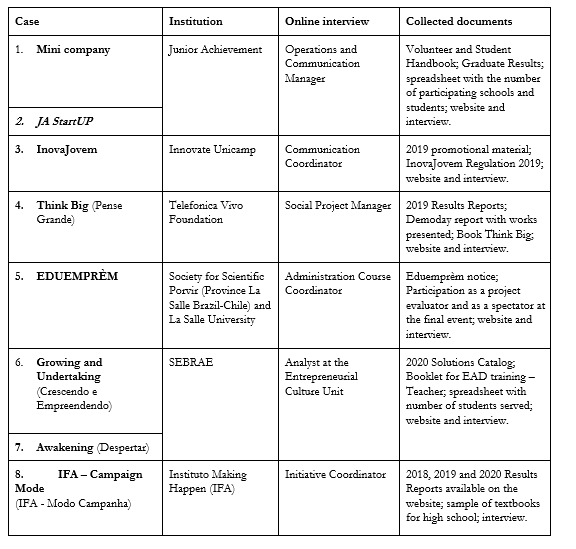
Figure 4.
EE cases and types of data collection.
Source: prepared by the authors.
Analysis and analysis categories
For the analysis, the categories of analysis indicated by the EE model of Fayolle and Gailly (2008) were followed at two levels: ontological and educational. An Excel spreadsheet was used in which the data collected from the different sources for each case were organized and integrated, configuring data triangulation, and which were examined according to the analysis categories (Figure 5).
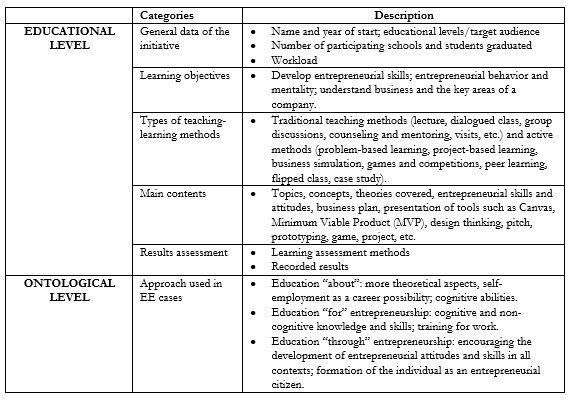
Figure 5.
Description of analysis categories
Source: prepared by the authors based on the theoretical framework.
The analyzes and the discussion of the results were structured in steps (adapted from Gioia et al., 2012): exploration of primary and secondary data compiled in the spreadsheet about each of the initiatives, followed by theoretical interpretation in the development of intra-case and inter-case analyzes (Miles & Huberman, 1994).
The intra-case analyzes considered the consolidated data from each of the EE cases in high school, and this step allowed the main educational characteristics of each of them to be highlighted, making it possible to make interpretations for a first identification of types of ontological approaches. As the analysis progressed in intra-case comparisons, reflecting on the theoretical framework adopted, it was possible to point out similarities and differences, which led to the grouping of cases of EE initiatives in high school into two groups. Analyzes of the cases that made up the two groups were also developed in order to identify similarities and their specificities.
The results of the analysis will be presented below.
Presentation and analysis of results
Based on the pre-defined criteria, 8 cases of EE in high school were identified: Mini company, JA StartUp, InovaJovem, Think Big, EDUEMPRÈM, Growing and Undertaking, Awakening and IFA - Campaign Mode.
Synthetic description of EE cases in high school
Cases 1 and 2 Mini company and JA Startup are offered by Junior Achievement, a North American, private, non-profit institution, created in 1919 and present in 120 countries. Mini company began in Brazil in 1983 and is offered to schools as a separate course (after-school). They have partnerships with state and federal technical institutes, as well as public and private schools. In the state network of the state of Ceará, the initiative is part of the curriculum as an elective subject. Students experience the creation and management of a company and its departments, learning economics and business concepts. JA Startup was created in 2017, and is based on the use of modern entrepreneurship concepts and tools such as Design Thinking to create disruptive business models, also operating in public and private schools.
Case 3 - InovaJovem2 - is offered by the Unicamp Innovation Agency (State University of Campinas), which has worked in partnership with regular and technical high schools across Brazil since 2014. It is an initiative outside the curriculum, formatted as an online competition for business ideas that contain an innovative element of social impact, based on pre-defined themes (in 2019 they were: health and well-being; quality education; clean and accessible energy; sustainable cities and communities; consumption and responsible production). Includes online training and mentoring.
Telefonica Vivo Foundation (from the company Vivo and part of the Telefonica group) is responsible for case 4 - Think Big - operating in Brazil since 2013. In partnership with regular and technical high schools, teachers are trained as multipliers to work on content entrepreneurship, technology and, above all, social impact, which seeks to train young protagonists in their communities.
Case 5 - EDUEMPRÈM - has been applied since 2018 in schools in the La Salle Network, part of the La Salle Brazil-Chile Province group, present in Brazil since 1907. The training of the professionals involved (including teachers from La Salle University) is carried out by representatives from La Salle Technovade Barcelona, a startup incubator located in Spain. It is offered as a complementary after-school activity and focuses on the development of innovative solutions.
SEBRAE, the organization responsible for cases 6 and 7 - Awakening and Growing and Undertaking, is recognized for its over 25 years of experience in “developing entrepreneurship solutions for formal education” (SEBRAE, 2020, p. 5). Until 2019, the Awakening and Growing and Undertaking initiatives were offered in person, both to formal educational institutions and to social projects. The number of young people served is significant, exceeding 50 thousand in 2019 in each of the programs, and reaching almost all states of the federation.
And finally, case 8 - IFA Campaign Mode - consists of workshops in an extracurricular format offered to children and young people aged 10 to 18, created by Instituto Fazendo Acontecer (Making it Happen Institute), a private non-profit entity dedicated to “disseminating entrepreneurship among children and teenagers in a playful and fun way” (IFA, 2018).
The inter-case analysis revealed some similarities, making it possible to classify EE initiatives into 2 groups: 1. “Business Creation” - whose content includes the formation of companies and the creation of products or services (Alcantara et al., 2018; Elert et al ., 2015; Fejes et al., 2019); and 2. “Entrepreneurial Behavior” - whose content addresses the topic of entrepreneurship and related aspects, such as entrepreneurial attitude and behavior, the job market and planning for the future.
In the sequence, each group of cases is analyzed and discussed according to the educational level categories.
“Business Creation” Group
The five cases in this group (figure 6) have their content focused on creating a new business (Hytti & O'Gorman, 2004; Mwasalwiba, 2010), using active and experiential methodologies referred to as “hands-on” or “learning by doing”3, typical of learning project-based. Thus, they seek to mirror the real world and encourage the development of non-cognitive skills, therefore aligning with the “for” and “through” approaches to entrepreneurship (Fayolle & Gailly, 2008; Johansen & Schanke, 2011). Only the Think Big initiative addresses the role of the entrepreneur, the types of people who become entrepreneurs and their motivations, aspects that characterize teaching “about” entrepreneurship (Blenker et al., 2011; Hannon, 2005; Johansen & Schanke, 2011 ).
Mini company is offered on a non-shift basis, in 15 weeks, totaling 52 hours, the second highest workload among the cases. Present in international publications (Athayde, 2012; Johansen & Schanke, 2011; Lindqvist, 2017), it was the object of study in Ceará (Alcantara et al., 2018) and Pará (Machado, Fortes, Lima, & Santos, 2021). It is the only initiative that includes “practical experience in economics and business, in the organization and operation of a company” (Hytti & O'Gorman, 2004; JA, 2014), and aims to develop entrepreneurial skills and other skills such as teamwork , negotiation and creativity, (Mwasalwiba, 2010).
The other four cases - JA Startup, InovaJovem, Think Big and EDUEMPRÈM - follow the “startup” model, encouraging the identification of problems, search for solutions and preparation of a business plan, using tools with the aim of transforming ideas into impactful startups. Unlike the Mini company (with manufacturing of the created product), the “startup” model involves the business modeling, MVP and prototyping stages, ending with the presentation of the idea (pitch).
The proposed structure is reflected in the working hours, and three are similar - JA Startup, InovaJovem and EDUEMPRÈM - between 10 and 24 hours in total. The Think Big initiative has the largest workload (60 hours), justified by the most comprehensive content: topics related to technology, the search for solutions to community problems, and topics such as self-knowledge and an entrepreneurial attitude. InovaJovem and EDUEMPRÈM also encourage solutions with social impact, similar to the initiative called “Seeds of the Future”, in which students exercise ways of solving problems such as poverty and child labor using business tools (Berglund et al., 2017).
Regarding the methods of teaching and learning, face-to-face and online workshops, visits, lectures and mentoring with businesspeople are used, in line with what Hytti & O'Gorman (2004) and Mwasalwiba (2010) point out as methods adopted in EE. EDUEMPRÈM and Think Big participants have access to Fab Labs4, used for prototyping. Other tools and methodologies are adopted: (a) Canvas (Business Model Canvas), a predominant pedagogical tool in the field of entrepreneurship (Jackson et al., 2015); (b) Design Thinking, an effective methodology to stimulate the development of an entrepreneurial mindset in adolescents (Zupan et al., 2018); (c) pitch training, a sales argument training (Greene et al., 2015).
Regarding learning assessment, similarities were found on some pre-defined criteria, groups evaluated in stages, and a final award. In terms of results according to a survey of 1276 graduates of JA Mini company, from 1995 to 2015, 49% said they owned or had already had their own companies, and indicated that the program motivated them to think about their careers and set goals for life. In 2019, teachers participating in Think Big at a school in São Vicente - SP - reported the positive evolution of even students with depression, and that some with communication difficulties discovered that they had this ability. Some of the projects created by the students follow startup paths, such as incubation and opening to angel investors, as reported by those responsible for four initiatives. Thus, there is a mix of quantitative follow-up studies and unsystematic collection of success cases.
Group “Entrepreneurial Behavior”
It is comprised of three cases whose content includes themes that seek to stimulate attitudes and behaviors related to entrepreneurship (Mwasalwiba, 2010), helping people to become more entrepreneurial in their lives and more prepared for the world of work (Hytti & O'Gorman, 2004). Although case 7 - Awakening (SEBRAE), includes the creation of a product and the organization of the “Young Entrepreneur Fair”(FJE), this is not the predominant topic, as will be explained later, which is why it was classified in the “entrepreneurial behavior” group.
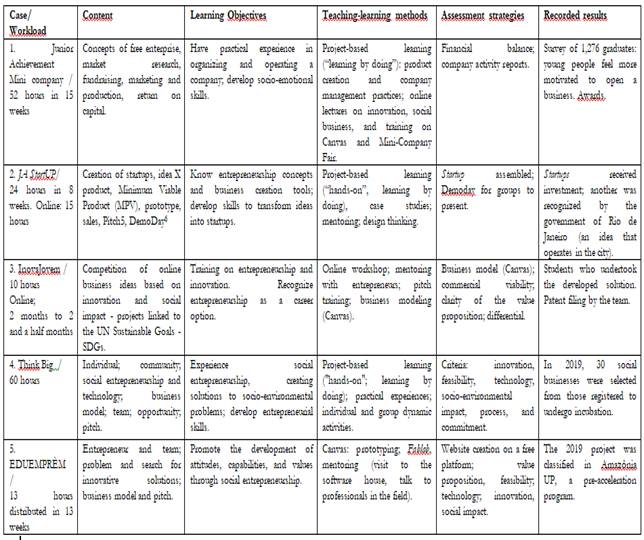
Figure 6.
Cases of EE group “Business Creation”
Source: prepared by the authors based on research data
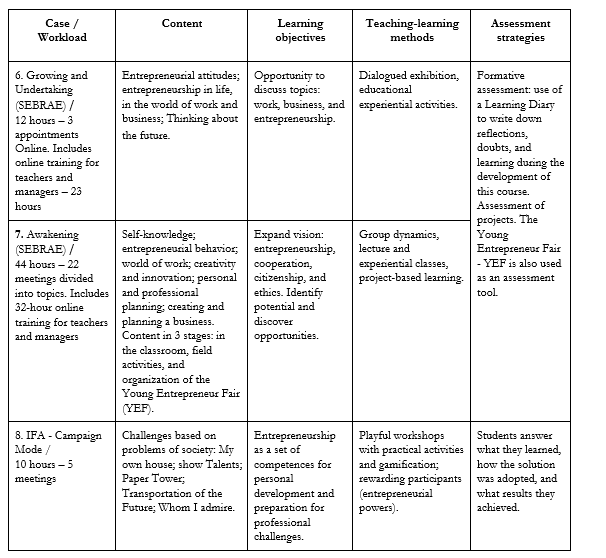
Figure 7
Cases of EE group “Entrepreneurial Behavior”.
Source: prepared by the authors with research data. FJE: Young Entrepreneur Fair
As for the content, the case Awakening (7) covers topics related to the labor market, the development of personal skills and competencies (European Commission/EACEA/Eurydice, 2016), and the assessment of opportunities and organization of an entrepreneurial fair (Fejes et al., 2019). Growing and Undertaking (6) has a shorter workload and content focused on entrepreneurial behavior, the job market, and planning for the future, knowledge considered important for entering the job market (Gomes & Silva, 2018). These contents are related to the type of teaching “about” and “for” entrepreneurship, as they stimulate the development of cognitive entrepreneurial skills, such as knowing about the role of entrepreneurs, evaluating business ideas, and how to start them (Moberg, 2015).
The learning objectives of IFA – Campaign Mode (8) aim for participants to perceive entrepreneurship as behavioral characteristics that help them in their professional future. The content includes playful challenges that encourage participants to create and build ways to solve something. Similar, then, to the playful approach used in the Seeds of the Future initiative in Swedish schools, in which children participate in games, role-play, and do creativity and innovation exercises (Berglund, Lindgren, & Packendorff, 2017). Here, teaching “through” entrepreneurship is identified, which, through its workshops, provides participants with opportunities to develop entrepreneurial skills. In addition to more traditional methods such as group dynamics and lectures adopted by the SEBRAE initiatives - Growing and Undertaking and Awakening, IFA – Campaign Mode innovates by adopting gamification tools, to encourage and reward participants. Rewarding points or badges is a way to motivate and create engagement among participants (Hamari, Koivisto, & Sarsa, 2014).
In terms of learning assessment, the three cases work similarly, adopting a Learning Diary (SEBRAE cases) and a questionnaire (IFA – Campaign Mode), in which participants write down doubts, solutions to challenges, lessons learned, and results achieved. Regarding results, in the two Sebrae cases, no information was obtained. Regarding IFA – Campaign Mode, there are reports, such as two participants who liked the project “because they saw that the group interacted a lot and obtained many different ideas and thoughts about the view of society” (IFA, 2020).
Analysis of EE cases at the ontological level
EE approaches configure the ontological level of Fayolle & Gailly (2008) and are discussed by several authors (Hoppe, 2016; Lackéus & Middleton, 2015; O'Connor, 2013), making it possible to compare the cases from this perspective. Figure 8 shows the classification according to the criteria: content, learning objectives, and methods used. It is more common for them to associate two approaches: "for" and "through", or "about" and "for" entrepreneurship. Two cases combine the three approaches: Think Big and Awakening (SEBRAE). Only one case - IFA – Campaign Mode was classified with an approach - “through” entrepreneurship, as it uses playful workshops focused on themes of training the individual as an entrepreneurial citizen (Hannon, 2005; Moberg, 2015). The cases with content “about” entrepreneurship, include topics such as the entrepreneur, his characteristics, his role in society, and entrepreneurship as a career option, as young people are at the moment of making career choices to enter the job market.
Organizations responsible for EE initiatives face some challenges, as the topic of entrepreneurship is not yet, in fact, included in the high school curriculum. Generally, its programs are offered as an extracurricular activity, during after-school hours, a format that is more accepted in private schools. In the public education network, after-school activities are generally offered to those with full education, such as ETECs in the state of São Paulo, schools in the SESI network, and federal technical schools. EDUEMPRÈM, offered by the LaSalle Network, is the only one that does not face this challenge as it is a private network.
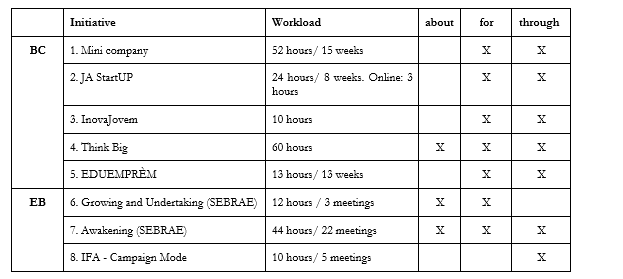
Figure 8.
Classification of initiatives by approach.
Source: prepared by the authors. BC: Business Creation. EB: Entrepreneurial Behavior.
Another challenging aspect is regional partnerships, with state departments or education councils, to operate across the entire public network of a given state. Negotiations are carried out separately between the organizations and government agencies. Training for teachers is a challenge that also deserves to be highlighted: organizations train teachers and other professionals who, in turn, disseminate the methodology. In the case of Junior Achievement, volunteers from partner companies are trained to apply the methodology in schools. And, in the cases of SEBRAE, training and teaching materials are offered to teachers.
With the publication of the New Secondary Education guidelines (MEC, 2018), schools began to search for solutions to meet the new curricular standards, being a factor in encouraging the relationship between these organizations and public and private education networks. Although the pandemic impacted the process of implementing the new high school curriculum, the organizations responsible for EE cases adapted their models to the new reality. All created online versions through applications that could be installed on cell phones or accessed by computers. In the case of SEBRAE, in 2020, Remote Entrepreneurship Workshops were created, offered with an intermediate workload (24 hours), compared to the other two from the same institution. IFA created an application to facilitate the workshop (IFA – Campaign Mode), allowing registration and access to instructors and participants. JA Startup was implemented in an online format, increasing the age of participants: from 15 to 24 years old. InovaJovem and EDUEMPRÈM were applied online in 2020 and the Telefonica Vivo Foundation created the Think Big Digital platform, a training trail aimed at young people and based on gamification.
Thus, the COVID-19 pandemic, according to some interviewees, boosted the development of online solutions that enable the participation of young people from all over Brazil.
Final considerations
The present research aimed to analyze cases of EE in high school from an ontological point of view - examining the levels of meaning "about", "for" and "through" entrepreneurship - and educational - learning objectives, target audience, contents, teaching-learning methods, evaluation methods, and recorded results.
The EE in high school is still little implemented in Brazil. Educational public policies included entrepreneurship as one of the structuring axes of secondary education in 2018, and the New Secondary Education Implementation Guide predicted the process of implementing changes for the beginning of 2020 (Brazil, 2018), delayed by the impacts of the pandemic. At the same time, as demonstrated, several independent initiatives operate in the country, offering solutions for students in public and private education networks, which can now be used and emulated to boost and disseminate EE in secondary education.
The eight EE cases focused on high school education identified and analyzed in this research were divided into two groups: 1. "business creation" - with cases whose content involves the creation of a product, the management of a company, or the transformation of ideas into impact startups; 2. "entrepreneurial behavior" - formed by cases with more comprehensive content, including development of entrepreneurial skills, discussions and activities about business and the job market. The business creation group more frequently adopts project-based learning, business modeling, and mentoring, in addition to forms of evaluating results, in which criteria for evaluating and rewarding the solutions presented are established. The entrepreneurial behavior group uses experiential activities in groups and, in one case, challenges and gamification are adopted, with project-based learning being less frequent.
In terms of results, an opportunity is identified for all initiatives to use quantitative and/or qualitative models for evaluating results, whether concerning attitudes, behavior and/or entrepreneurial skills, in addition to intentions to open a business or knowledge of entrepreneurship, according to examples published in international literature (Kirkley, 2017; Peterman & Kennedy, 2003). This gap constitutes a contribution to the field of study, opening up opportunities for new research.
The study developed can contribute to the institutions responsible for the initiatives focused on, by allowing the comparison of similarities and differences, offering ideas and indications for improvement.
The mapping carried out and the analyses can serve as a reference for educational managers and professionals responsible for preparing the planning and implementing solutions for the topic of entrepreneurship in high school. Even though there are eight initiatives, compared to the size of the secondary education network, the experience of more than two decades of these independent initiatives can help the process of implementation and growth in educational institutions, as they are diverse references, both in approach, content, and methodologies.
As limitations, some aspects related to collection deserve to be mentioned. Due to the COVID-19 pandemic, data collection was made difficult as it was carried out during this period, when the organizations responsible for the initiatives were working remotely, adapting their formats to the new reality. Not all of them were able to provide the necessary information on time, and there were difficulties in subsequent contact to provide further information.
As future opportunities, we suggest studies that adopt methods such as action research, to make it possible to investigate the practice of one or more initiatives and allow the collection of data and perceptions from students, facilitators, teachers, and coordinators. Furthermore, given the lack of metrics for initiative results, quantitative studies can be carried out to measure the effects on participants.
Notes
1. Translation of the expression secondary schools, it is equivalent to high schools in Brazil. In this article, this translation will be used when the original text uses this expression.
2. In, 2019, InovaJovem already offered online workshops, in addition to in-person ones. In 2020, all initiatives adopted 100% online mode, due to the COVID-19 pandemic.
3. The English terms “hands-on” and “learning by doing” are present in EE literature as teaching methods used in practical activities (Hatak & Reiner, 2011 ).
4. Fab Labs: place for prototyping and innovation, for playing, learning, and creating (“The Fab Foundation,” 2022, Available at: https://fabfoundation.org/).
5. Pitch: brief presentation made by entrepreneurs about their product or service and company mission, aimed at potential investors (Marcovitch & Saes, 2018).
6. Demoday: name used for the day on which the final projects of participating students are presented.
7. Considering the pre-established criteria for the initiatives researched here and the data collection period, these versions were not included in this research.
References
Acúrcio, M. R. B. (Coord) (2005). Empreendedorismo - Um Novo Passo em Educação. In O empreendedorismo na escola (p. 248). Porto Alegre /Belo Horizonte: Artmed/Rede Pitágoras.
Alcantara, S. R. A. S. de, Coelho, A. L. G. de F. T., Forte, L. I. & Rocha, T. L. da C. G. da. (2018). Empreendedorismo e Voluntariado: O Programa Mini company da Junior Achievement do Ceará. Brazilian Journal of Development, 4(1), 102–119. https://ojs.brazilianjournals.com.br/ojs/index.php/BRJD/article/view/107
Arruda, C. Burchart, A. & Dutra, M. (2016). Relatório da Pesquisa Bibliográfica sobre Empreendedorismo e Educação Empreendedora. SEBRAE-MG, 2016. 148 p. https://cer.sebrae.com.br/estudos-e-pesquisas/page/3/
Athayde, R. (2012). The impact of enterprise education on attitudes to enterprise in young people: An evaluation study. Education and Training, 54(8), 709–726. https://doi.org/10.1108/00400911211274846
Bae, T. J., Qian, S., Miao, C., & Fiet, J. O. (2014). The relationship between entrepreneurship education and entrepreneurial intentions: A meta-analytic review. Entrepreneurship Theory and Practice, 38(2), 217- 254. https://doi.org/10.1111/etap.12095
Béchard, J.-P., & Grégoire, D. (2005). Entrepreneurship Education Research Revisited: The Case of Higher Education. Academy of Management Learning & Education, 4(1), 22–43. https://doi.org/10.5465/AMLE.2005.16132536
Bergman, N, Rosenblatt, Z, Erez M & De-Haan, U. (2011) Gender and the effects of an entrepreneurship training programme on entrepreneurial self-efficacy and entrepreneurial knowledge gain. Int J Entrepr Small Bus13(1),38–54. https://doi.org/10.1504/IJESB.2011.040415
Berglund, K., Lindgren, M., & Packendorff, J. (2017). Responsibilising the next generation: Fostering the enterprising self through de-mobilising gender. Organization, 24(6), 892–915. https://doi.org/10.1177/1350508417697379
Bes, P. et al. (2019). Metodologias para aprendizagem ativa. Porto Alegre: SAGAH.
Blenker, P., Korsgaard, S., Neergaard, H., & Thrane, C. (2011). The questions we care about: paradigms and progression in entrepreneurship education. Industry and Higher Education, 25(6), 417–427. https://doi.org/10.5367/ihe.2011.0065
Boon, J., Van der Klink, M., & Janssen, J. (2013). Fostering intrapreneurial competencies of employees in the education sector. International Journal of Training and Development, 17(3), 210-220. https://doi.org/10.1111/ijtd.12010
Brasil. (2018). Guia de implementação do Novo Ensino Médio. Ministério Da Educação e Conselho Nacional dos Secretários Estaduais de Educação.
Bux, S. & van Vuuren, J. (2019) The effect of entrepreneurship education programmes on the development of self-efficacy, entrepreneurial intention and predictions for entrepreneurial activity. Acta Commercii19(2):1–13. https:// doi. org/ 10. 4102/ ac. v19i2. 615
Chaves, R., & Parente, C. (2011). O empreendedorismo na escola e o paradigma das competências: o caso da Junior Achievement-Portugal. Sociologia, Problemas e Práticas, (67), 65–84.
Comissão Europeia/EACEA/Eurydice. (2016). Educação para o Empreendedorismo nas Escolas Europeias. Luxemburgo: Serviço de Publicações da União Europeia. Disponível em: https://www.dgeec.mec.pt/np4/np4/%7B$clientServletPath%7D/?newsId=192&fileName=EC0216104PTN_002.pdf
Dias, M. , & Brantley-Dias, L. (2017). Setting the Standard for Project Based Learning: A Proven Approach to Rigorous Classroom Instruction. Interdisciplinary Journal of Problem-Based Learning, 11(2). https://doi.org/10.7771/1541-5015.1721
do Paço, A., Ferreira, J. M., Raposo, M., Rodrigues, R. G., & Dinis, A. (2013). Entrepreneurial intentions: is education enough? International Entrepreneurship and Management Journal, 11(1), 57–75. https://doi.org/10.1007/s11365-013-0280-5
Dolabela, F., & Filion, L. J. (2013). Fazendo revolução no Brasil: a introdução da pedagogia empreendedora nos estágios iniciais da educação. REGEPE - Revista de Empreendedorismo e Gestão de Pequenas Empresas, 3(2), 134–181. https://doi.org/10.14211/regepe.v2i3.137
Elert, N., Andersson, F. W., & Wennberg, K. (2015). The impact of entrepreneurship education in high school on long-term entrepreneurial performance. Journal of Economic Behavior and Organization, 111, 209–223. https://doi.org/10.1016/j.jebo.2014.12.020
European Commission. (2002). Final Report of the expert group “best procedure” project on education and training for entrepreneurship. Brussels, Belgium.
European Commission. (2004). Final Report of the Expert Group “Education for Entrepreneurship.” Disponível em: https://gesventure.pt/newsletter/pdf/n97-entrepreneurship-education-final-en.pdf
European Commission (2012). Rethinking education: investing in skills for better socio-economic outcomes. Strasbourg, France: European Commission. Disponível em: https://www.cedefop.europa.eu/files/com669_en.pdf
European Education and Culture Executive Agency, Eurydice, Bourgeois, A., Zagordo, M., Antoine, A. et al., Entrepreneurship education at school in Europe– Eurydice report, Publications Office, 2016. Disponível em: https://data.europa.eu/doi/10.2797/301610
Farias, A. C., Freitas, M. C. C., & Santos, D. (2012). Ensino Médio Integrado No Estado Do Ceará: O “Caminho De Pedras” Do Empreendedorismo Para a Escola Pública. Revista Expressão Católica, 1(2), 115–138. http://publicacoesacademicas.unicatolicaquixada.edu.br/index.php/rec/article/view/1301
Fayolle, A. (2018). Personal views on the future of entrepreneurship education. In A. Fayolle (Ed.), A research agenda for entrepreneurship education (pp. 127-138). Cheltenham, UK: Edward Elgar Publishing Ltd.
Fayolle, A., & Gailly, B. (2008). From craft to science. Journal of European Industrial Training, 32(7), 569–593. https://doi.org/10.1108/03090590810899838
Fejes, A., Nylund, M., & Wallin, J. (2019). How do teachers interpret and transform entrepreneurship education? Journal of Curriculum Studies, 51(4), 554–566. https://doi.org/10.1080/00220272.2018.1488998
Filatro, A. & Cavalcanti, C. C. (2018) Metodologias inov-ativas na educação presencial, a distância e corporativa. 1.ed., São Paulo: Saraiva Educação.
Frese M, Rousseau DM, Wiklund J (2014) The emergence of evidence–based entrepreneurship. Entrep Theory Pract 38(2):209–216. https://doi.org/10.1111/etap.12094
Gil, A. C. (2008). Métodos e Técnicas de Pesquisa Social (6a). São Paulo -SP: Atlas.
Gioia, D. A., Corley, K. G., & Hamilton, A. L. (2012). Seeking Qualitative Rigor in Inductive Research. Organizational Research Methods, 16(1), 15–31. https://doi.org/10.1177/1094428112452151
Godoi, C. K. ; Bandeira-de-Mello, R. & Silva, A. B. (2006) . Pesquisa Qualitativa e o Debate sobre a Propriedade de Pesquisar. In: Christiane Kleinubing Godoi; Rodrigo Bandeira-de-Mello; Anielson Barbosa da Silva. (Org.). Pesquisa Qualitativa em Organizações: Paradgimas, Estratégias e Métodos. 1ed.São Paulo: Editora Saraiva, v. 1, p. 1-13.
Godoy, A. S. (1995). Introdução à pesquisa qualitativa e suas possibilidades. Revista de Administração de Empresas, 35(2), 57–63. https://doi.org/10.1590/S0034-75901995000200008
Gomes, D. C., & Silva, L. A. F. (2018). Educação Empreendedora no Ensino Profissional: Desafios e Experiências numa Instituição de Ensino. Holos, 1, 118–139. https://doi.org/10.15628/holos.2018.5264
Greene, P. G., Brush, C. G., Eisenman, E. J., Neck, H., & Perkins, S. (2015). Entrepreneurship Education: A Global Consideration From Practice to Policy Around the World With contributions from: The Finnish Lifelong Learning Foundation. Disponível em: http://hdl.handle.net/10576/5417
Greene, P. G., Fetters, M. L., Bliss. R. & Donnelon, A. (2018). The future of entrepreneurship education: education for economic and social impact. In Fayolle,. A (Ed.) A Research agenda for Entrepreneurhip Education. Elgar Research Agendas. Disponível em: https://doi.org/10.4337/9781786432919
Hamari, J., Koivisto, J., & Sarsa, H. (2014). Does gamification work? - A literature review of empirical studies on gamification. In 47th Annual Hawaii International Conference on System Sciences (pp. 3025–3034). IEEE. Disponível em: 10.1109/HICSS.2014.377
Hannon, P. D. (2005). Philosophies of enterprise and entrepreneurship education and challenges for higher education in the UK. International Journal of Entrepreneurship and Innovation, pp. 105–114. https://doi.org/10.5367/0000000053966876
Hatak, I., & Reiner, E. (2011). Entrepreneurship Education in Secondary Schools: Education systems, teaching methods and best practice - a survey of Austria, Finland, France, Germany, Italy, Spain, Sweden, in: RiCC - research report 2011/1, hrsg. v. Rößl Dietmar.
Hoppe, M. (2016). Policy and entrepreneurship education. Small Bus Econ, 46, 13–29. 10.1007/s11187-015-9676-7
Hytti, U., & O’Gorman, C. (2004). What is “enterprise education”? An analysis of the objectives and methods of enterprise education programmes in four European countries. Education + Training, 46(1), 11–23. http://dx.doi.org/10.1108/00400910410518188
IFA. (2018). Instituto Fazendo Acontecer. Disponível em: https://www.fazendoacontecer.org.br/
Israr, A. & Hashim, N. (2017). Effect of Experiential Teaching Methodology on Personality and Entrepreneurial Intentions: A Proposed Framework. International Journal of Academic Research in Business and Social Sciences, 7(11). http://dx.doi.org/10.6007/IJARBSS/v7-i11/3453
JA. (2014). Mini company - Manual do Adviser. Junior Achievement Brasil.
Jackson, W. T., Scott, D. J., & Schwagler, N. (2015). Using the Business Model Canvas as a Methods Approach to Teaching Entrepreneurial Finance. Journal of Entrepreneurship Education, 18(2), 99–112.
Jamieson, I. (1984). Schools and enterprise. In A. G. Watts & P. Moran (Eds.), Education for enterprise (pp. 19-27). Cambridge, MA: Careers Research and Advisory Centre (CRAC).
Johansen, V., & Schanke, T. (2011). Entrepreneurship Education in Secondary Education and Training. Scandinavian Journal of Education Research, 57(4), 1–135. https://doi.org/10.1080/00313831.2012.656280
Jones, B., & Iredale, N. (2010). Enterprise education as pedagogy. Education + Training, 52(1), 7–19. https://doi.org/10.1108/00400911011017654
Kirby, D. (2007). Changing the entrepreneurship education paradigm. Handbook of research in entrepreneurship education – Volume 01. UK: Edward Elgar Publishing Limited.
Kirkley, W. W. (2017). Cultivating entrepreneurial behaviour: entrepreneurship education in secondary schools. Asia Pacific Journal of Innovation and Entrepreneurship, 11(1), 17–37. https://doi.org/10.1108/APJIE-04-2017-018
Lackéus, M. (2015). Entrepreneurship in Education- What, Why, When, How. OECD - Organisation for Economic Co-operation and Development.
Lackéus, M. (2020). Comparing the impact of three different experiential approaches to entrepreneurship in education. International Journal of Entrepreneurial Behavior & Research,26(5), 937-971. https://doi.org/10.1108/IJEBR-04-2018-0236
Liberato, A. C. T. (2007). Empreendedorismo na Escola Pública: Despertando Competências, Promovendo a Esperança! Brasília: Sebrae, 2007. Disponível em: https://bis.sebrae.com.br/bis/conteudoPublicacao.zhtml?id=1583
Lindqvist, S. H. (2017). What and How Students Perceive They Learn When Doing Mini-Companies in Upper Secondary School. Karlstad University Studies.
Lopes, R. M. A. (2020). Termo de Referência em Educação Empreendedora. Belo Horizonte: SEBRAE/MG, 2020. Disponível em: https://cer.sebrae.com.br/estudos-e-pesquisas/page/2/
Machado, R. R., Fortes, G. P., Lima, M. T. da S., & Santos, J. M. dos. (2021). Empreender na escola - aplicando o Mini company. Revista Caminho Aberto, 8(14), 96–105. doi.org/10.35700/ca.2021.ano8n14.p96-105.2906
Malacarne, R., Brunstein, J., & Brito, M. D. (2014). Formação de Técnicos Agropecuários Empreendedores: O caso do IFES e sua participação na OBAP. REGEPE - Revista de Empreendedorismo e Gestão de Pequenas Empresas, 3(2), 20. https://doi.org/10.14211/regepe.v3i2.125
Marconi, M., & Lakatos, E. (2003). Fundamentos de metodologia científica. São Paulo -SP: Atlas.
Marcovitch, J., & Saes, A. M. (2018). Pioneirismo e educação empreendedora: projetos e iniciativas. Com-Arte.
Marcovitch, J., & Saes, A. M. (2020). Educação empreendedora: trajetória recente e desafios. REGEPE - Revista de Empreendedorismo e Gestão de Pequenas Empresas, 9(1), 1–9. https://doi.org/10.14211/regepe.v9i1.1776
Martins, G. de A., & Theóphilo, C. R. (2009). Metodologia da investigação científica para ciências sociais aplicadas. São Paulo: Atlas.
McCaughan, K. Dr. (2013). Barrows’ Integration of Cognitive and Clinical Psychology in PBL Tutor Guidelines. Interdisciplinary Journal of Problem-Based Learning, 7(1). https://doi.org/10.7771/1541-5015.1318
MEC. (2013). Diretrizes Curriculares Nacionais da Educação Básica. Ministério da Educação. Brasília.
MEC. (2017). Base Nacional Comum Curricular - BNCC. Brasil.
MEC. (2018). Diretrizes Curriculares Nacionais para o Ensino Médio.
Mergendoller, J. R. (2018). Defining high quality PBL: A look at the research. High Quality Project Based Learning.
Miles, M. & Huberman, A. (1994). Qualitative data analysis: an expanded sourcebook. 2. ed. Thousand Oaks: Sage.
Moberg, K., Fosse, H., Hoffman, A., & Junge, M. (2015). Impact of Entrepreneurship Education in Denmark -2014. Danish Foundation for Entrepeneurship. Disponível em: www.ffe-ye.dk/videncenter
Moberg, K. (2014a). Assessing the Impact of Entrepreneurship Education - From ABC to PhD. PhD Series.
Disponível em: https://www.econstor.eu/handle/10419/208895
Moberg, K. (2014b). Two approaches to entrepreneurship education: The different effects of education for and through entrepreneurship at the lower secondary level. International Journal of Management Education, 12(3), 512–528. https://doi.org/10.1016/j.ijme.2014.05.002
Morais, P. R. B. de. (2009). Estruturação de produtos educacionais para a capacitação empreendedora de alunos da Educação Básica: um estudo de casos múltiplos. Dissertação de Mestrado. Faculdade de Economia, Administração e Contabilidade de Ribeirão Preto. Universidade de São Paulo. https://doi.org/10.11606/D.96.2009.tde-28072009-111628
Moran, J. (2018). Metodologias ativas para uma aprendizagem mais profunda. In. BACICH, L.; Moran, J. (org.) Metodologias ativas para uma educação inovadora: uma abordagem téorico-prática. Porto Alegre: Penso.
Mwasalwiba, E. S. (2010). Entrepreneurship education: A review of its objectives, teaching methods, and impact indicators. Education and Training, 52(1), 20–47. https://doi.org/10.1108/00400911011017663
Nabi, G., Fayolle, A., Linan, F., Krueger, N., & Welmsley, A. (2017). The impact of entrepreneurship education in higher education: A systematic review and research agenda. Academy of Management Learning and Education, 16(2), 1-23. https://doi.org/10.5465/amle.2015.0026
Neck, H. M., & Greene, P. G. (2011). Entrepreneurship education: known worlds and new frontiers. Journal of Small Business Management, 49(1), 55-70. http://dx.doi.org/10.1111/j.1540-627X.2010.00314.x
O’Connor, A. (2013). A conceptual framework for entrepreneurship education policy: Meeting government and economic purposes. Journal of Business Venturing, 28(4), 546–563. https://doi.org/10.1016/j.jbusvent.2012.07.003
Peterman, N. E., & Kennedy, J. (2003). Enterprise education: Influencing students’ perceptions of entrepreneurship. Entrepreneurship Theory and Practice, 28(2), 129–144. https://doi.org/10.1046/j.1540-6520.2003.00035.x
Politis D. (2005), The Process of Entrepreneurial Learning: A Conceptual Framework, Entrepreneurship Theory and Practice, 29(4), 399-424. https://doi.org/10.1111/j.1540-6520.2005.00091.x
Purwana, D. & Suhud, U. (2017). Entrepreneurship education and taking/receiving & giving (TRG) motivations on entrepreneurial intention: Do vocational school students need an entrepreneurial motivator? International Journal of Applied Business and Economic Research,15(22), 349-363.
QAA - The Quality Assurance Agency for Higher Education. (2018). Enterprise and Entrepreneurship Education: Guidance for UK Higher Education Providers. (Andy Peñaluna, president do QAA Enterprise and Entrepreneurship Review). January 2018. Disponível em: https://www.voced.edu.au/content/ngv:60352
Sánchez, J. C. (2013). The Impact of an Entrepreneurship Education Program on Entrepreneurial Competencies and Intention. Journal of Small Business Management, 51(3):447–465.
https://doi.org/10.1111/jsbm.12025
Sarasvathy, S. D., & Venkataraman, S. (2011). Entrepreneurship as Method: Open Questions for an Entrepreneurial Future. Entrepreneurship Theory and Practice, 35(1), 113–135.
https://doi.org/10.1111/j.1540-6520.2010.00425.x
Schaefer, R., & Minello, I. F. (2016). Educação Empreendedora: premissas, objetivos e metodologias. Revista Pensamento Contemporâneo Em Administração, 10(3), 60–81. https://doi.org/10.12712/rpca.v10i3.11270
SEBRAE. (2020). Empreendedorismo no currículo do Ensino Médio. Sebrae: Brasília.
Sreenivasan, A. & Suresh, M.(2023). Twenty years of entrepreneurship education: a bibliometric analysis. Entrepreneurship Education. https://doi.org/10.1007/s41959-023-00089-z
Streicher, M., Huber, L. R., Moberg, K., Jørgensen, C., Redford, D. (2019) Filling in the blanks? The impact of entrepreneurship education on European high school students. Acad Manag Proc 1:14096. https://doi.org/10.5465/AMBPP.2019.168
Suparno, Wibowo, A., Herlitah, Mukhtar, S., Kusumojanto, D.D., Narmaditya,B.S. & Raudah,M.
(2019). Do entrepreneurial education and training impact on entrepreneurial skills-based ecopreneurship? Humanities and Social Sciences Letters, 7(4), 246-253. https://doi.org/10.18488/journal.73.2019.74.246.253
UN. (2015). Transforming our World: The 2030 Agenda for Sustainable Development. Disponível em: https://sdgs.un.org/2030agenda
Vesper, K. H., & Gartner, W. B. (1997). Measuring Progress in Entrepreneurship Education. Journal of Business Venturing, 12, 403–421. https://doi.org/10.1016/S0883-9026(97)00009-8
Vianna, S. C. G., & Bondioli, A. C. V. (2017). Interdisciplinaridade interníveis: uma experiência empreendedora. Revista ENIAC, 6(2), 146–152. https://doi.org/10.22567/rep.v6i2.465
Yin, R. K. Estudo de caso: planejamento e métodos, 2. ed. Porto Alegre: Bookman, 2001.
Zupan, B., Cankar, F., & Setnikar Cankar, S. (2018). The development of an entrepreneurial mindset in primary education. European Journal of Education, 53(3), 427–439.