IMPLEMENTATION OF ENTREPRENEURIAL EDUCATION THROUGH THE EFFECTUATION LOGIC
IMPLEMENTAÇÃO DE EDUCAÇÃO EMPREENDEDORA PELA LÓGICA EFFECTUATION
 Siliane Ferrari silianeferrari@gmail.com
Marianne Hoeltgebaum marianne@furb.br
Sílvio Luís de Vasconcellos silviolvasconcellos@gmail.com
Siliane Ferrari silianeferrari@gmail.com
Marianne Hoeltgebaum marianne@furb.br
Sílvio Luís de Vasconcellos silviolvasconcellos@gmail.com
IMPLEMENTATION OF ENTREPRENEURIAL EDUCATION THROUGH THE EFFECTUATION LOGIC
Revista Pensamento Contemporâneo em Administração, vol. 18, Esp., 2024
Universidade Federal Fluminense
Recepción: 16 Febrero 2023
Aprobación: 06 Diciembre 2023
Abstract: This paper aims to describe the application of an entrepreneurship course following the effectuation logic developed for families. To achieve this aim, we applied participant observation. The course occurred in a municipal public school, with 18 participants observed. The main result was the comprehensive description of the methodology used and the confirmation of the participant's understanding of the content. In addition to contributing to the research field of entrepreneurial education, this paper contributes by describing a course replicable in various contexts.
Keywords: Entrepreneurial education, Effectuation logic, Entrepreneurship by Necessity.
Resumo: O objetivo deste artigo é descrever a aplicação de um curso de empreendedorismo seguindo a lógica effectuation, desenvolvido para famílias. Para atingir o objetivo, utilizou-se a observação participante. O curso foi ministrado em uma escola pública municipal, e no total 18 participantes foram observados. O principal resultado foi a descrição completa da metodologia utilizada e a confirmação da compreensão do conteúdo por parte dos participantes. Além da contribuição para o campo de pesquisa sobre educação empreendedora, este artigo contribui com a descrição de um curso que pode ser replicado em diferentes contextos.
Palavras-chave: Educação empreendedora, Lógica Effectuation, Empreendedorismo por necessidade.
Introduction
Traditional models of entrepreneurial education focus on visualizing and exploiting an opportunity. However, since 2001, the Global Entrepreneurship Monitor (GEM) has classified two forms of entrepreneurship: opportunity and necessity (Bygrave et al., 2003). From the perspective of opportunity entrepreneurship, entrepreneurs in this model can choose to open their businesses instead of staying in their current jobs (GEM, 2018). From the perspective of entrepreneurship by necessity, entrepreneurs tend to start their ventures due to financial needs, whether due to unemployment, economic crisis, or family restructuring (Block & Sandner, 2009).
Papagiannis (2018) highlights the importance of defining methodology, using theories and didactics focused on entrepreneurship, and the necessity of preparing entrepreneurial education courses. The teaching of entrepreneurship, in these cases, aims to seek and take advantage of market opportunities to undertake (Fellnhofer, 2019; Pittaway & Cope, 2007a). According to the theory of entrepreneurial action, individuals' beliefs about the results they can achieve and whether this achievement fulfills their original motive determine the decision to explore entrepreneurial viability (Mcmullen & Shepherd, 2014).
Entrepreneurial education for entrepreneurs out of necessity can increase the chance that a venture will be more successful than others (Papagiannis, 2018). Education impacts the entrepreneurial's success because when the level of education is higher, the chances of the enterprise being successful are increased (Block & Sandner, 2009). Entrepreneurial education based on effectuation logic is recommended for entrepreneurs interested in starting a business but needing a well-defined idea (Ilonen et al., 2018).
Although studies on entrepreneurial education have drawn the attention of academia in recent years, only some deal with entrepreneurial education aimed at entrepreneurs who undertake it out of necessity, given the scenario in which they are, in which the family is an integral part of the entrepreneurial effort to meet their basic needs, the proposition of entrepreneurial education aimed at families in their context becomes even more relevant. When it comes to entrepreneurial education, out of necessity, the gaze turns to the less favored social classes. As this is entrepreneurship in the periphery, family involvement is natural during the entrepreneurial process. For this reason, it is essential to develop teaching methodologies consistent with the reality of participants in the entrepreneurial education course. This article describes the development and application of a family entrepreneurship course.
2. Theoretical Background
2.1 Entrepreneurial Behaviour
Among the various approaches that study entrepreneurs and their behavior are Sarasvathy's causation and effectuation logic (Chandler et al., 2011; Fisher, 2012). Causation and effectuation are two approaches developed by Sarasvathy (2001) that entrepreneurs use in the process of creating and developing new businesses. Sarasvathy (2008) uses the metaphor comparing a puzzle (causation) and a patchwork quilt (effectuation) to explain the differences between the two approaches. In the puzzle approach (causation), the entrepreneur takes advantage of an existing market opportunity and uses resources to create a sustainable competitive advantage. Entrepreneurs clearly define the goals they want to achieve in advance and develop their business plans (Sarasvathy, 2008).
In the patchwork approach (effectuation), the entrepreneur's task is to develop the business opportunity through experiments in changing direction according to new market information. Entrepreneurs who apply the effectuation approach realize that the business world is still in its formative stage (Sarasvathy, 2008). The causation approach refers to traditional methods of planned strategies. The planning and analysis required by the causal model are in conditions in which the distribution of results in a group is predictable through calculation or statistical inference (Sarasvathy, 2001), corroborating with the traditional entrepreneurship that involves the process of discovery, evaluation and exploration of opportunities (Shane & Venkataraman, 2000). In this approach, the concepts of intentionality (Katz & Gartner, 1988), identification and evaluation of opportunities (Shane & Venkataraman, 2000), planning (Delmar & Shane, 2003), acquisition of resources (Katz & Gartner, 1988) interrelate—and deliberate exploitation of opportunity (Shane & Venkataraman, 2000).
In creating new ventures, following the causation approach, entrepreneurs clearly define objectives and can predict the way to go (Fiet, 2001; Fisher, 2012). By viewing opportunities, entrepreneurs can select which activities maximize expected returns, develop analysis, and plan activities according to exploring existing knowledge and resources (Chandler et al., 2011). So, the enterprise is foreseen from the beginning, and all efforts are directed toward reaching the objectives.
If, on the one hand, the causation approach is consistent with planned strategic directions, which include activities such as opportunity recognition and business plan development, on the other hand, the effectuation approach is consistent with emergent strategy. It consists of selecting alternatives based on the availability of losses, flexibility, and experimentation (Chandler et al., 2011). The processes of the effectuation approach (Sarasvathy, 2001) corroborate with emergent and non-predictive strategies. The creation of the enterprise takes place in conditions of uncertainty and unique circumstances, which make it impossible to draw statistical inferences (Sarasvathy, 2008). Furthermore, there is no viable way to calculate an expected return for a given course of action (Chandler et al., 2011). Thus, instead of analyzing possibilities and selecting the highest expected return, the entrepreneur chooses alternatives based on bearable losses (Sarasvathy, 2001).
The effectuation approach suggests that, under conditions of uncertainty, entrepreneurs adopt a decision logic different from that explained by a traditional and more rational entrepreneurship model (Fisher, 2012). Instead of focusing on goals, the entrepreneur exercises control over the available means - things and situations over which the entrepreneur has control (Sarasvathy, 2001). At the individual level, this includes personal knowledge, skills, and social networks; at the business level, it includes physical, human, and organizational resources (Fisher, 2012).
We describe the factors that are part of the explanation for the role of the effectuation approach in entrepreneurship in Figure 1. They are a) starting with means instead of establishing final goals; b) considering bearable losses rather than expected returns when evaluating options and opportunities; c) focusing on building relationships rather than competitive analysis when assessing relationships with other organizations and individual organizations; and d) explore and not avoid contingencies (Sarasvathy, 2008).
The first factor, "starting with means," describes how entrepreneurs make essential decisions, mainly focusing on the resources under their control – answering the questions: "Who am I?"; "What do I know?" and "Who do I know?" - instead of focusing on a predefined end goal (Sarasvathy, 2008). Entrepreneurs engage in activities and allow plans to be created and modified as they explore the means under their control; they are in a continuous exploration process to discover new options (Fisher, 2012).
The second factor, "Affordable Loss," is related to the decisions entrepreneurs are willing to make, which implies losing and committing a specific number of resources to an effort with the understanding and acceptance that such resources can approach (Chandler et al., 2011). The third factor, "relationship building," implies the creation of strategic relationships and suggests that entrepreneurs can focus on building partnerships instead of doing systematic competitive analysis (Fisher, 2012). Moreover, the last one, "exploring contingencies," means taking advantage of unexpected events and turning them into opportunities to obtain anticipated results instead of reaching a pre-established objective (Sarasvathy, 2008).
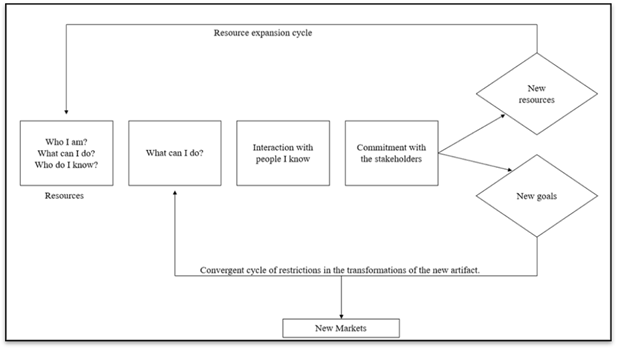
Figure 1:
Factors that explain the role of effectuation in entrepreneurship.
Source: Adapted from Sarasvathy (2008).
The effectuation approach has a basis in the decision-making theory literature. It suggests that if decision-makers believe they are dealing with relatively unpredictable phenomena, they will try to gather information about future trends through experiential learning (Fisher, 2012). The elements used in the effectuation approach represent experimental learning techniques that allow entrepreneurs to discover information about the future over time (Sarasvathy, 2001). For this reason, in the methodology of the course evaluated in this work, the definition of entrepreneurship by necessity is used and, as a theoretical basis, the effectuation approach, by understanding that the decision-making of those who start a business by necessity is not a process guided by opportunity and, yes, by the individual and context characteristics of those who undertake.
2.2 Entrepreneurial Education
Entrepreneurial education is the dynamic and social process in which individuals are educated to identify opportunities to innovate and transform their ideas into activities and practices in a social, cultural, or economic context (European Commission, 2012). From the perspective of entrepreneurship by opportunity, the development of entrepreneurship courses should focus on critical skills such as negotiation, leadership, product development, creative thinking, and technological innovation with a focus on business creation (Vesper & McMullan, 1988). Entrepreneurship meets a growing demand for apprentices; it can act as an interdisciplinary and multidisciplinary education opportunity; it challenges environments, cultures, and learning practices; it challenges the role of educators; it requires clarity and philosophical and conceptual support (Hannon, 2006).
The ability of the entrepreneurship course to simulate an entrepreneurial learning environment gives participants the freedom and responsibility to act, make decisions, and develop their knowledge (Pittaway & Cope, 2007a). Entrepreneurial education is essential for building more substantial and more flexible societies. From the perspective of Paço e Palinhas (2011), the educational system can be improved, from primary school to the university level, to guarantee solid development based on the participation of all agents.
In general, education for entrepreneurship has three main objectives: a) it is an education aimed at companies, with the development of various skills and sensitivities necessary for the creation of companies; b) consists of education about the company, providing students with an understanding of the entrepreneurial spirit; and, c) it is education through the company, using it as a broad platform of learning outcomes (Lewis & Massey, 2003).
Teaching how to develop an entrepreneurial spirit involves building knowledge, skills, attitudes, and personal characteristics appropriate to the student's age and level of development (Rauch & Hulsink, 2012). It also means teaching the value of theory and admitting inherent theoretical limitations (Paço & Palinhas, 2011). Entrepreneurship education can be a way to increase the prevalence rate of entrepreneurs and thus stimulate economic growth (Rauch & Hulsink, 2012).
Education for entrepreneurship is related to the evolution of learning processes and methods, moving from a didactic form to an entrepreneurial model (Gibb, 1993). In addition, educational institutions offer a wide range of awareness-raising and entrepreneurial education activities (Fayolle & Gailly, 2004; Vesper & Gartner, 1997). Entrepreneurship education should be provided by universities and primary and secondary schools, exposing young people to the concepts of entrepreneurship at an early stage of their development (Paço & Palinhas, 2011).
Predominantly, entrepreneurship literature has focused on the perspective of vision and exploitation of opportunities (Salusse & Andreassi, 2016). Rauch and Hulsink (2012) emphasize that new formats for teaching entrepreneurship have recently developed, actively involving students and programs that focus on action, experimentation, and practice of entrepreneurship, more in line with the effectuation theory. Thus, these new approaches include different teaching techniques, covering initial endeavors such as coursework, games and simulations, and design-based thinking (Kuratko, 2005; Mustar, 2009; Neck & Greene, 2011; Paço et al., 2011). These approaches emphasize knowledge acquisition and inspire and increase the perception of available resources, aiming to stimulate entrepreneurial behavior (Rauch & Hulsink, 2012), consistent with the perspective of entrepreneurship by necessity.
2.3 Entrepreneurial Education through the Effectuation Logic
Entrepreneurial education methods must evolve in parallel with developing technologies and knowledge linked to entrepreneurship. Politis (2005) reinforces that entrepreneurial education should focus on experiential learning so that individuals can build understanding. In connection with the Historical-Cultural Theory, individuals need to interact with the social environment, discussing ideas and interacting with others to develop learning and knowledge (Schroeder, 2004).
Fayolle and Gailly (2008) and Maritz (2017) describe some new approaches that are being carried out in the entrepreneurial education scenario, identifying methods using the effectuation logic. Koivumaa and Puhakka (2013) point out that entrepreneurship is linked to creation and that entrepreneurial education needs tools related to knowledge, the desire for change, and the creation of networks connected by the effectuation logic.
Koivumaa and Puhakka (2013) explain that using effectuation logic in entrepreneurial education generates a dynamic behavior, enabling the creation of cognitive meanings and social interpretation. Developing entrepreneurial education based on the effectuation logic demands a differentiated way of teaching, generating the reconstruction of the course curriculum as a whole (Ilonen et al., 2018; Koivumaa & Puhakka, 2013; Melinda et al., 2015; Salusse & Andreassi, 2016). The teaching and learning method's adequacy can significantly influence how students manage their businesses (Koivumaa & Puhakka, 2013).
About the effectuation logic, Sarasvathy (2001) warns that it is an approach that aims to concentrate on the resources already available to entrepreneurs to develop new products and services. Fayolle and Gailly (2008) point out that when creating the entrepreneurial education curriculum through the effectuation logic, it is essential to recognize that this model focuses on facilitating entrepreneurship learning in limiting situations. Effectuation logic identifies the means available before determining a goal (Sarasvathy, 2001). Thus, entrepreneurs start their businesses in proportion to their resources, knowledge, experiences, and network of contacts (Melinda et al., 2015).
One of the most relevant aspects of this logic is the ability to train entrepreneurs to visualize market alternatives and, at the same time, transform market failures into challenges (Melinda et al., 2015). The learning pattern based on effectuation logic serves as a means and a bridge to respond to these needs (Chandler et al., 2009). According to Sarasvathy (2001), entrepreneurs must elaborate their practical and pedagogical applications using the five principles and the general logic of effectuation that were named as follows: a) a bird in the hand; b) Affordable loss; c) patchwork quilt; d) lemonade; and e) pilot in the plane, described in Table 1.
| Principle | Definitions |
| A bird in the hand | The entrepreneur must start the business with the available means or resources identified with who I am, what I know how to do, and who I know. |
| Affordable Loss | The entrepreneur must decide what he can afford to lose rather than expected returns. |
| Patchwork quilt | Entrepreneurs should focus on developing strategic alliances rather than conducting complex, competitive analyses. |
| Lemonade | Instead of using pre-existing knowledge, the entrepreneur must incorporate contingencies into the business development process. |
| Pilot in the plane | Entrepreneurs control and shape the future with their actions and do not rely on forecasting methods that they consider uncertain. |
The first principle described is a bird in the hand when the subject can answer the questions "Who am I?", "What do I know how to do?" and "Whom do I know" (Sarasvathy, 2008). With that, it stops just identifying the market gap and transforms its experience and practical knowledge into a means to transform new business opportunities (Read & Sarasvathy, 2005; Sarasvathy, 2008). With this, the objective of entrepreneurial education, based on the effectuation logic, is to develop and realize opportunities for entrepreneurship (Koivumaa & Puhakka, 2013), differing from the previous logic in which chance was something that guided actions and, therefore, needed to be discovered. In the effectuation logic, the initial conditions of the entrepreneur define the type of opportunity he can create. Thus, entrepreneurs design their future, requiring less planning to achieve predefined goals (Sarasvathy, 2001).
Sarasvathy (2001) argues that the effectuation logic can develop skills in creating and exploring contingencies, helping the entrepreneur visualize the scenario from different aspects. Students should be encouraged to self-evaluate, highlighting their primary personal skills, professional experience, and hobbies to start the process (Koivumaa & Puhakka, 2013). Users use this method to develop entrepreneurial skills and to train participants in entrepreneurial education courses. The main objective of entrepreneurial education, based on the effectuation logic, is to place the student at the center of the entire process, allowing them to take responsibility for the actual learning and the whole process (Ilonen et al., 2018; Koivumaa & Puhakka, 2013; Melinda et al., 2015; Salusse & Andreassi, 2016).
Sarasvathy (2001, 2008) describes the second principle of Affordable loss. The entrepreneur must calculate which risks he is willing to face and which bearable upsets. Entrepreneurs must define the number of sufficient resources as an affordable loss and what value they can work as a margin for failure, taking on fewer risks than to bear (Koivumaa & Puhakka, 2013). Melinda et al. (2015) recommend that entrepreneurs calculate these risks because they can maintain the venture if a loss occurs. Based on the effectuation logic, entrepreneurs who follow entrepreneurial education are willing to face bearable losses, committing only a limited amount of their enterprise's resources (Chandler et al., 2011; Fisher, 2012; Salusse & Andreassi, 2016a; Sarasvathy, 2008).
The patchwork quilt is the third principle Sarasvathy (2001, 2008) describes. Entrepreneurs must create and manage a network of contacts to help maintain and expand their business. Using entrepreneurial education, based on the effectuation logic, the student establishes a network of relationships and manages shows to start his enterprise in parallel with resource availability (Salusse & Andreassi, 2016). For this reason, Koivumaa and Puhakka (2013) highlight the importance of analyzing the existing network of contacts and how to expand it.
The fourth principle Sarasvathy (2001, 2008) described is named lemonade. Entrepreneurs must always be alerted to face the unexpected. Koivumaa and Puhakka (2013) explain that one of the main concerns of students is the fear of facing systematic risks and uncertainties in running a business. Therefore, entrepreneurial education models, based on the effectuation logic, should train students for uncertain market environments, discovering what they can do to overcome these obstacles (Ilonen et al., 2018; Koivumaa & Puhakka, 2013; Melinda et al. al., 2015; Salusse & Andreassi, 2016).
While traditional entrepreneurial education programs indicate the use of causation logic to deal with uncertainties (Gibb, 2002; Honig, 2004; Kuratko, 2005), entrepreneurial education programs, based on effectuation logic, offer alternatives for students to are more flexible and can face future uncertainties (Chandler et al., 2011; Fisher, 2012). Ilonen et al. (2018) describe that the effectuation logic approach allows students to use learning to develop various products and services, adding other ways of selling, distributing, and adapting to market demand.
Finally, the fifth principle Sarasvathy (2001, 2008) describes the pilot in the plane. Entrepreneurs must be able to control and shape the future of their enterprise and minimize risks. Entrepreneurs based on the effectuation logic, entrepreneurial education programs that the entrepreneurial environment is uncertain and that entrepreneurs need to focus on available resources to predict the market (Chandler et al., 2011; Fisher, 2012; Sarasvathy, 2008). For Melinda et al. (2015), implementing learning through entrepreneurial education, based on the effectuation logic, is more suitable for today's society. Students can provide their enterprise according to market changes and from understanding and learning the five principles of effectuation logic. This learning offers different ways and experiences, other rent scenarios, and prod, cut/service development, enabling entrepreneurs to find different ways of managing the same type of business (Koivumaa & Puhakka, 2013; Melinda et al., 2015; Salusse & Andreassi, 2016).
In entrepreneurial education, based on the effectuation logic, some traditional teaching methods are used to assist in developing knowledge, such as lectures, exercises, business plan assembly, and case studies (Heinonen & Poikkijoki, 2006; Maritz, 2017). Salusse and Andreassi (2016) highlight 28 teaching methodologies based on entrepreneurial education through the effectuation logic, which aims to understand and practice the dynamic teaching model. Table 2 describes them.
| Entrepreneurship teaching methodologies (general) | ||
| Lectures | Case studies | |
| Creativity and business ideas | Coaching (mentors) | |
| Simulation (role-playing) | Diagnostic tools | |
| Dynamic "all" | Videos | |
| Games & simulation | Hypothesis test | |
| Multimedia tool (website) | Textbook | |
| Pitch (storytelling) | Consulting with entrepreneurs | |
| Social media (blog) | Field trip | |
| Real challenges | Design thinking | |
| Company Opening | Interviews with entrepreneurs | |
| Negotiation (control x equity) | Guest speakers | |
| Business model | Student start-ups | |
| Business plan | Films | |
| Reflection on the practice | ||
| Customer development |
It should be noted that entrepreneurship teaching methodologies, based on effectuation logic, must be distributed throughout the model and related to the principles of effectuation logic. This distribution helps understand and develop essential skills for creating and developing a business (Salusse & Andreassi, 2016).
3. Research Design
We used the participant observation method to describe the methodology used in the family entrepreneurship course and assess the members' perceptions of the method. Participant observation constitutes the primary operational tool of ethnography because the researcher is inserted in the field (Abib et al., 2013). The results obtained by the participant observation are individual; the conclusions can be discussed with the actors as the observation is carried out and the researcher builds the analyses (Angrosino, 2009). This work is not characterized as ethnographic, but its nuances are perceived throughout its development given the adopted methodology of participant observation and the ontological proximity between observer and observed, as already identified by Garud, Kumaraswamy, and Karnøe (2010) in related studies to the entrepreneurial mindset.
Participant observation is an investigation characterized by intense social interactions between the observer and the observed, a procedure in which data are collected systematically (Bogdan & Biklen, 1994). Spradley (1980) proposes distinct levels of commitment and involvement of the observed. These levels can range from a low level of involvement participation to the highest, with zero, low, moderate, active, or complete participation. Participant observation is not just a research method but a facilitating strategy for data collection, as it combines the role of the researcher (participant in some way) with data collection techniques (observation) (Angrosino, 2009).
Interviews with the observation actors, collection of documents and observer notes, and video recording are other techniques that allow data collection in this context (Abib et al., 2013). In participant observation, participants and observers have much greater interaction and are no longer seen as objects of research but as subjects contributing to the study (Serva & Jaime Júnior, 2012).
To analyze the data obtained with the participant observation, we used content analysis on the notes registered by the observer. As content analysis is a technique that works with the collected data, aiming to identify what is being said about a given topic (Vergara, 2005), there is a need to decode what is being communicated. Content analysis is a research technique for reaching conclusions through the systematic and objective identification of a text's specific characteristics, verifying the frequency in which each category is observed in the studied documents (Vieira & Zouain, 2005).
3.1 Course Context
The course's main objective was to teach entrepreneurship to low-income families in Blumenau, Brazil, through effectuation logic. The teacher had already selected the region where she was interested in working and had spoken with members of the Department of Education of the Municipality of Blumenau. The family entrepreneurship course is an extracurricular activity. It was carried out in a public school on the outskirts of Blumenau—the system aimed to attract families living in peripheral neighborhoods interested in increasing their income as participants. The prerequisite for the family to participate in the course is that the child was enrolled in the selected school, regardless of the degree of kinship between the children and their guardians.
The course was publicized at the school, during a meeting for parents, and through notices in the students' diaries. These actions took place on March 21st, 2018, one month before the beginning of the course. Those interested in participating in the class left their details with the school's directors, who forwarded the registration of participants to the teacher responsible for the course. Twenty-three enrolled in the course, but only eighteen attended all meetings; they were the observed participants.
The course was conducted in five meetings that took place fortnightly, on Saturdays in the afternoon. The responsible teacher worked on the five principles of effectuation during the procedure, with participant observation by the author. During the meetings, several discussions, experiences, reports, and exchanges of ideas emerged. In addition to the observer role, the author sometimes helped the participants solve some problems or clarify small doubts.
4. Presentation and Analysis of Results
The complexity of working on entrepreneurship, especially with children, requires a variety of approaches and responses due to a series of difficulties, such as a) subjects challenging to define, such as duration, due to the individual's lifetime; b) subjects that involve other complex realities (e.g., family and education), c) many scientific areas study this subject, but the borders are not always well defined (Tomás, 2007). Given the complexity of the problem, we decided to employ different methodological approaches and use various materials, techniques, and procedures.
The first theme of the course was "Visualizing the business opportunity" and started with the first principle of the effectuation model by the author Sarasvathy, called a bird in the hand; the first question from Sarasvathy (2001) arises: "Who am I?". At that moment, the participants introduced themselves and talked about their interests, what they liked to do, what they wanted to study, and why they were interested in the course to get to know them better. The second question asked to the participants was, "What do I know how to do?" At that moment, parents and children talked about activities they liked to do. They could do together food ideas (mug cakes, bread, ice cream), toys (slime, jewelry, modeling clay), and household objects (wooden organizer boxes, coasters, pots to store condiments, etc.). The first day of the course ended with a homework assignment, finding out which product the family was able to develop together, testing it, and taking it to the next meeting, whose theme was "Market information and sales data." The importance of parental supervision during activities involving the use of sensitive materials and glue was highlighted.
In the second, after defining the product of each family, the following question was asked following Sarasvathy (2001), "who do you know?" this process started with a conversation about the product produced; children were asked if they would buy their products, how that product could be helpful, what the outcome would need to have for friends and family to buy it. Then, there was a brief explanation about networking and techniques to reduce embarrassment when selling, demonstrating some dynamics with simple sales techniques, such as getting to know the customer and starting a simple sale. These techniques were passed on to the participants through theatrical activities among the participants present in the course, using the products of the course participants.
Regarding the Affordable Loss Principle, instead of making the decision based on the expected return on investment, the effectuation approach establishes that the entrepreneur must determine how much he would bear to lose when pursuing a given opportunity for decision-making to undertake. The consequence is that the entrepreneur must quickly test his product or service in the market and use any contingencies as a source of strategic direction for business development (Sarasvathy, 2001).
In elucidating the second principle of Sarasvathy (2001), the effectuation model, the concept of affordable loss refers to the practice of only expending resources to the extent that they are perceived within one's financial capacity. It was emphasized that children must understand that the family must maintain its finances in preparing the product to sell. Costs must be calculated; time is also part of the cost, so it must be spent on a pleasurable activity, respecting the time of children and parents, thus increasing family life. Requiring parental supervision in activities where children may handle sensitive materials, glue, and other hazardous materials was reinforced.
The explanation of the third principle of Sarasvathy's effectuation model (2008), patchwork quilt, which corroborates the second principle, began. The emphasis of the analysis of the effectuation approach is on identifying the possible alliances that the entrepreneur can build for the continuation of his business instead of worrying about the market's competitiveness or only the company's resources (Sarasvathy, 2001). Alliances allow entrepreneurs to reduce environmental uncertainty and build the necessary elements for success. The Patchwork Quilt principle advises that it is crucial to develop partnerships. At that moment, participants were told which collaboration networks they already had and how they could increase them. The idea of creating social networks to disseminate and sell products arose.
At the third meeting, the theme was "Information on Finance and Accounting," information on Initial Capital, the elaboration of a Social Contract, a brief explanation of the Individual Micro Entrepreneur program, and the opening of companies, revenues, and organizational expenses and investments. Continuing the principle of the effectuation model of Sarasvathy (2001), in a patchwork quilt, parents and professors of the course exchanged experiences with starting a business, and doubts about it were answered; the importance of accounting professionals and social media was discussed. Always playfully and simply so that the children present could understand, and it did not become a boring subject for them. The day's handout was delivered with many pictures for the children and many theoretical explanations for the parents. In the end, the families were asked to take the products they made to the next meeting to explain how the product was developed, with photo tips for social networks, sales tips, and storage and transportation of products.
The topic addressed in the fourth meeting was "Product/Service Development"; participants were asked to bring their developed products. Initially, ways of photographing and editing products for posts on social networks and tips for creating captions for photos were handled. After everyone had a picture of their main product, there was a brief introduction about the business plan and market analysis, later commenting on the packaging of the products and how to organize them for delivery and storage in stocks. The dynamic adopted was to ask the families to assemble the product's primary packaging with the appropriate labels and descriptions. Afterward, they were asked to create a gift/transport package and ideas for stocking the products. At that time, the children interacted with their parents and peers, and there was much exchange of ideas and interaction between families.
The fourth principle of the Sarasvathy effectuation model (2001) is lemonade, i.e., "From a lemon, make a lemonade." Assuming the experimentation of innumerable possibilities that arise as contingencies in the day-to-day, considering that the entrepreneur's objectives are not yet completely defined. When new business development focuses on exploring pre-existing knowledge with a defined goal, relationships based on causal logic tend to be more suitable for achieving that objective (Sarasvathy, 2001). This principle emphasized that parents and children could transform the idea of products to generate a second income into a primary income by creating a formal company. Remember that the nomenclature of this principle refers to popular jargon in the sense that if life presents you with lemons, make lemonade. Instead of avoiding contingencies, you should use them to benefit your business. Convert the family business into an opportunity for dialogue and joint planning, and constantly bear in mind that the course's primary aim, apart from instilling the "seed" of entrepreneurship, is to emphasize the importance of family cohesion.
In the fifth meeting held at the university, dynamics were developed for family interaction. The activities initially carried out to promote the exchange of the participants were: sack race, rubber band, chair dance, mummy, and balloon race. After the break, the families were invited to visit the University Campus to establish proximity and convey that they could and should be part of families so that everyone could participate in the academic world.
The child carried out the closing dynamic, divided into two teams, and given some sweets (marshmallows, gum candy, candies in general, and toothpicks) to elaborate a sales plan where they needed to develop the product and define the price and sales forms. The teachers would "buy" the products, bargaining for prices and simulating market operations. At the end of this activity, the children shared their feelings during the training and the strategies adopted by the teams. The products were also distributed to the participating children. At that moment, the sixth and last principle of the effectuation model by Sarasvathy (2001), the "Pilot of the Plane" (pilot in the plane), was passed. , is what understands the future as being unpredictable and uncertain. In this sense, decisions must be taken based on experimentation and to control the future instead of predicting it. The entrepreneur's decisions, actions, and interactions can shape this uncertain future, eliminating the need to expect it (Sarasvathy, 2001).
The Family Entrepreneurship Course (CEF) featured a series of methodologies that allowed using tools and languages aimed at a specific audience and stimulating social interaction to better develop entrepreneurial learning based on the effectuation logic. This course made it possible to understand a new teaching methodology for entrepreneurial education, as suggested by authors in the area (Fayolle, 2013; Pittaway & Cope, 2007a); it also enabled the description of the course to contribute to studies in the area, enabling replication and new tests (Jason. Cope, 2005; Politis, 2005). The content of entrepreneurial education programs comprises management theory and practice combined with pedagogy methodologies to generate knowledge (Maritz & Brown, 2013). The students must also evaluate whether the objectives, the content, and how it was carried out followed what was proposed in class (Maritz, 2017).
The teaching and learning methodology influence the business management capacity of participants in education courses (Melinda et al., 2015). In this context, it is crucial to assess the participant's perception of the methodology used for entrepreneurial education (Maritz & Brown, 2013). Based on the effectuation logic, as it was used in the family entrepreneurship education course, entrepreneurial education is used to develop and work on the essential characteristics of entrepreneurship (Chandler et al., 2011). This entrepreneurial education format allows the subject to be more flexible and to develop alternatives based on available resources (Chandler et al., 2011; Fisher, 2012).
The role of the entrepreneurship teacher is to guide the student in the learning process, recognize the different ways each student learns, and insert this information into the teaching process to facilitate learning (Gibb, 1993). The five principles of effectuation logic were understood and discussed among students. It is noticed that with an effectuation approach in entrepreneurial education, the interaction between individuals is essential to expand learning and entrepreneurship with the appropriate learning method; entrepreneurial education assists in developing entrepreneurs who can minimize risks and strengthen their ventures (Melinda et al., 2015).
5. Conclusion
This article holds significant importance for the literature on entrepreneurial education and the development and implementation of the presented course. The overarching objective of the article was to delineate the application of an entrepreneurship course grounded in effectuation logic, specifically tailored for families. The course was delivered in a municipal public school with 18 participants, and participant observation was employed as the primary research method. The principal outcome of the study was a comprehensive exposition of the methodology employed, coupled with confirmation of participants' understanding of the course content. Beyond contributing to the research landscape of entrepreneurial education, this article provides valuable insights by detailing a course adaptable to diverse contexts.
During the application of the course, the five principles of effectuation developed by Sarasvathy (2001, 2008) were worked on in the classroom. In addition to the lecture, other activities, such as product development, were created with the students. Salusse & Andreassi (2016) identified methodologies used in entrepreneurship education courses with an effectuation approach; some were used in the family entrepreneurship course.
This work has some limitations inherent to the inductive method, such as participant observation. As for the course analyzed, it is the first group of participants in the family entrepreneurship course offered in a medium-sized city in Brazil and reported in scientific studies. Because it is only one course, it is not possible to capture the main specificities of the poorest regions where entrepreneurship by necessity, according to data from the GEM (2018), develops in a more significant proportion. Based on the limitations, it suggested to researchers in the area of entrepreneurship education topics for future research.
As a suggestion for future research and entrepreneurial education courses with an effectuation approach: a) carry out the course application in other periphery environments to know the specificities of each location. c) Carry out surveys over a more extended period to monitor the evolution and development of the course participants' undertakings, which could isolate the effects of the natural maturation of the participating children. d) with the observation of the reports of the research subjects, in entrepreneurship, by necessity, the family is part of the maintenance of the enterprise. For this reason, developing courses and studies involving families is suggested.
With the development of this work, we contribute to the field of research in entrepreneurial education for entrepreneurs by necessity. In addition to the theoretical contributions arising from using the effectuation logic in developing the entrepreneurial education course for entrepreneurs out of necessity, this work contributes to public policy programs. By elaborating a national grid of a family entrepreneurship course, it is possible to encourage entrepreneurship in underprivileged areas in Brazil and develop projects whose target is family groups. Entrepreneurial education for families of entrepreneurs out of necessity can, in the long term, help in local economic growth and development, minimizing the mortality of enterprises built without formal guidance.
References
Abib, G., Hoppen, N., & Hayashi Junior, P. (2013). OBSERVAÇÃO PARTICIPANTE EM ESTUDOS DE ADMINISTRAÇÃO DA INFORMAÇÃO NO BRASIL. RAE Revista de Administracao de Empresas, 53(6), 604–616. https://doi.org/10.1590/S0034-759020130608
Angrosino, M. (2009). Etnografia e Observação Participante (Artmed (ed.); 1st ed.). Artmed.
Block, J., & Sandner, P. (2009). Necessity and opportunity entrepreneurs and their duration in self-employment: Evidence from German Micro data. Journal of Industry, Competition and Trade, 9(2), 117–137. https://doi.org/10.1007/s10842-007-0029-3
Bogdan, R. C., & Biklen, S. K. (1994). Investigação qualitativa em educação :uma introdução a teoria e aos métodos (P. Ed (ed.); 1st ed.). Porto Ed.
Bygrave, W. D., Hay, M., Ng, E., & Reynolds, P. (2003). Executive forum: A study of informal investing in 29 nations composing the Global Entrepreneurship Monitor. Venture Capital, 5(2), 101–116. https://doi.org/10.1080/1369106032000097021
Chandler, G. N., DeTienne, D. R., McKelvie, A., & Mumford, T. V. (2011). Causation and effectuation processes: A validation study. Journal of Business Venturing, 26(3), 375–390. https://doi.org/10.1016/j.jbusvent.2009.10.006
Delmar, F., & Shane, S. (2003). Does business planning facilitate the development of new ventures? Strategic Management Journal, 24(12), 1165–1185. https://doi.org/10.1002/smj.349
European Commission. (2012). Effects and impact of entrepreneurship programmes in higher education. In European Commission (Issue March).
Fayolle, A., & Gailly, B. (2008). From craft to science. In Journal of European Industrial Training (Vol. 32, Issue 7). https://doi.org/10.1108/03090590810899838
Fayolle, A., & Gailly, B. (2004). Using the Theory of Planned Behaviour to Assess Entrepreneurship Teaching Programmes. Center for Research in Change, Innovation and Strategy of Louvain School of Management, 5. https://www.researchgate.net/publication/228752441
Fellnhofer, K. (2019). Toward a taxonomy of entrepreneurship education research literature: A bibliometric mapping and visualization. Educational Research Review, 27(October 2016), 28–55. https://doi.org/10.1016/j.edurev.2018.10.002
Fiet, J. O. (2001). The pedagogical side of entrepreneurship theory. Journal of Business Venturing, 16(2), 101–117. https://doi.org/10.1016/S0883-9026(99)00042-7
Fisher, G. (2012). Effectuation, causation, and bricolage: A behavioral comparison of emerging theories in entrepreneurship research. Entrepreneurship: Theory and Practice, 36(5), 1019–1051. https://doi.org/10.1111/j.1540-6520.2012.00537.x
Garud, R., Kumaraswamy, A., & Karnøe, P. (2010). Path dependence or path creation? Journal of Management Studies, 47(4), 760–774. https://doi.org/10.1111/j.1467-6486.2009.00914.x
GEM, G. E. M. (2018). Empreendedorismo no Brasil: Relatório Executivo 2018. https://datasebrae.com.br/wp-content/uploads/2019/02/Relatório-Executivo-Brasil-2018-v3-web.pdf
Gibb, A. (1993). Enterprise Culture and Education: Understanding Enterprise Education and its Links with Small Business,Entrepreneurship and Wider Educational Goals. International Small Business Journal, 11(3), 11–34. https://doi.org/10.1177/026624269301100301
Gibb, A. (2002). Creative Destruction, New Values, New Ways of Doing Things and New Combinations of Knowledge. International Journal of Management Reviews, 4(3), 233–269.
Hannon, P. D. (2006). Teaching pigeons to dance: Sense and meaning in entrepreneurship education. Education + Training, 48(5), 296–308. https://doi.org/10.1108/00400910610677018
Honig, B. (2004). Entrepreneurship Education: Toward a Model of Contingency-Based Business Planning. Academy of Management Learning & Education, 3(3), 258–273. https://doi.org/10.5465/amle.2004.14242112
Ilonen, S., Heinonen, J., & Stenholm, P. (2018). Identifying and understanding entrepreneurial decision-making logics in entrepreneurship education. International Journal of Entrepreneurial Behaviour and Research, 24(1), 59–80. https://doi.org/10.1108/IJEBR-05-2017-0163
Katz, J., & Gartner, W. B. (1988). Properties of Emerging Organizations. Academy of Management Review, 13(3), 429–441. https://doi.org/10.5465/amr.1988.4306967
Koivumaa, S. M., & Puhakka, V. (2013). Effectuation and Causation in Entrepreneurship Education. International Journal of Entrepreneurial Venturing, 5(1), 68–83.
Kuratko, D. F. (2005). The emergence of entrepreneurship education: Development, trends, and challenges. Entrepreneurship: Theory and Practice, 29(5), 577–597. https://doi.org/10.1111/j.1540-6520.2005.00099.x
Lewis, K., & Massey, C. (2003). Delivering enterprise education in New Zealand. Education + Training, 45(4), 197–206. https://doi.org/10.1108/00400910310478120
Maritz, A. (2017). Illuminating the black box of entrepreneurship education programmes: Part 2. Education and Training, 59(5), 471–482. https://doi.org/10.1108/ET-02-2017-0018
Mcmullen, J. S., & Shepherd, D. A. (2014). Entrepreneurial action and the role of uncertainty in the theory of the entrepreneur. A Psychological Approach to Entrepreneurship: Selected Essays of Dean A. Shepherd, 31(1), 3–23. https://doi.org/10.4337/9781783479801.00007
Melinda, T., Sutanto, J. E., & Christian, S. (2015). Effectiveness of Effectuation-Based Entrepreneurship Learning. Liceo Journal of Higher Education Research, 11(1), 107–118.
Mustar, P. (2009). Technology management education: Innovation and entrepreneurship at MINES Paris tech, a leading French engineering school. Academy of Management Learning and Education, 8(3), 418–425. https://doi.org/10.5465/AMLE.2009.44287940
Neck, H. M., & Greene, P. G. (2011). Entrepreneurship Education : Known Worlds. Journal of Small Business Management, 49(1), 55–70.
Paço, A. M. F., Ferreira, J. M., Raposo, M., Rodrigues, R. G., & Dinis, A. (2011). Behaviours and entrepreneurial intention: Empirical findings about secondary students. Journal of International Entrepreneurship, 9(1), 20–38. https://doi.org/10.1007/s10843-010-0071-9
Paço, A., & Palinhas, M. J. (2011). Journal of Vocational Education & Teaching entrepreneurship to children : a case study. Education, 63(April 2012), 37–41.
Papagiannis, G. D. (2018). Entrepreneurship education programs: The contribution of courses, seminars and competitions to entrepreneurial activity decision and to entrepreneurial spirit and mindset of young people in Greece. Journal of Entrepreneurship Education, 21(1). https://www.scopus.com/inward/record.uri?eid=2-s2.0-85044769709&partnerID=40&md5=08aa971c0387017fe16057e5848afa24
Pittaway, L., & Cope, J. (2007a). Simulating Entrepreneurial Learning. Management Learning, 38(2), 211–233. https://doi.org/10.1177/1350507607075776
Pittaway, L., & Cope, J. (2007b). Entrepreneurship education: A systematic review of the evidence. In International Small Business Journal (Vol. 25, Issue 5, pp. 479–510). https://doi.org/10.1177/0266242607080656
Politis, D. (2005). The Process of Entrepreneurial Learning: A Conceptual Framework. Entrepreneurship Theory and Practice, July, 399–424.
Rauch, A., & Hulsink, W. (2012). An Investigation into the Impact of Entrepreneurship Education On Entrepreneurial Behaviour. Academic of Management Learning & Education, 2–49.
Read, S., & Sarasvathy, S. D. (2005). What You Know : Effectuation. Journal of Private Equity, 9(1), 45–62.
Salusse, M. A. Y., & Andreassi, T. (2016). O Ensino de Empreendedorismo com Fundamento na Teoria Effectuation/Teaching Entrepreneurship Using Effectuation Theory. Revista de Administração Contemporânea, 20(3), 1,305-327. https://doi.org/http://dx.doi.org/10.1590/1982-7849rac2016150025
Sarasvathy, S. D. (2001a). Causation and Effectuation: Toward a Theoretical Shift from Economic Inevitability to Entrepreneurial Contingency. Academy of Management Review, 26(2), 243–263. https://doi.org/10.5465/amr.2001.4378020
Sarasvathy, S. D. (2001b). Causation and effectuation: Toward a theoretical shift from economic inevitability to entrepreneurial contingency. Academy of Management Review, 26(2), 243–263. https://doi.org/10.5465/AMR.2001.4378020
Sarasvathy, S. D. (2008). Effectuation: Elements of entrepreneurial expertise. Effectuation: Elements of Entrepreneurial Expertise, 1–368. https://doi.org/10.4337/9781848440197
Schroeder, E. (2004). A Aprendizagem Conceitual em Sala de Aula: Contribuições da Teoria Histórico-Cultural. In FURB (Ed.), Processos de Ensinar e Aprender: reflexões sobre formação de professores, teoria histórico-cultural e educação inclusiva (1st ed., pp. 83–106). FURB.
Serva, M., & Jaime Júnior, P. (2012). Observação participante pesquisa em administração: uma postura antropológica. Revista de Administração de Empresas, 35(3), 64–79. https://doi.org/10.1590/s0034-75901995000300008
Shane, S., & Venkataraman, S. (2000). The Promise of Entrepreneurship as a Field of Research. Https://Doi.Org/10.5465/Amr.2000.2791611. https://doi.org/10.5465/AMR.2000.2791611
Spradley, J. P. (1980). Participant Observation (I. Holt, Rinehart and Winston (ed.); 1st ed.). Holt, Rinehart and Winston, Inc.
Tomás, C. A. (2007). Há muitos mundos no mundo…direitos da crianças, cosmopolitismo infantil movimentos sociais de crianças : diálogos entre crianças de Portugal e Brasil [Universidade do Minho]. https://doi.org/http://hdl.handle.net/1822/6269
Vergara, S. C. (2005). Métodos de pesquisa em administração (Atlas (ed.)). Atlas.
Vesper, K. H., & Gartner, W. B. (1997). Measuring progress in entrepreneurship education. Journal of Business Venturing, 12(5), 403–421. https://doi.org/10.1016/S0883-9026(97)00009-8
Vesper, K. H., & McMullan, E. W. (1988). Contributing Editor' s Feature Entrepreneurship : Today Courses , Tomorrow Degrees ? Entrepreneurship: Today Courses, Tomorrow Degrees?, 13(1), 7.
Vieira, M. M. F., & Zouain, D. M. (2005). Pesquisa Qualitativa em Administração (E. FGV (ed.); 1st ed.). Editora FGV.