MATHEMATICS ANXIETY IN BUSINESS EDUCATION: CONTRIBUTIONS OF A DIAGNOSTIC SCALE
ANSIEDADE MATEMÁTICA NA EDUCAÇÃO EMPRESARIAL: CONTRIBUIÇÕES DE UMA ESCALA DIAGNÓSTICA
 Saulo Barroso Rocha saulorocha@id.uff.br
MATHEMATICS ANXIETY IN BUSINESS EDUCATION: CONTRIBUTIONS OF A DIAGNOSTIC SCALE
Revista Pensamento Contemporâneo em Administração, vol. 19, núm. 2, pp. 93-108, 2025
Universidade Federal Fluminense
Recepción: 14 Abril 2025
Aprobación: 03 Julio 2025
Abstract: This study aims to validate the Abbreviated Math Anxiety Scale (AMAS) for undergraduate business students. The instrument was applied to a probabilistic sample of 176 students enrolled in the first semester of business programs. Factor analysis confirmed the bifactorial structure of the scale, distinguishing between evaluation-related and learning-related anxiety. The psychometric robustness of the AMAS is discussed, and its potential use as a pedagogical diagnostic tool is highlighted. Results suggest that the AMAS can support instructors in identifying students who may face emotional barriers to quantitative learning, thereby allowing for more effective planning of pedagogical strategies in business courses.
Keywords: Math anxiety, business education, diagnostic tools, quantitative literacy.
Resumo: Este estudo tem como objetivo validar a Escala Abreviada de Ansiedade Matemática (AMAS) em uma amostra de estudantes de graduação na área de gestão. O instrumento foi aplicado a uma amostra probabilística de 176 estudantes ingressantes no primeiro período, durante dois anos. A análise fatorial confirmou a estrutura bifatorial da escala, distinguindo ansiedade relacionada à avaliação e à aprendizagem. Discute-se a robustez psicométrica da AMAS e seu uso como ferramenta diagnóstica pedagógica. Os resultados sugerem que a AMAS pode auxiliar docentes na identificação de estudantes que enfrentam barreiras emocionais à aprendizagem quantitativa, permitindo um planejamento pedagógico mais eficaz em cursos de gestão.
Palavras-chave: ansiedade matemática, ensino em administração, ferramentas diagnósticas, alfabetização quantitativa.
Introduction
Mathematics plays a vital role in the education of management professionals, being essential for understanding and applying concepts related to finance, economics, statistics, and data analysis. However, many students enter higher education with negative past experiences in mathematics, contributing to the development of math anxiety—a psychological condition characterized by fear, tension, and apprehension when engaging with quantitative reasoning (Dowker et al., 2016; Handler, 1990; Hembree, 1990; F. C. Richardson & Suinn, 1972; Stodolsky, 1985). Research shows that such anxiety can impair logical thinking, affect performance in quantitative tasks, and even influence professional decision-making that involves data analysis (Handler, 1990; A. Howard & Warwick, 2016). In Business Administration programs and related fields, these skills are fundamental not only for academic success but also for effective professional performance in increasingly data-driven environments. Overcoming the notion that mathematics is a domain reserved for a few individuals—often reinforced by gender and stereotypes—is key to building a more inclusive and competent management education. In this sense, it is necessary to understand how students experience mathematics learning in higher education and how these experiences are affected by emotional barriers (Boaler, 2020; Geist, 2010; Shi & Liu, 2016). The presence of math anxiety among business students should be treated as a real obstacle to quantitative literacy, understood as the ability to understand, communicate, and apply numerical information in real decision-making contexts.
It is common to observe that students in the early periods of graduation often belong to younger age groups. Many of these students bring negative experiences with the teaching and learning of mathematics from their school trajectory. Because of this, the curricular and didactic approach requires special attention, integrating the students' context into the teaching of the subject in the classroom. It is essential to prioritize the development of mathematical thinking, to the detriment of an approach focused solely on the memorization of functions and equations (Geist, 2010; Shi & Liu, 2016). Such an approach should enable students to think about real management problems, autonomously, using mathematical knowledge.
This article aims to validate the Abbreviated Scale of Mathematical Anxiety (AMAS) (Hopko et al., 2003) in a sample of undergraduate students in Management Processes. In addition to measuring the level of anxiety, it is proposed to use the scale as a complementary diagnostic tool in the planning of introductory courses with quantitative content. Although this study does not investigate the origin of anxiety, recent literature identifies factors associated with the phenomenon, such as traumatic school experiences, low mathematical self-esteem, social influences, and even evaluation contexts (Chang & Beilock, 2016; Charlo et al., 2024; Lukowski et al., 2019; Madjar et al., 2018; Maloney et al., 2015; Maloney & Beilock, 2012; Schaeffer et al., 2018; Wang et al., 2014). The understanding and diagnosis of mathematical anxiety represents, therefore, a relevant first step to improve teaching practices in business courses and related areas, aiming at the training of professionals able to deal with numbers in a contextualized way.
Anxiety and Mathematical Thinking
Mathematical reasoning, whether abstract, concrete, or intuitive, plays a crucial role in data analysis and the subsequent decision-making process in organizational contexts, private or public. However, it is common that, in undergraduate courses focused on management, professors of disciplines with mathematical content hear from their students the following statement: 'Professor, I am from the humanities and not from the exact sciences', used to justify unsatisfactory performances, prior to or after the evaluations. This attitude results in a generalized aversion to these subjects, which are introductory, such as statistics, mathematics for administration, applied linear algebra or calculus I, among others. There is ample academic literature refuting this dominant thinking, both from the perspective of neuroscience (Boaler, 2015, 2020) and from the socio-historical-cultural influence (Giraldo & Roque, 2021). This aversion culminates in an anxiety that is harmful to the teaching-learning process, leading certain students to believe that mathematics is not suitable for them. They believe that mathematics is knowledge given only to some, and not constructed (Brown et al., 2020; Shafer, 2016). Some historical myths reinforce this social construction, such as that mathematics is for men, making a mistaken distinction in gender superiority, when studies point to the non-existence of this statement, because the performances are similar (Carmo & Simionato, 2012; Chipman et al., 1992; Devine et al., 2012; Goetz et al., 2013; A. Howard & Warwick, 2016; Primi et al., 2014). The implications for student learning with consequences at work can be negative for these future professionals, bringing the application of concepts and tools in the wrong way in administrative practice (Viana & Viana, 2012). If they perpetrate intimidation in the classroom or use aggressive language, then teachers contribute to the maintenance of these myths and the aggravation of this aversion, attitudes such as exposure of "failed" students with low grades and separation from groups of better performances contribute to this aggravation (Lin et al., 2017). One of the most serious consequences of this complex situation is mathematical anxiety, qualified by counterproductive emotional and physiological reactions in relation to everything related to mathematics (Boaler, 2020; Carey et al., 2016; Carmo & Simionato, 2012; Caviola et al., 2017; F. C. Richardson & Suinn, 1972). With these reactions it can lead to a lack of motivation, characterized by the feeling of incompetence and devaluation of the activity (Viana & Viana, 2012).
Beyond the professional issue, mathematical thinking is a relevant tool as underlying knowledge in the construction of price perceptions and purchase decisions (Andersen & Weisstein, 2016). Equations are mathematical facts, an important part of the process, but they are best understood by using numbers in different situations. For example, people with a mathematical sense are those who can use numbers flexibly. When asked to solve a multiplication of 7×8 someone with number sense may have memorized 56, but they would also be able to figure out that 7×7 equals 49 and then add 7 to make 56, or they can calculate 10×7 and subtract 2 ×7 (70-14) (Boaler, 2015; Radford, 2010). This way of thinking about mathematics is useful to professionals in administration. For example, there are at least 13 different ways to discuss the concept of linear correlation (Lee Rodgers & Nicewander, 1988), in a first approach this should be an intuitive process, using context applied to administration, thus reducing the level of anxiety; addressing, for example, geometric concepts with the use of vectors (Rocha, 2024). A different impact happens when in the first approach, the student is presented with formulas, which can potentially result in a mechanical process of problem solving. The mathematical anxiety generated by this context can produce negative results for the teaching-learning process (Moura-Silva et al., 2020). Low commitment and participation are visible results during classes, originating, among other factors, from severe mathematical anxiety, defined here as "a feeling of tension and anxiety that interferes with the manipulation of numbers and the resolution of mathematical problems in ordinary life and academic situations" (Chipman et al., 1992; F. C. Richardson & Suinn, 1972). Among non-students, math anxiety can contribute to stresses during routine or everyday activities, such as handling money, making bank accounts, evaluating selling prices, or assigning assignments (Mamedova et al., 2012). In a survey with a sample of 1000 adults (Hart & Ganley, 2019), the authors describe a significant negative correlation of mathematical anxiety with knowledge of probability and mathematical fluency and positively correlated with general anxiety and a certain anxiety test. In a broader view of education, students in Basic Education in Brazil with an important level of mathematical anxiety may limit career choices based on this type of anxiety. This phenomenon is observed in other countries, especially with female students(Tobias apud Hembree, 1990).
Research has shown that math anxiety is associated with reduced working memory capacity, which is crucial for maintaining and manipulating information during math tasks (Ashcraft, 2002; Ashcraft & Krause, 2007; Charlo et al., 2024; Ramirez et al., 2013; Skagerlund et al., 2019). Individuals anxious about mathematics tend to attribute excessive attention and cognitive resources to preoccupation with mathematics, resulting in a decrease in cognitive capacity for effective mathematical thinking. Additionally, math anxiety can hinder data analysis skills, which are essential for extracting meaningful information from large data sets. When in contact with large volumes of data, business professionals need to acquire quantitative skills to discover patterns and trends that lead to informed decisions. Mathematical anxiety can reduce the ability of individuals to apply statistical concepts effectively, limiting their ability to apply relevant data-driven strategy solutions in administrative activity.
Methodological Outlines
This study adopts a quantitative approach with a descriptive and analytical objective. The sample was composed of 176 undergraduate students in Management Processes from a federal public university located in the state of Rio de Janeiro, Brazil, from the night and face-to-face shifts. All participants were first-year students in the first period of the course, and data collection took place between the second semester of 2022 and the second semester of 2024, covering different classes throughout the academic semesters. The option to investigate undergraduate students at the beginning of their training is justified by the fact that many enter with a history of negative experiences with mathematics, which can directly impact their adaptation to mandatory quantitative disciplines, such as applied quantitative methods, financial mathematics, calculation elements, and data analysis. In addition, this initial moment is important for pedagogical diagnoses that guide leveling practices. The mean age of the respondents was approximately 22 years, ranging from 17 to 48 years, reflecting the presence of both students who had just left high school and students with previous academic or professional experience.
To measure mathematical anxiety, the instrument used was the Abbreviated Math Anxiety Scale (AMAS) developed in 2003 (Hopko et al., 2003), based on the work of Richard & Suinn (1972), translated into Portuguese (Brazilian variant). The instrument consists of 9 items, distributed into two main factors identified by the original authors: (1) Mathematical Learning Anxiety (items 1, 3, 6, 7 and 9) and (2) Mathematical Assessment Anxiety (items 2, 4, 5 and 8). The scale adopts a 5-point Likert score, ranging from 1 (low anxiety) to 5 (high anxiety). Previous studies indicate that the AMAS explains about 52% of the total variance between the factors, being considered a psychometrically robust instrument. In the study by Hopko et al (2003), the exploratory analysis of two factors was responsible for 52% of the variance. The factor loadings were distributed in two factors: Mathematical Learning Anxiety and Mathematical Assessment Anxiety. The result was a 5-point AMAS scale (1=Low anxiety to 5=High anxiety) with 9 items (P1 to P9), translated into Portuguese (Appendix). The Mathematical Learning factor contains questions 1, 3, 6, 7 and 9; and the Mathematical Anxiety factor contains questions 2, 4, 5 and 8. However, it should be noted, existing research on mathematical anxiety is based almost exclusively on self-reports of habitual anxiety, as opposed to state (momentary) anxiety assessed during real-life experiences. Assessments of state characteristics and self-report can lead to different results, and this is a limitation to consider (Goetz et al., 2013).
Statistical analysis of the data was performed using the SAS Viya software, using descriptive statistics techniques and factor analysis with orthogonal rotation (varimax), in addition to the evaluation of internal reliability using Cronbach's alpha coefficient.
Limitations
Although the study used a probabilistic sample, all participants belong to the same educational institution and the same course, which may limit the generalization of the results to other educational contexts. In addition, the exclusive use of a self-report instrument (AMAS) does not allow the assessment of observational aspects of mathematical anxiety, nor does it allow the capture of situational variables, such as the influence of the teacher, the classroom environment, or the didactic strategies used. Finally, the absence of data on the academic performance of the participants prevents more in-depth analyses of the relationship between anxiety and performance in quantitative disciplines. However, there is a vast literature on this relationship (Ashcraft & Krause, 2007; Carey et al., 2016; Cargnelutti et al., 2017; Chang & Beilock, 2016; Foley et al., 2017; Lukowski et al., 2019; Opstad, 2023; Schillinger et al., 2018; Zhang et al., 2019).
Findings
This section reconnects the empirical findings with key constructs discussed in the theoretical framework, notably the Working‑Memory Interference Model (Ashcraft, 2002; Ashcraft & Krause, 2007; Ramirez et al., 2013) and the dual‑factor structure of the Abbreviated Math Anxiety Scale (AMAS) proposed by Hopko et al. (2003). Grounded in these premises, we expected (i) items involving formal evaluation to cause higher anxiety means than routine learning activities and (ii) a bifactorial solution capturing Evaluation Anxiety and Learning Anxiety, respectively. First, we examine the general picture of educational activities that generate mathematical anxiety.
| Variable | Description | Average | Standard deviation |
| P1 | Having to look at the tables in the back of a math textbook | 2,1 | 2,1 |
| P2 | Thinking about an upcoming math test 1 day before, on the eve of the test | 3,8 | 1,3 |
| P3 | Watch a teacher work on an algebraic equation on the board | 2,8 | 1,3 |
| P4 | Taking a test in a math subject | 3,7 | 1,3 |
| P5 | Receive a homework assignment with many difficult problems that should be turned in in the next class | 3,9 | 1,2 |
| P6 | Attending a math class | 2,2 | 1,1 |
| P7 | Listening to another student explain a mathematical formula | 2,0 | 1,1 |
| P8 | Receive a quiz or game test in math class | 2,7 | 1,4 |
| P9 | Starting a new chapter in a math textbook | 2,5 | 1,3 |
| Age | Age | 22,0 | 6,4 |
| TG | Graduation Time in years | 2,6 | 3,9 |
| Total | % | % |
The results of Table 1 show that the activities of questions P5 (3.9), P2 (3.8) and P4 (3.7) have the highest averages on the mathematical anxiety scale, all items linked to evaluative contexts. At the bottom, we have P7 (2.0), P1 (2.1) and P6 (2.2) with the lowest averages. A higher level of mathematical anxiety was observed in questions related to some type of assessment (P2, P4 and P5), and a moderate level of anxiety in questions related to the teaching-learning process. This pattern confirms the theoretical assertion that formal assessments increase anxiety through amplified fear of judgment and working‑memory load. The importance of identifying the level of mathematical anxiety a priori, that is, in the first week of the school term, implies (re)thinking pedagogical practices to mitigate this anxiety, providing students with better performance in the discipline. These findings can support pedagogical practices in disciplines such as Financial Mathematics, Applied Statistics or Quantitative Methods, allowing teachers to adjust the initial approach to content that involves assessments, especially in contexts with high dropout or failure.
The variable time since graduation (TG) was used to verify the existence of other undergraduate courses taken by the students in a period prior to the current one, even if incomplete. As all the interviewees are from the first period, if , then the respondent has attended some undergraduate course, which could represent a difference in the averages observed on the mathematical anxiety scale. In the sample, 61.49% of the students were having their first contact with an undergraduate degree. The age variable was also collected to observe the effect on the scale's means, with the sample being distributed with 48.85% of students aged between 17 and 19 years, 24.14% between 20 and 22 years, and the remaining respondents (27.01%) aged over 22 years. A significant effect emerged only for item P6 (F=1.72; α=0.05; p=0.03).
Results of the factor analysis and discussion
Before we performed the factor analysis, we inspected the correlation matrix (Table 2) to verify their strength (Bedeian, 2014; Dziuban & Shirkey, 1974). In general, correlations exceeding 0.30 provide evidence of the existence of similarities or uniformity to justify the inclusion of factors.
| P1 | P2 | P3 | P4 | P5 | P6 | P7 | P8 | P9 | |
| P1 | 1 | . | . | . | . | . | . | . | . |
| P2 | 0,32 | 1 | . | . | . | . | . | . | . |
| P3 | 0,27 | 0,39 | 1 | . | . | . | . | . | . |
| P4 | 0,31 | 0,71 | 0,43 | 1 | . | . | . | . | . |
| P5 | 0,18 | 0,37 | 0,39 | 0,47 | 1 | . | . | . | . |
| P6 | 0,14 | 0,36 | 0,41 | 0,48 | 0,38 | 1 | . | . | . |
| P7 | 0,16 | 0,22 | 0,26 | 0,28 | 0,13 | 0,40 | 1 | . | . |
| P8 | 0,09 | 0,31 | 0,21 | 0,38 | 0,28 | 0,19 | 0,26 | 1 | . |
| P9 | 0,21 | 0,36 | 0,39 | 0,41 | 0,23 | 0,60 | 0,32 | 0,18 | 1 |
The overall Kaiser-Meyer-Olkin (KMO) measure was 0.815, with six items in the ‘meritorious’ range (≥ 0.80) and three in the ‘middling’ range (0.70–0.79). Table 3 provides evidence that the matrix is appropriate for factor analysis (Beavers et al., 2013; Dziuban & Shirkey, 1974; Kaiser, 1970).
| P1 | P2 | P3 | P4 | P5 | P6 | P7 | P8 | P9 |
| 0,85 | 0,79 | 0,91 | 0,79 | 0,84 | 0,77 | 0,82 | 0,83 | 0,81 |
Although 4 factors have an eigenvalue close to 1, based on the explained cumulative variance of 52.47% (Table 4) and on the scree-plot elbow (Figure 1), 2 factors were retained. Table 4 shows that two factors account for 52.47% of the explained variance, which are considered satisfactory for the context of this research (Beavers et al., 2013; Costello & Osborne, 2005; Henson & Roberts, 2006; M. C. Howard, 2016; Pohlmann, 2004; Shrestha, 2021; Watkins, 2018); similar to that found in Hopko et al. (2003), when two factors were responsible for 52% of the variance, as in other studies (Megreya et al., 2024). Then, the factor structure mirrors Hopko et al. (2003) and supports bifactor configuration hypothesis.
| Eigenvalues | Proportion Variance | Cumulative | |
| 1 | 3,6554 | 0,4062 | 0,4062 |
| 2 | 1,0667 | 0,1185 | 0,5247 |
| 3 | 0,94589697 | 0,1051 | 0,6298 |
| 4 | 0,86818935 | 0,0965 | 0,7262 |
| 5 | 0,69124153 | 0,0768 | 0,803 |
| 6 | 0,5784778 | 0,0643 | 0,8673 |
| 7 | 0,57040954 | 0,0634 | 0,9307 |
| 8 | 0,35757794 | 0,0397 | 0,9704 |
| 9 | 0,26614246 | 0,0296 | 1 |
Table 4 shows the proportion of variance that each factor can retain. Factor extraction attempts to extract the variable-common variable-set variance from the original association matrix. After the first factor (or common variance for a set of variables) has been extracted, a residual matrix remains. A second factor, which is orthogonal to the first, is then extracted from the residual matrix to account for the maximum remaining variance between the possible variables. The process continues until observable variances can no longer be explained by factors. Every factor or component has an eigenvalue. This principle can be noticed in mathematics, by simplifying multinomial expressions. For example, the binomial
can be described as
The value of "2" is the maximum common quantity that can be extracted or explained. Although the process of determining eigenvalue based on common variance is significantly more complex, the conceptual principle is the same (Beavers et al., 2013). The Slope Diagram (Figure 1) shows the number of factors plotted against the amount of variance explained. The rule was to look at the graph and check where the point is where the graph starts to become almost horizontal, corroborating the decision for 2 factors.
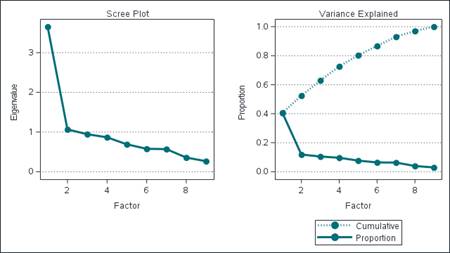
Figure 1 –
Slope Diagram
Source: prepared by the authors.
In practice, it is possible to extract as many factors as the number of variables, but this contradicts the objectives of factor analysis. The sum of the eigenvalues is equal to the number of variables in the analysis. Each factor that had an eigenvalue above 1 was retained. Mathematically, Principal Component Analysis (PCA) and Common Factor Analysis (CFA) differ in the amount of variance included in the solution. There are several types of variances: common variance (shared), specific variance (single), and variance error (measurement error). Common variance is the variability present in an item that is shared with other items and factors. Specific variance is the variance resulting from an item's unique attributes that cannot be explained by other variables or factors. The extraction method used was Principal Component Analysis (PCA), and the rotation method was varimax with Kaiser normalization. The goal of varimax rotation is to maximize high correlations and minimize low correlations by emphasizing the difference between loads (of variables with each factor) (KAISER, 1958). Factor extraction through PCA is intended to simply summarize many variables into fewer components, and latent constructs (i.e., factors) are not the focus of the analysis. On the other hand, Principal Axis Factoring (PAF) explicitly focuses on the common variance between items and therefore focuses on the latent factor. Both methods were used in this study, analyzing orthogonal and oblique rotation (Henson & Roberts, 2006), when observing what Thompson described in his research:
The practical difference between the methods is often negligible in terms of interpretation. Differences in outcomes will decrease as (a) the measured variables have higher scoring reliability or (b) the number of measured variables increases. Regarding (a), the higher the reliability of the score for a variable, the closer to one is the diagonal PAF entry, which is used by the PCA [...] (Thompson, 1992).
Regardless of the choice, attention should be paid to the method in which variance is accounted for and considered at each stage of decision-making and interpretation of results. This debate is not the scope of this article, but several authors discuss this choice (Beavers et al., 2013; Costello & Osborne, 2005; Henson & Roberts, 2006; M. C. Howard, 2016; Pohlmann, 2004; Thompson, 1992).
As can be seen in Table 5, there are 11 items with a load greater than 0.60, so the sample size is not relevant for the discussion of the results (Guadagnoli & Velicer, 1988).
| Description | Factor 1 | Factor 2 | |
| P4 | Taking a test in a math subject | 0,7912 | |
| P2 | Thinking about an upcoming math test 1 day before the test | 0,7765 | |
| P5 | Receive a homework assignment with many difficult problems that should be turned in in the next class | 0,6591 | |
| P1 | Having to look at the tables in the back of a math textbook | 0,5293 | |
| P8 | Receive a quiz or game test in math class | 0,5169 | |
| P3 | Watch a teacher work on an algebraic equation on the board | 0,5075 | |
| P6 | Attending a math class | 0,8066 | |
| P9 | Starting a new chapter in a math textbook | 0,7779 | |
| P7 | Listening to another student explain a mathematical formula | 0,6986 | |
The decision of how many factors to retain was made based on understanding and interpreting the context of the research. Factor analysis should always be interpreted in the light of theory and common sense (Beavers et al., 2013). The first factor had six variables, with the strongest loads in P4, P2 and P5, related to the respondents' perception of evaluation. The second factor included three variables. The statements with the most strongly positive charge were P6 and P9, which are related to the concept of learning, as well as P7.
This two-factor structure identified in the analysis — composed of evaluation anxiety and learning anxiety — offers subsidies for pedagogical planning in management courses. Mathematical evaluation anxiety, represented by items involving tests, difficult tasks, and performance measurement moments, is associated with fear of judgment, exposure, and the consequences of low performance. On the other hand, mathematical learning anxiety, related to contact with added content, teacher observation or explanations from colleagues, reflects a more generalized discomfort with the process of acquiring knowledge. This distinction is valuable for teachers and coordinators, as it allows them to differentiate students who need emotional support in the face of formal assessments from those who face broader difficulties in engaging with the content. The literature indicates that specific interventions — such as formative feedback, diversification of assessment methods, and use of applied contexts — can mitigate the anxiety associated with assessment (Ashcraft & Krause, 2007; Carey et al., 2016; Ramirez et al., 2013, 2018). On the other hand, strategies such as active learning, problem-based teaching, and collaborative tutoring have shown positive effects in reducing learning anxiety (Boaler, 2015, 2020; Geist, 2010; Shi & Liu, 2016). By recognizing these two types of anxiety, the AMAS Scale can guide differentiated pedagogical actions, more sensitive to the diversity of students and the specific context of quantitative disciplines in the business area.
Cronbach's alpha statistics are more valuable over single-construction scales and less informative when reported for instruments that measure multiple constructions at the same time (Adams & Wieman, 2011). In addition to this fact, it should be noted that all that alpha can reveal about the "interrelation of items" is its average degree of "interrelation", if there are no negative covariances, and bearing in mind that alpha also depends on the number of items in the test (Sijtsma, 2009). Table 6 shows the consistency of the factors, in line with the statement: "A scale can be composed of several groups of items, each measuring a distinct factor; as long as each item correlates well with some other items" (Gardner, 1995).
| Factors | Cronbach´s Alpha |
| Factor 1 | 0,76 |
| Factor 2 | 0,70 |
Cronbach’s alpha revealed satisfactory internal consistency: α = 0.76 (Evaluation Anxiety) and α = 0.70 (Learning Anxiety). Exact 95 % confidence intervals, obtained via the Feldt method, were 0.69–0.82 and 0.62–0.77, respectively, indicating stable reliability across replications (Feldt et al., 1987). It should be noted that Cronbach's alpha is more valuable in indicating the reliability of the scale in the sense of item equivalence within single-construction scales, but the statistic offers no indication that the scales are one-dimensional.
The clear bifactor distinction suggests differentiated interventions. For Evaluation Anxiety, we recommend low‑stakes quizzes, formative feedback, and diversified assessment formats. For Learning Anxiety, active‑learning strategies such as peer instruction, problem‑based cases and collaborative tutoring are indicated. Mapping AMAS scores at the start of each semester will enable targeted support and may reduce dropout in quantitative courses.
Conclusion
The research validates the application of the AMAS Scale (Dual‑Factor Structure) as an instrument for diagnosing mathematical anxiety in management courses, offering practical subsidies for pedagogical planning. In the research sample, the prevalence of a higher level of mathematical anxiety when students are faced with some type of evaluation, and a moderate level of anxiety in questions related to the teaching-learning process, was identified. In addition to the main objective, the use of the abbreviated scale for mathematical anxiety (Hopko et al., 2003) was described, and the application methodology can be replicated in other contexts. The Abbreviated Math Anxiety Scale is designed to assist educators and school administrators in identifying factors that negatively impact the teaching-learning process. As a complementary assessment tool, it enriches the analyses carried out in a specific discipline of mathematical or statistical content. From the point of view of academic management, the systematic application of AMAS can integrate welcoming and leveling processes in management courses, helping to reduce dropout in disciplines with strong quantitative content. The institutional adoption of this type of instrument contributes to an educational culture that is more sensitive to the emotional barriers that affect student performance. For school managers in the field of administration or business management, such as undergraduate coordinators and pedagogical coordinators, the scale offers a valuable resource to be employed at the beginning of the school term. It serves as a starting point for discussions with the teaching team, paving the way for the development of new pedagogical strategies and learning methodologies. The AMAS Scale can be part of a system of continuous institutional evaluation of learning in management courses, aligning itself with practices to improve the quality of higher education provided for in public educational policies in Brazil.
In undergraduate courses in management, where part of the students is imbued with restrictive "thinking" (e.g. "I'm from the humanities", "I don't like numbers"), it is relevant to understanding that a career in management implies the knowledge of different applied contents, including mathematics. Business professionals suffering from math anxiety may struggle with quantitative reasoning, decision-making, and data analysis, limiting their potential to succeed in numerically demanding roles. Overcoming mathematical anxiety in an organizational context is crucial to foster mathematical thinking and improve the performance of individuals, providing career alternatives and improving the performance of the organization, whether private or public. Several strategies have shown promise in mitigating mathematical anxiety.
Gradual exposure to math tasks and challenges can help desensitize individuals to math-related anxiety triggers and boost confidence (Lent & Russell, 1978; F. C. Richardson & Suinn, 1972; F. Richardson & Suinn, 1973, 1974). Techniques such as cognitive restructuring and relaxation exercises can help individuals reframe negative thoughts, manage anxiety, and improve mathematical performance (Hembree, 1990; Samuel & Warner, 2021). By emphasizing the practical relevance of mathematical concepts in a business context, people can develop a deeper appreciation of the value and usefulness of mathematics in their professional lives (Carey et al., 2016; Devine et al., 2012). Students with high math anxiety claim that they use and benefit from the same teaching methods as students with low math anxiety, with the exception that they get more out of the help of other students. It is suggested that coordinators promote collaborative spaces, such as tutorials between veteran and first-year students, thematic study groups, and active learning workshops focused on practical applications of mathematics in management. Therefore, activities such as group work, study groups, and collaboration systems could be implemented to provide additional help to students suffering from math anxiety (Bjälkebring, 2019).
This research has limitations in methods and literature. For instance, Lukowski et al. (2019) investigated mathematical anxiety and the evaluation of mathematical problems, using a structural equation modeling approach. The results suggested that math anxiety was related to three factors: anxiety when performing math calculations, anxiety about math in classroom situations, and anxiety about math tests. Among the three factors of math anxiety, only calculus anxiety was significantly and negatively related to math performance. Therefore, other research methods address the same problem, but with different diagnostic applications. From the point of view of the literature, it is observed that mathematical anxiety has its origin in a variety of factors (Dowker et al., 2016; Hart & Ganley, 2019; Lukowski et al., 2019; Madjar et al., 2018; Rubinsten et al., 2018; Wang et al., 2015) not covered in this article. Despite the outcomes, external validity is constrained by a single‑institution sample and reliance on self‑report measures. Future research should assess factorial invariance across different business programs and correlate AMAS scores with objective performance data to assess predictive validity.
The possibilities of research in the field of Mathematics Education in higher education institutions, particularly in the context of applied social sciences, are limited in Brazil, especially about understanding and mitigating mathematical anxiety. Due to its interdisciplinary nature, which involves the interweaving of knowledge from psychology, mathematics education and business, there is an intrinsic difficulty in constituting research groups dedicated to this theme within the scope of higher education in administration or business management., in Brazil. Finally, the relevance of this debate in undergraduate courses in business administration and management is highlighted, aiming at the deconstruction of erroneous conceptions about mathematical learning and the impact of these conceptions on the professional career of students. In view of the growing emphasis on data analysis, critical thinking and evidence-based communication – all associated with the Brazilian National Curriculum Guidelines – it is imperative that the teaching of quantitative subjects in management courses be accompanied by diagnostic and pedagogical strategies that address emotional barriers to learning. The articulation between educational psychology, mathematics education and teaching management presents itself as a promising path for inclusive and effective management training.
References
Adams, W. K., & Wieman, C. E. (2011). Development and validation of instruments to measure learning of expert-like thinking. International Journal of Science Education, 33(9), 1289–1312. https://doi.org/10.1080/09500693.2010.512369
Andersen, P., & Weisstein, F. L. (2016). The effects of math anxiety on consumer price perception and purchase decision. In Dissertation Abstracts International Section A: Humanities and Social Sciences.
Ashcraft, M. H. (2002). Math Anxiety: Personal, Educational, and Cognitive Consequences. Current Directions in Psychological Science, 11(5), 181–185. https://doi.org/10.1111/1467-8721.00196
Ashcraft, M. H., & Krause, J. A. (2007). Working memory, math performance, and math anxiety. Psychonomic Bulletin & Review, 14(2), 243–248. https://doi.org/10.3758/BF03194059
Beavers, A. S., Lounsbury, J. W., Richards, J. K., Huck, S. W., Skolits, G. J., & Esquivel, S. L. (2013). Practical considerations for using exploratory factor analysis in educational research. Practical Assessment, Research and Evaluation, 18(6), 1–13.
Bedeian, A. G. (2014). “More Than Meets the Eye”: A Guide to Interpreting the Descriptive Statistics and Correlation Matrices Reported in Management Research. Academy of Management Learning & Education, 13(1), 121–135. https://doi.org/10.5465/amle.2013.0001
Bjälkebring, P. (2019). Math Anxiety at the University: What Forms of Teaching and Learning Statistics in Higher Education Can Help Students With Math Anxiety? Frontiers in Education, 4. https://doi.org/10.3389/feduc.2019.00030
Boaler, J. (2015). Fluency Without Fear: Research Evidence on the Best Ways to Learn Math Facts. Stanford University, 28. https://bhi61nm2cr3mkdgk1dtaov18-wpengine.netdna-ssl.com/wp-content/uploads/2017/09/Fluency-Without-Fear-1.28.15.pdf
Boaler, J. (2020). Mente sem barreiras: as chaves para destravar seu potencial ilimitado de aprendizagem. (1a ed.). Intituto Sidarta, Penso.
Brown, J. L., Ortiz-Padilla, M., & Soto-Varela, R. (2020). Does Mathematical Anxiety Differ Cross-Culturally? Journal of New Approaches in Educational Research, 9(1), 126–136. https://doi.org/10.7821/naer.2020.1.464
Carey, E., Hill, F., Devine, A., & Szücs, D. (2016). The chicken or the egg? The direction of the relationship between mathematics anxiety and mathematics performance. In Frontiers in Psychology (Vol. 6, Issue JAN). https://doi.org/10.3389/fpsyg.2015.01987
Cargnelutti, E., Tomasetto, C., & Passolunghi, M. C. (2017). How is anxiety related to math performance in young students? A longitudinal study of Grade 2 to Grade 3 children. Cognition and Emotion, 31(4). https://doi.org/10.1080/02699931.2016.1147421
Carmo, J. dos S., & Simionato, A. M. (2012). Reversão de ansiedade à matemática: alguns dados da literatura. Psicologia Em Estudo, 17(2), 317–327. https://doi.org/10.1590/S1413-73722012000200015
Caviola, S., Carey, E., Mammarella, I. C., & Szucs, D. (2017). Stress, time pressure, strategy selection and math anxiety in mathematics: A review of the literature. In Frontiers in Psychology (Vol. 8, Issue SEP). https://doi.org/10.3389/fpsyg.2017.01488
Chang, H., & Beilock, S. L. (2016). The math anxiety-math performance link and its relation to individual and environmental factors: A review of current behavioral and psychophysiological research. In Current Opinion in Behavioral Sciences (Vol. 10). https://doi.org/10.1016/j.cobeha.2016.04.011
Charlo, J. C. P., del Carmen Canto López, M., & Leiva, C. C. (2024). Treating trainee teacher’s mathematical anxiety by using Game-Based Learning: a case study. Bolema - Mathematics Education Bulletin, 38. https://doi.org/10.1590/1980-4415v38a220218
Chipman, S. F., Krantz, D. H., & Silver, R. (1992). Mathematics Anxiety and Science Careers among Able College Women. Psychological Science, 3(5), 292–296. https://doi.org/10.1111/j.1467-9280.1992.tb00675.x
Costello, A. B., & Osborne, J. W. (2005). Best practices in exploratory factor analysis: four recommendations for getting the most from your analysis. Pratical Assesssment, Research, and Evaluation, 10. https://doi.org/10.7275/jyj1-4868
Devine, A., Fawcett, K., Szucs, D., & Dowker, A. (2012). Gender differences in mathematics anxiety and the relation to mathematics performance while controlling for test anxiety. Behavioral and Brain Functions, 8. https://doi.org/10.1186/1744-9081-8-33
Dowker, A., Sarkar, A., & Looi, C. Y. (2016). Mathematics anxiety: What have we learned in 60 years? Frontiers in Psychology, 7(APR). https://doi.org/10.3389/fpsyg.2016.00508
Dziuban, C. D., & Shirkey, E. C. (1974). When is a correlation matrix appropriate for factor analysis?Some decision rules. In Psychological Bulletin (Vol. 81, Issue 6).
Feldt, L. S., Woodruff, D. J., & Salih, F. A. (1987). Statistical Inference for Coefficient Alpha. Applied Psychological Measurement, 11(1), 93–103. https://doi.org/10.1177/014662168701100107
Foley, A. E., Herts, J. B., Borgonovi, F., Guerriero, S., Levine, S. C., & Beilock, S. L. (2017). The Math Anxiety-Performance Link: A Global Phenomenon. Current Directions in Psychological Science, 26(1). https://doi.org/10.1177/0963721416672463
Gardner, P. L. (1995). Measuring Attitudes to Science: Unidimensionality and Internal Consistency Revisited. In Research in Science Education (Vol. 25, Issue 3).
Geist, E. (2010). The Anti-Anxiety Curriculum: Combating Math Anxiety in the Classroom. Journal of Instructional Psychology, 37(1), 24–31.
Giraldo, V., & Roque, T. (2021). Por uma Matemática Problematizada: as Ordens de (Re)Invenção. Perspectivas Da Educação Matemática, 14(35), 1–21. https://doi.org/10.46312/pem.v14i35.13409
Goetz, T., Bieg, M., Lüdtke, O., Pekrun, R., & Hall, N. C. (2013). Do Girls Really Experience More Anxiety in Mathematics? Psychological Science, 24(10), 2079–2087. https://doi.org/10.1177/0956797613486989
Guadagnoli, E., & Velicer, W. F. (1988). Relation of Sample Size to the Stability of Component Patterns. Psychological Bulletin, 103(2), 265–275. https://doi.org/10.1037/0033-2909.103.2.265
Handler, J. R. (1990). Math Anxiety in Adult Learning. Adult Learning, 1(6), 20–23. https://doi.org/10.1177/104515959000100609
Hart, S. A., & Ganley, C. M. (2019). The nature of math anxiety in adults: Prevalence and correlates. Journal of Numerical Cognition, 5(2), 122–139. https://doi.org/10.5964/jnc.v5i2.195
Hembree, R. (1990). The Nature, Effects, and Relief of Mathematics Anxiety. Journal for Research in Mathematics Education JRME, 21(1), 33–46. https://doi.org/10.5951/jresematheduc.21.1.0033
Henson, R. K., & Roberts, J. K. (2006). Use of Exploratory Factor Analysis in Published Research Common Errors and Some Comment on Improved Practice. Educational and Pschological Measurement, 66(3), 11–14. https://doi.org/10.1177/0013164405282485
Hopko, D. R., Mahadevan, R., Bare, R. L., & Hunt, M. K. (2003). The Abbreviated Math Anxiety Scale (AMAS). Assessment, 10(2), 178–182. https://doi.org/10.1177/1073191103010002008
Howard, A., & Warwick, J. (2016). The Prevalence of Mathematical Anxiety in a Business School : A Comparative Study across Subject Areas. International Journal of Social Sciences & Educational Studies, 3(2), 4–25.
Howard, M. C. (2016). A Review of Exploratory Factor Analysis Decisions and Overview of Current Practices: What We Are Doing and How Can We Improve? International Journal of Human–Computer Interaction, 32(1), 51–62. https://doi.org/10.1080/10447318.2015.1087664
Kaiser, H. F. (1970). A second Generation little jiffy. Psychometrika, 35(4), 401–415. http://www.springerlink.com/index/4175806177113668.pdf
Lee Rodgers, J., & Nicewander, W. A. (1988). Thirteen Ways to Look at the Correlation Coefficient. The American Statistician, 42(1), 59–66. https://doi.org/10.1080/00031305.1988.10475524
Lent, R., & Russell, R. (1978). Treatment of test anxiety by cue controlled desensitisation and study skills training. Journal of Counseling Psychology, 25, 217–224. https://doi.org/10.1037/0022-0167.25.3.217
Lin, Y., Durbin, J. M., & Rancer, A. S. (2017). Perceived instructor argumentativeness, verbal aggressiveness, and classroom communication climate in relation to student state motivation and math anxiety. Communication Education, 66(3). https://doi.org/10.1080/03634523.2016.1245427
Lukowski, S. L., DiTrapani, J., Jeon, M., Wang, Z., J.Schenker, V., Doran, M. M., Hart, S. A., Mazzocco, M. M. M., Willcutt, E. G., A.Thompson, L., & Petrill, S. A. (2019). Multidimensionality in the measurement of math-specific anxiety and its relationship with mathematical performance. Learning and Individual Differences, 70, 228–235. https://doi.org/10.1016/j.lindif.2016.07.007
Madjar, N., Zalsman, G., Weizman, A., Lev-Ran, S., & Shoval, G. (2018). Predictors of developing mathematics anxiety among middle-school students: A 2-year prospective study. International Journal of Psychology, 53(6). https://doi.org/10.1002/ijop.12403
Maloney, E. A., & Beilock, S. L. (2012). Math anxiety: who has it, why it develops, and how to guard against it. Trends in Cognitive Sciences, 16(8), 404–406. https://doi.org/10.1016/j.tics.2012.06.008
Maloney, E. A., Ramirez, G., Gunderson, E. A., Levine, S. C., & Beilock, S. L. (2015). Intergenerational Effects of Parents’ Math Anxiety on Children’s Math Achievement and Anxiety. Psychological Science, 26(9), 1480–1488. https://doi.org/10.1177/0956797615592630
Mamedova, S., Stephens, M., Liao, Y., Sennett, J., Sirma, P., & Burg, S. S. (2012). 2012–2016 Program for International Student Assessment Young Adult Follow-up Study (PISA YAFS): How reading and mathematics performance at age 15 relate to literacy and numeracy skills and education, workforce, and life outcomes at age 19. https://nces.ed.gov/pubsearch.
Megreya, A. M., Al‐Emadi, A. A., Al‐Ahmadi, A. M., Moustafa, A. A., & Szűcs, D. (2024). A large‐scale study on the prevalence of math anxiety in Qatar. British Journal of Educational Psychology. https://doi.org/10.1111/bjep.12662
Moura-Silva, M. G., Neto, J. B. T., & Gonçalves, T. O. (2020). Neural bases of mathematical anxiety - Implications for the teaching-learning process. Bolema - Mathematics Education Bulletin, 34(66), 246–267. https://doi.org/10.1590/1980-4415v34n66a12
Opstad, L. (2023). Is performance in mathematics and statistics related to success in business education? Journal of Applied Research in Higher Education. https://doi.org/10.1108/JARHE-08-2023-0361
Pohlmann, J. T. (2004). Use and Interpretation of Factor Analysis in The Journal of Educational Research: 1992-2002. The Journal of Educational Research, 98(1), 14–23. https://doi.org/10.3200/JOER.98.1.14-23
Primi, C., Busdraghi, C., Tomasetto, C., Morsanyi, K., & Chiesi, F. (2014). Measuring math anxiety in Italian college and high school students: Validity, reliability and gender invariance of the Abbreviated Math Anxiety Scale (AMAS). Learning and Individual Differences, 34, 51–56. https://doi.org/10.1016/j.lindif.2014.05.012
Radford, L. (2010). Algebraic thinking from a cultural semiotic perspective. Research in Mathematics Education, 12(1), 1–19. https://doi.org/10.1080/14794800903569741
Ramirez, G., Gunderson, E. A., Levine, S. C., & Beilock, S. L. (2013). Math Anxiety, Working Memory, and Math Achievement in Early Elementary School. Journal of Cognition and Development, 14(2), 187–202. https://doi.org/10.1080/15248372.2012.664593
Ramirez, G., Shaw, S. T., & Maloney, E. A. (2018). Math Anxiety: Past Research, Promising Interventions, and a New Interpretation Framework. Educational Psychologist, 53(3), 145–164. https://doi.org/10.1080/00461520.2018.1447384
Richardson, F. C., & Suinn, R. M. (1972). The Mathematics Anxiety Rating Scale: Psychometric data. Journal of Counseling Psychology, 19(6), 551–554. https://doi.org/10.1037/h0033456
Richardson, F., & Suinn, R. (1973). A comparison of traditional systematic desensitization, accelerated massed desensitization, and anxiety management training in the treatment of mathematics anxiety. Behavior Therapy, 4, 212–218. https://doi.org/10.1016/S0005-7894(73)80030-9
Richardson, F., & Suinn, R. (1974). Effects of two short-term desensitization methods in the treatment of test anxiety. Journal of Counseling Psychology, 21, 457–458. https://doi.org/10.1037/h0037101
Rocha, S. B. (2024). Educação matemática em administração: Avaliando uma abordagem geométrica para correlação linear. Congresso de Administração, Sociedade e Inovação - CASI. https://www.even3.com.br/anais/16casi/954276-educacao-matematica-em-administracao--avaliando-uma-abordagem-geometrica-para-correlacao-linear
Rubinsten, O., Marciano, H., Eidlin Levy, H., & Daches Cohen, L. (2018). A Framework for Studying the Heterogeneity of Risk Factors in Math Anxiety. Frontiers in Behavioral Neuroscience, 12(December), 1–11. https://doi.org/10.3389/fnbeh.2018.00291
Samuel, T. S., & Warner, J. (2021). “I Can Math!”: Reducing Math Anxiety and Increasing Math Self-Efficacy Using a Mindfulness and Growth Mindset-Based Intervention in First-Year Students. Community College Journal of Research and Practice, 45(3), 205–222. https://doi.org/10.1080/10668926.2019.1666063
Schaeffer, M. W., Rozek, C. S., Berkowitz, T., Levine, S. C., & Beilock, S. L. (2018). Disassociating the relation between parents’ math anxiety and children’s math achievement: Long-term effects of a math app intervention. Journal of Experimental Psychology: General, 147(12), 1782–1790. https://doi.org/10.1037/xge0000490
Schillinger, F. L., Vogel, S. E., Diedrich, J., & Grabner, R. H. (2018). Math anxiety, intelligence, and performance in mathematics: Insights from the German adaptation of the Abbreviated Math Anxiety Scale (AMAS-G). Learning and Individual Differences, 61. https://doi.org/10.1016/j.lindif.2017.11.014
Shafer, L. (2016). Becoming a Math Person. Graduate School of Education - Harvard University. https://www.gse.harvard.edu/news/uk/16/01/becoming-math-person
Shi, Z., & Liu, P. (2016). Worrying thoughts limit working memory capacity in math anxiety. PLoS ONE, 11(10). https://doi.org/10.1371/journal.pone.0165644
Shrestha, N. (2021). Factor Analysis as a Tool for Survey Analysis. American Journal of Applied Mathematics and Statistics, 9(1), 4–11. https://doi.org/10.12691/ajams-9-1-2
Sijtsma, K. (2009). On the Use, the Misuse, and the Very Limited Usefulness of Cronbach’s Alpha. Psychometrika, 74(1), 107–120. https://doi.org/10.1007/s11336-008-9101-0
Skagerlund, K., Östergren, R., Västfjäll, D., & Träff, U. (2019). How does mathematics anxiety impair mathematical abilities? Investigating the link between math anxiety, working memory, and number processing. PLoS ONE, 14(1). https://doi.org/10.1371/journal.pone.0211283
Stodolsky, S. S. (1985). Telling Math: Origins of Math Aversion and Anxiety. Educational Psychologist, 20(3), 125–133. https://doi.org/10.1207/s15326985ep2003_2
Thompson, B. (1992). A partial test distribution for cosines among factors across samples. Advances in Social Science Methodology, 2, 81–97.
Viana, G. S., & Viana, A. B. N. (2012). ATITUDE E MOTIVAÇÃO EM RELAÇÃO AO DESEMPENHO ACADÊMICO DE ALUNOS DO CURSO DE GRADUAÇÃO EM ADMINISTRAÇÃO EM DISCIPLINAS DE ESTATÍSTICA: FORMAÇÃO DE CLUSTERS. Administração: Ensino e Pesquisa, 13(3), 523. https://doi.org/10.13058/raep.2012.v13n3.88
Wang, Z., Hart, S. A., Kovas, Y., Lukowski, S., Soden, B., Thompson, L. A., Plomin, R., McLoughlin, G., Bartlett, C. W., Lyons, I. M., & Petrill, S. A. (2014). Who is afraid of math? Two sources of genetic variance for mathematical anxiety. Journal of Child Psychology and Psychiatry, 55(9), 1056–1064. https://doi.org/10.1111/jcpp.12224
Wang, Z., Lukowski, S. L., Hart, S. A., Lyons, I. M., Thompson, L. A., Kovas, Y., Mazzocco, M. M. M., Plomin, R., & Petrill, S. A. (2015). Is Math Anxiety Always Bad for Math Learning? The Role of Math Motivation. Psychological Science, 26(12), 1863–1876. https://doi.org/10.1177/0956797615602471
Watkins, M. W. (2018). Exploratory Factor Analysis: A Guide to Best Practice. Journal of Black Psychology, 44(3), 219–246. https://doi.org/10.1177/0095798418771807
Zhang, J., Zhao, N., & Kong, Q. P. (2019). The relationship between math anxiety and math performance: a meta-analytic investigation. Frontiers in Psychology, 10(AUG). https://doi.org/10.3389/fpsyg.2019.01613
Información adicional
redalyc-journal-id: 4417