CUSTOMER-CENTRIC SUSTAINABILITY IN PEER-TO-PEER PLATFORMS
SUSTENTABILIDADE CENTRADA NO CLIENTE EM PLATAFORMAS PEER-TO-PEER
 Lilian Carolina Viana liliancviana@gmail.com
Christiano França da Cunha chfcunha@unicamp.br
Lilian Carolina Viana liliancviana@gmail.com
Christiano França da Cunha chfcunha@unicamp.br
CUSTOMER-CENTRIC SUSTAINABILITY IN PEER-TO-PEER PLATFORMS
Revista Pensamento Contemporâneo em Administração, vol. 19, núm. 3, pp. 33-54, 2025
Universidade Federal Fluminense
Recepción: 27 Junio 2025
Aprobación: 16 Octubre 2025
Abstract: This study investigates how the perceived economic, social, and environmental benefits influence consumer attitudes and behavioural intentions toward Peer-to-Peer (P2P) platforms in São Paulo, Brazil. A quantitative survey with 499 respondents was analysed using Partial Least Squares Structural Equation Modelling (PLS-SEM). Results show that economic benefits most strongly affect attitudes, which in turn predict intention to use. The study contributes to the literature by linking customer-centric sustainability to P2P usage and offers insights into how these platforms can foster sustainable urban development in emerging economies.
Keywords: Customer-centric Sustainability, P2P platforms, Sharing Economy, Circular Economy.
Resumo: Este estudo investiga como os benefícios econômicos, sociais e ambientais percebidos influenciam as atitudes e intenções comportamentais de consumidores em plataformas Peer-to-Peer (P2P) em São Paulo, Brasil. Com abordagem quantitativa com 499 respondentes, os dados foram analisados por meio da modelagem de equações estruturais PLS-SEM. Os resultados mostram que os benefícios econômicos impactam fortemente as atitudes, que por sua vez influenciam a intenção de uso. O estudo contribui ao integrar sustentabilidade centrada no consumidor e oferece insights sobre como essas plataformas podem promover o desenvolvimento urbano sustentável em economias emergentes.
Palavras-chave: Sustentabilidade centrada no cliente, Plataformas P2P, Economia Compartilhada, Economia Circular.
Introduction
Urban sustainability is a central theme in discussions about the future of cities, especially in the context of integrating digital technologies that promote the circular economy (CE). The theoretical and practical foundations of the CE represent a relatively new trend in sustainable urban development, considering the social, economic, and ecological needs of different actors (Veckalne & Tambovceva, 2021). In this context, sharing practices have become popular, particularly in urban areas, due to space limitations and the increased exploration of access to products and services, alongside a structural shift towards re-urbanisation (Bardhi & Eckhardt, 2012).
One means of sharing is Peer-to-Peer (P2P) platforms, a specific network configuration in which members are interconnected directly or through other members, connected by an organising core (John, 2013). The advent of these platforms has revolutionised the urban consumption landscape, introducing disruptive economic models that reconfigure relationships between consumers and how they value goods and services. In bustling urban contexts, P2P markets have become sociocultural phenomena that stimulate new consumption habits due to economic benefits, community-based interactions, and being more environmentally friendly (De Canio et al., 2020; López et al., 2020; Wirtz et al., 2019).
P2P technology is key to building a more collaborative society where resources are shared cooperatively and equitably, ensuring equal access (Schor, 2016). The access promoted by new P2P business models is emerging as an alternative to traditional ownership-based models, promoting circular economy (CE) strategies focused on prevention, reduction, and resource valorisation (Sposato et al., 2017). Applying the principles of the CE in business models requires special attention to creating sustainable value and actively engaging users, encouraging more responsible behaviours (Homrich et al., 2018; Urbinati et al., 2017). The environmental, political, and social implications of the CE model highlight the need for active user engagement towards more sustainable and responsible behaviors (Urbinati et al., 2017).
Despite the potential of circular and sharing economies to promote sustainability, their implementation in emerging economies may face significant challenges. According to Hobson et al. (2021), the transition to a CE requires fostering the “circular consumer” who adopts more sustainable daily practices and actively participates in the sharing economy (SE). Given the growing popularity of sharing economies in large metropolises, it becomes imperative to emphasise the importance of customer-centric sustainability (CCS) in these urban areas. By adopting this perspective, companies can not only increase consumer satisfaction and loyalty but also promote more responsible and sustainable practices, aligning with the environmental goals of contemporary metropolises (Sheth et al., 2011).
The adoption of P2P sharing practices can be seen as a step towards making cities more sustainable, with positive effects on economic, social, and environmental aspects (Cohen & Kietzmann, 2014; Ertz & Leblanc-Proulx, 2018; Perren & Grauerholz, 2015). However, is this the consumers' perception? So far, the literature on CE tends to focus on production, with less emphasis on consumption and consumer acceptance (Alves et al., 2023).
Thus, this article aims to understand how the perceived benefits of consumers using P2P platforms influence their attitudes and behavioural intentions in the context of the sharing economy, aligning with the principles of the circular economy. Understanding consumer attitudes and intentions, especially regarding sustainability, is essential to encouraging behaviours that contribute to the circular economy (Sun & Ertz, 2021). The city of São Paulo, Brazil, is presented as an ideal setting for this study, given its population density and role as an epicentre of economic, technological, and cultural activity (Ferrari et al., 2023). Moreover, it can be considered an appropriate urban setting for adopting P2P platforms, especially considering that the emergence of shared services is more evident in cities with this profile (Cohen & Kietzmann, 2014).
This study is organised as follows: after this introduction, a theoretical framework on P2P platforms and the circular economy is presented. Then, the methods used for data collection and analysis are discussed. Subsequently, the results are presented and analysed. Finally, the implications of the findings for theory and practice are discussed, along with suggestions for future research.
Sharing economy via P2P platforms
According to Ahsan (2020), the sharing economy aids in understanding and guiding new economic practices and social interactions (Heinrichs, 2013). In this economic model, consumption is collaborative, based on the exchange, commercialisation, or rental of products and services, allowing access over ownership. Sharing is mediated by digital platforms and encompasses three fundamental bases, as outlined by Acquier et al. (2017): an access economy, a platform economy, and a community-based economy.
Digital platforms propelled the modern sharing economy in the late 1990s and early 2000s. Notable examples include eBay and CouchSurfing, which facilitated large-scale network formation among individuals. Simultaneously, business models such as Zipcar illustrate direct interaction between companies and consumers, promoting sharing access to resources (Martin, 2016).
Among the various business models, P2P sharing and reuse platforms promote collaboration and the exchange of idle assets among peers, encouraging functionality and reducing waste (Ho & Yanagisawa, 2023). In summary, Ho and Yanagisawa (2023) describe that on P2P platforms: (1) exchanges occur between users mediated by the online platform; (2) users interact as peers without hierarchy; (3) access is based on egalitarian exchanges or market mechanisms; and (4) the assets exchanged can be tangible or intangible, such as idle space or skills.
The benefits and impacts of P2P interaction have encouraged more studies (Caldieraro et al., 2018). For some, customers are attracted by lower prices, unique experiences, and reputation (Birinci et al., 2018; Prayag & Ozanne, 2018). Other authors emphasise the uniqueness and social benefits as essential, providing community integration and local experiences (Tussyadiah & Pesonen, 2018). These platforms are particularly effective in developing countries, where they can be used to improve sustainability factors, especially in urban environments (Ertz et al., 2019; Raza et al., 2021).
With the support of these platforms and the internet, the practice of sharing expands on a broad social scale, involving strangers, creating contacts, and increasing social integration (Frenken & Schor, 2017).
Thus, the sharing economy presents an intuitive environmental logic; by sharing goods, the impacts of primary production are reduced, scarce resources are preserved, and waste is minimised (Martin et al., 2019). Moreover, sharing practices can become a standard business model under the circular economy concept, as the reuse of goods through P2P sharing is one strategy to meet consumer needs with minimal environmental impact and material consumption (He et al., 2021). Therefore, as argued by Del Vecchio et al. (2021), it is necessary to investigate how a digital platform can support the creation of a favourable environment to achieve goals related to the circular economy.
Digital technologies and P2P circularity
In contrast to the linear model, the circular economy creates closed loops where resources circulate within a production and consumption system, aiming to optimise resource use and reduce pollution and waste at each stage (Sauvé et al., 2016). As argued by Hedberg and Šipka (2020), it is time to understand that the transition to the circular economy can be accelerated by digital technology solutions. This transition can constitute a new supply of products and services, more sustainable production processes, new organisational environments, and alternative and sustainable consumption behaviours and cultures (Del Vecchio et al., 2021).
In this sense, some authors claim that digitalisation is one of the main enablers of the circular economy, highlighting the merging of the sharing economy with more sustainable practices and business models (Burmaoglu et al., 2023; Rosário & Dias, 2022). Additionally, digital technologies drive economic sustainability by facilitating digital sharing (Rosário & Dias, 2022). In terms of networks and connections, Romero et al. (2017) explain how virtual environments help create green businesses, providing the rapid formation of closed-loop supply networks.
The use of product and service-sharing platforms helps increase the containment of natural resources and support sustainable development (Lingaitienė et al., 2022). Berg and Wilts (2019) highlighted the capability of these platforms to address deficiencies in current market information on waste and recyclable materials, in addition to creating networks between the production sector, the waste and recycling industry, and the digital sector. The platforms contribute to a more decentralised organisation of economic activities, accompanied by potential sustainability benefits, including the transition to a circular economy (Bauwens et al., 2020).
Particularly noteworthy is P2P circularity as a preferable scenario, implying the development of product reuse and sharing practices facilitated by technologies and governed by multilevel institutions (Bauwens et al., 2020). In other words, it involves the creation of technologies that enable decentralised collaboration, allowing for a sharing-based circular economy (Alberich et al., 2023). The sharing economy is fundamental, as it allows individuals to conduct P2P transactions with each other without requiring permission from central authorities (Bauwens et al., 2020).
Sharing and exchange enable people to refuse or reduce the purchase of new products, utilising the idle capacity of existing assets, thereby reducing the demand for new assets (Liaros, 2021). Moreover, if the platforms are community-owned and promote truly collaborative consumption, P2P circularity can demonstrate a real reduction in consumption (Lowe & Genovese, 2022).
This scenario can imply more active consumer involvement, increasing the business value proposition, for instance, through user-provided data or the return of waste to the store (Bauwens et al., 2020). According to Spychalska-Wojtkiewicz (2020), it is essential to pay attention to customers, as the connection between sustainable development trends and customer value management can be strengthened, influencing the implementation of sustainable development principles.
Hypothesis development
The increase in population and per capita consumption, combined with human intervention, has raised several questions about sustainability, the constraints of natural resources, urbanisation, industrialisation, and modern agricultural practices (Arora, 2018). In this context, new innovative methods are emerging, including the support from technologies (Fernández-Portillo et al., 2019), resulting in positive social changes toward a new economy more integrated with environmental factors and sustainable development (Ali & Puppim de Oliveira, 2018).
Sharing and circular economies are beneficial for businesses and society in this context (Sposato et al., 2017). According to Mensah (2019), sustainability is destined to influence the future discourse of sustainable development, based on three interconnected pillars: environmental, economic, and social (Mensah, 2019; Schiano & Drake, 2021). Given the growing importance of sustainability, managers and policymakers must understand which dimensions most influence consumers' purchase intentions (Trudel, 2018).
The current literature on these themes often neglects the role of the customer as a vital stakeholder (Lai & Ho, 2020; Sun & Ertz, 2021). Sheth et al. (2011) argue that insufficient focus on the customer can limit the effectiveness of sustainability efforts. Therefore, they propose the concept of “customer-centred Sustainability”, adopted in this study, as performance-oriented towards sustainable outcomes that have personal consequences for customers regarding economic, social, and environmental well-being.
The three customer-centred dimensions, linked to sustainability, aim to offer a holistic view of the impact of consumption, which can be related to the context of P2P consumption, as shown in Table I.
| Customer-centered sustainability Sheth et al. (2011) | Customer perspective based on P2P consumption |
| Economic dimension: relates to the impact of consumption on consumers' economic well-being, including financial aspects such as debt burden, income pressures, and work-life balance. | Financial or utilitarian advantages that users obtain by participating in sharing activities through P2P platforms. These advantages may include reduced costs, greater convenience, time savings, and efficiency in obtaining goods or services, as well as maximizing personal utility. |
| References: De Canio et al. (2020); Hamari et al. (2016); Lamberton and Rose (2012); Möhlmann (2015). | |
| Social dimension: impact of consumption on consumers' well-being, reflecting individual (and family) well-being or quality of life, and associated community well-being. | Intangible advantages and gains that emerge from user interactions on P2P platforms. These advantages may include but are not limited to establishing bonds, forming a community, and personal satisfaction derived from social interaction. |
| References: Botsman and Rogers (2010); Bucher et al. (2016); De Canio et al. (2020); Kim et al. (2015). | |
| Environmental dimension: impact of consumption on environmental well-being, i.e., the consequences for human health and well-being from environmental changes due to consumption. | Refers to the positive environmental impacts generated by participating in sharing activities through P2P platforms. These benefits may manifest through waste reduction, resource use efficiency, and extending the lifespan of products and services. |
| References: Barbu et al., (2018); Botsman and Rogers (2010); De Canio et al. (2020); Hamari et al. (2016). |
The incorporation of technologies and social networks into business models has the potential to further optimise resource utilisation, contributing to sustainability in various dimensions (Cohen & Kietzmann, 2014; Gansky, 2011). This scenario suggests that a more customer-centred approach can not only improve the effectiveness of sustainability efforts but also align them more closely with current trends.
Economic benefits stand out in P2P exchanges, such as on accommodation platforms, offering advantages for the involved parties, host, and user (De Canio et al., 2020). Collaborative consumption, by providing economic benefits, constitutes more individualistic motives, as participating in sharing can maximise utility, since the consumer exchanges exclusive ownership of goods for lower-cost options (Hamari et al., 2016). In this sense, economic benefits exert a strong effect on consumer behaviour in the sharing economy (Hawlitschek et al., 2018). This leads to the following hypothesis:
H1: The perceived economic benefits by users of P2P platforms positively influence their attitude.
The internet has enabled the development of social sharing activities that go beyond local communities (Barnes & Mattsson, 2017). The emergence of online communities has expanded boundaries for people. In the case of P2P platforms, besides facilitating interaction, they have become a “place” for social promotion (De Canio et al., 2020). According to Kim et al. (2015), direct interactions with other users on P2P platforms facilitate the establishment of social bonds that go beyond economic exchanges. Moreover, Dabbous and Tarhini (2019) conducted a study indicating the connection between the social aspect, attitude, and intention to engage in sustainable consumption through the sharing economy. Thus, the hypothesis is:
H2: The perceived social benefits by users of P2P platforms positively influence their attitude.
The redistribution of resources in this lifestyle offers significant environmental benefits, such as improving efficiency and reducing waste (Botsman & Rogers, 2010). Thus, more than individual motivations, sharing can generate beneficial effects for society and the environment, as resources can be used more judiciously (Barbu et al., 2018). According to Botsman and Rogers (2010), environmental benefits are obtained due to the use of assets that would otherwise go unused, and the environmental impact is minimised by extending the product's lifespan.
Even if consumers prefer economic or social benefits, environmental benefits will still be present, depending on consumers' willingness to share (Barnes & Mattsson, 2017; Coelho & Romero, 2020). Furthermore, according to De Canio et al. (2020), environmental benefits combined with other benefits can increase individuals' intention to participate in P2P accommodation platforms (Böcker & Meelen, 2017). Therefore, the following hypothesis is defined:
H3: The perceived environmental benefits by users of P2P platforms positively influence their attitude.
The choice to focus solely on the link between attitude and behavioral intention using the Theory of Planned Behavior (TPB) as a basis is justified by strong evidence of the former's role as a predictor in this relationship (Ajzen, 1991; Hagger et al., 2021), particularly in the context of new economies (Ajzen, 1991; Laurenti & Acuña, 2020). Ahmad et al. (2016) highlight the flexibility of TPB in integrating additional variables, provided they contribute to defining the behaviour being studied. From the perspective of P2P platforms, this connection is particularly relevant, as consumers' attitudes towards these platforms directly influence their intentions to use them.
The Theory of Planned Behaviour suggests that attitude, defined as an individual's positive or negative evaluation of performing a specific behaviour, is a crucial element directing actual behaviour (Ajzen, 1991). Although subjective norm (perceived social pressure) and perceived behavioural control (ease or difficulty of performing a behaviour) significantly influence behavioural intention, their influences are considered background factors here due to our specific focus on attitude as the primary driver. Furthermore, the subjective norm has been considered a weak predictor (Armitage & Conner, 2001), and perceived behavioural control as an “out-of-place” moderator (La Barbera & Ajzen, 2020).
By emphasising attitude, the aim is to deepen the understanding of how individual evaluations can drive the willingness and effort to perform an expected behaviour (Ajzen, 1991; Armitage & Conner, 2001). The proposed hypothesis is then:
H4: The attitude of users of P2P platforms positively influences their behavioral intention to participate in these platforms.
Methodological procedures
he choice of a quantitative approach allowed for a systematic and objective analysis of the data. The analysis and processing were carried out using the Partial Least Squares Structural Equation Modelling (PLS-SEM
The choice of a quantitative approach allowed for a systematic and objective analysis of the data. The analysis and processing were carried out using the Partial Least Squares Structural Equation Modelling (PLS-SEM), a technique that generates parameter estimates that maximise the explained variance (R²), which is a predictive measure used to assess the quality of fit in endogenous constructs (Hair et al., 2020). This approach supports prediction and explanation objectives for structural model constructs, is flexible, and has comparatively high statistical power (Hair et al., 2011). The data were tabulated in Microsoft Excel and processed using SmartPLS® 4.0 software (Ringle et al., 2015).
The sampling technique adopted was non-probabilistic by quota, consisting of two stages as guided by Malhotra (2019). In the first stage, control quotas for population elements were defined according to demographic variables (gender, age, education, and income) based on information from the Brazilian Institute of Geography and Statistics (IBGE, 2023b). The quotas were proportionally assigned to the population composition in the city of São Paulo, Brazil.
Research in the city of São Paulo is justified by a series of demographic, economic, political, and social factors. First, São Paulo is the most populous municipality in Brazil, with over 11.451 million inhabitants (IBGE, 2023a). This high population density provides fertile ground for the rise and dissemination of collaborative consumption practices. Academic research in the region indicates positive impacts of these services on efficiency and reducing economic and spatial inequality in the city (Bó & Petrini, 2019; Haddad et al., 2019).
Besides the economic and academic scenario, recent public policies also corroborate the suitability of São Paulo as a locus of investigation. In 2021, the city hall launched events and initiatives such as “Virada ODS” and “Sampa Circular,” aiming to engage the population in more sustainable practices (Ideia Circular, 2021; Prefeitura de São Paulo, 2021). The “Ligue os Pontos” project by the Municipal Urbanism and Licensing Department, for example, aims to strengthen local agriculture and its value chain, using technology as a tool for integration and coordination among stakeholders. This reflects an environment in which public power and society are engaged in collaborative and circular practices (Prefeitura de São Paulo, 2023).
The sample size was planned to ensure the robustness of statistical inferences. With a 95% confidence interval, the calculations indicated the need for 384 respondents. Additionally, the a priori estimate was calculated using G*Power 3 software, considering a medium effect size (f² = 0.15, equivalent to R² of 13%), 80% statistical power, and a 5% significance level (Cohen, 1988; Hair et al., 2022).
The criteria for sample selection included people who use or have used P2P platforms as consumers at least once. The exclusion criteria were: a) individuals under 18 years old; b) non-residents of the city of São Paulo; and c) individuals who have not used P2P platform at least once in the year preceding this research.
Data were collected from June to August 2023, with respondents recruited online, which is consistent with the nature of P2P platform users. A link to the questionnaire was hosted on the Google Forms platform. The questionnaire consisted of sociodemographic questions about users and the 33 final variables (randomly arranged) related to the constructs based on adapted scales from Tussyadiah (2016) (economic benefits), Bucher et al. (2016) (social benefits and behavioural intentions) and Hamari et al. (2016) (attitude and environmental benefits). All were evaluated on a 7-point Likert scale ranging from “strongly disagree” to “strongly agree”, based on other research (De Canio et al., 2020; Hamari et al., 2016) and the guidelines of Francis et al. (2004).
Results
A total of 622 questionnaires were returned, and they underwent adequacy analysis to verify their validity for the research (Malhotra, 2019). In the end, 499 questionnaires were considered for analysis, a number that exceeded the calculated sample size. Post hoc analysis indicated that any R² greater than 2.15% would be detected as significant, and for the medium effect size (f²) of 0.10 obtained by G*Power, the power achieved was 0.999.
Descriptive statistics provided a better understanding of the research participants' profiles. Of the total, 53.1% were women, 45.7% were men, 0.8% identified as non-binary, and 0.4% chose not to disclose their gender. Respondents' ages ranged from 18 to 81 years, with an average of 34 years. Age groups were distributed as follows: 46.9% were 18 to 25 years old, 22.8% from 26 to 43 years, 19.8% from 44 to 58 years, and 10.4% were 59 years or older. Regarding education, 23.8% had completed secondary education, 37.3% had incomplete higher education, 20.6% had completed higher education, and 18.2% had postgraduate education. Regarding monthly family income, 15.0% received up to USD 580.00, 26.9% between USD 580.01 and USD 1,420.00, 36.5% between USD 1,420.01 and USD 4,400.00, and 21.6% had an income above USD 4,400.01.
Of those interviewed, 89.8% are only consumers, and 10.2% use the platforms both as suppliers and consumers. As for the group of platforms indicated by respondents as used in the last year, 64% used more than one type. Overall, ride-sharing platforms were the most frequently used, being indicated in 50.6% of responses, followed by accommodation platforms (24.3%), product purchase or sharing platforms (14.6%), service platforms (7.2%), and vehicle (product) platforms (2.5%). This profile aligns with the nature of the P2P sharing economy, where users primarily interact as peer consumers (Ho & Yanagisawa, 2023). The prevalence of service platforms also reflects the maturity and widespread adoption of this model (Frenken & Schor, 2017).
The conceptual model was formed only by reflective indicators. In this case, Hair et al. (2022) recommend estimating the model in two stages: i) evaluation of the measurement model (relationship between indicators and constructs); and ii) evaluation of the structural model (relationship between constructs).
In the evaluation of the measurement model, Confirmatory Composite Analysis (CCA) was used. Hair et al. (2020) highlight its use in PLS-SEM modelling, as the various items in the construct measurement increase precision and reduce the degree of error (Hair et al., 2022). The reliability of the indicators was analysed, that is, the magnitude of their outer loadings, with a desirable value of 0.708 or more and statistically significant, and for loadings between 0.40 and 0.70, they can be retained if they increase internal consistency reliability or convergent validity (Hair et al., 2022). For significance, the t-statistic was evaluated above ±1.96 at the 5% level (Hair et al., 2022; Henseler et al., 2015). In PLS-SEM, this is obtained by bootstrapping confidence intervals (Hair et al., 2011, 2019). Table II shows all the results, where all indicators met the criteria.
| Construct | Pathloading | Sample mean | Standard deviation | T-value | P-value (two-tailed) | |
| Attitude (ATT) | att_1 | 0.891 | 0.891 | 0.013 | 68.758 | 0.000 |
| att_2 | 0.903 | 0.903 | 0.012 | 78.132 | 0.000 | |
| att_3 | 0.888 | 0.888 | 0.012 | 73.321 | 0.000 | |
| att_4 | 0.678 | 0.677 | 0.044 | 15.369 | 0.000 | |
| att_5 | 0.582 | 0.580 | 0.042 | 13.866 | 0.000 | |
| Environmental Benefits (ENV) | env_1 | 0.763 | 0.763 | 0.030 | 25.746 | 0.000 |
| env_2 | 0.862 | 0.861 | 0.014 | 60.412 | 0.000 | |
| env_3 | 0.910 | 0.910 | 0.010 | 90.983 | 0.000 | |
| env_4 | 0.884 | 0.883 | 0.014 | 61.704 | 0.000 | |
| env_5 | 0.862 | 0.862 | 0.018 | 48.539 | 0.000 | |
| env_6 | 0.903 | 0.903 | 0.010 | 89.701 | 0.000 | |
| Economic Benefits (ECO) | eco_1 | 0.753 | 0.752 | 0.028 | 26.783 | 0.000 |
| eco_2 | 0.770 | 0.770 | 0.022 | 34.623 | 0.000 | |
| eco_3 | 0.777 | 0.776 | 0.024 | 32.389 | 0.000 | |
| eco_4 | 0.807 | 0.808 | 0.017 | 48.812 | 0.000 | |
| eco_5 | 0.697 | 0.696 | 0.038 | 18.511 | 0.000 | |
| Social Benefits (SOC) | soc_1 | 0.831 | 0.830 | 0.019 | 44.165 | 0.000 |
| soc_2 | 0.832 | 0.832 | 0.017 | 49.203 | 0.000 | |
| soc_3 | 0.720 | 0.720 | 0.028 | 26.072 | 0.000 | |
| soc_4 | 0.821 | 0.820 | 0.022 | 37.635 | 0.000 | |
| soc_5 | 0.856 | 0.856 | 0.015 | 58.103 | 0.000 | |
| Perceived Behavioral Control (PBC) | pbc_1 | 0.882 | 0.879 | 0.026 | 34.447 | 0.000 |
| pbc_3 | 0.918 | 0.919 | 0.012 | 79.531 | 0.000 | |
| Behavioral Intention (BI) | bi_1 | 0.835 | 0.835 | 0.019 | 44.816 | 0.000 |
| bi_2 | 0.801 | 0.801 | 0.022 | 37.004 | 0.000 | |
| bi_3 | 0.849 | 0.849 | 0.018 | 46.389 | 0.000 | |
| bi_4 | 0.746 | 0.746 | 0.028 | 26.911 | 0.000 | |
| bi_5 | 0.752 | 0.752 | 0.025 | 30.280 | 0.000 | |
| Subjective Norm (SN) | ns_1 | 0.921 | 0.921 | 0.008 | 114.065 | 0.000 |
| ns_2 | 0.891 | 0.890 | 0.012 | 75.545 | 0.000 | |
| ns_3 | 0.902 | 0.902 | 0.012 | 77.677 | 0.000 | |
For internal consistency reliability, the traditional Cronbach's alpha and composite reliability were verified, the latter because it has items weighted based on individual indicator loadings, being superior to alpha (Hair et al., 2019). Moreover, Cronbach's alpha can be conservative, and composite reliability is very liberal, so the exact reliability coefficient (ρA) was also analysed. According to Hair et al. (2022), higher values indicate higher levels of reliability, namely, from 0.60 to 0.70 are acceptable, in more advanced stages between 0.70 and 0.90; however, values above 0.95 are not desirable as they indicate semantically redundant items. As shown in Table III, it can be affirmed that the model has internal consistency since the criteria were met. The internal consistency of the constructs validates the theoretical operationalisation of customer-centric sustainability dimensions (Sheth et al., 2011), confirming that economic, social and environmental benefits are measured reliably and consistently.
For convergent validity, evaluations of a reflective construct should demonstrate significant convergence in terms of variance (Hair et al., 2022). The average variance extracted (AVE) was examined as a measure, which is acceptable at a value of 0.50 or higher. This metric was also evaluated as satisfactory, confirming convergent validity, as shown in Table III.
| Construct | Cronbach's alpha | ReliabilityCoefficient (ρA) | Compositereliability | AVE |
| ATT | 0.851 | 0.882 | 0.896 | 0.640 |
| ENV | 0.932 | 0.934 | 0.947 | 0.749 |
| ECO | 0.822 | 0.835 | 0.873 | 0.580 |
| SOC | 0.872 | 0.880 | 0.907 | 0.662 |
| PBC | 0.767 | 0.783 | 0.895 | 0.810 |
| BI | 0.857 | 0.861 | 0.897 | 0.637 |
| SN | 0.889 | 0.891 | 0.931 | 0.819 |
For discriminant validity, the Fornell-Larcker criterion was considered, which involves comparing the square root of AVE values with latent variable correlations, which should exceed the highest correlation of the construct with any other (Hair et al., 2022), as shown in Table IV. Additionally, Henseler et al. (2015) proposed an alternative to assess discriminant validity, the heterotrait-monotrait (HTMT) ratio of correlations, with easy interpretation: if indicators between two constructs exhibit an HTMT value less than 1.0, the true correlation between the two constructs is likely different from 1.0, and they should be distinct. Table IV shows that all HTMT indicators followed the criterion.
| Construct | ATT | ENV | ECO | SOC | PBC | BI | SN | |
| Fornell-Larcker Criterion | ||||||||
| ATT | 0.800 | |||||||
| ENV | 0.532 | 0.865 | ||||||
| ECO | 0.780 | 0.525 | 0.762 | |||||
| SOC | 0.431 | 0.524 | 0.410 | 0.813 | ||||
| PBC | 0.478 | 0.193 | 0.442 | 0.129 | 0.900 | |||
| BI | 0.825 | 0.456 | 0.729 | 0.450 | 0.502 | 0.798 | ||
| SN | 0.480 | 0.455 | 0.450 | 0.492 | 0.149 | 0.535 | 0.905 | |
| HTMT | ||||||||
| ENV | 0.597 | |||||||
| ECO | 0.898 | 0.605 | ||||||
| SOC | 0.495 | 0.574 | 0.472 | |||||
| PBC | 0.599 | 0.225 | 0.524 | 0.145 | ||||
| BI | 0.954 | 0.509 | 0.837 | 0.515 | 0.612 | |||
| SN | 0.549 | 0.496 | 0.519 | 0.560 | 0.176 | 0.615 | ||
For the evaluation of the structural model, each endogenous construct (attitude and behavioural intention) was calculated as a dependent variable, and their antecedents as independent variables (perceived economic, social, and environmental benefits) (Hair et al., 2011). The potential collinearity among constructs was verified using the variance inflation factor (VIF), with values below 5 but preferably below 3 to ensure that collinearity does not have a considerable effect on structural model estimates (Hair et al., 2020, 2022). As shown in Table V, the relationship values demonstrate no collinearity problem.
After identifying that collinearity is not at a critical level, Hair et al. (2022) recommend evaluating the importance and relevance of estimates between structural model constructs, called path coefficients, with values ranging from +1 to -1. It can be seen in Table V that the strongest relationships are from economic benefits to attitude and from attitude to behavioural intention. The other relationships of environmental and social benefits to attitude are weaker. This robust result confirms the central premise of Hamari et al. (2016) and shows that the economic argument is the main way of encouraging consumers to engage in circular consumption practices via P2P platforms, where access is considered more valuable than ownership (Sposato et al., 2017). The central role of attitude as a precursor to intention is validated, in line with the Theory of Planned Behaviour (Ajzen, 1991) and its application to sustainable consumption contexts (Laurenti & Acuña, 2020). However, the moderate influence of environmental benefits and the weak influence of social benefits suggest that, although circular economy and urban sustainability are relevant theoretical frameworks (Veckaline & Tambovceva, 2021), consumers' perception of their personal contribution to closing the material cycle (Alves et al., 2023) has less impact on their attitude than the immediate financial advantage.
| Relationships | VIF | Path loading | Standard deviation | T- value | P-value | Originalsample | Sample mean | Confidenceintervals | |
| 2,5% | 97,5% | ||||||||
| ATT à BI | 1.660 | 0.658 | 0.038 | 17.213 | 0.000 | 0.658 | 0.655 | 0.576 | 0.726 |
| ENV à ATT | 1.641 | 0.128 | 0.043 | 2.949 | 0.003 | 0.128 | 0.127 | 0.043 | 0.211 |
| ECO à ATT | 1.431 | 0.680 | 0.037 | 18.268 | 0.000 | 0.680 | 0.680 | 0.604 | 0.751 |
| SOC à ATT | 1.428 | 0.081 | 0.035 | 2.279 | 0.023 | 0.081 | 0.082 | 0.012 | 0.149 |
| PBC à BI | 1.313 | 0.157 | 0.035 | 4.493 | 0.000 | 0.157 | 0.159 | 0.095 | 0.230 |
| SN à BI | 1.307 | 0.198 | 0.030 | 6.508 | 0.000 | 0.198 | 0.200 | 0.143 | 0.262 |
For significance, the t-test, p-value, with standard deviation, and bootstrapping confidence intervals were performed; all relationships were significant. The relationship of social benefits to attitude was significant at 5%, and other relationships at 1%. Additionally, all path coefficient values between the constructs of the original sample, as well as the sample mean, are within the respective positive confidence intervals above 0. From these results, we can state that hypotheses H1, H2, H3, and H4 can be non-rejected.
The next steps involved judging the explanatory and predictive capabilities of the model and the relationships between constructs (Hair et al., 2022). The coefficient of determination (R²) is a prediction measure for endogenous constructs, with values ranging from 0 to 1, where higher values indicate greater explanatory power (Hair et al., 2019). The values for attitude (R² = 0.632) and behavioural intention (R² = 0.729) constructs can be considered “moderate”, a good explanatory power in the studied context. The adjusted R² systematically corrects the R² value downwards based on sample size and the number of predictive constructs, with little change. The model's “moderate” to “high” explanatory power shows that the theoretical framework adopted, based on the three pillars of sustainability (Mensah, 2019) and mediated by attitude, is quite effective at capturing the complexity of the intention to use P2P platforms.
The effect size f² evaluates the contribution of each exogenous construct to the calculated R² value (Hair et al., 2022). The economic benefits have a large effect on attitude (f² = 0.878), while environmental benefits have a small effect (f² = 0.027), and social benefits have no effect (f² = 0.012). The strong economic impact highlights that the transition to a circular economy (Hedberg & Šipka, 2020) can be accelerated by emphasising the financial benefits of this option, making it more attractive. However, the reduced influence of environmental benefits highlights a challenge: although closing cycles is central to the concept (Sauvé et al., 2016), this value is not the main motivator for adoption but rather a supplementary factor. The weak influence of social benefits calls into question the relevance of the “community economy” (Acquier et al., 2017) in the circular economy, suggesting that social interaction is perceived more as a by-product than as a driver of engagement.
Attitude stands out for its large effect on behavioural intention (f² = 0.961), compared to the small effect of the others (PBC: f² = 0.069; SN: f² = 0.111). The significant impact of attitude on intention highlights its importance in the decision-making process. It acts as the primary cognitive mechanism through which perceived benefits are converted into the intention to act (Ajzen, 1991).
For predictive power analysis, one of the most used measures is redundancy with cross-validation (Q²), where values above 0, 0.25, and 0.50 represent small, medium, and large relevance, respectively (Hair et al., 2019). The Q² index values indicate significant predictive relevance for both endogenous constructs (ATT: Q² = 0.625; BI: Q² = 0.619). The model's significant predictive relevance is validated not only theoretically, but also empirically. This suggests that the customer-centred benefit structure is a robust instrument for predicting the actual adoption of these platforms (Sheth et al., 2011).
Finally, the quality of the structural model fit was evaluated, a crucial step in SEM model validation (Schuberth et al., 2023). The Standardised Root Mean Square Residual (SRMR) is recommended to detect incorrect specifications reliably between matrices (Henseler et al., 2017; Pavlov et al., 2021; Sarstedt et al., 2022). According to Henseler et al. (2017), a value of 0 would indicate a perfect fit, but a cutoff value of 0.080 seems more appropriate for PLS path models. For this study's model, an SRMR value of 0.076 was found, below the stricter criterion, indicating a good fit. Based on all results, Figure 1 demonstrates the final structural model.
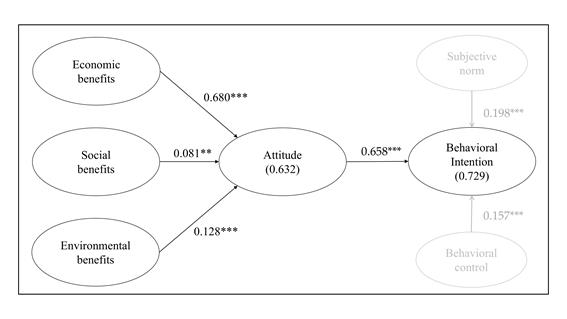
Fig. 1.
Final SEM model with path coefficients. Nota. *** p < 0,01; ** p < 0,05.
As reported and proven, all hypotheses were empirically not rejected, providing support for the suggested theoretical influences. In short, the model is not only valid but also clarifies theoretical debates about the main factors that motivate P2P consumption (Hawlitschek et al., 2018; Barnes & Mattsson, 2017), revealing a hierarchy of influence in attitude formation. This finding is crucial for implementing the circular economy (Bauwens et al., 2020), indicating that communicating economic value is fundamental to attracting users, and that environmental and social aspects should be integrated as elements of added value and purpose.
Implications for the urban circular economy
The relationship of economic benefits, verified for attitude, was the strongest, most positive, and significant among the benefits studied. This result is consistent with previous studies (De Canio et al., 2020; Ek Styvén & Mariani, 2020; Tussyadiah, 2016), indicating that consumers are primarily driven by financial aspects (Milanova & Maas, 2017). Thus, the more economic benefits consumers perceive in P2P platforms, the stronger their attitude and intention to participate in them (Li & Wen, 2019; Raza et al., 2021).
Although it was the weakest relationship, social benefits showed a significant impact, suggesting that P2P platforms promote social interactions that transcend economic exchanges (De Canio et al., 2020; Kim et al., 2015). The significant and positive impact of perceived social benefits provides pathways for a more favorable attitude (Ratilla et al., 2021). According to Milanova and Maas (2017), greater appreciation for social interactions requires various stimuli, such as the symbolic meaning of the community or the feeling of social empowerment by the consumer.
While economic factors predominantly influence consumers, the potential for environmental benefits can also be an attraction for users (Tussyadiah & Pesonen, 2018). Consumers with greater ecological concerns tend to lead collaborative consumption and can more easily associate environmental impacts and waste reduction with a more positive attitude (Won & Kim, 2020). Furthermore, it should be considered that increasing environmental concerns may drive preferences for more environmentally beneficial alternatives in the future (Kaushal & Prashar, 2022).
The results showed a strong relationship between attitude and behavioural intention, reinforcing other studies in the sharing context (Bucher et al., 2016; Dabbous & Tarhini, 2019; Ek Styvén & Mariani, 2020; García-Rodríguez et al., 2022; Kaushal & Prashar, 2022). The significant variance of over 70% represents how much attitude influences the explanatory power of the behavioural intention construct. Individuals with a positive attitude towards sharing are more likely to demand collaborative consumption (Bäro et al., 2022) and, therefore, circular consumption as well.
To demonstrate this connection, Table VI was created to relate the concepts of “Consumer-centred Sustainability in P2P Platforms” and “Urban Circular Economy”, highlighting how the results obtained in this study can translate into practices and policies for the circular economy in cities.
| Aspect | Customer-centric sustainability in P2P platforms | Urban Circular Economy |
| Economic benefits | Strongest and most significant | Financial incentives and cost |
| Social benefits | Significant impact, but weaker | Promotion of social cohesion and sharing |
| Environmental benefits | Potentially | Waste reduction and positive environmental |
| Positive Attitude | A strong relationship with behavioral | Education and awareness on |
| Behavioral intention | 70% of variance | Perception changes through concrete |
It is known that the urban circular economy has emerged as an innovative and sustainable approach to addressing the financial and environmental challenges of contemporary cities. This model aims to optimize resource use through practices of reuse, recycling, and sharing. This results in a significant reduction of waste and negative environmental impacts. The urban circular economy, which offers several benefits beyond the sharing economy, can be a catalyst for a change in consumption dynamics on P2P platforms.
The economic, social, and environmental benefits are the three main aspects of customer-centred sustainability addressed when studying the consequences of the urban circular economy. Based on the results, the analysis assumes that economic benefits are the primary motivator for consumers to participate in P2P platforms. However, the importance of social interactions and the attraction of environmental benefits also play crucial roles in promoting sustainable practices. In other words, circularity can provide significant benefits to customers, optimised digitally to become more competitive and sustainable (Townsend & Coroama, 2018).
Thus, it is understood that urban policies and initiatives can be organised to promote an effective and engaged circular economy, as demonstrated:
Economic benefits as the main driver: The main motivator for customers to participate in P2P platforms is economic. This finding is important for the urban circular economy, as it indicates that urban policies and initiatives promoting circular practices should emphasise financial gains for citizens. The most individual motives and gains for consumers need to be clearer, so that comparison with other alternatives can attract customers' attention. Adherence to the circular economy can be increased through tax incentives, cost reduction via the sharing economy, and more opportunities for additional income.
Importance of social interactions: Even though it is not the main focus, digital platforms in the context of the circular economy must consider the social relations promoted by exchanges, as they are significant. P2P platforms facilitate social interactions that can transcend economic transactions, promoting a sense of community and social cohesion. In the urban circular economy, fostering spaces and opportunities for social interactions can strengthen community engagement in sustainable practices, creating a culture of sharing and resource reuse.
Attraction of environmental benefits: Environmental issues can be a differentiating factor to add value to the use of digital platforms. The potential of environmental benefits as an attraction for P2P platform users indicates that increasing ecological awareness can drive the urban circular economy. Initiatives that highlight waste reduction and the positive environmental impacts of circular practices can resonate well with consumers who have greater ecological concerns. Communication strategies that emphasise sustainability and positive environmental impacts can, therefore, be effective.
Relationship between attitude and behavioural intention: The strong relationship between attitude and behavioural intention observed in the results reflects the importance of shaping positive perceptions towards sharing and sustainable practices. In the urban circular economy, educational and awareness campaigns that promote the benefits of collaborative consumption and resource reuse can significantly influence citizens' attitudes, encouraging more sustainable behaviours.
Significance of explained variance: The significant variance explained by attitude about behavioural intention (over 70%) indicates that actions can transform attitudes and have great potential to influence real behaviours. Positive experiences, success stories, and concrete examples of economic, social, and environmental benefits can help people change their perceptions. This can be extremely effective in the urban circular economy.
The findings of this study suggest that a multifaceted approach, combining economic incentives, promotion of social interactions, and highlighting environmental benefits, can significantly influence citizens' adherence to urban circular economy practices. Thus, well-designed policies and strategic initiatives have the potential to transform attitudes and behaviours, promoting an effective transition to a more circular and sustainable economy.
Concluding remarks
This study set out to investigate the drivers of consumer behaviour in P2P platforms through the lens of customer-centred sustainability, aiming to shed light on its implications for the urban circular economy. The results provide a clear and delineated hierarchy revealing that while all three dimensions of sustainability (economic, social, and environmental) play a role, economic utilitarianism is the dominant force shaping consumer attitudes and, consequently, their intention to engage in sharing consumption practices.
The strong mediating role of attitude confirms the centrality of individual evaluation in this process. In the urban circular economy, educational and awareness campaigns that promote the benefits of collaborative consumption and resource reuse can significantly impact citizens' attitudes, encouraging more sustainable behaviours. Positive experiences, success stories, and concrete examples of benefits can help change perceptions.
This research offers three key theoretical advancements. First, it empirically validates and quantifies a hierarchy of motivations based on the sharing economy literature, firmly establishing economic benefit as the primary driver in the P2P context of an emerging economy. Second, it successfully operationalises and tests the customer-centred sustainability framework, demonstrating its efficacy in explaining behavioural intentions within the urban circular economy. Third, it bridges a critical gap between macro-level circular economy principles and micro-level consumer behaviour, providing a validated model to understand the psychological mechanisms, specifically attitude formation, that drive the adoption of circular practices.
As practical implications for policymakers and urban planners, our results advocate for a pragmatic approach. To effectively promote circularity, initiatives must lead with clear economic incentives, such as tax benefits or subsidies for sharing-based services, while leveraging environmental and social benefits as reinforcing values, not primary messages. For platform managers, the imperative is to design and market their services, highlighting cost-saving and income-generation features prominently. Fostering community features and transparently showcasing environmental savings can then enhance the value proposition for specific user segments. It is crucial to highlight that the research conducted in this megacity of the Global South, São Paulo, can have significant practical implications for other urban areas in developing countries.
This study is not without limitations. Although clear criteria and special attention to methodological elements were adopted, its focus on a single megacity (São Paulo) and a non-probabilistic sample cautions against overgeneralization. Furthermore, the measurement of intention rather than actual behaviour presents an opportunity for further research.
Future studies should therefore: (1) test this model in diverse cultural and economic contexts to assess its cross-cultural validity; (2) employ longitudinal designs to track the transition from intention to actual behaviour on P2P platforms; and (3) investigate sector-specific models (e.g., comparing mobility vs. accommodation platforms) to uncover potential variations in motivational hierarchies. Exploring the role of digital literacy and trust as moderating variables could also yield valuable insights.
In conclusion, the transition to an urban circular economy is not merely a technological or infrastructural challenge; it is profoundly a human-centric one. This study demonstrates that its acceleration hinges on understanding and leveraging the fundamental economic motivations of consumers, using attitude as a key lever to transform circular principles from a lofty ideal into a practical and attractive everyday reality.
References
Acquier, A., Daudigeos, T., & Pinkse, J. (2017). Promises and paradoxes of the sharing economy: An organizing framework. Technological Forecasting and Social Change, 125(1), 1–10. https://doi.org/10.1016/j.techfore.2017.07.006
Ahmad, M. S., Bazmi, A. A., Bhutto, A. W., Shahzadi, K., & Bukhari, N. (2016). Students’ Responses to Improve Environmental Sustainability Through Recycling: Quantitatively Improving Qualitative Model. Applied Research in Quality of Life, 11(1), 253–270. https://doi.org/10.1007/s11482-014-9366-7
Ahsan, M. (2020). Entrepreneurship and Ethics in the Sharing Economy: A Critical Perspective. Journal of Business Ethics, 161(1), 19–33. https://doi.org/10.1007/s10551-018-3975-2
Ajzen, I. (1991). The theory of planned behavior. Organizational Behavior and Human Decision Processes, 50(2), 179–211. https://doi.org/10.1016/0749-5978(91)90020-T
Alberich, J. P., Pansera, M., & Hartley, S. (2023). Understanding the EU’s circular economy policies through futures of circularity. Journal of Cleaner Production, 385, 135723. https://doi.org/10.1016/j.jclepro.2022.135723
Ali, S. H., & Puppim de Oliveira, J. A. (2018). Pollution and economic development: an empirical research review. Environmental Research Letters, 13(12), 123003. https://doi.org/10.1088/1748-9326/aaeea7
Alves, M. N., Seixas, C., Castro, A., & Leitão, A. (2023). Promoting the Transition to a Circular Economy: A Study about Behaviour, Attitudes, and Knowledge by University Students in Portugal. Sustainability, 16(1), 343. https://doi.org/10.3390/su16010343
Armitage, C. J., & Conner, M. (2001). Efficacy of the Theory of Planned Behaviour: A meta-analytic review. British Journal of Social Psychology, 40(4), 471–499. https://doi.org/10.1348/014466601164939
Arora, N. K. (2018). Environmental Sustainability—necessary for survival. Environmental Sustainability, 1(1), 1–2. https://doi.org/10.1007/s42398-018-0013-3
Barbu, C. M., Florea, D. L., Ogarca, R. F., & Barbu, M. C. R. (2018). From Ownership to Access: How the Sharing Economy is Changing Consumer Behavior. Amfiteatru Economic, 20(48), 373. https://doi.org/10.24818/EA/2018/48/373
Bardhi, F., & Eckhardt, G. M. (2012). Access Based Consumption: The Case of Car Sharing. Journal of Consumer Research, 39(4), 881–898. https://doi.org/10.1086/666376
Barnes, S. J., & Mattsson, J. (2017). Understanding collaborative consumption: Test of a theoretical model. Technological Forecasting and Social Change, 118, 281–292. https://doi.org/10.1016/j.techfore.2017.02.029
Bäro, A., Toepler, F., Meynhardt, T., & Velamuri, V. K. (2022). Participating in the sharing economy: The role of individual characteristics. Managerial and Decision Economics, 43(8), 3715–3735. https://doi.org/10.1002/mde.3624
Bauwens, T., Hekkert, M., & Kirchherr, J. (2020). Circular Futures: What Will They Look Like? Ecological Economics, 175, 106703. https://doi.org/10.1016/j.ecolecon.2020.106703
Berg, H., & Wilts, H. (2019). Digital platforms as marketplaces for the circular economy—requirements and challenges. NachhaltigkeitsManagementForum | Sustainability Management Forum, 27(1), 1–9. https://doi.org/10.1007/s00550-018-0468-9
Birinci, H., Berezina, K., & Cobanoglu, C. (2018). Comparing customer perceptions of hotel and peer-to-peer accommodation advantages and disadvantages. International Journal of Contemporary Hospitality Management, 30(2), 1190–1210. https://doi.org/10.1108/IJCHM-09-2016-0506
Bó, G. J. D., & Petrini, M. (2019). Empowering and Resisting in a Sharing Economy: Two Sides of the Same Coin. BAR - Brazilian Administration Review, 16(3), 1–27. https://doi.org/10.1590/1807-7692bar2019180133
Böcker, L., & Meelen, T. (2017). Sharing for people, planet, or profit? Analyzing motivations for intended sharing economy participation. Environmental Innovation and Societal Transitions, 23, 28–39. https://doi.org/10.1016/j.eist.2016.09.004
Botsman, R., & Rogers, R. (2010). Whatʼs mine is yours: The rise of collaborative consumption. HarperCollins.
Bucher, E., Fieseler, C., & Lutz, C. (2016). What’s mine is yours (for a nominal fee) – Exploring the spectrum of utilitarian to altruistic motives for Internet-mediated sharing. Computers in Human Behavior, 62, 316–326. https://doi.org/10.1016/j.chb.2016.04.002
Burmaoglu, S., Gungor, D. O., Kirbac, A., & Saritas, O. (2023). Future research avenues at the nexus of circular economy and digitalization. International Journal of Productivity and Performance Management, 72(8), 2247-2269. https://doi.org/10.1108/IJPPM-01-2021-0026
Caldieraro, F., Zhang, J. Z., Cunha, M., & Shulman, J. D. (2018). Strategic Information Transmission in Peer-to-Peer Lending Markets. Journal of Marketing, 82(2), 42–63. https://doi.org/10.1509/jm.16.0113
Ideia Circular. (2021). São Paulo e a economia circular [entrevista com a secretaria de Relações Internacionais]. https://ideiacircular.com/sao-paulo-economia-circular/
Coelho, P. F. da C., & Romero, C. B. A. (2020). Drivers of different types of collaborative consumption. Revista de Administração FACES Journal, 18(3), 72–87. https://doi.org/10.21714/1984-6975FACES2019V18N3ART6669
Cohen, B., & Kietzmann, J. (2014). Ride On! Mobility Business Models for the Sharing Economy. Organization & Environment, 27(3), 279–296. https://doi.org/10.1177/1086026614546199
Cohen, J. (1988). Statistical power analysis for the behavioral sciences (2nd ed.). Erlbaum.
Dabbous, A., & Tarhini, A. (2019). Assessing the impact of knowledge and perceived economic benefits on sustainable consumption through the sharing economy: A sociotechnical approach. Technological Forecasting and Social Change, 149, 119775. https://doi.org/10.1016/j.techfore.2019.119775
De Canio, F., Nieto-García, M., Martinelli, E., & Pellegrini, D. (2020). The motives behind consumers' intention to use peer-to-peer accommodation: a fsQCA application. International Journal of Contemporary Hospitality Management, 32(9), 2969–2989. https://doi.org/10.1108/IJCHM-02-2020-0142
Del Vecchio, P., Passiante, G., Barberio, G., & Innella, C. (2021). Digital Innovation Ecosystems for Circular Economy: the Case of ICESP, the Italian Circular Economy Stakeholder Platform. International Journal of Innovation and Technology Management, 18(01), 1–20. https://doi.org/10.1142/S0219877020500534
Ek Styvén, M., & Mariani, M. M. (2020). Understanding the intention to buy secondhand clothing on sharing economy platforms: The influence of sustainability, distance from the consumption system, and economic motivations. Psychology & Marketing, 37(5), 724–739. https://doi.org/10.1002/mar.21334
Ertz, M., Durif, F., & Arcand, M. (2019). A conceptual perspective on collaborative consumption. AMS Review, 9(1–2), 27–41. https://doi.org/10.1007/s13162-018-0121-3
Ertz, M., & Leblanc-Proulx, S. (2018). Sustainability in the collaborative economy: A bibliometric analysis reveals emerging interest. Journal of Cleaner Production, 196, 1073–1085. https://doi.org/10.1016/j.jclepro.2018.06.095
Fernández-Portillo, A., Almodóvar-González, M., Coca-Pérez, J. L., & Jiménez-Naranjo, H. V. (2019). Is Sustainable Economic Development Possible Thanks to the Deployment of ICT? Sustainability, 11(22), 6307. https://doi.org/10.3390/su11226307
Ferrari, R. H. De, Ocepek, A., Travis, R., & Armony, A. C. (2023). Migration and urban development in São Paulo. Ethnic and Racial Studies, 46(11), 2446–2466. https://doi.org/10.1080/01419870.2023.2174809
Francis, J. J., Eccles, M. P., Johnston, M., Walker, A., Grimshaw, J., Foy, R., Kaner, E. F. S., Smith, L., & Bonetti, D. (2004). Constructing questionnaires based on the Theory of Planned Behaviour: a manual for health services researchers. In Quality of life and management of living resources; Centre for Health Services Research.https://openaccess.city.ac.uk/id/eprint/1735/1/
Frenken, K., & Schor, J. (2017). Putting the sharing economy into perspective. Environmental Innovation and Societal Transitions, 23, 3–10. https://doi.org/10.1016/j.eist.2017.01.003
Gansky, L. (2011). The mesh: Why the future of business is sharing [Mesh: Porque o futuro dos negócios é compartilhar]. Alta Books.
García-Rodríguez, F. J., Gutiérrez-Taño, D., Ruiz-Rosa, I., & Baute-Díaz, N. (2022). New Models for Collaborative Consumption: The Role of Consumer Attitudes Among Millennials. SAGE Open, 12(4), 215824402211403. https://doi.org/10.1177/21582440221140389
Haddad, E. A., Vieira, R. S., Jacob, M. S., Guerrini, A. W., Germani, E., Barreto, F., Bucalem, M. L., & Sayon, P. L. (2019). A socioeconomic analysis of ride-hailing emergence and expansion in São Paulo, Brazil. Transportation Research Interdisciplinary Perspectives, 1, 100016. https://doi.org/10.1016/j.trip.2019.100016
Hagger, M., Hamilton, K., Ajzen, I., Bosnjak, M., & Schmidt, P. (2021). Testing the Replicability of the Theory of Planned Behavior: A Large-Scale Multi-Sample Registered Replication Study. Leibniz Institut Für Psychologische Information Und Dokumentation. https://doi.org/10.23668/psycharchives.4807
Hair, J. F., Howard, M. C., & Nitzl, C. (2020). Assessing measurement model quality in PLS-SEM using confirmatory composite analysis. Journal of Business Research, 109, 101–110. https://doi.org/10.1016/j.jbusres.2019.11.069
Hair, J. F., Hult, G. T. M., Ringle, C. M., & Sarstedt, M. (2022). A Primer on Partial Least Squares Structural Equation Modeling (PLS-SEM) (Third edit). SAGE Publications, Inc.
Hair, J. F., Ringle, C. M., & Sarstedt, M. (2011). PLS-SEM: Indeed a silver bullet. Journal of Marketing Theory and Practice, 19(2), 139–152. https://doi.org/10.2753/MTP1069-6679190202
Hair, J. F., Risher, J. J., Sarstedt, M., & Ringle, C. M. (2019). When to use and how to report the results of PLS-SEM. European Business Review, 31(1), 2–24. https://doi.org/10.1108/EBR-11-2018-0203
Hamari, J., Sjöklint, M., & Ukkonen, A. (2016). The sharing economy: Why people participate in collaborative consumption. Journal of the Association for Information Science and Technology, 67(9), 2047–2059. https://doi.org/10.1002/asi.23552
Hawlitschek, F., Teubner, T., & Gimpel, H. (2018). Consumer motives for peer-to-peer sharing. Journal of Cleaner Production, 204, 144–157. https://doi.org/10.1016/j.jclepro.2018.08.326
He, L., Sopjani, L., & Laurenti, R. (2021). User participation dilemmas in the circular economy: An empirical study of Scandinavia’s largest peer-to-peer product sharing platform. Sustainable Production and Consumption, 27, 975–985. https://doi.org/10.1016/j.spc.2021.02.027
Hedberg, A., & Šipka, S. (2020). The circular economy: Going digital. European Policy Centre. https://circulareconomy.europa.eu/platform/sites/default/files/drce_final.pdf
Heinrichs, H. (2013). Sharing Economy : A Potential New Pathway to Sustainability. GAIA - Ecological Perspectives for Science and Society, 22(4), 228–231. https://doi.org/10.14512/gaia.22.4.5
Henseler, J., Hubona, G., & Ray, P. A. (2017). Partial Least Squares Path Modeling: Updated Guidelines. In Partial Least Squares Path Modeling (pp. 19–39). Springer International Publishing. https://doi.org/10.1007/978-3-319-64069-3_2
Henseler, J., Ringle, C. M., & Sarstedt, M. (2015). A new criterion for assessing discriminant validity in variance-based structural equation modeling. Journal of the Academy of Marketing Science, 43(1), 115–135. https://doi.org/10.1007/s11747-014-0403-8
Ho, M.-X., & Yanagisawa, H. (2023). Design for Well-Being and Sustainability: A Conceptual Framework of the Peer-to-Peer Sharing and Reuse Platform in the Circular Economy. Sustainability, 15(11), 8852. https://doi.org/10.3390/su15118852
Hobson, K., Holmes, H., Welch, D., Wheeler, K., & Wieser, H. (2021). Consumption Work in the circular economy: A research agenda. Journal of Cleaner Production, 321, 128969. https://doi.org/10.1016/j.jclepro.2021.128969
Homrich, A. S., Galvão, G., Abadia, L. G., & Carvalho, M. M. (2018). The circular economy umbrella: Trends and gaps on integrating pathways. Journal of Cleaner Production, 175, 525–543. https://doi.org/10.1016/j.jclepro.2017.11.064
Instituto Brasileiro de Geografia e Estatística (IBGE). (2023a). População no último censo 2022. Cidades e Estados Do Brasil. https://cidades.ibge.gov.br/brasil/sp/sao-paulo/panorama
Instituto Brasileiro de Geografia e Estatística (IBGE). (2023b). Universo - Indicadores socias municipais. Censo 2010. https://cidades.ibge.gov.br/brasil/sp/sao-paulo/pesquisa/23/25124?detalhes=true
John, A. N. (2013). Sharing, collaborative consumption, and Web 2.0 (MEDIA@LSE Working Papers No. 26). London School of Economics and Political Science. https://www.lse.ac.uk/media-and-communications/assets/documents/research/working-paper-series/EWP26.pdf
Kaushal, L. A., & Prashar, A. (2022). Determinants of Service consumer’s attitudes and Behavioural intentions towards Sharing Economy for Sustainable consumption: An Emerging Market Perspective. Journal of Global Information Technology Management, 25(2), 137–158. https://doi.org/10.1080/1097198X.2022.2062993
Kim, J., Yoon, Y., & Zo, H. (2015). Why people participate in the sharing economy: A social exchange perspective. In Proceedings of the Pacific Asia Conference on Information Systems (PACIS 2015). Association for Information Systems. https://aisel.aisnet.org/pacis2015/
La Barbera, F., & Ajzen, I. (2020). Control interactions in the theory of planned behavior: Rethinking the role of subjective norm. Europe’s Journal of Psychology, 16(3), 401–417. https://doi.org/10.5964/ejop.v16i3.2056
Lai, M. K. W., & Ho, A. P. Y. (2020). Unraveling potentials and limitations of sharing economy in reducing unnecessary consumption: A social science perspective. Resources, Conservation and Recycling, 153, 104546. https://doi.org/10.1016/j.resconrec.2019.104546
Laurenti, R., & Acuña, F. M. B. (2020). Exploring antecedents of behavioral intention and preferences in online peer-to-peer resource sharing: A Swedish university setting. Sustainable Production and Consumption, 21, 47–56. https://doi.org/10.1016/j.spc.2019.10.002
Li, H., & Wen, H. (2019). How Is Motivation Generated in Collaborative Consumption: Mediation Effect in Extrinsic and Intrinsic Motivation. Sustainability, 11(3), 640. https://doi.org/10.3390/su11030640
Liaros, S. (2021). Circular Food Futures: What Will They Look Like? Circular Economy and Sustainability, 1(4), 1193–1206. https://doi.org/10.1007/s43615-021-00082-5
Lingaitienė, O., Grybaitė, V., & Burinskienė, A. (2022). Core Elements Affecting Sharing Evidence from the European Union. Sustainability, 14(7), 3845. https://doi.org/10.3390/su14073845
López, Á. G., De Rivera, J., & Cassidy, P. R. (2020). The measurement of the economic, social and environmental impact of Peer-to-Peer online platforms: The case of collaborative consumption. Empiria. Revista de Metodología de Ciencias Sociales, 49, 87. https://doi.org/10.5944/empiria.49.2021.29233
Lowe, B. H., & Genovese, A. (2022). What theories of value (could) underpin our circular futures? Ecological Economics, 195, 107382. https://doi.org/10.1016/j.ecolecon.2022.107382
Malhotra, N. K. (2019). Marketing research: An applied orientation [Pesquisa de Marketing: Uma Orientação Aplicada] (7a ed.). Bookman.
Martin, C. J. (2016). The sharing economy: A pathway to sustainability or a nightmarish form of neoliberal capitalism? Ecological Economics, 121, 149–159. https://doi.org/10.1016/j.ecolecon.2015.11.027
Martin, M., Lazarevic, D., & Gullström, C. (2019). Assessing the Environmental Potential of Collaborative Consumption: Peer-to-Peer Product Sharing in Hammarby Sjöstad, Sweden. Sustainability, 11(1), 190. https://doi.org/10.3390/su11010190
Mensah, J. (2019). Sustainable development: Meaning, history, principles, pillars, and implications for human action: Literature review. Cogent Social Sciences, 5(1), 1653531. https://doi.org/10.1080/23311886.2019.1653531
Milanova, V., & Maas, P. (2017). Sharing intangibles: Uncovering individual motives for engagement in a sharing service setting. Journal of Business Research, 75, 159–171. https://doi.org/10.1016/j.jbusres.2017.02.002
Pavlov, G., Maydeu-Olivares, A., & Shi, D. (2021). Using the Standardized Root Mean Squared Residual (SRMR) to Assess Exact Fit in Structural Equation Models. Educational and Psychological Measurement, 81(1), 110–130. https://doi.org/10.1177/0013164420926231
Perren, R., & Grauerholz, L. (2015). Collaborative Consumption. In International Encyclopedia of the Social & Behavioral Sciences (Second Edi, Issue 4, pp. 139–144). Elsevier. https://doi.org/10.1016/B978-0-08-097086-8.64143-0
Prayag, G., & Ozanne, L. K. (2018). A systematic review of peer-to-peer (P2P) accommodation sharing research from 2010 to 2016: progress and prospects from the multi-level perspective. Journal of Hospitality Marketing & Management, 27(6), 649–678. https://doi.org/10.1080/19368623.2018.1429977
Prefeitura Municipal de São Paulo. (2021). Prefeitura lança Virada ODS em São Paulo. Cidade de São Paulo - Relações Internacionais. https://www.prefeitura.sp.gov.br/cidade/secretarias/relacoes_internacionais/noticias/?p=318749
Prefeitura Municipal de São Paulo. (2023). Sobre o projeto. Ligueospontos.Prefeitura.so.Gov.Br. https://ligueospontos.prefeitura.sp.gov.br/projeto/
Ratilla, M., Dey, S. K., & Chovancová, M. (2021). The sharing economy and the antecedents of resource sharing intentions: Evidence from a developing country. Cogent Business & Management, 8(1). https://doi.org/10.1080/23311975.2021.1997245
Raza, A., Asif, M., & Ayyub, S. (2021). The era of sharing economy: Factors that influence the behavioral intentions of user and provider to participate in the peer-to-peer sharing economy. Serbian Journal of Management, 16(1), 103–124. https://doi.org/10.5937/sjm16-24481
Ringle, C. M., Wende, S., & Becker, J.-M. (2015). SmartPLS 3 [Computer software]. SmartPLS GmbH. http://www.smartpls.com
Romero, D., Noran, O., & Bernus, P. (2017). Green virtual enterprise breeding environments enable the resolve framework. In IFIP Advances in Information and Communication Technology (Vol. 506, pp. 603–613). https://doi.org/10.1007/978-3-319-65151-4_53
Rosário, A., & Dias, J. (2022). Sustainability and the Digital Transition: A Literature Review. Sustainability, 14(7), 4072. https://doi.org/10.3390/su14074072
Sarstedt, M., Hair, J. F., Pick, M., Liengaard, B. D., Radomir, L., & Ringle, C. M. (2022). Progress in partial least squares structural equation modeling use in marketing research in the last decade. Psychology & Marketing, 39(5), 1035–1064. https://doi.org/10.1002/mar.21640
Sauvé, S., Bernard, S., & Sloan, P. (2016). Environmental sciences, sustainable development, and circular economy: Alternative concepts for trans-disciplinary research. Environmental Development, 17, 48–56. https://doi.org/10.1016/j.envdev.2015.09.002
Schiano, A. N., & Drake, M. A. (2021). Invited review: Sustainability: Different perspectives, inherent conflict. Journal of Dairy Science, 104(11), 11386–11400. https://doi.org/10.3168/jds.2021-20360
Schor, J. (2016). Debating the sharing economy. Journal of Self-Governance and Management Economics, 4(3), 7–22.
Schuberth, F., Rademaker, M. E., & Henseler, J. (2023). Assessing the overall fit of composite models estimated by partial least squares path modeling. European Journal of Marketing, 57(6), 1678–1702. https://doi.org/10.1108/EJM-08-2020-0586
Sheth, J. N., Sethia, N. K., & Srinivas, S. (2011). Mindful consumption: A customer-centric approach to sustainability. Journal of the Academy of Marketing Science, 39(1), 21–39. https://doi.org/10.1007/s11747-010-0216-3
Sposato, P., Preka, R., Cappellaro, F., & Cutaia, L. (2017). Sharing economy and circular economy. How technology and collaborative consumption innovations boost closing-the-loop strategies. Environmental Engineering and Management Journal, 16(8), 2017. http://eemj.eu/index.php/EEMJ/article/view/3352
Spychalska-Wojtkiewicz, M. (2020). The Relation between Sustainable Development Trends and Customer Value Management. Sustainability, 12(14), 5496. https://doi.org/10.3390/su12145496
Sun, S., & Ertz, M. (2021). Theory-Based Roadmap for Assessing Sustainability in the Collaborative Economy. Frontiers in Psychology, 12, 1–15. https://doi.org/10.3389/fpsyg.2021.752867
Townsend, J., & Coroama, V. (2018). Digital Acceleration of Sustainability Transition: The Paradox of Push Impacts. Sustainability, 10(8), 2816. https://doi.org/10.3390/su10082816
Trudel, R. (2018). Sustainable consumer behavior. Consumer Psychology Review, September 2018, arcp.1045. https://doi.org/10.1002/arcp.1045
Tussyadiah, I. P. (2016). Factors of satisfaction and intention to use peer-to-peer accommodation. International Journal of Hospitality Management, 55, 70–80. https://doi.org/10.1016/j.ijhm.2016.03.005
Tussyadiah, I. P., & Pesonen, J. (2018). Drivers and barriers of peer-to-peer accommodation stay–an exploratory study with American and Finnish travelers. Current Issues in Tourism, 21(6), 703–720. https://doi.org/10.1080/13683500.2016.1141180
Urbinati, A., Chiaroni, D., & Chiesa, V. (2017). Towards a new taxonomy of circular economy business models. Journal of Cleaner Production, 168, 487–498. https://doi.org/10.1016/j.jclepro.2017.09.047
Veckalne, R., & Tambovceva, T. (2021). Innovations in circular economy for sustainable urban development. Marketing and Management of Innovations, 5(4), 196–209. https://doi.org/10.21272/mmi.2021.4-15
Wirtz, J., So, K. K. F., Mody, M. A., Liu, S. Q., & Chun, H. H. (2019). Platforms in the peer-to-peer sharing economy. Journal of Service Management, 30(4), 452–483. https://doi.org/10.1108/JOSM-11-2018-0369
Won, J., & Kim, B.-Y. (2020). The Effect of Consumer Motivations on Purchase Intention of Online Fashion-Sharing Platform. The Journal of Asian Finance, Economics and Business, 7(6), 197–207. https://doi.org/10.13106/jafeb.2020.vol7.no6.197
Información adicional
redalyc-journal-id: 4417