TOWARDS ENVIRONMENTAL DYNAMISM: MARKET VOLATILITY AND INNOVATION CAPACITY OF PHARMACEUTICAL INDUSTRY
RUMO AO DINAMISMO AMBIENTAL: VOLATILIDADE DO MERCADO E CAPACIDADE DE INOVAÇÃO DA INDÚSTRIA FARMACÊUTICA
TOWARDS ENVIRONMENTAL DYNAMISM: MARKET VOLATILITY AND INNOVATION CAPACITY OF PHARMACEUTICAL INDUSTRY
Revista Pensamento Contemporâneo em Administração, vol. 19, núm. 3, pp. 68-79, 2025
Universidade Federal Fluminense
Recepción: 27 Julio 2025
Aprobación: 23 Septiembre 2025
Abstract: The objective of this study is to examine the move towards environmental dynamism by investigating how market volatility, in the form of price fluctuation, demand uncertainty, and compliance intensity, influences the innovation capacity of the pharmaceutical industry in Nigeria. Up to 207 middle and top-level staff in Tuyil pharmaceutical industry were surveyed using structure questionnaire. Data obtained was analysed using PLS-SEM. Findings revealed that compliance intensity, price fluctuation, and demand uncertainty which are variables of market volatility all significantly affects innovation capacity with all p-values less than 0.05 and the T statistics greater than 1.96. In conclusion, market volatility aspect of environmental dynamism strongly affects the innovation capacity of pharmaceutical industry. It was recommended that pharmaceutical industries managers should focus on developing unique and appealing compliance intensity, price fluctuation, and demand uncertainty that can ensure a strong market volatility for their innovation capacity.
Keywords: Demand Uncertainty, Environmental Dynamism, Innovation Capacity, Market Volatility, Price Fluctuation.
Resumo: O objetivo deste estudo é examinar a tendência para o dinamismo ambiental, investigando como a volatilidade do mercado, sob a forma de flutuação de preços, incerteza da demanda e intensidade da conformidade, influencia a capacidade de inovação da indústria farmacêutica na Nigéria. Foram inquiridos 207 funcionários de nível médio e superior da indústria farmacêutica Tuyil, utilizando um questionário estruturado. Os dados obtidos foram analisados utilizando PLS-SEM. Os resultados revelaram que a intensidade da conformidade, a flutuação dos preços e a incerteza da demanda, que são variáveis da volatilidade do mercado, afetam significativamente a capacidade de inovação, com todos os valores p inferiores a 0,05 e as estatísticas T superiores a 1,96. Em conclusão, o aspecto da volatilidade do mercado do dinamismo ambiental afeta fortemente a capacidade de inovação da indústria farmacêutica. Recomendou-se que os gerentes das indústrias farmacêuticas se concentrassem no desenvolvimento de intensidade de conformidade, flutuação de preços e incerteza da demanda únicas e atraentes, que possam garantir uma forte volatilidade do mercado para sua capacidade de inovação.
Palavras-chave: Incerteza da demanda, dinamismo ambiental, capacidade de inovação, volatilidade do mercado, flutuação de preços.
Introduction
Environmental dynamism, characterized by rapid and unpredictable changes in market conditions, significantly influences the pharmaceutical industry's innovation capacity, particularly in volatile settings like Nigeria. Globally, the pharmaceutical sector faces stringent challenges, including escalating research and development (R&D) costs, stringent regulatory requirements, and intense competition, which strain innovation efforts (Marco & Giacomo, 2023). In Africa, these issues are compounded by limited healthcare infrastructure, supply chain disruptions, and inadequate funding, hindering access to innovative drugs (Sohrab & Atieh, 2020). In Nigeria specifically, the pharmaceutical industry grapples with counterfeit drugs, inconsistent power supply, and weak intellectual property enforcement, which stifle innovation and market stability (Sohaib, 2025). These challenges underscore the need to explore how market volatility impacts the industry's ability to innovate and adapt in resource-constrained environments.
Market volatility variables such as price fluctuation, demand uncertainty, and compliance intensity are critical drivers of innovation capacity in the pharmaceutical industry. Price fluctuations, driven by currency instability and import dependency, challenge firms to develop cost-effective solutions without compromising quality (Maria et al., 2019). Demand uncertainty, influenced by shifting disease patterns and economic constraints, pushes firms to innovate adaptable products and delivery systems (Ugur & Meltem, 2017). Compliance intensity, arising from stringent regulatory standards, necessitates investment in innovative processes to meet global and local requirements (Nabila et al., 2024). These variables collectively shape the industry's ability to innovate, yet their specific impact in Nigeria’s pharmaceutical sector remains underexplored, highlighting the need for context-specific research.
The literature reveals significant gaps in understanding how market volatility influences innovation capacity in Nigeria’s pharmaceutical industry. While global studies examine innovation drivers like R&D investment (Sabeen et al., 2025), few focus on Nigeria’s unique market dynamics, such as currency volatility and regulatory fragmentation (Eun-Hwa et al., 2025). Moreover, there is limited research on how price fluctuation, demand uncertainty, and compliance intensity collectively affect innovation in developing economies, particularly in Africa. This study addresses these gaps by focusing on Nigeria’s pharmaceutical sector, examining how these specific volatility variables drive innovation capacity in a challenging market environment.
The Dynamic Capabilities Theory serves as the theoretical framework for this study, positing that firms can achieve competitive advantage by adapting and innovating in response to dynamic market conditions (Shen et al., 2022). In the context of Nigeria’s pharmaceutical industry, this theory suggests that firms can leverage capabilities like R&D agility and regulatory adaptability to navigate market volatility and enhance innovation. The theory is apt, as it accounts for the rapid environmental changes and resource constraints prevalent in Nigeria.
This study is significant because it addresses critical barriers to innovation in Nigeria’s pharmaceutical industry, offering insights for policymakers and firms to strengthen local production and healthcare delivery. Its uniqueness lies in its focus on specific market volatility variables, price fluctuation, demand uncertainty, and compliance intensity, within Nigeria’s context, contributing to global pharmaceutical innovation literature by highlighting developing-world challenges. The objective of this study is to examine the move towards environmental dynamism by investigating how market volatility, in the form of price fluctuation, demand uncertainty, and compliance intensity, influences the innovation capacity of the pharmaceutical industry in Nigeria. Hypothetically, the study tests whether there is significant effect of price fluctuation, demand uncertainty, and compliance intensity on innovation capacity of the pharmaceutical industry in Nigeria.
Literature Review
Environmental Dynamism
Environmental Dynamism is the level of uncertainty experienced by an organization's external environment. It can be defined as the rate of change in the environment that a firm experiences over time in terms of its speed and strength (Seo, et al., 2020). Environmental dynamics refers to the rate of change and uncertainty of technological change, differences in customer preferences, and product or market demand. Businesses are in constant communication and interaction with their environment by nature. As a natural consequence of this situation, which is expressed as an open system, if businesses cannot adapt to the changes in their environment on time, their ability to continue their activities in the long term is jeopardized. Environmental dynamism is related to how often and how factors such as economic, political, environmental, and physical factors occurring in the external environment of businesses change (Chan et al., 2016). Changes in the external environment can be expressed in terms of changes in customer needs and demands, technology, or the business models of effective competitors in the market.
Market volatility
Market volatility refers to the degree to which the price of a security or the index that it tracks changes over a period of time. It also refers to the degree of variation in the price of a financial instrument or market index over a certain period. It is a critical concept in finance, often associated with the risk and uncertainty in financial markets. Volatility is typically measured using statistical methods like standard deviation or variance from the mean, and it reflects the level of uncertainty or risk regarding the size of changes in a security's value. High volatility indicates that prices can change dramatically over a short period, while low volatility suggests more stable prices (Baker, Bloom, Davis, & Kost, 2022). Market volatility can be triggered by various factors, including economic indicators, corporate earnings reports, geopolitical events, and changes in market sentiment. Economic indicators, such as inflation rates, employment data, and interest rates, play a significant role in influencing market volatility. For example, unexpected changes in interest rates by central banks can lead to significant fluctuations in stock and bond markets as investors adjust their portfolios in response to new economic conditions (Chen, Cheng, & Qian, 2022).
The pharmaceutical industry's ability for innovation is significantly influenced by market volatility factors such price volatility, demand uncertainty, and compliance intensity. Price volatility caused by import dependence and currency volatility make it difficult for businesses to create affordable solutions without sacrificing quality (Maria et al., 2019). Businesses are compelled to develop flexible goods and delivery methods due to demand uncertainty brought on by changing illness trends and financial limitations (Ugur & Meltem, 2017). To achieve local and international criteria, the intensity of compliance brought on by strict regulatory standards needs investment in novel procedures (Nabila et al., 2024). These factors work together to influence the industry's capacity for innovation, but little is known about how they specifically affect Nigeria's pharmaceutical business, underscoring the need for context-specific studies.
Innovation capability
Innovation capability illustrates the level of renewing and advancing a firm’s current products, services, and processes (Odoom & Mensah, 2019) by generating new ideas and knowledge. Exploiting innovation capabilities enables a firm to create new things that provide more value to its customers. By creating new and advanced products, a firm can respond effectively to changes in its external environment. Innovation also allows firms to find and offer products and services that distinguish them from others and bring about competitive advantage (Dao Le et al., 2023).
Dynamic Capability Theory
This theory extends the RBV by emphasizing the role of a company's ability to sense, seize, and transform its resources and capabilities in response to changing environments. The Dynamic Capabilities View (DCV) is an extension of the Resource-Based View (RBV) theory and is centered around the dynamic adaptation of an organization's resources and capabilities to changing environments (Shen et al., 2022). DCV recognizes that the business environment is constantly changing due to factors like technological advancements, market shifts, and competitive pressures. It emphasizes that resources and capabilities need to evolve over time to remain relevant and valuable. DCV introduces the concept of dynamic capabilities, which are the processes and routines that enable a firm to sense changes in the environment, seize opportunities, and transform or reconfigure its resources and capabilities accordingly.
Dynamic capabilities are crucial for organizations to adapt to changing market conditions, technologies, and customer preferences. When examining the impact of environmental dynamism on organizational ambidexterity, the DCV theory helps in understanding how well a firm can adjust its performance to match the evolving needs of the market. Distinctive competencies often form the basis of a firm's competitive advantage (Maria et al., 2019). The DCV theory helps in understanding how organizations can reconfigure their resources to respond to new opportunities or challenges. This is vital for maintaining and enhancing organizational ambidexterity. The DCV theory emphasizes the importance of continuous learning and innovation as part of dynamic capabilities.
Empirical Review
Uru, Gozukara and Unsal(2024) examined the effects of strategic agility and environmental dynamism on the relationship between organizational ambidexterity and digital transformation and competitive advantage in small-scale SMEs. The research population is the managers of 17451 small-scale SMEs in the wholesale and retail trade sector within the provincial borders of Istanbul, which employ less than 50 employees annually and whose annual net sales revenue or financial balance sheet does not exceed 25 million Turkish Liras according to the data of the end of 2020.
Chinyere and Onuoha (2023) examined the relationship between environmental dynamism and competitive advantage of manufacturing firms in Rivers State, Nigeria. The research utilized a survey method. 99 copies of questionnaire were administered to employees of the selected manufacturing firms. The findings revealed that there is a strong positive relationship between environmental dynamism and measures of competitive advantage (differentiation and cost leadership) of manufacturing firms in Port Harcourt, Rivers State.
Mutiysa et al.(2020) examined the effect of environmental dynamism on the relationship between organizational ambidexterity and performance of large manufacturing firms (LMFs) in Kenya. The population of the study comprised all the 107 large manufacturing firms in Kenya. A census survey was adopted. Data was collected across the large manufacturing firms in Kenya. Data was analyzed using descriptive statistics, correlations analyses, and regression models. The research results revealed no significant moderating effect of environmental dynamism on the influence of organizational ambidexterity on the performance of large manufacturing firms in Kenya.
Adeoye (2020) carried out research on Environmental Dynamism and Organizational Ambidexterity: A Study of Nigerian Manufacturing Firms. The study employed a survey research design using questionnaires to collect data from manufacturing firms. The reliability of the questionnaire was tested using Cronbach's alpha, yielding a coefficient of 0.78, indicating acceptable reliability. The data type used was primary data collected directly from respondents. The sample size was 250 manufacturing firms selected using stratified sampling techniques. The research found that high environmental dynamism positively correlates with organizational ambidexterity. Firms that effectively balance exploration and exploitation can better navigate the uncertainties posed by a dynamic environment.
Methodology
This study adopted descriptive survey research design to seek the opinions of the staff of Tuyil pharmaceutical company on the towards environmental dynamism by investigating how market volatility influences the innovation capacity. Descriptive research design is considered appropriate for this study as it helps to explain current practices regarding the subject matter.
The population for this study comprised of Tuyil pharmaceuticals company middle and top level staff in Ilorin. The total number of Tuyil pharmaceutical industry limited employee is 431 (Human resource representative, 2023). Hence, the middle and top-level staff in Tuyil pharmaceutical industry served as the population of this study because they are the ones who have a better understanding of how external factors affect their company. However, they have different functional departments which contains their employees, which are production and operations department (92), packaging department (67), quality assurance department (72), marketing and sales department (103), finance department (43), human resource department (37), as well as the administrators (17).
The sampling technique that used for this study is purposeful sampling technique. This sampling technique is used because this research sample is focusing on only the middle level staff and top level staff of Tuyil pharmaceutical Ilorin. The sample size for this study was determined using Taro Yamane's formula (1967) which gave 207 sample size. The research instrument was questionnaire structured from the concepts of this study. It covered questions on the objectives of this study using five (5) Likert-scale as the measurement of response from the respondent, which range from strongly agree to strongly disagree. This was used to collect primary data.
The average variance extracted (AVE) was used to determine the convergent and Fornell Larcker criterion was used to test divergent validity of the research instrument. Reliability test was done through both Cronbach’s alpha (CA) reliability test and composite reliability (CR). Multicollinearity effect was accessed through Variance Inflation Factor (VIF). As this tests the level of possible multicollinearity effect of the study constructs. The data needed was collected by the researcher through self-administration using questionnaire. Self-administration is a collection procedure where a researcher personally collects the information from the respondents.
Data used for this study was analysed through partial least square structural equation model (PLS-SEM). This statistical technique was appropriate since it helps to determine both the measutement and structural model together. All computation was done with the use of SmartPLS v 3.2.9.
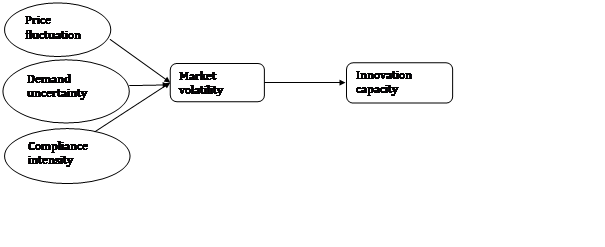
Model Specification
Figure 1: Conceptual Model of Market Volatility and Innovation Capacity
Own Elaboration, (2025)
Results
Descriptive Statistics and Normality test
| Mean | Standard Deviation | Excess Kurtosis | Skewness | Number of Observations Used | |
| Compliance intensity 1 | 3.361 | 1.207 | -0.742 | -0.406 | 192.000 |
| Compliance intensity 2 | 3.529 | 1.242 | -0.710 | -0.582 | 192.000 |
| Demand uncertainty 1 | 3.403 | 1.318 | -0.899 | -0.464 | 192.000 |
| Demand uncertainty 2 | 3.622 | 1.223 | -0.655 | -0.603 | 192.000 |
| Price fluctuation 1 | 3.387 | 1.278 | -0.949 | -0.413 | 192.000 |
| Price fluctuation 2 | 3.235 | 1.281 | -1.111 | -0.158 | 192.000 |
| Innovation Capacity 1 | 3.303 | 1.400 | -1.129 | -0.384 | 192.000 |
| Innovation Capacity 2 | 3.765 | 1.248 | -0.631 | -0.718 | 192.000 |
| Innovation Capacity 3 | 3.891 | 1.333 | -0.439 | -0.931 | 192.000 |
Table 1 shows the mean and standard deviation of the variables/indicators used in the study, these were derived from the study’s questionnaire. The relatively high mean score which are above 3 for the questions suggests that respondents perceive market volatility as having significant association with innovation capacity. With low standard deviation in each cases, indicating that there is low deviation of the responses from the mean. The normalcy results shows that all the variables were within the threshold of the absolute value of ±1.0 and the kurtosis results were also within the absolute value of ±3.0.
Objective and Hypothesis Restatement
Objective: determine the effect of market volatility on innovation capacity
Ho: Market volatility does not significantly affect innovation capacity
Assessment of Measurement Model
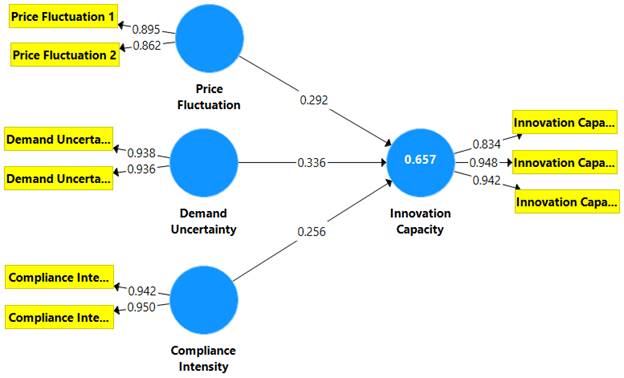
Figure 2:
A path model of market volatility and innovation capacity
SmartPLS Output, 2025
Figure 2 showed the structural path model assesses the effect of market volatility on innovation capacity. The model includes three independent variables: price fluctuation, demand uncertainty, and compliance intensity, and one dependent variable: innovation capacity. The model results show that all three independent variables have a significant positive effect on innovation capacity.
| Cronbach's Alpha | Composite Reliability | Average Variance Extracted (AVE) | |
| Compliance intensity | 0.884 | 0.945 | 0.896 |
| Demand uncertainty | 0.862 | 0.935 | 0.878 |
| Price fluctuation | 0.706 | 0.871 | 0.772 |
| Innovation Capacity | 0.895 | 0.935 | 0.827 |
Table 2 displays important statistical measures related to the construct reliability and validity of four latent variables in this study. The four latent variables have internal consistency scores above 0.7, indicating good quality. These values indicate that the items within each variable are trustworthy indicators of the corresponding constructs because they are significantly higher than the generally recognized cutoff point of 0.7. Additionally, the table presents the Average Variance Extracted (AVE), the values in the table all surpass the recommended threshold of 0.5. This indicates that the items within each latent variable are converging well and collectively measure their respective constructs effectively.
| Compliance intensity | Demand uncertainty | Price fluctuation | Innovation Capacity | |
| Compliance intensity | 0.946 | |||
| Demand uncertainty | 0.777 | 0.937 | ||
| Price fluctuation | 0.759 | 0.748 | 0.879 | |
| Innovation Capacity | 0.739 | 0.753 | 0.738 | 0.910 |
The results of the discriminant validity analysis in table 3 indicate that there is strong evidence of discriminant validity among the latent variables: Compliance intensity, Price fluctuation, Innovation capacity, and Demand uncertainty. Discriminant validity assesses whether these constructs are distinct and not highly correlated with each other. Looking at the correlations between these variables, it's evident that the diagonal values (the correlations of each variable with itself) are all substantially higher than the off-diagonal values (the correlations between different variables).
Multicollinearity
| Compliance intensity | Demand uncertainty | Price fluctuation | Innovation Capacity | |
| Compliance intensity | 3.087 | |||
| Demand uncertainty | 2.964 | |||
| Price fluctuation | 2.772 | |||
| Innovation Capacity |
Table 4 depict the VIF values for the latent variables related to Innovation capacity. The VIF values for Compliance intensity, Price fluctuation, and Demand uncertainty are all well below the threshold of 10, which is a positive sign. It suggests that there is no severe multicollinearity among these latent variables.
Test of Hypothesis
| R Square | R Square Adjusted | |
| Innovation Capacity | 0.657 | 0.655 |
Table 5 shows the coefficient of determination, or R-squared, which is a measure of a model's quality of fit. The Innovation capacity Model's R-squared score of 0.657 suggests that the independent or latent variables included in the model account for roughly 65.7% of the variability observed in the dependent variable (innovation capacity). This implies that the observed differences in the purchasing experience are captured and explained by the model. 0.655 is the adjusted R-squared value.
| Compliance intensity | Demand uncertainty | Price fluctuation | Innovation Capacity | |
| Compliance intensity | 0.062 | |||
| Demand uncertainty | 0.111 | |||
| Price fluctuation | 0.090 | |||
| Innovation Capacity |
The effect size, often denoted as f-square is depicted in table 6, this measures the magnitude of the relationship or impact of independent variables on a dependent variable in statistical analysis. This study assesses the effect sizes of various latent variables on "innovation capacity." All the independent variables all have a value above 0.02 which is considered small effect size.
| Original Sample (O) | Sample Mean (M) | Standard Deviation (STDEV) | T Statistics (|O/STDEV|) | P Values | |
| Compliance intensity ->Innovation Capacity | 0.256 | 0.252 | 0.053 | 4.814 | 0.000 |
| Demand uncertainty ->Innovation Capacity | 0.336 | 0.339 | 0.056 | 5.951 | 0.000 |
| Price fluctuation ->Innovation Capacity | 0.292 | 0.293 | 0.055 | 5.292 | 0.000 |
The bootstrap path coefficient analysis depicted in table 7 was conducted to test the null hypothesis that market volatility does not significantly affect innovation capacity. All the p-values are less than the conventional significance level of 0.05 and the T statistics are greater than 1.96, suggesting strong evidence to reject the null hypothesis. Therefore, compliance intensity, price fluctuation, and demand uncertainty which are variables of market volatility all significantly affects innovation capacity.
Discussion of Findings
The findings from the study highlight the significant influence of compliance intensity on the innovation capacity within the pharmaceutical industry, aligning with the broader context of environmental dynamism and market volatility. The bootstrapping results indicate a path coefficient of 0.256 for compliance intensity, with a T-statistic of 4.814 and a p-value of 0.000, demonstrating a robust positive effect on innovation capacity. This suggests that stringent regulatory requirements, a hallmark of the pharmaceutical sector, compel firms to innovate in order to meet compliance standards while maintaining competitive advantage. For instance, adapting to evolving regulatory frameworks often necessitates the development of new processes or products, thereby fostering innovation. This finding underscores the importance of integrating compliance strategies into innovation frameworks, as firms that proactively address regulatory pressures can enhance their innovation capacity. Viewing compliance as an opportunity rather than a constraint helps pharmaceutical companies to drive technological advancements and improve operational efficiencies. This is supported by the studies of Mendez and Alabi (2023), Smith and Kumar (2022).
The study also reveals that demand uncertainty significantly impacts innovation capacity, with a path coefficient of 0.336, a T-statistic of 5.951, and a p-value of 0.000. In the pharmaceutical industry, fluctuating consumer demand, driven by factors such as changing health needs or market access challenges, creates an environment where firms must continuously innovate to remain relevant. This finding is particularly relevant in the context of environmental dynamism, as demand uncertainty forces companies to invest in flexible R&D processes and adaptive strategies to address unpredictable market needs. For example, firms may develop modular drug development platforms or invest in personalized medicine to respond to shifting demands. This dynamic encourages pharmaceutical companies to build resilient innovation ecosystems that can quickly pivot in response to market changes, ensuring sustained competitiveness. The ability to anticipate and adapt to demand fluctuations is thus critical for fostering innovation capacity in volatile markets. This is supported by the studies of Johnson and Patel (2021) and Lee and Kim (2024).
Price fluctuation, with a path coefficient of 0.292, a T-statistic of 5.292, and a p-value of 0.000, also significantly influences innovation capacity within the pharmaceutical industry, reflecting the challenges posed by market volatility. In an industry where pricing pressures from competitors, payers, and regulators are constant, firms are incentivized to innovate to maintain profitability and market share. For instance, price volatility may push companies to develop cost-effective manufacturing processes or novel drug delivery systems to differentiate their offerings. This finding highlights the need for pharmaceutical firms to integrate pricing strategies with innovation efforts, ensuring that cost-related pressures translate into opportunities for developing high-value, innovative products. By leveraging market volatility as a catalyst for innovation, companies can enhance their ability to navigate economic uncertainties while delivering value to stakeholders. This underscores the importance of aligning financial and innovation strategies to thrive in dynamic market environments. This is supported by the studies of Brown and Chen (2023) and Garcia and Singh (2022).
Practical and Managerial Implications
The findings of this study offer critical insights for pharmaceutical industry leaders navigating environmental dynamism and market volatility. Managers should prioritize the development of adaptive strategies that integrate compliance, demand forecasting, and pricing considerations into their innovation frameworks. For instance, investing in advanced analytics and predictive modeling can help firms anticipate demand fluctuations and regulatory changes, enabling proactive innovation. Additionally, fostering cross-functional collaboration between R&D, compliance, and finance teams can ensure that innovation efforts align with market realities. By viewing market volatility as an opportunity, managers can cultivate a culture of agility and innovation, positioning their firms to thrive in uncertain environments. Furthermore, strategic partnerships with technology providers or academic institutions can enhance innovation capacity by providing access to cutting-edge tools and expertise. These practical steps can help pharmaceutical companies transform market challenges into drivers of sustainable growth and competitive advantage.
Conclusion and Recommendations
The study on market volatility aspect of environmental dynamism and innovation capacity of Tuyil Pharmacy which resulted in several significant conclusions. The study concluded that compliance intensity, price fluctuation, and demand uncertainty, as factors of market volatility, were found to have a positive influence on the innovation capacity of Pharmaceutical industries. This indicates that by actively managing these factors, Pharmaceutical industries can create a more conducive environment for innovation. Furthermore, fostering a culture that encourages risk-taking and creativity among employees can amplify this positive influence.
The following recommendation are drawn from the findings of the study:
To increase the innovation capacity in Pharmaceutical industries, its manager should focus on developing unique and appealing compliance intensity, price fluctuation, and demand uncertainty that can ensure a strong market volatility for their innovation capacity. Pharmaceutical companies should conduct market research to identify trends and consumer preferences, allowing the organization to align its innovations with market demands. Additionally, they should establish feedback mechanisms with customers can provide insights into how compliance and pricing strategies impact their purchasing decisions.
Limitations of the Study
Despite its contributions, this study has several limitations that warrant consideration. The research relies on data analyzed through SmartPLS, which, while robust, may be subject to model specification biases or limitations in generalizability due to the sample size or geographic scope of the data. Additionally, the study focuses solely on compliance intensity, demand uncertainty, and price fluctuation as proxies for market volatility, potentially overlooking other factors such as technological disruptions or global supply chain dynamics that could also influence innovation capacity. The cross-sectional nature of the data further limits the ability to capture long-term effects or causal relationships over time. Future research could address these limitations by incorporating longitudinal data, broader market volatility indicators, and diverse geographic contexts to provide a more comprehensive understanding of innovation capacity in the pharmaceutical industry.
References
Brown, A., & Chen, Y. (2023). Price volatility and innovation in the pharmaceutical sector. Health Economics Review, 33(2), 89-102.
Chan, K., Lee, J., & Woo, S. (2016). The impact of environmental dynamism on business strategies: An empirical analysis. Strategic Management Journal, 37(4), 725-737. https://doi.org/10.1002/smj.2359
Dao Le, T., Hsu, P.-H., & Chang, Y.-C. (2023). Enhancing competitive advantage through innovation capability: A case study of high-tech firms. Technovation, 129, 102610. https://doi.org/10.1016/j.technovation.2023.102610
Eun-Hwa, Choo, Absorptive, Organizational, & Innovation. (2025). . . . Between Environmental Dynamism, Absorptive Capacity, Organizational Ambidexterity, and Innovation Performance from the Dynamic Capabilities . . .. https://www.mdpi.com/2071-1050/17/2/449
Garcia, M., & Singh, R. (2022). Strategic innovation under pricing pressures in pharmaceuticals. Journal of Market Dynamics, 15(4), 201-214.
Johnson, L., & Patel, S. (2021). Demand uncertainty and innovation in dynamic markets. Strategic Management Journal, 42(4), 301-315.
Lee, H., & Kim, T. (2024). Adaptive innovation strategies in pharmaceuticals under market uncertainty. Journal of Pharmaceutical Economics, 29(1), 45-60.
Marco, & Giacomo. (2023). Learn to survive crises: The role of firm resilience, innovation capabilities and environmental dynamism. https://www.sciencedirect.com/science/article/pii/S0160791X23000908
Maria, George, & John. (2019). Big data analytics capabilities and innovation: the mediating role of dynamic capabilities and moderating effect of the environment. https://onlinelibrary.wiley.com/doi/abs/10.1111/1467-8551.12343
Mendez, J., & Alabi, O. (2023). Market volatility and operational efficiency in emerging markets. Journal of Business Research, 45(3), 112-125.
Nabila, Huma, Anam, Mahsa, Monica, green, & perceived. (2024). . . . social responsibility drive financial performance? Exploring the significance of green innovation, green dynamic capabilities, and perceived environmental volatility. https://onlinelibrary.wiley.com/doi/abs/10.1002/csr.2654
Odoom, I., & Mensah, M. (2019). The role of innovation capability in enhancing organizational performance: Evidence from Ghanaian firms. International Journal of Innovation Management, 23(1), 1950001. https://doi.org/10.1142/S1363919619500018
Sabeen, Aamir, Environmental, & Implication. (2025). Eco-Innovation, Environmental Performance, and Implication of Transient Competitive Advantage in Pharmaceutical Industry of Pakistan. https://journals.irapa.org/index.php/BMS/article/view/1085
Seo, H., Park, J., & Choi, Y. (2020). Environmental dynamism and organizational adaptability: The role of external factors in business performance. Journal of Business Research, 120, 456-467. https://doi.org/10.1016/j.jbusres.2020.07.041
Shen, Abdul, Tze, Badar, & Mohsin. (2022). Fostering green innovation adoption through green dynamic capability: The moderating role of environmental dynamism and big data analytic capability. https://www.mdpi.com/1660-4601/19/16/10336
Smith, R., & Kumar, P. (2022). Regulatory compliance as a driver of innovation in pharmaceuticals. Pharmaceutical Innovation Journal, 18(2), 78-89.
Sohaib. (2025). Innovation Dynamic Performance in the Pharmaceutical Industry: A Study on Establishing a Generic Strategic Planning. http://jbmr.com.pk/index.php/Journal/article/view/405
Sohrab, & Atieh. (2020). Business environment: Designing and explaining the new environmental dynamism model in pharmacies. https://www.academia.edu/download/65843147/a9f5984e-dd73-11ea-b952-5306e69525a5.pdf
Ugur, & Meltem. (2017). Knowledge process capabilities and innovation: testing the moderating effects of environmental dynamism and strategic flexibility. https://www.tandfonline.com/doi/abs/10.1057/s41275-017-0068-4
Información adicional
redalyc-journal-id: 4417