Investigación descriptiva, correlacional o cualitativa

Esta obra está bajo una Licencia Creative Commons Atribución-NoComercial-SinDerivar 4.0 Internacional.
Recepción: 24 Julio 2024
Recibido del documento revisado: 09 Enero 2025
Aprobación: 30 Enero 2025
Publicación: 13 Febrero 2025
DOI: https://doi.org/10.15517/pensarmov.v23i1.61234
Abstract: The aims of this study were: a) to provide a detailed health- and skill-related physical fitness profile of a cohort of Costa Rican Special Operations Police (SOP) units and b) to compare selected physical measures by age groups: body weight, body mass index (BMI), fat mass, body fat percentage, lean mass, resting heart rate, blood pressure, grip strength, flexibility, vertical jump height, muscular resistance, agility, anaerobic resistance and cardiorespiratory capacity were measured in SOP active members. Seventy-nine officers (age = 37.68 ± 7.86 years, height = 172.58 ± 5.35 cm, body weight = 80.49 ± 10.69 kg, BMI = 27.05 ± 3.34 kg∙m-2) participated in the study. Health- and skill-related physical fitness results of the participants were sub-optimal. Statistically significant differences were observed between age subgroups in lean mass in kg (F = 6.581, p = 0.002), A/G ratio (F = 10.078, p = 0.000), right- and left-hand grip (F = 5.680, p = 0.005; F = 8.386, p = 0.001), vertical jump (SQJ , F = 8.047, p = 0.001; CMJ , F = 8.167, p = 0.001), muscular resistance (F = 4.063, p = 0.021), agility (F = 9.055, p = 0.000), anaerobic resistance (F = 7.572, p = 0.001), and cardiorespiratory capacity (F = 5.034, p = 0.009). Police officers should review their strength and conditioning programs because their fitness profile is currently below general fitness standards. Age was shown to be an important factor in SOP units’ strength and conditioning performance.
Keywords: physical fitness, physical training & conditioning, motor skills, health.
Resumen: Los objetivos de este estudio fueron: a) proporcionar un perfil detallado de la condición física relacionada con la salud y las habilidades motrices de una cohorte de unidades de Policía de Operaciones Especiales (POE) de Costa Rica y b) comparar medidas físicas seleccionadas por grupos de edad. Se midió el peso corporal, índice de masa corporal (IMC), la masa grasa, el porcentaje de grasa corporal, la masa magra, la frecuencia cardíaca en reposo, la presión arterial, la fuerza de agarre, la flexibilidad, la altura de salto vertical, la resistencia muscular, la agilidad, la resistencia anaeróbica y la capacidad cardiorrespiratoria en los miembros activos del POE. Setenta y nueve oficiales (edad = 37.68 ± 7.86 años, estatura = 172.58 ± 5.35 cm, peso corporal = 80.49 ± 10.69 kg, IMC = 27.05 ± 3.34 kg∙m-2) participaron en el estudio. Los resultados de la condición física relacionada con la salud y las habilidades de los participantes fueron subóptimos. Se observaron diferencias estadísticamente significativas entre los subgrupos de edad en masa magra en kg (F = 6.581, p = .002), relación A/G (F = 10.078, p = .000), fuerza de agarre derecha e izquierda (F = 5.680, p = .005; F = 8.386, p = .001), salto vertical (SQJ , F = 8.047, p = .001; CMJ, F = 8,167, p = .001), resistencia muscular (F = 4.063, p = .021), agilidad (F = 9.055, p = .000), resistencia anaeróbica (F = 7,572, p = .001) y capacidad cardiorrespiratoria (F = 5.034, p = .009). Los oficiales de policía deben revisar sus programas de fuerza y acondicionamiento debido a que su perfil de condición física está por debajo de los estándares generales de aptitud física. La edad demostró ser un factor importante en el rendimiento de fuerza y acondicionamiento de las unidades POE.
Palabras clave: condición física, entrenamiento físico y acondicionamiento, habilidad motora, salud.
Resumo: Os objetivos deste estudo foram: a) fornecer um perfil detalhado da condição física relacionada à saúde e às habilidades motoras de uma coorte de unidades da Polícia de Operações Especiais (POE) da Costa Rica e b) comparar medidas físicas selecionadas por faixa etária. O peso corporal, o índice de massa corporal (IMC), a massa gorda, a porcentagem de gordura corporal, a massa magra, a frequência cardíaca em repouso, a pressão arterial, a força de preensão, a flexibilidade, a altura do salto vertical, a resistência muscular, a agilidade, a resistência anaeróbica e a capacidade cardiorrespiratória foram medidas nos membros ativos da POE. Setenta e nove policiais (idade = 37,68 ± 7,86 anos, altura = 172,58 ± 5,35 cm, peso corporal = 80,49 ± 10,69 kg, IMC = 27,05 ± 3,34 kg∙m-2) participaram do estudo. Os resultados da condição física relacionadas à saúde e às habilidades dos participantes estavam abaixo do ideal. Diferenças estatisticamente significativas entre os subgrupos de idade foram observadas na massa magra em kg (F = 6,581, p = 0,002), relação A/G (F = 10,078, p = 0,000), força de preensão da mão direita e esquerda (F = 5,680, p = 0,005; F = 8,386, p = 0,001), salto vertical (SJ , F = 8,047, p = 0,001; CMJ, F = 8,167, p = 0,001), resistência muscular (F = 4,063, p = 0,021), agilidade (F = 9,055, p = 0,000), resistência anaeróbica (F = 7,572, p = 0,001) e condicionamento cardiorrespiratório (F = 5,034, p = 0,009). Os policiais devem revisar seus programas de força e condicionamento porque seu perfil de condicionamento físico está abaixo dos padrões gerais de aptidão física. A idade demonstrou ser um fator importante no desempenho de força e condicionamento das unidades POE.
Palavras-chave: aptidão física, treinamento físico e condicionamento, habilidades motoras, saúde.
1. Introduction
Many police organizations have created special operations police (SOP) units to perform tasks with different frequencies and physical requirements than those of general duties police (Marins et al., 2020). Among SOP units, maintaining a high level of physical and operational preparedness is essential given the high risk and danger they are exposed to during numerous operational tasks (Pryor et al., 2012, Marins et al., 2020; Strader et al., 2020).
SOP are considered to be at a higher level of physical fitness than general police officers and may be considered as elite athletes (Scofield & Kardouni, 2015; Maupin et al., 2018b). SOP candidates must successfully pass a variety of assessments, including both fitness evaluations and job-specific skill tests, to ensure the operational readiness of these teams (Lockie et al., 2018a; Strader et al., 2020; Schram et al., 2020). Common indicators used to describe the physical fitness profile of SOP officers include body fat percentage (BF%), muscular endurance, and relative maximal oxygen consumption (VO2 max) (Maupin et al., 2018b; Robinson et al., 2018).
Other measures, such as strength, speed, and agility, have also been reported as critical for performance (Šimenko et al., 2015). Strength is essential to manage the demands of full tactical gear, which typically exceeds 25% of body weight and has a negative impact on operational performance (Carlton et al., 2014; Dawes et al., 2015; Davis et al., 2016; Irving et al., 2019; Pryor et al., 2012; Marins et al., 2020). Speed, combined with agility, plays a crucial role in rapid, surprise actions where potential suspects are apprehended, and it is fundamental for most movements performed by SOP (Šimenko et al., 2015). These capabilities become even more critical when performing advanced technical skills and tactics at higher intensities while carrying the heavy loads associated with tactical gear (Dawes et al., 2015, Williams & Westall, 2003; Carlton et al., 2014; Orr et al., 2015; Irving et al., 2019).
Maintaining high levels of physical and operational readiness is vital for the rapid, coordinated, and tactical operations required of SOP units, as operational capability is influenced by motor, physiological, and morphological characteristics (Šimenko et al., 2014). Nevertheless, there are no commonly standardized tests or norms available to assess the tactical, operational, and physical fitness of SOP members (Šimenko et al., 2016). Typically, these teams are responsible for implementing, developing, and evaluating their own standards for physical, tactical, and operational capacities, as well as establishing norms for the selection process of new members (Dawes, 2011; Šimenko et al., 2016).
Fitness evaluations are useful in designing programs that address specific identified weaknesses in fitness relative to task requirements and can be used as selection criteria for situations where key specific tasks will be performed (Alvar et al., 2017). Without a fitness profile, the ability to determine appropriate benchmarking in training and readiness for active duty or deployment of SOP personnel is restricted (Blacker et al., 2008). For example, Lockie et al. (2018a) identified a mild-to-moderate correlation (r = -0.127 to 0.574) and a predictive relationship (r² = 0.217 to 0.500) between fitness measures (e.g., push-ups, sit-ups, pull-ups, mountain climbers, and aerobic fitness tests) and job-specific skill performance (e.g., a 99-yard obstacle course run, chain-link fence climb, solid wall fence climb, and 500-yard run) in a population of general duties police officers. Similarly, Strader et al. (2020) found that both shoulder and grip strength were strong and significant predictors of occupational performance (r2 = 0.602).
Health-and skill-related physical fitness assessment provides a greater insight into the physical requirements of police agencies. Creating or modifying training plans, designing courses, providing information to potential candidates for specific tasks, minimizing injury risk, and avoiding significant declines in physical performance are crucial actions to adequately manage and support this population (Schram et al., 2020). Active and fit agents are either less likely to retire early from duty or be prone to occupational diseases (Violanti et al., 2017; Araujo et al., 2020). However, a general decline in muscular endurance, strength, lower-body power, and cardiorespiratory fitness has been observed among police officers with age (Marins et al., 2020).
Therefore, police agencies must be able to determine how officers’ body composition and other components differ between their SOP units according to age (Kukić et al., 2020). It has been established that police officers of SOP units must have a high level of physical fitness (i.e., above average) for general police service (Zwingmann et al., 2021), but this could not be true in Costa Rica. Therefore, the purpose of this study was two-fold: a) to provide a detailed health-and skill-related fitness profile of a cohort of Costa Rican SOP units, and b) to compare selected physical measures by age groups.
2. Methods
Design
A cross-sectional study was conducted to characterize and compare health-and skill-related physical fitness of Costa Rican SOP operators. Assessments were conducted through conventional laboratory and field-based performance testing recommended by the National Strength and Conditioning Association (NSCA) (Alvar et al., 2017). Collected data included demographic information (e.g., age), physiological (e.g., resting heart rate, blood pressure), and fitness measures (e.g., height, body mass, Body Mass Index [BMI], fat mass (kg), BF%, lean mass (kg), android/gynoid ratio, handgrip strength (kg), flexibility (cm), vertical jump height (cm), push-ups (reps), agility (seconds), anaerobic endurance (seconds) and cardiorespiratory capacity (ml O2∙kg-1∙min-1).
Participants
All members of the Costa Rica SOP units were invited to participate at the time of the study by an e-mail sent to the leadership of the SOP. The inclusion criteria required that officers volunteering for the study be fully qualified and operational members of an SOP unit for at least six months, currently assigned to operational teams within the unit, and serving in a full-time capacity (Irving et al., 2019). Exclusion criteria included failure to obtain physician approval from their occupational health department, not completing at least the body composition testing, or explicitly reporting physical impairments during the protocols. Only 6,0% women attended the invitation. This is a previous limitation reported in SOP personnel (Robinson et al., 2018; Orr et al., 2022; Maupin et al., 2018a; Irving et al., 2019; Marins et al., 2020).
A total of 84 police officers, recruited from two different SOP units (Unit 1, n = 45 [1 woman], age = 38.21 ± 8.74 years, body weight = 78.76 ± 8.29 kg, height = 171.97 ± 5.12 cm, BMI = 26.66 ± 2.42 kg∙m-2; Unit 2, n = 39 [4 women], age = 33.13 ± 6.64 years, body weight = 81.11 ± 13.44 kg, height = 171.57 ± 7.47 cm, BMI = 27.61 ± 4.10 kg∙m-2) volunteered for the study. Due to the limited sample size, data from the women's group were excluded from statistical analysis and are provided solely for future reference. Experience among SOP unit members ranged from 1 to 34 years. However, strict security protocols protecting the identities of these personnel prevented verification of this information, and it was not controlled in the analysis. This limitation has also been noted in previous research involving law enforcement populations (Orr et al., 2015).
All participants were informed in detail about the examination procedures, techniques, and risks before signing the institutionally approved informed consent document. Signed informed consent was obtained from all participants prior to data collection and after the study protocol was reviewed by the Institutional Review Board of the University of Costa Rica and approved on July 8, 2020, according to document CEC-294-2020.
Procedures
All assessment sessions were conducted between 8:00 am and 3:00 pm (Riebe et al., 2018). Also, to minimize the potential effects of circadian rhythms, the assessments of body composition, resting heart rate, blood pressure, and physical fitness were conducted following the same order and time of the day (Sá et al., 2022). The officers wore their standard academy t-shirt and shorts, and their own athletic shoes (Crawley et al., 2016). Participants were instructed to fast for 2-3 hours prior to the testing session (Lockie et al., 2018b). The order of the assessments progressed from nonfatiguing to more physically demanding tests. All measures were collected on-site in 2022.
Some of the tests applied to these participants have been described previously in Cervantes-Sanabria et al. (2025). Briefly, we assessed weight, height, BMI, handgrip strength, flexibility, vertical jump, agility, anaerobic resistance, and aerobic capacity. The instruments used included a stadiometer (Seca 286, Seca GmbH & Co KG, Hamburg, Germany), a dynamometer (CAMRY EH101, China), a flexibility box (Novel Products, Inc., USA), and a platform and light gates (Fusion Sport, Queensland, Australia). The agility, anaerobic resistance, and aerobic capacity tests were conducted on a predetermined course around the university's synthetic tartan athletic track.
Resting heart rate (HRR) and blood pressure (BP) were measured in a quiet seated position using an automated BP monitor (Omron, model HEM-7220 LA; Kyoto, Japan), with assessment time falling between 7 am –8 am (Elliott & Lal, 2016). A 5-minute resting period was provided before recording these measurements. Body composition (BF%, fat mass, lean mass, android/gynoid ratio) was assessed via dual-energy x-ray absorptiometry (DXA). A whole-body DXA scan was conducted using a Lunar DPX-IQ bone densitometer (Lunar, Inc., General Electric, Madison, WI, USA) (Beck et al., 2015).
To assess upper-body endurance, the subject was required to do as many pushups as possible in 60 seconds on the research center floor (Crawley et al., 2016). Participants maintained a prone position on a mat with their legs together and hands placed on the ground directly under the shoulders with their fingers pointed forward. On a signal, the participant, who started in the up position with the elbows locked, descended downward, keeping the body in a “flat” plane until the breastbone touched the floor. Each subject was instructed to avoid touching their stomach or thighs on the mat while in the down position. Participants then returned to the up position (counted as 1 push-up). Participants were allowed to rest in the up position with arms fully locked but only full repetitions were recorded. The test was terminated when the subject could not keep proper form or reached failure (Beck et al., 2015; Riebe et al., 2018). These criteria were specifically established to determine the appropriate endpoint for the test.
Statistical Analyses
Descriptive data (mean ± SD) were calculated for all participants and presented by unit and age groups. Normality and other model assumptions were assessed through visual inspection (e.g., histograms), as well as skewness, kurtosis, and the Kolmogorov-Smirnov (K-S) test (Table 1). Levene’s test for equality of variances was used to determine the homogeneity of variance for the data, with significance set at p ≤ 0.05 (Bloodgood et al., 2021).
Multiple t student test and one-way independent group analysis of variance (ANOVA) was conducted to compare mean values of health-and skill-related physical fitness scores. Due to distribution of the pooled data (men only) sample was stratified into three age groups: 20-29 years, 30-39 years and ≥40 years. These age groupings are consistent with those used in previous law enforcement research (Dawes et al., 2017; Lockie et al., 2019; Bloodgood et al., 2021). Statistical analyses were performed using SPSS (version 23.0; IBM Corporation, New York, NY). To identify specific differences between age groups, a Bonferroni correction was applied. Additionally, effect sizes (eta squared, η2) were calculated for between-group comparisons based on age, with the following classifications: small (0.2–0.6), moderate (0.6–1.2), large (1.2–2.0), and very large (≥ 2.0) (Buchheit, 2016).
Descriptive statistics for normality and other ANOVA model assumptions (males only).

Source: Author's own elaboration.BMI = body mass index; BF% = body fat percentage; A = android; G = gynoid; HR = heart rate; SBP = systolic blood pressure; DBP = diastolic blood pressure; GSRH/LH = grip strength for right or left hand; S&R = sit-and-reach; SQJ = squat jump; CMJ = counter movement jump; PU = push-ups. Source: Author's own elaboration.
3. Results
Seventy-nine active men officers from Costa Rican SOP units (age = 37.68 ± 7.86 years, height = 172.58 ± 5.35 cm, body weight = 80.49 ± 10.69 kg, BMI = 27.05 ± 3.34 kg∙m-2) were included in the study. Descriptive statistics by age subgroups are shown in Table 2. The data showed that groups differed significantly in age (p < 0.000, ES = 0.84), with average age increasing progressively across categories (Cervantes-Sanabria, et al., 2025).
Height also differed significantly with age, specifically between the 30–39-year and ≥ 40-year categories (p = 0.026, ES = 0.09). Body weight, BMI, fat mass, and body fat percentage (BF%) were not significantly different between age subgroups (p > 0.05); however, fat mass and BF% showed a slight tendency to increase between age subgroups. Lean mass (kg) was significantly lower in the ≥ 40-year group compared to the 30–39-year group (p = 0.002, ES = 0.14), although lean mass percentage showed no significant differences. The A/G Index differed significantly between the 30–39-year and ≥ 40-year groups (p = 0.000, ES = 0.21), indicating age-related changes in fat distribution. Resting heart rate increased slightly across age subgroups but did not show significant differences (p = 0.113, ES = 0.05). Similarly, systolic and diastolic blood pressure followed the same trend, with no significant differences (p = 0.326, ES = 0.02; p = 0.107, ES = 0.05, respectively).
Regarding strength measures, right-hand and left-hand grip strength significantly decreased in the ≥ 40 group compared to the 30–39 group (p = 0.005, ES = 0.13; p = 0.010, ES = 0.18, respectively). Both Squat Jump (SQJ) and Counter Movement Jump (CMJ) were significantly lower in the ≥ 40 group compared to other age groups (p = 0.001, ES = 0.17). Similarly, push-up performance showed a significant difference between the 30–39 group and the ≥ 40 group (p = 0.021, ES = 0.09).
Flexibility, measured through the sit-and-reach test, showed no significant differences across groups (p = 0.194, ES = 0.04). In contrast, agility was significantly reduced in the ≥ 40 group compared to younger groups (p = 0.000, ES = 0.16). Both the 300-m sprint and 2.4-km run tests showed significant differences between the 30–39 group and the ≥ 40 group (p = 0.001, ES = 0.18; p = 0.009, ES = 0.14, respectively), reflecting declines in anaerobic performance and cardiovascular capacity with age.
Descriptive characteristics for fitness measures by age groups (years) (males only)

Source: Author's own elaboration.HR = heart rate; SBP = systolic blood pressure; DBP = diastolic blood pressure; GSRH/LH = grip strength right-left hand; S&R = sit-and-reach; SQJ = squat jump; CMJ = counter movement jump; PU = 1-min push-ups; AG = agility
†Significant differences between all groups at p ≤ 0.05 (Bonferroni).
‡ Significant differences between categories 30-39-y and ≥ 40-y, p ≤ 0.05 (Bonferroni).
¥ Significant differences between categories 20-29-y and ≥ 40-y, p ≤ 0.05 (Bonferroni).
Descriptive estimates by unit location are summarized in Table 3. Significant differences were observed across units in several parameters, including fat mass (p = 0.025, ES = 0.06), body fat percentage (BF%) (p = 0.028, ES = 0.06), lean mass percentage (p = 0.031, ES = 0.05), resting heart rate (p = 0.012, ES = 0.07), systolic blood pressure (p = 0.023, ES = 0.06), grip strength for both right (p = 0.028, ES = 0.06) and left hands (p = 0.040, ES = 0.05), and performance on one-minute push-ups (p = 0.003, ES = 0.11).
Descriptive statistics for SOP units and t test results (males only).

Source: Author's own elaboration.BMI = body mass index; BF% = body fat percentage; A = android; G = gynoid; HR = heart rate; SBP = systolic blood pressure; DBP = diastolic blood pressure; GSRH/LH = grip strength for right or left hand; S&R = sit-and-reach; SQJ = squat jump; CMJ = counter movement jump; PU = push-ups.
4. Discussion
The aims of the current study were to identify a health-and skill-related physical fitness profile of a cohort of Costa Rican SOP units and to compare selected physical fitness measures according to age groups. Due to sample size, women were not including into the analysis. Regarding the fitness profile, the body composition results showed that SOP male officers were classified as overweight with an overall BF% categorized as very poor, below the 15th percentile (Liguori et al., 2021). Their lean mass (kg) and percentage were below the 40th and 50th percentiles, respectively (Imboden et al., 2017). Additionally, their A/G ratio exceeded the health risk threshold for men (1.0), with a mean value of 1.23 ± 0.17 (Okuson et al., 2015).
According to a previous systematic review (Maupin et al., 2018b), in SOP units, BMI has been estimated to be around 25.20 ± 2.96 kg∙m-2 (range = 23.26 to 30.10 kg∙m-2), while, mean BF% has been described to be around 15.08 ± 2.65% (range = 11.50 to 18.00%), being lower compared to civilians (~20.10% in male and female), general police (18.50% in male and female), and general military (17.30% in male). Lean mass (kg) values have been reported as approximately 65.59 ± 7.96 kg in U.S. law enforcement recruits (n = 91) (Collins et al., 2022) and 70.52 ± 8.19 kg in Argentinian SOP personnel (n = 36) (Fink et al., 2024), which are 8.55 kg and 13.48 kg higher, respectively, than the values observed in our study participants. The average A/G ratio observed among community police officers was reported as 1.2, ranging from 0.8 to 1.7, as measured by DXA (Alasagheirin et al., 2011), aligning closely with the specialist population in our study.
These data highlight critical questions regarding the identification of optimal training and nutrition strategies to reduce BF% and increase lean mass levels in Costa Rica's SOP units. Variables such as BF%, absolute fat mass, and lean mass have been strongly associated with the physical performance of tactical operators (Dawes et al., 2016; Fink et al., 2024). Elevated BF% has been identified as both a barrier to job performance and a risk factor for higher injury rates (Williams & Ramsey, 2017), while lower lean mass values have been linked to reduced strength and power performance in law enforcement populations (Dawes et al., 2016; Fink et al., 2024). The most effective training regimens to enhance and sustain the fitness levels required to meet the physical demands of specialist policing roles remain unclear (Irving et al., 2019). However, Costa Rican police agencies must critically evaluate their current regulations regarding body composition standards for this population.
Participants mean resting systolic and diastolic blood pressure were classified as normal (Fuchs & Whelton, 2020). Scientific literature describes that elevated blood pressure in law enforcement population and other emergency response professions could appear due to occupational factors such as lack of regular exercise, poor nutrition (sometimes attributable to limited access to healthy food choices while on-duty), shift work (linked to sleep disruption/deprivation), noise exposure, posttraumatic stress disorder (PTSD), and imbalance between job demands and decision latitude; leading eventually to cardiovascular disease, for example, in those whose blood pressure are in the range of 140–146/88–92 mmHg (Kales et al., 2009). The aforementioned work-related factors should be monitored constantly by Costa Rican police agencies to reduce the risk of elevated blood pressure in SOP units.
Both right and left handgrip strength were ranked below the 75th percentile in the present study (Liguori et al., 2021). Measures of handgrip strength reported in previous literature in SOP units for each hand (right hand mean = 56.24 kg, left hand mean = 53.57 kg) were higher than the observed in our results (52.23 kg and 50.47kg, respectively) (Dhahbi et al., 2015; Maupin et al., 2018a). During physical encounters and use of force, officers perform maximal efforts when pushing, twisting, applying holds, wrestling, using wrist arm locks, forcing persons to the ground, punching, lifting persons and, in general, taking a person into custody (Farenholtz & Rhodes, 1990; Williams & Ramsey, 2017). Thus, it is essential that training programs for SOP personnel focus on improving handgrip strength, as individuals with weaker grip strength appear to be at a greater risk of failing specialized police tasks (Orr et al., 2015).
Flexibility, indicated by sit and reach test scores, was classified as good according to the standard normative (Riebe et al., 2018). Compared to prior literature, our participants’ sit and reach distance (mean = 30.42 ± 7.68 cm, range = 13.00 to 48.00 cm) was lower than other SOP units (39.92 ± 31.63 cm; range = 13.57 to 75.00 cm) but higher than general US military (27.60 cm) (Maupin et al., 2018a). Poor hamstring and lower back flexibility, as measured by the sit-and-reach test, was found to be predictive of injury in other tactical professions (Butler et al., 2013). Authors like Lockie et al. (2019) have indicated that multiple actions (e.g., pushing, pulling, crawling, and vaulting) may be hindered by limited hamstring and lower back flexibility in police officers. Such limitations could predispose SOP to injuries during tasks requiring dynamic movements or load-bearing activities (Pryor et al., 2012). This area demands further investigation.
According to the Cooper Institute (2006), vertical jump performance (CMJ = 36.52 ± 7.41 cm) was located in the 99th percentile based on age classification. However, better results than the ones presented in the current study (49.60 ± 6.41 cm) have been reported in SOP units from the USA, being still higher than the civilians (~30 cm), but lower than general military (~44 cm), and general police (~40.34 - 58.47 cm) (Keeler, 2014; Maupin et al., 2018a). This result highlights the relevance of improving power training in Costa Rican SOP units. Studies show that violent situations are common (79% of the time). Therefore, performing rapid and powerful movements is critically important for SOP units (Anderson et al., 2001; Adams et al., 2010; Dawes et al., 2013; Davis et al., 2016; Williams & Ramsey, 2017).
Muscular endurance indicated by the 1-min push-up test among SOP officers was ranked in the 45th percentile (mean = 25.42 ± 12.64 reps) (The Cooper Institute, 2006). Similarly, previous research in SOP units has described muscular endurance using the 2-min push-ups test (Maupin et al., 2018a). Even if it is assumed that participants in the current study could achieve a mean of ~50 repetitions on that test, their performance would remain below the reference mean of 60.48 ± 4.20 repetitions (range: 56.46 to 64.50 reps) reported in the literature. Though, it would go above the performance of civilians (4 – 41 repetitions) and the general police population (39.20 – 46.52 reps) but not when compared to the general military population (60.2 reps) (Maupin et al., 2018b). Dealing with suspects that are heavier, taller, more physically fit, and, on average, ~7 years younger, requires individual relative strength and the ability to move their body mass (Lockie et al., 2019; Williams & Ramsey, 2017), which are primary reasons for improving such physical characteristics in SOP units.
Agility time in the Illinois test (mean = 17.69 ± 1.08 s) was categorized as average for our current SOP participants (Dawes, 2019). Agility has no similar measures reported in the literature, hindering comparisons among SOP units (Maupin et al., 2018b). Police officers often engage in pursuits that involve maneuvering around objects, running upstairs, and jumping over permanent structures such as ditches and walls (Williams & Ramsey, 2017). Costa Rican police agencies should consider adding agility exercises in their tactical athlete training programs.
Participants obtained a 55th percentile classification (mean = 56.98 ± 7.92 s) in the 300-m sprint, which indicates anaerobic endurance (The Cooper Institute, 2006). The result was lower than the 60 - 70 s needed for a typical healthy individual to complete the course (Cocke et al., 2016; Moreno et al., 2018). No evidence was found to compare our results with other SOP units as reported by Maupin et al. (2018a). However, Dawes (2011) reported values of 48.45 seconds in U.S. SOP units, which is 8.53 seconds faster than our results. The 300-meter run appears to have direct relevance to the job tasks of an SOP officer, such as running upstairs, employing defensive tactics, lifting and carrying over short distances, pushing and pulling, jumping over ditches or other obstacles, and maneuvering around barriers (Dawes, 2011; Hoffman & Collingwood, 2015). Additionally, scientific literature indicates that the average running distance for an operational police officer is approximately 87 meters, with a range of 5 to 350 meters (Alvar et al., 2017).
Cardiorespiratory endurance (VO2 max = 44.01 ± 5.74 ml∙kg-1∙min-1) was classified in the 55th percentile as fair in the present study (Riebe et al., 2018). In general, SOP units have shown a greater relative VO2 max (53.95 ± 5.21 ml∙kg-1∙min-1; range = 45.30 to 60.00 ml∙kg-1∙min-1) compared to the civilians (42.4 to 44.5 ml∙kg-1∙min-1), general police force (37.50 to 44.90 ml∙kg-1∙min-1) and general military personnel (47.80 ml∙kg-1∙min-1), respectively, based on age (Maupin et al., 2018b). Our results were lower than those reported in literature discussing SOP cardiorespiratory fitness. Poor levels of aerobic fitness limit officers’ ability to perform maximal anaerobic activities on duty (Williams & Ramsey, 2017). Agencies that allow officers to maintain poor levels of fitness, limit the response capacity of their officers, and waste public money through high institutional incurred healthcare costs (Lagestad & Van Den Tillaar, 2014; Williams & Ramsey, 2017).
Some scientific literature suggests that each SOP officer should fall into the excellent category and meet the standard scores in all five areas proposed by the Cooper Institute (Turck, 2008; The Cooper Institute, 2002). These standards include: 1 ½ mile run in 11:38 (min:sec), 38 push-ups, 42 sit-ups, a 300-meter sprint in 48 s, and a vertical leap of 23 inches (58.42 cm). However, further research is needed to develop and validate this information in this field.
Age differences
In support of the age differences hypothesis, certain health-and skill-related physical fitness characteristics declined as age categories increased (Figure 1). Significant differences in lean mass (kg) of approximately 4.45 kg were observed between the 30–39-year category and the ≥40-year category (p < 0.05). Differences in the A/G ratio between these groups were also significant (p < 0.05). Although fat mass and BF% tended to increase with age, these differences were not statistically significant. Height showed a significant difference between the 30–39-year and ≥40-year categories; however, this variable did not influence the results when used as a covariate.
Evidence shows that age plays a role in body composition changes for police officers (Sörensen et al., 2000; Kukić et al., 2020). In male police officers from Finland, Hawaii, and the U.S., an annual increase in body mass ranging from 0.5 to 1.8 kg has been reported (Boyce et al., 2008; Sörensen et al., 2000; Morioka & Brown, 1970). Additionally, the scientific literature indicates that lean mass gains of approximately 34% for women and 46% for men after 12 years of police service are common, with these changes being interdependent with variations in fat tissue (Boyce et al., 2008; Forbes, 1999). However, our study observed a significant reduction in lean mass. This is the first study to describe this phenomenon specifically in SOP units.
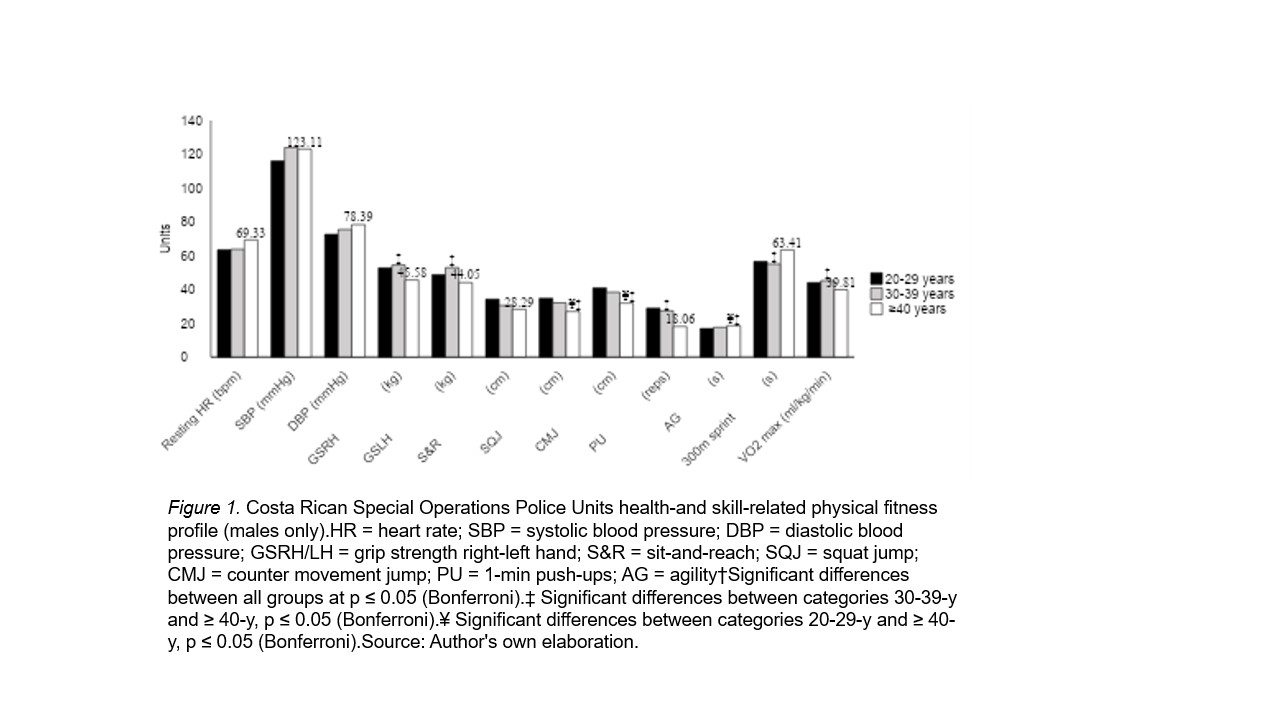
Figure 1
Costa Rican Special Operations Police Units health-and skill-related physical fitnessprofile (males only).
HR = heart rate; SBP = systolic blood pressure; DBP = diastolic blood pressure; GSRH/LH = gripstrength right-left hand; S&R = sit-and-reach; SQJ = squat jump; CMJ = counter movement jump;
PU = 1-min push-ups; AG = agility
†Significant differences between all groups at p ≤ 0.05 (Bonferroni).‡ Significant differences between categories 30-39-y and ≥ 40-y, p ≤ 0.05 (Bonferroni).
¥ Significant differences between categories 20-29-y and ≥ 40-y, p ≤ 0.05 (Bonferroni).
Source: Author's own elaboration.Hand grip, vertical jump, muscular endurance, agility, anaerobic resistance, and aerobic capacity performance differed between the 20-29- and 30-39-y age subgroups compared to the ≥40 years subgroup. Scientific literature describes that 20–29-y police officers usually display the best physical performance (Dawes et al., 2016, Lockie et al., 2019). All these variables are related to general strength and conditioning fitness, which has been reported to decline gradually, especially in older officers due to aging (Anderson et al., 2001; Adams et al., 2010; Dawes et al., 2013; Davis et al., 2016; Williams & Ramsey, 2017). Special units often wear body armor, helmets, weapons, ammunition, supplies, equipment belts, carrying shields and battering rams, holding perimeter positions for long periods, and carrying and slinging rescue victims so that there is potential injury in individuals with low levels of strength and conditioning (Williams & Ramsey, 2017).
Strength is the most imperative physical component for successful performance in specialized tactical teams (Davis et al., 2016; Williams & Ramsey, 2017). Investigations with military personnel carrying external loads of around 10–30 kg have found that the loads negatively affected carriers’ abilities to accelerate from a prone position (Schram et al, 2020; Billing et al., 2015). Additionally, police officers have indicated that physical fitness and agility are critical for the job of policing (Bissett et al., 2012). A general decline in mean performance between male officer age groups (20-29 vs ≥30 years) in vertical jump has been also reported (Dawes et al., 2017). The link between better jump performance with specific policing tasks such as vaulting barriers or suspect pursuit, and its relationship with the reduction of illness and injury risk remark, remains of importance (Lockie et al., 2018b).
5. Conclusion
The present study determined that Costa Rican SOP units’ fitness profiles are below general fitness standards and showed that age is an important factor in SOP performance. Police agencies need to review their strength and conditioning programs since the elite police population might not be optimally prepared for the physical demands of the profession.
Limitations
Specialist police units are considered to be at a higher level of fitness than the general police officers and may be considered elite athletes (Scofield & Kardouni, 2015). However, this was not demonstrated in the present study. Sub-optimal conditions to complete the fitness assessment, such as occupational demand, sleep deprivation, and fatigue, were not controlled in the present study, being factors that could potentially explain the low performance observed in the participant officers (Talaber et al., 2022). It is possible that not all the subjects were highly trained or motivated to achieve their best performance. Only 6.0% of women volunteered. This is a previous limitation reported in specialist personnel (Robinson et al., 2018; Orr et al., 2022; Maupin et al., 2018a; Irving et al., 2019; Marins et al., 2020).
Practical applications
This is the first study conducted in Costa Rican SOP units in the field of human movement science. Results showed several aspects that need further study in this population. Personnel in charge of tactical athletes’ physical readiness can use this information to create training programs to improve fitness and operative performance. Differences between age groups should be considered to develop specific exercise interventions in future conditioning and research initiatives.
Physical fitness plays a crucial role in the wellness and safety of SOP members, their colleagues, their agencies, and the communities they serve. However, it seems that police agencies are failing to address this issue with the urgency it requires. To enhance SOP members' performance, Costa Rican police administration must consider implementing specific and tailored exercise interventions scientifically based. Reducing the risks associated with poor physical fitness would be a significant step toward fostering a healthier and more efficient police force (Frick et al., 2024).
6. References
Adams, J., Schneider, J., Hubbard, M., McCullough-Shock, T., Cheng, D., Simms, K., & Strauss, D. (2010). Measurement of functional capacity requirements of police officers to aid in development of an occupation-specific cardiac rehabilitation training program. Baylor University Medical Center Proceedings, 23(1), 7-10. https://doi.org/10.1080/08998280.2010.11928571
Alvar, B. A., Sell, K., & Deuster, P. A. (2017). NSCA Essentials of Tactical Strength and Conditioning. Human Kinetics.
Anderson, G. S., Plecas, D., & Segger, T. (2001). Police officer physical ability testing–Re‐validating a selection criterion. Policing: An International Journal of Police Strategies & Management, 24(1), 8-31. https://doi.org/10.1108/13639510110382232
Alasagheirin, M. H., Clark, M. K., Ramey, S. L., & Grueskin, E. F. (2011). Body mass index misclassification of obesity among community police officers. AAOHN Journal, 59(11), 469-475. https://doi.org/10.1177/216507991105901102
Araujo, A. O., Cancela, J.M., Bezerra, P., Chaves, C., & Rodrigues, L.P. (2020). Age-related influences on somatic and physical fitness of elite police agents (Influencias de la edad en la aptitud física y somática de los agentes de policía de élite). Retos, 40, 281-288. https://doi.org/10.47197/retos.v1i40.82910
Beck, A. Q., Clasey, J. L., Yates, J. W., Koebke, N. C., Palmer, T. G., & Abel, M. G. (2015). Relationship of physical fitness measures vs. occupational physical ability in campus law enforcement officers. The Journal of Strength & Conditioning Research, 29(8), 2340-2350. https://doi.org/10.1519/jsc.0000000000000863
Billing, D. C., Silk, A. J., Tofari, P. J., & Hunt, A. P. (2015). Effects of military load carriage on susceptibility to enemy fire during tactical combat movements. The Journal of Strength & Conditioning Research, 29, S134-S138. https://doi.org/10.1519/jsc.0000000000001036
Bissett, D., Bissett, J., & Snell, C. (2012). Physical agility tests and fitness standards: perceptions of law enforcement officers. Police Practice and Research, 13(3), 208-223. https://doi.org/10.1080/15614263.2011.616142
Blacker, S. D., Wilkinson, D. M., Bilzon, J. L., & Rayson, M. P. (2008). Risk factors for training injuries among British Army recruits. Military medicine, 173(3), 278-286. https://doi.org/10.7205/MILMED.173.3.278
Bloodgood, A. M., Dawes, J. J., Orr, R. M., Stierli, M., Cesario, K. A., Moreno, M. R., Dulla, J. M., & Lockie, R. G. (2021). Effects of sex and age on physical testing performance for law enforcement agency candidates: Implications for academy training. Journal of Strength and Conditioning Research, 35(9), 2629–2635. https://doi.org/10.1519/JSC.0000000000003755
Boyce, R., Jones, G., Schendt, K.E., Lloyd, C., & Boone, E. (2008). A longitudinal observation of police: body composition changes over 12 years with gender and race comparisons. Journal of Exercise Physiology Online, 11(6).
Buchheit, M. (2016). The numbers will love you back in return—I promise. International journal of sports physiology and performance, 11(4), 551-554. https://doi.org/10.1123/ijspp.2016-0214
Butler, R. J., Contreras, M., Burton, L. C., Plisky, P. J., Goode, A., & Kiesel, K. (2013). Modifiable risk factors predict injuries in firefighters during training academies. Work, 46(1), 11-17. https://doi.org/10.3233/WOR-121545
Carlton, S. D., Carbone, P. D., Stierli, M., & Orr, R. M. (2014). The impact of occupational load carriage on the mobility of the tactical police officer. Journal of Australian strength and conditioning, 21(1), 32-37.
Cervantes-Sanabria, J., Camacho-Sánchez, G., Hernández-Elizondo, J., Carazo-Vargas, P., Brazo-Sayavera, J., Castillo-Hernández, I. M., & Salicetti-Fonseca, A. (2025). Age, sex and adiposity correlates of physical fitness in Costa Rican police academy cadets. Pensar en Movimiento: Revista de Ciencias del Ejercicio y la Salud, 25(1), e 61232. https://doi.org/10.15517/pensarmov.v23i1.61232
Cervantes-Sanabria, J., Hernández-Elizondo, J., Carazo-Vargas, P., Siles-Canales, F., Brazo-Sayavera, J., Castillo-Hernández, I. M., Salicetti-Fonseca, A., & Camacho-Sánchez, G. (2025). Data base of Health-and skill-related physical fitness in Costa Rican special operations police units. Pensar en Movimiento: Revista de Ciencias del Ejercicio y la Salud, 23(1). https://doi.org/10.15517/pensarmov.v23i1.63963
Cocke, C., Dawes, J., & Orr, R. M. (2016). The use of 2 conditioning programs and the fitness characteristics of police academy cadets. Journal of Athletic Training, 51(11), 887-896. https://doi.org/10.4085/1062-6050-51.8.06
Collins, K. S., Christensen, B. K., Orr, R. M., Dulla, J. M., Dawes, J. J., & Lockie, R. G. (2022). Analysis of total and segmental body composition relative to fitness performance measures in law enforcement recruits. International Journal of Exercise Science, 15(4), 245–260. https://doi.org/10.70252/eder1570
Crawley, A. A., Sherman, R. A., Crawley, W. R., & Cosio-Lima, L. M. (2016). Physical fitness of police academy cadets: Baseline characteristics and changes during a 16-week academy. The Journal of Strength & Conditioning Research, 30(5), 1416-1424. https://doi.org/10.1519/JSC.0000000000001229
Davis, M. R., Easter, R. L., Carlock, J. M., Weiss, L. W., Longo, E. A., Smith, L. M., Dawes. J.J., & Schilling, B. K. (2016). Self-reported physical tasks and exercise training in Special Weapons and Tactics (SWAT) teams. Journal of strength and conditioning research, 30(11), 3242-3248. https://doi.org/10.1519/JSC.0000000000001411
Dawes, J. (Ed.). (2019). Developing agility and quickness. Human Kinetics Publishers.
Dawes, J. J., Elder, C., Hough, L., Melrose, D. R., & Stierli, M. (2013). Description of selected physical performance measures and anthropometric characteristics of part and full time special weapons and tactics teams. J Aust Strength Cond, 21, 52-58. https://surl.li/smfuvj
Dawes, J. J., Orr, R. M., Elder, C. L., Krall, K., Stierli, M., & Schilling, B. (2015). Relationship between Selected Measures of Power and Strength and Linear Running Speed Amongst Special Weapons and Tactics Police Officers. Journal of Australian Strength & Conditioning, 23(2), 22–26. https://research.bond.edu.au/en/publications/relationship-between-selected-measures-of-power-and-strength-and-
Dawes, J. J., Orr, R. M., Flores, R. R., Lockie, R. G., Kornhauser, C., & Holmes, R. (2017). A physical fitness profile of state highway patrol officers by gender and age. Annals of occupational and environmental medicine, 29(1), 1-11. https://doi.org/10.1186/s40557-017-0173-0
Dawes, J. J., Orr, R. M., Siekaniec, C. L., Vanderwoude, A. A., & Pope, R. (2016). Associations between anthropometric characteristics and physical performance in male law enforcement officers: A retrospective cohort study. Annals of occupational and environmental medicine, 28(1), 1-7. https://doi.org/10.1186/s40557-016-0112-5
Dawes, J.J. (2011). A description of the anthropometric and physiological profile of tactical officers [Doctoral dissertation, Oklahoma State University]. https://surl.li/doviss
Dhahbi, W., Chaouachi, A., Padulo, J., Behm, D. G., & Chamari, K. (2015). Five-meter rope-climbing: A commando-specific power test of the upper limbs. International journal of sports physiology and performance, 10(4), 509-515. https://doi.org/10.1123/ijspp.2014-0334
Elliott, J. L., & Lal, S. (2016). Blood pressure, sleep quality and fatigue in shift working police officers: effects of a twelve hour roster system on cardiovascular and sleep health. International journal of environmental research and public health, 13(2), 172. https://doi.org/10.3390/ijerph13020172
Farenholtz, D. W., & Rhodes, E. C. (1990). Recommended Canadian standards for police physical abilities. Canadian Police College Journal, 14(1), 37-49. https://www.ojp.gov/ncjrs/virtual-library/abstracts/recommended-canadian-standards-police-physical-abilities
Fink, B., Freitas, T. T., & Zabaloy, S. (2024). Body Composition and Physical Performance Measures of a Special Operations Police Unit: Characteristics and Associations Between Determinant Factors of Physical Performance. Journal of Science in Sport and Exercise, 6(1), 61-70. https://doi.org/10.1007/s42978-022-00205-w
Forbes, G. B. (1999). Longitudinal changes in adult fat-free mass: influence of body weight. The American journal of clinical nutrition, 70(6), 1025-1031. https://doi.org/10.1093/ajcn/70.6.1025
Frick, K. A., Agostinelli, P. J., Swinford, J. F., Harris, M. E., Mobley, C. B., & Sefton, J. (2024). Age-Related Declines in Health and Fitness among Law Enforcement Officers Compared to Population Norms. Healthcare, 12(7), 714. https://doi.org/10.3390/healthcare12070714
Fuchs, F. D., & Whelton, P. K. (2020). High blood pressure and cardiovascular disease. Hypertension, 75(2), 285-292. https://doi.org/10.1161/HYPERTENSIONAHA.119.14240
Hoffman, R., & Collingwood, T. R. (2015). Fit for duty, 3E. Human Kinetics.
Imboden, M. T., Swartz, A. M., Finch, H. W., Harber, M. P., & Kaminsky, L. A. (2017). Reference standards for lean mass measures using GE dual energy x-ray absorptiometry in Caucasian adults. PLoS ONE, 12(4), e0176161. https://doi.org/10.1371/journal.pone.0176161
Irving, S., Orr, R., & Pope, R. (2019). Profiling the occupational tasks and physical conditioning of specialist police. International Journal of Exercise Science, 12(3), 173-186. https://doi.org/10.70252/LGPE4029
Kales, S. N., Tsismenakis, A. J., Zhang, C., & Soteriades, E. S. (2009). Blood pressure in firefighters, police officers, and other emergency responders. American journal of hypertension, 22(1), 11-20. https://doi.org/10.1038/ajh.2008.296
Keeler, J. M. (2014). The effect of tactical tasks and gear on muscle activation of SWAT officers. [Master of Science in the College of Education], University of Kentucky.
Kukić, F., Heinrich, K. M., Koropanovski, N., Poston, W. S., Čvorović, A., Dawes, J. J., Orr, R., & Dopsaj, M. (2020). Differences in body composition across police occupations and moderation effects of leisure time physical activity. International journal of environmental research and public health, 17(18), 6825. https://doi.org/10.3390/ijerph17186825
Lagestad, P., & Van Den Tillaar, R. (2014). Longitudinal changes in the physical activity patterns of police officers. International Journal of Police Science & Management, 16(1), 76-86. https://doi.org/10.1350/ijps.2014.16.1.329
Liguori, G., Feito, Y., Fountaine, C., & Roy, B. A. (Eds.). (2021). ACSM’s guidelines for exercise testing and prescription (11th ed.). Wolters Kluwer.
Lockie, R. G., Dawes, J. J., Balfany, K., Gonzales, C. E., Beitzel, M. M., Dulla, J. M., & Orr, R. M. (2018a). Physical fitness characteristics that relate to Work Sample Test Battery performance in law enforcement recruits. International journal of environmental research and public health, 15(11), 2477. https://doi.org/10.3390/ijerph15112477
Lockie, R. G., Dawes, J. J., Kornhauser, C. L., & Holmes, R. J. (2019). Cross-sectional and retrospective cohort analysis of the effects of age on flexibility, strength endurance, lower-body power, and aerobic fitness in law enforcement officers. The Journal of Strength & Conditioning Research, 33(2), 451-458. https://doi.org/10.1519/jsc.0000000000001937
Lockie, R. G., Dawes, J. J., Orr, R. M., Stierli, M., Dulla, J. M., & Orjalo, A. J. (2018b). Analysis of the effects of sex and age on upper-and lower-body power for law enforcement agency recruits before academy training. The Journal of Strength Conditioning Research, 32(7), 1968-1974. https://doi.org/10.1519/jsc.0000000000002469
Marins, E., Barbosa, O., Machado, E., Orr, R., Dawes, J., & Del Vecchio, F. (2020). Profile of self-reported physical tasks and physical training in Brazilian special operations units: A web-based cross-sectional study. International Journal of Environmental Research and Public Health, 17(19), 7135. https://doi.org/10.3390/ijerph17197135
Maupin, D., Robinson, J., Wills, T., Irving, S., Schram, B., & Orr, R. (2018). Profiling the metabolic fitness of a special operations police unit. Journal of Occupational Health, 60(5), 356-360. https://doi.org/10.1539/joh.2018-0029-OA
Maupin, D., Wills, T., Orr, R., & Schram, B. (2018). Fitness profiles in elite tactical units: A critical review. International journal of exercise science, 11(3), 1041-1062. https://doi.org/10.70252/XGJU7809
Moreno, M. R., Lockie, R. G., Kornhauser, C. L., Holmes, R. J., & Dawes, J. J. (2018). A preliminary analysis of the relationship between the multistage fitness test and 300-m run in law enforcement officers: Implications for fitness assessment. International Journal of Exercise Science, 11(4), 730-738. https://doi.org/10.70252/CKCK2099
Morioka, H. M., & Brown, M. L. (1970). Incidence of obesity and overweight among Honolulu police and firemen. Public Health Reports, 85(5), 433-439. https://doi.org/10.2307/4593869
Okosun, I. S., Seale, J. P., & Lyn, R. (2015). Commingling effect of gynoid and android fat patterns on cardiometabolic dysregulation in normal weight American adults. Nutrition & Diabetes, 5, e155. https://doi.org/10.1038/nutd.2015.5
Orr, R. M., Robinson, J., Hasanki, K., Talaber, K. A., Schram, B., & Roberts, A. (2022). The relationship between strength measures and task performance in specialist tactical police. Journal of Strength and Conditioning Research, 36(3), 757-762. https://doi.org/10.1519/jsc.0000000000003511
Orr, R., Dawes, J. J., Elder, C., Krall, K., Stierli, M., & Schilling, B. (2015). Relationship between selected measures of power and strength and linear running speed amongst Special Weapons and Tactics police officers. Journal of Australian strength and conditioning, 23(3), 23. https://surl.li/usxfca
Pryor, R. R., Colburn, D., Crill, M. T., Hostler, D. P., & Suyama, J. (2012). Fitness characteristics of a suburban special weapons and tactics team. Journal of Strength and Conditioning Research, 26(3), 752–757. https://doi.org/10.1519/JSC.0b013e31822dbd81
Riebe, D., Ehrman, J. K., Liguori, G., & Magal, M. (2018). ACSM’s guidelines for exercise testing and prescription (10th ed.). Wolters Kluwer.
Robinson, J., Roberts, A., Irving, S., & Orr, R. (2018). Aerobic fitness is of greater importance than strength and power in the load carriage performance of specialist police. International journal of exercise science, 11(4), 987-998. https://doi.org/10.70252/IWXE4027
Sá, M., Santos, T., Afonso, J., Gouveia, É. R., & Marques, A. (2022). Physical fitness and anthropometrical profile for the recruits of the elite close protection unit of the Portuguese public security police. Police Practice and Research, 23(3), 308-321. https://doi.org/10.1080/15614263.2021.1956317
Schram, B., Orr, R., Hinton, B., Pope, R., & Norris, G. (2019). The effects of body armour on the power development and agility of police officers. Ergonomics, 62(10), 1349-1356. https://doi.org/10.1080/00140139.2019.1648878
Schram, B., Robinson, J., & Orr, R. (2020). The Physical Fitness Effects of a week-long specialist tactical police selection course. International Journal of Environmental Research and Public Health, 17(18), 6782. https://doi.org/10.3390/ijerph17186782
Scofield, D. E., & Kardouni, J. R. (2015). The tactical athlete: a product of 21st century strength and conditioning. Strength & Conditioning Journal, 37(4), 2-7. https://doi.org/10.1519/ssc.0000000000000149
Šimenko, J., Ĉoh, M., & Ţvan, M. (2015). Motoriĉke karakteristike specijalnih policijskih jedinica (The motoric characteristics of special police units). In: I. Jukić, G. Cvita, S. Šalaj, L. Milanović, & V. Wertheimer (Eds.), Kondicijska priprema sportaša 2015: Zbornik Radova (pp. 59–63). Zagreb: Kineziološki fakultet Sveuĉilišta u Zagrebu.
Šimenko, J., Čoh, M., Škof, B., Zorec, B., & Milić, R. (2014). Comparison of Some Morphological and Physiological Characteristics of Slovenian Police Special Unit and American Special Forces SWAT. Journal of Criminal Justice and Security, (3), 312-320. UDC: 796.012.1:351.749
Šimenko, J., Škof, B., Hadžić, V., Milić, R., Zorec, B., Žvan, M., Vodicar, J., & Čoh, M. (2016). General and specific physical abilities of the members of special police unit. Facta Universitatis, Series: Physical Education and Sport, 14(1), 83-98. https://surl.li/hvpvsg
Sörensen, L., Smolander, J., Louhevaara, V., Korhonen, O., & Oja, P. (2000). Physical activity, fitness and body composition of Finnish police officers: a 15-year follow-up study. Occupational medicine, 50(1), 3-10. https://doi.org/10.1093/occmed/50.1.3
Strader, J., Schram, B., Irving, S., Robinson, J., & Orr, R. (2020). Special weapons and tactics occupational-specific physical assessments and fitness measures. International journal of environmental research and public health, 17(21), 8070. https://doi.org/10.3390/ijerph17218070
Talaber, K. A., Orr, R. M., Maupin, D., Schram, B., Hasanki, K., Roberts, A., & Robinson, J. (2022). Profiling the absolute and relative strength of a special operations police unit. BMC sports science, medicine and rehabilitation, 14(111). https://doi.org/10.1186/s13102-022-00502-5
The Cooper Institute. (2002). Physical fitness norms for law enforcement. The Cooper Institute.
The Cooper Institute. (2006). Physical Fitness Assessments and Norms for Adults and Law Enforcement Dallas.The Cooper Institute.
Turck, P. M. (2008). Development of a standardized physical fitness test for SWAT officers [Administrative research paper]. Bill Blackwood Law Enforcement Management Institute of Texas.
Violanti, J. M., Charles, L. E., McCanlies, E., Hartley, T. A., Baughman, P., Andrew, M. E., Fekedulegn, C.C., Mnatsakanova, A., & Burchfiel, C. M. (2017). Police stressors and health: a state-of-the-art review. Policing: An International Journal of Police Strategies & Management, 40(4), 642-656. https://doi.org/10.1108/PIJPSM-06-2016-0097
Williams, J. J., & Westall, D. (2003). SWAT and non-SWAT police officers and the use of force. Journal of Criminal Justice, 31(5), 469-474. https://doi.org/10.1016/S0047-2352(03)00051-5
Williams, J., & Ramsey, V. (2017). The need for law enforcement wellness interventions: A critical review. The Sport Journal, 24. https://surl.li/dmyynz
Zwingmann, L., Zedler, M., Kurzner, S., Wahl, P., & Goldmann, J. P. (2021). How fit are special operations police officers? A comparison with elite athletes from Olympic disciplines. Frontiers in Sports and Active Living, 3, 347. https://doi.org/10.3389/fspor.2021.742655
Notes
Notas de autor
Información adicional
Associated editor in charge:: Ph.D. Luis Fernando Aragón-Vargas
*Pedro Carazo and Alejandro Salicetti are associated editors from Pensar en Movimiento.: The peer review process was done independently of them until a decision was made
This manuscript was submitted for open peer review.: We thank Lic. José Ángel Ramírez and Msc. Bryan Montero Herrera for their reviews
Información adicional
redalyc-journal-id: 4420
