Investigación descriptiva, correlacional o cualitativa
Joint associations of moderate-to-vigorous physical activity and smartphone screen time with inhibitory control performance in adolescents [1]
Asociación conjunta entre actividad física moderada a vigorosa y el tiempo de uso de teléfonos celulares con el rendimiento del control inhibitorio en adolescentes
Associação conjunta entre atividade física moderada a vigorosa e tempo de uso do celular com desempenho no controle inibitório em adolescentes
 Romilton Victal Gomes romiltongomes.cz@gmail.com
João Paulo Rodrigues dos Santos joaopaulo.rodrigues@a.ucb.br
João Victor Morais do Nascimento joaovictor.morais@a.ucb.br
Anderson Almeida Alves andersonalmeida0604@gmail.com
Bianca Lins dos Santos linsbianca323@gmail.com
Eriston de Souza Bezerra eristonfaculdade@gmail.com
Samuel Lira da samuellira607@gmail.com
Vagner Deuel de O. Tavares deueltavares@gmail.com
Isabela Almeida Ramos isabela.viana@p.ucb.br
Ludmila Lucena Pereira Cabral ludmilalpcmartins@gmail.com
Rodrigo Alberto Vieira Browne rodrigo.browne@catolica.edu.br
Romilton Victal Gomes romiltongomes.cz@gmail.com
João Paulo Rodrigues dos Santos joaopaulo.rodrigues@a.ucb.br
João Victor Morais do Nascimento joaovictor.morais@a.ucb.br
Anderson Almeida Alves andersonalmeida0604@gmail.com
Bianca Lins dos Santos linsbianca323@gmail.com
Eriston de Souza Bezerra eristonfaculdade@gmail.com
Samuel Lira da samuellira607@gmail.com
Vagner Deuel de O. Tavares deueltavares@gmail.com
Isabela Almeida Ramos isabela.viana@p.ucb.br
Ludmila Lucena Pereira Cabral ludmilalpcmartins@gmail.com
Rodrigo Alberto Vieira Browne rodrigo.browne@catolica.edu.br
Joint associations of moderate-to-vigorous physical activity and smartphone screen time with inhibitory control performance in adolescents [1]
PENSAR EN MOVIMIENTO: Revista de Ciencias del Ejercicio y la Salud, vol. 23, núm. 1, e61044, 2025
Universidad de Costa Rica

Esta obra está bajo una Licencia Creative Commons Atribución-NoComercial-SinDerivar 4.0 Internacional.
Recepción: 13 Julio 2024
Recibido del documento revisado: 20 Marzo 2025
Aprobación: 28 Abril 2025
Publicación: 28 Mayo 2025
Abstract: This cross-sectional study investigated the joint associations of moderate-to-vigorous physical activity (MVPA) and smartphone screen time (ST) with inhibitory control performance in 210 Brazilian school adolescents. MVPA level was assessed using the Global School-based Student Health Survey questionnaire, categorized as inactive (<60 min/day) or active (60+ min/day). Weekly ST was measured using participants’ smartphones, categorized as low (<7 h/day) or high (7+ h/day) based on the median. Participants were divided into four groups: inactive + high ST, inactive + low ST, active + high ST, and active + low ST. Inhibitory control performance was evaluated using the Flanker task, measuring reaction time and accuracy in congruent/incongruent stimulus. A generalized multiple gamma model revealed that only the inactive + high ST group showed a higher reaction time in the incongruent phase compared to the active + low ST group (β = 41.1 ms; 95% CI 2.3, 79.9; p = .038). No differences were found in the accuracy (p > .05). In conclusion, physical inactivity combined with high smartphone ST is associated with poorer inhibitory control performance in school adolescents.
Keywords: adolescent health, cognition, sedentary behavior, physical activity.
Resumen: Este estudio transversal investigó las asociaciones conjuntas entre la actividad física moderada a vigorosa (AFMV) y el tiempo de uso de teléfonos celulares (TT) con el rendimiento del control inhibitorio en 210 adolescentes escolares brasileños. El nivel de AFMV se evaluó utilizando el cuestionario de la Encuesta Global de Salud Escolar, categorizado como inactivo (<60 min/día) o activo (60+ min/día). El TT semanal se midió utilizando los teléfonos celulares de los participantes, categorizado como bajo (<7 h/día) o alto (7+ h/día) según la mediana. Los participantes se dividieron en cuatro grupos: inactivo + alto TT, inactivo + bajo TT, activo + alto TT y activo + bajo TT. El rendimiento del control inhibitorio se evaluó utilizando la tarea Flanker, midiendo el tiempo de reacción y la precisión en estímulos congruentes/incongruentes. Un modelo gamma múltiple generalizado reveló que solo el grupo inactivo + alto TT mostró un tiempo de reacción más alto en la fase incongruente en comparación con el grupo activo + bajo TT (β = 41.1 ms; IC del 95%: 2.3; 79,9; p = .038). No se encontraron diferencias en la precisión (p > .05). En conclusión, la inactividad física combinada con un alto TT de teléfonos celulares está asociada con un peor rendimiento del control inhibitorio en adolescentes escolares.
Palabras clave: salud de adolescentes, cognición, comportamiento sedentario, actividad física.
Resumo: Este estudo transversal investigou as associações conjuntas entre atividade física moderada a vigorosa (AFMV) e tempo de uso do telefone celular (TT) com o desempenho do controle inibitório em 210 adolescentes escolares brasileiros. O nível de AFMV foi avaliado por meio do questionário Global School Health Survey, categorizado como inativo (<60 min/dia) o ativo (60+ min/dia). O TT semanal foi medido usando o celular dos participantes, categorizado como baixo (<7 h/dia) ou alto (7+ h/dia) segundo a mediana. Os participantes foram divididos em quatro grupos: inativo + TT alto, inativo + TT baixo, ativo + TT alto e ativo + TT baixo. O desempenho do controle inibitório foi avaliado por meio da tarefa de Flanker, medindo o tempo de reação e a precisão em estímulos congruentes/incongruentes. Um modelo gama múltiplo generalizado mostrou que apenas o grupo inativo + TT alto apresentou maior tempo de reação na fase incongruente em comparação com o grupo ativo + TT baixo (β = 41,1 ms; IC 95%: 2,3; 79,9; p = 0,038). Não foram encontradas diferenças na precisão (p> 0,05). Em conclusão, a inatividade física combinada com um TT alto de telefones celulares está associada a um pior desempenho no controle inibitório em adolescentes escolares.
Palavras-chave: saúde do adolescente, cognição, comportamento sedentário, atividade física.
1. Introduction
Adolescence is understood as the phase of transition from childhood to adulthood, delimited by significant changes in biological growth, hormonal alterations, and accelerated brain maturation (Best & Ban, 2021). This phase is marked not only by hormonal fluctuation but also substantial changes in the brain, with a notable example being the development and remodeling of the prefrontal cortex (Fandakova et al., 2017).
Inhibitory control is a component of executive functions, mediated by the prefrontal cortex, which activates intensively during tasks requiring attention and inhibition of impulsive responses (Diamond, 2020). This skill involves the ability to regulate thoughts, emotions, and behaviors in response to external demands, overriding internal predispositions, or refraining from impulsive actions (Diamond, 2020). It plays a critical role in managing distractions, regulating behavior, and making thoughtful decisions, with significant implications for academic success and social adaptation (Geertsen et al., 2016). Additionally, inhibitory control is crucial for adolescents to engage in goal-directed behavior and develop emotional regulation, both essential during this phase of rapid brain development (Best & Ban, 2021).
Various methods can be used to assess inhibitory control, such as behavioral tasks like the Flanker task, which evaluates the ability to suppress automatic responses in the context of selective visual attention (Diamond, 2020). Neuroimaging techniques, including functional magnetic resonance imaging, are also employed to observe brain activity in regions associated with inhibition, particularly the prefrontal cortex (Yen et al., 2023). These methods enable researchers to quantify inhibitory control and its neural mechanisms, which are essential for understanding its development and implications for behavior during adolescence. Neurobiological changes in the brain during this period highlight the importance of understanding how the environment influences cognitive development (Nelson et al., 2019).
The regular practice of moderate-to-vigorous physical activities (MVPA) is widely recommended for adolescents to promote health and prevent non-communicable chronic diseases, however, it can also positively impact cognition (Erickson et al., 2019; World Health Organization [WHO], 2020). Moreover, active behavior during childhood may have repercussions in adulthood (Lounassalo et al., 2021). Current recommendations suggest that adolescents should dedicate at least 60 minutes daily to MVPA to be classified as physically active, while those who do not meet these recommendations are considered physically inactive (WHO, 2020). Physical inactivity is associated with excessive sedentary behavior, especially in school-aged adolescents (da Costa et al., 2021; Vancampfort et al., 2021).
Sedentary behavior is defined as a wake energy expenditure ≤1.5 metabolic equivalents, whether in a sitting, reclining, or lying position (Tremblay et al., 2017). This behavior is often linked to an adolescent’s long-term exposure to screen time, particularly on smartphones (Barkley et al., 2016; da Costa et al., 2021; Lourenço et al., 2019). The excessive use of smartphones is associated with a decrease in physical activity levels among young individuals (Grimaldi-Puyana et al., 2020). Due to the COVID-19 pandemic, the use of smartphones has grown exponentially among adolescents (Humer et al., 2022). A observational study with Brazilian school adolescents showed that about 70% exhibited smartphone dependency and used it for 5.8 hours per day on weekdays and 8.8 hours per day on weekends (de Brito Nunes et al., 2021). Excessive screen time exposure has been associated with a negative impact on the fronto-striatal circuit, which in turn, may cause long-term effects on the development of inhibitory control, especially during adolescence, affecting reward sensitivity (Chen et al., 2023).
Previous studies have investigated the association between MVPA, screen time, and cognitive performance in children and adolescents (Guerrero et al., 2019; Li et al., 2021; Syväoja et al., 2014; Walsh et al., 2018; Wickel, 2017; Wilhite et al., 2023; Zeng et al., 2021). However, few studies have examined the joint associations of MVPA and screen time, particularly focusing on objectively measured smartphone use, with cognitive performance in the adolescent population. A study conducted in southeastern China examined the joint associations of MVPA and self-reported screen time on executive functions in children aged 6 to 12 years old (Zeng et al., 2021). Screen time encompassed after-school homework and leisure screen activities such as watching television or videos, playing video games, and using the computer, categorized as low (<2 h/day) or high (2+ h/day) (Zeng et al., 2021). The findings revealed that children with low MVPA and high screen time exhibited poorer cognitive performance compared to other groups.
Although previous studies have investigated the associations between MVPA and screen time with cognitive performance in children and adolescent populations, most studies have examined the independent associations of MVPA and screen time, primarily focusing on self-reported screen time from devices such as television, computers, and video games. To date, no studies have explored the joint associations between MVPA and objectively measured smartphone screen time, which is currently the most common screen device used among adolescents for leisure and sedentary activities such as gaming, social media engagement, and video streaming (da Costa et al., 2021; Lourenço et al., 2019; Xiang et al., 2020). Investigating the joint associations of MVPA and objectively measured smartphone screen time may provide a more comprehensive understanding of how these factors interact and influence inhibitory control performance. Therefore, the objective of this study was to analyze the joint associations between MVPA and objectively measured smartphone screen time with inhibitory control performance among adolescents.
2. Methods
Study design
A cross-sectional observational study design was employed to determine if MVPA and objectively measured smartphone screen time interact and influence inhibitory control performance. The data were collected at the Federal Institute of Education, Science, and Technology of Paraíba (IFPB) in Sousa, PB, Brazil, from June to October 2023. The research was conducted in accordance with the Declaration of Helsinki and Resolution No. 466/2012 of the Brazilian National Health Council, following approval by the Research Ethics Committee (CAAE No. 49857421.0.0000.5184). The study followed the STROBE criteria for observational studies (von Elm et al., 2014).
Participants
Participants were recruited through social media platforms and research announcements in classrooms. The institution is a federal public school that offers integrated high school education with technical courses, including agroindustry, agriculture and livestock farming, environment, and informatics, all in full-time (morning and afternoon) programs. Inclusion criteria for participation in the study were chosen as follows: both sexes; aged between 14 and 19 years, absence of diagnosed psychological, psychiatric, and cognitive disorders, ownership of a personal smartphone with the “digital well-being” function activated. Exclusion criteria included non-participation in any research assessment and voluntary withdrawal. All participants and their guardians provided written informed consent. During the data collection period, 297 students enrolled in the school. A total of 210 participants (71% of the school population) were included in the study analysis (Figure 1).

Figure 1
Flowchart of the study sample selection process
Source: the authors.
Procedures
Data were collected in the physical assessment laboratory, located at the Department of Physical Education of IFPB, with ambient temperature control set at approximately 24°C conducted in the morning, from 7:30 am to 11:00 am, and led by previously trained researchers. The data collection process was divided into two distinct moments. Firstly, participants completed the following questionnaires in a face-to-face manner with the evaluator: modules of personal, demographic, and physical activity information from the Global School-based Student Health Survey questionnaire (WHO, 2021) and the Pediatric Daytime Sleepiness Scale (Felden et al., 2016). Next, the evaluator asked the participant about smartphone screen time to obtain daily usage results from the past week. In the second moment, participants were led to a separate, climate-controlled room. In this environment, the windows remained closed, providing a distraction-free space with no visual or external auditory disturbances. This allowed participants to focus solely on completing the Flanker test, aided by a notebook. Finally, anthropometric measurements of the participant were taken.
Moderate-to-vigorous physical activity and smartphone screen time
The level of MVPA was measured using the physical activity module of the Global School-based Student Health Survey questionnaire (WHO, 2021). This module quantifies the weekly frequency and time spent (in minutes) on MVPA during a typical week. Based on this information, the level of MVPA was classified as physically inactive (<60 min/day of MVPA) or physically active (≥60 min/day of MVPA) (WHO, 2020). Screen time (ST) was measured using a built-in smartphone feature available on most devices, commonly referred to as “digital well-being”, “parental controls”, or “time using”. We used smartphone ST as an objective measure of adolescents’ daily screen use due to its association with sedentary behavior and predominant use for leisure while sitting (da Costa et al., 2021; Lourenço et al., 2019; Xiang et al., 2020). This feature automatically records daily smartphone usage time (in minutes). For this study, ST data were collected for the seven days of the previous week (Monday to Sunday). During data collection, participants accessed the feature on their own devices and reported their usage time to the researcher, ensuring no direct researcher intervention in manipulating the devices. The average daily ST over the previous week was then calculated and converted into hours per day. Given the lack of a well-established cutoff point for categorizing smartphone ST, we adopted the median value of our sample (7 h/day) to define low ST (<7 h/day) and high ST (≥7 h/day). Participants were categorized into four groups based on their MVPA and smartphone ST levels: physically inactive + high ST, physically inactive + low ST, physically active + high ST, and physically active + low ST (reference group).
Cognitive task
Inhibitory control performance was assessed using the modified Flanker task (Eriksen, 1995). The test was administered in a controlled environment, free from external distractions, with only a table, a chair, and a notebook where the task was conducted. Participants positioned their dominant hand over the notebook, with the arm supported on the table. The software used to administer the modified Flanker task was E-Prime v3.0 (Psychological Software Inc.) (Walk et al., 2017). The Flanker task is a reliable and efficient measure of inhibitory control, commonly used to assess error-related negativity, with intraclass correlation coefficients > 0.80 (Suchan et al., 2019) and established validity (Peng et al., 2019). In this task, participants were shown a central fish image (Figure 2), with flanking fish that could either point in the same direction (congruent trials) or in the opposite direction (incongruent trials). The task included 50 practice trials followed by 120 experimental trials, with an equal distribution of congruent and incongruent stimuli. Each stimulus consisted of five yellow fish, displayed for 200 ms against a blue background. Participants were required to respond by pressing a key to indicate the direction of the central fish, while ignoring the direction of the flanking fish. The response time (RT) and accuracy (percentage of correct responses) for congruent and incongruent trials were recorded as the main outcome measures. The task provides a measure of inhibitory control based on the participant’s ability to suppress automatic responses to incongruent stimuli.

Figure 2
Modified Flanker Task (Walk et al., 2017). Top panel: possible combinations of congruent (1 – fishes to the same direction), or incongruent conditions (2 – central fish in the opposite). Bottom panel: sequence of events and duration of each stimuli
Source: the authors
Other variables
The remaining variables, such as age, sex, ethnicity, residence area (urban and rural), socioeconomic level, excessive daytime sleepiness, and anthropometric measures used to characterize the sample or as confounding variables (covariates), were collected through the Global School-based Student Health Survey questionnaire (WHO, 2021), the 2022 Brazil Economic Classification Criteria (Associação Brasileira de Empresas de Pesquisa, 2024), the Pediatric Daytime Sleepiness Scale (PDSS) (Felden et al., 2016) and standardized measurements. Daytime sleepiness was assessed using the PDSS, which consists of eight multiple-choice questions. The sum of the scores was calculated, and the scale score ranges from zero to 32 points. The cutoff point for excessive daytime sleepiness was ≥ 15 points (Meyer et al., 2018). Height and weight were measured using a digital scale (model W200, Welmy, Brazil) and a portable stadiometer (model ES2060, Sanny, Brazil), respectively. Body mass index (BMI) was calculated as the ratio of weight to height squared (kg/m2). The BMI z-score of each participant was classified according to sex and age, following the reference table of the World Health Organization (WHO, 2006). The pubertal stage was assessed using the peak height velocity, calculated via an equation incorporating anthropometric measurements, categorizing participants as pre-pubescent, pubescent, or post-pubertal (Mirwald et al., 2002).
Statistical analysis
Continuous variables were presented as mean ± standard deviation, while categorical variables were described as absolute frequencies (n) and relative frequencies (%). The multiple generalized gamma model, with robust variance, was applied to analyze the coefficient estimates (β) and 95% confidence intervals (CI) for RT and correct % responses in congruent and incongruent stimulus between groups (active + low ST as the reference group), adjusted for confounding variables: age, socioeconomic level, BMI, and excessive daytime sleepiness. Estimated marginal means (EMM) and 95% CI were also calculated. The assumptions of the multiple models, including multicollinearity, were assessed. The sex variable was not included in the multiple model due to multicollinearity with the other predictors. The linear or gamma distribution model for each model was determined by the normality of the residuals in the Q-Q plot and/or by the lowest value of the Akaike Information Criterion. The fit quality of the models was assessed by the Omnibus test. A p-value < 0.05 was considered statistically significant for all analyses. All analyses were conducted using SPSS version 27 software (IBM Corp., Armonk, NY).
3. Results
Table 1 presents the results regarding the characterization of the participants. The majority comprised female individuals (66.7%), and pubescent adolescents (77.6%), with 51.4% identifying as white/yellow ethnicity and 48.6% as brown/black. Most participants resided in urban areas (67.6%) and did not experience delays in academic progression (86.7%), being in the expected grade for their age. Additionally, most participants had a normal weight (68.6%), experienced excessive daytime sleepiness (75.2%), and were physically inactive (68.6%). The mean and median time spent on smartphones was 7 hours per day. Regarding group comparisons, significant differences were observed only in age and gender distribution. Specifically, the active + low ST group exhibited a higher mean age and a lower proportion of female participants compared to the other groups (Victal Gomes et al., 2025).
Figure 3 (and Table 2 and Table 3) present the results of the joint associations of MVPA and smartphone ST with inhibitory control performance. Regarding adjusted models, a significant association was observed in the RT of the congruent and incongruent stimulus (p < 0.05). Only the inactive + low ST group (β = 37.0 ms; 95% CI 1.5, 72.5 p = 0.041) showed a higher RT in the congruent phase compared to the reference group. Similarly, only the inactive + high ST group showed a higher RT in the incongruent phase compared to the reference group (β = 41.1 ms; 95% CI 2.3, 79.9, p = 0.038). No differences were found in the accuracy (see Table S1 for more details).
| Active + Low ST | Active + High ST | Inactive + Low ST | Inactive + High ST | p | Total | |
| N, % | 40 (19.0 %) | 26 (12.4 %) | 64 (30.5 %) | 80 (38.1 %) | 210 | |
| Age, years | 17.1 ± 1.2 | 17.1 ± 1.3 | 16.6 ± 1.2a | 16.3 ± 1.0a,b | 0.001 | 16.6 ± 1.2 |
| Girls | 17 (42.5 %) | 18 (69.2 %)a | 43 (67.2 %)a | 62 (77.5 %)a | 0.002 | 140 (66.7 %) |
| Boys | 23 (57.5 %) | 8 (30.8 %)a | 21 (32.8 %)a | 18 (22.5 %)a | 70 (33.3 %) | |
| Pubescent | 27 (67.5%) | 19 (73.1%) | 49 (76.6%) | 68 (85.0%) | 0.139 | 163 (77.6%) |
| Post-pubertal | 13 (32.5%) | 7 (26.9%) | 15 (23.4%) | 12 (15.0%) | 47 (22.4%) | |
| Brown/Black | 16 (40.0 %) | 10 (38.5 %) | 40 (62.5 %) | 36 (45.0 %) | 0.056 | 102 (48.6 %) |
| White/Yellow | 24 (60.0 %) | 16 (61.5 %) | 24 (37.5 %) | 44 (55.0 %) | 108 (51.4 %) | |
| Lower class | 9 (22.5 %) | 6 (23.1 %) | 19 (29.7 %) | 23 (28.8 %) | 0.841 | 57 (27.1 %) |
| Middle/Upper class | 31 (77.5 %) | 20 (76.9 %) | 45 (70.3 %) | 57 (71.3 %) | 153 (72.9 %) | |
| Living in a rural area | 13 (32.5 %) | 7 (26.9 %) | 20 (31.3 %) | 28 (35.0 %) | 0.907 | 68 (32.4 %) |
| Living in an urban area | 27 (67.5 %) | 19 (73.1 %) | 44 (68.8 %) | 52 (65.0 %) | 142 (67.6 %) | |
| Height, m | 1.67 ± 0.09 | 1.66 ± 0.08 | 1.64 ± 0.10 | 1.64 ± 0.08 | 0.237 | 1.65 ± 0.09 |
| Weight, kg | 64.3 ± 10.4 | 66.7 ± 13.2 | 62.2 ± 15.7 | 60.6 ± 12.1 | 0.114 | 62.5 ± 13.2 |
| Body mass index, kg/m2 | 23.0 ± 3.1 | 24.2 ± 4.3 | 22.9 ± 4.7 | 22.5 ± 4.1 | 0.353 | 22.9 ± 4.2 |
| Normal weight | 29 (72.5 %) | 18 (69.2 %) | 43 (67.2 %) | 54 (67.5 %) | 0.944 | 144 (68.6 %) |
| Overweight/obesity | 11 (27.5 %) | 8 (30.8 %) | 21 (32.8 %) | 26 (32.5 %) | 66 (31.4 %) | |
| School delay | 7 (17.5 %) | 3 (11.5 %) | 6 (9.4 %) | 12 (15.0 %) | 0.627 | 28 (13.3 %) |
| No school delay | 33 (82.5 %) | 23 (88.5 %) | 58 (90.6 %) | 68 (85.0 %) | 182 (86.7 %) | |
| Excessive daytime sleepiness | 31 (77.5 %) | 19 (73.1 %) | 47 (73.4 %) | 61 (76.3 %) | 0.952 | 158 (75.2 %) |
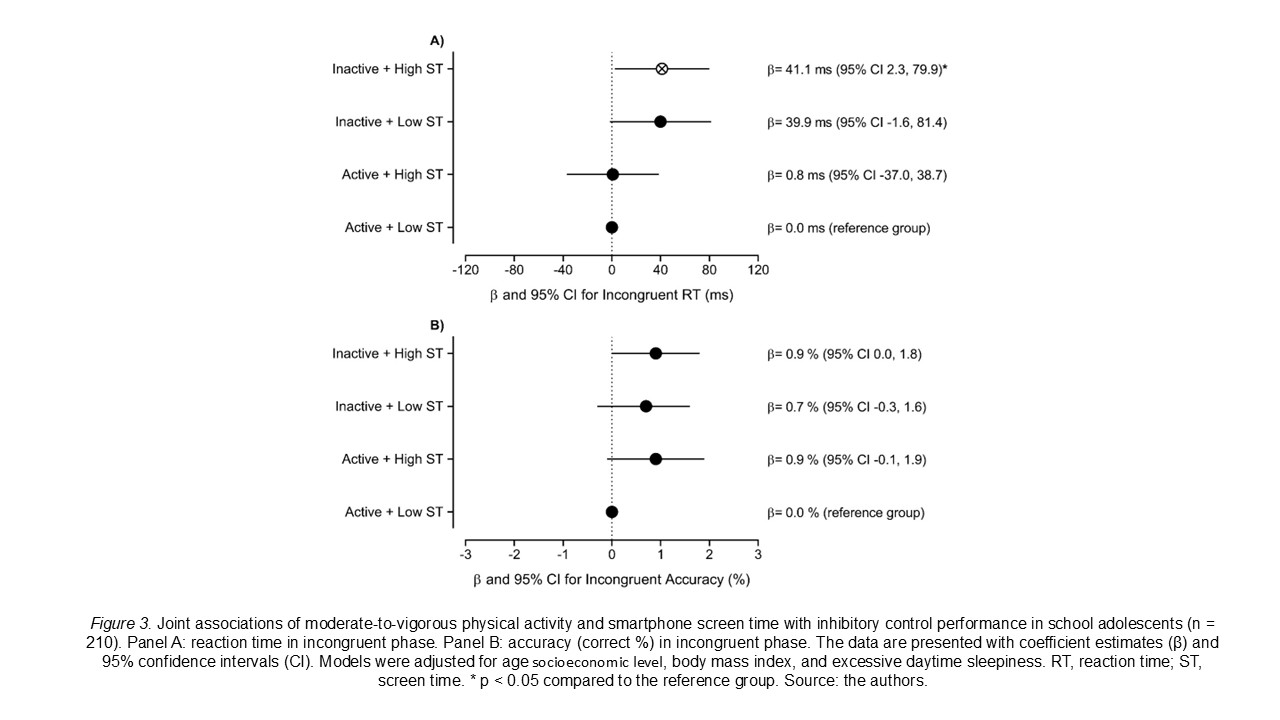
Figure 3
Joint associations of moderate-to-vigorous physical activity and smartphone screen time with inhibitory control performance in school adolescents (n = 210). Panel A: reaction time in incongruent phase. Panel B: accuracy (correct %) in incongruent phase. The data are presented with coefficient estimates (β) and 95% confidence intervals (CI). Models were adjusted for age socioeconomic level, body mass index, and excessive daytime sleepiness. RT, reaction time; ST, screen time. * p < 0.05 compared to the reference group
Source: the authors.
| Active + Low ST | Active + High ST | Inactive + Low ST | Inactive + High ST | |||||
| β (95% CI) | p | β (95% CI) | p | β (95% CI) | p | β (95% CI) | p | |
| Unadjusted model | ||||||||
| Congruent | ||||||||
| RT, ms | 0.0 | Ref. | 6.6 (-27.1, 40.2) | 0.702 | 44.0 (7.2, 80.9) | 0.019 | 34.5 (0.7, 68.2) | 0.046 |
| Accuracy, % | 0.0 | Ref. | 0.6 (-0.2, 1.3) | 0.136 | 0.7 (-0.1, 1.4) | 0.077 | 0.6 (-0.1, 1.3) | 0.112 |
| Incongruent | ||||||||
| RT, ms | 0.0 | Ref. | 3.1 (-35.8, 42.1) | 0.874 | 48.1 (6.5, 89.8) | 0.024 | 48.4 (10.8, 85.9) | 0.012 |
| Accuracy, % | 0.0 | Ref. | 0.9 (-0.1, 1.9) | 0.075 | 0.7 (-0.2, 1.6) | 0.141 | 0.9 (0.0, 1.9) | 0.052 |
| Adjusted model | ||||||||
| Congruent | ||||||||
| RT, ms | 0.0 | Ref. | 4.7 (-28.5, 37.8) | 0.782 | 37.0 (1.5, 72.5) | 0.041 | 27.3 (-7.2, 61.9) | 0.121 |
| Accuracy, % | 0.0 | Ref. | 0.6 (-0.2, 1.3) | 0.123 | 0.7 (0.0, 1.4) | 0.065 | 0.6 (-0.1, 1.3) | 0.085 |
| Incongruent | ||||||||
| RT, ms | 0.0 | Ref. | 0.8 (-37.0, 38.7) | 0.966 | 39.9 (-1.6, 81.4) | 0.060 | 41.1 (2.3, 79.9) | 0.038 |
| Accuracy, % | 0.0 | Ref. | 0.9 (-0.1, 1.9) | 0.064 | 0.7 (-0.3, 1.6) | 0.165 | 0.9 (0.0, 1.8) | 0.061 |
| Active + Low ST | Active + High ST | Inactive + Low ST | Inactive + High ST | ||
| EMM (95% CI) | EMM (95% CI) | EMM (95% CI) | EMM (95% CI) | p* | |
| Unadjusted model | |||||
| Congruent | |||||
| RT, ms | 446 (422, 471) | 453 (430, 476) | 490 (463, 518)a,b | 481 (457, 504)a | 0.040 |
| Accuracy, % | 98.5 (97.9, 99.1) | 99.1 (98.7, 99.5) | 99.2 (98.8, 99.5) | 99.1 (98.8, 99.4) | 0.347 |
| Incongruent | |||||
| RT, ms | 473 (445, 501) | 476 (449, 503) | 521 (490, 552)a,b | 521 (496, 546)a,b | 0.011 |
| Accuracy, % | 97.9 (97.1, 98.8) | 98.8 (98.3, 99.4) | 98.6 (98.2, 99.0) | 98.9 (98.4, 99.3) | 0.241 |
| Adjusted model | |||||
| Congruent | |||||
| RT, ms | 451 (425, 478) | 456 (435, 477) | 488 (463, 513) | 479 (456, 501) | 0.096 |
| Accuracy, % | 98.5 (97.8, 99.1) | 99.1 (98.7, 99.5) | 99.2 (98.8, 99.5) | 99.1 (98.8, 99.4) | 0.300 |
| Incongruent | |||||
| RT, ms | 478 (449, 508) | 479 (454, 504) | 518 (490, 547)b | 519 (495, 544)a,b | 0.045 |
| Accuracy, % | 97.9 (97.1, 98.8) | 98.9 (98.3, 99.5) | 98.6 (98.2, 99.0) | 98.8 (98.4, 99.3) | 0.234 |
4. Discussion
This study aimed to investigate the joint associations of MVPA and objectively measured smartphone ST with inhibitory control performance in school adolescents. The findings indicate a joint association of physical inactivity and high ST with poor inhibitory control task performance in the incongruent stimulus compared to those who are physically active. In addition, being physically inactive with low ST is associated with poor performance on the congruent stimulus compared to physically active with low ST.
In this present study, our results revealed an association of poorer performance in RT for physically inactive with high ST in both congruent and incongruent stimulus compared to physically active individuals with low ST among adolescents. Previous studies that adopted broader self-reported measures of ST, such as time spent on television, computer, and video games (Guerrero et al., 2019; Li et al., 2021; Syväoja et al., 2014; Walsh et al., 2018; Wickel, 2017; Wilhite et al., 2023; Zeng et al., 2021), our research focused exclusively on objectively measured smartphone ST. High smartphone ST may be associated with unhealthy behaviors that often persist into adulthood (Grimaldi-Puyana et al., 2020; Santos et al., 2023). For instance, adolescents who spend more time in front of screens tend to reduce their physical activity levels, decrease face-to-face social interaction by increasing their use of social media, all at the expense of time spent in front of screen (Grimaldi-Puyana et al., 2020; Santos et al., 2023). Furthermore, the consequences of these unhealthy behaviors can affect the brain's structure responsible for executive functions (Lissak, 2018). Interestingly, executive function may be a relevant predictor of physical activity (Gürdere et al., 2023). More specifically, the time spent in ST may be a determinant factor in enhancing executive function and participation in physical activity. However, not all content viewed on smartphone screens has a negative effect on executive functions; some may even enhance cognitive performance, depending on how the device is used and the purpose for which it is employed (Paulus et al., 2019).
In addition, although physically active adolescents with low ST completed the same number of correct responses in a faster RT, our results suggest that they exhibit greater inhibitory control. This is important to highlight that RT may be used as an efficiency index of cognitive performance (Tavares et al., 2021). In according with proficiency in both congruent and incongruent stimulus is crucial for real-world activities such as decision-making, self-regulation, and goal-directed behaviors (Diamond, 2020). It is noteworthy that the development of inhibitory control may be influenced by age due to brain maturation (Nelson et al., 2019). Considering that inhibitory control development significantly increases from 10 to 35 years old (Ferguson et al., 2021), adolescence emerges as a crucial phase in this process. These findings suggest that being physically inactive with high ST may be detrimental to adolescents inhibitory control development, and consequently, it may lead to functional impairments in real-world activities. In contrast, being physically active may be key to achieving benefits in inhibitory control.
There are multiple reasons proposed to support the benefits of being physically active. For example, during adolescence, several brain regions may participate in development (Casey et al., 2008). The prefrontal cortex and corticolimbic networks (i.e. amygdala, hippocampus, and striatum) are important regions that have a major function during adolescence, regulating decision-making, controlling inappropriate behavior and planning (Gee et al., 2013). These functions related to inhibitory control and are important for change behavior, especially being active and healthy (Li et al., 2021). Physical activity promoting increased cerebral blood flow and, consequently, greater availability of oxygen and nutrients necessary for neurotransmission metabolic processes plays an important key role in neuroplastic effects (Merege Filho et al., 2014; Ortiz Pulido & Ramírez Ortega, 2020). These physiological mechanisms dependent on physical activity may contribute to better cognitive performance on inhibitory control, as evidenced in physically active adolescents.
Additionally, no significant disparities in accuracy (correct % responses) were found between the groups in both stimulus on inhibitory control. It is important to note that all groups exhibited a high mean accuracy (≥ 97%), which is consistent with expectations for the age range of our sample (16.6 ± 1.2 years) (Dubuc et al., 2020). Typically, adolescents and adults tend to have higher accuracy in executive function tests compared to children (Chung-Fat-Yim et al., 2019; Goelz et al., 2023). Accuracy is directly related to the development of the prefrontal cortex, which matures significantly from childhood to adolescence, resulting in improvements in overall cognitive performance (Carbajal et al., 2019; Fandakova et al., 2017). Therefore, more accurate responses are associated with the suppression of inappropriate reactions, indicating better response inhibition (Schulz et al., 2024). However, according to our results, the lack of difference in accuracy suggests that accuracy may not be decisive in directing behavior changes or measuring improved efficiency of inhibitory control.
Our findings highlight the importance of regular physical activity and low smartphone ST, and their potentially positive combined impacts on adolescents’ inhibitory control. Therefore, it is essential for public policies to prioritize the implementation of programs that encourage the adoption of a more physically active lifestyle, with fewer screen-related sedentary behaviors, starting from adolescence, considering that behavior patterns established during this phase tend to persist into adulthood (Lounassalo et al., 2021). In this regard, physical activity programs integrated with ST reduction can be incorporated into schools as part of the regular curriculum, strengthening not only physical health but also cognitive and mental health among students (de Greeff et al., 2018; Wilhite et al., 2023). Additionally, it is crucial that schools design and implement curricula within physical education classes that target exposure to MVPA, as school-based physical activity interventions can enhance motivation and promote overall health and well-being (Kelso et al., 2020). Furthermore, physical activity is associated with improvements in executive functions, attention, and academic performance, which are critical for adolescent development (de Greeff et al., 2018). By fostering regular physical activity, schools can not only contribute to healthier and more engaged students but also help create a more positive and productive school environment.
This study has some limitations that need to be considered. Firstly, we opted for a cross-sectional design, which prevents establishing causal relationships. Therefore, conducting longitudinal studies is recommended to investigate the joint associations of MVPA and smartphone ST on the cognitive performance of school adolescents. Secondly, MVPA was subjectively measured through self-report in a questionnaire. Although this technique is validated, it is common for MVPA levels to be overestimated. Lastly, our sample was obtained conveniently from a federal public school in the northeast region of Brazil. Thus, it is necessary to interpret our results with caution, as their generalizability may not apply to adolescents from other schools and regions of the country. Additionally, we measured only the total smartphone usage time, without considering the consumed content and the participants' body position (whether they were sitting, lying down, or standing). Nevertheless, studies have shown that most young people use smartphones while sitting and for leisure purposes (Barkley & Lepp, 2016; Xiang et al., 2020).
5. Conclusion
In conclusion, physically inactive adolescents with high smartphone ST showed poorer inhibitory control compared to their physically active peers, regardless of smartphone usage time. These findings suggest the importance of promoting physical activity and reducing smartphone ST among adolescents as a potential strategy to enhance cognitive aspects, such as inhibitory control.
References
Associação Brasileira de Empresas de Pesquisa. (2024). Brazilian economic classification criteria. https://www.abep.org/criterio-brasil
Barkley, J. E., & Lepp, A. (2016). Mobile phone use among college students is a sedentary leisure behavior which may interfere with exercise. Computers in Human Behavior, 56, 29–33. https://doi.org/10.1016/j.chb.2015.11.001
Barkley, J. E., Lepp, A., & Salehi-Esfahani, S. (2016). College Students’ Mobile Telephone Use Is Positively Associated With Sedentary Behavior. American Journal of Lifestyle Medicine, 10(6), 437–441. https://doi.org/10.1177/1559827615594338
Best, O., & Ban, S. (2021). Adolescence: physical changes and neurological development. British Journal of Nursing, 30(5), 272–275. https://doi.org/10.12968/bjon.2021.30.5.272
Carbajal, I., O’Neil, J. T., Palumbo, R. T., Voss, J. L., & Ryals, A. J. (2019). Hemisphere‐specific effects of prefrontal theta‐burst stimulation on visual recognition memory accuracy and awareness. Brain and Behavior, 9(4), e01228. https://doi.org/10.1002/brb3.1228
Casey, B. J., Getz, S., & Galvan, A. (2008). The adolescent brain. Developmental Review, 28(1), 62–77. https://doi.org/10.1016/j.dr.2007.08.003
Chen, Y.-Y., Yim, H., & Lee, T.-H. (2023). Negative impact of daily screen use on inhibitory control network in preadolescence: A two-year follow-up study. Developmental Cognitive Neuroscience, 60, 101218. https://doi.org/10.1016/j.dcn.2023.101218
Chung-Fat-Yim, A., Himel, C., & Bialystok, E. (2019). The impact of bilingualism on executive function in adolescents. International Journal of Bilingualism, 23(6), 1278–1290. https://doi.org/10.1177/1367006918781059
de Brito Nunes, P. P., Abdon, A. P. V., de Brito, C. B., Silva, F. V. M., Santos, I. C. A., de Queiroz Martins, D., Fonseca Meira, P. M., & Frota, M. A. (2021). Fatores associados ao desempenho cognitivo de idosos da estratégia saúde da família. Ciência & Saúde Coletiva, 26(7), 2941–2952. https://doi.org/10.1590/1413-81232021267.08872021
da Costa, B. G. G., Chaput, J.-P., Lopes, M. V. V., Malheiros, L. E. A., da Silva, I. C. M., & Silva, K. S. (2021). Association between screen time and accelerometer-measured 24-h movement behaviors in a sample of Brazilian adolescents. Public Health, 195, 32–38. https://doi.org/10.1016/j.puhe.2021.03.029
de Greeff, J. W., Bosker, R. J., Oosterlaan, J., Visscher, C., & Hartman, E. (2018). Effects of physical activity on executive functions, attention and academic performance in preadolescent children: a meta-analysis. Journal of Science and Medicine in Sport, 21(5), 501–507. https://doi.org/10.1016/j.jsams.2017.09.595
Diamond, A. (2020). Executive functions. In A. Gallagher, C. Bulteau, D. Cohen, & J.L. Michaud (Eds.), Handbook of Clinical Neurology (Vol. 173, pp. 225–240). Elsevier. https://doi.org/10.1016/B978-0-444-64150-2.00020-4
Dubuc, M.-M., Aubertin‐Leheudre, M., & Karelis, A. D. (2020). Relationship between interference control and working memory with academic performance in high school students: The Adolescent Student Academic Performance longitudinal study (ASAP). Journal of Adolescence, 80(1), 204–213. https://doi.org/10.1016/j.adolescence.2020.03.001
Erickson, K. I., Hillman, C., Stillman, C. M., Ballard, R. M., Bloodgood, B., Conroy, D. E., Macko, R., Marquez, D. X., Petruzzello, S. J., & Powell, K. E. (2019). Physical Activity, Cognition, and Brain Outcomes: A Review of the 2018 Physical Activity Guidelines. Medicine & Science in Sports & Exercise, 51(6), 1242–1251. https://doi.org/10.1249/MSS.0000000000001936
Eriksen, C.W. (1995). The flankers task and response competition: A useful tool for investigating a variety of cognitive problems. Visual Cognition, 2(2-3), 101-118. https://doi.org/10.1080/13506289508401726
Fandakova, Y., Selmeczy, D., Leckey, S., Grimm, K. J., Wendelken, C., Bunge, S.A., & Ghetti, S. (2017). Changes in ventromedial prefontal and insultar cortex support the development of metamemory from childhood into adolescense. Proceedings of the National Academy of Sciences, 114(29), 7582-7587. https://doi.org/10.1073/pnas.1703079114
Felden, É. P. G., Carniel, J. D., Andrade, R. D., Pelegrini, A., Anacleto, T. S., & Louzada, F. M. (2016). Translation and validation of the Pediatric Daytime Sleepiness Scale (PDSS) into Brazilian Portuguese. Jornal de Pediatria, 92(2), 168–173. https://doi.org/10.1016/j.jped.2015.05.008
Ferguson, H. J., Brunsdon, V. E. A., & Bradford, E. E. F. (2021). The developmental trajectories of executive function from adolescence to old age. Scientific Reports, 11(1), 1382. https://doi.org/10.1038/s41598-020-80866-1
Gee, D. G., Humphreys, K. L., Flannery, J., Goff, B., Telzer, E. H., Shapiro, M., Hare, T. A., Bookheimer, S. Y., & Tottenham, N. (2013). A Developmental Shift from Positive to Negative Connectivity in Human Amygdala–Prefrontal Circuitry. The Journal of Neuroscience, 33(10), 4584–4593. https://doi.org/10.1523/jneurosci.3446-12.2013
Geertsen, S. S., Thomas, R., Larsen, M. N., Dahn, I. M., Andersen, J. N., Krause-Jensen, M., Korup, V., Nielsen, C. M., Wienecke, J., Ritz, C., Krustrup, P., & Lundbye-Jensen, J. (2016). Motor Skills and Exercise Capacity Are Associated with Objective Measures of Cognitive Functions and Academic Performance in Preadolescent Children. PLOS ONE, 11(8), e0161960. https://doi.org/10.1371/journal.pone.0161960
Goelz, C., Reuter, E.-M., Fröhlich, S., Rudisch, J., Godde, B., Vieluf, S., & Voelcker-Rehage, C. (2023). Classification of age groups and task conditions provides additional evidence for differences in electrophysiological correlates of inhibitory control across the lifespan. Brain Informatics, 10(11), 11. https://doi.org/10.1186/s40708-023-00190-y
Grimaldi-Puyana, M., Fernández-Batanero, J. M., Fennell, C., & Sañudo, B. (2020). Associations of Objectively-Assessed Smartphone Use with Physical Activity, Sedentary Behavior, Mood, and Sleep Quality in Young Adults: A Cross-Sectional Study. International Journal of Environmental Research and Public Health, 17(10), 3499. https://doi.org/10.3390/ijerph17103499
Guerrero, M. D., Barnes, J. D., Walsh, J. J., Chaput, J.-P., Tremblay, M. S., & Goldfield, G. S. (2019). 24-Hour Movement Behaviors and Impulsivity. Pediatrics, 144(3), e20190187. https://doi.org/10.1542/peds.2019-0187
Gürdere, C., Strobach, T., Pastore, M., & Pfeffer, I. (2023). Do executive functions predict physical activity behavior? A meta-analysis. BMC Psychology, 11(33). https://doi.org/10.1186/s40359-023-01067-9
Humer, E., Probst, T., Wagner-Skacel, J., & Pieh, C. (2022). Association of Health Behaviors with Mental Health Problems in More than 7000 Adolescents during COVID-19. International Journal of Environmental Research and Public Health, 19(15), 9072. https://doi.org/10.3390/ijerph19159072
Kelso, A., Linder, S., Reimers, A. K., Klug, S. J., Alesi, M., Scifo, L., Borrego, C. C., Monteiro, D., & Demetriou, Y. (2020). Effects of school-based interventions on motivation towards physical activity in children and adolescents: A systematic review and meta-analysis. Psychology of Sport and Exercise, 51, 101770. https://doi.org/10.1016/j.psychsport.2020.101770
Li, L., Yu, Q., Zhao, W., Herold, F., Cheval, B., Kong, Z., Li, J., Mueller, N., Kramer, A. F., Cui, J., Pan, H., Zhan, Z., Hui, M., & Zou, L. (2021). Physical Activity and Inhibitory Control: The Mediating Role of Sleep Quality and Sleep Efficiency. Brain Sciences, 11(5), 664. https://doi.org/10.3390/brainsci11050664
Lissak, G. (2018). Adverse physiological and psychological effects of screen time on children and adolescents: Literature review and case study. Environmental Research, 164, 149–157. https://doi.org/10.1016/j.envres.2018.01.015
Lounassalo, I., Hirvensalo, M., Palomäki, S., Salin, K., Tolvanen, A., Pahkala, K., Rovio, S., Fogelholm, M., Yang, X., Hutri-Kähönen, N., Raitakari, O. T., & Tammelin, T. H. (2021). Life-course leisure-time physical activity trajectories in relation to health-related behaviors in adulthood: the Cardiovascular Risk in Young Finns study. BMC Public Health, 21(533). https://doi.org/10.1186/s12889-021-10554-w
Lourenço, C. L. M., de Souza, T. F., & Mendes, E. L. (2019). Relationship between smartphone use and sedentary behavior: a school-based study with adolescents. Revista Brasileira de Atividade Física & Saúde, 24, 1–8. https://doi.org/10.12820/rbafs.24e0078
Merege Filho, C. A. A., Rodrigues Alves, C. R., Sepúlveda, C. A., dos Santos Costa, A., Lancha Junior, A. H., & Gualano, B. (2014). Influence of physical exercise on cognition: an update on physiological mechanisms. Revista Brasileira de Medicina Do Esporte, 20(3), 237–241. https://doi.org/10.1590/1517-86922014200301930
Meyer, C., Barbosa, D. G., Junior, G. J. F., Andrade, R. D., Santos Silva, D. A., Pelegrini, A., & Gomes Felden, É. P. (2018). Proposal of cutoff points for pediatric daytime sleepiness scale to identify excessive daytime sleepiness. Chronobiology International, 35(3), 303–311. https://doi.org/10.1080/07420528.2017.1400980
Mirwald, R. L., Baxter-Jones, A. D. G., Bailey, D. A., & Beunen, G. P. (2002). An assessment of maturity from anthropometric measurements. Medicine and Science in Sports and Exercise, 34(4), 689–694. https://doi.org/10.1249/00005768-200204000-00020
Nelson, M. B., O’Neil, S. H., Wisnowski, J. L., Hart, D., Sawardekar, S., Rauh, V., Perera, F., Andrews, H. F., Hoepner, L. A., Garcia, W., Algermissen, M., Bansal, R., & Peterson, B. S. (2019). Maturation of Brain Microstructure and Metabolism Associates with Increased Capacity for Self-Regulation during the Transition from Childhood to Adolescence. The Journal of Neuroscience: The Official Journal of the Society for Neuroscience, 39(42), 8362–8375. https://doi.org/10.1523/jneurosci.2422-18.2019
Ortiz Pulido, R., & Ramírez Ortega, M. L. (2020). Actividad física, cognición y rendimiento escolar: una breve revisión desde las neurociencias (Physical Activity, cognition, and academic performance: a brief review from the neurosciences). Retos, 3(38), 868–878. https://doi.org/10.47197/retos.v38i38.72378
Paulus, M. P., Squeglia, L. M., Bagot, K., Jacobus, J., Kuplicki, R., Breslin, F. J., Bodurka, J., Sheffield Morris, A., Thompson, W. K., Bartsch, H., & Tapert, S. F. (2019). Screen media activity and brain structure in youth: Evidence for diverse structural correlation networks from the ABCD study. NeuroImage, 185, 140–153. https://doi.org/10.1016/j.neuroimage.2018.10.040
Peng, S., Kuang, B., & Hu, P. (2019). Memory of ensemble representation was independent of attention. Frontiers in Psychology, 10, 228. https://doi.org/10.3389/fpsyg.2019.00228
Santos, R. M. S., Guimaraes Mendes, C., Yanq Sen Bressani, G., de Alcantara Ventura, S., de Almeida Nogueira, Y. J., de Miranda, D. M., & Romano-Silva, M. A. (2023). The associations between screen time and mental health in adolescents: a systematic review. BMC Psychology, 11(127). https://doi.org/10.1186/s40359-023-01166-7
Schulz, D., Lenhard, W., Mangold, M., Schindler, J., & Richter, T. (2024). Balancing accuracy and speed in the development of inhibitory control. Journal of Experimental Child Psychology, 243, 105915. https://doi.org/10.1016/j.jecp.2024.105915
Suchan, F., Kopf, J., Althen, H., Reif, A., & Plichta, M. M. (2019). Reliable and efficient recording of the error-related negativity with a speeded Eriksen Flanker Task. Acta Neuropsychiatrica, 31(3), 135–142. https://doi.org/10.1017/neu.2018.36
Syväoja, H. J., Tammelin, T. H., Ahonen, T., Kankaanpää, A., & Kantomaa, M. T. (2014). The Associations of Objectively Measured Physical Activity and Sedentary Time with Cognitive Functions in School-Aged Children. PLoS ONE, 9(7), e103559. https://doi.org/10.1371/journal.pone.0103559
Tavares, V. D. O., da Costa, K. G., Cabral, D. A. R., Rego, M. L. M., Price, M., & Fontes, E. B. (2021). Cardiorespiratory Fitness Predicts Higher Inhibitory Control in Patients With Substance Use Disorder. Journal of Clinical Sport Psychology, 15(1), 4–19. https://doi.org/10.1123/jcsp.2019-0026
Tremblay, M. S., Aubert, S., Barnes, J. D., Saunders, T. J., Carson, V., Latimer-Cheung, A. E., Chastin, S. F. M., Altenburg, T. M., & Chinapaw, M. J. M. (2017). Sedentary Behavior Research Network (SBRN) – Terminology Consensus Project process and outcome. International Journal of Behavioral Nutrition and Physical Activity, 14(1), 75. https://doi.org/10.1186/s12966-017-0525-8
Vancampfort, D., Firth, J., Smith, L., Stubbs, B., Rosenbaum, S., Hallgren, M., Van Damme, T., & Koyanagi, A. (2021). Association between physical activity and leisure-time sedentary behavior among 140,808 adolescents aged 12 to 15 from 47 low- and middle-income countries. Public Health, 199, 1–9. https://doi.org/10.1016/j.puhe.2021.08.001
Victal Gomes, R., Rodrigues dos Santos, J. P., Morais do Nascimento, J. V., Almeida Alves, A., Lins dos Santos, B., de Souza Bezerra, E., da Silva Barbosa, S. L., Deuel de O. Tavares, V., Almeida Ramos, I., Pereira Cabral, L. L., & Vieira Browne, R. A. (2025). Data base of Joint associations of moderate-to-vigorous physical activity and smartphone screen time with inhibitory control performance in adolescents. Pensar en Movimiento: Revista de Ciencias del Ejercicio y la Salud, 23(1). https://doi.org/10.15517/pensarmov.v23i1.65251
von Elm, E., Altman, D. G., Egger, M., Pocock, S. J., Gøtzsche, P. C., & Vandenbroucke, J. P. (2014). The strengthening the reporting of observational studies in epidemiology (STROBE) statement: Guidelines for reporting observational studies. International Journal of Surgery, 12(12), 1495–1499. https://doi.org/10.1016/j.ijsu.2014.07.013
Walk, A. M., Raine, L. B., Kramer, A. F., Cohen, N. J., Khan, N. A., & Hillman, C. H. (2017). Differential Effects of Carbohydrates on Behavioral and Neuroelectric Indices of Selective Attention in Preadolescent Children. Frontiers in Human Neuroscience, 11, 614. https://doi.org/10.3389/fnhum.2017.00614
Walsh, J. J., Barnes, J. D., Cameron, J. D., Goldfield, G. S., Chaput, J.-P., Gunnell, K. E., Ledoux, A.-A., Zemek, R. L., & Tremblay, M. S. (2018). Associations between 24 hour movement behaviours and global cognition in US children: a cross-sectional observational study. The Lancet. Child & Adolescent Health, 2(11), 783-791. https://doi.org/10.1016/S2352-4642(18)30278-5
World Health Organization. (2006). WHO Child Growth Standards: Length/Height-for-Age, Weight-for-Age, Weight-for-Length, Weightfor-Height and Body Mass Index-for-Age: Methods and Development. https://www.who.int/publications/i/item/924154693X
Wickel, E. E. (2017). Sedentary Time, Physical Activity, and Executive Function in a Longitudinal Study of Youth. Journal of Physical Activity and Health, 14(3), 222–228. https://doi.org/10.1123/jpah.2016-0200
Wilhite, K., Booker, B., Huang, B.-H., Antczak, D., Corbett, L., Parker, P., Noetel, M., Rissel, C., Lonsdale, C., del Pozo Cruz, B., & Sanders, T. (2023). Combinations of Physical Activity, Sedentary Behavior, and Sleep Duration and Their Associations With Physical, Psychological, and Educational Outcomes in Children and Adolescents: A Systematic Review. American Journal of Epidemiology, 192(4), 665-679. https://doi.org/10.1093/aje/kwac212
World Health Organization. (2020). WHO guidelines on physical activity and sedentary behaviour. https://www.who.int/publications/i/item/9789240015128
World Health Organization. (2021). Global school-based student health survey.https://www.who.int/teams/noncommunicable-diseases/surveillance/systems-tools/global-school-based-student-health-survey
Xiang, M.-Q., Lin, L., Wang, Z.-R., Li, J., Xu, Z., & Hu, M. (2020). Sedentary Behavior and Problematic Smartphone Use in Chinese Adolescents: The Moderating Role of Self-Control. Frontiers in Psychology, 10, 3032. https://doi.org/10.3389/fpsyg.2019.03032
Yen, C., Lin, C.-L., & Chiang, M.-C. (2023). Exploring the Frontiers of Neuroimaging: A Review of Recent Advances in Understanding Brain Functioning and Disorders. Life, 13(7), 1472. https://doi.org/10.3390/life13071472
Zeng, X., Cai, L., Heung-sang Wong, S., Lai, L., Lv, Y., Tan, W., Jing, J., & Chen, Y. (2021). Association of Sedentary Time and Physical Activity With Executive Function Among Children. Academic Pediatrics, 21(1), 63-69. https://doi.org/10.1016/j.acap.2020.02.027
Notes
Información adicional
redalyc-journal-id: 4420