ARTICLES
Received: 18 December 2017
Accepted: 24 April 2018
DOI: https://doi.org/10.5433/1679-0359.2018v39n5p2233
Abstract: More than half of the milk in Brazil comes from family-owned dairy farms, which account for 84.4% of all dairy farms. Despite this, little is known about family-owned dairy farms, especially those in the western Amazon. As such, the objective of this study was to analyze and characterize the production, sanitary conditions, reproductive rates, and milk quantities produced on 100 family dairy farms in Vale do Acre, in the western Amazon. The data were collected from March to June 2016, using a semi-structured questionnaire containing 549 questions. The answers given by producers, as well as local observations were registered in SPSS® spreadsheets, and descriptive statistics were used to summarize the data. Results indicated low rates of productivity, low total milk production, and low quantities of milk/cow/day. The data also revealed sanitary and productive problems such as inadequate herd composition, lack of grouping of lactating cows, and short duration of lactation. In addition, not all heifers were immunized against brucellosis, and there was often an absence of water troughs. We concluded that it is necessary to improve the management of family-owned farms, and take technical assistance measures to correct weak points in dairy cow health and reproduction. Moreover, it is essential to improve productivity to raise the profitability of rural dairy farms.
Key words: Acre, Amazon, Dairy farming Diagnosis, Dairy farming, Rural development.
Resumo: Objetivou-se caracterizar 100 propriedades leiteiras, em regime de economia familiar, da Mesorregião do Vale do Acre, na Amazônia Ocidental, no que diz respeito aos aspectos produtivos, sanitários, reprodutivos e de qualidade do leite. Os dados foram coletados no período de março a junho de 2016, a partir de um formulário semiestruturado, contendo 549 questões, por meio da observação in loco, bem como pelas respostas obtidas com os proprietários; e cadastrados em planilhas do SPSS®. Adotou-se a estatística descritiva. Evidenciaram-se baixos índices de produtividade, de produção de leite total e de quantidade de leite/vaca/dia. Essas propriedades também apresentaram problemas sanitários e produtivos tais como: composição do rebanho inadequada, ausência de agrupamento das vacas lactantes, baixa persistência de lactação, não vacinar todas as bezerras contra brucelose e ausência de bebedouros. Concluiu-se que são necessárias ações que visem à melhoria do manejo das propriedades, e de medidas para correção dos pontos fracos na sanidade e na reprodução, pautadas na assistência técnica. Além disso, é fundamental a melhoria da produtividade o que, consequentemente, elevará a rentabilidade das propriedades rurais.
Palavras-chave: Acre, Amazônia, Desenvolvimento rural, Diagnóstico propriedades leiteiras, Pecuária leiteira.
Introduction
Milk is produced and consumed by people all over the world. The importance of milk is reflected in production and economic environments all over the world, especially in developing countries and in family farming systems (FAO, 2017). In Brazil, dairy farming is of great importance, both in social and economic contexts, as it plays an important role in promoting income distribution. It is also fundamental for the development of family-based agriculture (EURICH et al., 2016), as more than half (58%) of the milk produced in Brazil comes from family-owned dairy farms, which account for 84.4% of all dairy farms (DIEESE, 2011).
In the State of Acre, Brazil, dairy farming is characterized by the predominance of production systems with a low technological level, mostly in the areas of nutrition, genetics, health, and infrastructure (ANDRADE et al., 2014). Dairy farms in Acre are in need of technical and managerial efforts, which, according to Lopes et al. (2015a), can increase productivity and profitability.
However, little is known about these dairy farms. Characterization studies are needed to implement programs to correct weak production points, and to identify the limitations and perspectives of the productive sector, as well as to implement regional development projects and create public policies to regulate dairy farming in the state. Bovine milk production generates employment and income for a substantial number of rural families in the western Amazon. However, economic, technological, managerial, and professional qualification problems in production units lack consistent solutions. Therefore, due to the inexistence of research related to the subject in the region, the objective of this research was to characterize 100 family-owned dairy farms in the mesoregion of Vale do Acre.
Materials and Methods
The research was carried out in 100 family-owned dairy farms located in the mesoregion of Vale do Acre, in the western Amazon, between March and June 2016. The geographic area studied covers 73.6% of the municipalities in the State of Acre, i.e. 14 out of a total of 19. These municipalities include the following (shown as the name of municipality and the number of family-owned dairy farms in that municipality included in the study): Acrelândia (six), Assis Brasil (three), Brasiléia (seven), Bujari (four), Capixaba (eight), Epitaciolândia (seven), Manoel Urbano (four), Plácido de Castro (11), Porto Acre (six), Rio Branco (16), Santa Rosa dos Purus (five), Sena Madureira (12), Senator Guiomard (nine), and Xapuri (two). The dairy farms were selected randomly (GUDKOVA et al., 2016) from a list provided by the Secretaria de Agropecuária do Estado (SEAP - State Secretariat of Agriculture and Livestock) and the Secretaria de Extensão Agroflorestal e Produção Familiar do Estado do Acre (SEAPROF - Secretariat of Agroforestry Extension and Family Production of the State of Acre), independently of the volume of milk sold or the type of production system. Dairy farmers were interviewed on their farms. The number of interviewees was estimated according to Barbetta (2003), considering a maximum sample error of 5%.
A semi-structured questionnaire containing 549 questions adapted from Lopes et al. (2016b) was used for interviews and data collection. The questions were divided into the following subjects: producer and property registration (52 questions), herd characterization (12 questions), and milk production (485 questions). The last topic includes production system, agricultural practices, nutritional management, infrastructure, zootechnical bookkeeping, animal identification, and reproductive management.
The data were tabulated in SPSS® software, and we used descriptive statistics to calculate mean, standard deviation, median, interquartile range, minimum and maximum values (LOPES et al., 2015b).
Results and Discussion
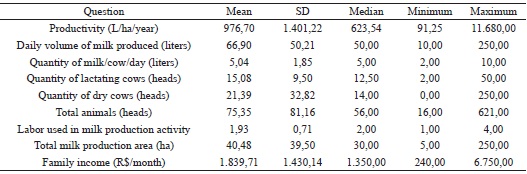
The characterization of milk-producing properties in the mesoregion of Vale do Acre allowed us to identify the management techniques used, which can help producers identify the most critical points in the production system. We recorded a mean productivity of 976.7 L ha-1 year (Table 1), which is much lower than the productivity found by Ferrazza et al. (2015) (10,816.1 L/ha/year) in family-owned farms in Minas Gerais, and by Moraes et al. (2016) (13,085.59 L/ha/year) in family-owned farms in Rio de Janeiro. The high standard deviation found (Table 1) is due to the great heterogeneity in productivity among the properties studied. The mean daily volume of milk produced was 66.90 L (Table 1), and the mean daily volume of milk produced by each lactating cow (lc) was 5.04 L (L/lc/day). This mean is higher than the national mean, which was reported as 1.70 L/lc/day in 2016 (IBGE, 2016). It is worth emphasizing that the productivity per lactating cow has a direct influence on land and animal productivity, and, consequently, on the profitability of the farm. Lopes et al. (2012) showed that many managerial and technological measures must be implemented to increased daily productivity means, but ideally these improvements would be made without increasing the mean variable cost. According to previous studies, one option is to increase productive efficiency, that is, the productivity per cow. This will optimize costs associated with labor, drugs, artificial insemination, fixed taxes, energy, and others, as an increased productivity per cow will not increase these costs.
Descriptive statistics of the characteristics of the 100 dairy farms studied in the mesoregion of Vale do Acre, from March to June 2016.
SD: Standard deviation.
The average herd composition was inadequate, since there were, on average, only 15.08 lactating cows in herds that had a mean of 75.35 animals, meaning that only 20.01% of the animals were lactating cows (Table 1). This rate is well below the ideal composition of 42% lactating cows (CAMPOS; FERREIRA, 2009). Good planning and adequate herd composition raise the probability of greater economic efficiency and increased income from animal sales, which, according to Lopes et al. (2011) represents about 20% of total revenues on dairy farms. The dairy farms had an average of 1.93 workers involved in running the farms (Table 1).
The total mean area used for milk production on the family-owned farms was 40.48 hectares (Table 1). It is essential to produce more milk in a smaller area, which requires a more efficient use of land (DIAS-FILHO, 2011), and reduces the land remuneration (fixed cost component) through optimization (LOPES et al., 2008), with a consequent increase in profitability. The mean monthly family income was R$1,839.71 (Table 1).
It is important to mention that all measures of productivity must be improved with the implementation of technical assistance. According to Nascimento and Pinto (2017), a lack of technical assistance often reduces the productive potential of dairy farms, reducing productivity, profitability, and competitiveness.
All dairy farms included in this study used the pasture production system (Table 2). In the mesoregion of Vale do Acre there is a tendency to produce grazing milk, with the objective of reducing production costs due to the high price of concentrated cattle feed in the region. According to Ribeiro Filho et al. (2007), grazed forage is the most economical way to provide energy and protein for ruminant animals, but it is essential to have a satisfactory quantity and quality of grazed forage.
Herd characteristics and production systems of the 100 dairy farms studied in the mesoregion of Vale do Acre, from March to June 2016.
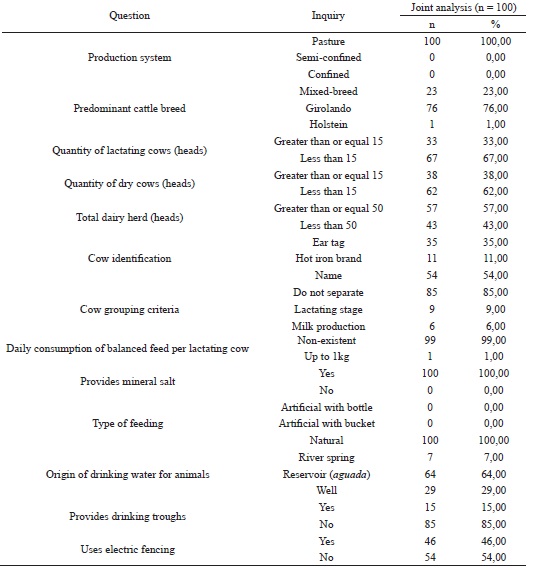
Only one dairy farm (1%) had Holstein cattle; the others had mixed-breed cattle (23%), and Girolando cattle (76%) (Table 2). In tropical countries, milk production is limited by the low productive levels of native breeds, and by the adaptive difficulties of European breeds, which results in low productivity, high age at first calving, and long calving intervals. These factors contribute to an underdeveloped dairy industry (VASCONCELLOS et al., 2003).
Regarding animal identification, 54% of dairy farmers identified cows by name, 11% used hot iron branding, and 35% used ear tags (Table 2). According to Lopes (1997), a reliable means of identifying animals is the basis for all functions of a management system, including zootechnical processes, control, and production.
Most dairy farms (85%) did not group lactating cows (Table 2). Animal grouping involves the creation of groups that will be as uniform as possible in size, age, production, and lactation stage and/or reproductive condition (SILVA; SILVA, 2016). It is an important practice because the animals can be fed with specific diets, which means nutritional requirements can be more accurately met (CARRIJO et al., 2008).
The daily supply of balanced feed per lactating cow occurred on only one dairy farm (1%) (Table 2). Deresz (2001) reports that efficient quantities of concentrate feed supplementation for dairy cows in pasture-based systems varies from 0.50 to 0.90 kg of milk/kg of concentrate feed in the rainy season, and 0.80 to 0.95 in the dry season. Mineral salt supplementation was reported in all dairy farms (Table 2).
Farmers on all dairy farms included in this study reported natural calf suckling (Table 2). According to Van Amburgh and Drackley (2005), conventional feeding practices generally do not meet the nutritional requirements of dairy calves. Virgínio Junior et al. (2016) reported that artificial feeding of calves provides the correct amount of milk in the first weeks of life, stimulating optimal growth, and adaptation to bulky and concentrated diets.
A structural problem that we observed, based on our data, is that 85% of the included dairy farms did not have drinking troughs (Table 2). Troughs have better accessibility and offer better quality fresh and clean water, according to the animals' ingestion needs, which preserves the animals' energy and reduces hierarchical disputes, thus offering productivity gains (TAVARES; BENEDETTI, 2012). In addition, in most of the dairy farms (64%) the animals drank water from large reservoirs called aguadas, which are dug in the pasture during the dry season, and fill up in the rainy season. These reservoirs alter the physical characteristics of water, such as temperature, color, and turbidity, as well as its organoleptic characteristics such as appearance, taste, and odor, and may be unsuitable for drinking purposes (WHO, 1993). Water quantity and quality are fundamental for the production process, since they directly interfere in cattle nutrition (BIZINOTO, 2002).
The use of electrified fencing occurred in 46% of the dairy farms (Table 2). According to Torres et al. (2007), this technology allows cost reduction in production systems, increasing efficiency and profits in dairy farming. When properly planned and used, electrified fences can reduce grazing division costs by up to 80% in comparison to barbed wire fences.
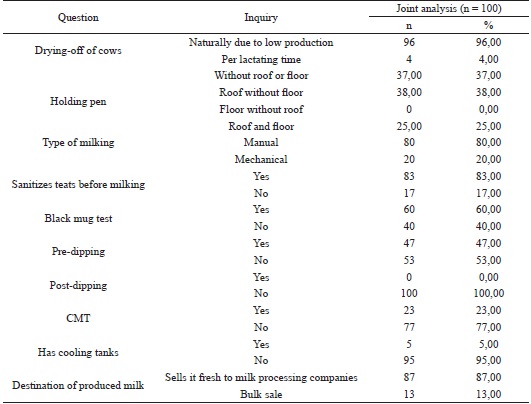
One of the greatest problems observed in 96% of the dairy farms is related to drying-off the cows (Table 3). Most animals dried-off naturally well before the ideal 305 days period because of low persistence of lactation (LOPES et al., 1996). This is due to the genetic and nutritional standards of the herds included in this study.
Characterization of milk production on the 100 dairy farms studied in the mesoregion of Vale do Acre, from March to June 2016.
CMT: California mastitis test.
Regarding holding pens, in 37% of the dairy farms they had no roof or floor (Table 3). The design of holding pens is among the strategic problems related to animal production, and, in some cases, may be responsible for the failure of production systems (SILVA et al., 2002). In Brazil, zootechnical constructions, such as holding pens, provide more comfort and minimize stress for dairy cattle in the pre-milking stage (BUCKLIN et al., 1991), improving productivity.
The dairy farms included in our study had different milking systems, and only 20% of the farms had a mechanical milking machine (Table 3). The current milk production scenario demands high quality labor and an adequate number of workers, which are scarce and costly due to the rural exodus, among other factors (MACULAN; LOPES, 2016). Therefore, Hansen (2015) recommended the use of milking equipment to minimize the need for human labor.
With regards to teat hygiene before milking, 83% of the producers follow this practice. Sixty percent of the producers used the black mug test (Table 3). According to Santos and Fonseca (2007), this test is important to identify animals with clinical mastitis. However, producers should also worry about the subclinical form of mastitis, which has greater epidemiological importance (BLOOD; RADOSTITIS, 1991). To diagnose it, it is necessary to use complementary tests such as the California mastitis test (CMT). However, only 23% of the dairy farms used the CMT test (Table 3). The prevention of mastitis is very important, due to its high economic impact, estimated by Demeu et al. (2016) at US$493.03, US$ 813.78, and US$ 1,134.53 per year per lactating cow at production rates production of 10; 20, and 30 L/day, respectively.
Pre-dipping was used in only 47% of the dairy farms (Table 3). Disinfection is one of the most important aspects of disease prevention for dairy cattle (BODDIE et al., 1997). None of the dairy farms used post-dipping (Table 3) because of the natural feeding system adopted. In this system the calves feed from their mothers after milking, and are separated hours later.
The use of milk cooling tanks in the studied dairy farms was rare, and only 5% of the dairy farms used these (Table 3). It is important to emphasize that better quality milk has a higher concentration of total solids and protein, and a lower total concentration of bacteria (DEITOS et al., 2010). In addition, it is mandatory to refrigerate milk since the IN51 (BRASIL, 2002), and this procedure inhibits bacterial growth, reducing economic losses caused by acidification, and prolonging milk storage time (PINTO et al., 2006).
Most producers (87%) sold fresh milk to dairy product companies (Table 3). However, the informal sale of milk transported on motorcycles, bicycles, and even horses, stored in disposable bottles without refrigeration and hygiene control, is still a widespread practice in rural areas of the State of Acre. Hygiene control of milk, as well as the control of storage temperature for raw milk, are fundamental for the quality of raw dairy material and its derivatives (LIMA et al., 2016).
Regarding the health of the herds, only 10% of the dairy farms followed an immunization calendar (Table 4). The only vaccine used by all owners was against foot-and-mouth disease, which is mandatory by law. The immunization against brucellosis is also mandatory, but was not done in all dairy farms (94%) (Table 4).
Characterization of some health aspects of cattle on the 100 dairy farms studied in the mesoregion of Vale do Acre, from March to June 2016.
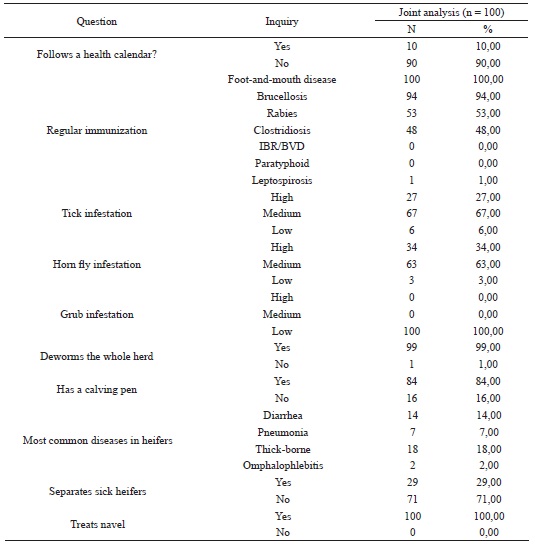
Most of the dairy farms had a medium degree of horn fly (Haematobia irritans) (63%) and tick (67%) infestation (Table 4). The damage attributed to tick infestation is related to the transmission of pathogens (anthrax, leucosis, anaplasmosis, and the helminth Stephanofilaria sp.) (GRISI et al., 2014). In addition to this transmission, the tick parasite increases stress in cattle (JORGE et al., 2016), decreasing productivity. The incidence of grubs (Dermatobia hominis) in the mesoregion of Vale do Acre is minimal, and all dairy farmers reported a low infestation levels on their farms. All producers reported deworming the entire bovine population on their farms. One of the tick-borne diseases, known in Brazil as tristeza parasitária bovina (TPB), was the most frequent disease in 18% of the dairy farms (Table 4).
There was a calving pen in 84% of the dairy farms (Table 4). It is worth emphasizing that the absence of a calving pen is a matter of concern, since its main purpose is to closely watch the cows and monitor births in case intervention is necessary, and helps ensure that calves are born in due time and in an appropriate environment (COELHO et al., 2009).
Our data indicated that sick heifers were not separated from the rest of the herd in 71% of the dairy farms (Table 4). This is a serious problem, as it can result in the infection of the other animals. Among all categories of cattle, heifers are the most susceptible to disease. Gonçalves (2009) pointed out that the incidence of most health problems in heifers can be managed at economically acceptable levels if the producer implements well-designed preventive health programs that combine standard operational procedures that include all aspects of heifer rearing.
All producers treated navel infections in calves (Table 4). This management is a mandatory practice in calf rearing. The treatment includes the use of antiseptics, curative, and preventative drugs (PEREIRA, 2004), avoiding omphalophlebitis.
Pastures were considered to be of regular quality in 72% of the dairy farms (Table 5). In cattle production systems based only on the use of forage as a source of nutrients, animal performance may be lower than desired (MESACASA et al., 2015). In case of pastures considered to be of regular quality and quantity, as in this study, the diet may be influenced, since grazing animals are selective (HODGSON; BROOKES, 1999), affecting their voluntary consumption and, consequently, the consumption of dry matter. Invasive plants were present in 98% of the pastures (Table 5).
Characterization of some zootechnical and reproductive aspects of the 100 dairy farms studied in the mesoregion of Vale do Acre, from March to June 2016.
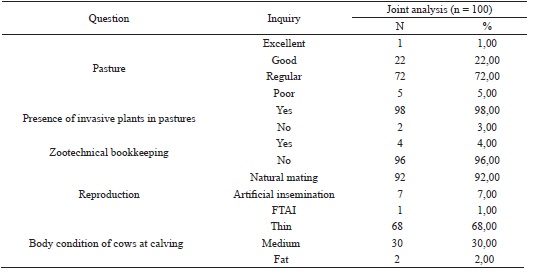
FTAI: Fixed time artificial insemination.
Zootechnical bookkeeping was not a practice in 96% of the dairy farms included in this study (Table 5). The main objective of this practice is to obtain information that is highly necessary for planning, monitoring, managing, and decision-making in any milk production system (BORGES et al., 2011). Regarding reproduction, 92% of the producers (Table 5) used natural mating as the reproductive management.
Most dairy farms (68%) reported having animals with poor body condition at birth. The loss of body weight in this period, and the establishment of a negative energy balance may have a negative influence on the return to estrus and ovarian activity in cattle (MBAYAHAGA et al., 1998). Body score is a determining factor for a shorter recovery time of the endometrium and a faster return to estrus, promoting shorter calving intervals (BARBOSA et al., 2016) and, thus, increasing productivity.
Considering the dynamic nature of production environments, the identification, quantification, and establishment of technical-managerial and zootechnical reference practices have a practical use in the professional environment, and should be taken into consideration by rural company managers and professionals who work with technical assistance and rural development (FERRAZZA et al., 2015). Based on the data collected from the dairy farms included in this study, we believe that there is a need for technical assistance, and for producers and employees with greater knowledge of appropriate management of dairy farms. This will allow for the implementation of measures using appropriate management tools (LOPES et al., 2016a), so that the weak points can be minimized, better results can be obtained, and, consequently, profitability can be improved.
Conclusions
The farmers on dairy farms included in this study reported low productivity, low total milk production, and a low quantity of milk/cow/day. These dairy farms also had health and production problems such as inadequate herd composition, no grouping of lactating cows, low lactation persistence, partial immunization of heifers against brucellosis, and no drinking troughs.
Acknowledgments
We thank FAPEMIG (Fundação de Amparo a Pesquisa de Minas Gerais - Foundation for Research Support of Minas Gerais), FAPAC (Fundação de Amparo a Pesquisa do Acre - Foundation for Research Support of Acres), and CNPq (Conselho Nacional de Desenvolvimento Científico e Tecnológico - National Council for Scientific and Technological Development), for their support during this research.
Referências
ANDRADE, C. M. S.; SÁ, C. P.; CAVALCANTE, A. Sistema de produção de leite a pasto no Acre. Rio Branco: Sistemas de Produção EMBRAPA, 2014. 45 p. (Comunicado técnico). Disponível em: <https://www.spo.cnptia.embrapa.br/conteudo?p_p_id=conteudoportle>. Acesso em: 14 jul. 2017.
BARBETTA, P. A. Estatística aplicada às ciências sociais. 7. ed. Florianópolis: Editora da UFSC, 2003. 118 p.
BARBOSA, L. P.; RODRIGUES, J. D.; GUIMARÃES, C. A. A.; TORRES, G. R.; CARVALHO, L. S.; AMORIM, P. A.; DUTRA. Influência da condição corporal ao parto no balanço energético e desempenho reprodutivo de cabras leiteiras no pós-parto. Arquivos Brasileiros de Medicina Veterinária e Zootecnia, Belo Horizonte v. 68, n. 5, p. 1283-1291, 2016.
BIZINOTO, A. L. Instalações e equipamentos para bovinos de corte. In: SIMPÓSIO GOIANO SOBRE MANEJO E NUTRIÇÃO DE BOVINOS, 4., 2002, Goiânia. Anais... Goiânia: CBNA, 2002. p. 35-54.
BLOOD, D. C.; RADOSTITIS, O. M. Clínica veterinária. 7. ed. Rio de Janeiro: Guanabara Koogan, 1991. cap. 15. 1263 p.
BODDIE, R. L.; NICKERSON, S. C.; ADKINSON, R. W. Efficacies of teat germicides containing 0. 5% chlorhexidine and 1% iodine during experimental challenge with Staphylococcus aureus and Streptococcus agalactiae. Journal of Dairy Science, Champaign v. 80, n. 11, p. 2809-2814, 1997.
BORGES, I.; SILVA, A. G. M.; ALBUQUERQUE, F. H. M. A. R. Escrituração zootécnica e sua importância no gerenciamento da caprinoculturura. Itapetinga: Universidade Estadual do Sudoeste da Bahia 2011. 16 p. (Equipe de pesquisa em caprinos e ovinos).
BRASIL. Ministério da Agricultura, Pecuária e Abastecimento. Instrução Normativa n° 51, de 20 de setembro de 2002. Aprova os regulamentos técnicos de produção, identidade e qualidade do leite tipo... Diário Oficial [da] União, Brasília, 18 set. 2002. Seção 1. p. 13-49.
BUCKLIN, R. A.; BEEDE, D. K.; BRAY, D. R. Methods to relieve heat stress for dairy cows in hot, humid climates. Applied Engineer Agricultural, Saint Joseph v. 7, n. 2, p. 241-252, 1991.
CAMPOS, A. T.; FERREIRA, A. M. Composição do rebanho e sua importância no manejo. 4. ed. Juiz de Fora: Ed. EMBRAPA Gado de Leite, 2009. 84 p.
CARRIJO, M. S.; LINHARES, W. D.; BARCELOS, K. A. Descrição do manejo produtivo, reprodutivo e sanitário de 10 rebanhos leiteiros localizados em 7 municípios do estado de Goiás. Pubvet, Maringá v. 2, n. 28, p. 279-294, 2008.
COELHO, S. G.; GONÇALVES, L. C.; COSTA, T. C.; FERREIRA, C. S. Alimentação de bezerras. In: GOLÇALVES, L. C.; BORGES, I.; FERREIRA, P. D. S. Alimentação de gado leiteiro. 3. ed. Belo Horizonte: Ed. FEPMVZ, 2009. p. 50-98.
DEITOS, A. C.; MAGGIONI, D.; ROMERO, E. A. Produção e qualidade de leite de vacas de diferentes grupos genéticos. Campo Digit@l, Campo Mourão, v. 5, n. 1, p. 26-33, 2010.
DEMEU, F. A.; LOPES, M. A.; COSTA, G. M.; ROCHA, C. M. B. M.; SANTOS, G. Efeito da produtividade diária de leite no impacto econômico da mastite em rebanhos bovinos. Boletim da Indústria Animal, Nova Odessa v. 73, n. 1, p. 53-61, 2016.
DEPARTAMENTO INTERSINDICAL DE ESTATÍSTICA E ESTUDOS SOCIOECONÔMICOS - DIEESE. Estatísticas do meio rural 2010-2011. 4. ed. São Paulo: Ed. DIEESE/NEAD/MDA, 2011. 292 p.
DERESZ, F. Produção de leite de vacas mestiças Holandês x Zebu em pastagem de capim Elefante, manejada em sistema rotativo com e sem suplementação durante a época das chuvas. Revista Brasileira de Zootecnia, Viçosa, MG v. 30, n. 1, p. 197-204, 2001.
DIAS-FILHO, M. B. Os desafios da produção animal em pastagens na fronteira agrícola brasileira. Revista Brasileira de Zootecnia, Viçosa, MG v. 1, n. 2, p. 2-10, 2011.
EURICH, J.; WEIRICH NETO, P. H. W.; ROCHA, C. H. Pecuária leiteira em uma colônia de agricultores familiares no município de Palmeira, Paraná. Revista Ceres, Viçosa, MG v. 63, n. 6, p. 454-460, 2016.
FERRAZZA, R. A.; LOPES, M. A.; MORAES, F. M.; BRUHN, F. R. P.. Índices de desempenho zootécnico e econômico de sistemas de produção de leite com diferentes níveis tecnológicos. Semina: Ciências Agrárias, Londrina, v. 36, n. 1, p. 485-496, 2015
FOOD AND AGRICULTURE ORGANIZATION OF THE UNITED NATIONS - FAO. Dairy production and products - milk production. Rome: Stylus Publishing, 2017. Available at: <http://www.fao.org/agriculture/dairygateway/milk-production/en/#.V3AZwbgrLIV>. Accessed at: 24 june 2016.
GONÇALVES, R. C. O sistema respiratório na sanidade de bezerros. Ciência Animal Brasileira, Goiânia v. 1, n. 2, p. 173-189, 2009.
GRISI, L.; LEITE, C. R.; MARTINS, S. R. J.; BARROS, M. T. A.; ANDREOTTI, R.; CANÇADO, D. H. P.; LEÓN, P. A. A.; PEREIRA, B. J.; VILLELA, S. H. Reassessment of the potential economic impact of cattle parasites in Brazil. Revista Brasileira de Parasitologia Veterinária, Jaboticabal v. 23, n. 2, p. 150-156, 2014.
GUDKOVA, S.; CHEREPANOVA, N.; DUPLYAKOV, D.; GOLOVINA, G.; KHOKHLUNOV, S.; SURKOVA, E.; ROTAR, O.; KONRADI, A.; SHLYAKHTO, E. Lifetime prevalence of transient loss of consciousness in an urban russian population. Arquivos Brasileiros de Cardiologia, Rio de Janeiro v. 106, n. 5, p. 382-388, 2016.
HANSEN, B. G. Robotic milking-farmer experiences and adoption rate in Jæren, Norway. Journal of Rural Studies, Aberystwyth v. 41, n. 1, p. 109-117, 2015.
HODGSON, J.; BROOKES, I. M. Nutrition of grazing animals. In: WHITE, J.; HODGSN, J. (Ed.). Parture and crop science. 7th ed. Auckland: Oxford University Press, 1999. 117 p.
INSTITUTO BRASILEIRO DE GEOGRAFIA E ESTATÍSTICA - IBGE. Pesquisa de Pecuária Municipal. Rio de Janeiro: Ed. Ministério da Agricultura. 2016. Disponível em: <https://biblioteca.ibge.gov.br/visualizacao/periodicos/84/ppm_2016_v44_br.pdf>. Acesso em: 02 maio 2018.
JORGE, M. A.; ROSA, C.; SANTOS, G. Impacto econômico da mosca dos chifres em bovinos de corte. Revista iPecege, Piracicaba v. 2, n. 3, p. 27-39, 2016.
LIMA, L. N. C.; TÔRRES, L. S.; SILVA, L. K. B.; SANTOS, R. S.; CRUZ, T. M. S.; FIGUEIREDO, E. L.. Avaliação microbiológica do leite in natura e pasteurizado comercializado no município de Benevides-PA. Scientia Plena, Aracaju v. 12, n. 6, p. 1-6, 2016.
LOPES, M. A. Informática aplicada à bovinocultura. Jaboticabal: Ed. FUNEP, 1997. 82 p.
LOPES, M. A.; CARDOSO, M. G.; DEMEU, F. A.; DIAS, A. S. Composição de rebanhos bovinos leiteiros: levantamento, estimativa do dimensionamento e da evolução. Boletim de Indústria Animal, Nova Odessa v. 65, n. 2, p. 167-171. 2008.
LOPES, M. A.; DEMEU, F. A.; ROCHA, C. M. B. M. da; COSTA G. M. da; FRANCO NETO, A.; SANTOS, G. Avaliação do impacto econômico da mastite em rebanhos bovinos leiteiros. Arquivos do Instituto Biológico, São Paulo v. 79, n. 4, p. 477-483, 2012.
LOPES, M. A.; MORAES, F.; CARVALHO, F. M.; PERES, A. A. C.; BRUHN, F. R. P.; REIS, E. M. B. Efeito de índices técnicos e gerenciais na rentabilidade da atividade leiteira com diferentes níveis tecnológicos. Revista Científica de Produção Animal, Areia v. 17, n. 2, p. 92-102, 2015a.
______. Efeito do nível tecnológico na rentabilidade de sistemas de produção de leite participantes do programa Balde Cheio: um estudo multicascos. Semina: Ciências Agrárias, Londrina, v. 36, n. 4, p. 2909-2922, 2015b.
LOPES, M. A.; NEIVA, R. S.; VALENTE, J.; MARTINEZ, M. L.; VEIGA, R. D.; SILVA, A. R. P.; FREITAS, A. F. de. Aplicação da função tipo gama incompleta no estudo da curva de lactação de vacas da raça Holandesa variedade preto e branca mantidas em sistema intensivo de produção. Revista Brasileira de Zootecnia, Viçosa, MG v. 25, n. 6, p. 1086-1101, 1996.
LOPES, M. A.; REIS, E. M. B.; DEMEU, F. A.; MESQUITA, A. A.; ROCHA, A. G. F.; BENEDICTO, G. C.. Uso de ferramentas de gestão na atividade leiteira: um estudo de caso no sul de Minas Gerais. Revista Científica de Produção Animal, Areia v. 18, n. 1, p. 26-44, 2016a.
LOPES, M. A.; REIS, E. M. B.; FERRAZZA, R. N Formulário de diagnóstico da propriedade leiteira. Lavras: Ed. UFLA, 2016b. 19 p.
LOPES, M. A.; SANTOS, G.; RESENDE, M. C.; CARVALHO, F. M.; CARDOSO, M. G. Estudo da rentabilidade de sistemas de produção de leite no município de Nazareno, MG. Ciência Animal Brasileira, Goiânia v. 12, n. 1, p. 58-69, 2011.
MACULAN, R.; LOPES, M. A.. Ordenha robotizada de vacas leiteiras: uma revisão. Boletim da Indústria Animal, Nova Odessa v. 73, n. 1, p. 80-87, 2016.
MBAYAHAGA, J.; MANDIKI, S. N. M.; BISTER, J. L.; PAQUAY, R. Body weight, oestrous and ovarian activitiy in local Burundian ewes and goats after parturition in the dry season. Animal Reproduction Science, Armidale v. 51, n. 4, p. 289-300, 1998.
MESACASA, A. C.; ZERVOUDAKIS, J. T.; HATAMOTO-ZERVOUDAKIS, L. K.; CABRAL, L. S.; ABREU, J. G.; SOARES, J. Q.. Torta de girassol em suplementos múltiplos para bovinos em pastejo no período seco do ano: parâmetros nutricionais. Semina: Ciências Agrárias, Londrina, v. 36, n. 3, p. 1559-1570, 2015
MORAES, F.; LOPES, M. A.; BRUHN, F. R. P.; CARVALHO, F. M.; LIMA, A. L. R.; REIS, E. M. B. Efeito de índices técnicos e gerenciais na rentabilidade da atividade leiteira com diferentes tipos de mão de obra. Archivos Latinoamericanos de Producción Animal, Maracaibo v. 24, n. 1, p. 29-38, 2016.
NASCIMENTO, V. A.; PINTO, J. A. A importância da escrituração e avaliação dos índices zootécnicos em pequenas propriedades dos assentamentos Formiguinha, Pouso Alegre e Serra das Araras do munícipio de Mineiros. In: COLÓQUIO ESTADUAL DE PESQUISA MULTIDISCIPLINAR - CEPM, 1., 2017, Mineiros. Anais... Mineiros: UNIFIMES, 2017. p. 74-77.
PEREIRA, J. C. Criação de bezerros de rebanhos leiteiros para produção de carne. Brasília: SENAR, 2004. 24 p. (Comunicado técnico).
PINTO, C. L. O.; MARTINS, M. L.; VANETTI, M. C. D. Qualidade microbiológica de leite cru refrigerado e isolamento de bactérias psicrotróficas proteolíticas. Ciência e tecnologia de alimentos, Campinas v. 26, n. 3, p. 645-651, 2006.
RIBEIRO FILHO, H. M. M.; SEMMELMANN, C. E. N.; THALER NETO, A. Suplementação energética para vacas leiteiras pastejando Azevém com alta oferta de forragem. Revista Brasileira de Zootecnia, Viçosa, MG v. 36, n. 6, p. 2152-2158, 2007.
SANTOS, M. V.; FONSECA, L. F. L. Estratégias para controle de mastite e melhoria da qualidade do leite. Barueri: Ed. Manole, 2007. 314 p.
SILVA, G. S. L.; SILVA, J. B. A importância da definição de um modelo de negócio na pecuária leiteira para a escolha da estratégia de comercialização. Revista de Administração do Sul do Pará (REASP), Redenção, v. 3, n. 1, p. 49-66, 2016.
SILVA, I. J. O.; PANDORFI, H.; ACARARO JUNIOR, I.; PIEDADE, S.; MOURA, D. Efeitos da climatização do curral de espera na produção de leite de vacas Holandesas. Revista Brasileira de Zootecnia, Viçosa, MG v. 31, n. 5, p. 2036-2042, 2002.
TAVARES, J. E.; BENEDETTI, E. Água: uso de bebedouros e sua influência na produção de bovinos em pasto. Cadernos de Pós-Graduação da FAZU, Uberlândia, v. 2, n. 1, p. 12-19, 2012.
TORRES, R. A.; MACHADO, J. R. C.; MUNDIM, P. M. Estratégias de manejo e alimentação visando a melhoria da pecuária leiteira familiar das Regiões Sul e Centro-Sul Fluminense. Juiz de Fora: Ed. da EMBRAPA Gado de Leite, 2007. 84 p.
VAN AMBURGH, M.; DRACKLEY, J. Current perspectives on the energy and protein requirements of the pre-weaned calf. In: GARNSWORTHY, P. C. (Ed.). Calf and heifer rearing: principles of rearing the modern dairy heifer from calf to calving. Nottingham: Nottingham University Press, 2005. p. 67-82.
VASCONCELLOS, B. R.; PÁDUA, J. T.; MUÑOZ, M. F. C.; TONHATI, H. Efeitos genéticos e ambientais sobre a produção de leite, o intervalo de partos e a duração da lactação em um rebanho leiteiro com animais mestiços, no Brasil. Revista de Ciências da Vida, Seropédica v. 23, n. 1, p. 39-45, 2003.
VIRGÍNIO JUNIOR, G. F.; AZEVEDO, R. A.; ORNELAS, L. T. C.; OLIVEIRA, N. J. F.; GERASSEV, L. C.; DUARTE, E. R.. Caracterização físico-química e microbiológica do fluido ruminal e do conteúdo gastrointestinal de bezerros holandeses em aleitamento artificial convencional ou fracionado. Acta Veterinária Brasílica, Mossoró v. 10, n. 4, p. 305-313, 2016.
WORLD HEALTH ORGANIZATION - WHO. World health organization guidelines for drinking-water quality. 2th ed. Geneva: Ed. FAO, 1993. 117 p.
Author notes
*Author for correspondence
