ARTICLES
Occurrence of antibodies against Neospora caninum in cattle and dogs from dairy farms from the central northern region of Paraná State
Ocorrência de anticorpos contra Neospora caninum em bovinos e cães oriundo de propriedades produtoras de leite do Norte Central do Estado do Paraná
Occurrence of antibodies against Neospora caninum in cattle and dogs from dairy farms from the central northern region of Paraná State
Semina: Ciências Agrárias, vol. 39, no. 6, pp. 2449-2456, 2018
Universidade Estadual de Londrina
Received: 16 November 2017
Accepted: 10 July 2018
Abstract: Neosporosis is one of the principal causes of reproductive problems in cattle worldwide. The aim of this study was to evaluate the occurrence of anti-Neospora caninum antibodies in cattle and dogs from dairy farms from the central northern region of Paraná state. Blood samples with and without EDTA were collected from 400 cattle and 46 dogs from 20 properties. Nested polymerase chain reaction (n-PCR) was performed on whole blood samples and indirect immunofluorescence reaction (IFR) on the serum samples (after clot retraction). Cattle and dogs with titers ≥ 100 and ≥ 50, respectively, were considered positive. Anti-N. caninum was detected in 20,1% (80/400) of cattle, with titers ranging from 100 to 1600. The n-PCR presented only two cattle positives (0.5%). Anti-N. caninum was detected in 19,6% (9/46) of the dogs, with titers ranging from 50 to 6400. The occurrence of antibodies against N. caninum obtained in the present study was similar to those in studies performed in other regions of Paraná and Brazil. The probability of detecting parasitemia in epidemiological studies is a rare event.
Key words: Neosporosis, Neospora caninum, Reproductive Problems, Dairy cattle, Seropositive, Abortion.
Resumo: A neosporose é uma das principais causas de abortamentos em bovinos no mundo todo. O objetivo do presente estudo foi avaliar a ocorrência de anticorpos contra Neospora caninum em soros de bovinos de leite e cães provenientes de propriedades da região centro norte do estado do Paraná. Sangue com e sem EDTA foram colhidos de 400 bovinos e de 46 cães provenientes de 20 propriedades. Para detecção de anticorpos contra N. caninum a Reação de Imunofluorescência Indireta (RIFI) foi realizada, e bovinos e cães foram considerados positivos quando apresentaram títulos ≥ 100 e ≥ 50, respectivamente. Anticorpos contra-N. caninum foram detectados em 20,1% (80/400) dos bovinos, cujos títulos variaram de 100 a 1600. A n-PCR apresentou apenas dois animais positivos (0,5%) para os bovinos. Dos 46 cães estudados 19,6% (9/46) foram considerados positivos na RIFI, com títulos variando de 50 a 6400. Os resultados permitem concluir que a ocorrência de anticorpos contra N. caninum em bovinos e cães na mesorregião centro norte do Paraná foram semelhantes aos observados em outras mesorregiões do Paraná. A n-PCR de sangue total revelou uma baixa positividade em bovinos e cães, mostrando que a probabilidade de se detectar parasitemia em estudos epidemiológicos é baixa.
Palavras-chave: Neosporose, Problemas reprodutivos, Soropositivo, Aborto.
Introduction
Bovine neosporosis is a disease widely spread throughout the world and has been associated with cases of sporadic, endemic, and epidemic abortions in cattle (DUBEY et al., 2007; KAMGA-WALADJO et al., 2010). Studies have been conducted in several countries, including Brazil (CORBELLINI et al., 2002; ORLANDO et al., 2013; MACEDO et al., 2013), to identify Neospora caninum as the main cause of miscarriages in dairy cows (DUBEY; LINDSAY, 1996; WILSON et al., 2016).
The economic impact of neosporosis adds the values of aborted fetuses, indirect costs with veterinary care and diagnostic tests, increased lactation time and interval between deliveries, drop in milk production, and animal discarding (THURMOND; HIETALA, 1996). Thus, economic losses were estimated at 1,155 to 1,244 euros/100 animals and 2,305 Canadian dollars/50 animals (CHI et al., 2002; DOHERTY et al., 2015). Worldwide, the annual loss in the dairy industry due to neosporosis is estimated at USD 843 million (REICHEL et al., 2013).
N. caninum is widespread across all countries (DUBEY; SCHARES, 2011), including Brazil where several studies have been carried out to detect the frequency of antibodies, which varied from 10.6 to 53.7% (GONDIM et al., 1999; BENETTI et al., 2009; CARDOSO et al., 2012; SANTOS et al., 2012; VILAS BOAS et al., 2015), in dairy cattle. In the State of Paraná, some mesoregions have been studied, such as the eastern center with a 34.8% frequency of antibodies (LOCATELLI-DITTRICH et al., 2001), north of the state with 14.3% (GUIMARÃES JUNIOR et al., 2004) and 12% (OGAWA et al., 2005) frequency of antibodies, and the southwestern region with a variation of 24 to 35.1% frequency of antibodies (CAMILLO et al., 2010; LANGONI et al., 2013; ROCHA et al., 2015). However, no research has been performed on the north central region of the state.
Thus, the objective of the present study was to evaluate the occurrence of antibodies against N. caninum in sera from dairy cattle and dogs from properties in the north central region of the State of Paraná. In addition, whole blood samples were obtained to evaluate parasitemia by polymerase chain reaction (PCR).
Material and Methods
Characterization of study place
The present study was carried out in the municipality of Ivaiporã, located in the north central mesoregion of the State of Paraná. The municipality has an area of 434,662 km², and 31,816 inhabitants, located at latitude of 24º14’52’’ S and longitude 51º41’05’’ W, being at an altitude of 692 m (IPARDES, 2018).
The climatic type according to the Köppen classification is a humid subtropical type characterized by mean temperatures in the coldest months below 18º C (mesothermic) and in the warmer months above 22º C, hot summers, winters with rare frosts and tendency of concentration of rainfall in the summer months, but without a defined dry season (RITTA NETO, 2010). The mean rainfall is 1,600 to 1,800 mm annually and the average annual temperature is 21 to 22 ºC (CAVIGLIONE et al., 2000).
Samples
The animals that were included in the present study were of the Dutch, Jersey, and Girolando breeds. The predominant system of cattle management is semi-confined. The animals have access to the rotated pastures, supplemented with bulks practically all the year and with concentrated feed all the year. The places of storage and supply of these foods allow the access of dogs, rodents, and other animals. All properties provide water through drinking fountains from mines or artesian wells.
According to IBGE (2013), the cattle herd was composed of 23,748 heads. The region studied includes rural properties that are dedicated to the production of type C milk. For the calculation of the number of bovine samples, the Epi Info program version 6 was used, with a prevalence of 50% and a confidence interval of 95%. A total of 400 bovine blood samples were obtained from 20 animals of different ages from each of the 20 randomly selected properties.
Blood samples were taken from February to April 2015. Samples were collected in restrained animals through venocentesis from the coccidian (bovine) and jugular (dog) veins using siliconized vacuum tubes with a cap, without anticoagulants, and properly identified. After clot retraction, the serum was aliquoted into Eppendorf® tubes, identified and stored at -20º C until the serological test. Whole blood samples were used for DNA extraction and PCR.
Epidemiological questionnaire
Initially, epidemiological questionnaires, addressing sanitary management and considering aspects related to neosporosis, were applied to 20 properties. On this occasion, the authorization for the use and dissemination of data for this dissertation was obtained from all producers. These questionnaires were conducted through individual interviews.
Serology
For the detection of IgG antibodies against N. caninum the indirect immunofluorescence reaction (IFR) was performed as previously described by Conrad et. al. (1993). N. caninum antigen was produced from cell culture derived from tachyzoites of strain NC-1. Sera were considered positive when the entire surface of tachyzoites was fluorescent (PARÉ et al., 1995), and antibody titers ≥ 100 for cattle and ≥ 50 for dogs.
DNA extraction and nested PCR (n-PCR)
DNA extraction was performed using the DNA extraction kit PureLink Genomic DNA Mini Kit (Life Technologies) following the methodology proposed by the manufacturer. After DNA extraction, the samples were submitted for n-PCR, in triplicate, based on the ITS-1 region for the detection of samples positive for N. caninum, according to a protocol previously described by Buxton et al. (2001). The external primers used were: NN1 - TCAACCTTTGAATCCCAA, NN2 - CGAGCCAAGACATCCATT, and internal NEO1 - TACTACTCCCTGTGAGTTG; NEO2 - TCTCTTCCCTCAAACGCT.
Aliquots of each PCR were submitted for 2% agarose gel electrophoresis. Tachyzoites of the NC-1 strain (106 taq/ml) were diluted in Tris-EDTA buffer (TE), and the DNA was extracted to be used as a positive control. The negative control consisted of water samples without N. caninum. A positive and negative control was included in each test.
Ethics committee
The present study was approved by the Ethics Committee for the Use of Animals of the University of North Paraná - UNOPAR under protocol number 009/14.
Statistical analysis
The analysis of association between groups was performed by the Chi-square test (X2), considering the statistical significance level of 5% using the EpiInfo 6 software. The Spearman correlation coefficient was calculated using the GraphPad Prism software 5.0 to determine the distribution relationship of antibody titers to the ages.
Results and Discussion
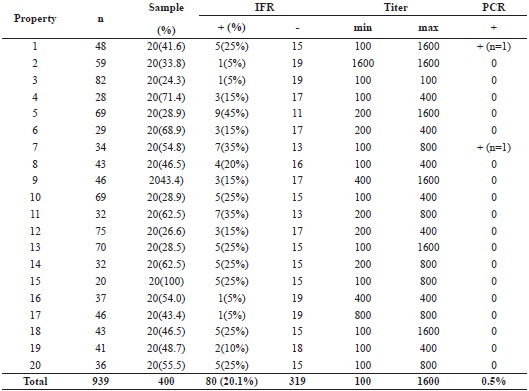
Of the 400 bovine sera samples studied, 80 animals (20.1%) were found to be positive on IFR for N. caninum, and in all the properties at least one animal was positive (Table 1). Antibody titers ranged from 100 to 1,600; 15 (3.8%) cattle presented with a titer of 100, 28 (7.0%) with a titer of 200, 22 (5.5%) with a titer of 400, 8 (2.0%) with a titer of 800, and 7 (1.8%) with a titer of 1,600 (Table 1). These results can be compared to those obtained in the southwestern region of the state, with a prevalence of 24% (CAMILLO et al., 2010; LANGONI et al., 2013). The results were higher in the center eastern and southwestern regions, with prevalences of 34.8% (LOCATELLI-DITTRICH et al., 2001) and 35.1% (ROCHA et al., 2015), respectively. However, care should be taken when comparing the results because of different serological techniques, cut-off points, study models, and sample sizes (DUBEY; SCHARES, 2011). Additionally, there are differences in the prevalence of neosporosis across countries, regions, and management systems (DUBEY; SCHARES, 2011).
The variables studied, such as age, race, presence of dogs, size of properties, and feeding did not present significant statistical differences with respect to seropositivity for N. caninum (p> 0.05). These data were similar in Brazil (CAMILLO et al., 2010; MELO et al., 2001) and other regions of the world (HEMPHILL; GOTTESTEIN, 2000; PITEL et al., 2001).
All the producers that participated in the study reported a history of reproductive problems in the properties, with the highest incidence of abortion (4.47%), retention of placenta (3.72%) and repetition of estrus (18.10%); hence, it was not possible to associate these factors with seropositivity for N. caninum. However, seropositive cows have a risk of miscarriage ranging from 3.3 to 3.9 times higher than seronegative animals (CORBELLINI et al., 2002; LANDMANN et al., 2011). Thus, although there is no data to associate the economic losses to neosporosis in the present study, we can suspect that a good part of the reproductive problems could have been caused by parasite presence in the studied herds, since this parasite is an important etiological agent of abortions in cattle.
The n-PCR for cattle showed only two positive samples (0.5%), which were derived from seronegative animals in IFR, so they would probably be in an acute infection phase. PCR techniques are very useful in the diagnosis of Neospora because they allow to amplify very small amounts of DNA, even in tissues that are autolyzed and have a high sensitivity and specificity. Macedo et al. (2013) have shown that the combination of diagnostic techniques such as PCR and serology improves the diagnosis of neosporosis.
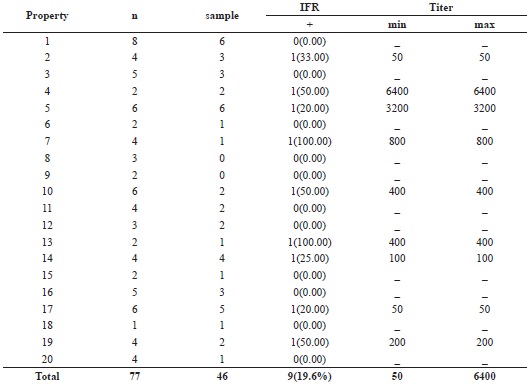
Of the 46 sera samples from the dogs studied, 9 animals (19.6%) were positive on IFR (Table 2). Antibody titers ranged from 100 to 1,600; 2 (4.3%) dogs presented with a titer of 50, 1 (2.2%) with a titer of 100, 1 (2.2%) with a titer of 200, 2 (4.3%) with a titer of 400, 1 (2.2%) with a titer of 800, and 1 (2.2%) with a titer of 3,200 (Table 2). No dogs were positive on n-PCR. Similar results were observed in Paraná by Souza et al. (2002) and Romanelli et al. (2007), who verified seroprevalences of 21.6% and 29.1%, respectively.
The results allow us to conclude that the occurrence of antibodies against N. caninum in cattle and dogs in the north central mesoregion of Paraná were like those observed in other mesoregions of Paraná, and that although no significant difference between the studied variables was observed, all properties exhibited reproductive problems. Total blood PCR revealed a low positivity in cattle and dogs, showing that the probability of detecting parasitemia in epidemiological studies is low.
References
BENETTI, A. H.; SCHEIN, F. B.; SANTOS, T. R.; TONIOLLO, G. H.; COSTA, A. J.; MINEO, J. R.; LOBATO, J.; SILVA, D. A. O.; GENNARI, S. M. Pesquisa de anticorpos anti-Neospora caninum em bovinos leiteiros, cães e trabalhadores rurais da região sudoeste do estado de Mato Grosso. Revista Brasileira de Parasitologia Veterinária, Jaboticabal, v. 18, p. 29-33, 2009. Suplemento 1.
BUXTON, D.; WRIGHT, S.; MALEY, S. W.; RAE, A. G.; LUNDEÂN, A.; INNES, E. A. Immunity to experimental neosporosis in pregnant sheep. Parasite Immunology, Oxford, v. 23, n. 2, p. 85-91, 2001.
CAMILLO, G.; CADORE, G.; CEZAR, A. S.; TOSCAN, G.; BRÄUNIG, P.; SANGIONI, L. A.; VOGEL, F. S. F. Anticorpos anti-Neospora caninum em bovinos de leite do sudoeste do estado do Paraná. Arquivos Brasileiros de Medicina Veterinária e Zootecnia, Belo Horizonte, v. 62, n. 6, p. 1511-1513, 2010.
CARDOSO, J. M.; AMAKU, M.; ARAUJO, A. J.; GENNARI, S. M. A longitudinal study of Neospora caninum infection on three dairy farms in Brazil. Veterinary Parasitology, Amsterdam, v. 187, n. 3-4, p. 553-557, 2012.
CAVIGLIONE, J. H.; KIIHL, L. R. B.; CARAMORI, P. H.; OLIVEIRA, D. Cartas climáticas do Paraná. Londrina: IAPAR, 2000. CD-ROM. Disponível em: <http://www.iapar.br/pagina-677.html>. Acesso em: 05 sept 2018.
CHI, J.; VANLEEUWEN, J. A.; WEERSINK, A.; KEEFE, G. P. Direct production losses and treatment costs from bovine viral diarrhoea virus, bovine leukosis virus, Mycobacterium avium subspecies paratuberculosis, and Neospora caninum. Preventive Veterinary Medicine, Colorado, v. 55, n. 2, p. 137-153, 2002.
CONRAD, P. A.; BARR, B. C.; SVERLOW, K. W.; ANDERSON, M.; DAFT, B.; KINDE, H.; DUBEY, J. P.; MUNSON, L.; ARDANS, A. In vitro isolation and characterization of a Neospora sp. from aborted foetuses. Parasitology, Glasgow, v. 106, n. 3, p. 239-249, 1993.
CORBELLINI, L. G.; DRIEMEIER, D.; CRUZ, C. F. E.; GONDIN, L. F. P.; WALD, V. Neosporosis as a cause of obortion in dairy cattle in Rio Grande do Sul, southern Brazil. Veterinary Parasitology, Amsterdam, v. 103, n. 3, p. 195-202, 2002.
DOHERTY, E. O.; SAYERS, R.; GRADY, L. O.; SHALLOO, L. Effect of exposure to Neospora caninum, Salmonella, and Leptospira interrogans serovar Hardjo on the economic performance of Irish dairy herds. Journal of Dairy Science, 98, n. 4, p. 1-12, 2015.
DUBEY, J. P.; LINDSAY, D. S. A review of Neospora caninum and neosporosis. Veterinary Parasitology, Amsterdam, v. 67, n. 1-2, p. 1-59, 1996.
DUBEY, J. P.; SCHARES, G. Neosporosis in animals - the last five years. Veterinary Parasitology, Amsterdam, v. 180, n. 1-2, p. 90-108, 2011.
DUBEY, J. P.; SCHARES, G.; ORTEGA-MORA, L. M. Epidemiology and control of neosporosis and Neospora caninum. Clinical Microbiology Reviews, 20, n. 2, p. 323-367, 2007.
GONDIM, L. F. P.; SARTOR, I. F.; HASEGAWA, M.; YAMANE, I. Seroprevalence of Neospora caninum in dairy cattle in Bahia, Brazil. Veterinary Parasitology, Amsterdam, v. 86, n. 1, p. 71-75, 1999.
GUIMARÃES JUNIOR, J. S.; SOUZA, S. L. P.; BERGAMASCHI, D. P.; GENNARI, S. M. Prevalence of Neospora caninum antibodies and factors associated with their presence in dairy cattle of the north of Paraná state. Brazil. Veterinary Parasitology, Amsterdam, v. 124, n. 1-2, p. 1-8, 2004.
HEMPHILL, A.; GOTTSTEIN, B. A. European perspective on Neospora caninum. International Journal of Parasitology, 30, n. 8, p. 1887-1924, 2000.
INSTITUTO BRASILEIRO DE GEOGRAFIA E ESTATÍSTICA - IBGE. PPM - Perfil da Pecuária Municipal. 2013. Disponível em: <https://ww2.ibge.gov.br/home/estatistica/economia/ppm/2013/default_ xls_perfil.shtm>. Acesso em: 5 set 2018.
INSTITUTO PARANAENSE DE DESENVOLVIMENTO ECONÔMICO E SOCIAL - IPARDES. Caderno Estatístico Município de Ivaiporã. 2018. Disponível em: <http://www.ipardes.gov.br/cadernos/MontaCad Pdf1.php?Municipio=86870>. Acesso em: 05 set. 2018
KAMGA-WALADJO, A. R.; GBATI, O. B.; KONE, P.; LAPO, R. A.; CHATOGNON, G.; BAKOU, S. N.; PANGUI, L. J.; DIOP PEL, H.; AKAKPO, J. A.; TAINTURIER, D. Seroprevalence of Neospora caninum antibodies and its consequences for reproductive parameters in dairy cows from Dakar-Senegal, West Africa. Tropical Animal Health Production, 42, n. 5, p. 953-959, 2010.
LANDMANN, J. K.; GUNN, A. A. ; O’DONOGHUE, P. J.; TRANTER, W. P.; MCGOWAN, M. R. Epidemiology and impact of Neospora caninum infection in three Queensland tropical dairy cattle. Reproduction in Domestic Animals, 46, n. 4, p. 734-737, 2011.
LANGONI, H.; SILVA, A. V. da; KATAGIRI, S.; CAGNINI, F.; RIBEIRO, C. M. Avaliação sorológica para Neospora caninum em propriedades de bovinos leiteiros com alterações reprodutivas. Veterinária e Zootecnia, Botucatu, v. 20, n. 1, p. 124-130, 2013.
LOCATELLI-DITTRICH, R.; SOCCOL, V. T.; RICHARTZ, R. R.; GASINO-JOINEAU, M. E.; VINNE, R.; PINCKNEY, R. D. Serological diagnosis of neosporosis in a herd of dairy cattle in Southern Brazil. Journal of Parasitology, Laurence, v. 87, n. 6, p. 1493-1494, 2001.
MACEDO, C. A. B.; MACEDO, M. F.; CARDIM, S. T.; PAIVA, M. C.; TARODA, A.; BARROS, L. D.; CUNHA, I. A.; ZULPO, D. L.; GARCIA, J. L. Neospora caninum: evaluation of vertical transmission in slaughtered dairy cows (Bos taurus:>). Revista Brasileira de Parasitologia Veterinária, Jaboticabal, v. 22, n. 1, p. 13-17, 2013.
MELO, C. B.; LEITE, R. C.; SOUZA, G. N.; LEITE, R. C. Frequência de infecção por Neospora caninum em dois diferentes sistemas de produção de leite e fatores predisponentes à infecção em bovinos em Minas Gerais. Revista Brasileira de Parasitologia Veterinária, Jaboticabal, v. 10, n. 2, p. 67-74, 2001.
OGAWA, L.; FREIRE, R. L.; VIDOTTO, O.; GONDIM, L. F. P.; NAVARRO, I. T. Occurence of antibodies to Neospora caninum and Toxoplasma gondii in dairy cattle from the northern region of the Paraná state, Brazil. Arquivos Brasileiros de Medicina Veterinária e Zootecnia, Belo Horizonte, v. 57, n. 3, p. 312-316, 2005.
ORLANDO, D. R.; COSTA, R. C.; SOARES, B. A.; OLIVEIRA, N. S. C.; NASCIMENTO, L. C.; PECONICK, A. P.; RAYMUNDO, D. L.; VARASCHIN, M. S. Neospora caninum abortions in cattle in southern Minas Gerais, Brazil. Pesquisa Veterinária Brasileira, Seropédica, v. 33, n. 11, p. 1332-1338, 2013.
PARÉ, J.; HIETALA, S. K.; THURMOND, M. C. An enzyme-linked immunosorbent assay (ELISA) for serological diagnosis of Neospora sp infection in cattle. Journal of Veterinary Diagnostic Investigation, 7, n. 3, p. 352-359, 1995.
PITEL, P. H.; PRONOST, S.; CHATAGNON, G.; TAINTUNIER, D.; FORTIER, G.; BALLET, J. J. Neosporosis in bovine dairy herds from the west of France: detection of Neospora caninum DNA of abortes fetuses, seroepidemiology of N. caninum in cattle and dogs. Veterinary Parasitology, Amsterdam, v. 102, n. 4, p. 269-277, 2001.
REICHEL, M. P.; AYANEGUI-ALCE´RRECA, A. M.; GONDIM, L. F. What is the global economic impact of Neospora caninum in cattle - the billion dollar question. International Journal of Parasitology, 43, n. 2, p. 133-142, 2013.
RITTA NETO, A. S. Análise da conjuntura agropecuária - agrometeorologia - safra 2010/11 - Paraná. SEAB/DERAL, 2010. Disponível em: <http://www.agricultura.pr.gov.br/arquivos/File/deral/Prognosticos/ agrometeorologia_2010_11.pdf>. Acesso em: 05 set 2018.
ROCHA, J. X.; PIVOTO, F. L.; AIRES, A. R.; ROCHA, R. X. da; FERREIRA, A. G. T.; LEAL, M. R. Levantamento sorológico de Neospora caninum em vacas da raça holandesa da microrregião de Francisco Beltrão. Veterinária e Zootecnia, Botucatu, v. 22, n. 3, p. 396-399, 2015.
ROMANELLI, P. R.; FREIRE, R. L.; VIDOTTO, O.; MARANA, E. R. M.; OGAWA, L.; DEPAULA, V. S. O.; GARCIA, J. L.; NAVARRO, I. T. Prevalence of Neospora caninum and Toxoplasma gondii in sheep and dogs from Guarapuava farms, Paraná State, Brazil. Research in Veterinary Science, Oxford, v. 82, n. 2, p. 202-207, 2007.
SANTOS, R. R. D.; ROCHA, C. M. da; GONÇALVES, T. D. E. M.; GUIMARÃES, A. M. Quantification of vertical transmission of Neospora caninum in dairy cows in Minas Gerais, Brazil. Revista Brasileira de Parasitologia Veterinária, Jaboticabal, v. 21, n. 3, p. 294-297, 2012.
SOUZA, S. L. P.; GUIMARÃES JÚNIOR, J. S.; FERREIRA, F.; DUBEY, J. P.; GENNARI, S. M. Prevalence of Neosporacaninum antibodies in dogs from dairy cattle farms in Parana, Brazil. Journal of Parasitology, Laurence, v. 88, n. 2, p. 408-409, 2002.
THURMOND, M. C.; HIETALA, S. K. Culling associated with Neospora caninum infection in dairy cows. American Journal of Veterinary Research, Chicago, v. 57, n. 11, p. 1559-1562, 1996.
VILAS BOAS, R.; PACHECO, T. A.; MELO, A. L.; OLIVEIRA, A. C. de; AGUIAR, D. M. de; PACHECO, R. C. Infection by Neospora caninum in dairy cattle belonging to family farmers in the northern region of Brazil. Brazilian Journal of Veterinary Parasitology, Jaboticabal, v. 24, n. 2, p. 204-208, 2015.
WILSON, D. J.; ORSEL, K.; WADDINGTON, J.; RAJEEV, M.; SWEENY, A. R.; JOSEPH, T.; GRIGG, M. E.; RAVERTY, S. A. Neospora caninum is the leading cause of bovine fetal loss in British Columbia, Canadá. Veterinary Parasitology, Amsterdam, v. 218, p. 46-51, 2016.
Author notes
* Author for correspondence