ARTICLES
Metabolic status of crossbreed F1 Holstein × Gyr dairy cows during the transition period in two different seasons in Brazil
Perfil Metabólico de vacas F1 Holandês x Gir durante o período de transição em duas épocas do ano no Brasil
Metabolic status of crossbreed F1 Holstein × Gyr dairy cows during the transition period in two different seasons in Brazil
Semina: Ciências Agrárias, vol. 39, no. 6, pp. 2487-2500, 2018
Universidade Estadual de Londrina
Received: 01 October 2016
Accepted: 20 September 2019
Funding
Funding source: Ethics Committee on Animal Experimentation of the Federal University of Minas Gerais
Contract number: 82/2011
Funding statement: This project was approved by the Ethics Committee on Animal Experimentation of the Federal University of Minas Gerais (CETEA/UFMG), under the protocol number 82/2011.
Abstract: Crossbreed F1 Holstein × Gyr cows are proving to be a good alternative to pure Holstein for milk production under tropical conditions. In order to further assess the characteristics of these cattle, we focused on clarifying the metabolic pattern of F1 Holstein × Gyr dairy cows during the most critical phase in the lactation cycle, the transition period, and compared their performance in two seasons. Blood samples were collected from 15 cows during summer (January to April) and from 13 cows during winter (May to August), beginning 3 weeks prior to the estimated calving date until 30 days post-calving. We found that the season had a considerable influence on the metabolic status of the cattle. With the exception of aminotransferase, non-esterified fatty acids (NEFA), and β-hydroxybutyrate (BHB), which showed no seasonal variation, all evaluated metabolites showed a different pattern between summer and winter. Liver functions were enhanced during the postpartum period, with increased liver enzyme activity and increased concentrations of cholesterol and BHB being recorded. During this period, the cows had a negative energy balance and a relatively high number of animals experienced subclinical ketosis and had high NEFA concentrations. Overall, we found that the metabolic profile of cows differed substantially between summer and winter, particularly in response to the different environmental and management conditions. Despite these differences, however, the average milk production of crossbreed ½ Holstein ½ Gyr dairy cows was similar in both seasons, indicating that this crossbreed of dairy cows is a good option for milk production in tropical environments.
Key words: Non-esterified fatty acid, Beta-hydroxybutyrate, Ssubclinical ketosis, Heat stress.
Resumo: Vacas mestiças F1 Holandês x Gir estão provando ser uma boa alternativa para a produção de leite em condições tropicais. A fim de contribuir para essa afirmativa, o nosso trabalho se concentrou em esclarecer e avaliar o perfil metabólico de vacas F1 Holandês x Gir durante o período mais crítico do ciclo de lactação, o período de transição, e comparar seu desempenho em duas épocas do ano. Foram realizadas coletas de sangue em 15 vacas durante o verão (janeiro a abril) e em 13 vacas durante o inverno (maio a agosto), começando três semanas antes da data prevista para o parto até 30 dias depois do parto. A estação teve uma grande influência sobre o perfil metabólico. Quase todos os metabólitos avaliados, com exceção para aspartato aminotransferase (AST), ácidos graxos não esterificados (NEFA) e β-hidroxibutirato (BHBA), mostraram variação entre estações, demonstrando um comportamento diferentes entre verão e inverno. A atividade hepática aumentou durante o pós-parto, com o aumento da atividade de enzimas do fígado e aumento da concentração de colesterol e BHB. Animais passaram por um balanço energético negativo (NEB) e um número alarmante de animais experimentaram cetose subclínica e altas concentrações de NEFA. De forma geral, o perfil metabólicos dos animais variou consideravelmente entre o verão e o inverno. Apesar disso, a produção leiteira foi similar nas duas estações, o que indica que o cruzamento Holandês x Gir é uma boa opção para a produção de leite em regiões tropicais.
Palavras-chave: NEFA, BHB, cetose sub-clínica, stress calórico, Bos indicus.
Introduction
During the last few weeks before parturition and the first weeks after calving, dairy cows undergo many endocrine, metabolic, and social changes (SUNDRUM, 2015; LACASSEA et al., 2018). These sudden changes occur within a short space of time and are often associated with reduced feed intake, negative energy balance, insulin resistance, and impaired immune function. As a consequence, between 30% and 50% of dairy cows suffer from metabolic or infectious disease during this transition period (SORDILLO; RAPHAEL, 2013; SUNDRUM, 2015; LACASSEA et al., 2018).
Assessing the health status of cattle on an individual or herd level provides opportunities for proactive investigation and timely preventive action. Two of the screening approaches used for this purpose are body condition scoring and blood sampling. An analysis of blood metabolites permits the identification of cows that are at a greater risk of developing diseases and animals that are experiencing subclinical symptoms (LEBLANC, 2010), which is of considerable importance, particularly during the transition period. At the herd level, an assessment of blood metabolites can yield important evidence regarding farm bottlenecks, and provide more accurate information for achieving desired goals (SORDILLO; RAPHAEL, 2013).
In Brazil, milk is produced on a seasonal basis due to differences in the climate and food supplies, which accordingly necessitates two distinct management strategies over the year. In Minas Gerais, which is Brazil's principal milk-producing state, the summer period is hot and rainy, with a high availability of pasture for grazing. In winter, the temperature is mild, there is almost no rain, and nutrition is normally based on stored food. In the summer, heat stress can be extremely severe and can have considerable detrimental effects on livestock production (BAUMGARD; RHOADS, 2013; MOREIRA et al., 2015). Under these conditions, Bos indicus cattle tend to perform better than Bos taurus (COSTA et al., 2014) due to their more efficient heat loss mechanisms, such as a thinner skin, lower metabolic rate, and larger sweat gland perimeter (CARVALHO et al., 1995).
In an attempt to combine the superior heat stress performance and resistance to tick infestations of Bos indicus with the higher milk yield from Holstein cattle, these cattle have been crossbred, and the resulting crossbreed F1 Holstein × Gyr cows are proving to be a good alternative for milk production under tropical conditions. Currently, the majority of milk produced in Brazil is derived from crossbreed Bos indicus × Bos taurus cows (SILVA, 2017), and in the present study, we aimed to clarify the metabolic pattern of F1 Holstein × Gyr dairy cows during the most critical time in the lactation cycle, the transition period.
Material and Methods
Experiment site and management
The research was undertaken at a commercial dairy farm located in Martinho Campos, Minas Gerais State, at an altitude of 663 m above sea level. The regional climate is defined as Aw according to the Koppen classification, which is a tropical savanna climate with hot rainy summers and dry mild winters. The farm herd comprises 120 lactating cows and produces 2,000 liters of milk per day.
Data collections were performed during two different periods, from January to April 2011 (summer period) and from May to August 2011 (winter period). The average temperatures in summer and winter were 25.5°C and 20.6°C, respectively, whereas the maximum and minimum temperatures during these seasons were 36.0°C and 15.2°C, and 34.3°C and 7.9ºC, respectively. Total precipitation was 707.5 mm in summer and 20.2 mm in winter. Monthly data for the maximum and minimum temperatures and precipitation, obtained from the National Institute of Meteorology (Inmet), Pompeu, Brazil, are presented in Figure 1.
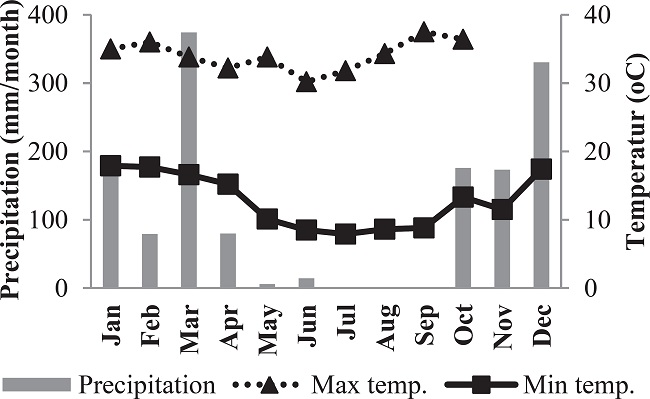
Figure 1
Maximum and minimum temperatures (ºC) and precipitation (mm month-1) during the year of 2011 in Martinho Campos/MG. Data were obtained from the National Institute of Meteorology (Inmet), Pompeu, Brazil.
Cows were maintained under a semi-confined system, in which they were fed twice daily with a mixed ration, based on concentrate and corn silage, and remained in mixed paddocks of Panicum maximum, Cynodon sp. and Brachiaria brizanta. The paddocks had areas with natural and artificial shading and the cows had free access to water and mineral mixture. The diet consisted of corn silage, ground corn, soybean, and minerals during summer; and corn silage, sugar cane, ground corn, soybean, citrus pulp, cottonseed, and minerals during winter. In both seasons, the forage:concentrate ratio was approximately 75:25.
Animals and sample collection
Blood samples were collected from 15 cows during summer and 13 cows during winter. All cows were pluriparous ½ Holstein ½ Gyr crossbreed, with between two to five lactations. Milk production was evaluated at 15-day intervals using an automatic device (Milkmeter®; Waikato Milking Systems, Hamilton, New Zealand). The animals sampled had an average daily milk production of 21.8 ± 4.3 L in summer and 22.0 ± 4.1 L in winter, the difference between which was non-significant (P > 0.05).
Blood was collected weekly via coccygeal venipuncture into tubes containing EDTA and tubes containing clot activator, commencing 3 weeks before the expected calving date, followed by samplings within 24 h after calving, and at 2, 5, 10, 15, 21, and 30 days post-calving. Serum and plasma were separated after centrifugation and frozen at -20ºC for subsequent analysis. Blood was invariably collected prior to feeding.
Metabolic assays
Analyses of triglycerides, cholesterol, glucose, gamma-glutamyl transferase (GGT), lactate dehydrogenase (LDH), aspartate aminotransferase (AST), albumin, total protein, non-esterified fatty acids (NEFA), and β-hydroxybutyrate (BHB) were performed using commercial kits (Synermed Brasil Ltd, São Paulo, Brazil; Randox Laboratories Brazil, São Paulo, Brazil), with measurement being made spectrophotometrically in an automatic device (COBAS Mira Plus, ROCHE). Globulin levels were calculated as the difference between total protein and albumin.
Simultaneously with the collection of blood samples, body condition scores (BCS) were assigned to cows using a 5-point scale (Ferguson et al. 1994). All assessments were made by the same trained person.
Statistical analysis
The average concentrations of blood components were compared using the Scott-Knott test for time of assessment and using the SNK test for comparisons between seasons. For BCS analysis, we used Dunn Multiple Comparisons for comparing the two seasons of the year and the Mann-Whitney test for comparison between assessments (SAMPAIO, 2010).
On the basis of our analysis of BHB, cows were diagnosed with subclinical ketosis when concentrations of BHB were greater than 1.2 mmol L-1, according to LeBlanc (2010). The cutoffs of 0.4 mmol L-1 NEFA during prepartum and 0.7 mmol L-1 NEFA during postpartum were used to assess the increased risk of disease, according to Ospina et al. (2010).
Results and Discussion
We found that season had a considerable influence on the metabolic status of cows. Among all the metabolites assessed, only AST, NEFA, and BHB showed no seasonal differences between summer and winter. Our analysis of metabolites revealed that the concentrations of total protein and globulin were invariably higher during summer, whereas those of glucose were higher in winter (Tables 1 and 2).
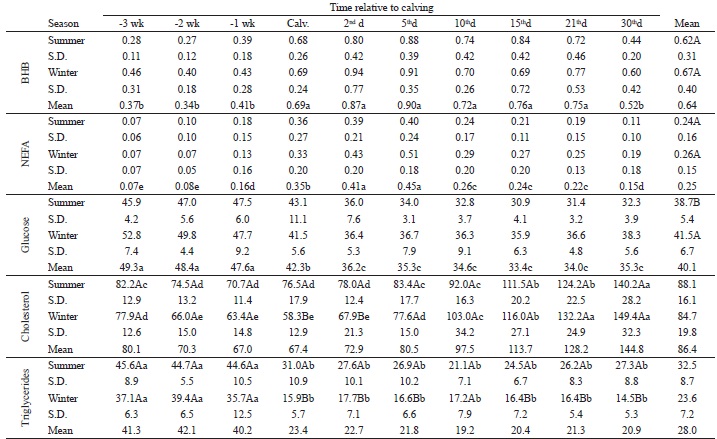
Means followed by different capital letters in the same column differ significantly, as determined by the Scott–Knott test (P < 0.05). Means followed by different lowercase letters in the same row differ significantly, as determined by the SNK test (P < 0.05). S.D. - Standard deviation; Wk – week.
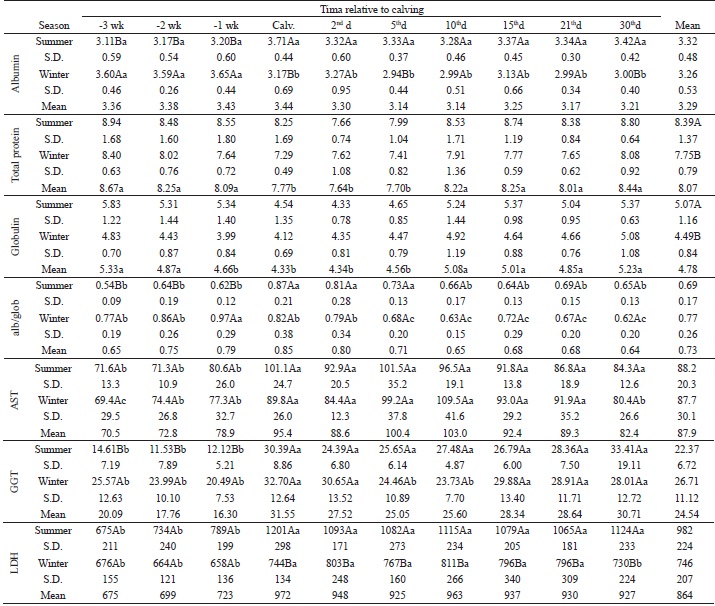
Means followed by different capital letters in the same column differ significantly, as determined by the Scott–Knott test (P < 0.05). Means followed by different lowercase letters in the same row differ significantly, as determined by the SNK test (P < 0.05). S.D. - Standard deviation; Wk – week.
As expected, the time of sampling during each season proved to be a prominent factor determining variations in the metabolic profile, owing to the substantial metabolic changes that occur during the transition period, with albumin during summer being the only metabolite that did not vary with time (Table 2).
For herd evaluation, differences in metabolite patterns during the transition period among seasons are more important than the differences in metabolite concentration, the former of which can be evaluated by the interaction between the day of sampling and the season. In this regard, with the exception of total protein, globulin, glucose, NEFA, and BHB, all evaluated metabolites showed a different pattern between seasons (Table 1 and 2).
Glucose concentrations were observed to decrease after calving, with postpartum concentrations being lower than those during the prepartum period. The only difference from the expected pattern was that glucose did not peak on the day of calving, which contrasts with the findings of previous studies (PARK et al., 2010; MOREIRA et al., 2015). This disparity can probably be explained by fact that the peak in glucose concentration occurs a few hours after calving (AQUINO NETO, 2012), and in the present study, samples were generally taken 12 h after parturition.
The lower glucose concentrations in summer can probably be attributed to differences in diet and the occurrence of heat stress. In winter, the diet was based on corn silage and concentrate, which enhances the production of propionate and subsequently the production of glucose. With regards to heat stress, cows under such conditions show a greater insulin response, which decreases the use of NEFA and ketone bodies as energy sources and increases the use of glucose (BAUMGARD; RHOADS, 2013). This is also indicated by the fact that the cows lost more body condition during winter then during summer, as shown in Table 3, even though the glucose concentration was higher in winter. If cows were indeed under heat stress, this did not appear to affect milk production, as the average milk yield per animal was similar in both seasons. Thus, F1 Holstein × Gyr cows seem to be able to overcome thermal stress without a loss of productivity, due to their enhanced ability to regulate body temperature. Under similar conditions, Moreira et al. (2015) showed that cows with a high Holstein composition suffer from heat stress in summer and have a lower average milk production. The findings of the present study thus provide evidence of the better performance of Bos indicus cattle in tropical climates.
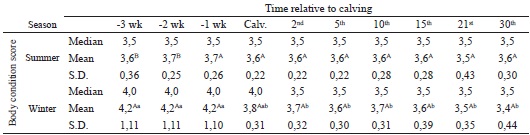
Means followed by different capital letters in the same column differ significantly, as determined by the Dunn Multiple Comparisons test (P < 0.05). Means followed by different lowercase letters in the same row differ significantly, as determined by the Mann–Whitney test (P < 0.05). S.D. - Standard deviation; Wk – week.
In both seasons, cholesterol concentration showed the same characteristic pattern of decreasing in prepartum, reaching low values near parturition, and then gradually increasing thereafter. Cholesterol concentration is related to dry matter intake and negative energy balance, and can also act as an indirect indicator to assess lipoprotein production by the liver (SEPÚLVEDA-VARAS et al., 2015). Therefore, the observed pattern in cholesterol concentration is indicative of a decrease in dry matter intake near parturition, with a subsequent increase and a higher liver activity in postpartum.
Regarding the differences between seasons, cholesterol was lower in winter than in summer during the first week prepartum and on the day of calving. Although the serum concentrations of NEFA and BHB did not differ between seasons, the observed decrease in cholesterol concentration may represent a more pronounced reduction in food intake in winter around parturition (SEPÚLVEDA-VARAS et al., 2015). This may have occurred because during winter, animals have a better body condition, which might have led to a lower dry matter intake (RATHBUN et al., 2017). This may also explain why the body condition of animals decreased to a greater extent in winter than in summer.
The concentration of NEFA started to rise after the first week prepartum and reached a peak between the second and fifth day postpartum, indicating an increase in lipid mobilization, as described previously (MOREIRA et al., 2015; SEPÚLVEDA-VARAS et al., 2015; BARLETTA et al., 2018). The elevation in NEFA concentration was followed by an increase in BHB concentration on the day of calving. At day 10 postpartum, NEFA levels started to decrease, and at 30 days after calving, they reached the same levels recorded 1 week postpartum. This timing is similar to that observed in previous studies conducted under similar conditions (MOREIRA et al., 2015; BARLETTA et al., 2018), indicating that 10 days postpartum is the approximate time at which cow experience a more severe negative energy balance. Despite the fact that NEFA concentration decreased after this time, BHB remained higher until 30 days postpartum, indicating that the liver is unable to completely oxidize all NEFA taken up.
The mean concentration of NEFA never reached the designated cutoff points of 0.4 mmol L-1 during prepartum and 0.7 mmol L-1 during postpartum, and the mean concentration of BHB never exceeded 1.2 mmol L-1. However, as shown in Fig. 2, a large number of cows experienced subclinical ketosis or had concentrations of NEFA above the cutoff points. In total, 40.0% of animals suffered subclinical ketosis and 46.67% had high levels of NEFA in winter, whereas in summer, 53.85% of animals had subclinical ketosis and 30.77% had high levels of NEFA. The highest frequency of animals with subclinical ketosis and high NEFA concentrations was observed on the fifth day postpartum: 15.38% and 20% of the cows during summer and winter, respectively. A further finding of concern was that during summer, even at 2 weeks postpartum, 30.77% of animals were still experiencing subclinical ketosis, whereas 7.14% of animals were similarly affected at 30 days post-calving during winter.
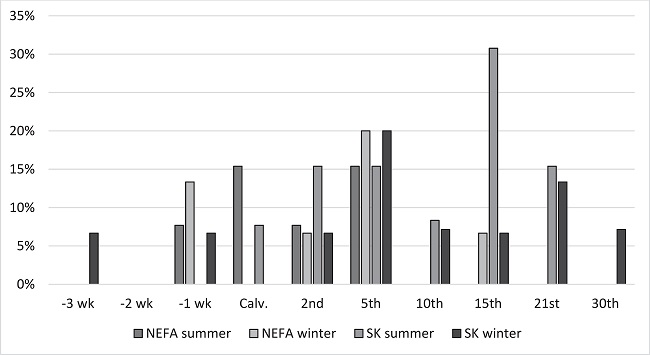
Figure 2
Incidence of subclinical ketosis (SK) and high non-esterified fatty acid (NEFA) concentrations (> 0.4 mmol L-1 in prepartum and >0.7 mmol L-1 in postpartum) in crossbreed F1 Holstein × Gyr dairy cows in a semi-intensive system in summer and winter.
These results indicate that the optimum time for collection of BHB and NEFA samples in F1 Holstein × Gyr cows is around the first week postpartum, similar to that for Holstein cattle (OSPINA et al., 2010; MOREIRA et al., 2015; BARLETTA et al., 2018). It is also important to note that the prevalence of animals with concentrations of NEFA and BHB above the designated cutoff points does not follow the same pattern as that shown by the mean concentrations. This accordingly indicates that the data need to be analyzed using two different methods (SUNDRUM et al., 2015).
Regarding protein metabolites, globulin concentrations and the albumin:globulin (A:G) ratio were higher during prepartum in summer, whereas albumin concentrations were higher in winter than in summer during prepartum and parturition. Total protein concentrations were invariably higher in summer than in winter because of the higher globulin concentration during summer. The decrease in globulin concentration around parturition due to the mobilization of immunoglobulins to colostrum was reflected in the protein pattern.
One notable observation was that the incidence of animals that had an A:G ratio below the physiological limits (0,8 to 0,9) (SMITH, 2009) in summer was particularly high, typically in excess of 60% (Fig. 3). Collectively, these findings indicate that, in summer, the animals could be suffering from chronic or subclinical diseases, even though plasma concentrations of total protein and albumin were invariably within the standard reference ranges, from 6.8 to 8.6 g dL-1 and 2.5 to 3.8 g dL-1, respectively (SMITH, 2009).
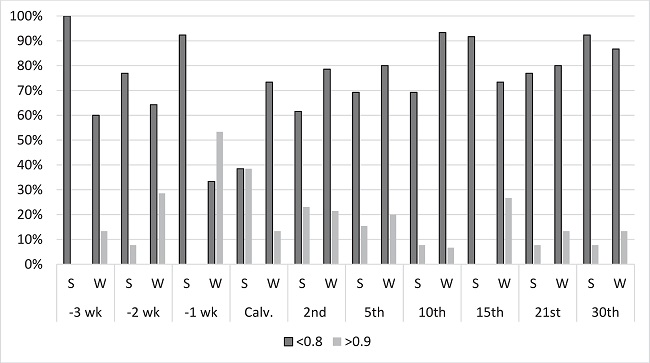
Figure 3
Incidence of F1 Holstein × Gyr cows above or below the physiological limit of the albumin:globulin ratio (0.8 to 0.9) (Smith, 2009) from 3 weeks prepartum to 30 days postpartum in a semi-intensive system in summer (S) and winter (W).
In summer, albumin was the only metabolite that showed no variation during the peripartum period, whereas in winter, albumin concentrations were lower during the postpartum period than during prepartum, which is in contrast to the expected pattern (BOBBO et al., 2017). Moreira et al. (2015) made similar observations with crossbreed cows during the winter period. It can be speculated that this is pattern is related to the fact that albumin is negatively correlated with BHB, cholesterol, and LDH (ALVARENGA et al., 2015), and consequently albumin production is reduced during periods of negative energy balance and impaired liver function.
We found that all liver enzymes had higher activity on the day of calving and remained higher during the postpartum period than during the prepartum period. Despite showing variation, the activity of serum GGT, AST, and LDH typically remained within the reference values for the species (SMITH, 2009), thereby indicating a physiological increase in hepatic metabolism after calving. The observed increase in LDH activity is indicative of the utilization of lactate in the Cori cycle to fulfill energy needs (REYNOLDS et al., 2003). This is particularly apparent during summer when glucose concentrations are lower, as has also been described by Moreira et al. (2015). Similarly, AST activity is related to the use of amino acids derived from muscle catabolism for gluconeogenesis, which is more pronounced during early postpartum (REYNOLDS et al., 2003), and in response to muscular effort during calving (AQUINO NETO, 2012).
Conclusions
We found that the metabolic status of crossbreed ½ Holstein ½ Gyr dairy cows appears to be very similar to the known pattern shown by Holsteins cows or cows with a high Holstein composition when maintained under similar conditions.
As a matter of concern, a relatively high number of animals experienced subclinical ketosis and had high NEFA concentrations, indicating that these animals have a greater likelihood of developing other diseases. It is also important to note that the frequency of animals with serum NEFA concentrations above the designated cutoff points can represent a very important index for monitoring and improving farm management.
The metabolic profile of F1 Holstein × Gyr cows maintained within a semi-confined system differs considerably between summer and winter, and is particularly dependent on environmental and management conditions. However, despite the observed variations, we found that the average milk production of crossbreed ½ Holstein ½ Gyr dairy cows was similar in both seasons. Collectively, our results corroborate the presumption that crossbreed ½ Holstein ½ Gyr dairy cows are a good option for milk production in tropical environments.
Acknowledgments
The authors gratefully acknowledge the cooperation of the owners, herdsman, and staff of the farm used in this study. We also acknowledge the Federal University of Minas Gerais and Brazilian Research Council (CNPq) and the National Council for the Improvement of Higher Education (CAPES) for supporting this work.
References
ALVARENGA, E. A.; MOREIRA, G. H. F. A.; FACURY FILHO, E. J.; LEME, F. O. P.; COELHO, S. G.; MOLINA, L. R.; LIMA, J. A. M.; CARVALHO, A. U. Avaliação do perfil metabólico de vacas da raça Holandesa durante o período de transição. Pesquisa Veterinária Brasileira, Belo Horizonte, v. 35, n. 3, p. 281-290, 2015.
AQUINO NETO, H. M. Perfil hidroeletrolítico, ácido-base, metabólico e mineral de vacas da raça Holandesa no pós-parto e avaliação da fluidoterapia oral. 2012. PhD Thesis (Ciência Animal) - Universidade Federal de Minas Gerais, Belo Horizonte.
BARLETTA, R. V. ; MATURANA, FILHO M.; CARVALHO, P. D.; DEL VALLE, T. A.; NETTO, A. S.; RENNÓ, F. P.; MINGOTI, R. D.; GANDRA, J. R.; MOURÃO, G. B.; FRICKE, P. M.; SARTORI, R.; MADUREIRA, E. H.; WILTBANK, M. C. Association of changes among body condition score during the transition period with NEFA and BHBA concentrations, milk production, fertility, and health of Holstein cows. Theriogenology, Milan, v. 104, p. 30-36, 2017.
BAUMGARD, L. H.; RHOADS, R. P. Effects of heat stress on postabsorptive metabolism and energetics. Annual Review of Animal Bioscience, Palo Alto, v. 1, p. 311-337, 2013.
BOBBO, T., FIORE, E.; GIANESELLA, M.; MORGANTE, M.; GALLO, L.; RUEGG, P.; BITTANTE, G.; CECCHINATO, A. Variation in blood serum proteins and association with somatic cell count in dairy cattle from multi-breed herds. Animal, Cambridge, v. 11, n. 12, p. 2309-2319, 2017.
CARVALHO, F. A.; LAMMOGLIA, M. A.; SIMOES, M. J.; RANDEL, R. D. Breed affects thermoregulation and epithelial morphology in imported and native cattle subjected to heat stress. Journal of Animal Science, Illinois, v. 73, n. 12, p. 3570-3573, 1995.
COSTA, A. N. L.; FEITOSA, J. V.; MONTEZUMA JÚNIOR, P. A.; SOUZA, P. T.; ARAÚJO, A. A. Hormonal profiles, physiological parameters, and productive and reproductive performances of Girolando cows in the state of Ceará-Brazil. International Journal of Biometeorology, Ohio, v. 59, n. 2, p. 231-236, 2014.
FACÓ, O.; LÔBO, R. N. B.; MARTINS FILHO, R.; MOIRA, A.A.A. Análise do desempenho produtivo de diversos grupos genéticos Holandês-Gir no Brasil. Revista Brasileira de Zootecnia, Piracicaba, v. 31, n. 5, p. 1944-1952, 2002.
FERGUSON, J. D.; GALLIGAN, D. T.; THOMSEN, N. Principal descriptors of body condition score in Holstein cows. Journal of Dairy Science, Champaign, v. 77, n. 9, p. 2695-2703, 1994.
LACASSEA, P.; VANACKERA, N.; OLLIERA, S. ; STER C. Innovative dairy cow management to improve resistance to metabolic and infectious diseases during the transition period. Research in Veterinary Science, Rome, v. 116, p. 40-46, 2018.
LEBLANC, S. Monitoring metabolic health of dairy cattle in the transition period. Journal Reproduction and Development, Perth, v. 56, p. S29-35, 2010.
MOREIRA, T. F.; FACURY FILHO, E. J.; MENESES, R. M.; MENDONÇA, F. L. M.; LIMA, J. A. M.; CARVALHO, A. U. Energetic status of crossbreed dairy cows during transition period in two different seasons. Arquivo Brasileiro de Medicina Veterinária e Zootecnia, Belo Horizonte, v. 67, n. 5, p. 1327-1334. 2015.
OSPINA, P. A.; NYDAM, D.V.; STOKOL, T.; OVERTON, T. R. Evaluation of nonesterified fatty acids and beta-hydroxybutyrate in transition dairy cattle in the northeastern United States: Critical thresholds for prediction of clinical diseases. Journal of Dairy Science, Champaign, v. 93, n. 2, p. 546-554, 2010.
PARK, A. F.; SHIRLEY, J. E.; TITGEMEYER, E. C.; COCHRAN, R. C.; DEFRAIN, J. M.; WICKERSHAM, E. E.; JOHNSON, D. E. Characterization of plasma metabolites in Holstein dairy cows during periparturient period. International Journal of Dairy Science, Islamabad, v. 5, n. 4, p. 253-263, 2010.
RATHBUN, F. M.; PRALLE, R. S.; BERTICS, S. J.; ARMENTANO, L. E.; CHO, K.; DO, C.; WEIGEL, K. A.; WHITE, H. M. Relationships between body condition score change, prior mid-lactation phenotypic residual feed intake, and hyperketonemia onset in transition dairy cows. Journal of Dairy Science, Champaign, v. 100, n. 5, p. 3685-3696, 2017.
REYNOLDS, C. K.; AIKMAN, P. C.; LUPOLI, B.; HUMPHRIES, D. J.; BEEVER, D. E. Splanchnic metabolism of dairy cows during the transition from late gestation through early lactation. Journal of Dairy Science, Champaign, v. 86, n. 4, p. 1201-1217, 2003.
SAMPAIO, I. B. M. Estatística aplicada a experimentação animal. 3th ed. Belo Horizonte: FEPMVZ, 2010. 266 p.
SEPÚLVEDA-VARAS, P.; WEARY, D. M.; NORO, M.; VON KEYSERLINGK, M. A. G. Transition diseases in grazing dairy cows are related to serum cholesterol and other analytes. PLoS ONE, San Francisco, v. 10, n. 3, e0122317, 2015.
SILVA, M. V. G. B.; MARTINS, M. F.; CEMBRANELLI, M. A. R.; PAIVA, L. C.; PANETTO, J. C. C.; MACHADO, M. A.; VERARDO, L. L.; GONÇALVES, G.S.; FAZA, D. R. L. R. Programa de melhoramento genético da raça Girolando Sumário de Touros Resultado do Teste de Progênie Junho/2017. Embrapa Gado de Leite, Juiz de Fora, 2017. 58 p.
SMITH, B. P. Large animal internal medicine. 4th ed. Missouri: MOSBY-Elsevier, St. Louis, 2009. 1856 p.
SORDILLO, L. M.; RAPHAEL, W. Significance of metabolic stress, lipid mobilization, and inflammation on transition cow disorders. Veterinary Clinics: Food Animal Practice, Maryland Heights, v. 29, n. 2, p. 267-278, 2013.
SUNDRUM, A. Metabolic disorders in the transition period indicate that the dairy cows' ability to adapt is overstressed. Animals, Cambridge, v. 5, n. 4, p. 978-1020, 2015.
Notes
This project was approved by the Ethics Committee on Animal Experimentation of the Federal University of Minas Gerais (CETEA/UFMG), under the protocol number 82/2011.
Author notes
*Author for correspondence
Conflict of interest declaration
The authors declare that they have no conflict of interest.