ARTICLES
Kaolin and chromic oxide under different forms of administration in a study of consumption and digestibility
Caulim e óxido crômico sob diferentes formas de administração em estudo de consumo e digestibilidade
Kaolin and chromic oxide under different forms of administration in a study of consumption and digestibility
Semina: Ciências Agrárias, vol. 39, no. 6, pp. 2607-2620, 2018
Universidade Estadual de Londrina
Received: 07 June 2017
Accepted: 10 September 2018
Abstract: Animal nutrition needs simple methodologies to be applied under field conditions, providing valid estimates of consumption and digestibility that can be used by both farmers and animal input industry. Thus, the search for new substances, provided in a practical way, quantified by simple and low-cost analytical methodologies, replacing external indicators (chromic oxide used as reference) would be well accepted by the scientific community. In this context, the aim of this study was to assess the supply of chorionic oxide by esophageal route or mixed in the diet and the use of kaolin as an indicator, under the same forms of administration, to estimate fecal production and digestibility using four castrated male Holstein cattle. The experimental design was a 4 × 4 Latin square design, with four experimental periods of 12 days and six-day intervals between periods. Treatments consisted of supplying chromic oxide by esophageal route (COer), kaolin by esophageal route (Kaoer), chromic oxide mixed to the diet (COdiet), and kaolin mixed to the diet (Kaodiet). The treatment Kaodiet allowed obtaining estimates of fecal production similar to the treatment COer. The treatment COdiet did not differ from the treatment COer (p > 0.05) considering all the assessed parameters, evidencing that the indicator chromic oxide can be supplied mixed directly in the diet without damaging the estimates of fecal production and digestibility. Under the studied conditions, kaolin was not an effective indicator to obtain accurate estimates of fecal production and further studies are needed to adjust the analytical techniques of aluminum extraction as well as to resolve some doubts regarding its digestion process.
Key words: Aluminum, Feces, Indicator, Fecal production.
Resumo: A nutrição animal necessita de metodologias simples que possam ser aplicadas em condições de campo, que sejam capazes de fornecer estimativas válidas de consumo e digestibilidade e que possam ser utilizadas tanto pelos produtores rurais quanto pela indústria produtora de insumos para animais. Assim a busca por novas substâncias, fornecidas de forma prática, quantificadas por metodologias analíticas simples e de baixo custo em substituição aos indicadores externos (óxido crômico usado como referência) seriam bem aceitas pela comunidade científica. Neste contexto objetivou-se avaliar o fornecimento do óxido crômico via esofágica ou misturado na ração, e o uso do caulim como indicador, sob as mesmas formas de fornecimento, para estimar a produção fecal e digestibilidade, utilizando quatro bovinos machos castrados da raça Holandesa. Foram testados quatro tratamentos, distribuídos aos animais segundo um delineamento quadrado latino 4x4, sendo o primeiro aquele em que os animais foram submetidos ao fornecimento de óxido crômico fornecido via esofágica (OCesof), no segundo tratamento os animais receberam o caulim via esofágica (Caulesof), no terceiro o fornecimento do óxido crômico aos animais foi misturado à ração (OCrac) e no quarto tratamento o caulim foi administrado misturado à ração (Caulrac), em quatro períodos experimentais de 12 dias, com intervalos de seis dias entre os períodos. O tratamento Caulrac permitiu obter estimativas de produção fecal semelhante ao tratamento OCesof. O tratamento OCrac não diferiu do tratamento OCesof (p > 0,05) em nenhum dos parâmetros avaliados, evidenciando que o indicador óxido crômico pode ser fornecido misturado diretamente na ração sem prejudicar as estimativas de produção fecal e digestibilidade.
Palavras-chave: Alumínio, Fezes, Indicador, Produção fecal.
Introduction
The measurement of variables such as consumption and digestibility assists in determining food quality and the amount of absorbable nutrients present in the food (MOURA et al., 2013). In grazing situations, these variables can be compromised due to the difficulty in obtaining accurate and precise estimates. In this sense, the use of the indicator technique represents a tool in the studies of consumption and digestibility. Based on information on the digestibility of ingested pasture and amount of excreted feces estimated by indicators, it is possible to estimate the consumption of dry matter (DM) of the pasture (OLIVEIRA, 2005).
Indicators are substances used to monitor chemical (hydrolysis and synthesis) and physical (fluxes) aspects of digestion (OWENS; HANSON, 1992). Some characteristics are required to use them, such as being inert and non-toxic, having no physiological function, being non-metabolizable, able to being processed with food and fully recovered from the gastrointestinal tract (GIT), having no influence on the intestinal motility and secretions, having no influence and not being influenced by the GIT microbiota, having physicochemical properties that does not interfere with the digestive processes, flowing in a similar way to the marked material, and presenting an easy, precise, and accurate analytical method (FAHEY JÚNIOR; JUNG, 1983).
The supply of an external indicator to the animal, i.e. a non-diet substance, represents an important source of variation in results (FUKUMOTO et al., 2007) due to possible losses of the indicator at the time of its administration or due to the stress caused to the animal due to the management of supplying it by esophageal route. Chromic oxide (Cr2O3) have been the most used external indicator in studies of consumption and digestibility (MOURA et al., 2013) to estimate fecal production. The supply of Cr2O3 mixed in the concentrate has the advantage of reducing stress to the animals when compared to the administration by esophageal route. However, due to its low palatability, the inclusion of 5% Cr2O3 in the concentrate, as recommended by Penning (2004), has limited its use in animals with or without ruminal cannula (RIBEIRO FILHO et al., 2003).
Some problems such as incomplete mixing with ruminal digesta, faster passage through the rumen than the fibrous material, possibility of accumulation in some part of the digestive tract, and difficulties in the analysis (MACHADO et al., 2011) indicate the need for new indicators. Kaolin has physicochemical characteristics required for an external indicator for consumption and digestibility studies. It is inert in a wide pH range (3 to 9), has an easy dispersion, low thermal and electrical conductivity, low abrasiveness, low cost (SILVA, 2007; LUZ et al., 2009), and good resistance to chemical attack by acids or alkalis (COELHO et al., 2007). However, there are no standardized analytical techniques for its quantification in digestibility tests and its accuracy and precision have not been assessed.
In this sense, this study aimed to assess the use of kaolin as a possible external indicator to estimate fecal production, provided by esophageal route or mixed in the diet (concentrate + silage), comparing it with chromic oxide under similar supply conditions and its respective adequacy of results in relation to those obtained by animals in tests of apparent digestibility.
Material and Methods
The experiment was conducted at the Laboratory of Animal Metabolism of the Faculty of Veterinary Medicine and Animal Science (FAMEZ) of the Federal University of Mato Grosso do Sul and was approved by the Ethics Committee on Animal Use (CEUA) under the No. 752/2016.
Four castrated male Holstein cattle with an average weight of 573 ± 104 kg were used. These animals were confined in individual stalls equipped with troughs provided with roughage and concentrate and drinking trough. The animals were treated against endo- and ectoparasites before starting the experimental period.
The troughs for providing roughage and concentrate were manufactured from longitudinally cut plastic barrels, which gave them a low roughness, not interfering with the indicator consumption. The roughage was made of shoot corn silage and was supplied ad libitum twice a day to the animals of all treatments.
Animals received 1.0 kg day-1 of protein-energetic concentrate formulated to contain 20% crude protein (CP), 76% total digestible nutrients (TDN), and mineral components (Table 1). This concentrate was supplied once a day mixed with a small portion of the roughage provided in the morning. Only after the animal has consumed this first portion of the total diet, the remaining roughage was added to the trough, guaranteeing 100% concentrate consumption. Water was permanently available to animals.
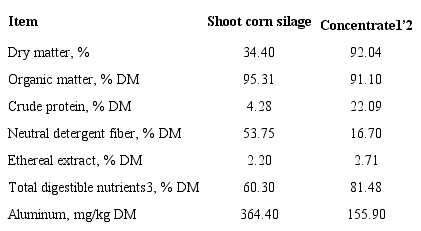
1 Concentrate ingredients: corn, soybean meal, Ilcon carbonate, salt, micro bicalcic phosphate, molasses powder, urea, sulfur powder, magnesium oxide, zinc oxide, copper sulfate, manganese sulfate, cobalt sulfate, calcium iodate, and sodium selenite.2 Mineral levels: Calcium, 15.50 g kg-1 DM; sulfur, 10.02 g kg-1 DM; magnesium, 4.02 g kg-1 DM; potassium, 7.36 g kg-1 DM; sodium, 8.09 g kg-1 DM; cobalt, 8.00 mg kg-1 DM; copper, 82.00 mg kg-1 DM; iron, 85.37 mg kg-1 DM; iodine, 11.05 mg kg-1 DM; manganese, 82.61 mg kg-1 DM; selenium, 2.25 mg kg-1 DM; zinc, 306.35 mg kg-1 DM.3 Data estimated from the equation: Total digestible nutrients = 91.0246 − 0.571588 × Neutral detergent fiber (CAPELLE et al., 2001).
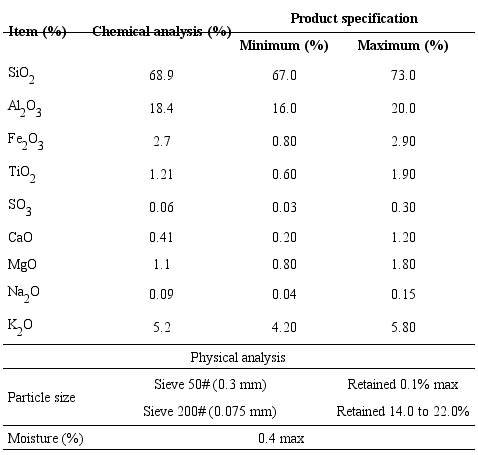
Four treatments containing chromic oxide and kaolin supplied by esophageal route, using a bolus applicator (COer and Kaoer), or mixed in the concentrate supplement (COdiet and Kaodit) were tested. The kaolin came from the extraction and processing of rock from the metamorphic sedimentary group, presenting aluminum (Al) silicate as the main ingredient. The product presented a density of 0.8 g cm-3 and a pH of 6.5, in addition to specific physicochemical characteristics shown in Table 2.
The animals submitted to the treatment of chromic oxide by esophageal route (COer) received 15 g day-1 of the indicator. For this, it was conditioned in a paper cartridge in order to avoid losses. In the treatment in which kaolin was administered by esophageal route (Kaoer), the animals received 50 g day-1 of kaolin. In the third treatment, the animals received 15 g day-1 of chromic oxide (COdiet) diluted in 1 kg of protein-energetic concentrate. Finally, the fourth treatment consisted of providing 50 g day-1 of kaolin diluted in 1 kg of concentrate (Kaodiet). The concentrate containing the respective indicators was provided in the morning mixed with a small amount of roughage. The administration of the respective indicators occurred once a day during the 12 days of each experimental period.
The supply of indicators by esophageal route were performed in the morning, just before animal management. The treatments were distributed to the animals following a 4 × 4 Latin square design. Four periods of 12 days were performed, with intervals of six days between periods for the complete elimination of the indicator from the digestive tract of animals.
During the six days of intervals between experimental periods, an adjustment in animal consumption was performed by defining the daily amount of silage to be supplied during the next experimental period. Silage was supplied twice a day (60% of DM at 6:00 h and 40% at 16:00 h).
In each experimental period, the interval between the days zero and four (D0 to D4) was used to adapt the animals to the treatment and stabilize the fecal excretion of the indicator. The remaining eight days (D5 to D12) were destined to the protocol of total feces collection.
In the total feces collection, each sample consisted of a representative subsample of a 24-hour period, obtaining at the end of each experimental period 8 fecal samples from each animal. The feces were collected from the floor of the stalls immediately after animal defecation to avoid contamination with urine or trampling. After each defecation, the feces were weighed and then 15% of the weighing value was removed to compose the daily feces sample.
Throughout the fecal collection period, samples of diet and leftovers were also collected and weighed. All the collected components were weighed, sampled by quartering, and stored in a freezer at -20 °C for further analysis.
These samples of feces, food supplied, and leftovers stored in the freezer were thawed and pre-dried in a forced air ventilation oven at 55 °C for 72 to 96 hours, ground in a knife mill with 1 mm diameter sieve for further analysis.
All samples were analyzed for the content of DM (method 930.15), ethereal extract (EE) (method 920.39), mineral matter (MM) (method 942.05), and crude protein (CP) (method 976.05) according to AOAC (1990). The analyses of neutral detergent fiber (NDF) were performed according to the recommendations of Van Soest et al. (1991).
The non-fibrous carbohydrates were determined by the equation proposed by Hall (2000): NFC = OM - (CP + EE + NDF -
CPurea + Urea), where NFC is the non-fibrous carbohydrates, OM is the organic matter, CP is the crude protein, EE is the ethereal extract, NDF is the neutral detergent fiber, CPurea is the crude protein derived from urea, and Urea is the percentage of urea.
The dose of chromic oxide in the feces was performed by atomic absorption spectrophotometry (AAS) (WILLIAMS et al., 1962), with modifications suggested by Saliba (1998).
The aluminum was dosed to quantify the kaolin in samples containing original kaolin, feces, food, and leftovers. The contents of Al were determined through a colorimetric method using the Aluminone technique (BRAUNER et al., 1966). The extraction method used was the sequential hydrochloric digestion (SHD) performed in two steps. In the first digestion step, 10 mL 50% HCl (pa) v/v was added to the 0.5 g of original sample (in natura), taken to the digester block at an initial low temperature, followed by a gradual temperature elevation, and maintained in the block to almost total acid evaporation. Subsequently, 15 mL 10% HCl (pa) v/v was added, maintaining the digester block under the same conditions as that of the more concentrated acid. Finally, 15 mL of deionized water was added, waiting for its evaporation to approximately 1 mL.
The material was filtered on Whatman No. 541 (low ash) filter paper in a 25 mL volumetric flask using a 500 mL wash bottle adapted with a tip for launching fine jets of deionized water during the filtering process.
In the second step (digestion of ashes from the residue of the first stage), the filter paper containing the material retained after the first digestion step was placed in a crucible, oven dried, and then calcined in a muffle (600 °C) for one hour. The ashes were submitted to hydrochloric digestion and filtration as performed in the first digestion step.
The extracts obtained after filtration were used to quantify the aluminum contents of samples.
The fecal production estimated by the indicators was obtained by means of specific equations (Eq. 1, 2, and 3) according to the respective treatments, as described below:
Where FPCOer is the fecal production estimated from the treatment COer (kg day-1), COoff is the daily amount of chromic oxide offered to the animal (g day-1), ChromeCO is the concentration of chrome present in the chromic oxide (g kg-1), and ChromeFc is the concentration of chrome in the feces (g kg-1).
Where FPKaoer and Kaodiet is the fecal production estimated from the treatments Kaoer and Kaodiet, respectively (kg day-1), KA is the daily amount of kaolin offered to the animal (g day-1), AlKA is the concentration of aluminum in the kaolin (g kg-1), Alfor is the daily amount of aluminum consumed by the animal from silage (g day-1), Alcon is the daily amount of aluminum consumed by the animal from concentrate (g day-1), Allo is the amount of aluminum present in the leftovers (g day-1), and AlFc is the concentration of aluminum present in the feces (g kg-1).
Where FPCOdiet is the fecal production estimated from the treatment COdiet (kg day-1), COoff is the daily amount of chromic oxide offered to the animal (g day-1), ChromeCO is the concentration of chrome present in the chromic oxide (g kg-1), ChromeLo is the amount of chrome present in the leftovers (g day-1), and ChromeFc is the concentration of chrome present in the feces (g kg-1).
The percentages of fecal recovery (FR) of indicators of the respective treatments were calculated as described in Eq. 4, 5, and 6:
Where FRCOer is the fecal recovery of chrome from the treatment COer, ChromeFc is the concentration of chrome present in the feces (g kg-1), DMfecal real is the amount of fecal dry matter excreted, quantified from the total feces collection, and dried in an oven at 105 °C (kg), COoff is the daily amount of chromic oxide offered to the animal (g day-1), and ChromeCO is the concentration of chrome present in the chromic oxide (g kg-1).
Where FRCOdiet is the fecal recovery of chrome from the treatment COdiet, ChromeFc is the concentration of chrome present in the feces (g kg-1), DMfecal real is the amount of fecal dry matter excreted, quantified from the total feces collection, and dried in an oven at 105 °C (kg), COoff is the daily amount of chromic oxide offered to the animal (g day-1), ChromeCO is the concentration of chrome present in the chromic oxide (g kg-1), and ChromoLo is the amount of chrome present in the leftovers (g day-1).
Where FRKaoer and Kaodiet is the fecal recovery of aluminum from the treatments Kaoer and Kaodiet, respectively, AlFc is the concentration of aluminum present in the feces (g kg-1), DMfecal real is the amount of fecal dry matter excreted and quantified from the total feces collection (kg), KA is the daily amount of kaolin offered to the animal (g day-1), AlKA is the concentration of aluminum in the kaolin (g kg-1), Alfor is the daily amount of aluminum consumed by the animal from silage (g day-1), Alcon is the daily amount of aluminum consumed by the animal from concentrate (g day-1), and Allo is the amount of aluminum present in the leftovers (g day-1).
The real and predicted coefficients of apparent digestibility (AD) of nutrients were determined by the difference between the daily amount consumed and excreted by the animal, using the model below:
Where AD is the coefficient of apparent digestibility of nutrients and nutrient are DM, CP, EE, OM, NDF, and NFC.
The real values of fecal excretion used in AD calculations are represented by the values obtained (measured) during total fecal collection, while the predicted values were estimated by indicators.
The total digestible nutrients (TDN) content of the diet was estimated from the data of composition and digestibility of each nutrient, according to Eq. 8:
Where TDN is the total digestible nutrients (%), CCP is consumption of crude protein (kg day-1), CDM is the consumption of dry matter (kg day-1), CPAD is the coefficient of crude protein apparent digestibility (%), CEE is the consumption of ethereal extract (kg day-1), EEAD is the coefficient of ethereal extract apparent digestibility (%), CNDF is the consumption of neutral detergent fiber (kg day-1), NDFAD is the coefficient of neutral detergent fiber apparent digestibility (%), CNFC is the consumption of non-fibrous carbohydrate (kg day-1), NFCAD is the coefficient of non-fibrous carbohydrate apparent digestibility (%).
The means by minimum squares of FR of indicators in the respective treatments were compared by the Tukey's test.
The data on fecal production, AD, and TDN estimated from each indicator were compared to real data (measured in the apparent digestibility) and, when appropriate, by the Dunnett test. Subsequently, they were compared with each other by the t-test.
The software SAS version 9.3 (SAS Institute Inc., Cary, CA, USA) was used for comparing the treatments.
The assessment of the adequacy of prediction results was performed as suggested by Tedeschi (2006). A linear regression of the observed data was estimated from the data predicted by each treatment, being assessed the coefficient of determination (R2) and the simultaneous F-test for the identity of parameters (β0 = 0 and β1 = 1). Other criteria used were the concordance correlation coefficient (CCC), the root mean square error of prediction (RMSEP), and the partition of the mean square error of prediction into mean bias, systematic bias, and random error. All the calculations of assessment statistics were performed using the MES - Model Evaluation System (TEDESCHI, 2006). A significance level of 5% was adopted in all statistical procedures.
Results and Discussion
The average dry matter consumption of animals during the experiment was 9.18 kg day-1 or 2% of live weight. Although no differences were observed in the dry matter consumption of animals, the use of the Latin square design, in which all the animals were submitted to all treatments, would allow corrections of these differences that could interfere with the assessment of indicators.
The similarity of concentrate consumption by animals in the different treatments allows inferring that the inclusion of the indicators kaolin and chromic oxide did not interfere with the consumption of concentrate and dry matter.
When comparing the estimates of the indicator kaolin to the real values of fecal production and digestibility (control) (Table 3), it is observed that in the treatment Kaoer, all the parameters estimated by this indicator differed (p<0.05) from the real values, overestimation the fecal production and underestimation AD and TDN values.
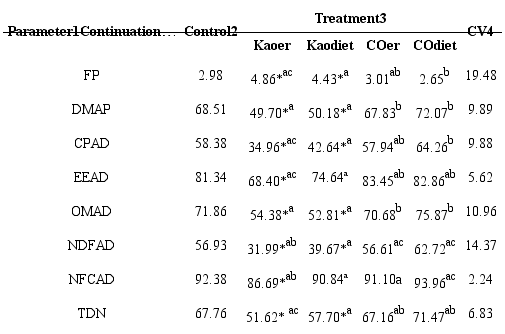
1 FP is the fecal dry matter production, kg/day; DMAP is the dry matter apparent digestibility,%; CPAD is the crude protein apparent digestibility,%; EEAP is the ethereal extract apparent digestibility,%; OMAD is the organic matter apparent digestibility,%; NDFAD is the neutral detergent fiber apparent digestibility,%; NFCAD is the non-fibrous carbohydrate apparent digestibility,%; and TDN is the total digestible nutrients,%.2 Control represents the observed data obtained from the total collection of feces.3 Kaoer is the treatment with kaolin provided by esophageal route; Kaodiet is the treatment with kaolin provided in the diet; COer is the treatment with chromic oxide provided by esophageal route; and COdiet is the treatment with chromic oxide provided in the diet.4 CV is the coefficient of variation. Means followed by “*” differ from control treatment by the Dunnett test at 5% significance level. Means followed by the same letter in the row do not differ from each other by the t-test at 5% significance level.
The differences between real values (control) and estimated values (Table 3) indicate a lack of accuracy in the results obtained from kaolin under both administration forms (esophageal route and in the diet).
The quantification of kaolin was obtained from indirect measures by means of doses of aluminum present in its composition. Therefore, losses and defects resulting from the processes of aluminum extraction and quantification may interfere directly with the estimates of this indicator.
Thus, the choice and adjustments in the methodologies for sample extraction are crucial to obtaining robust and accurate results that could reflect in the obtained results because according to Melo and Silva (2008), the extraction represents the most critical stage of the analytical process to characterize the sample. In addition, little is known about the recovery of Al from organic compounds such as those run on the samples of concentrate, silage, and feces considering the different extraction methods (ZHELJAZKOV; WARMAN, 2002).
The formation of a metastable oxide (alumina) during the sample calcination process at temperatures between 400 and 800 °C (CARTAXO et al., 2011; OSMARI, 2015) could result in underestimates of the aluminum content in the analyzed samples due to an incomplete alumina solubilization by acids during the extraction procedure.
Another factor to consider is that in the routine of extracting samples containing high aluminum contents, such as in the kaolin, may require a higher number of dilutions (or an adjustment in the ratio of sample mass and extractor acid volume) that may result in an incomplete digestion and influence the results. That is, the high aluminum content of the sample may require adjustments in the extraction methodologies, with a demand for more replications of the digestion phase.
Another aspect to consider is that existing methods for the extraction of total aluminum may not be able to perform the complete extraction of the element present in the samples due to the sample characteristic (feces and food) or the excess of aluminum present in the kaolin samples. Therefore, an uncertainty persists that the extraction method used has been able to provide all the aluminum to be quantified.
The natural contamination of soil particles (containing silicate clays such as kaolin) via roughage intake can interfere with the analytical results. However, in this study, the animals were confined and the main source of contamination would come from forage, but relatively low levels (up to 50 mg kg-1 aluminum in the grass and clover composition) (UNDERWOOD, 1977) would not be sufficient to promote profound changes in the obtained results.
Factors of digestion kinetics such as degradation and passage rates may influence the results by accelerating or reducing the rate of fecal excretion of the indicator. However, considering a DM consumption in the apparent digestibility test as being 2% of body weight, it is assumed that the indicator (pre-mixed in the concentrate for subsequent mixing with the roughage) adhered to the particles of the concentrate had a faster passage rate when compared to that contained in the roughage, which probably had a longer permanence time in the rumen and hence a slower passage to the posterior GIT.
Although the indicator kaolin has presented different results when compared to those obtained from the total feces collection in almost all the assessed parameters, the treatment Kaodiet allowed obtaining estimates of fecal production (except DMAD and OMAD) similar to that observed in the treatment COer (Table 3).
The administration of indicators (kaolin and chromic oxide) via supplement did not interfere with the estimates since the results were similar to that observed in the administration by esophageal route of the respective indicators. Although the kaolin did not show adequate prediction estimates, the results in both forms of administration were similar, evidencing that the problem lies in the analytical methodology for extracting and quantifying this indicator.
The similarity of FP, AD, and TDN values estimated by COdiet with those obtained from the total collection (control) shows that the individual administration of indicators by means of their homogenization in the diet allowed obtaining accurate results from a management simpler and less stressful than that observed in COer.
A similar result was observed by Ferreira et al. (2009). In that experiment, the coefficients of apparent digestibility and total digestible nutrients obtained with chromic oxide did not differ from those observed with the total feces collection.
The values of fecal recovery (FR) of the indicators kaolin and chromic oxide were different (p <0.05), regardless of the form of administration (Table 4). However, when comparing the FR values of this indicator under different forms of administration (diet or esophageal), no statistical difference was observed (p>0.05).
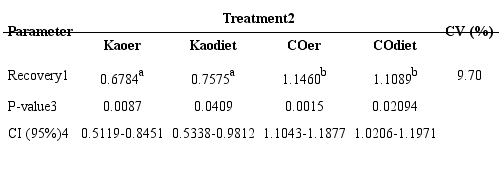
1 Means by minimum squares followed by different letters differ by the Tukey’s test at 5% level.2 Kaoer is the treatment with kaolin provided by esophageal route; Kaodiet is the treatment with kaolin provided in the diet; COer is the treatment with chromic oxide provided by esophageal route; and COdiet is the treatment with chromic oxide provided in the diet.3 P-value for the difference between the observed mean in this treatment and the recovery value of 1.00 (representative of the ideal recovery of 100% of the total provided).4 CI (95%) is the 95% confidence interval.
All the assessed treatments (Table 4) presented results of FR different from 100% (p<0.05), with a lower FR when using the indicator kaolin (Kaoer and Kaodiet) and a higher FR for the indicator chromic oxide (COer and COdiet).
Aluminum is not absorbed by animals under normal conditions, since aluminosilicates are poorly soluble even in an acid pH, being not absorbed when solubilized (MAURAS et al., 1983).
Due to the composition of aluminum sources be classified as aluminosilicates, we considered that all aluminum from kaolin or another source was excreted in the feces without being absorbed. However, the results of FR showed a recovery lower than that ingested. Therefore, new studies should be carried out to clarify the physiological events of Al absorption and excretion.
From the results of fecal production obtained here (Table 5), COer showed to be the best treatments in predicting the fecal production of animals since it presented the lowest dispersion (R2 = 0.86) and data with an acceptable precision and accuracy (CCC = 0.76). However, the high value of the root mean square error of prediction (RMSEP = 0.78) observed in the results indicates a low precision in the estimates. Despite the value of RMSEP (0.44) found by Souza et al. (2015) be lower than that observed here, the authors associated it with inaccurate results.
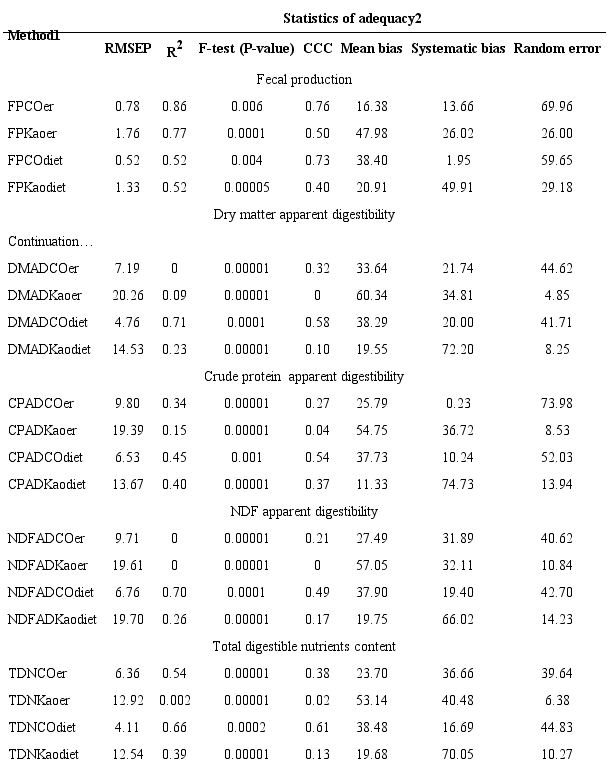
1 Kaoer is the treatment with kaolin provided by esophageal route; Kaodiet is the treatment with kaolin provided in the diet; COer is the treatment with chromic oxide provided by esophageal route; and COdiet is the treatment with chromic oxide provided in the diet.2 RMSEP is the root mean square error of prediction, kg; R2 is the coefficient of determination of the linear regression of the observed data as a function of the predicted data; F-test is the P-value for the simultaneous test for the identity of parameters (β0 = 0 and β1 = 1) of the linear regression of the observed data as a function of the predicted data; CCC is the concordance correlation coefficient.
When assessing the error of prediction of these treatments by using RMSEP divided by the average fecal production observed in the respective treatments, the lowest error of prediction (19.6%) was observed in COdiet.
Fecal production estimates may undergo additive and multiplicative corrections, as demonstrated by the mean and systematic bias, respectively, in order to improve data prediction. The decomposition of RMSEP into a mean bias, systematic bias, and random error (Table 5) showed that the treatment Kaoer presented a sum of 74% between the mean and systematic bias.
The estimate of dry matter apparent digestibility from the treatment COdiet (DMADCOdiet) presented a less dispersed data (R2 = 0.71) and a higher CCC (0.58), indicating a higher accuracy and precision when compared to the other treatments.
The estimates of DMADKaoer showed the lowest random error (4.85%) among the assessed treatments, with a higher possibility of additive and multiplicative corrections of the model, respectively, allowing reaching results more consistent for DMAD from estimates carried out with the indicator kaolin offered by esophageal route.
The prediction of crude protein apparent digestibility performed through the treatments presented very dispersed data (very low R2), as well as a low accuracy and precision of these data (CCC<0.6).
The different treatments used for predicting the neutral detergent fiber apparent digestibility resulted in highly dispersed data (low R2) and proved to be inefficient in obtaining accurate and precise data, with a CCC ranging from 0 to 0.49. However, there is the possibility of additive and multiplicative corrections when taking into account the mean and systematic bias, respectively, which together represented approximately 90% of the RMSEP.
Considering the obtained results and the applied statistical analysis, we can infer that the equations used to obtain the estimates of apparent digestibility and total digestible nutrients (TDN) were not robust enough to meet the statistical tests of adequacy performed using MES (Model Evaluation System).
Conclusions
The assessment process of fecal excretion from the indicator kaolin was not efficient to reach accurate estimates of fecal production. In addition, it is not clear whether the results obtained are due to kaolin itself or to analytical failures throughout the determination process.
The administration of the indicators kaolin and chromic oxide in the diet allows obtaining results similar to that observed by esophageal one.
Methodological and/or analytical failures, mainly in the kaolin dose, may have caused interferences in the results, indicating the need for adjustments in the methodology and new studies to clarify and prove the results.
Acknowledgments
To the CAPES, to the Associação Brasileira de Indústrias de Suplementos Minerais (ASBRAM), and to the FUNDECT for granting the scholarship and financial support, to the UFMS and to the EMBRAPA PANTANAL for the experimental development and analysis of the study.
References
ASSOCIATION OF OFFICIAL ANALYTICAL CHEMISTS - AOAC. Official methods of analysis. 15th ed. Washington: AOAC, 1990.
BRAUNER, J. L.; CATANI, R. A.; BITTENCOURT, W. C. Extração e determinação do alumínio trocável do solo. Anais da Escola Superior de Agricultura Luiz de Queiroz, Piracicaba, v. 23, p. 53-73, 1966.
CAPELLE, E. R.; VALADARES FILHO, S. C.; SILVA, J. F. C.; CECON, P. R. Estimativas do valor energético a partir de características químicas e bromatológicas dos alimentos. Revista Brasileira de Zootecnia, Viçosa, MG, v. 30, n. 6, p. 1837-1856, 2001.
CARTAXO, J. M.; GALDINO, M. N.; MENEZES, R. R.; FERREIRA, H. S.; NEVES, G. A. Síntese de alumina-α utilizando acetato de alumínio. Revista Eletrônica de Materiais e Processos, Campina Grande, v. 6, n. 3, p. 194-197, 2011.
COELHO, A. C. V.; SANTOS, P. S.; SANTOS, H. S. Argilas especiais: o que são, caracterização e propriedades. Química Nova, São Paulo, v. 30, n. 1, p. 146-152, 2007.
FAHEY JÚNIOR, G. C.; JUNG, H. G. Lignin as a marker in digestion studies: a review. Journal of Animal Science, Champaign, v. 57, n. 1, p. 220-225, 1983.
FERREIRA, M. A.; VALADARES FILHO, S. C.; MARCONDES, M. I.; PAIXÃO, M. L.; PAULINO, M. F.; VALADARES, R. F. D. Avaliação de indicadores em estudos com ruminantes: digestibilidade. Revista Brasileira de Zootecnia, Viçosa, MG, v. 38, n. 8, p. 1568-1573, 2009.
FUKUMOTO, N. M.; DAMASCENO, J. C.; CÔRTES, C.; PAINE, R. C.; QUEIROZ, M. F. S.; SANTOS, G. T.; MATSUSHITA, M. Consumo e digestibilidade da matéria seca de fenos de braquiária decumbens e amendoim forrageiro em ovinos estimados por meio de n-alcanos. Revista Brasileira de Zootecnia, Viçosa, MG, v. 36, n. 2, p. 471-479, 2007.
HALL, M. B. Calculation of non-structural carbohydrate content of feeds that contain non-protein nitrogen. Gainesville, USA: University of Florida, 2000. p. A25-A34. (Bulletin, n. 339).
LUZ, A. B.; CARVALHO, E. A.; BERTOLINO, L. C.; SCORZELLI, R. B.; CAMPOS, A. R. Caulim. 2. ed. Rio de Janeiro: CETEM/MCT, 2009. 727 p. (Comunicação Técnica. Elaborada para o livro Rochas & Minerais Industriais: usos e especificações).
MACHADO, A. S.; GODOY, M. M.; LIMA, M. L. M.; FARIA JÚNIOR, O. L.; MORGADO, H. S.; ARAÚJO, E. P. Utilização de óxido crómico e LIPE® como indicadores externos na estimativa de digestibilidade em ruminantes. PUBVET, Londrina, v. 5, n. 20, ed. 167, p. art. 1124, p. 1-16, 2011.
MAURAS, Y.; RENIER, J. C.; TRICARD, A.; ALLAIN, P. Mise en evidence de I'absorption gastro-intestinale du silicium a partir d'un alumino-silicate (Evidence for the gastrointestinal absorption of silicon from an aluminosilicate). Therapie, Mars-Avril, v. 38, n. 2, p. 175-178, 1983.
MELO, L. C. A; SILVA, C. A. Influência de métodos de digestão e massa de amostra na recuperação de nutrientes em resíduos orgânicos. Química Nova, São Paulo, v. 31, n. 3, p. 556-561, 2008.
MOURA, A. K. B.; LIMA, R. N.; LOPES, K. T. L.; MORAIS, J. H. G.; MIRANDA, M. V. F. G.; LIMA, P. O. Uso de indicadores nos estudos da nutrição animal. PUBVET, Londrina, v. 7, n. 24, ed. 247, art. 1634, p. 1-23, 2013.
OLIVEIRA, L. O. F. Desempenho, consumo, dinâmica ruminal e cinética da degradação da Brachiaria brizantha cv Marandu, em bovinos de corte suplementados com proteinados. 2005. 94 p. Tese (Doutorado em Ciência Animal) - Universidade Federal de Minas Gerais, Escola de Veterinária, Belo Horizonte.
OSMARI, T.A. Cinética da reação de desidratação de etanol em alumina. 2015. Dissertação (Mestrado em Engenharia de Processos) - Universidade Federal de Santa Maria. Centro de Tecnologia. Santa Maria, RS.
OWENS, F. N.; HANSON, C. F. Symposium: external and internal markers for appraising site and extent digestion in ruminants. Journal Dairy Science, Savoy, v. 75, n. 9, p. 2605-2617, 1992.
PENNING, P. D. Animal-based techniques for estimating herbage intake. In: PENNING, P. D. . (Ed). Herbage intake handbook. 2th ed. Reading: The British Grassland Society, 2004. p. 53-94.
RIBEIRO FILHO, H. M. N.; DELAGARDE, R.; PEYRAUD, J. L. Inclusion of white clover in strip-grazed perennial ryegrass swards: herbage intake and milk yield of dairy cows at different ages of sward regrowth. Animal Science, Midlothian, v. 77, n. 3, p. 499-510, 2003.
SALIBA, E. O. S. Caracterização química e microscópica das ligninas dos resíduos agrícolas de milho e soja expostas a degradação ruminal e seu efeito sobre a digestibilidade dos carboidratos estruturais. 1998. 252 p. Tese (Doutorado em Ciência Animal) - Universidade Federal de Minas Gerais. Escola de Veterinária, Belo Horizonte.
SILVA, F. A. N. G. Estudos de caracterização tecnológica e beneficiamento do caulim da região Borborema - Seridó. 2007. 70 p. Dissertação (Mestrado em Ciências em Engenharia Metalúrgica e de Materiais) - Universidade Federal do Rio de Janeiro, COPPE, Rio de Janeiro.
SOUZA, J.; BATISTEL, F.; WELTER, K. C.; SILVA, M. M.; COSTA, D. F.; SANTOS, F. A. P. Evaluation of external markers to estimate fecal excretion, intake, and digestibility in dairy cows. Tropical Animal Health Production, Edinburgh, v. 47, n. 1, p. 265-268, 2015.
TEDESCHI, L. O. Model evaluation system - MES. Kleberg Center: College Station, 2006. Available at: <http.//nutritionmodels.tamu.edu/mes.htm>. Accessed at: 03 aug. 2016.
UNDERWOOD, E. J. Trace elements in human and animal nutrition. 4th ed. New York: Academic Press, 1977. 560 p.
VAN SOEST, P. J.; ROBERTSON, J. B.; LEWIS, B. A. Methods for dietary fiber, neutral detergent fiber, and nonstarch polysaccharides in relation to animal nutrition. Journal of Dairy Science, Savoy, v. 70, n. 10, p. 3583-3597, 1991.
WILLIAMS, C. H.; DAVID, D. J.; IISMA, O. The determination of chromic oxide in faeces samples by atomic absorption spectrophotometry. Journal of Agricultural Science, Belgrado, v. 59, n. 3, p. 381-385, 1962.
ZHELJAZKOV, V. D.; WARMAN, P. R. Comparison of three digestion methods for the recovery of 17 plant essential nutrients and trace elements from six composts. Compost Science and Utilization, London, v. 10, n. 3, p. 197-203, 2002.
Author notes
*Author for correspondence