SHORT COMMUNICATIONS
Received: 28 August 2017
Accepted: 14 December 2017
DOI: https://doi.org/10.5433/1679-0359.2018v39n2p893
Abstract: This study aimed to evaluate the effect of post-hatch fasting time on the weights of body and digestive organs of chicks. Fertile eggs from 62-week-old broiler breeders (Cobb Fast lineage) were incubated and, after hatching, female chicks were randomly divided into six treatments, which corresponded to fasting periods (0, 6, 12, 24, 48, and 72 hours), with 40 chicks per treatment. At 01, 03, 06, and 10 days after hatching, measurements of body weight; residual yolk weight; relative weights of proventriculus + gizzard, intestine + pancreas and liver; and intestine total length were made. At 6 days of age, the chicks submitted to post-hatch fasting, for up to 12 hours, demonstrated greater development, with body weights higher than the other birds. Yet, when fed, no compensatory gain was observed and, at 10 days of age, the birds submitted to 48- and 72-h fasting remained with a lower body development. Intestine growth was also compromised by post-hatch fasting, being reduced in both weight and length. A post-hatching fasting of up to 24 hours did not interfere with the weights of body and digestive organs of 10-day-old female broiler chickens. However, 48- and 72-h post-hatch fastings affected adversely the weight and growth of digestive organs in the birds.
Key words: Broilers, Hatch window, Incubation.
Resumo: O efeito dos períodos de jejum pós-eclosão foi avaliado sobre o peso inicial das aves e de seus órgãos digestórios. Ovos férteis de matrizes de frango de corte (linhagem Cobb Fast) de 62 semanas de idade foram incubados e após a eclosão os pintinhos (fêmeas) foram divididos em seis tratamentos de 40 aves cada, correspondentes a tempos diferentes de jejum (0, 6, 12, 24, 48 e 72 horas). Com 1, 3, 6 e 10 dias de idade, o peso corporal das aves e do vitelo residual, pesos relativos do proventrículo + moela, intestino + pâncreas, fígado, e o comprimento total do intestino foram analisados. Aos 6 dias de idade, os animais que foram submetidos ao jejum pós-eclosão de até 12 horas demonstraram melhor desenvolvimento com maior peso corporal em relação aos demais. Essas aves não apresentaram ganho compensatório quando alimentadas; no entanto, aos 10 dias de idade, os animais submetidos a 48 e 72 horas de jejum, permaneceram com menor desenvolvimento corporal. O crescimento do intestino também foi comprometido em função do jejum pós-eclosão, com redução de comprimento e peso. O jejum pós-eclosão de até 24 horas não afetou o peso corporal e o peso de órgãos digestórios em fêmeas de frango de corte criadas até 10 dias. Já jejum de 48 e 72 horas afeta de forma negativa o peso corporal e o crescimento dos órgãos digestórios.
Palavras-chave: Pintos de corte, Janela de nascimento, Incubação.
Brazil has been ranked as the third largest chicken meat exporter worldwide since 2004, behind only the United States and China. The country also has a per capita meat consumption of 43.25 kilograms yearly (ABPA, 2016).
In hatcheries, after hatching, chicks are exposed to various procedures prior to transport to the farms, such as vaccination, sexing, and selection. In a continental country such as Brazil, the transport route is often long and may cause water and feed restriction for up to two days (SILVA et al., 2007). In addition, due to the hatch window, it is common to transport animals born at different times, from 24 to 48 hours, which further increases the fasting time.
During this period of food and water fasting, birds may undergo a dehydration process (AGOSTINHO et al., 2012). Furthermore, if transport takes too long, in addition to dehydration, a prolonged fasting may increase mortality rates (PEDROSO et al., 2006) and decrease liver, pancreas and intestine weights, besides hindering yolk-sac absorption (ALMEIDA et al., 2006), therefore, reducing zootechnical performance of birds at 42 days of age (CARVALHO et al., 2013).
During the last days of incubation and after hatching, energy and protein are directed towards the digestive-tract development, especially small intestines (UNI, 2006). This metabolism behavior occurs even in the absence of food during the first hours post-hatching. In an experiment carried out by Agostinho et al. (2012), chicks fasted for 48 hours after hatching lost body weight, and the intestine weight increased by 60%, whereas those fed soon after hatching had intestinal weight increased by 200%. Notably, rapid access to food can improve performance by stimulating digestive enzymes and developing intestinal villi.
Thus, this study aimed to evaluate the effect of different periods of post-hatching fasting on the initial weights of female chicks and their digestive organs until 10 days post-hatch.
The Research and Ethics Committee of Assis Gurgacz College approved the experiment, under protocol number 017/2014. Eggs (n=240) from 62-week-old Cobb Fast broilers were used, being incubated in a commercial incubator.
After hatching, chicks were removed from the incubators and sexed; females were homogenized by weight and then distributed in a completely randomized experimental design of six treatments with 40 chicks. Each chick was considered as an experimental unit. The first treatment consisted of chicks fed using trays in the hatchery (0h) and, after hatching, all the chicks were randomly distributed into 1-m2 metabolic cages, receiving water. Chicks from each fasting period were fed according to treatments after 6, 12, 24, 48, or 72 hours.
Electric heaters accomplished the heating of the room, keeping an average temperature of 29 ± 2°C during the study. After the fasting period, the chickens received commercial feed based on corn and soybean meal, which was formulated according to the requirements of Rostagno et al. (2011).
Then, ten chicks of each treatment were weighed and euthanized by cervical displacement on the days 01, 03, 06, and 10 corresponding to 24, 72, 144, and 240 hours after removal from the incubator, respectively. Afterwards, the residual yolk was weighed, total intestine length was measured, and organs were dissected, cleaned, and weighed. The relative weights of proventriculus + gizzard, intestine (small and large) + pancreas, and liver were estimated by the formula: (organ weight/body weight) x 100.
The data were submitted to analysis of variance (ANOVA), and the results were compared by the Tukey's test at 5% probability.
The studied fasting times had a significant effect (P<0.05) on the body weight of birds (Table 1). At 6 days of age, the chicks submitted to post-hatch fasting for up to 12 hours demonstrated greater development with higher body weights if compared to the others. This difference might be related to dehydration, yolk-sac absorption, and use of muscle reserves to obtain glucose from gluconeogenesis. Under acute metabolic demands, muscle tissue can be metabolized to meet the basic survival needs of chicks (UNI et al., 2005), which could explain the low body weight in longer fasting periods (48 and 72 hours).
Body, residual yolk, liver, proventriculus + gizzard, and small intestine + pancreas weights, and intestine length of female broiler chickens (n=10) under varying post-hatch fasting times.
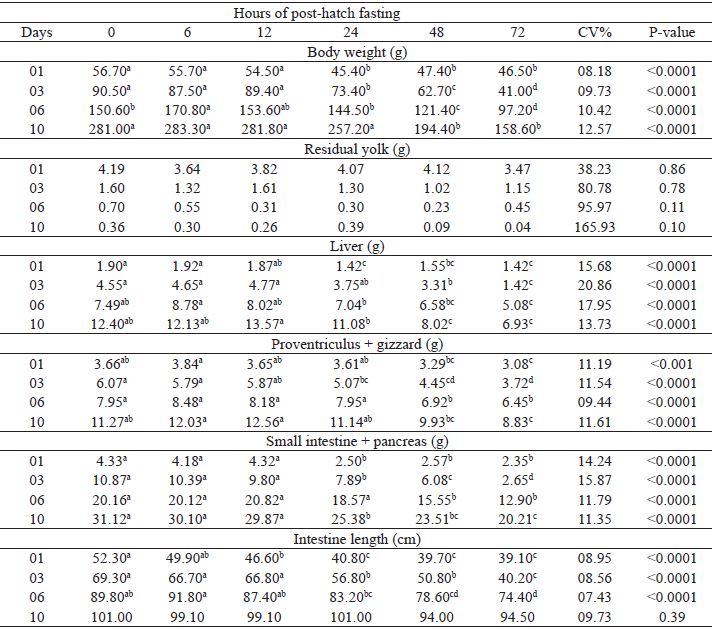
Means followed by distinct letters in the same line differ significantly from each other by the Tukey's test at 5% probability. CV=coefficient of variation
Additionally, no compensatory gain was observed in the birds. At 10 days of age, birds submitted to 48- and 72-h fasting had lower body development; therefore, such period might be critical to chick growth. Similar observations were obtained by Baião and Cançado (1998); Almeida et al. (2006); Pedroso et al. (2006); El-Husseiny et al. (2008); Riccardi et al. (2009) and Carvalho et al. (2013), who observed a decrease in the body weight of chicks under post-hatching food restriction.
No significant effect was observed for residual yolk weight (P>0.05); hence, the presence or absence of food in the digestive tract of birds had no effect on the yolk volume in their bodies (Table 1). On the third day after hatching, all the chicks had residual yolk around 1 g, even those still under fasting for 72 hours.
This pattern of yolk absorption among groups may be explained by the low development of gastrointestinal tract in birds under fasting, which, by slowing metabolism and growth, their energy needs are hence reduced (GONZALES et al., 2003). These findings point the feed as the main source of nutrient in post-hatching, once the animals under fasting (48 and 72 hours) consumed no yolk content to supply their nutrient requirements, which may have contributed to their low body weight.
Unlike the results obtained here, Noy and Sklan (2001) alleged that yolk weight is higher when animals are fed if compared to those fasting. This assertion can be attributed to the physical presence of feed, peristaltic movements, and negative pressure of the abdominal cavity, inducing the passage of yolk contents to the intestinal tract.
Agostinho et al. (2012) observed that chicks from 30-week-old breeders obtained a faster yolk absorption when they had access to the food. In contrast, the same authors found no changes in yolk absorption rates for chicks from 60-week old breeders, with or without food access. Our findings are similar to this last observation but using eggs from 62-week-old breeders. Egg and yolk from older broiler breeders are larger than are those of younger birds (MAIORKA et al., 2000). Therefore, the final residual yolk would also be different between young and older breeders, as well as the yolk composition. These factors can contribute to the intestinal yolk absorption in chicks during the last hours before hatching.
Regarding liver growth, the chicks under fasting had the liver weight reduced, being the livers of 10-day-old chicks 44% smaller than those of control treatment (Table 1). Conversely, for relative weight, the liver was proportionally smaller in chicks submitted to a fasting period of 72 hours (P<0.05) only on the third day (Table 2).
Relative weights of liver, proventriculus + gizzard, and small intestine + pancreas of female broiler chickens (n=10) under varying post-hatch fasting times.
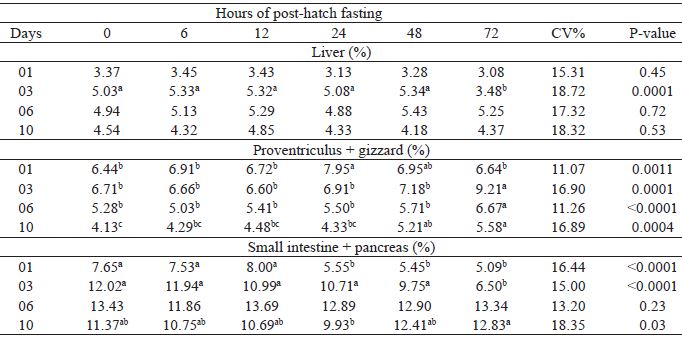
Means followed by distinct letters in the same line differ significantly from each other by the Tukey's test at 5% probability. CV=coefficient of variation.
After feeding, chicks increased body weight; thus, from 6 days of age, no difference in relative liver weight was observed as a function of the studied treatments (P>0.05).
By increasing the period in which the chicks remained without food, the weight of stomach (proventriculus + gizzard) and small intestine + pancreas, as well as the intestine length reduced considerably (Table 1-2); these results were observed until 10 days after hatching. As body growth was affected, the fasting also had an effect on the relative weight. Furthermore, the growth rate of gastrointestinal viscera was reduced during the fasting time but increased when animals were fed.
During the first hours of life, the nutrient demands of birds are directed towards the growth of organs from the gastrointestinal tract; this is because these organs will support the growth of other tissues with nutrient supply (CANÇADO; BAIÃO, 2002; MAIORKA et al., 2003). The absence of nutrients in early feeding impairs the digestive tract development and, hence, the body weight; it occurs because an intensive early growth of birds is related to the increase of visceral organs, mainly intestine.
Post-hatch fasting also compromised the intestine growth. However, at 10 days of age, all the chicks had similar size (P>0.05) and relative weight, indicating compensatory gain. Chicks under non-fasting had the total intestine length increased by 1.94 fold (52.3 to 101.0 cm), while chicks submitted to 72-h post-hatch fasting had an increment of 2.4 fold (39.1 to 94.5 cm) (Table 1).
Similar results were found in a study with turkeys (CORLESS; SELL, 1999), in which delays in access to food and water slowed digestive system growth, limiting the nutrient-use ability of birds and, hence, resulting in a body weight reduction.
According to Maiorka et al. (2003), the absence of food and water, shortly after hatching, adversely affects intestinal development and, therefore, food should be offered as soon as possible after hatching, to avoid delays in the development of the gastrointestinal tract of chicks.
In conclusion, a post-hatching fasting of up to 24 hours did not interfere with the weights of body and digestive organs of 10-day-old female broiler chickens. However, 48- and 72-h post-hatch fastings affected adversely the weight and growth of digestive organs in the birds.
References
AGOSTINHO, T. S. P.; CALIXTO, L. F. L.; GOMES, A. V. C.; TOGASHI, C. K.; CURVELLO, F. A.; LIMA, M. F. Desenvolvimento de órgãos do trato gastrintestinal e desempenho de frangos de corte arraçoados na fase pré-alojamento. Revista Brasileira de Saúde e Produção Animal, Salvador, v. 13, n. 4, p. 1143-1155, 2012.
ALMEIDA, J. G.; DAHLKE, F.; MAIORKA, A.; MACARI, M.; FURLAN, R. L. Efeito do jejum no intervalo entre o nascimento e o alojamento sobre o desempenho de frangos de corte provenientes de matrizes de diferentes idades. Archives of Veterinary Science, Curitiba, v. 11, n. 2, p. 50-54, 2006.
ASSOCIAÇÃO BRASILEIRA DE PROTEÍNA ANIMAL - ABPA. Relatório anual 2016. São Paulo: ABPA, 2016.
BAIÃO, N. C.; CANÇADO, S. V. Efeito do intervalo entre nascimento e o alojamento de pintos sobre o desempenho dos frangos. Arquivo Brasileiro de Medicina Veterinária e Zootecnia, Belo Horizonte, v. 50, n. 2, p. 191-194, 1998.
CANÇADO, S. V.; BAIÃO, N. C. Efeito do período de jejum entre o nascimento e o alojamento de pintos de corte e da adição de óleo a ração sobre o desenvolvimento do trato gastrintestinal e concentração de lípase. Arquivo Brasileiro de Medicina Veterinária e Zootecnia, Belo Horizonte, v. 54, n. 6, p. 623-629, 2002.
CARVALHO, L. S. S.; MACHADO, C. A.; FAGUNDES, N. S.; LITZ, F. H.; FERNANDES, E. A. Desenvolvimento biométrico e desempenho de frangos de corte submetidos a diferentes períodos de jejum pós-eclosão. Brazilian Journal of Veterinary Research and Animal Science, São Paulo, v. 50, n. 4, p. 300-306, 2013.
CORLESS, A. B.; SELL, J. L. The effects of delayed access to feed and water on the physical and functional development of the digestive system of young turkeys. Poultry Science, Champaign, v. 78, n. 8, p. 1158-1169, 1999.
EL-HUSSEINY, O. M.; ABOU EL-WAFA, S.; EL-KOMY, H. M. A. Influence of fasting or early feeding on broiler performance. International Journal of Poultry Science, v. 7, n. 3, p. 263-271, 2008.
GONZALES, E.; KONDO, N.; SALDANHA, E. S.; LODDY, M. M.; CAREGHI, C.; DECUYPERE, E. Performance and physiological parameters of broiler chickens subjected to fasting on the neonatal period. Poultry Science, Champaign, v. 82, n. 8, p. 1250-1256, 2003.
MAIORKA, A.; SANTIM, E.; DAHLKE, F.; BOLELI, I. C.; FURLAN, R. L.; MACARI, M. Posthatching water, and feed deprivation affect the gastrointestinal tract and intestinal mucosal development of broiler chicks. Journal of Applied Poultry Research, Champaign, v. 12, n. 4, p. 483-492, 2003.
MAIORKA, A.; SANTIN, E.; SILVA, A. V. F.; BRUNO, L. D. G.; BOLELI, I. C.; MACARI, M. Desenvolvimento do trato gastrointestinal de embriões oriundos de matrizes pesadas de 30 e 60 semanas de idade. Revista Brasileira de Ciência Avícola, Campinas, v. 2, n. 2, p. 141-148, 2000.
NOY, Y.; SKLAN, D. Yolk and exogenous feed utilization in the posthatch chick. Poultry Science, Champaign, v. 80, n. 10, p. 1490-1495, 2001.
PEDROSO, A. A.; BARBOSA, C. E.; STRINGHINI, J. H.; CAFÉ, M. B.; LEANDRO, N. S. M.; BARBOSA, V. T. Intervalo entre a retirada do nascedouro e o alojamento de pintos de diferentes pesos oriundos de matrizes jovens. Ciência Rural, Santa Maria, v. 7, n. 3, p. 249-256, 2006.
RICCARDI, R. R.; MALHEIROS, E. B.; BOLELI, I. C. Efeito do jejum pós-eclosão sobre pintos de corte provenientes de ovos leves e pesados. Ciência Animal Brasileira, Goiânia, v. 10, n. 4, p. 1013-1020, 2009.
ROSTAGNO, H. S.; ALBINO, L. F. T.; DONZELE, J. L.; GOMES, P. C.; OLIVEIRA, R. F.; LOPES, D. C.; FERREIRA, A. S.; BARRETO, S. L. T.; EUCLIDES, R. F. Tabelas brasileiras para aves e suínos: composição de alimentos e exigências nutricionais de aves e suínos. Viçosa, MG: UFV, 2011. 252 p.
SILVA, J. H. V.; RIBEIRO, M. L. G.; JORDÃO FILHO, J.; SILVA, E. L. Avaliação de programas de alimentação para pintos de corte submetidos a jejum de 72 horas pós-eclosão. Ciência e Agrotecnologia, Lavras, v. 31, n. 1, p. 206-211, 2007.
UNI, Z. Early development of small intestinal function. In: PERRY, G. C. Avian gut function in health and disease. Abingdon: Poultry Science Symposium Series, 2006. v. 28, 29-42.
UNI, Z.; FERKET, P. R.; TAKO, E.; KEDAR, O. In ovo feeding improves energy status of late-term chicken embryos. Poultry Science, Champaign, v. 84, n. 5, p. 764-770, 2005.
Author notes
*Author for correspondence
