Carátula del artículo
Theresimima ampellophaga (Bayle-Barelle, 1808) rediscovered in the Republic of North Macedonia by using sex attractant traps (Lepidoptera: Zygaenidae)
Theresimima ampellophaga (Bayle-Barelle, 1808) redescubierta en la República Macedonia del Norte usando trampas con atrayente sexual (Lepidoptera: Zygaenidae)
 A. Nahirnic-Beshkova ana.diaphana@gmail.com
National Museum of Natural History. Bulgarian Academy of Sciences, Bulgaria
S. Beshkov stoyan.beshkov@gmail.com
National Museum of Natural History. Bulgarian Academy of Sciences, Bulgaria
E. E. Kucherenko shysh1981@mail.ru
V. I. Vernadsky Crimean Federal University, Rusia
K. A. Efetov efetov.konst@gmail.com
V. I. Vernadsky Crimean Federal University, Rusia
SHILAP Revista de lepidopterología, vol. 49, núm. 193, pp. 161-170, 2021
Sociedad Hispano-Luso-Americana de Lepidopterología
Recepción: 21 Septiembre 2020
Aprobación: 17 Octubre 2020
Publicación: 30 Marzo 2021
Introduction
Sex pheromones and sex attractants are fast becoming a key instrument in detection, monitoring and studying the seasonal activity of Lepidoptera, including Zygaenidae species (CAN et al., 2019; EFETOV et al., 2011, 2014a, 2015, 2016, 2018a, 2019; NAHIRNIĆ et al., 2015; RAZOV et al., 2017; SUBCHEV et al., 2012, 2013, 2016; TOSHOVA et al., 2017). Based on the recent classification, the Zygaenidae family is represented by five subfamilies: Inouelinae Efetov & Tarmann, 2017, Procridinae Boisduval, 1828, Chalcosiinae Walker, 1865, Callizygaeninae Alberti, 1954, and Zygaeninae Latreille, 1809 (EFETOV & TARMANN, 2017). Zygaenidae include approximately 30 pest species from subfamilies Procridinae, Chalcosiinae and Zygaeninae (TARMANN, 2003), and one of the most known among them is Theresimima ampellophaga (Bayle-Barelle, 1808) (Procridinae). Theresimima ampellophaga is a Ponto-Mediterranean species. Its main host-plant is Vitis vinifera L. and occasionally Parthenocissus spp. (EFETOV, 1990; TARMANN, 1998). In some regions it is reported as a pest species in vineyards, however in the Balkans outbreaks were reported only sporadically (e.g. DIMIĆ et al., 1996; HARIZANOV et al., 1994; MACELJSKI, 2002).
Grape and wine production in North Macedonia contributes to around 17-20% of the agricultural Gross Domestic Product and wine production in North Macedonia has large export trade relevance (ANONYMOUS, 2007). Vineyards are covering 5% of a total agricultural area in the country (ANONYMOUS, 2018). Areas of vineyards are reducing, from being 38759 ha in 1981 (VOJNOSKI et al., 2009), ca. 29000 in 1997 (ANONYMOUS, 2008), 22665 ha in 2007 (ANONYMOUS, 2008) to 23703 ha in 2017 (ANONYMOUS, 2018). There are three vine-growing regions in North Macedonia: Povardarie region with 83% of production, Pelagonia - Polog region covering 13% of production and Pchinja - Osogovo region covering 4% of production (ANONYMOUS, 2007).
All data considering Th. ampellophaga in North Macedonia are faunistic while observations of damages in vineyards caused by this species are unknown to us. It was reported from only three localities in North Macedonia: Drenovo (ALBERTI, 1922), Mt. Galichica (DRENOWSKY, 1930) and Ohrid (THURNER, 1938-1941).
Monitoring with usage of sex attractants or sex pheromones provides information on the presence, abundance and seasonal activity of species and thus it enables us to make a decision whether species should be considered as a pest in a specific area and year. The main component of the sex pheromone of Th. ampellophaga was identified as (2R)-butyl (7Z)-tetradecenoate (SUBCHEV et al., 1998). The presence of this species was established by using synthetic sex pheromone in Albania (VRENOZI et al., 2019), Bulgaria (MUMUN et al., 2018; NAHIRNIĆ-BESHKOVA et al., 2021; SUBCHEV et al., 1998, 2008b; TOSHOVA & SUBCHEV, 2002; TOSHOVA et al., 2017), Croatia (RAZOV et al., 2017), France (DROUET & LAMBERT, 2010; RYMARCZYK & DROUET, 2006), Greece (SUBCHEV et al., 2006), Hungary (SUBCHEV et al., 2004; TOSHOVA & SUBCHEV, 2005; TOSHOVA et al., 2007; VOIGT et al., 2000), Italy (SUBCHEV et al., 2008b), Romania (SUBCHEV et al., 2008a), Russia (SUBCHEV et al., 2008b), Serbia (NAHIRNIĆ et al., 2015) and Turkey (CAN et al., 2010; CAN CENGIZ et al., 2012). Theresimima ampellophaga was attracted to the opposite enantiomer (2R)-butyl (7Z)-tetradecenoate in Turkey (EFETOV et al., 2010). Synthetic sex attractant EFETOV-2 (racemic mixture of (2R)-butyl 2-dodecenoate and (2S)-butyl 2-dodecenoate) was successfully used for attracting males of Th. ampellophaga in Albania (VRENOZI et al., 2019), Greece (TARMANN et al., 2019) and Russia (EFETOV et al., 2018b), while EFETOV-S-2 ((2R)-butyl 2- dodecenoate) attracted Th. ampellophaga in Russia (EFETOV et al., 2018b) and Turkey (CAN CENGIZ et al., 2018).
The aim of our investigation was to confirm the presence of Th. ampellophaga in already known areas in North Macedonia and to discover new ones as well as to determine its seasonal flight.
Material and methods
Sex attractant EFETOV-2 (racemic mixture of (2R)-butyl 2-dodecenoate and (2S)-butyl 2- dodecenoate) produced in the Crimean Federal University (EFETOV et al., 2014b) was applied onto rubber caps which were attached to hard paper and placed inside the traps. Delta traps of transparent PVC foil and sticky layers were used. Two traps were set in each of the vineyard with a distance of 10- 20 m.
Only abandoned vineyards were selected at the following localities: Ohrid town, Trebenishta village, 41º12’44” N, 20º45’33” E, 715 m (Fig. 1).
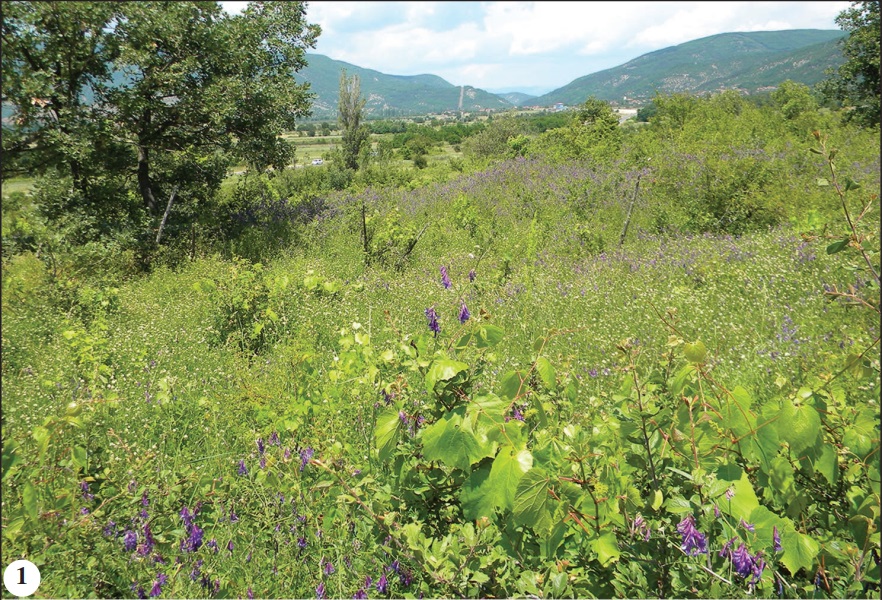 Figure 1
Studied localities
Figure 1
Studied localities
Ohrid town, Trebenishta village, 09-VI-2016
Photos: A. Nahirnić
The area is characterized by vineyards of various management, other agricultural fields, and abandoned fields. It is 5 km in the North from Ohrid Lake.
Ohrid Lake, between Ljubanishta village and Sveti Naum, 40º54’49” N, 20º45’21” E, 710 m (Fig. 2).
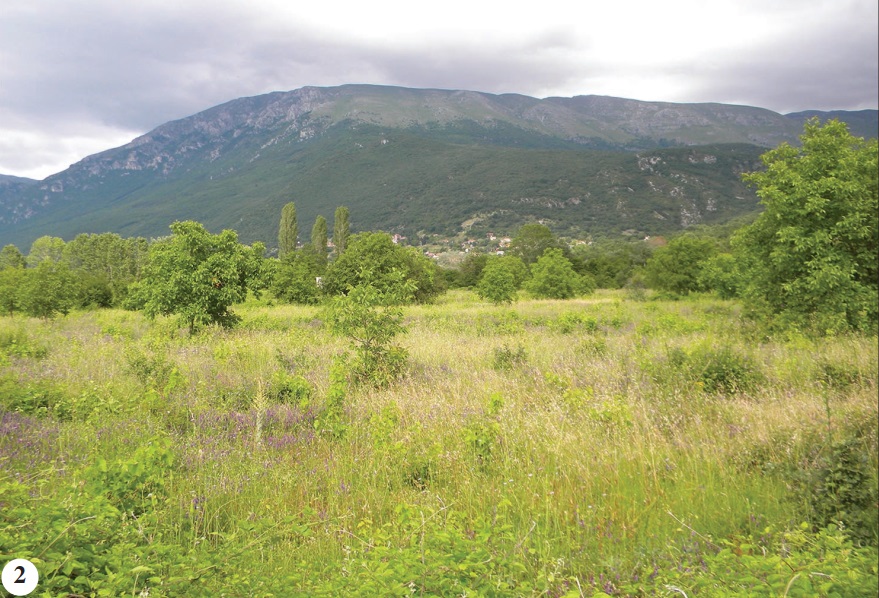 Figure 2
Studied localities
Figure 2
Studied localities
Ohrid Lake, between Ljubanishta village and Sveti Naum, 05-VI-2016
Photos: A. Nahirnić
The area of ca. 300 ha surrounded by Ohrid Lake and Mt. Galichica foothill consists of one small village, scattered vineyards of various management, other agricultural fields, and many meadows.
Demir Kapija, Chiflik village E, Gorna Ergela, 41º23’18” N, 22º12’44” E, 168 m (Fig. 3).
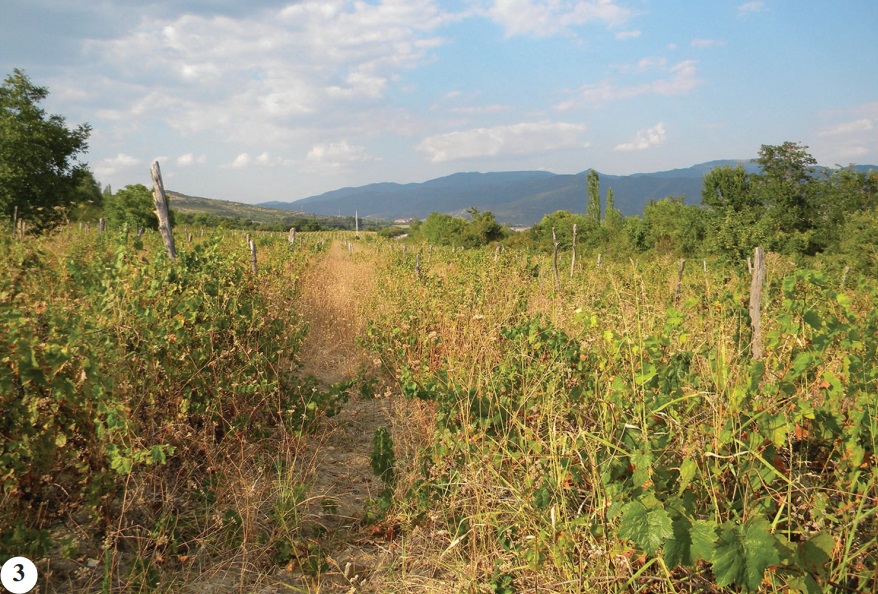 Figure 3
Studied localities
Figure 3
Studied localities
Demir Kapija, Chiflik village E, Gorna Ergela, 18-VIII-2017
Photos: A. Nahirnić
Demir Kapija is situated in a well-known viticulture area of Tikvesh. It was difficult to find abandoned vineyard of size of at least 2 ha around Demir Kapija. Selected vineyard is almost 7 ha. The majority of the agricultural fields in the valley were moderately to well-managed vineyards with usage of pesticides. Valley is surrounded by hills covered mostly with pseudomaquis.
Dojran Lake, Nov Dojran 6 km NW, Atica, 41º14’38” N, 22º38’07” E, 178 m (Fig. 4).
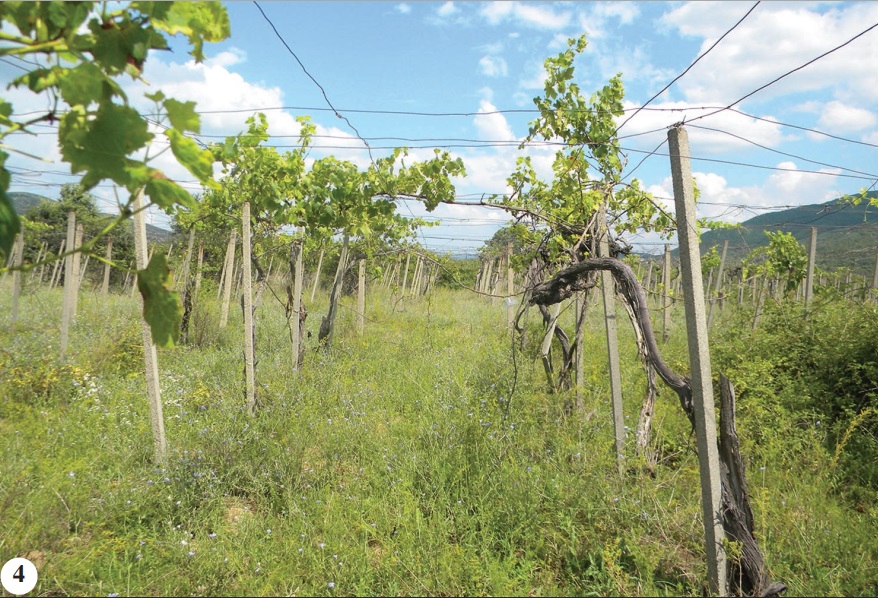 Figure 4
Studied localities
Figure 4
Studied localities
Dojran Lake, Nov Dojran 6 km NW, Atica, 08-VII-2018
Photos: A. Nahirnić
Abandoned vineyard of 50 ha. Vines are growing upon horizontal network trellis. There are several vineyards of similar size and with various management as well as abandoned vineyards and vineyards of smaller sizes.
Results
Theresimima ampellophaga males were observed in traps at all four investigated sites: Trebenishta and between Ljubanishta village and Sveti Naum in 2016, in Demir Kapija in 2017 and near Nov Dojran in 2018. In the area of Ohrid Lake traps were checked once or twice just to record the presence of Th. ampellophaga. In Trebenishta traps were set on 9 June and removed on 8 August and checked only once on 9 July. Two and three moths were caught in both periods, respectively. On 9 July one specimen was found alive in the trap. In the vineyard between Ljubanishta village and Sveti Naum traps were set on 5 June and checked on 4 July when they were removed. Three moths were caught in the traps. In Demir Kapija traps were set in the field from 6 May to 25 August, and lures were replaced on 9 July. Altogether 45 moths were recorded in traps from 20 May until 9 July (Fig. 5). Near Nov Dojran traps were placed on 2 June and checked on 11 June, 8 July, 5 August and removed on 25 September. Only one male was found in a trap on 11 June.
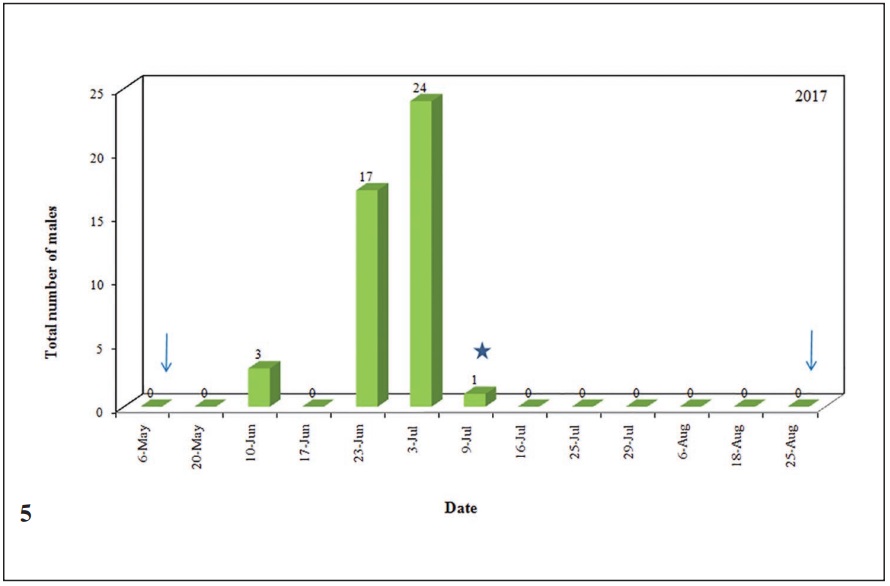 Figure 5
Seasonal flight of Th. ampellophaga males at Chiflik village (Demir Kapija) in 2017 recorded from two replicates of traps baited with synthetic sex attractant EFETOV-2 (racemic mixture of (2R)-butyl 2- dodecenoate and (2S)-butyl 2-dodecenoate). The arrows indicate the monitoring period while asterisk indicates date when lures were renewed
Figure 5
Seasonal flight of Th. ampellophaga males at Chiflik village (Demir Kapija) in 2017 recorded from two replicates of traps baited with synthetic sex attractant EFETOV-2 (racemic mixture of (2R)-butyl 2- dodecenoate and (2S)-butyl 2-dodecenoate). The arrows indicate the monitoring period while asterisk indicates date when lures were renewed
Discussion
In North Macedonia sex attractants were used for the detection of this species for the first time. The last time Th. ampellophaga was recorded in North Macedonia about 80 years ago by THURNER (1938-1941). We confirmed the occurrence of this species in the area of Ohrid Lake – Mt. Galichica and reported it from two new localities (Fig. 6). Demir Kapija is a new locality in central part of North Macedonia ca. 27 km from Drenovo, the next nearest locality of Th. ampellophaga. Dojran Lake represents the first locality of Th. ampellophaga in south-eastern North Macedonia.
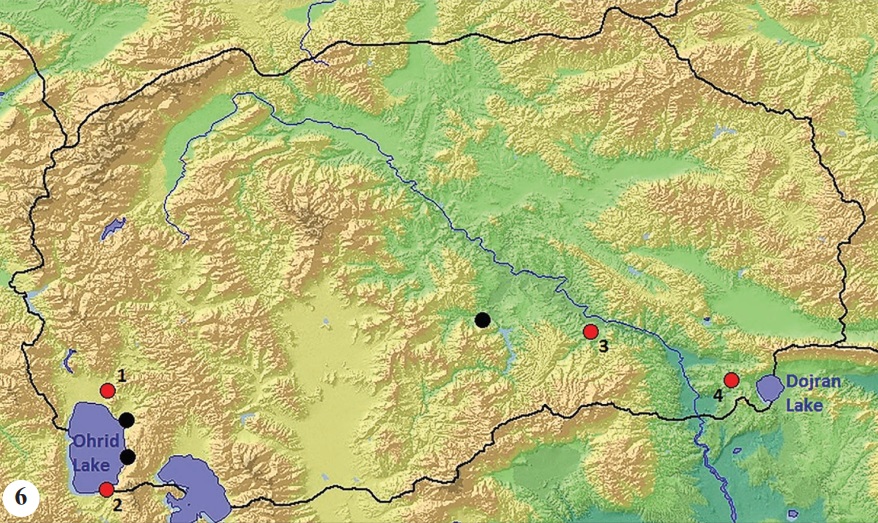 Figure 6
Localities of Theresimima ampellophaga in North Macedonia. Black dots - published records, red dots - new records. 1 - Trebenishta, 2 - between Ljubanishta and Sveti Naum, 3 - Demir Kapija, 4 - Nov Dojran.
Figure 6
Localities of Theresimima ampellophaga in North Macedonia. Black dots - published records, red dots - new records. 1 - Trebenishta, 2 - between Ljubanishta and Sveti Naum, 3 - Demir Kapija, 4 - Nov Dojran.
Theresimima ampellophaga was very rarely found at altitudes above 700 m. DRENOWSKY (1930) placed this species in a group of species that appear up to 1000 m. As Ohrid Lake surface is at 700 m this span appears to be 700-1000 m. We recorded exact altitudes in this area (710 and 715) which represent the highest altitudes on the Balkan Peninsula where Th. ampellophaga occurs. Besides localities at Ohrid Lake, the only locality where Th. ampellophaga occurs around 700 m on the Balkan Peninsula is Dragoman town area in Bulgaria at 700 m and 250 km inland (FREINA & WITT, 2001). It occurs at higher altitudes in France (DROUET & LAMBERT, 2010; RYMARCZYK & DROUET, 2006), Italy (BERTACCINI & FIUMI, 1999) and Turkey (CAN et al., 2010), but most of these localities are close to the sea. In Kahramanmarar province in Turkey Th. ampellophaga was found at several localities at 784-916 m and ca. 100-130 km inland (CAN et al., 2010; Can, personal communication). However, these localities are on smaller latitude and situated in a Amuq - Islahiye - Marar depression which is opened to the sea. Another exceptional locality is Pond in Italian Alps (BERTACCINI & FIUMI, 1999) where Th. ampellophaga could have penetrated through Aosta river valley. Pond is situated at 900 m and it is ca. 180 km inland. The distance of 105-110 km from the sea over the mountains, not connected to any valley opened to the sea, makes Ohrid area quite unique among the other Th. ampellophaga localities. The presence of Th. ampellophaga so high and so inland is driven by the limestone bedrock, western exposition and the vicinity of the big water body Ohrid Lake which mitigates the local climate.
In the area Ohrid-Galichica assumable flight period was in July, thought it is possible that specimens could have been caught in June as well, however one of the two specimens in traps was alive on 9 July in Trebenishta. Moreover, flight period could extend to August since our observation period was from 10 July to 8 August in Trebenishta. THURNER (1938-1941) found this species in Ohrid in June. In Demir Kapija flight period began between 20 May and 10 June and lasted until the period 3 July - 9 July. During the period of 10-17 June, no moths were caught in traps which can be explained by the very bad weather that time. ALBERTI (1922) reported Th. ampellophaga from the beginning of May in Drenovo. Although we do not have weekly data, we can conclude that flight period of Th. ampellophaga in the area Ohrid-Galichica started approximately one month later than in Demir Kapija probably because of the difference in elevation which is ca. 550 m higher. Only one male in Dojran Lake area was certainly not expected considering wide area of vineyards especially those abandoned, good connectivity between vineyards, vicinity of other vineyard areas such as Valandovo and Bogdanci and suitable climate.
Theresimima ampellophaga does not represent a threat for vineyards in North Macedonia. However, abandoned vineyards in vicinity of managed ones can constitute potential reservoirs of various diseases and pests. On the other side, they may provide a refuge for wildlife in highly intensified agricultural areas. Eventually, succession will take place and they will change toward primary potential vegetation.
Acknowledgments
We are thankful to Nikola Micevski (ENTOMAK, Skopje, North Macedonia) for checking traps at Demir Kapija. Feza Can (University of Mustafa Kemal, Faculty of Agriculture, Hatay, Turkey) is thanked for sharing her data on distribution of Th. ampellophaga in Turkey.
BIBLIOGRAPHY
ALBERTI, B., 1922.– Beitrag zur kenntnis der Makrolepidopterenfauna Mazedoniens.– Zeitschrift fur Wissenschaftliche Insektenbiologie, 17(3-4): 33-40; 17(5-6): 73-82.
ANONYMOUS, 2007.– National agricultural and rural development strategy (NARDS) for the period 2007-2013: 132 pp. Ministry of Agriculture, Forestry and Water Economy, Republic of Macedonia, Skopje.
ANONYMOUS, 2008.– Statistical review: Agriculture. Field crops, orchards and vineyards, 2007: 58 pp. State Statistical Office of the Republic of Macedonia, Skopje.
ANONYMOUS, 2018.– Statistical review: Agriculture. Field crops, orchards and vineyards, 2017: 60 pp. State Statistical Office of the Republic of Macedonia, Skopje.
BERTACCINI, E. & FIUMI, G., 1999.– Bombici e sfingi d’Italia (Lepidoptera Zygaenidae). Volume III: 159 pp. Natura - Giuliano Russo Editore, Monterenzio.
CAN, F., DEMIREL, N., SAǦIROǦLU, E. I., TOSHOVA, T. & SUBCHEV, M., 2010.– Employing pheromone traps to establish the distribution and seasonal activity of Theresimima ampellophaga in Turkey.– Phytoparasitica, 38(3): 217-222. DOI: 10.1007/s12600-010-0098-4.
CAN, F., EFETOV, K. A., BURMAN, J., KAYA, K., KUCHERENKO, E. E., ULARLI, B. & TARMANN, G. M., 2019.– A study of the Zygaenidae (Lepidoptera) fauna of Central Anatolia, Turkey.– Turkish Journal of Entomology (Türkiye Entomoloji Dergisi), 43(2): 189-199. DOI: https://doi.org/10.16970/entoted.512580.
CAN CENGIZ, F., ÖZSEMERCI, F., KARSAVURAN, Y. & SUBCHEV, M. A., 2012.– Theresimima ampellophaga (Bayle-Barelle, 1808) in the Aegean region of Turkey (Lepidoptera: Zygaenidae, Procridinae), p. 3.– In G. M. TARMANN, W. G. TREMEWAN & M. R. YOUNG (Eds). XIII International Symposium on Zygaenidae (Innsbruck, Tirol, Austria, 16-23 September 2012), 11. Innsbrucker Lepidopterologengespräch: I-XX, 40 pp. Tiroler Landesmuseen Ferdinandeum, Innsbruck.
CAN CENGIZ, F., EFETOV, K. A., KAYA, K., KUCHERENKO, E. E., OKYAR, Z. & TARMANN, G. M., 2018.– Zygaenidae (Lepidoptera) of Thrace Region of Turkey.– Nota lepidopterologica, 41(1): 23-36. DOI: https://doi.org/10.3897/nl.41.21065.
DIMIĆ, N., KRNJAJIĆ, S., PERIĆ, P., CVETKOVIĆ, M. & VUKŠA, M., 1996.– Theresimima ampelophaga – kod nas manje poznata stetogina vinove loze.– Biljni lekar, 4: 350-353.
DRENOWSKI, A. K., 1930.– Beitrag zur lepidopterenfauna S. W. Mazedoniens.– Zeitschrift der Bulgarischen Akademie der Wissenschaftliche, 42(22: Natürwissenschaftlichen Mathematisch Zweig): 129-177.
DROUET, E. & LAMBERT, B., 2010.– Trois ans de recherche de Theresimima ampellophaga (Bayle-Barelle, 1808) en France (Lep. Zygaenidae).– Oreina, 11: 5-7.
EFETOV, K. A., 1990.– Family Zygaenidae, pp. 84-85.– In K. A. EFETOV & YU. I. BUDASHKIN. Lepidoptera of the Crimea: 112 pp., 40 pts. Tavriya, Simferopol.
EFETOV, K. A., CAN, F., TOSHOVA, T. B. & SUBCHEV, M., 2010.– New sex attractant for Jordanita anatolica (Naufock) (Lepidoptera: Zygaenidae: Procridinae).– Acta zoologica Bulgarica, 62(2): 315-319.
EFETOV, K. A., HOFMANN, A. & TARMANN, G. M., 2014a.– Application of two molecular approaches (use of sex attractants and DNA barcoding) allowed to rediscover Zygaenoprocris eberti (Alberti, 1968) (Lepidoptera, Zygaenidae, Procridinae), hitherto known only from the female holotype.– Nota lepidopterologica, 37(2): 151- 160. DOI: https://doi.org/10.3897/nl.37.7871.
EFETOV, K. A., KOSHIO, C. & KUCHERENKO, E. E., 2018a.– A new synthetic sex attractant for males of Illiberis .Primilliberis. pruni Dyar, 1905 (Lepidoptera: Zygaenidae, Procridinae).–SHILAP Revista de lepidopterología, 46(182): 263-270.
EFETOV, K. A., KUCHERENKO, E. E. & PARSHKOVA, E. V., 2018b.– Application of sex attractants EFETOV- 2, EFETOV-S-2 and EFETOV-S-S-2 for monitoring of the pest Theresimima ampellophaga (Bayle-Barelle, 1808) (Zygaenidae, Procridinae) in the Crimea, p. 17.– In F. CAN & Z. OKYAR (Eds). XVI. International Symposium on Zygaenidae (Izmir-Turkey, 1-5 May 2018): I-VIII, 39 pp. Mustafa Kemal University, Hatay.
EFETOV, K. A., KUCHERENKO, E. E., PARSHKOVA, E. V. & TARMANN, G. M., 2016.– 2-butyl 2- dodecenoate, a new sex attractant for Jordanita .Tremewania. notata (Zeller, 1847) and some other Procridinae species (Lepidoptera: Zygaenidae).– SHILAP Revista de lepidopterología, 44(175): 519-527.
EFETOV, K. A., KUCHERENKO, E. E. & TARMANN, G. M., 2019.– New synthetic sex attractants for the males of two endemic Iberian Procridinae species (Lepidoptera: Zygaenidae).– SHILAP Revista de lepidopterología, 47(186): 307-315.
EFETOV, K. A., PARSHKOVA, E. V., BAEVSKY, M. Y. & PODDUBOV, A. I., 2014b.– Sec-butyl ester of dodecenoate: synthesis and attractive properties.– The Ukrainian Biochemical Journal (Ukrainskyi biokhimichnyi Zhurnal), 86(6): 175-182. DOI: https://doi.org/10.15407/ubj86.06.175.
EFETOV, K. A., SUBCHEV, M. A., TOSHOVA, T. B. & KISELEV, V. M., 2011.– Attraction of Zygaenoprocris taftana (Alberti, 1939) and Jordanita horni (Alberti, 1937) (Lepidoptera: Zygaenidae, Procridinae) by synthetic sex pheromones in Armenia.– Entomologist’s Gazette, 62(2): 113-121.
EFETOV, K. A. & TARMANN, G. M., 2017.– The hypothetical ground plan of the Zygaenidae, with a review of the possible autapomorphies of the Procridinae and the description of the Inouelinae subfam. nov.– Journal of the Lepidopterists’ Society, 71(1): 20-49. DOI: https://doi.org/10.18473/lepi.v71i1.a5.
EFETOV, K. A., TARMANN, G. M., TOSHOVA, T. B. & SUBCHEV, M. A., 2015.– Enantiomers of 2-butyl 7Z- dodecenoate are sex attractants for males of Adscita mannii (Lederer, 1853), A. geryon (Hübner, 1813), and Jordanita notata (Zeller, 1847) (Lepidoptera: Zygaenidae, Procridinae) in Italy.– Nota lepidopterologica, 38(2): 161-169. DOI: https://doi.org/10.3897/nl.38.6312.
FREINA, J. J. DE & WITT, T. J., 2001.– Die Bombyces und Sphinges der Westpalaearktis (Insecta, Lepidoptera).Band III: Zygaenidae: 559 pp. Forschung & Wissenschaft Verlag GmbH, München.
HARIZANOV, A., NAKOV, B., HARIZANOVA, V. & NAKOVA, M., 1994.– Disease and pest control for grapevine: 159 pp. Zemizdat, Sofia. (In Bulgarian).
MACELJSKI, M., 2002.– Poljoprivredna entomologija. II dopunjeno izdanje. 519 pp. Zrinski, Ćakovec.
MUMUN, N., ATANASOVA, D. & TOSHOVA, T., 2018.– Seasonal monitoring of the vine bud moth Theresimima ampellophaga (Bayle-Barelle, 1808) by pheromone traps in the region of Kardzhali.– Scientific Works, Academic Publishing House of the Agricultural University - Plovdiv, 61(1): 73-79. DOI: 10.22620/sciworks. 2018.01.009.
NAHIRNIĆ, A., PETROVIĆ, S., KRIVOŠEJ, Z., JAKŠIĆ, P. & TOSHOVA, T., 2015.– Using pheromone traps for the detection and monitoring of the seasonal flight of the vine bud moth Theresimima ampellophaga (Bayle- Barelle, 1808) (Lepidoptera: Zygaenidae) in Serbia.– Entomologist’s Gazette, 66(3): 175-181.
NAHIRNIĆ-BESHKOVA, A., TOSHOVA, T. B. & BESHKOV, S., 2021.– New data for Bulgarian Zygaenidae (Lepidoptera) from Sakar Mountain.– Acta Zoologica Bulgarica, 73: in press.
RAZOV, J., EFETOV, K. A., FRANIN, K., TOSHOVA, T. B. & SUBCHEV, M. A., 2017.– The application of sex pheromone traps for recording the Procridinae fauna (Lepidoptera: Zygaenidae) in Croatia.– Entomologist’s Gazette, 68(1): 49-53.
RYMARCZYK, F. & DROUET, E., 2006.– Etat des connaissances sur la distribution de Theresimima ampellophaga (Bayle-Barelle, 1808) (Lepidoptera, Zygaenidae) dans Alpes-Maritimes (France) et les départements limitrophes en 2006.– Riviéra Scientifique, 90: 65-70.
SUBCHEV, M. A., EFETOV, K. A., TOSHOVA, T. B. & KOSHIO, C., 2016.– Sex pheromones as isolating mechanisms in two closely related Illiberis species - I. (Primilliberis. rotundata Jordan, 1907, and I. (P.) pruni Dyar, 1905 (Lepidoptera: Zygaenidae, Procridinae).– Entomologist’s Gazette, 67(1): 51-57.
SUBCHEV, M., HARIZANOV, A., FRANCKE, W., FRANKE, S., PLASS, E., RECKZIEGEL, A., SCHRÖDER, F., PICKETT, J. A., WADHAMS, L. J. & WOODCOCK, C. M., 1998.– Sex pheromone of female vine bud moth, Theresimima ampellophaga comprises (2S)-butyl (7Z)-tetradecenoate.– Journal of Chemical Ecology, 24(7): 1141-1151; 25(5): 1203; erratum, i.e. corrected to (2R)-butyl (7Z)-tetradecenoate. DOI: https://doi.org/10.1023/A:1022438717287.
SUBCHEV, M. A, KOSHIO, C., TOSHOVA, T. B. & EFETOV, K. A., 2012.– Illiberis .Primilliberis. rotundata Jordan (Lepidoptera: Zygaenidae: Procridinae) male sex attractant: Optimization and use for seasonal monitoring.– Entomological Science, 15: 137-139. DOI: https://doi.org/10.1111/j.1479-8298.2011.00485.x.
SUBCHEV, M., KOSHIO, C., TOSHOVA, T., EFETOV, K. A. & FRANCKE, W., 2013.– (2R)-butyl (7Z)- dodecenoate, a main sex pheromone component of Illiberis .Primilliberis. pruni Dyar (Lepidoptera: Zygaenidae: Procridinae)?.– Acta zoologica Bulgarica, 65(3): 391-396.
SUBCHEV, M. A., TOSHOVA, T. B., DROSU, S., CAZACU, S. & EFETOV, K., 2008a.– Recent records of Theresimima ampellophaga (Bayle-Barelle, 1808) in Romania, pp. 59-63.– In E. DROUET (Ed.). Actes du Xe Symposium International sur les Zygaenidae (Lyon, 27 September - 1 October 2006), Les Cahiers du Musée des Confluences 2 (L’Expérimentation): 135 pp. Musée des Confluences, Lyon.
SUBCHEV, M. A., TOSHOVA, T. B., EFETOV, K. A. & TARMANN, G. M., 2008b.– Recent distribution of Theresimima ampellophaga (Bayle-Barelle, 1808) in Europe estimated by pheromone traps, pp. 65-75.– In E. DROUET (Ed.). Actes du Xe Symposium International sur les Zygaenidae (Lyon, 27 September - 1 October 2006), Les Cahiers du Musée des Confluences 2 (L’Expérimentation): 135 pp. Musée des Confluences, Lyon.
SUBCHEV, M., TOSHOVA, T., TÓTH, M., VOIGT, E., MIKULÁS, J. & FRANCKE, W., 2004.– Catches of vine bud moth Theresimima ampellophaga (Lep., Zygaenidae: Procridinae) males in pheromone traps: effect of purity and age of baits, design, colour and height of the traps, and daily sexual activity of males.– Journal of Applied Entomology, 128(1): 44-50. DOI: 10.1046/j.1439-0418.2003.00805.x.
SUBCHEV, M., TOSHOVA, T., TSITSIPIS, J. A., ZARPAS, K. D. & MARGARITOPOULOS, J. T., 2006.– Distribution and seasonal flight of Theresimima ampellophaga (Bayle-Barelle, 1808) in Greece estimated by pheromone traps.– Acta zoologica Bulgarica, 58(3): 345-354.
TARMANN, G. M., 1998.– Die Weinzygaene Theresimima ampellophaga (Bayle-Barelle 1808) (Lepidoptera, Zygaenidae, Procridinae) Kehrt ein verschwundener Weinschädling zurück?.– Stapfia, 55: 57-84.
TARMANN, G. M., 2003.– Zygaenidae as pest species, pp. 151-229.– In K. A. EFETOV, W. G. TREMEWAN & G. M. TARMANN (Eds). Proceedings of the 7th International Symposium on Zygaenidae (Lepidoptera) (Innsbruck, Austria, 4-8 September 2000): 360 pp. CSMU Press, Simferopol.
TARMANN, G. M., EFETOV, K. A. & KUCHERENKO, E. E., 2019.– A second generation of Theresimima ampellophaga (Bayle-Barelle, 1808) (Lepidoptera: Zygaenidae, Procridinae) discovered by using the sex attractant EFETOV-2 on the Kassandra peninsula (Halkidiki) in Greece.– Entomologist’s Gazette, 70(1): 19-26.
THURNER, J., 1938-1941.– Die Schmetterlinge der Ochrid Gegend in Macedonien.– Mitteilungen aus den Königlish Naturwissenschaftlichen Instituten in Sofia, 11: 121-179; 14: 9-35.
TOSHOVA, T. B., ATANASOVA, D. Y., STALEV, B. S. & NAHIRNIC, A., 2017.– New data on the distribution and seasonal flight of the vine bud moth Theresimima ampellophaga (Bayle-Barelle, 1808) in Bulgaria - investigations by pheromone-baited traps.– Ecologia Balkanica, 9(1): 79-89.
TOSHOVA, T. & SUBCHEV, M., 2002.– Seasonal monitoring of the vine bud moth Theresimima ampellophaga (Bayle-Barelle) (Lepidoptera: Zygaenidae) by pheromone traps.– Acta Entomologica Bulgarica, .(2): 5-9.
TOSHOVA, T. & SUBCHEV, M., 2005.– Circadian rhythm of female calling and mating in Procridinae (Lepidoptera: Zygaenidae).– Acta Entomologica Bulgarica, 11(1-2): 57-64.
TOSHOVA, T. B., SUBCHEV, M. & TÓTH, M., 2007.– Role of olfactory and visual stimuli in the mating behaviour of male vine bud moths, Theresimima ampellophaga (Lepidoptera: Zygaenidae).– European Journal of Entomology, 104(1): 57-65. DOI: 10.14411/eje.2007.009.
VOIGT, E., MIKULÁS, J., SUBCHEV, M. & TÓTH, M., 2000.– Flight phenology of Theresimima ampellophaga (Bayle-Barelle) (Lepidoptera: Zygaenidae) based on pheromone trap catches: contributions to occurrence of the pest in Hungary.– IOBC/WPRS Bulletin, 23: 167-170.
VOJNOSKI, B., SERAFIMOVSKA, A., MILANOV, G., DIMOVSKA, V. & BELESKI, K., 2009.– Lozarstvoto i vinarstvoto vo Republika Makedonija - sostojba i trendovi.– Yearbook of the Institute of Agriculture 2009: 75-77.
VRENOZI, B., TOSHOVA, T. B., EFETOV, K. A., KUCHERENKO, E. E., RREDHI, A. & TARMANN, G. M., 2019.– The first well-documented record of the vine bud moth Theresimima ampellophaga (Bayle-Barelle, 1808) in Albania established by field screening of sex pheromone and sex attractant traps (Lepidoptera: Zygaenidae, Procridinae).– SHILAP Revista de lepidopterología, 47(187): 567-576.
Notas
Notas de autor
*Autor para la correspondencia / Corresponding author efetov.konst@gmail.com
