Abstract:
The sex attractant 2-butyl 2-dodecenoate (EFETOV-2), (2R)-butyl (7Z)-dodecenoate (R12) (a component of Illiberis rotundata sex pheromone) and a mixture with its opposite enantiomer (2S)-butyl (7Z)-dodecenoate (R12+S12, 1:1), were tested over a period of two years for studying Zygaenidae fauna in south-eastern France. As a result, eight Zygaenidae species were attracted in the vicinity of the lures, one of them in quantities never previously recorded by other methods in France.
Keywords:LepidopteraLepidoptera,ZygaenidaeZygaenidae,sex attractantssex attractants,Rhagades pruniRhagades pruni,2-butyl 2-dodecenoate2-butyl 2-dodecenoate,(2R)-butyl (7Z)- dodecenoate(2R)-butyl (7Z)- dodecenoate,(2S)-butyl (7Z)-dodecenoate(2S)-butyl (7Z)-dodecenoate,FranceFrance.
Résumé:
L’attractant sexuel 2-butyl 2-dodecenoate (EFETOV-2), (2R)-butyl (7Z)-dodecenoate (R12) (un composé des phéromones sexuelles de Illiberis rotundata) et un mélange avec son énantiomère opposé (2S)-butyl (7Z)- dodecenoate (R12+S12, 1:1), ont été testés durant deux années pour étudier la faune des Zygaenidae du sud-est de la France. Ces appâts ont attirés 8 espèces de Zygaenidae et pour l’une d’entre elle, dans des quantités jamais observées avec d’autres méthodes en France.
Mots clés: Lepidoptera, Zygaenidae, attractants sexuels, Rhagades pruni, 2-butyl 2-dodecenoate, (2R)-butyl (7Z)-dodecenoate, (2S)-butyl (7Z)-dodecenoate, France.
Resumen:
El atrayente sexual 2-butil 2-dodecanoato (EFETOV-2), (2R)-butil (7Z)-dodecanoato (R12) (un componente de la feromona sexual de Illiberis rotundata), y una mezcla con su enantiómero opuesto (2R)-butil (7Z)-dodecanoato (R12+S12, 1:1), fueron testados por un período de dos años para estudiar la fauna de Zygaenidae del sudeste de Francia. Como el resultado ocho especies de Zygaenidae fueron atraídas en las proximidades de los señuelos, una de ellas en cantidades antes nunca registradas, por otros métodos en Francia.
Palabras clave: Lepidoptera, Zygaenidae, atrayente sexual, Rhagades pruni, 2-butil 2-dodecanoate, (2R)-butil (7Z)-dodecanoate, (2S)-butil (7Z)-dodecanoate, Francia.
Carátula del artículo
Results of the use of synthetic sex attractant lures for Zygaenidae in south-eastern France (Lepidoptera: Zygaenidae)
Résultats de l’usage d’attractants sexuels pour l’étude des Zygaenidae, dans le sud-est de la France (Lepidoptera: Zygaenidae)
Resultados del uso de los señuelos del atrayente sexual para Zygaenidae en el sudeste de Francia (Lepidoptera: Zygaenidae)
 E. Drouet edrouet.zyg@wanadoo.fr
Francia
T. B. Toshova teodora_toshova@yahoo.com
Bulgarian Academy of Sciences, Bulgaria
K. A. Efetov efetov.konst@gmail.com
Vernadsky Crimean Federal University, Rusia
SHILAP Revista de lepidopterología, vol. 49, núm. 193, pp. 183-191, 2021
Sociedad Hispano-Luso-Americana de Lepidopterología
Recepción: 30 Noviembre 2020
Aprobación: 07 Enero 2021
Publicación: 30 Marzo 2021
Introduction
Over last two decades, new sex pheromones and sex attractants of the Zygaenidae were discovered (SUBCHEV et al., 1998, 2009; EFETOV et al., 2014c; EFETOV & KUCHERENKO, 2020; SUBCHEV, 2014). Their application allowed to obtain new knowledge on the distribution, ecology and phenology of many species of this family in different countries (SUBCHEV et al., 2004, 2006, 2008a, 2008b, 2010, 2012, 2013, 2016; CAN et al. 2010, 2019; EFETOV et al., 2010, 2011, 2012, 2014b, 2015, 2016, 2018, 2019; NAHIRNIĆ et al., 2015; RAZOV et al., 2017, CAN CENGIZ et al., 2018; TOSHOVA et al., 2017; VRENOZI et al., 2019, 2020).
According to the contemporary systematics the family Zygaenidae is represented by five subfamilies (EFETOV, 1999; EFETOV & TARMANN, 2013, 2014a, 2017; EFETOV et al., 2014a), three of which are present in France: Chalcosiinae, Procridinae and Zygaeninae, the last subfamily being most numerous (RYMARCZYCK, 2007; DROUET & LAMBERT, 2010; EFETOV & TARMANN, 2014b; DROUET, 2016). Several species of French foresters (Procridinae) are not observed attracted to flowers, or rarely have been seen sitting on them, during the day. Locating adults, therefore, is very difficult so that their regional distribution and local abundance are poorly known. Such species often do not appear during surveys conducted to evaluate conservation measures in protected territories. This situation applies also to some species of burnet moths (Zygaeninae), which are not on the wing during the hottest part of the day, or which are difficult to be detected with low indigenous populations.
Consequently, a combination of methods is necessary to obtain a clearer picture of the species spectrum of Zygaenidae in certain region and relative abundance of the target species. Most common methods are searching by eye for larvae and adults on host plants, or by beating convenient bushes. Resorting to live virgin females is very efficient but not easy to carry out, since it is limited to the calling period, and by the short life of captive females. The use of synthetic sex pheromones or sex attractants gives possibilities for faunistic investigations and the results obtained could enrich our knowledge of Zygaenidae distribution. Recently, a comprehensive review of the known sex pheromones and attractants of Zygaenidae species had been published (SUBCHEV, 2014). Later synthesis, discovering of the attractive properties of 2-butyl 2-dodecenoate (EFETOV et al., 2014c) and intensive field testing of the enantiomer molecules and their racemic mixture in different countries resulted of increased knowledge about distribution and relative abundance of several Procridinae species in the studied regions (EFETOV et al., 2016, 2018, 2019, 2020).
The purpose of this study was to establish occurrence and distribution of Zygaenidae species attracted by the synthetic sex attractant and sex pheromone lures in south-eastern France.
Materials and methods
In 2017 and 2018, the first author used the sex attractant EFETOV-2 (racemic mixture of enantiomers of 2-butyl 2-dodecenoate), produced by the method described in EFETOV et al. (2014c). For preparing lures, rubber caps mounted on cardboard holders were impregnated with 50 μl of the racemic mixture and wrapped singly in aluminium foil pieces. During the experiments, the static method of using lures without trap was followed (EFETOV et al., 2011; TARMANN et al., 2019). The lure wrapped in a piece of aluminum foil was stored in a freezer before the use in the field. At the selected locality, the lure was exposed for 10-15 minutes. It was fixed to a stem or a branch at a maximum height of 1 meter from the ground, taking care of the wind direction when there was one. The occurrence of Zygaenidae species in the biotope were checked by visual observation before and during the trial. The Procridinae males attracted to the lure were netted and captured. The netted Zygaena were identified, counted, kept in a net and then released after the trial. The trials had been carried out from May to July 2017 during the afternoon, in places where target species where flying or supposed to exist. Some results obtained in 2016 with a lure containing the blend EFETOV-2, using the same protocol are added.
In 2018, (2R)-butyl (7Z) dodecenoate) (R12), the sex pheromone component of Illiberis rotundata Jordan (SUBCHEV et al., 2009) and the mixture of this compound and its opposite enantiomer, (2S)- butyl (7Z) dodecenoate) (S12), (R12 + S12; ratio 1:1) were also tested in the field. For preparing the lures, the pure compounds were dissolved in hexane and applied at a dose of 100 μg onto rubber vial caps of serum bottles mounted on cardboard holders. The lures were prepared at the Institute of Biodiversity and Ecosystem Research, Bulgarian Academy of Sciences. The lure with R12+S12 was tested using the static method while the lure with R12 alone was tested by Delta sticky trap of transparent PVC foil.
A total of 31 trials were carried out using the static method, 20 with EFETOV-2, and 11 with R12+S12.
All trials took place in France, in the departement of Hautes-Alpes, except for those in Venterol, Curbans and Uvernet-Fours, which are located in the department of Alpes-de-Haute-Provence and that at Quet-en-Beaumont, located in the department of Isère. Details about localities and periods of observations are present in Table 1, with a map of localities on Fig. 1.
Table 1
Trials with EFETOV-2 and R12+S12 using the static method of exposure of attractant lure in south-eastern France in 2016-2018.
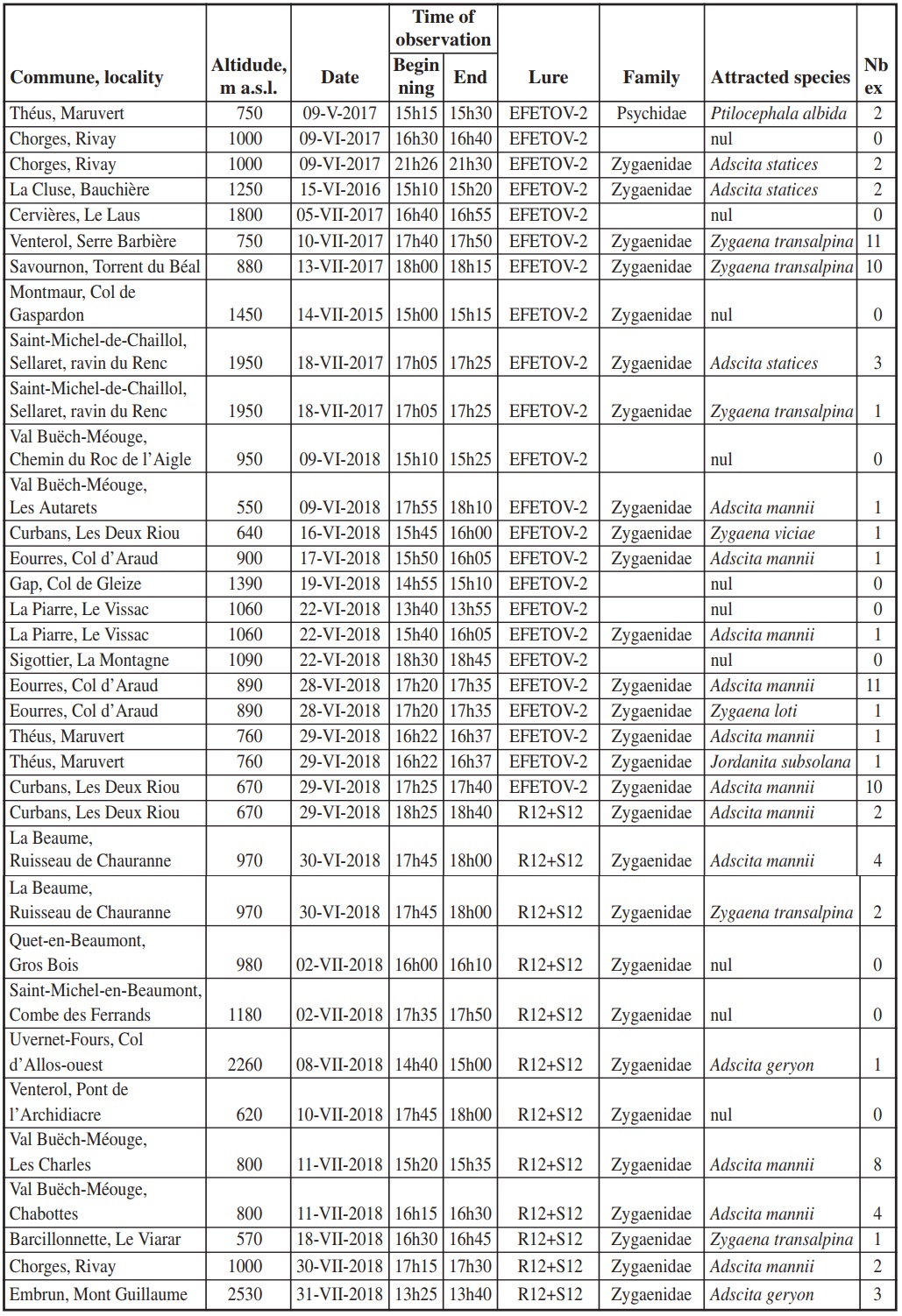
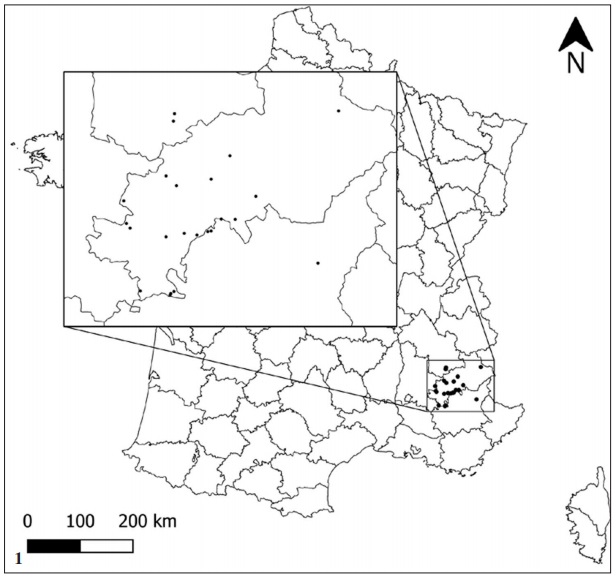 Figure 1
Map of France showing the area covered by the survey. One dot corresponds to a surveyed commune.
Figure 1
Map of France showing the area covered by the survey. One dot corresponds to a surveyed commune.
Results
Totally five species of Procridinae and three species of Zygaeninae were attracted to the lures tested during the study (Tables 1-2). They belong to the genera Adscita Retzius, 1783 (three species), Jordanita Verity, 1946 (one species), Rhagades Wallengren, 1863 (one species), and Zygaena Fabricius, 1775 (three species). EFETOV-2 lures attracted males of the following species: Adscita statices (Linnaeus, 1758) (three localities), A. mannii (Lederer, 1853) (six localities), J. subsolana (Staudinger, 1862) (one locality), Zygaena transalpina (Esper, 1780) (three localities), Z. loti ([Denis & Schiffermüller], 1775) (one locality), and Z. viciae ([Denis & Schiffermüller], 1775) (one locality) (Table 1). The lures with the mixture R12+S12 showed behavioural activity for A. mannii (five localities), A. geryon (Hübner, 1813) (two localities) and Z. transalpina (two localities). The most frequently observed species during the study were A. mannii and Z. transalpina.
Traps baited with R12 captured males of Rhagades pruni ([Denis & Schiffermüller], 1775), in two localities at the end of June - middle of July, 2018 (Table 2, Fig. 2).
Table 2
Trials with the sex pheromone compound R12 by means of Delta sticky trap in south-eastern France in 2018 (one trap per locality).

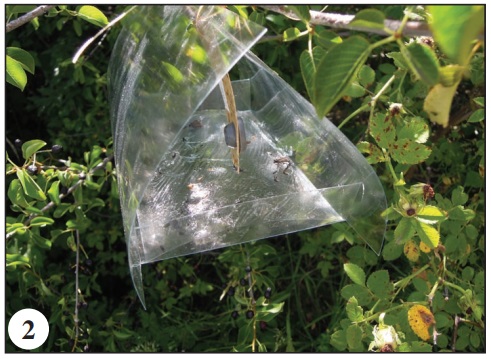 Figure 2
Catches of Rh. pruni in a Delta trap baited with R12, Hautes-Alpes, Remollon, 10-VII-2018, photo E. Drouet.
Figure 2
Catches of Rh. pruni in a Delta trap baited with R12, Hautes-Alpes, Remollon, 10-VII-2018, photo E. Drouet.
Eleven trials were unsuccessful and no Zygaenidae specimens were attracted. One of the observations, on 14-VII-2015, from 15:00 to 15:15, gave no result in a biotope where A. geryon, J. subsolana, J. globulariae (Hübner, 1793), and eight Zygaena species (Zygaena carniolica (Scopoli, 1763), Z. hilaris Ochsenheimer, 1808, Z. loti, Z. filipendulae (Linnaeus, 1758), Z. lonicerae (Scheven, 1777), Z. transalpina, Z. viciae, and Z. romeo Duponchel, 1835, were observed on the wing. In addition to the target species, the lure with EFETOV-2 was attractive to two males of Ptilocephala albida (Esper, 1786) (Psychidae) in Théus, Maruvert in May 2017 (Table 1 and Fig. 3). A single specimen of Tischeria ekebladella (Bjerkander, 1795) (Tischeriidae) was captured in a trap baited with R12 (Table 2).
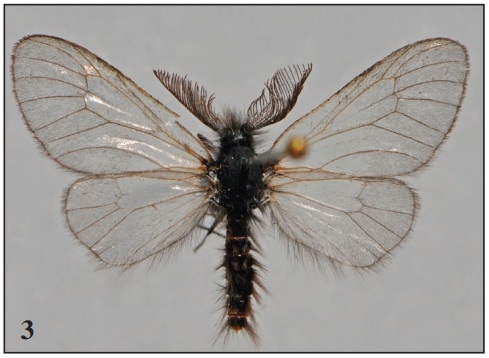 Figure 3
P. albida, Hautes-Alpes, Théus, Maruvert, 750 m, 09-V-2017, which was attracted to EFETOV-2 lure, photo Jean Raillot.
Figure 3
P. albida, Hautes-Alpes, Théus, Maruvert, 750 m, 09-V-2017, which was attracted to EFETOV-2 lure, photo Jean Raillot.
Discussion
During the investigation period, eight Zygaenidae species were attracted out of the 34 potential species in the area (DROUET, 2016; BENCE & RICHAUD, 2020). EFETOV-2 attracted wider spectrum of species (six species) while the mixture R12+S12 attracted four species. The most frequent response to the sex attractant was by A. mannii - it was attracted during 11 observation periods to two types of lures - EFETOV-2 and R12+S12.
Attractiveness of a lure with EFETOV-2 to males of A. statices (EFETOV & GORBUNOV, 2016; CAN CENGIZ et al., 2018), A. mannii (EFETOV et al., 2020) and J. subsolana (EFETOV et al., 2016; CAN CENGIZ et al., 2018) have been published from several countries.
R. pruni was recorded by trapping method in traps baited with R12. It is an interesting result, because we do not have a clear idea about the density of R. pruni in the region. Earlier it was recorded in France mainly by beating blackthorn Prunus spinosa L. and Crataegus sp. in the spring, with rarely more than one caterpillar per locality (BENCE & RICHAUD, 2020). R12 or the mixture R12+S12 were attractive to R. pruni in Crimea and Hungary (SUBCHEV et al., 2010)
Z. transalpina has been the most attracted Zygaena species and the number of specimens is a testimony of the efficiency of the EFETOV-2 sex attractant. Some specimens were attracted also to R12+S12. Attraction of Zygaena species to esters of long-chain unsaturated fatty acids was observed for the first time.
Trials were carried out only during the afternoon. Nevertheless, the results show the peak of flight activity for A. mannii males, to be in the afternoon, between 16:00 to 18:00. This is consistent with the results of visual observations of responses of males of this species made by G. TARMANN, in Pordenone, Friuli, Italy to the sex attractant EFETOV-S-2 (EFETOV et al., 2020).
As far as we know, no sex attractant is known for the species P. albida (EL-SAYED, 2020). Although few males of this species were observed attracted to the lure baited with EFETOV-2, this is not surprising taking into account the similarity in pheromone chemistry and sex pheromone glands in the Zygaenidae subfamily Procridinae and Psychidae (see SUBCHEV et al., 2000). In one of the Delta traps, although without result regarding Zygaenidae, T. ekebladella male was captured. The larvae of this species mine the leaves of Quercus sp. Since the trap was hung on a Quercus branch and, without a control trap, this capture could have been purely accidental. MOLNÁR et al. (2012) identified the sex pheromone of T. ekebladella females as a two-component mixture of (3Z,6Z,9Z)-tricosa-3,6,9-triene and (3Z,6Z,9Z,19Z)-tricosa-3,6,9,19-tetraene but only the tetraene attracted males in the field.
Our results reinforce our knowledge of the distribution of the Zygaenidae in the study area, enabling the discovery of species in places, where they were previously unknown. The methods applied in the current study are less time consuming and can be managed easily in locations of interest to assess the presence of a particular species and its abundance.
Acknowledgments
We are grateful to Gerhard M. Tarmann (Völs) for his suggestions on the manuscript and for transporting the lures from Simferopol. Many thanks are due to Alain Cama (La Chappelle-sur-Loire) who kindly identified the Microlepidoptera attracted, and to Terence Hollingworth (Blagnac) who carefully checked the English. We are grateful to Alain Migeon (Saint Drézéry) who designed the map and to Jean Raillot (Gap) for his photo of P. albida. The study was partially supported by ANIDIV-4 project (Institute of Biodiversity and Ecosystem Research, Bulgaria).
BIBLIOGRAPHY
BENCE, S. & RICHAUD, S., 2020.– Atlas des papillons de jour et zygènes de Provence-Alpes-Côte d’Azur: 544 pp. CEN PACA & Le Naturographe edit., Gap.
CAN, F., DEMIREL, N., SAGIROGLU, E. I., TOSHOVA, T. & SUBCHEV, M., 2010.– Employing pheromone traps to establish the distribution and seasonal activity of Theresimima ampellophaga in Turkey.– Phytoparasitica, 38(3): 217-222. https://doi.org/10.1007/s12600-010-0098-4.
CAN, F., EFETOV, K. A., BURMAN, J., KAYA, K., KUCHERENKO, E. E., ULARLI, B. & TARMANN, G. M., 2019.– A study of the Zygaenidae (Lepidoptera) fauna of Central Anatolia, Turkey.– Turkish Journal of Entomology (Turkiye Entomoloji Dergisi), 43(2): 189-199. Available from http://dx.doi.org/10.16970/entoted.512580.
CAN CENGIZ, F., EFETOV, K. A., KAYA, K., KUCHERENKO, E. E., OKYAR, Z. & TARMANN, G. M., 2018.– Zygaenidae (Lepidoptera) of Thrace Region of Turkey.– Nota lepidopterologica, 41(1): 23-36. Available from https://doi.org/10.3897/nl.41.21065.
DROUET, E., 2016.– Les Procris de France, French Forester Moths (Lepidoptera, Zygaenidae, Procridinae): 128 pp. Roland Robineau edit., Thoury-Férottes.
DROUET, E. & LAMBERT, B., 2010.– Trois ans de recherche de Theresimima ampellophaga (Bayle-Barelle, 1808) en France (Lep. Zygaenidae).– Oreina, 11: 5-7.
EFETOV, K. A., 1999.– Inouela gen. n. from Japan and Taiwan (Lepidoptera: Zygaenidae, Chalcosiinae).– Entomologist’s Gazette, 50(2): 91-95.
EFETOV, K. A., CAN, F., TOSHOVA, T. & SUBCHEV, M., 2010.– New sex attractant for Jordanita anatolica (Naufock) (Lepidoptera: Zygaenidae: Procridinae).– Acta Zoologica Bulgarica, 62(2): 315-319.
EFETOV, K. A. & GORBUNOV, O. G., 2016.– Attraction of the males of Adscita statices (Linnaeus, 1758) (Lepidoptera: Zygaenidae, Procridinae) by synthetic sex attractant in Moscow Region.– Tavricheskiy Mediko- biologicheskiy Vestnik, 19(3): 40-46 (in Russian; English summary).
EFETOV, K. A., HOFMANN, A. & TARMANN, G. M., 2014b.– Application of two molecular approaches (use of sex attractants and DNA barcoding) allowed to rediscover Zygaenoprocris eberti (Alberti, 1968) (Lepidoptera, Zygaenidae, Procridinae), hitherto known only from the female holotype.– Nota lepidopterologica, 37(2): 151-160. Available from https://doi.org/10.3897/nl.37.7871.
EFETOV, K. A., HOFMANN, A., TARMANN, G. M. & TREMEWAN, W. G., 2014a.– Taxonomic comments on the treatment of the Zygaenidae (Lepidoptera) in volume 3 of Moths of Europe, Zygaenids, Pyralids 1 and Brachodids (2012).– Nota lepidopterologica, 37(2): 123-133. Available from https://doi.org/10.3897/nl.37.7940.
EFETOV, K. A., KOSHIO, C. & KUCHERENKO, E. E., 2018.– A new synthetic sex attractant for males of Illiberis .Primilliberis. pruni Dyar, 1905 (Lepidoptera: Zygaenidae, Procridinae).– SHILAP Revista de lepidopterología, 46(182): 263-270.
EFETOV, K. A. & KUCHERENKO, E. E., 2020.– Structural analysis of sex pheromones and attractants in Zygaenidae (Insecta, Lepidoptera): biochemical and evolutionary aspects.– Journal of Evolutionary Biochemistry and Physiology, 56(5): 381-395. DOI: 10.1134/S0022093020050014.
EFETOV, K. A., KUCHERENKO, E. E., PARSHKOVA, E. V. & TARMANN, G. M., 2016.– 2-butyl 2-dodecenoate, a new sex attractant for Jordanita .Tremewania. notata (Zeller, 1847) and some other Procridinae species (Lepidoptera: Zygaenidae).– SHILAP Revista de lepidopterología, 44(175): 519-527.
EFETOV, K. A., KUCHERENKO, E. E. & TARMANN, G. M., 2019.– New synthetic sex attractants for the males of two endemic Iberian Procridinae species (Lepidoptera: Zygaenidae).– SHILAP Revista de lepidopterología, 47(186): 307-315.
EFETOV, K. A., KUCHERENKO, E. E. & TARMANN, G. M., 2020.– An application of the synthetic sex attractants from the series “EFETOV-2” for studying Procridinae (Lepidoptera Zygaenidae) in Italy.– SHILAP Revista de lepidopterología, 48(192): 733-749.
EFETOV, K. A., PARSHKOVA, E. V., BAEVSKY, M. Y. & PODDUBOV, A. I.– 2014c. Sec-butyl ester of dodecenoate: synthesis and attractive properties.– The Ukrainian Biochemical Journal (Ukrainskyi biokhimichnyi Zhurnal), 86(6): 175-182. Available from https://doi.org/10.15407/ubj86.06.175.
EFETOV, K. A., SUBCHEV, M. A., TOSHOVA, T. B. & KISELEV, V. M., 2011.– Attraction of Zygaenoprocris taftana (Alberti, 1939) and Jordanita horni (Alberti, 1937) (Lepidoptera: Zygaenidae, Procridinae) by synthetic sex pheromones in Armenia.– Entomologist’s Gazette, 62(2): 113-121.
EFETOV, K. A. & TARMANN, G. M., 2013.– Chrysartona (Chrystarmanna) mineti sp. nov. (Lepidoptera: Zygaenidae, Procridinae) from northern Vietnam.– Entomologist’s Gazette, 64(3): 197-206.
EFETOV, K. A. & TARMANN, G. M., 2014a.– Illiberis (Alterasvenia) banmauka sp. nov. (Lepidoptera: Zygaenidae, Procridinae) from China and Myanmar.– Entomologist’s Gazette, 65(1): 62-70.
EFETOV, K. A. & TARMANN, G. M., 2014b.– A new European species, Adscita dujardini sp. nov. (Lepidoptera: Zygaenidae, Procridinae) confirmed by DNA analysis.– Entomologist’s Gazette, 65(3): 179-200.
EFETOV, K. A. & TARMANN, G. M., 2017.– The hypothetical ground plan of the Zygaenidae, with a review of the possible autapomorphies of the Procridinae and the description of the Inouelinae subfam. nov.– Journal of the Lepidopterists’ Society, 71(1): 20-49. Available from https://doi.org/10.18473/lepi.v71i1.a5.
EFETOV, K. A., TARMANN, G. M., TOSHOVA, T. & SUBCHEV, M. A., 2012.– Attraction of Adscita mannii (Lederer, 1853), A. geryon (Hübner, 1813) and Jordanita notata (Zeller, 1847) (Lepidoptera: Zygaenidae, Procridinae) to 2-butyl 7Z-dodecenoate in Italy.– XIII International Symposium on Zygaenidae (Innsbruck, 16- 23 September 2012), 2012: 15.
EFETOV, K. A., TARMANN, G. M., TOSHOVA, T. & SUBCHEV, M. A., 2015.– Enantiomers of 2-butyl 7Z- dodecenoate are sex attractants for males of Adscita mannii (Lederer, 1853), A. geryon (Hübner, 1813), and Jordanita notata (Zeller, 1847) (Lepidoptera: Zygaenidae, Procridinae) in Italy.– Nota lepidopterologica, 38(2): 161-169. Available from https://doi.org/10.3897/nl.38.6312.
EL-SAYED, A. M., 2020.– The Pherobase: Database of Pheromones and Semiochemicals. Available from http://www.pherobase.com (Accessed on 16 October 2020).
MOLNAR, B., TROGER, A., TOSHOVA, T. B., SUBCHEV, M., VAN NIEUKERKEN, E., SJAAK J., KOSTER, J. C., SZÓCS, G., TÓTH, M. & FRANCKE, W., 2012.– Identification of the female-produced sex pheromone of the oak leaf-miner moth, Tischeria ekebladella.– Journal of Chemical Ecology, 38(10): 1298-1305. Available from https://link.springer.com/article/10.1007/s10886-012-0184-9.
NAHIRNIĆ, A., PETROVIĆ, S., KRIVOŠEJ, Z., JAKŠIĆ, P. & TOSHOVA, T., 2015.– Using pheromone traps for the detection and monitoring of the seasonal flight of the vine bud moth Theresimima ampellophaga (Bayle- Barelle, 1808) (Lepidoptera: Zygaenidae) in Serbia.– Entomologist’s Gazette, 66: 175-181.
RAZOV, J., EFETOV, K. A., FRANIN, K., TOSHOVA, T. & SUBCHEV, M., 2017.– The application of sex pheromone traps for recording the Procridinae fauna (Lepidoptera: Zygaenidae) in Croatia.– Entomologist’s Gazette, 68(1): 48-53.
RYMARCZYCK, F., 2007.– Etat des connaissances sur la distribution de Theresimima ampellophaga (Bayle-Barelle, 1808) .Lepidoptera, Zygaenidae) dans les Alpes-Maritimes (France) et les départements limitrophes.– Riviéra Scientifique, 90: 65-70.
SUBCHEV, M., 2014.– Sex pheromone communication in the family Zygaenidae (Insecta: Lepidoptera): a review.– Acta Zoologica Bulgarica, 66(2): 147-157.
SUBCHEV, M. A., EFETOV, K. A., TOSHOVA, T. B. & KOSHIO, C., 2016.– Sex pheromones as isolating mechanisms in two closely related Illiberis species - I. (Primilliberis) rotundata Jordan, 1907, and I. (P.) pruni Dyar, 1905 (Lepidoptera: Zygaenidae, Procridinae).– Entomologist’s Gazette, 67(1): 51-57.
SUBCHEV, M. A., EFETOV, K. A., TOSHOVA, T., PARSHKOVA, E. V., TÓTH, M. & FRANCKE, W., 2010.– New sex attractants for species of the zygaenid subfamily Procridinae (Lepidoptera: Zygaenidae).– Entomologia Generalis, 32(4): 243-250. Available from https://doi.org/10.1127/entom.gen/32/2010/243.
SUBCHEV, M., HARIZANOV, A., FRANCKE, W., FRANKE, S., PLASS, E., RECKZIEGEL, A., SCHRÖDER, F., PICKETTT, J. A., WADHAMS, L. J. & WOODCOCK, C. M., 1998.– Sex pheromone of female vine bud moth, Theresimima ampellophaga comprises (2S)-butyl (7Z)-tetradecenoate.– Journal of Chemical Ecology24(7): 1141-1151; 25(5): 1203; erratum, i.e. corrected to (2R)-butyl (7Z)-tetradecenoate. Available from https://doi.org/10.1023/A:1022438717287 [erratum 1999].
SUBCHEV, M. A., KOSHIO, C., TOSHOVA, T. B. & EFETOV, K. A., 2012.– Illiberis .Primilliberis. rotundata Jordan (Lepidoptera: Zygaenidae: Procridinae) male sex attractant: Optimization and use for seasonal monitoring.– Entomological Science, 15: 137-139. Available from https://doi.org/10.1111/j.1479-8298.2011.00485.x.
SUBCHEV, M., KOSHIO, C., TOSHOVA, T., EFETOV, K. A. & FRANCKE, W., 2013.– (2R)-butyl (7Z)- dodecenoate, a main sex pheromone component of Illiberis (Primilliberis) pruni Dyar (Lepidoptera: Zygaenidae: Procridinae)?.– Acta Zoologica Bulgarica, 65: 391-396.
SUBCHEV, M. A., TOSHOVA, T. B., DROSU, S., CAZACU, S & EFETOV, K., 2008a.– Recent records of Theresimima ampellophaga (Bayle-Barelle, 1808) in Romania. In Les cahiers du Musée des Confluences, 135 pp.– Actes du Xe Symposium International sur les Zygaenidae (Lyon, 27 September - 1 October 2006), .: 59-63. Lyon.
SUBCHEV, M. A., TOSHOVA, T. B., EFETOV, K. A. & TARMANN, G. M., 2008b.– Recent distribution of Theresimima ampellophaga (Bayle-Barelle, 1808) in Europe estimated by pheromone traps, In Les cahiers du Musée des Confluences, 135 pp.– Actes du Xe Symposium International sur les Zygaenidae (Lyon, 27 September- 1 October 2006), 2: 65-76. Lyon.
SUBCHEV, M., TOSHOVA, T., KOSHIO, C., FRANCKE, S., TRÖGER, A., TWELLE, R., FRANCKE, W., PICKETT, J. A., WADHAMS, L. J. & WOODCOCK, C. M., 2009.– Identification and biological activity of sex pheromone components from females of the plum moth Illiberis rotundata Jordan (Lepidoptera: Zygaenidae: Procridinae).– Chemoecology, 19: 47-54. Available from https://doi.org/10.1007/s00049-009-0008-8.
SUBCHEV, M., TOSHOVA, T., STANIMIROVA, L., STAN, G. H., EMBACHER, G., FRANCKE, W., RECKZIEGEL, A., FERREIRA, J. T. & PRIESNER, E., 2000.– 1-Methylethyl octanoate, a new Lepidopteran sex pheromone from the bagworm, Megalophanes viciella.– Journal of Chemical Ecology, 26(2): 487-495. Available from https://doi.org/10.1023/A:1005421808497.
SUBCHEV, M. A., TOSHOVA, T., TSITSIPIS, J. A., ZARPAS, K. D., MARGARITOPOULOS, J. T., 2006.– Distribution and seasonal flight of Theresimima ampellophaga (Bayle-Barelle, 1808) in Greece estimated by pheromone traps.– Acta Zoologica Bulgarica, 58(3): 345-354.
TARMANN, G. M., EFETOV, K. A. & KUCHERENKO, E. E., 2019.– A second generation of Theresimima ampellophaga (Bayle-Barelle, 1808) (Lepidoptera: Zygaenidae, Procridinae) discovered by using the sex attractant EFETOV-2 on the Kassandra peninsula (Halkidiki) in Greece.– Entomologist’s Gazette, 70(1): 19-26.
TOSHOVA, T. B., ATANASOVA, D. Y., STALEV, B. S. & NAHIRNIĆ, A., 2017.– New data on the distribution and seasonal flight of the vine bud moth Theresimima ampellophaga (Bayle-Barelle, 1808) in Bulgaria - investigations by pheromone-baited traps.– Ecologia Balkanica, 9(1): 79-89.
VRENOZI, B., BURMAN, J., TOSHOVA, T. B. & TARMANN, G. M., 2020.– The application of sex attractant traps for studying the Zygaenidae (Lepidoptera) fauna of Albania.– Entomologist’s Gazette, 71(2): 135-148. Available from https://doi.org/10.31184/G00138894.712.1751.
VRENOZI, B., TOSHOVA, T. B., EFETOV, K. A., KUCHERENKO, E. E., RREDHI, A. & TARMANN, G. M., 2019.– The first well-documented record of the vine bud moth Theresimima ampellophaga (Bayle-Barelle, 1808) in Albania established by field screening of sex pheromone and sex attractant traps (Lepidoptera: Zygaenidae, Procridinae).– SHILAP Revista de lepidopterología, 47(187): 567-576.
Notas
Notas de autor
*Autor para la correspondencia / Corresponding author edrouet.zyg@wanadoo.fr
