2024
52206
14062023
18102023
Abstract: In this study, we report for the first time a new larval host plant Cassia fistula L. for Galleria mellonella (Linnaeus, 1758) from Kolkata, West Bengal, India. Galleria mellonella is an established pest of beehives and till date, its larvae were known to feed only on the wax comb of Apis sp.,and destroy it. For this reason, beekeeping enterprises face high economic losses. Our finding opens a scope for extensive surveys in areas surrounding apiaries in order to quantify infestations in C. fistula which might provide a new insight in the pest management practices for G. mellonella.
Keywords: Lepidoptera, Pyralidae, Galleriinae, new host plant, Galleria, Kolkata, India.
Resumen: En este estudio presentamos por primera vez una nueva planta alimenticia de las larvas de Galleria mellonella (Linnaeus, 1758), Cassia fistula L., de Calcuta, Bengala Occidental, India. Galleria mellonella es una plaga establecida de las colmenas y, hasta la fecha, se sabía que sus larvas sólo se alimentaban del panal de cera de Apis sp. y lo destruían. Por esta razón, las empresas apícolas se enfrentan a elevadas pérdidas económicas. Nuestro hallazgo abre la posibilidad de realizar estudios exhaustivos en las zonas circundantes a los colmenares para cuantificar las infestaciones de C. fistula, lo que podría aportar una nueva perspectiva sobre las prácticas de control de plagas de G. mellonella.
Palabras clave: Lepidoptera, Pyralidae, Galleriinae, nueva planta alimenticia, Galleria, Calcuta, India.
Artículos
Report of a New Larval Host Plant of Galleria mellonella (Linnaeus, 1758) from Kolkata, West Bengal, India (Lepidoptera: Pyralidae, Galleriinae)
Informe de una nueva planta alimenticia de las larvas de Galleria mellonella (Linnaeus, 1758) en Calcuta, Bengala Occidental, India (Lepidoptera: Pyralidae, Galleriinae)
Received: 14 June 2023
Accepted: 18 October 2023
Published: 30 June 2024
The term wax moth is a common name which represents different species of moths that usually invade, attack and damage honeybee colonies and hive products. The list of wax moths are G. mellonella (Linnaeus, 1758), Achroia grisella (Fabricius, 1794), Plodia interpunctella (Hübner, [1813]) Aphomia sociella (Linnaeus, 1758) and Ephestia kuehniella Zeller, 1879. G. mellonella, the pest was classified Tinea cerella by Fabricus (1775), Vindana obliquella by Walker (1866) and later reclassified and named G. melonella (Linnaeus, 1758). Subfamily of Galleria mellonella is Galleriinae and its family is Pyralidae of order Lepidoptera. The species is well known for its parasitization of honeybees and their hives (Kwadha et al. 2017). G. mellonella undergoes four developmental stages in its life cycle (egg, larva, pupa, and adult), so it is a typical holometabolous insect (Wojda et al. 2020). The eggs of this particular species vary in size (average length and width 0.478 mm and 0.394 mm), spheroidal shape with interspersed wavy lines which gives it a rough texture. Difference between male and female is not possible at larval stage, because Sex specific external morphological characters are absent. Polypod larvae with six legs on the thorax. The head of larva is composed of 3 well developed apical teeth but lacks sub-apical teeth with cream white body with sclerotized body parts. Male pupae are smaller in size than females. Pupa is white to yellow and gradually changes to dark brown. Sexual differentiation is possible in pupa. The adult moth shows sexual dimorphism. Males are generally smaller and less dark than females. The forewings for both sexes show varying intensities of pigmentation. The anterior two-third of the forewing is covered by scales that give it a uniformly darker pigmentation with comparison to the posterior one-third which is a mixture of stripes of darker and lighter pigment (Kwadha et al. 2017).
Female moths of Galleria mellonella (Linnaeus, 1758) lay eggs in honeybee comb cracks and crevices. The larvae feed honey, pollen, and brood, destroying the comb structure. Sometimes they show aggregation and cannibalism when there is a shortage of food (Kwadha et al. 2017). It was first reported in colonies of Asian honeybee, Apis cerana Fabricius, 1793. Williams (1997) and Shimanuki (1980), later designated this species as a pest as it is ubiquitously distributed everywhere beekeeping is practiced (Kwadha et al. 2017). After hatching, larvae move from cracks and crevices to the honeycomb where they begin to feed and build protective silken tubes, destroying the honeycomb structure in the process. This directional movement and feeding are stimulated chemically (Paddock, 1918; Nielson & Brister, 1979; Wojda et al. 2020). Worldwide record of larval host species of Galleria melonella is Apis sp. (Paddock, 1918; Nielsen & Briester, 1979; Shimanuki, 1980; Williams, 1997; Hosamani et al. 2017; Kwadha et al. 2017; Wojda et al. 2020).
Beekeeping has taken the shape of a promising enterprise. It is a very popular and highly economically beneficial integrated farming. India has a great scope for increasing bee farming. Bee-farming has two beneficial sides - firstly, the wax, honey, and different medical products, all have great market demands globally and secondly pollination services. But in India have some problems with beekeeping. One of the major problems is their natural enemies (Hosamani et al. 2017).
The Galleria’s larval stage destroys Apis sp. For this reason, beekeepers face heavy economic loss, approximately 60-70% worldwide (Ambaw et al. 2020). The larvae can also damage the box hive frames in highly infected hives, it can cause a huge amount of economic loss for beekeepers (Ambaw et al. 2020).
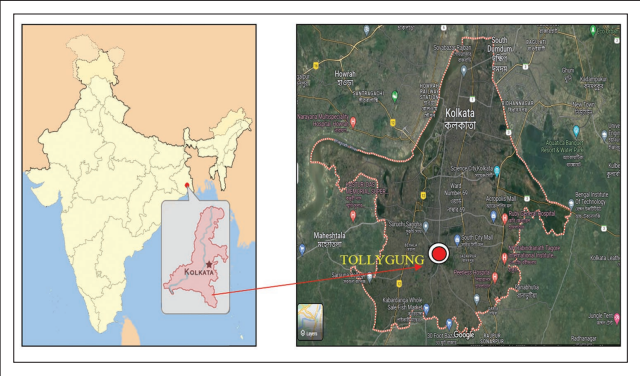
The larvae are feed mainly honeybee comb substances, but we observed a new type of food is consumed by these larvae. On 28-VIII-2022, we collected a fruit of Cassia fistula L. from a place nearby the Mahanayak Uttam Kumar metro station, Tollygunge, Southern part of the Kolkata, West Bengal, India. Kolkata, the eastern part of India is a warm, humid place. High temperature along with enough humidity is one the characteristics of this place during summer. In winter season, supposed to be in December and January, the average high temperature remains around 27ºC and low temperature remains around 13.8º C along with 11-17 mm average rainfall. During monsoon in July and August (to some extent the September month), this place accounts high rainfall. In July average rainfall is 411 mm and in August 349 mm respectively. This specimen is collected by us in the month of August 2022 when the average temperature was 26ºC -32ºC (Mitra, 2019) (Figure 1). It is a metropolitan city with Latitude 22.4986ºN and Longitude 88.3454ºE.
The next day we suddenly observed a hole in the fruit, cut around the hole, and found in the area the pupa shell of a moth covered in a silk cotton-like material and surrounded by old excreta left by moth’s larvae (Figure 2). Hoping to know what came out of the hole; we placed the fruit in a clean transparent container and covered its open mouth with a clean cloth. The next morning, we noticed that there were three more holes in the fruit as before, but this time the organisms that came out through the holes to stay covered could not escape. We took the opportunity to take photos of them and the photos were identified by one of the experts in the field as adult Galleria melonella.
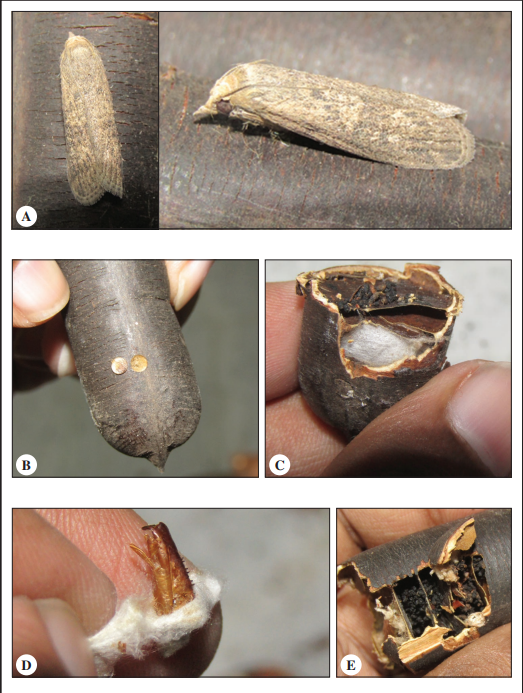
In Galleria melonella sexual dimorphism is observable. Galleria melonella moth’s body length is 15-20 mm and wingspan are 31 mm, darker grey in color. In Galleria melonella, the labial palps of female projecting forward which looks like a beak in the head region (Kwadha et al. 2017). In males semi-lunar notch present in outer margin of front wing (Hosamani et al. 2017). All these morphological characters are able to separate this moth from the close congeners.
This study suggests a new larval host plant for the larvae of Galleria mellonella, which is not previously reported elsewhere. Based on our observation, we can suggest that planting this host plant Cassia fistula around the beekeeping area may reduce the damage to the bee hives by this moth larvae. However, further studies are warranted for the outcome whether prefer this new host plants more than the wax hives or not. If so, this will give both-way benefits. It is very known to us that the ability to feed on multiple host species permits them to avail more resources. The larvae of the greater wax moth will get options and not depend fully on beehives. On the other hand, the practice of beekeeping or the apiary will be benefited to some extent and, so the apiculture industry. In the future, we have plans to explore more on it.
Authors are supported by their respective institutes. The first author would like to thank his mother Mrs. Shyamali Das and his friend Mr. Sahanur Mondal for maintenance and proper scientific caring.
* Autor para la correspondencia / Corresponding author: kaustavc17@gmail.com

