2024
52206
25082023
22102023

National Academy of Sciences of Ukraine, Ukraine
Staatliches Museum fur Naturkunde Stuttgart, Germany
Abstract: Additions to original descriptions are provided for three little-known species - Chrysoesthia falkovitshi Lvovsky & Piskunov, 1989, C. mironovi Bidzilya, 2001 and C. tuvella Bidzilya, 2005. The colour photographs of adults and ventral view of the male genitalia are given for all three species for the first time, and their diagnostic characters are discussed. The hitherto unknown female genitalia of C. falkovitshi are described. The diagnosis of the genus and its differences from closely related Metanarsia Staudinger, 1871 are briefly discussed.
Keywords: Lepidoptera, Gelechiidae, Chrysoesthia, Metanarsia, diagnoses, Palaearctic.
Resumen: Se añaden descripciones originales de tres especies poco conocidas: Chrysoesthia falkovitshi Lvovsky & Piskunov, 1989, C. mironovi Bidzilya, 2001 y C. tuvella Bidzilya, 2005. Para las tres especies se ofrecen por primera vez fotografías en color de adultos y una vista ventral de la genitalia del macho y se discuten sus caracteres diagnósticos. Se describen la genitalia de la hembra de C. falkovitshi, hasta ahora desconocida. Se discuten brevemente el diagnóstico del género y sus diferencias con Metanarsia Staudinger, 1871.
Palabras clave: Lepidoptera, Gelechiidae, Chrysoesthia, Metanarsia, diagnóstico, Paleártica.
Artículos
Re-description of three little known species of Palaearctic Chrysoesthia Hübner, [1825], with description of the hitherto unknown female of Chrysoesthia falkovitshi Lvovsky & Piskunov, 1989 (Lepidoptera: Gelechiidae)
Redescripción de tres especies Paleárticas poco conocidas de Chrysoesthia Hübner, [1825], con descripción de una hembra hasta ahora desconocida de Chrysoesthia falkovitshi Lvovsky & Piskunov, 1989 (Lepidoptera: Gelechiidae)
Received: 25 August 2023
Accepted: 22 October 2023
Published: 30 June 2024
The genus Chrysoesthia Hübner, [1825] comprises about 26 species distributed in Holarctic (22 species) and Afrotropical (4 species) regions. Twenty species are known in the Palaearctic, of which 11 occur in Europe (Huemer & Karsholt, 2020, pp. 81-82). Despite the genus remains unrevised and status of some taxa is uncertain (Huemer & Karsholt, 2020, p. 124), several new species have been described over the past two decades from Central Asia (Bidzilya, 2001, 2005), Eastern Asia (Omelko & Omelko, 2010) and Europe (Bidzilya & Budashkin, 2015). Some of these descriptions are based on single, sometimes worn specimen, lack the photographs of adult and accompanied by rather schematic drawings of the male genitalia that make some difficulties with separation of these taxa from similar species of the genus. This is especially true for Chrysoesthia mironoviBidzilya, 2001 and Chrysoesthia tuvellaBidzilya, 2005 described from Turkmenistan and Tuva Republic of Russia respectively. In this contribution, I provide the photographs of adults and slides of the male genitalia of these species, as well as give additions to original descriptions, which clear indicate their differences from related species. Particularly, Chrysoesthia tuvella is compared with Chrysoesthia falkovitshiLvovsky & Piskunov, 1989. The latter species is re-described based on additional material, inclusive the hitherto unknown female.
Male and female genitalia were dissected and prepared using standard methods (Huemer & Karsholt, 2010). Male genitalia were spread using the unrolling technique as described by Pitkin (1986) and Huemer (1988). The genitalia preparation temporary stored in glycerol vials, inclusive the holotype of C. tuvella were remounted in euparal. Pinned specimens and details of external morphology were photographed with a Canon EOS 5DSR DSLR camera attached to light box. Slide-mounted genitalia were photographed with a Canon EOS Rebel T5 DSLR camera mounted on an Olympus U-CTR30-2 trinocular head combined with a Carl Zeiss compound microscope. For each photographed specimen, sets of 10–20 images were taken at different focal planes and focus-stacked using Helicon Focus 6 with the final image edited further in Adobe Photoshop CS5.
The material examined is deposited in Zoological Museum Kyiv Taras Shevchenko National University, Kyiv, Ukraine (ZMKU).
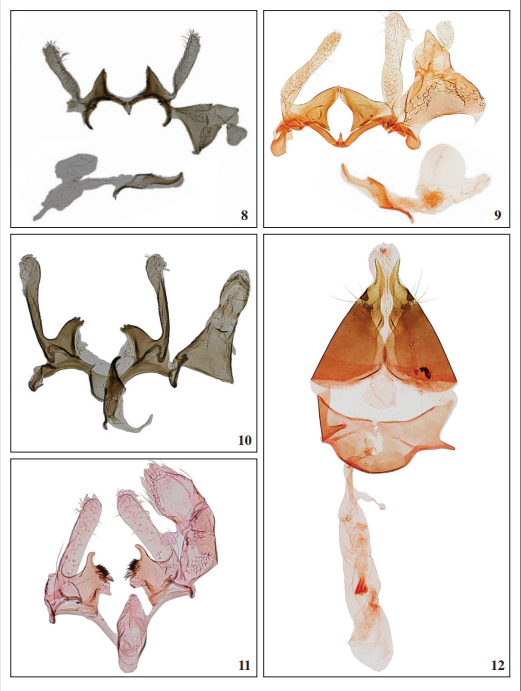
Chrysoesthia falkovitshi Lvovsky & Piskunov, 1989 (Figures 1, 2, 5, 8, 9, 12.
Chrysoesthia falkovitshi Lvovsky & Piskunov, 1989. Nasekom. Mongol., 10, 553, figs 41, 42 TL: MONGOLIA, Bayan-Khongor aimak, 120 km S of Shine-Dzhinsta.
Material examined: UKRAINE, Crimea, Nanikovo vil. env., Barakol lake, saline marsh, 1 1, 18-VI-2004 (Budashkin) (gen. slide 150/22, O. Bidzilya); Primorskiy, Kamyshin Lug, 1 ♀, 31- VIII-2010 (Budashkin) (gen. slide 190/22, O. Bidzilya); Primorskiy, Kamyshin Lug, 4 ♂, 28- VIII-2010 (Budashkin) (gen. slide 3/23, O. Bidzilya) (all ZMKU).
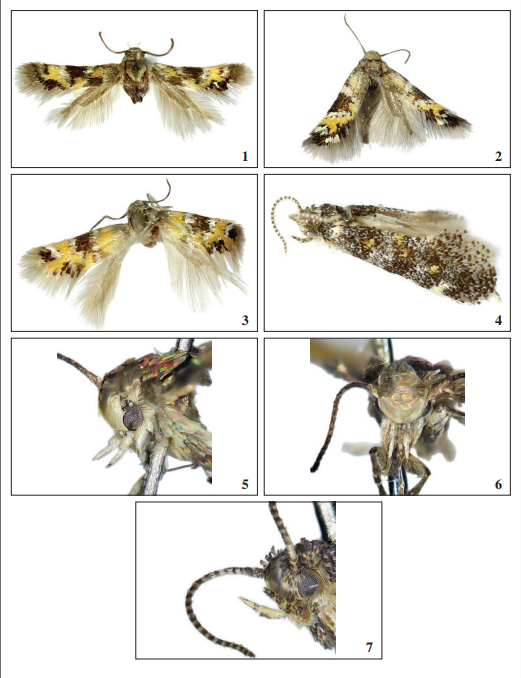
Chrysoesthia falkovitshi was described from single male collected 26-VII-1981 in Mongolia, Bayan-Khongor aimak, 120 km S of Shine-Dzhinsta. The specimen was cough at daytime on Chenopodium album L. (Lvovsky & Piskunov, 1989, p. 554). The holotype lacks labial palpus and unscaled in head and thorax. Here I re-described the species based on material of both sexes from Ukraine. The female genitalia are described for the first time.
Additions to original description: Adult (figures 1-2, 5). Head smooth, shine, light brown with yellow frons, labial palpus almost straight, segment 2 about as long and slightly narrower than segment 3, acute, scape and flagellomeres shine, dark brown; thorax and tegulae light brown. Forewing 2.2-2.7 mm in length, yellow with extensive black pattern mixed with silver: basal 1/5-1/4 black densely suffused with silver from outer side, costal margin with black irroration from base to large black irregular spot in medial 1/3 of costa edged from both side with silver, black patch at 2/5 of dorsal margin almost connected in fold with medial black spot, tornus and apex black mixed with silver, black transverse touch edged with silver on costal margin before apex, fringes greyish-brown; hindwing greyish brown.
Male genitalia (figures 8-9): Uncus triangular, apex pointed or rounded; distal portion of gnathos heart-shaped, membranous, densely covered with minute spines, equal to uncus; tegumen trapezoid, as broad at base as long and about 1.5 times as long as uncus, band of pocket of coremata extending posterio-medially from basal corners to 3/4 length; cucullus digitate, uniform in width throughout except very slender base, apex rounded; sacculus strongly sclerotized, triangular; saccus very short triangular; phallus sigmoidal, broadest in middle, distal portion slender with distinct apical hook, base bifurcate.
Female genitalia (figure 12): Papillae anales very large, densely sclerotized, broad at base, then gradually narrowed posteriorely towards strongly sclerotized, laterally compressed, slender, lanceolate and turned dorsally processes; sternum VIII band-shaped, anterior margin gradually bent and protruded ventrally, strongly edged, posterior margin weakly bent anteriorely; apophyses anteriores short, straight, ostium opening large, rounded; ductus bursae slender, with gradual transition to elongated corpus bursa, posterior portion finely spinose, ductus seminalis arises from its anterior part; no signum.
Remark 1: The species in unique in respect of papillae anales in the female genitalia. The latter are extremely large and terminated into lanceolate, turned dorsally sclerites without bristles. Somewhat similar but much slender at base papillae anales are known in C. gaditella (Staudinger, 1859) (LEPIFORUM, 2023).
Remark 2: According to original description, the holotype of C. falkovitshi resembles C. sexguttella f. naeviferella (Duponchel, 1843) with reduced yellow pattern on the forewing: “black, shiny forewing with basal half covered with blackish-brown scales mixed with light yellow. Three transverse silver spots on costal margin: the first one near the apex, the second on 1/3 from the apex and the third one on 2/3. The first spot is surrounded with blackish-brown scales. The area between 1-st and 2nd spot covered with light yellow scales except blackishbrown stripe along outer margin” (translation from Lvovsky & Piskunov, 1989, p. 553). This description suggests that the holotype differs from specimens from Ukraine in darker appearance without yellow spot in middle length of dorsal margin and yellow pattern at basal half of the wing. Despite these differences, the description and drawing of the male genitalia of the holotype in the original description match in all details males from Ukraine. Taking into consideration the considerable variability in the forewing pattern in some species of Chrysoesthia (e. g. C. sexguttella (Thunberg, 1794)) I suggest that differences between the holotype of C. falkovitshi and specimens from Ukraine is the individual variation.
Distribution: Ukraine, Crimea (Bidzilya & Budashkin, 2009, p. 16), Russia, S Ural, Lower Volga (Junnilainen et al. 2010, p. 18), Mongolia (Lvovsky & Piskunov, 1989, p. 553). The colour photograph of adult from S Ural (Junnilainen et al. 2010, p. 19, fig. 17) more resembles C. tuvella than C. falkovitshi. This record should be verified by examination of the genitalia.
Chrysoesthia tuvellaBidzilya, 2005 (Figures 3, 6, 10.
Chrysoesthia tuvellaBidzilya, 2005. Proc. Zool. Mus. Kiev Taras Shevchenko Nat. Univ., 3, 7, figs 1, 2
TL: RUSSIA, Tuva Republic, Ujukskii khrebet in 30 km S of Kyzyl.
Material examined: Holotype ♂, Tuva, 30 km S of Kyzyl, Ujukskii khrebet, 1000 m, 14-VI2001 (Ustjuzhanin) (gen. slide 149/22, O. Bidzilya) (ZMKU).
Chrysoesthia tuvella was described from a single male collected in the vicinity of Kyzyl, Tuva Republic of Russia. The original description is accompanied with monochrome photograph of adult and drawing of the male genitalia in lateral view. Here I provide the colour photograph of the holotype and its genitalia in ventral view mounted in euparal using “unrolling” technique. The species is also compared with externally similar C. falkovitshi.
Additions to original description: Male genitalia (figure 10). Uncus subovate, laterally setose, gnathos long, slender, membranous, distal portion weakly broadened; tegumen about 3/4 length of uncus, trapezoid, slightly longer than broad at base; cucullus digitate, gradually broadened apically, with distinct longitudinal ridge, apex membranous, rounded, extending to posterior margin of uncus; sacculus subrectangular, both dorsal and ventral margins weakly bent, posterior margin with three short teeth; saccus short, subtriangular, with rounded apex; phallus distinctly broadened in middle, apex slender, with distinct hook, base bifurcate.
Distribution: Russia: Tuva Republic.
Comparative remarks: The species resembles both superficially and in the male genitalia C. falkovitshi. The latter differs by more extensive dark pattern on the forewing with basal 1/4 completely black (slightly darkened under costa in C. tuvella) and narrowly connected (not connected in C. tuvella) with black medial spot-on costal margin and black spot at 1/3 of dorsal margin. The male genitalia differ from those of C. falkovitshi in ovate rather than triangular uncus, slender (broad, heart-shaped in C. falkovitshi) gnathos, longer and narrower tegumen, apically serrate rather than acute sacculus and broadly rounded (triangular in C. falkovitshi) saccus.
Chrysoesthia mironoviBidzilya, 2001 (Figures 4, 7, 11.
Chrysoesthia mironoviBidzilya, 2001. SHILAP Revta. lepid., 29(114), 161, figs 1a, b. TL: TURKMENISTAN, Mary, Vatan kolkhos.
Material examined: TURKMENISTAN, Mary vic., Vatan kolkhoz, 1 ♂, 19-VIII-1990 (Mironov) (gen. slide 187/22, O. Bidzilya) (ZMKU).
Chrysoesthia mironovi was described from single male collected in Mary, Turkmenistan. Original description is accompanied with drawing of the male genitalia in lateral view. Here I provide the photographs of adult of specimen collected in synpatry with the holotype, and its genitalia from ventral view mounted in euparal using “unrolling” technique.
Addition to original description: Adult (figures 4, 7). Head greyish-brown, frons light grey, weakly shine; labial palpus brown mixed with white, inner surface of segment 2 white, segment 3 slightly slender and about 1/2 length of segment 3, acute, scape brown, flagellomeres brown ringed with white; forewing 3.3 mm in length, covered with blackish-brown, grey or white to silver-tipped slightly shining scales, the latter forming diffuse transverse irregular lines at base, at 1/3 and 2/3, small yellow spot at 1/3 in mid width, two joined yellow spots on 1/2 near dorsal margin, small yellow spot on 3/4 under costal margin, white elongated spot on costal margin before apex, fringes grey, tipped with brown; hindwing and fringes light grey.
Male genitalia (figure 11): Uncus subovate, covered with short hairs in distal half; gnathos short, membranous, distal part rounded, covered with minute spines; tegumen equal to uncus, trapezoid, slightly broader at base than long, with pocket of coremata on anterior 1/3; cucullus digitate, nearly uniform in width throughout, apex rounded; sacculus subrectangular with slender, weakly curved dorsal process and dense brush of setae on ventral margin; saccus triangular; phallus about fl length of cucullus, broadest in middle, with distinct distal hook, base rounded.
Distribution: Turkmenistan.
Comparative remarks: Chrysoesthia mironovi is recognizable by dark blackish-brown forewing with yellow spots and slender irregular white to silver, slightly shining transverse bands. The species resembles dark forms of C. sexgutella but differs in the presence of yellow spot on 1/3. The male genitalia are characteristic by having distinct dorsal process on sacculus.
Palaearctic species of Chrysoesthia is a rather homogenous in respect to the male genitalia. The latter are characteristic in having membranous spinose gnathos, short tegumen normally with group of coremata pockets, valva divided into elongate digitate cucullus and short, broad sacculus usually with denticles, brush of hairs or process on ventral margin, as well as phallus with normally bifurcate base, inner trunk and apical hook, with or without spines in the vesica. Two Afrotropical species are distinct in having very slender, straight or strongly curved sigmoidal phallus (Vári, 1963). The female genitalia of the large majority of species have large strongly sclerotized papillae anales with dense bristles, short apophyses, anteriorely protruded band-shaped anterior margin of sternum VIII and membranous ductus bursae without signum (Gregersen & Karsholt, 2022). Two species, C. falkovitshi and C. gaditella differ clearly from other of Chrysoesthia in modified, extremely large papillae anales without bristles. Forewing pattern of species of Chrysoesthia is variable, but silver spots or bands are characteristic for most of species.
Within the tribe Apatetrini Chrysoesthia was considered as most related to Metanarsia Staudinger, 1871 based on similarity of male and female genitalia characters (Bidzilya, 2005; Karsholt & Vives Moreno, 2014; Bidzilya et al. 2019). Absence of antennal scape in Chrysoesthia was treated as most constant feature that separates the genus from Metanarsia (Karsholt & Vives Moreno, 2014). Based on analyse of male genitalia of Chrysoesthia one can consider that pockets of coremata on dorsal wall of tegumen and at basal half of valva is another character that separates Chrysoesthia from Metanarsia and other genera of Apatetrini. Despite this character is not found in some species of the genus (e. g. C. mironovi), it can be considered as presumed autapomorphy of Chrysoesthia.
The genus needs revision to clarify the status of some South European/North African taxa (Huemer & Karsholt, 2020, p. 124). Several undescribed species are found in Eastern Africa (Bidzilya in prep.), and one can expect that further species of Chrysoesthia can be discovered in the Afrotropical region and Central Asia when the fauna of Gelechiidae from this area becomes better explored.
The work was supported by the Ukrainian State Budget Program “Support for the Development of Priority Areas of Scientific Research” (Code: 6541230).
