2024
52206
08082023
31102023
Abstract: A survey for the diversity of Rhopalocera at the Mizoram University (MZU) campus was carried out in selected areas with different habitat types. Pollard walks sampling method was adopted, and 16 randomly selected permanent line transects were established in three different sites. The length of the studied transacts was 500 m and the breadth was a region covered by visual observation on both sides from the point of observation along the length. Survey was carried out during September to November 2016 and from February to May 2017. A total of 3,618 individuals of 78 species of these insects belonging to six families were recorded. Maximum number of species recorded belonged to the family Nymphalidae while the family Riodinidae is represented by one species only. Three rare species namely, Parthenos sylvia (Cramer, 1775), Elymnias patna (Westwood, 1851), and Tanaecia lepidea (Butler, 1868) were also recorded. Another consequential aspect in this study is the record of Euploea midamus (Linnaeus, 1758), Castalius rosimon (Fabricius, 1775), Jamides allectus (Grose-Smith, 1894), Euploea mulciber (Cramer, [1777]), and Polytremis discreta (Elwes & Edwards, 1897), which are categorized into different conservation schedules of the Indian Wildlife (Protection) Act of 1972 with amendment made in 2022. Nymphalidae is the most diverse (H = 3.295) and dominant species (D = 22.727) while evenness is highest for the family Pieridae (E = 0.973) and diversity, dominance, and evenness (H = 1.818, D = 5.646, E = 0.826) is least for the family Lycaenidae. This study manifest that the modified habitats are also important repository for biodiversity which also need attention for conservation.
Keywords: Lepidoptera, Papilionoidea, Rhopalocera, survey, biodiversity, conservation, habitat, India.
Resumen: Se realizó un estudio de la diversidad de Rhopalocera en el campus de la Universidad de Mizoram (MZU) en zonas seleccionadas con diferentes tipos de hábitat. Se adoptó el método de muestreo Pollard walks y se establecieron 16 transectos lineales permanentes seleccionados al azar en tres lugares diferentes. La longitud de los transectos estudiados era de 500 m y la anchura era una región cubierta por la observación visual a ambos lados desde el punto de observación a lo largo de la longitud. El estudio se llevó a cabo de septiembre a noviembre de 2016 y de febrero a mayo de 2017. Se registró un total de 3.618 individuos de 78 especies de estos insectos pertenecientes a seis familias. El mayor número de especies registradas pertenecía a la familia Nymphalidae, mientras que la familia Riodinidae está representada por una sola especie. También se registraron tres especies raras: Parthenos sylvia (Cramer, 1775), Elymnias patna (Westwood, 1851) y Tanaecia lepidea (Butler, 1868). Otro aspecto importante de este estudio es el registro de Euploea midamus (Linnaeus, 1758), Castalius rosimon (Fabricius, 1775), Jamides allectus (Grose-Smith, 1894), Euploea mulciber (Cramer, [1777]) y Polytremis discreta (Elwes & Edwards, 1897), que están clasificadas en diferentes listas de conservación de la Ley de la Fauna India (Protección) Acto 2022. Nymphalidae es la especie más diversa (H = 3,295) y dominante (D = 22,727), mientras que la uniformidad es mayor para la familia Pieridae (E = 0,973) y la diversidad, dominancia y uniformidad (H = 1,818, D = 5,646, E = 0,826) es menor para la familia Lycaenidae. Este estudio pone de manifiesto que los hábitats modificados son también importantes depósitos de biodiversidad a los que hay que prestar atención para su conservación.
Palabras clave: Lepidoptera, Papilionoidea, Rhopalocera, estudio, biodiversidad, conservación, hábitat, India.
Artículos
Rhopalocera in modified landscape: The Mizoram University Campus, Aizawl, Mizoram, India (Lepidoptera: Papilionoidea)
Rhopalocera en un paisaje modificado: El campus universitario de Mizoram, Aizawl, Mizoram, India (Lepidoptera: Papilionoidea)
Received: 08 August 2023
Accepted: 31 October 2023
Published: 30 June 2024
These insects are severely affected by the vegetation structure and composition because they have a close dependency on different vegetation types. (Pollard & Yates, 1993). Various Lepidoptera species firmly show seasonal availability and prefer a particular set of habitat conditions (Kunte, 1997), and habitat quality (Kocher & Williams, 2000). Thus, like other animals and birds, rhopaloceron species are now studied as dynamic biotic components of an ecosystem (Kehimkar, 2008).
Declining of global biodiversity is mainly due to habitat fragmentation, change in land use pattern, and over-exploitation (Fahrig, 2003; Pereira et al. 2012). Widespread urbanization, modern agriculture practices, and unregulated resource extraction has impacted upon loss of earth’s biodiversity by 13 to 75 % (Haddad et al. 2015; Wintle et al. 2018). The fragmentation of larger landscapes has developed into small and isolated patches which are functioning as a refuge for local biodiversity in degraded habitats and increasing their conservation value (Wintle et al. 2018). Since rapid urbanization has several negative impacts on the native flora and fauna; nevertheless, it also serves as valuable habitat and corridor for dispersal of some local animal species (Opdam et al. 2003; Fernandez & Simonetti, 2013). The universities and other academic campuses also hold good green patches and different landscapes that support rich biodiversity (Liu et al. 2017, 2021). Such landscapes and modified habitats within the campus of academic institutions also serve the potential habitat for small to medium sized faunal groups (Vallejo et al. 2008; Mazumdar et al. 2011; Voon et al. 2014; Nerlekar et al. 2016).
Mizoram, a state in north-eastern part of India, represents a rich biodiversity in this region because it shares Indo-Myanmar biodiversity hotspot. The influence of Eastern Himalayan biodiversity hotspot is evident in this region because few species of Lepidoptera including threatened ones which occur in Central Nepal are also present in Mizoram and adjoining areas (Khanal et al. 2013). The expansion of area under shifting cultivation and urbanization in the region has however led to a change in landscape form, rate of deforestation, and ecosystem modification (Teegalapalli et al. 2009; Yadav, 2013; Hossain & Ahmed, 2017). Anthropogenic activities in the region have created a mosaic of residue forest patches of different size which is demarcated by a network of roads, and settlements areas (Mazumdar et al. 2011).
Mizoram University (MZU) campus is a large area with lush green landscape having several patches of natural vegetation. Some of the faunal groups namely herpetofauna (Vanlalhlimpuia, 2012), spiders (Lalthafamkima, 2017), birds (Sailo et al. 2019), mammals (Zothanpuii et al. 2020) were studied in and around the campus area which have indicated a rich biodiversity profile of this campus. A study recorded here on the diversity of the rhopalocera in this campus will enrich the diversity status academic campus and highlights the importance of the modified habitats.
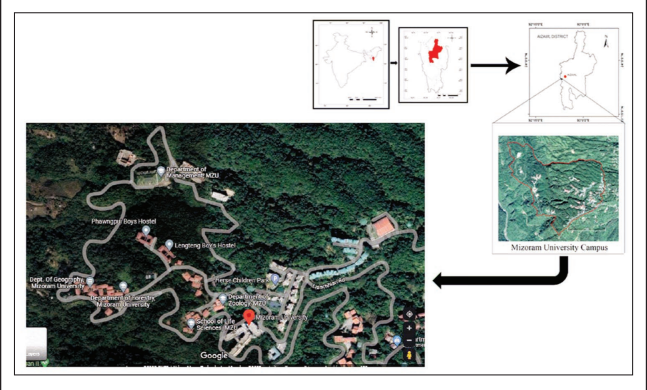
The Mizoram University (MZU) campus encompasses the area of 978.20 acres and lies between 23.7394º N and 92.6651º E. It is 15 km away from the Aizawl town, the state capital of Mizoram. The elevation of campus ranges from 300 m to 880 m above mean sea level. Climate of Aizawl is tropical type and experiences an average low temperature is 11.4ºC in January, and average high temperature of 20.4ºC in April. The average annual precipitation is 2161.4 mm. The administrative block, academic blocks, hostels, playgrounds, and other facilities are there inside university campus encompasses which are sparsely embedded within regenerating tropical wet evergreen and semi-evergreen forests (Map).
Additionally, a protected forested and water catchment reserve in the north and a small biodiversity Park are also there inside the campus. Adjoining to the campus area there are few settlements and agricultural fields, several small seasonal streams also flow through the campus. The vegetation profile is dominated by the trees comprised of 384 species under 290 genera and 107 families (Lalchhuanawma, 2008) apart from second layer vegetations and lianas and climbers.
The Pollard Walk sampling method (Pollard & Yates, 1993) was followed for scanning the butterflies. Line-transect distance sampling and a point-count method were considered together for total sampling. Altogether, 16 randomly selected permanent line transects were established in three selected sites inside the campus area. Surveys were conducted on three sites which are at three different locations from September to November 2016 and from February to May 2017. A visual search was done on sunny days between 9 am and 3 pm. The length of the studied transacts was 500 m and the breadth was a region covered by eyesight on both sides from the point of observation along the length. Some random observations on point count were also recorded.
Identification of the observed species of Rhopalocera was confirmed with the help of field guides and photographs taken in the field. The confused species were captured with the help of a net and released after proper identification. Relevant literatures and books like, Swinhoe (1905-1910), Evans (1932), Talbot (1947) and photographic guides of Kehimkar (2008) were consulted for identification.
The recorded data was analyzed by for the Species Diversity using Shannon Index (H) (Shannon, 1948), Species Dominance using Simpson Index (D) (Simpson, 1949) and Evenness using Pielou’s Evenness index (J) (Pielou, 1969).
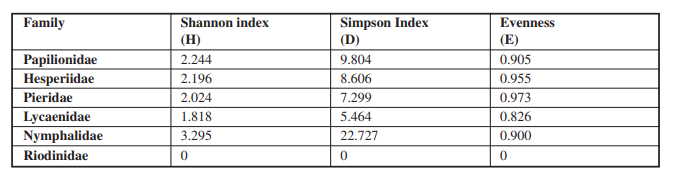
Shannon Index indicates degree of representation of species in a sample. The Shannon Index (H) was calculated using the following equation: H = ∑ pi (ln pi), where, pi is the proportion (n/N), n is no. of individuals of a species of one particular family, N is a total number of individuals of the family, ln is the natural log.
Simpson Index gives weightage to the species, common or dominant. The Simpson Index (D) was calculated using the following equation: D = ∑ pi (pi-1)/N (N-1). Where pi is the proportion (n/N), n is the number of individuals of a species of one particular family, N is the total number of individuals of the family, ∑ is the sum of the pi2.
Evenness refers to number of species and their closeness to the environment. The evenness (J) was calculated using the following equation: J = H/Hmax , Where H is the Shannon Index and Hmax is the natural log of S, where S is the total number of species in the sample.
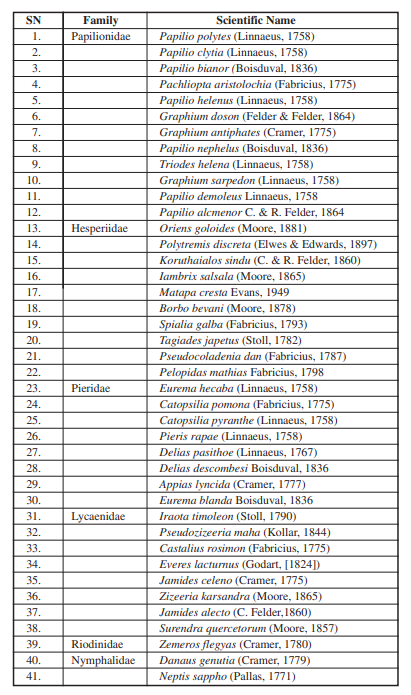
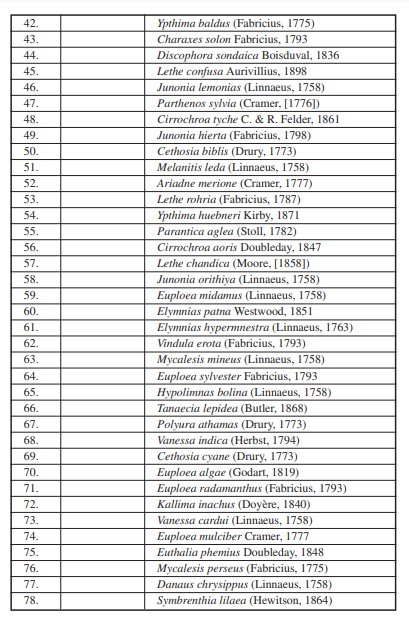
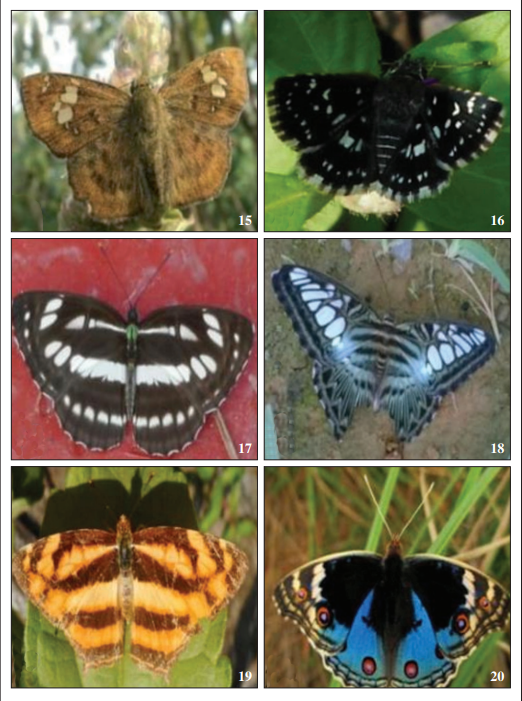
78 species of Rhopalocera from six families were recorded from three sampling sites inside campus area (Table 1). The highest species record was made from the family Nymphalidae (50%), which included 39 species, followed by family Papilionidae (15%) with 12 species, Hesperiidae (13%) with 10 species, Lycaenidae (11%) with 9 species, Pieridae (10%) with 8 species and Riodinidae with 1 species only (Table 2).
Zoological Survey of India (2007) has reported 84 species from Mizoram State and 96 species were recorded by Ghosh and Majumdar (2007), Gupta (2007), and Gupta & Maulick (2007). The survey of Rhopalocera conducted by the Zoological Survey of India described for the geographical area of 21,081 km2 of the entire Mizoram State while the present survey recorded 78 Rhopalocera species from 3.96 km2 area of the Mizoram University. Geographical ratio between Mizoram University (MZU) campus and Mizoram state is 1:5323 and the ratio of the record of the Rhopalcocera species between these areas is 1:1.23. Proportionally the rhopaloceron richness is quite evident in this campus area. However, 125 Rhopalocera species of five families were recorded from Dampa Tiger Reserve, a largest protected area of 500 km2 and 488 km2 as buffer to Mizoram (Zothansangi et al. 2018). All other surveys carried out in Mizoram have reported only five families while six families reported in this study generated a hypothesis that the modified habitats or an academic campus are living repositories (Guthala et al. 2022) and support rich biodiversity components. The family Riodinidae was reported for the first time in this study.
A similar study reported 96 species of Rhopalocera from the nearby areas of the Assam University (Bora & Meitei, 2014) and 140 species from the Gauhati University Campus of the northeast India (Saikia, 2014). The older campus shows stability in vegetation cover and land use changes that brings stability and richness in biodiversity (Liu et al. 2021). Rhopalocera are sensitive group of biotas which is severely affected by the environmental variations and changes in the forest structure and composition (Pollard & Yates, 1993). Modified habitat and/or fragmented habitat exbibits more negative impact on the biodiversity in comparison to the natural habitat of that area (Fahring, 2003).
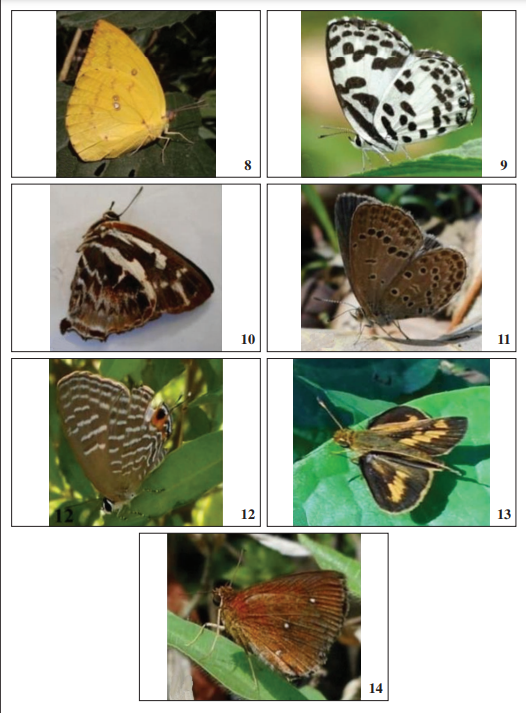
The peak season for the Rhopalocera in this part starts from July to September. Family Nymphalidae is always dominant in the tropical areas due to their polyphagous nature, and preference for diverse range of habitats. Moreover, many species of this family are strong, and active fliers that enable them to search large areas for rich food resources availability (Eswaran & Pramod, 2005; Kumar et al. 2007). Report of three rare species Parthenos sylvia, Elymnias patna, and Tanaecia lepidea is important findings in this study. Of the recorded Rhopalocera, five species are included in the schedule categories as per Wildlife (Protection) Amendment Act, 2022. These species are Euploea midamus WPA schedule-I, Castalius rosimon schedule-I, Jamides alecto schedule-II, Euploea mulciber, schedule-IV and Polytremis discreta schedule-IV (Table 1). Presence of these threatened species was also reported from the Dibang valley in the Arunachal Pradesh of eastern Himalaya (Gogai, 2012).
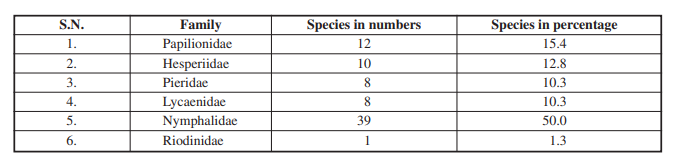
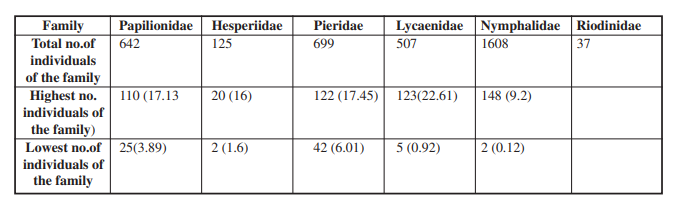
The highest and lowest records of indivudal of each family is presented in Table 3. Species richness in tropical regions was also reported by De Vries (1987, 1997) in his studies in Costa Rica, where family Riodinidae and Nymphalidae together constitute nearly 90% of the rainforest’s butterfly fauna. The geographical distribution of Punchinello in India ranges from Uttarakhand to Northeastern India (Varshney & Smetacek, 2015).
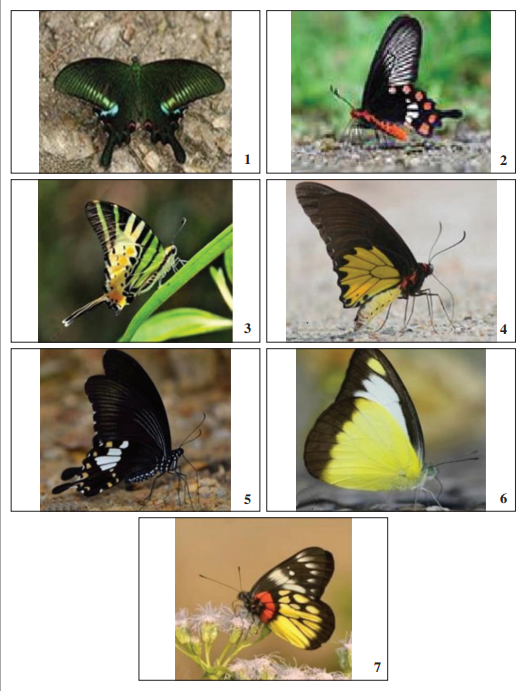
Pieridae are mosly nector foragers thus they may be monophagus or polyphagus in their habit (Courteny, 1986). Members of the Papilionidae are largely associated with pristine forest and their abundance is directly related with loss of the forest cover due to logging and human disturbances (Barua, 2007). The entire campus represents a mixed type of habitat where a diverse rhopaloceron species (78) are accomodated which equals to 80% of the species of the entire Mizoram state. This testifies the hypothesis that the habitat modification also accomodates a rich insect diversity in a particular area.
Diversity indices of the recorded species provided in Table 4 indicate that the Nymphalidae has the highest diversity and dominance values (H=3.295) (D=22.727) while Pieridae shows the highest evenness index (E=0.973). The family Lycaenidae has the least H (1.818), D (5.464) and E (0.862) values with a low diversity but evenness in distribution. Riodinidae has one species only with zero diversity. Traditional practices of shifting cultivation, deforestation, and forest fire in Mizoram lead to modification to their habitats, atmosphere, local weather, and climate. Plant diversity and local distributions of vegetations can also affect the distribution patterns of rhopalocerons and is regarded as a co-evolved situation (Singh, 2010). Thirty-six species of Nymphalidae (Table 2) clearly indicates a rich abundance of its host plants in study area. Regular monitoring of the Rhopalocera in the university area may help to develop a congregate database on diversity of this insect which also reveals the ecological value of modified habitats.
This study suggests that a large portion of the biodiversity is also sheltered in human modified landscapes and private properties besides academic institutions. Out of 78 species of Rhopalocera noted in this work, three were rare including nine locally common species. Five species belonged to the schedule categories as per the Wildlife (Protection) Act that requires adequate conservation measures. Nymphalidae is the most dominant and diverse family and Pieridae showed an even pattern in distribution. The majority of the mentioned species also extend their range to the eastern Himalayas, China, Nepal, Bhutan, and Burma.
This work presented has been part of master’s degree program of the last author. She is highly grateful to the Head, Department of Zoology for providing opportunity and technical support for conducting this piece of work. I also express my gratefulness to the Administration of Mizoram University for infrastructure support during this work. Lastly, I acknowledge my sincere gratitude to my mentors who extended their valuable suggestion and academic inputs for the success of this work.
* Autor para la correspondencia / Corresponding author: gssolanki02@yahoo.co.in

