2024
52206
15082023
25112023
Abstract: Two new species of the Indo-Australian genus Pelagodes Holloway, 1996 are described as new. Pelagodes sebastiani Lindt, Lennuk & Viidalepp, sp. nov. resembles Pelagodes rana Holloway, 1996 in the shape of its frog-leglike appendages on the male eighth abdominal sternite. The appendages are strongly curved in P. rana, while almost straight in P. sebastiani Lindt, Lennuk & Viidalepp, sp. nov. The second newly described species, Pelagodes tristani Lindt, Lennuk & Viidalepp, sp. nov., somewhat resembles Pelagodes furcatus Inoue, 2006 but differs in many aspects in the ornamentation of the male genitalia. The adults and their male genitalia structures are described and illustrated. It is noteworthy that both Papuan species of Pelagodes share massive processes on their eight sternites.
Keywords: Lepidoptera, Geometridae, Geometrinae, Thalassodini, Pelagodes, new species, New Guinea.
Resumen: Se describen como nuevas dos especies del género indoaustraliano Pelagodes Holloway, 1996. Pelagodes sebastiani Lindt, Lennuk & Viidalepp, sp. nov. se parece a Pelagodes rana Holloway, 1996 en la forma de sus apéndices en forma de patas de rana en el octavo esternito abdominal del macho. Los apéndices están fuertemente curvados en P. rana, mientras que son casi rectos en P. sebastiani Lindt, Lennuk & Viidalepp, sp. nov. La segunda especie recién descrita, Pelagodes tristani Lindt, Lennuk & Viidalepp, sp. nov., se parece en cierto modo a Pelagodes furcatus Inoue, 2006, pero difiere en muchos aspectos en la ornamentación de la genitalia del macho. Se describen e ilustran los adultos y la estructuras de su genitalia del macho. Cabe destacar que ambas especies papúes de Pelagodes comparten procesos masivos en sus ocho esternitos.
Palabras clave: Lepidoptera, Geometridae, Geometrinae, Thalassodini, Pelagodes, nueva especie, Nueva Guinea.
Artículos
Two new species of Pelagodes Holloway, 1996 from Eastern New Guinea (Lepidoptera: Geometridae, Geometrinae, Thalassodini)
Dos nuevas especies de Pelagodes Holloway, 1996 de Nueva Guinea oriental (Lepidoptera: Geometridae, Geometrinae, Thalassodini)
Received: 15 August 2023
Accepted: 25 November 2023
Published: 30 June 2024
Pelagodes Holloway is a speciose Indo-Australian genus of the tribe Thalassodini (Ban et al. 2018), which has been intensively studied in recent decades following its separation from Thalassodes Guenée, 1857 by Holloway (1996): Inoue (2006), Han & Xue (2010, 2011), Viidalepp et al. (2012), Sommerer & Tautel (2022), Lindt et al. (2022). Some species groups are separated from Pelagodes as genera of their own - Reniformvalva Inoue, 2006 and SternitornantodesSommerer & Tautel, 2022. The aim of the present article is to add the descriptions of two hitherto unknown species from New Guinea to this group.
During late April and May 2012, the first author and Dr I. Renge (Tartu University, Estonia) collected Heterocera during their trip to the eastern part of the Indonesian New Guinean province of Highland Papua, near Womena, on both the northern and southern slopes of the Baliem Valley. Two collecting sites in tropical rainforest fragments in this dense, populated agricultural district yielded two new species of Pelagodes as part of the rich material that is mounted and deposited in the insect collection of the Estonian Museum of Natural History for study. This is the third publication dealing with moths from this tropical island (Lindt et al. 2017).
When mounting and identifying the geometrid moth material collected 2012 in the Papua Highlands, a series of two small green moths with appendages on the last sternite of the male abdomen were labelled as belonging to Pelagodes rana Holloway, 1996 and Pelagodes furcatus Inoue, 2006. We made a side-by-side comparison of morphological characteristics of adult moths and their genitalia slides in a series of specimens across the available populations.
A side-by-side comparison of male genitalia slides of the Malaysian P. rana, and Papuan series of similar specimens with frog-leg-like processes on the male last abdominal sternites yielded some differences, which together allow us to assign the Papuan population the rank of species - Pelagodes sebastiani Lindt, Lennuk & Viidalepp, sp. nov. - as described below. Another series is similar in appearance to P. furcatus Inoue, 2006 but has appendages on the eighth sternite that are broad and blade-like with a large, flat, sharply pointed lateral spine, instead of being twig- or thorn-like with some additional thin spines.
Genus Pelagodes Holloway, 199.
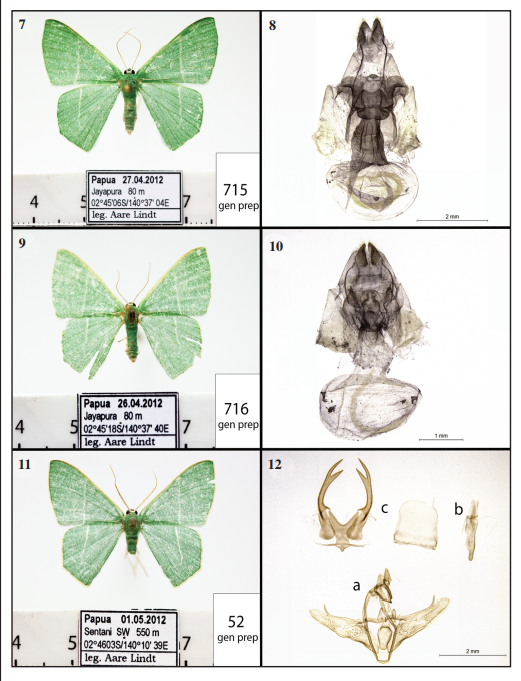
Holloway, when revising the moth fauna of Borneo, separated from the widespread genus Thalassodes Guenée, 1857 all species with lateral appendages on the eighth sternite of male abdomen in the new genus Pelagodes Holloway. The males of these species also have simple hindlegs, which are slender and provided with two pairs of spurs but lack the tibial hair pencils that characterize Thalassodes. The moths have a bluish green colour to the wings, densely speckled with pale strigulae, and whitish lines traversing the wings (two fasciae on forewing, one fascia on hindwing). Despite the uniform wing pattern of adult moths (Figures 1, 7, 9), the species are diagnosed according to structures on underside of male abdomen without dissection (Figures 4, 5, 6).
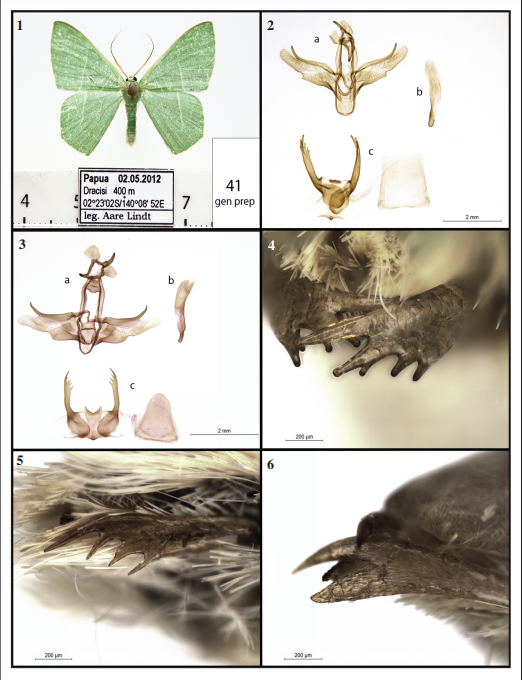
Pelagodes sebastiani Lindt, Lennuk & Viidalepp, sp. nov. (Figures 1, 2, 4,7, 8.
Material: Holotype, ♂, INDONESIA, Papua, Jayapura, 80 m, 27-IV-2012, 02º45’06”S/140º37’04”’E, (A. Lindt), Type id. TAMZ0227602. Paratypes (24 ♂, 2 ♀: Indonesia, Papua, 1 ♂, Jayapura, 50 m, 25- IV-2012, 02º39’09”’S/140º52’27”’E; 5 ♂, Jayapura, 80 m, 26-IV-2012, 02º45’18”S/140º37’40”’E (gen. 41) Type id. TAMZ0227604; 17 ♂, 1 ♀, Jayapura, 80 m, 27-IV-2012, 02º45’06”S/140º37’04”E (gen. 680, 715) Type id. TAMZ0227605; 1 ♀, Sentani SW, 550 m, 01-V-2012, 02º46’03”S/140º10’39”E; 1 ♂, Dracis, 400 m, 02-V-2012, 02º45’06”S/140º37’04”E (A. Lindt). The holotype is deposited in the zoological collection of the Estonian Museum of Natural History (Tallinn). The paratypes are in the Estonian Museum of Natural History, in the IZBE insect collection (Tartu) and in the private collection of A. Lindt.
Description. Wingspan, 28-30 mm in males (Figure 1) and 35-36 mm in females (Figure 7). Frons colour green. Fillet white, head bluish green, thorax and abdomen bluish green. Male antennae pectinate in basal third, length of rami reaching 1.25 mm. Forewing external margin rounded, hindwing external margin angulate at middle. Forewing and hindwing concolorous, postmedian fascia whitish, fringe pale greenish. Male hind legs slender. Wings underside pale greenish.
Male genitalia (Figure 3 [gen. 680]) typical for the genus Pelagodes, uncus and gnathos projecting and of equal length, valva with costal sclerite strong, outcurving as dorsal process at 2/3, not sharptipped. Transtilla continuous, downcurved, juxta tipped with plate-shaped sclerite dorsally. Aedeagus slender. The last sternite with lateral appendages broader than in P. rana Holloway (compare Figure 302 in Holloway (1996)), rounded basally, connected by a flexible membrane, which has a small black sclerite posteriorly. The lateral processes are tipped with fleshy, finger-shaped, small processes, as in arboreal frogs. The last tergite broader than in P. rana, with its distal margin weakly concave.
Female genitalia: (Figure 8 [gen. 715]).
Discussion: The processes on the last sternite are usually slender, but broad and flat in Pelagodes rana (Holloway, 1996, fig. 302 and fig. 3 below), P. waterstradti (Holloway, 1996, fig. 304), P. tridens (Holloway, 1996, fig. 305) and P. semirana (Inoue, 2006). Pelagodes rana only has the processes rectangularly elbowed at the basal third (the other three species listed have generally slenderer and straight lateral processes on the sternites).
The processes on the last sternite of the new species, Pelagodes sebastiani, are ornamented, equally short and in a cluster at their distal ends (one distal spine much long than the others). The frogleg-shaped ornamentation is pointed at the tips in P. rana (Holloway, 1996, fig. 5) but fleshy and rounded in the new species (Figure 4). The lateral processes in the newly described species are tipped with fleshy ornamentation, recalling the adhesive fingers in arboreal frogs, and do not taper to points. The sclerite between the bases of processes is V-shaped in P. rana. There is no V-shaped sclerite between the bases of processes of the sternite of P. sebastiani, and the posterior edge of the last tergite is slightly concave or nearly straight.
Pelagodes tristani Lindt, Lennuk & Viidalepp, sp. n. (Figures 6, 9, 10, 11, 12.
Material: Holotype, ♂, INDONESIA, Papua, Sentani, 220 m, 24-IV-2012, 02º32’45”S/140º30’33”E, (A. Lindt), Type id. TAMZ0227603. Paratypes (1 ♂, 1 ♀): Indonesia, Papua, 1 ♂, Sentani SW, 550 m, 01-V-2012, 02º46’03”S/140º10’39”E (gen. 52); 1 ♀, Jayapura, 80 m, 26-IV-2012, 02º45’18”S/140º37’40”E (gen. 716) (A. Lindt). The holotype is deposited in the zoological collection (TAMZ) of the Estonian Museum of Natural History (Tallinn) and the paratype in the private collection of A. Lind.
Description: Wingspan, 26-29 mm in males (Figure 11) and 29 mm in females (Figure 9). Male antennae pectinate in basal third, length of rami reaching 1.05 mm. Frons scaled, dark green. Forewing and hindwing concolorous bluish green, postmedian fascia whitish, fringe pale greenish. Dorsum of abdomen green, without ornamentation. Wing underside pale greenish. Forewing external margin smoothly rounded, hindwing external margin angulate at middle (smoothly rounded in P. forceps). Fillet white, head bluish green, thorax and abdomen bluish green without markings. Male hind legs slender.
Male genitalia (Figure 12 [gen. 52]) typical for the genus Pelagodes. Uncus and socii equal in length. The costa of the valva sclerotized with its distal quarter free, slender-tipped and upcurved (straight in P. forceps Inoue and almost reaching beyond the valvula), sacculus smoothly fused to valvula. Lateral processes on the last sternite arising from oblong bases (bases roundish in P. forceps), fairly curved with a pointed tip and a strong lateral spine. The medial sclerite between bases of lateral processes wide and is a deeply incised V-shape (almost straight in P. forceps). The last tergite is broad, smoothly roundish posteriorly. Aedeagus without sclerotization.
Female genitalia: (Figure 10 [gen. 716]).
Etymology: The new species are named after the first author’s grandsons Sebastian and Tristan Truu.
Dr. Robert Barry Davis kindly revised the English of the article.
* Autor para la correspondencia / Corresponding author: Lennart.Lennuk@loodusmuuseum.ee

