2024
52206
09102023
12122023
Abstract: Theresimima ampellophaga (Bayle-Barelle, 1809) (Lepidoptera: Zygaenidae, Procridinae), occurs as a partly harmful species in vineyards in the Mediterranean region, where it has the proper conditions for larvae development, including the host plants and hilly relief. In 2017, has been registered as a new country record in the vineyards of the western lowland in Albania on the base of a large-scale study using traps baited with the synthetic sex pheromone of Th. ampellophaga females or the sex attractant EFETOV-2. The further field works in 2018 and 2019 using sex pheromone traps aimed to establish in new localities in Albania and determine the northern distribution limit of Th. ampellophaga in this country. In 2019, low numbers males were captured in three vineyards in Apolloni, Radostinë (district of Fier) and Dukat i Ri (district of Vlorë), southern Albania in the first half of July, all from the first generation. As a preliminary result, the northern distribution limit in Albania is reported.
Keywords: Lepidoptera, Zygaenidae, Procridinae, Theresimima, autochthonous grapevine, monitoring, (2R)-butyl (7Z)-tetradecenoate, Albania.
Resumen: Theresimima ampellophaga (Bayle-Barelle, 1809) (Lepidoptera: Zygaenidae, Procridinae), se presenta como una especie parcialmente dañina en los viñedos de la región mediterránea, donde tiene las condiciones adecuadas para el desarrollo de las larvas, incluyendo las plantas alimenticias y el relieve montañoso. En 2017, se ha registrado como un nuevo registro del país en los viñedos de las tierras bajas occidentales de Albania sobre la base de un estudio a gran escala utilizando trampas cebadas con la feromona sexual sintética de las hembras de Th. ampellophaga o el atrayente sexual EFETOV-2. Los trabajos de campo adicionales en 2018 y 2019 utilizando trampas de feromona sexual tenían como objetivo establecer en nuevas localidades de Albania y determinar el límite de distribución septentrional de Th. ampellophaga en este país. En 2019, se capturó un bajo número de machos en tres viñedos de Apolloni, Radostinë (distrito de Fier) y Dukat i Ri (distrito de Vlorë), al sur de Albania, en la primera quincena de julio, todos de la primera generación. Como resultado preliminar, se informa del límite de distribución septentrional en Albania.
Palabras clave: Lepidoptera, Zygaenidae, Procridinae, Theresimima, vid autóctona, seguimiento, (2R)-butil (7Z)- tetradecenoato, Albania.
Artículos
The northern distribution limit of Theresimima ampellophaga (Bayle-Barelle, 1809) in Albania: results obtained by sex pheromone traps (Lepidoptera: Zygaenidae, Procridinae)
El límite de distribución septentrional de Theresimima ampellophaga (Bayle-Barelle, 1809) en Albania: resultados obtenidos mediante trampas de feromonas sexuales (Lepidoptera: Zygaenidae, Procridinae)
Received: 09 October 2023
Accepted: 12 December 2023
Published: 30 June 2024
Theresimima ampellophaga (Bayle-Barelle, 1809), (Lepidoptera, Zygaenidae) is an oligophagous species whose larvae feed on Vitaceae hosts - grape vine Vitis vinifera L. and ornamental vines of Parthenocissus ssp. (Tarmann, 1998). Recently Efetov et al. (2023) reported the correct date of description and type locality of this species. Theresimima ampellophaga was documented for the first time in Albania in 2017 (Vrenozi et al. 2019). Male moths of this species were attracted to transparent Delta sticky traps using the (2R)-butyl (7Z)-tetradecenoate (the main sex pheromone compound of the conspecific females) (Subchev et al. 1998), and the racemic mixture of (2R)-butyl 2-dodecenoate and (2S)-butyl 2-dodecenoate (sex attractant EFETOV-2) (Efetov et al. 2014). The vineyards with these first records were located in the villages of Sarandë, Vlorë, and Fier, in the southwestern Albania. The species is univoltine or bivoltine and the number of generations is different from one country to another and even in a particular country. According to the literature sources the flight of the 1st generation is from the beginning of May till late July- beginning of August, and the 2nd in between mid-August to the second part of September (Chireceanu et al. 2020; Nahirnic-Beshkova et al. 2021a; Tarmann et al., 2019; Toshova et al. 2017). Accorging to some authors univoltine and partially bivoltine populations of Th. ampellophaga have been also documented in Bulgaria, South Russia, Georgia, and Azerbaijan (see Toshova et al. 2017). In Albania, two generations of Th. ampellophaga were reported (Vrenozi et al. 2019). Similarly, two generations are known in Bulgaria (Mumun et al. 2018; Toshova et al. 2017), Greece (Subchev et al. 2006; Tarmann et al. 2019), Turkey (Can et al. 2010; Can Cengiz et al. 2012), Syria and Lebanon (Talhouk, 1969).
The larvae cause damage to leaves and buds and young grape growth, which results in the loss of photosynthesizing and fewer blossoms and reduced fruit yield (Voigt et al. 2000). The domestication of the grape varieties Shesh i Bardhë and Shesh i Zi named after the village “Shesh” in Tirana, is an established grape variety found in every village of Albania (Gixhari & Ramadani, 2016). Vrenozi et al. (2019) revealed that the male adults were attracted by the pheromone traps placed in the autochthonous grapevine varieties.
The present research work aimed to add additional data about the occurrence Th. ampellophaga using pheromone traps at different altitudes and grapevine varieties in Albania.
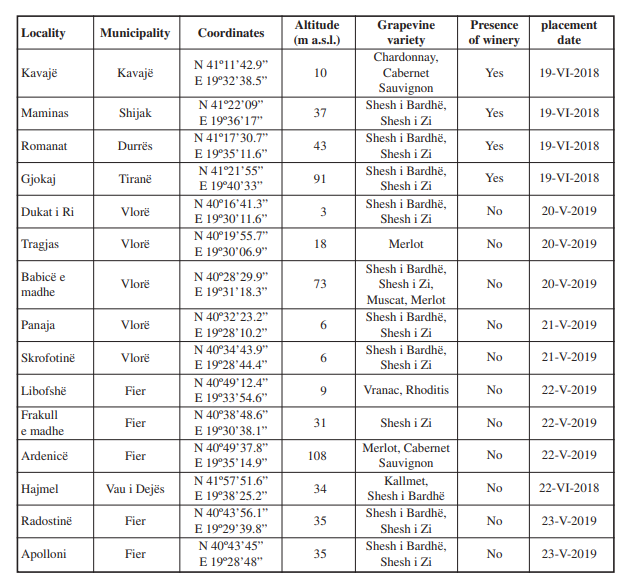
Based on the results for distribution in Albania obtained in 2017 (Vrenozi et al. 2019), in this study, we focused the fieldwork on bigger vineyards from May-September, 2018. These vineyards occupied large areas, and the presence of wineries suggests they are associated with the wine-making industry. For monitoring the occurrence of Th. ampellophaga, vineyards randomly selected in the Western Lowland of Albania, districts of Vlorë, Fier, Lushnje, Kavajë, Tiranë, and Shkodër, either large ones or smaller ones for family production of grappa and wine. Grape varieties were mainly the autochthon Sheshi Bardhë and Sheshi Zi, but also some other varieties such as Cabernet Sauvignon, Chardonnay, Merlot, Muscat, Roditis, and Vranac. The fieldwork started with the placement of the traps in the vineyard in late May, followed by weekly inspection of them from June till September, both in 2018 and 2019. In each vineyard, two Delta sticky traps baited with the synthetic sex pheromone (2R)-butyl (7Z)-tetradecenoate (Subchev et al. 1998) (dose of 100 µg), were placed at 10 m distance and hanged 1-1.5 m from the ground.
Details about studied sites, grape varieties, presence of winery in the area, and dates when pheromone traps were set up in the vineyards are present in Table 1. Information about the management of pests in vineyards is not available.
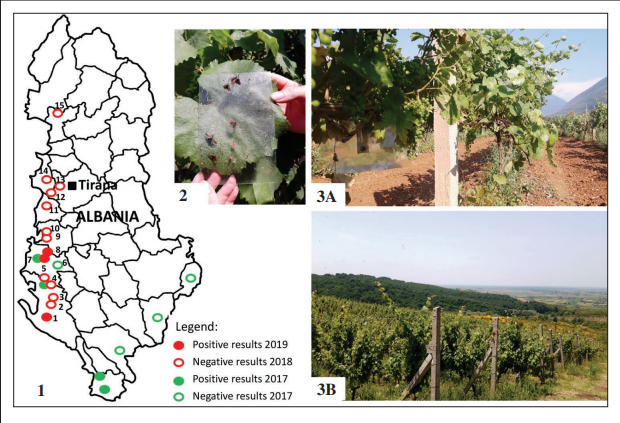
In 2018, no Th. ampellophaga males were captured by the pheromone traps placed in central and northern Albania. This led us to set up the traps in the southern vineyards in 2019, where we already had some results from the previous study in 2017 (Vrenozi et al. 2019), and 14 km more northern.
The results of the field monitoring in 2019 revealed the presence of Th. ampellophaga in vineyards in two new localities in Albania - Dukat i Ri (Vlorë) and Radostinë (Fier) (Table 2).
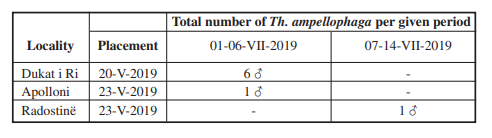
At the two localities, where autochthonous grapevine varieties Shesh i Bardhë and Shesh i Zi are present, the relative abundance of the target species was low. In addition to that, there were higher expectations on the vineyard in Apolloni (Fier) that had a previous documented case of the presence of the moth (Vrenozi et al. 2019), nevertheless, only a single male specimen was registered.
Southern vineyards with positive results for the vine bud moth presence were in the municipalities Vlorë and Fier (Figures 1-3), and the vineyards northern to Fier, such as in Lushnje, Kavajë, Shijak, Durrës, Tiranë, and Vau i Dejës municipalities showed the absence of this species.
The absence of the target species in 2018 could relate to the influence of climatic factors, natural enemies, use of pesticides, vine variety or complex factors (Anastasova & Georgieva, 1975; Dominici & Pucci, 1987; Pucci & Dominici, 1986). Pucci & Dominici (1986) reported that in addition to the rainfalls, winds and higher temperatures that kill the preadult instar of the vine bud moth, fungicide and insecticide commonly sprayed in summer against other pests (mites and grape berry moth) are dangerous for Th. ampellophaga. Considering the lack of moths during the fieldwork of 2018, the year later, we placed the traps in small vineyards (Apolloni) for family usage, with mainly the autochthones grape varieties, close to the areas with previous confirmed data on the presence of the vine bud moth and a bit further in the northern vineyards. The results showed the presence of the target species in relatively low population density, similar to Vrenozi et al. (2019). The new records in the vineyard of the village Radostinë revealed the northern limit of this species in Albania. The northern limit is not related to the higher altitudes, except to the different latitudes, different grapevine varieties, and to the association with the wine-making industry (Table 1).
Presence of Th. ampellophaga in 2019 in the vineyards with the resistant variety of French hybrid (a crossing between V. vinifera and another Vitis species) in Apolloni, reinforces that the limited usage of chemical pesticides in the vineyards is the main reason of the moth occurrence (Pucci & Dominici, 1986). Shesh i Bardhë and Shesh i Zi were confirmed in this study as varieties susceptible (Vrenozi et al. 2019), in the two new vineyards in the villages Dukat i Ri and Radostinë. These two varieties are among the most important cultivars for Albanian viticulture (Kullaj et al. 2015). The autochthonous grape varieties have gone through the natural selection of many decades and have shown to be resistant to harsh climate conditions, low soil quality, pest species, and diseases. Therefore, the usage of pesticides is a minor necessity, and this doesn’t impact sustainable grape production (Gixhari & Ramadani, 2016).
Both grape varieties belong to the small to medium vineyards, positioned on the western and eastern sides of the hills, which have a maximum altitude of up to 35 m a.s.l. Nevertheless, studies have shown that Th. ampellophaga is present also in higher altitudes in the southern Balkans, such as in Bulgaria (478 m a.s.l., Gornoslav, 231-239 m a.s.l., Lozitsa, Toshova et al. 2017; 254 m a.s.l., Mumun et al. 2018, 270 m a.s.l, Nahirnic-Beshkova et al. 2021b), Greece (90 m a.s.l., May & Tarmann 2020), North Macedonia (168-715 m a.s.l., Nahirnic-Beshkova et al. 2021a), Turkey (115 m a.s.l., Can Cengiz et al. 2018; 310 m a.s.l., Can et al. 2022).
Catches of Th. ampellphaga males at the first half of July, 2019 revealed that they are from the first generation of this species. In the previous study in 2017 in Albania (Vrenozi et al. 2019), catches during the period of end of June - beginning of July and September were recorded, that showed two generations of the vine bud moth. Similarly, variation in voltinism of Th. ampellophaga was reported in Bulgaria (Toshova & Subchev, 2002; Toshova et al. 2017; Mumun et al. 2018), Greece (Subchev et al. 2006; Tarmann et al. 2019) and Turkey (Can et al. 2010). The vine bud moth usually develops two generations annually in southern areas of its distribution. Usually many species and populations are bivoltine or multivoltine at lower latitude and univoltine - at higher latitude. The location and environmental conditions are important factors that explained most of the variation in phenologies of many insect species (Altermatt 2010; Marchioro et al. 2021; Numata & Shintani 2023).
In 2019, low numbers of males were captured in three vineyards of Fier (Apolloni, Radostinë) and Vlorë (Dukat i Ri) in the first half of July. All specimens were from the first generation. Northern limit presence in Albania was so far in the district of Fier (village Radostinë).
Blerina Vrenozi acknowledges Anila Kule and Beqir Nelaj for assistance during the field work. The English language is improved using the academic program of Grammarly https://www.grammarly.com. This study is funded by Faculty of Natural Sciences, University of Tirana, Albania, and partly supported by a project ANIDIV 5 (Institute of Biodiversity and Ecosystem Research, Bulgarian Academy of Sciences).
* Actor para correspondencia: blerina.vrenozi@fshn.edu.al

