2024
52206
18092023
05112023

Himachal Pradesh University, India
Abstract: A field survey of the Spiti and Pin Valley of Himachal Pradesh in September 2023 revealed the presence of Pseudochazara baldiva Moore, 1865 in the region. In the earlier studies recently conducted in the region, the species is believed to have been misidentified by many authors as Pseudochazara lehana Moore, 1878. The identification of the species was done based on the phenotypic description given in Moore (1865), Evans (1932), and Talbot (1947). The study also provides the first photographic evidence of Pseudochazara baldiva Moore, 1865, from the region.
Palabras clave: Lepidoptera, Nymphalidae, Pseudochazara, Himachal Pradesh, Himalaya occidental, India.
Resumen: Un estudio de campo realizado en septiembre de 2023 en el valle de Spiti y Pin, en Himachal Pradesh, reveló la presencia de Pseudochazara baldiva Moore, 1865 en la región. En los estudios anteriores realizados recientemente en la región, se cree que la especie ha sido identificada erróneamente por muchos autores como Pseudochazara lehana Moore, 1878. La identificación de la especie se hizo basándose en la descripción fenotípica dada en Moore (1865), Evans (1932) y Talbot (1947). El estudio también proporciona la primera evidencia fotográfica de Pseudochazara baldiva Moore, 1865, de la región.
Palabras clave: Lepidoptera, Nymphalidae, Pseudochazara, Himachal Pradesh, Himalaya occidental, India.
Keywords: Lepidoptera, Nymphalidae, Pseudochazara, Himachal Pradesh, Western Himalayas, India
Artículos
Unveiling the Hidden Gem: An Observational Report, Taxonomic Insights and First Photographic Evidence of Pseudochazara baldiva Moore, 1865, from India (Lepidoptera: Nymphalidae)
Revelando la joya escondida: un informe de observación, conocimientos taxonómicos y primera evidencia fotográfica de Pseudochazara baldiva Moore, 1865, de la India (Lepidoptera: Nymphalidae)
Received: 18 September 2023
Accepted: 05 November 2023
Published: 30 June 2024
Pseudochazara baldivaMoore, 1865 is an uncommon but local species that flies in the Himalayan inner ranges, 3000 to 3900 m, in the Lahaul & Spiti, and Kinnaur districts of Himachal Pradesh (Gasse, 2018). The species is named after the region where it is predominantly found and is commonly known as Spiti Rockbrown. The species is given as Eumenis mniszechii in Evans (1932), and as Hipparchia mniszechii in Talbot (1947), later placed in the genus Pseudochazara by de Lesse, 1951 (Gasse, 2018). There are three sub-species of Pseudochazara baldivaMoore, 1865, in the Indian subcontinent: baldivaMoore 1865; baluchaEvans, 1932; and baltistana which was described in 1949 and was considered a synonym of lehana. Subspecies baluchaEvans, 1932, is common in Pakistan in North Baluchistan, between 1800 to 2400 m; subspecies baltistana occurs in Chitral, Gilgit-Baltistan, and possibly in Ladakh between 2200 to 4000 m; and subspecies baldiva is typically found in the Lahaul Spiti and Kinnaur district of Himachal Pradesh, India between 3000 to 3900 m (Gasse, 2018).
The study of the androconia scale of Pseudochazara specie-group type specimens provides that Pseudochazara baldivaMoore, 1865, and Pseudochazara lehana Moore, 1878 have distinctively shaped androconia (Wakeham-Dawson et al. 2007).
During the first two weeks of September 2023, many field surveys of the Lahaul, Spiti, and Pin Valley were conducted to study the Rhopalocera diversity in the region. The altitude of the studied area extends from 3000 m to 4500 m which supports a good number of Rhopalocera diversity. About 15 specimens of Pseudochazara baldivaMoore, 1865, were observed and studied in Kaza, Kibber, Langza, and Mud village. The species prefers to visit the Thistle plant (Cirsium spp.) and is often seen puddling over the mud and basking over the rocks. The study was conducted mostly during the early hours of the day when the individuals of the species were more active.
Description (Adult) (Figure 1-2): Pseudochazara baldivaMoore, 1865, is a rockbrown species of the Nymphalidae family, sized about 50-55 mm. Underside: grey in males and greyish-white in females with numerous black striae on the hindwings. Forewing in males with single black spots and females with two black spots (Moore, 1865). Forewing apical ocellus with white pupil and yellow iride, there are two white spots in spaces 3 and 4 just below the apical ocellus. Hindwing with post-discal and submarginal lines strongly marked. The submarginal line is sinuous or zigzag (Talbot, 1947). There is a black spot near the hindwing tornus, also with a white pupil and yellow iride. Hindwing cilia silvery grey. Upperside: forewing with posterior ocellus larger than lehana and gilgitica (Talbot, 1947). The post-discal area of the upper wings is paler. Forewing with two black spots, centred with white. Hindwing with one black spot also centred with a white dot. The author provides that the hindwing tornal spot is obscure in Pseudochazara lehana Moore, 1878 which closely resembles Pseudochazara baldivaMoore, 1865.
During the field surveys, both male and female specimens were studied and photographed (Figures 1-2). A detailed study of recent literature on Indian Rhopalocera (Kehimkar, 2016; Sondhi & Kunte, 2018) reveals no photographic evidence of Pseudochazara baldivaMoore, 1865. Other publications specifically focused on Himachal Pradesh (de Rhe-Philipe 1931; Talbot 1939; WynterBlyth 1940-1947; Arora et al. 2009) do not provide any photographic evidence of the species. It is worth mentioning that there is no photographic record of Pseudochazara baldivaMoore, 1865, given on the Rhopalocera of India website (Kunte et al. 2023).
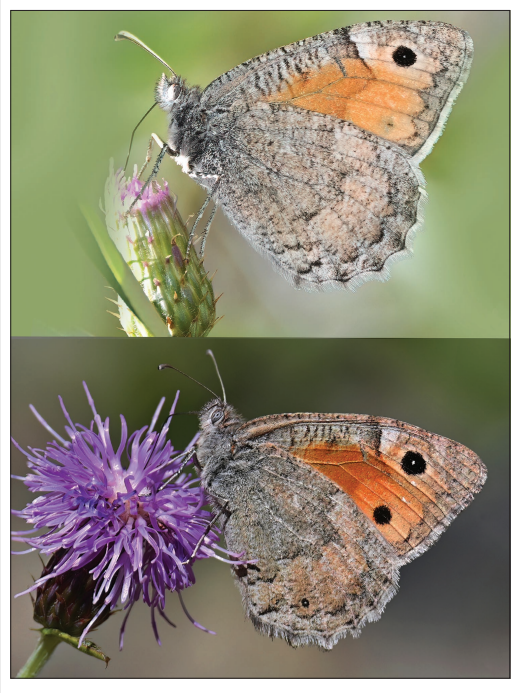
Hence, the study and record of Pseudochazara baldivaMoore, 1865, is the first photographic documentation from the Indian subcontinent and it will definitely contribute to the awareness and conservation of species. Moreover, the taxonomic inputs provided in this article will simplify future studies on Pseudochazara baldivaMoore, 1865.
The author is thankful to the Himachal Pradesh State Forest Department for providing permission to conduct the study in high-altitude regions of the state. The study is self-funded by the author, but it couldn’t have been possible without the immense support of Mr. Sanjeev Kumar, Range Forest Officer, Bhattiyat Forest Range, Himachal Pradesh. The author acknowledges the cooperation of local communities for helping during the study.
