Artículos
Received: 22 June 2023
Accepted: 10 August 2023
Published: 30 June 2024
DOI: https://doi.org/10.57065/shilap.918
Abstract: In the present communication we report Vigna stipulacea (Lam). Kuntze as a larval host plant of Euchrysops cnejus (Fabricius, 1798) and Caesalpinia bonduc (L.) Roxb. as a larval host plant of Rapala manea schistacea (Moore, 1879) for the first time from the coastal areas of Purba Medinipur district, West Bengal, India. The study also report new record of Vigna stipulacea for the state West Bengal.
Keywords: Lepidoptera, Lycaenidae, new records, Fabaceae, Purba Medinipur, India.
Resumen: En la presente comunicación registramos a Vigna stipulacea (Lam). Kuntze como planta nutricia de Euchrysops cnejus (Fabricius, 1798) y Caesalpinia bonduc (L.) Roxb. como planta nutricia de Rapala manea schistacea (Moore, 1879) por primera vez en las zonas costeras del distrito de Purba Medinipur, Bengala Occidental, India. El estudio también informa de un nuevo registro de Vigna stipulacea para el estado de Bengala Occidental.
Palabras clave: Lepidoptera, Lycaenidae, nuevos registros, Fabaceae, Purba Medinipur, India.
Introduction
Recording data on the larval host plants of Lepidoptera is very crucial in order to understand their ecology, as well as significant for the formulation of conservation strategies. The diversity and distribution of Lepidoptera chiefly governed by the diversity and distribution of their larval host plants. Some of the major contributions to the documentation of larval host plants of Indian Lepidoptera are of Bell (1909, 1910, 1927), Wynter-Blyth (1957), Kunte (2000), Kalesh & Prakash (2007), Naik & Mustak (2015), Nitin et al. (2018) and Karmakar et al. (2018). In recent five years several authors have reported new larval host plants of Lepidoptera from different parts of the West Bengal (Dey, 2021; Payra, 2021; Mukherjee 2021, 2022; Banerjee et al. 2023). In the present communication, we report for the first time Vigna stipulacea (Lam). Kuntze as a larval host plant of Euchrysops cnejus (Fabricius, 1798) and Caesalpinia bonduc (L.) Roxb. as host plant of Rapala manea schistacea (Moore, 1879) from the coastal areas of Purba Medinipur district, West Bengal, India.
Results and discussions
E. cnejus is widely distributed from Indian Subcontinent to Myanmar, China, Thailand, Lao PDR, Cambodia, Vietnam, Taiwan, Japan, West Malaysia, Singapore to New Guinea, Northeastern Australia, Fiji and Samoa (Inayoshi, 2023). In India, it occurs throughout the country except in some parts of north Indian states (western Rajasthan, western Haryana and southern Punjab) and in some states of Northeast India (Arunachal Pradesh and Mizoram) (Varshney & Smetacek, 2015; Kehimkar, 2016; van Gasse, 2021). In the adjoining coastal areas of Purba Medinipur district, West Bengal the status of the Lycaenidae is “Common” (Payra et al. 2017).The larval stages of this Lycaenidae are known to feed mainly on the members of Fabaceae family (Robinson et al. 2010) and the previously recorded larval host plants of this species are Acacia caesia (L.) Willd., Butea monosperma (Lam.) Taub., Cajanus cajan (L.) Millsp., Canavalia ensiformis (L.) DC, Lablab purpureus (L.) Sweet, Ougeinia oojeinensis (Roxb.) Hochr., Paracalyx scariosus (Roxb.) Ali, Phaseolus, Pisum satvum L., Pueraria phaseoloides (Roxb.) Benth., Vigna cylindrica (L.) Skeels, Vigna radiata (L.) R. Wilczek, Vigna trilobata (L.) Verdc., and Vigna unguiculata (L.) Walp. (Wynter-Blyth, 1957; Kunte, 2000; Robinson et al. 2010; Nitin et al. 2018). On 09-VII-2020 a female of Euchrysops cnejus was observed laying eggs underneath the leaves of a Vigna plant near Kuliyata village (21º39’47.93”N, 87º34’11.44!E), Purba Medinipur, West Bengal (Figure 1. A-H). On the same day several caterpillars were also observed underneath the leaves, on stem, stipule, flowers and pods of the plant. Later on, during July-August 2020 several caterpillars were observed at the same place. A final instar caterpillar was collected from the field during August and reared. The Vigna plant was identified as V. stipulacea by the characteristics of angular stem, large stipule, raceme above foliage, compact inflorescence, purple keel, oblong shaped hilum, and which can easily be separated from its closely allied species V. trilobata. Aforementioned records show V. stipulacea was unreported as larval host plant of this Lycaenidae. Moreover, previous distribution records of this plant indicate, it has never been reported from West Bengal (Yadav et al. 2014, Bhattacharjee et al. 2019; Gore et al. 2019). Hence the present record from Purba Medinipur district represents new locality of this plant and resulting in 11thVigna spp. of the state West Bengal. This study also reports V. stipulacea as the first larval host plant of an Indian Lepidoptera.
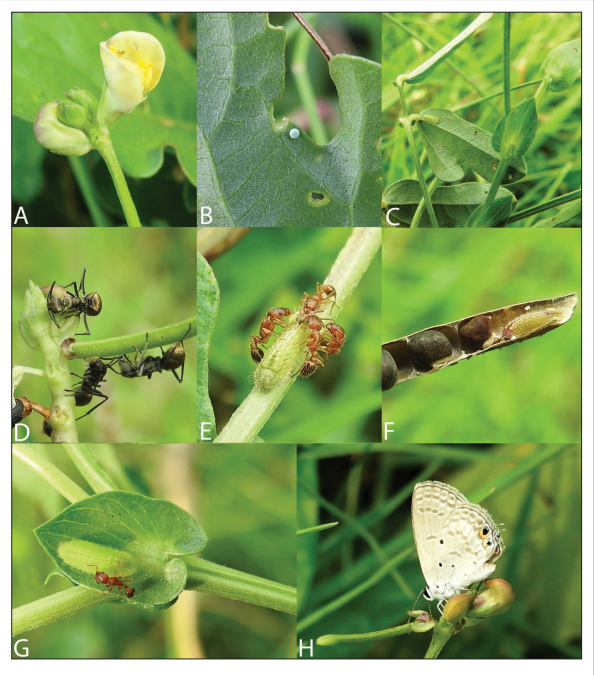
Figure 1.
A. Flowers of Vigna stipulacea (09-VII-2020). B. Egg of Euchrysops cnejus underneath the leaf (09- VII-2020). C. Caterpillar of E. cnejus underneath the leaf (09-VII-2020). D. Caterpillar of E. cnejus associated with Polyrhachis ants (16-VIII-2020). E. Caterpillar of E. cnejus associated with Tetramorium ants (16-VIII2020). F. Caterpillar of E. cnejus inside the pod (16-VIII-2020). G. Final instar caterpillar of E. cnejus on stipule (09-VII-2020). H.Euchrysops cnejus (09-VII-2020) (Photos: A Payra).
R. manea schistacea widely occurs in Oriental region, distributed from Indian subcontinent to Myanmar, southern China, Thailand, Lao PDR and Vietnam (Inayoshi, 2023). It occurs throughout India, except northern Arid region and Northeastern state Mizoram (Varshney & Smetacek, 2015; Kehimkar, 2016; van Gasse, 2021). This Lycaenidae stated as “Not Rare” in the adjoining coastal areas of Purba Medinipur district, West Bengal (Payra et al. 2017). Until now, the recorded larval host plants of R. manea schistacea are Mangifera indica L. and Spondias pinnata (L.f.) Kurz (Anacardiaceae); Combretum indicum (L.) DeFilipps (Combretaceae); Mallotus repandus (Willd.) Müll.Arg. (Euphorbiaceae); Acacia caesia (L.) Willd., Acacia megaladena Desv., Acacia pennata (L.) Willd. Calliandra heamatocephala Hassk. Mimosa diplotricha C. Wright ex Sauvalle, Saraca asoca (Roxb.) Willd., Senegalia torta (Roxb.) Maslin, Seigler & Ebinger and Senna tora (L.) Roxb. (Fabaceae); Clerodendrum infortunatum L. (Lamiaceae); Syzygium sp. (Myrtaceae); Urena lobata L. (Malvaceae); Averrhoa bilimbi L. (Oxalidaceae); Antidesma acidum Retz. and Antidesma ghaesembilla Gaertn. (Phyllanthaceae); Ziziphus spp. (Rhamnaceae); Ixora sp. (Rubiaceae); Lepisanthes tetraphylla Radlk. and Litchi chinensis Sonn. (Sapindaceae); Camellia sinensis (L.) Kuntze (Theaceae); Lantana camara (Verbenaceae) (Wynter-Blyth, 1957; Kunte, 2000; Robinson et al. 2010; Bhakare & Ogale, 2018; Nitin et al. 2018; Naik & Mustak, 2020; Mukherjee 2021, 2022; Banerjee et al. 2023). On 22-VIII-2020, two females of R. manea schistacea were observed laying eggs on the inflorescence and leaves of C. bonduc near Shankarpur (21º38’47.17”N, 87º34’18.09”E), Purba Medinipur, West Bengal (Figure 2 AF). On the same day a caterpillar was also observed inside the inflorescence. Later on 26-X-2020, an individual was observed laying eggs on the inflorescence of C. bonduc, near Nilpur Village (21º39’1.50”N, 87º33’52.29”E). Although, the caterpillar was not reared, findings of caterpillar and egg laying observations suggest C. bonduc as a putative larval host plant of Rapla manea schistacea. C. bonduc already been reported as larval host plant of Nacaduba beroe gythion Fruhstorfer, 1916, Nacaduba kurava canaraica Toxopeus, 1927 (Lycaenidae). Charaxes bharata C. Felder & R. Felder, [1867] (Nymphalidae); Eurema blanda (Boisduval, 1836) (Pieridae) (Nitin et al. 2019, Payra, 2020).
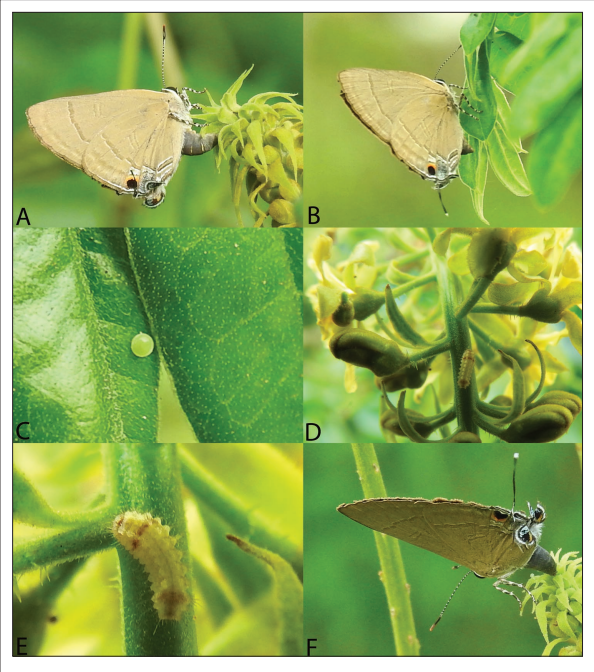
Figure 2.
A.Rapala manea schistacea laying eggs on the inflorescence of C. bonduc (22-VIII-2020). B.R. manea schistacea laying eggs on the leaf (22-VIII-2020). C. Egg of R. manea schistacea (22-VIII-2020). D-E. Caterpillar of R. manea schistacea (22-VIII-2020). F. R.manea. schistacea laying eggs on the inflorescence (26-X-2020) (Photos: A Payra).
Acknowledgments
Authors would like to thank Dr. Pankaj Koparde and Dr. Anup Kale (Dr. Vishwanath Karad MIT World Peace University, Pune, Maharashtra, India) for their encouragement and support.
References
Banerjee, D., Singhamahapatra, A., & Roy, S. (2023). New larval host plants for three butterfly (Lepidoptera, Papilionidae) species from Rahr region of West Bengal, India. Journal of Insect Biodiversity and Systematics, 9(1), 67-79. https://doi.org/10.52547/jibs.9.1.67
Bell, T. R. (1909).The common butterflies of the plains of India (including those met with the hill stations of the Bombay Presidency). Journal of the Bombay Natural History Society, 19, 16-58.
Bell, T. R. (1910).The common butterflies of the plains of India (including those met with the hill stations of the Bombay Presidency). Journal of the Bombay Natural History Society, 19, 846-878.
Bell, T. R. (1927).The common butterflies of the plains of India (including those met with the hill stations of the Bombay Presidency). Journal of the Bombay Natural History Society, 31, 951-974.
Bhakare, M., & Ogale, H. (2018). A Guide to Butterflies of Western Ghats (India) Includes Butterflies of Kerala, Tamil Nadu, Karnataka, Goa, Maharashtra and Gujarat state. Privately published.
Bhattacharjee, B., Bhattacharjee, A., Karthigeyan, K., & Dey, A. (2019).Vigna marina (Fabaceae)- A new addition to the flora of West Bengal. International Journal of Advanced Research in Botany, 5(2), 45-47. http://dx.doi.org/10.20431/2455-4316.0502005
Dey, R. (2020). New Hesperiidae (Insecta: Lepidoptera) larval host plant associations from West Bengal, India. Bionotes, 22(4), 218-225.
Gore, P. G., Tripathi, K., Pratap, A., Bhat, K. V., Umdale, S. D., Gupta, V., & Pandey, A. (2019). Delineating taxonomic identity of two closely related Vigna species of section Aconitifoliae: V. trilobata (L.) Verdc. and V. stipulacea (Lam.) Kuntz in India. Genetic Resources and Crop Evolution, 66, 1155-1165. https://doi.org/10.1007/s10722-019-00767-9
Inayoshi, Y. (2023). A checklist of Butterflies in Indo-China chiefly from Thailand, Laos & Vietnam. http://yutaka.itn.jp/index.html
Kalesh, S., & Prakash, S. K. (2007). Additions to larval host plants of butterflies of the Western Ghats, Kerala, southern India (Rhopalocera, Lepidoptera): Part 1. Journal of the Bombay Natural History Society, 104, 235238.
Karmakar, T., Nitin, R., Sarkar, V., Baidya, S., Mazumder, S., Chandrasekharan, V. K., Das, R., Kumar, G. S. G., Lokhande, S., Veino, J., Veino, L., Veino, R., Mirza, Z., Sanap, R. V., Sarkar, B., & Kunte, K. (2018). Early stages and larval host plants of some northeastern Indian butterflies. Journal of Threatened Taxa, 10(6), 11780-11799. http://doi.org/10.11609/jott.3169.10.6.11780-11799
Kehimkar, I. (2016). Butterflies of India. Bombay Natural history Society. Oxford University Press.
Kunte, K. (2000). Butterflies of Peninsular India. Universities Press (Hyderabad) and Indian Academy of Sciences (Bangalore).
Mukherjee, K. (2021). New larval host plants for the Slate flash, Black rajah and Tiny grass blue butterflies (Insecta: Lycaenidae, Nymphalidae) from Bankura, West Bengal, India. Journal of Animal Diversity, 3(4), 56-63. http://dx.doi.org/10.52547/JAD.2021.3.4.8
Mukherjee, K. (2022). Additions to the known larval host plants of Leptosia nina (Fabricius, 1793), and Rapala manea (Hewitson, 1863) (Insecta: Lepidoptera, Pieridae, Lycaenidae) from Bankura, West Bengal, India. Bionotes, 24(3-4), 290-301.
Naik, D., & Mustak, M. S. (2020). Additions to known larval host plants of butterflies of the Western Gats, India. Journal of Threatened Taxa, 12(1), 15205-15207. https://doi.org/10.11609/jott.4770.12.1.15205-15207
Naik, D., & Mustak, M. S. (2015). Additions to larval host plants of Indian butterflies (Lepidoptera). Journal of the Bombay Natural History Society, 112(3), 181-183.
Nitin, R., Balakrishnan, V. C., Churi, P. V., Kalesh, S., Prakash, S., & Kunte, K. (2018). Larval host plants of the butterflies of the Western Ghats, India. Journal of Threatened Taxa, 10, 11495-11550. http://doi.org/10.11609/jott.3104.10.4.11495-11550
Payra, A. (2021). Toddalia asiatica: new larval host plant of two Papilio species from eastern India. Zoo’s Print, 36(12), 25-28.
Payra, A., Mishra, R. K., & Mondal, K. (2017). Butterflies (Lepidoptera - Rhopalocera) of coastal areas of Purba Medinipur district, southern West Bengal, India. Tap chi Sinh hoc, 39(3), 276-290. https://doi.org/10.15625/0866-7160/v39n3.9243
Payra, A. (2020). A note on the defence by Eurema blanda Boisduval (Lepidoptera: Pieridae) pupae in response to oviposition behaviour of the chalcid wasp Brachymeria sp. (Hymenoptera: Chalcididae). Revista Chilena de Entomología, 46(3), 485-487. https://doi.org/10.35249/rche.46.3.20.13
Robinson, G. S., Ackery, P. R., Kitching, I. J, Beccaloni, G. W., & Hernández, L. M. (2010). HOSTS - A Database of the World’s Lepidopteran Hostplants. Natural History Museum. http://www.nhm.ac.uk/hosts
Van Gasse, P. (2021). Butterflies of the Indian subcontinent Distributional Checklist. Tshikolovets publications.
Varshney, R. K., & Smetacek, P. (eds.) (2015). A Synoptic catalogue of the Butterflies of India. Butterfly Research Center, Bhimtal and Indinov Publishing.
Wynter-Blyth, M. A. (1957). Butterflies of the Indian Region. Bombay Natural History Society.
Yadav, S. R., Bhat, K. V., Latha, M., John, J. K., Malik, S. K., Aitwade, M., Rao, S. R., Scariah, S., Nissar, M., Umdale, S., Patil, P., Krishnan, G., & Khedsana, R. (2014). Genus Vigna in India. National Bureau of Plant Genetic Resources, New Delhi and Shivaji University.
Author notes
* Autor para la correspondencia / Corresponding author: arapayra@gmail.com
