2024
52206
17082023
28102023
Abstract: The present study encompasses twelve Plusiinae species, shedding light on their taxonomy, and geographical distribution. Among these, four species viz. Chrysodeixis acuta (Walker, [1858]), Cornutiplusia circumflexa (Linnaeus, 1767), Autographa nigrisigna (Walker, [1858]), and Sclerongenia jessica (Butler, 1878) are reported for the first time from the union territory of Jammu and Kashmir, India thereby adding novel insights to the local lepidopteran fauna. For future scientific endeavors, each of these newly reported species has been meticulously prepared and preserved with mounted specimens and genitalia, ensuring that researchers have access to valuable reference material for further studies.
Keywords: Lepidoptera, Noctuoidea, Plusiinae, new records, Himalayas, Kashmir, India.
Resumen: El presente estudio abarca doce especies de Plusiinae, arrojando luz sobre su taxonomía y distribución geográfica. Entre ellas, cuatro especies, Chrysodeixis acuta (Walker, [1858]), Cornutiplusia circumflexa (Linnaeus, 1767), Autographa nigrisigna (Walker, [1858]) y Sclerongenia jessica (Butler, 1878), se han descrito por primera vez en el territorio de la unión de Jammu y Cachemira, India, añadiendo así nuevos datos a la fauna local de Lepidoptera. Para futuros esfuerzos científicos, cada una de estas nuevas especies ha sido meticulosamente preparada y conservada con especímenes montados y genitalia, asegurando que los investigadores tengan acceso a un valioso material de referencia para futuros estudios.
Palabras clave: Lepidoptera, Noctuoidea, Plusiinae, nuevos registros, Himalaya, Cachemira, India.
Artículos
Plusiinae of Kashmir: Taxonomy, distribution and new faunistic records (Lepidoptera: Noctuoidea)
Plusiinae de Cachemira: Taxonomía, distribución y nuevos registros faunísticos (Lepidoptera: Noctuoidea)
Received: 17 August 2023
Accepted: 28 October 2023
Published: 30 June 2024
Boisduval (1829) established the subfamily Plusiinae within the Noctuidae family of moths, using Plusia Ochsenheimer (1816) as the type of the genus. The Plusiinae subfamily is notable for its large and well-organized taxonomy. It comprises approximately 500 species globally distributed, found in tropical, temperate, and polar climates (Zahiri & Fibiger, 2008; Ronkay et al. 2008, 2010). The subfamily Plusiinae originated in the Southeastern Palearctic and Eastern Oriental regions, where the majority of plesiomorphic plusiine are located (Kitching, 1987). Members of the Plusiinae subfamily hold agricultural significance. Adult Plusiinae moths are characterized by large scale tufts on the thorax, a convex occiput, few apical styloconic sensilla, semicircular strengthening bars on the most apical portion of the proboscis, dorsal scale tufts on one or more abdominal segments, and a quadrifid hindwing (vein Cu appears 4-branched) (Kitching, 1987; Shashank & Singh, 2014; Muddasar et al. 2020).
Hampson (1894) described 31 species of Plusiinae belonging to the genus Plusia and one species under the genus Abrostola Ochsenheimer (1816) from India. Subsequently, Ronkay (1986), Ronkay (1987), and Ronkay et al. (2008, 2010) documented much of the Indian Plusiinae fauna. Sivasankaran et al. (2012) compiled a list of 21 species under Plusiinae as part of the Noctuidae family, recorded from India. Shashank & Singh (2014) provided a thorough inventory of Indian Plusiinae, comprising 59 species. On the other hand, Sinha et al. (2018) documented Antoculeora ornatissima (Walker, 1858) as a novel range record from the western Himalayan region of India, and in a separate study, Twinkle and Shashank (2018) recorded Ctenoplusia kosemponensis (Strand, 1920) from Karnataka, India. In another study, Sondhi et al. (2018) documented Plusiopalpa adrasta (Felder and Rogenhofer, 1874) and Scriptoplusia nigriluna (Walker, 1858) as new records from Kerala, India. More recently, Twinkle et al. (2018) reported eight species and Twinkle et al. (2020) reported 31 species of Plusiinae from India, along with DNA barcoding and taxonomic accounts. The larvae of most Plusiinae species are polyphagous and cause damage to various agricultural crops, including Glycine max L.-Soybean, Brassica oleracea var. botrytis-Cauliflower, Brassica oleracea var. capitata-Cabbage, Solanum tuberosum L.-Potato, Solanum lycopersicum L.-Tomato, Raphanus sativus L.-Radish, Phaseolus vulgaris L.-Common Bean, Vigna unguiculata L.-Cowpea, Solanum melongena L.-Eggplant and several aromatic and Oleraceae plant species (Sarwar et al. 2021).
In Jammu and Kashmir, Dar (2014) had documented five species with four new records from subfamily Plusiinae, while Riyaz & Sivasankaran (2022a) recently reported Anadevidia peponis as a new record from Jammu and Kashmir. In this study, we provide taxonomic descriptions, distributions, of eight Plusiinae members along with their precisely mounted photographs, which facilitate their straightforward identification.
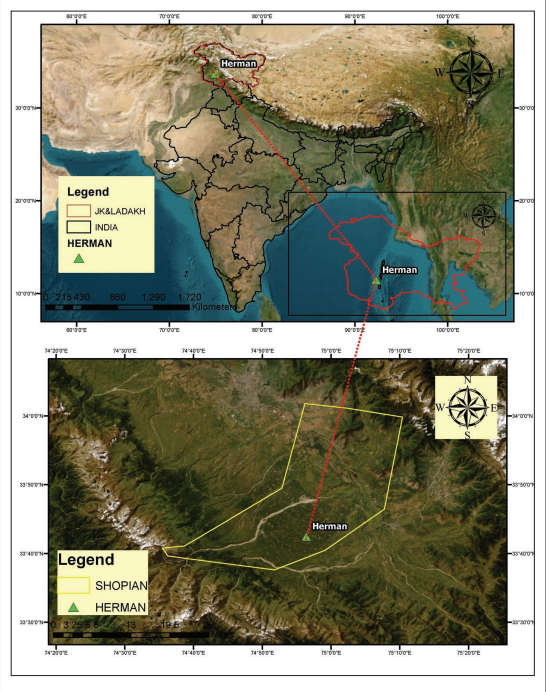
During insect explorations in the Kashmir Himalayas, nine adult specimens belonging to the subfamily Plusiinae were collected in the agroecosystems of Tehsil Herman of District Shopian, Kashmir (Figure 1). The study area experiences a total annual precipitation of 660 mm and has an average temperature of 25º. It is mainly rural and contains vast agricultural areas. (Riyaz & Sivasankaran, 2022b). The major vegetable crop species around the site were Brassica oleracea var. botrytis, Brassica oleracea var. capitata, Raphanus sativus L., Solanum melongena L., Phaseolus vulgaris L., Solanum tuberosum L., Solanum lycopersicum L., Brassica oleraceae var. virdis, Cucurbita maxima, Lagenaria siceraria, Cyclanthera pedata and Pisum sativum L. The collected specimens were deposited in the museum of the Xavier Research Foundation, St. Xavier’s College, Palayamkottai, India with specimen voucher numbers (XRF-KMR-279-87 and XRF-KMR-GS-280-84). The samples were collected at night using a ProTac HL Headlamp and cotton-wrapped ethyl acetate vials. Photographs of the species were captured using a Xiaomi Redmi Note 8 Pro smartphone equipped with a 20 mm macro lens. The first author collected the specimen during his exploration of the insect diversity in the Kashmir Valley of India. Further taxonomic studies, including the removal and preparation of the genitalia, were conducted. The specimen’s abdomen was cleaned with KOH at 135ºC for several minutes before preparing the genitalia. The prepared genitalia were then rinsed with distilled water, placed in glycerin, and preserved for future analysis.
The identification of the newly recorded species was accomplished by examining the specimen’s morphological characteristics and the genitalia. This process involved utilizing relevant literature such as works of (Zahiri & Fibiger, 2008; Dar, 2014; Twinkle et al. 2018; Twinkle et al. 2020). Through these resources, the species were precisely identified.
Family Noctuidae Latreille, 180.
Subfamily Plusiinae Boisduval, 182.
Tribe Argyrogrammatini Eichlin & Cunningham, 197.
Anadevidia peponis (Fabricius, 1775) (Figure 2)
Material examined: 1 ♂, India, Jammu and Kashmir, Herman, 33º42’18”’N, 74º56’23”’E, 1596 m, 20-X-2021, Muzafar Riyaz. (Coll. ERIB-KMR-271).
Distribution: India, Jammu and Kashmir (Riyaz & Sivasankaran, 2022), Himachal Pradesh, Delhi, Punjab, Karnataka, Bihar, Sikkim. Elsewhere: Korea, Japan, Australia, Russia, Indonesia, Japan, China, Sunderland (Twinkle et al. 2020).
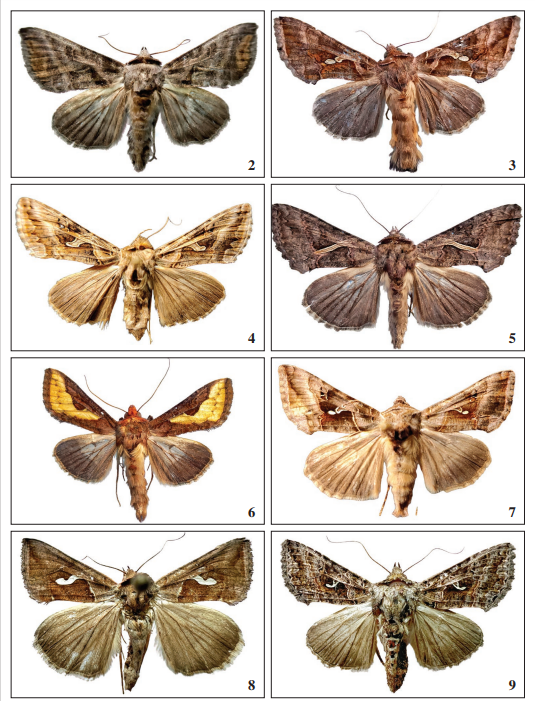
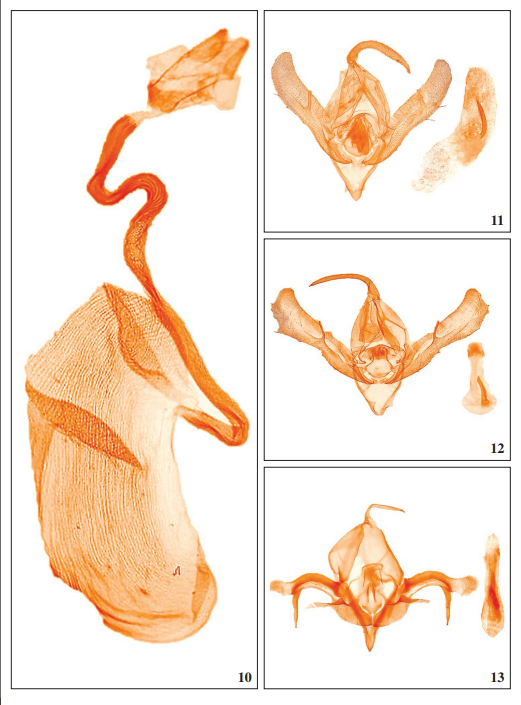
Chrysodeixis acuta (Walker, [1858]) (Figures 3, 10)
Material examined: 1 ♀, India, Jammu and Kashmir, Herman, 33º42’18”’N, 74º56’23”’E, 1596 m, 18-X-2022, Muzafar Riyaz. (Coll. XRF-KMR-279, XRF-KMR-GS-280).
Distribution: India, Himachal Pradesh, Arunachal Pradesh, Punjab, Delhi, Kerala, Tamil Nadu, West Bengal, Meghalaya. Elsewhere: Africa, Canary Islands, South Asia, Indonesia, Japan, China (Twinkle et al. 2017; 2020). New Record for Jammu and Kashmir.
Chrysodeixis eriosoma (Doubleday, 1843).
Material examined: 2 ♀, India, Jammu and Kashmir, Affarwatt, 34º03’17”N, 74º25’35”E, 4000 m, 21-VIII-2011, Kongdori, 34º02’38”’N, 74º25’06”’E, 3300 m, 2 ♀, 25 ♂, 2-IX-2010. Mudasir Ahmad Dar. (Coll. Dept. of Zoology & Env. Sciences, Punjabi University Patiala, India).
Distribution: India, Jammu and Kashmir (Dar, 2014), Uttarakhand, Punjab, Delhi, Sikkim. Elsewhere: Indonesia, New Guinea, New Zealand, Australia, Malaysia, Sunderland, China (Twinkle et al. 2020).
Cornutiplusia circumflexa (Linnaeus, 1767) (Figures 4, 11.
Material examined: 1 ♀, India, Jammu and Kashmir, Herman, 33º42’18”’N, 74º56’23”E, 1596 m, 17-X-2022, Muzafar Riyaz. (Coll. XRF-KMR-280, XRF-KMR-GS-281).
Distribution: India, Punjab, West Bengal. Elsewhere: Italy-Greece, South-West-Russia, South Urals, Africa, Canary Islands, Arabia, Southwest Asia, Sri Lanka, Nepal, South-East China, Japan, Turkey, England (Twinkle et al. 2020). New Record for Jammu and Kashmir.
Ctenoplusia albostriata (Bremer & Grey, 1853) (Figure 5.
Material examined: 6 ♂, India, Jammu and Kashmir, Ramban, 33º14’25”’N, 75º14’32”’E, 1780 m, 26-IX-2010, Mudasir Ahmad Dar. (Coll. Dept. of Zoology & Env. Sciences, Punjabi University Patiala, India).
Distribution: India, Jammu and Kashmir (Dar, 2014), Himachal Pradesh, Arunachal Pradesh, Uttarakhand, Punjab, Delhi, Kerala, Tamil Nadu, Karnataka, Orissa, Meghalaya. Elsewhere: China, Indonesia, Sri Lanka, Australia, New Guinea, New Zealand (Twinkle et al. 2020).
Thysanoplusia orichalcea (Fabricius, 1775) (Figure 6.
Material examined: 1 ♂, India, Jammu and Kashmir, Herman, 33º42’18”N, 74º56’23”E, 1596 m, 18-X-2022, Muzafar Riyaz. (Coll. XRF-KMR-282).
Distribution: India, Jammu and Kashmir, Himachal Pradesh, Uttarakhand, Punjab, Delhi, Kerala, Tamil Nadu, Karnataka, Bihar, West Bengal, Meghalaya, Manipur, Sikkim. Elsewhere: South Asia.
Taiwan, Philippines, Indonesia, Indochina, Europa, New Guinea, Africa, Southern Palearctic region. (Twinkle et al. 2018; 2020).
Tribe Plusiini Boisduval, 192.
Antoculeora ornatissima (Walker, 1858).
Material examined: 2 ♂, 1 ♀, India, Jammu and Kashmir, Srinagar, 34º11’70”N, 74º77’60”E, 1585 m, 05-IX-2007 (Coll. Rajesh).
Distribution: India, Jammu and Kashmir, Himachal Pradesh, Uttarakhand, Punjab, Delhi, Kerala, Tamil Nadu, Karnataka, Bihar, West Bengal, Meghalaya, Manipur, Sikkim. Elsewhere: South Asia, Taiwan, Philippines, Indonesia, Indochina, Europa, New Guinea, Africa, Southern Palearctic region. (Twinkle et al. 2018, 2020; Sinha et al. 2018).
Autographa gamma (Linnaeus, 1758).
Material examined: 6 ♂, 1 ♀, India, Jammu and Kashmir, Baramulla (Gulmarg), 34º04’84”N, 74º38’05”’E, 3000 m, 15-VI-2012. Mudasir Ahmad Dar. (Coll. Dept. of Zoology & Env. Sciences, Punjabi University Patiala, India).
Distribution: India, Jammu and Kashmir (Dar, 2014). Elsewhere: Greenland (Lafontaine & Poole, 1991), Countries in Europe, Africa, USA, Asia (Sullivan & Molet, 2014).
Autographa nigrisigna (Walker, [1858]) (Figsures 7, 12.
Material examined: 1 ♀, India, Jammu and Kashmir, Herman, 33º42’18”N, 74º56’23”E, 1596 m, 18-X-2022, Muzafar Riyaz. (Coll. XRF-KMR-281, XRF-KMR-GS-282).
Distribution: India, Himachal Pradesh, Uttarakhand, Delhi, Punjab. Elsewhere: Pakistan, Afghanistan, Nepal, Bhutan, Russia, Korea, Japan, China (Twinkle et al. 2018; 2020). New record for Jammu and Kashmir.
Euchalcia orophasma (Boursin, 1960).
Material examined: 1 ♀, India, Jammu and Kashmir, Taglang La (present day, Union Territory of Ladakh), 34º05’14”N, 74º47’51”E, 5328 m, 03-VII-1994, H. Hacker & W. Ludwig (Coll. NPC-IARI).
Distribution: India, Previously Jammu and Kashmir (Now Ladakh UT). Elsewhere: Pakistan, Afghanistan, Tajikistan (Twinkle et al. 2020).
Macdunnoughia confusa (Stephens, 1850) (Figure 8.
Material examined: 1 ♀, India, Jammu and Kashmir, Herman, 33º42’18”N, 74º56’23”E, 1596 m, 16-X-2022, Muzafar Riyaz. (Coll. XRF-KMR-282).
Distribution: India, Jammu and Kashmir (Dar, 2014). Elsewhere: Japan, Korea, Siberia, China, France, Austria, Hungary (Twinkle et al. 2020).
Sclerogenia jessica (Butler, 1878) (Figures 9, 13.
Material examined: 1 ♀, India, Jammu and Kashmir, Herman, 33º42’18”N, 74º56’23”E, 1596 m, 18-X-2022, Muzafar Riyaz. (Coll. XRF-KMR-283, XRF-KMR-GS-282).
Distribution: India, Himachal Pradesh, Uttarakhand. Elsewhere: Japan, Korea, Taiwan, Russia, Indo China (Twinkle et al. 2020). New Record for Jammu and Kashmir
Kashmir’s rich biodiversity in both agricultural and natural ecosystems presents a unique opportunity for further studies and exploration. The relatively unexplored nature of the region’s biodiversity underscores the need for continued efforts to document, understand, and conserve the diverse array of species that inhabit the area. As scientific knowledge advances, there is potential for uncovering even more hidden facets of Kashmir’s ecosystems, contributing not only to academic understanding but also to informed conservation efforts and sustainable management of the region’s natural resources. The present study has provided a checklist of the Plusiinae species in the Kashmir region, shedding light on their taxonomy, and distribution. The findings of four previously unreported species in Jammu and Kashmir highlights the potential for ongoing biodiversity exploration and research in the area. The meticulously prepared and preserved specimens, along with their genitalia preparations, offer valuable reference materials for future scientific endeavors. The availability of such specimens will undoubtedly contribute to the advancement of research in the field of lepidopterology and promote a deeper understanding of the intricate relationships between different Plusiinae species and their environment.
Authors are thankful to IDEA WILD (USA) for providing field equipment and XRF, St. Xavier’s College, Palayamkottai, for support and guidance.
* Autor para la correspondencia / Corresponding author: bhatmuzaffar471@gmail.com

