2024
52206
12022024
04032024
Abstract: The Lepidoptera images in the ancient Egyptian tomb of Nakht have been studied. The opinion of V. Nabokov on these images is discussed. Most probably, not Zygaena sp. but the dimorphic butterfly Hypolimnas misippus (Linnaeus, 1767) was the model for the ancient painters.
Keywords: Insecta, Lepidoptera, Zygaenidae, Zygaena, Nymphalidae, Hypolimnas misippus, Nabokov, tomb of Nakht, Ancient Egypt.
Resumen: Se han estudiado las imágenes de Lepidoptera de la antigua tumba egipcia de Nakht. Se discute la opinión de V. Nabokov sobre estas imágenes. Muy probablemente, no Zygaena sp. sino la mariposa dimórfica Hypolimnas misippus (Linnaeus, 1767) fue el modelo de los antiguos pintores.
Palabras clave: Insecta, Lepidoptera, Zygaenidae, Zygaena, Nymphalidae, Hypolimnas misippus, Nabokov, tumba de Nakht, Antiguo Egipto.
Artículos
The secret of ancient images of Lepidoptera in the Egyptian tomb of Nakht - Nabokov’s opinion and the contemporary view (Insecta: Lepidoptera)
El secreto de las antiguas imágenes de Lepidoptera en la tumba egipcia de Nakht - La opinión de Nabokov y la visión contemporánea (Insecta: Lepidoptera)
Received: 12 February 2024
Accepted: 04 March 2024
Published: 30 June 2024
By this work the authors continue their series of publications dealing with various aspects of Zygaenidae study (Can Cengiz et al. 2018; Efetov et al. 2015a, 2015b, 2018; Efetov & Tarmann, 2016; Razov et al. 2017; Subchev et al. 2016) including Zygaenidae in art (Efetov & Tarmann, 2008; Nazari & Efetov, 2023). In 2008 the authors published a paper in the Entomologist’s Gazette (Efetov & Tarmann, 2008) in which they mentioned one of the oldest images of Zygaena Fabricius, 1775 (Insecta, Lepidoptera, Zygaenidae), painted in the 17th century by the Dutch artist Otto Marseus Van Schrieck approximately 100 years before the “Systema Natura” of Carolus Linnaeus. The editor of the journal, Dr W. G. Tremewan, advised us to mention the publication of Parent (1987) in which the author wrote about the ancient fresco from the Egyptian tomb of Nakht with seven images of insects, some of them, according to his opinion, looking like Zygaena (Parent, 1987, pp. 22, 41, pl. 1, fig. 2). However, we think that Nakht’s images do not show a Zygaena.
At first, we need to give some information about the history of the tomb of Nakht. A detailed overview has been published on the Internet by O. E. Akimov under the title “Problems of Egyptology” (http://sceptic-ratio.narod.ru/rep/kn18.htm). Nakht served as an astrologer and scribe under the Egyptian pharaoh Thutmose IV (who ruled 1402-1392 BC or 1397-1388 BC, New Kingdom, 18th Dynasty) and possibly under Amenhotep III (who ruled 1391-1353 BC or 1388-1351 BC, New Kingdom, 18th Dynasty). Nakht’s burial place is situated in Sheikh Abd el-Qurna, a part of the Theban Necropolis on the west bank of the Nile opposite to Luxor (Thebes [Theban tomb No TT52]).
The local people informed Europeans about the position of the burial place of Nakht in 1889. The wall painting of the tomb shows the theme of hunting in the thickets of the Nile. There is a drawing preserved by Faucher-Gudin from a photograph by Alexander Gayet taken most probably at 1892 (Figure 1). This drawing is published in the second volume of Gaston Maspero’s 12-volume “History of Egypt, Chaldea, Syria, Babylon, and Assyria” (Maspero, 1903).
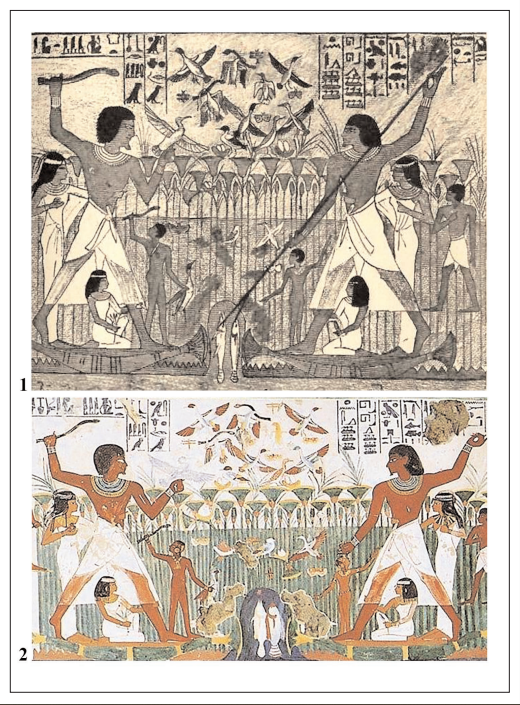
However, the first professional Egyptologist, Norman de Garis Davies, visited the site only in 1907, after the first reconstruction of the Nakht’s tomb made by non-professionals. Most likely, sometime between 1892 and 1902, there was a serious collapse of the tomb. This conclusion can be made because on the next picture taken by A. Beato in 1902, we see many differences from the drawing of Faucher-Gudin. The frescoes of the tomb became well-known only when their copies made between 1907 and 1910 appeared in the New York Metropolitan Museum of Art. It means that the wellknown images of these Egyptian masterpieces are a result of non-professional restoration (Figures 2-3) and strongly differ from the original figure by Faucher-Gudin (Figure 1). On his drawing one can see at least five insects which look like butterflies. All of them have good visible antennae. On the fresco after restoration there are seven insects. Two of the original five changed and now look like dragonflies (Figures 2-3). In one butterfly the antennae have disappeared. It is possible to recognise two additional butterflies, one without antennae, the second with only the right wings visible.
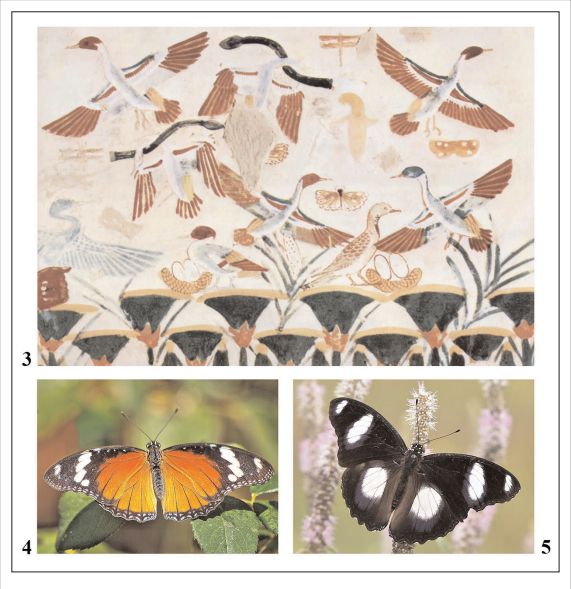
Nazari (2015) published a paper in which he wrote that these images in Nakht’s tomb are more likely Nymphalidae, most probably the Danaid Eggfly Hypolimnas misippus (Linnaeus, 1767) or the Plain Tiger Danaus chrysippus (Linnaeus, 1758). It is necessary to note that the females of Hypolimnas misippus copy the wing coloration of Danaus chrysippus as a result of mimicry, while males have a different wing pattern (Figures 4-5).
The famous Russian and American writer Vladimir V. Nabokov mentioned these Egyptian Lepidoptera images in 1942 in his letter to his wife Vera (Nabokov et al. 2017). According to his opinion these images represent butterflies of the family Nymphalidae. He wrote on 20-X-1942: “My love, I’m writing to you on the way from Atlanta to Cowan - the train hasn’t started yet. Please, write a few words to Miss Read - my husband has been telling me so much about you in his letters that I almost feel as if I knew you - something like that - and thank her for all the kindness that you and your wonderful college showed him. She… presented me with a huge print of details from an Egyptian fresco with butterflies, about which I’ll write something…KISSES…V..
Nabokov wanted to use these images in his book “Butterflies in Art”. He began this book in the mid-1960s but did not complete the project.
Dieter Zimmer in a large monograph “A Guide to Nabokov’s Butterflies and Moths” (Zimmer, 2001) wrote.
“In his research for a book on Lepidoptera in art, Nabokov came across a very special Plain Tiger [Danaus chrysippus (Linnaeus, 1758)]: “This butterfly has the distinction of being the oldest known to have been represented by man. Seven specimens of it (with a typical white-dotted Danaus body but somewhat Vanessa cardui like wingtips) are shown flitting over the papyrus swamp in a fowling scene from a Theban tomb (XVIII Dynasty. 1580-1350 BC), Brit.Mus.” About Alice Ford’s edition of Audubon’s butterfly drawings, he wrote, “She [Ford] might have traveled back some thirty-three centuries to the times of Tuthmosis IV or Amenophis III and, instead of the obvious scarab, found there frescoes with a marvelous Egyptian butterfly (subtly combining the pattern of our Painted Lady [Vanessa cardui (Linnaeus, 1758)] and the body of an African ally of the Monarch [Danaus plexippus (Linnaeus, 1758)].” The butterflies Nabokov was speaking of are on one of the murals in the Tomb of Nakht, a scribe and official at the temples of Karnak, in the necropolis of Thebes-West. The mural is known as “Hunt in the Papyrus Swamp” and believed to have been painted during the reign of Thutmosis IV (1402-1392 BC), 18th Dynasty. The butterflies fly among eleven birds of several species and are flanked by two large hunters and seven smaller persons. Behind and underneath them there is a green wall of papyrus. In the foreground there is blue water with a “mountain” of fishes. The tomb was opened in 1889 and is still in place (and not at the British Museum). Between 1907 and 1910 all its wall paintings were carefully copied by the British egyptologist Norman de Garies Davis and his wife Nina for the New York Metropolitan Museum of Art which subsequently published them and made them famous..
We do not agree with the determination of Nabokov. As these images in Nakht’s tomb are clearly dimorphic (Figures 1-3) they represent most probably the Danaid Eggfly Hypolimnas misippus (Linnaeus, 1767) which has a strongly pronounced sexual dimorphism (Figures 4-5) and its range covers Egypt. The male of Hypolimnas misippus (Figure 5) has two large white spots on the forewing and one on the hindwing. This wing pattern is clearly visible now in two of the seven insects on the fresco (Figures 2-3).
The authors want to express their thanks to Dr Vazrick Nazari (Padova, Italy) for fruitful discussions, to Mr Ajith Unnikrishnan (Bengalore, India) for photos of Hypolimnas misippus, and to Dr Adrian Spalding (Truro, Great Britain) for editing the English text.
* Autor para la correspondencia / Corresponding author: shysh1981@mail.ru

