2024
52206
04072023
16102023
Abstract: Brithys crini (Fabricius, 1775) is here recorded after many years from the Maltese archipelago.
Keywords: Lepidoptera, Noctuidae, Brithys crini, Maltese archipelago.
Resumen: Brithys crini (Fabricius, 1775) se registra aquí después de muchos años procedente del archipiélago de Malta.
Palabras clave: Lepidoptera, Noctuidae, Brithys crini, Malta.
Artículos
The discovery of a localized colony of Brithys crini (Fabricius, 1775) in the Maltese archipelago (Lepidoptera: Noctuidae)
El descubrimiento de una colonia localizada de Brithys crini (Fabricius, 1775) en el archipiélago de Malta (Lepidoptera: Noctuidae)
Received: 04 July 2023
Accepted: 16 October 2023
Published: 30 June 2024
The genus Brithys Hübner, [1821] is represented by the species Brithys crini (Fabricius, 1775), which has a wide distribution across the globe. This species has been recorded from Europe in all the countries bordering the Mediterranean, including most of the larger islands. It is also known from Australia, eastern and south-eastern Asia, Africa, and Central America (GBIF Secretariat, 2022). It is typically found in coastal areas and is known to be highly variable in terms of forewing colour and pattern intensity. Larvae feeding on Pancratium maritimum L. used to prevail in sheltered small bays in the North of Malta, during the months of November and December, with only one brood emerging in May-June (Valletta, 1973). Unexplainably, the species was never recorded after the year 1990.
During a field study in Comino on the 12th of February 2023, one of the authors, S. Mifsud, discovered larvae of Brithys crini (Fabricius, 1775), feeding on their food plant Pancratium maritimum L. at Santa Marija Bay. This is a small bay about 120 m long with fragmented pockets of sand dune vegetation including Pancratium maritimum L. A second visit on the 18th of February by both authors, revealed that a colony of Brithys crini (Fabricius, 1775) larvae, mostly in the last instar, was present on all Pancratium maritimum L. plants across Santa Marija Bay.
The presence of Brithys crini (Fabricius, 1775) on the small island of Comino is unexpected since it was only recorded from the sandy bays of Armier, Golden Bay, Slug Bay, and Marfa (Valletta, 1973) at the North of Malta, each harboring populations of Pancratium maritimum L. Comino is a small island located between the islands of Malta and Gozo, typically having hot, dry summers and mild wet winters, with an average precipitation of 500 mm. It is largely an uninhabited island known for its stunning beaches, clear blue waters, and rugged terrain. Comino’s total area is just 3.5 km2 with a terrain that is mostly rocky garrigue or derelict fields, featuring limestone cliffs and hills that rise to around 80 meters above sea level.
Despite its rocky terrain, rich vegetation of some 440 species (Mifsud, unpublished data) occurs on Comino, mostly native species but also some introduced ornamental species at the hotel and pig farm. These include antique olive trees, carob trees, Tamarisk trees, and Aleppo pines, as well as scrubland and garrigue shrubs and annual plants. The island is also home to several endemic and subendemic plant species, including Limonium melitense Brullo, L. zeraphae Brullo, Matthiola incana melitensis Brullo, Lanfr., Pavone & Ronsisv., Salsola melitensis Botsch. and Allium lojaconoi Brullo, Lanfr. & Pavone, amongst others. A fragmented population of Pancratium maritimum L. of approximately 200 mature plants is found in Santa Marija Bay on which larvae of Brithys crini (Fabricius, 1775) were discovered.
It is most probable that Brithys crini (Fabricius, 1775) has been introduced to Comino through deliberate or accidental human activity. A natural dispersion from the closest site in Vendicari, Sicily (ca. 176 km away) is unlikely. The fact that there has never been any record of Brithys encausta (Hübner, [1808]) from Comino, during the years when it was common in the North of Malta is questionable. The relatively short distance from Santa Marija Bay (Comino) to Armier Bay sand dune in the north of Malta, is less than 3 km and the distance from Armier Bay to Ramla l-Hamra Bay, a potential sand dune with a stable population of Pancratium maritimum L. in Gozo is 10 km. Brithys encausta (Hübner, [1808]) was quite common in both these two sites in the North of Malta, so the fact that this species has poor flying capabilities explains its poor dispersal.
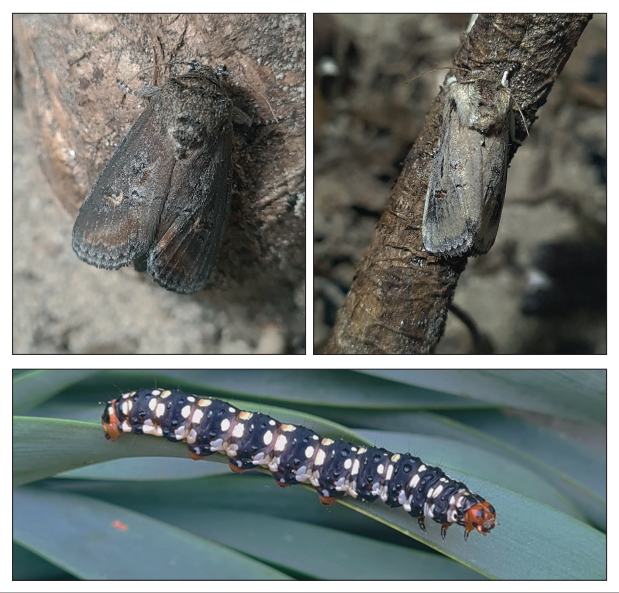
Brithys encausta (Hübner, [1808]) was reported to feed on other bulbous plants including Narcissus tazetta L. by Valletta (1973), but larvae were never found naturally in gardens. This fact indicates that dispersal is through connected beaches where the foodplant grows and is not dependent on flying moths. Larvae collected from Comino produced both the dark and light forms of adults. All the previous records of Brithys encausta (Hübner, [1808]) from Malta were greyish brown. This colour may have favored the species to camouflage better on dry areas like the Maltese beaches. A dark or black specimen is more conspicuous and may have less chance of mimicking the environment. Black moths have a disadvantage in the light-colored sand and the black moths are easily hunted down by predators.
There are conflicting ideas about Brithys crini (Fabricius, 1775) and Brithys encausta (Hübner, [1808]) and its status as a taxon. Thirty larvae were collected from Comino and all produced moths from which three were light greyish brown like Brithys encausta (Hübner, [1808]) and twenty-seven of the black form Brithys crini (Fabricius, 1775). Specimens that have been previously recorded from the Maltese islands are of the greyish brown form. Valletta (1973) states that Brithys encausta (Hübner, [1808]) is a species known to occur in Sicily, but in later years, it was also reported in Greece. However, Zilli et al. (1992) consider Brithys encausta (Hübner, [1808]) to be a light-coloured form of Brithys crini pancratii (Cyrillo, 1787).
Research conducted by Fibiger & Hacker (2007) revealed that Brithys crini (Fabricius, 1775), is a highly variable species in terms of forewing colour and pattern intensity. The researchers noted that there were several colour forms of the moth that had been previously regarded as distinct species, but upon further analysis, it was determined that all these forms represented the same taxon. However, Leraut (2019) disagrees with Fibiger & Hacker (2007) that this is one variable taxon. Instead, based on his examination of the general habitus and genitalia, Leraut (2019) suggests that Brithys crini (Fabricius, 1775), B. pancratii (Cyrillo, 1787), and B. encausta (Hübner, [1808]) are in fact distinct species. He further suggests that the European taxa should be classified under the species names Brithys pancratii (type locality “Naples” in Italy) and Brithys encausta (Hübner, [1808]), (type locality “Europe”).
Sammut (2020) treats Brithys encausta (Hübner, [1808]) as a synonym of Brithys crini (Fabricius, 1775), and only mentions the latter species in his work. Given these conflicting opinions, further research and possibly DNA analysis would be necessary to definitively resolve the taxonomic status of this species.
MALTA, Comino, (36º0’58.95”N, 14º20’15.18”E), 18-II-2023, A. Catania, leg. Thirty larvae mostly in stage L5 were collected, all pupated and produced moths.
Larvae of Brithys crini (Fabricius, 1775) collected from Comino on the 18th of February were reared and pupated on the 4th of March. Moths emerged from the twenty fourth of March and pairings were noticed late at night. Egg laying took place on the leaf blades of Pancratium maritimum L. and on the sides of the rearing container but did not yet hatch until the time of writing this paper.
The authors would like to thank Dr. Antonio Vives for the Spanish translation.
* Autor para la correspondencia / Corresponding author: aldocatania47@gmail.com

