2024
52206
12102023
25122023

Altai State University, Rusia
Tomsk State University, Rusia
University of Sciences, Malí
University of Sciences, Malí
University of Sciences, Malí
Abstract: Nine species of Pterophoridae are recorded for the Republic of Mali. All species except Exelastis pumilio (Zeller, 1873) are recorded for the fauna of the country for the first time.
Keywords: Insecta, Lepidoptera, Pterophoridae, new records, Mali.
Resumen: Se han registrado nueve especies de Pterophoridae para la República de Malí. Todas las especies, excepto Exelastis pumilio (Zeller, 1873), se registran por primera vez en la fauna del país.
Palabras clave: Insecta, Lepidoptera, Pterophoridae, nuevos registros, Malí.
Artículos
The Pterophoridae fauna of Mali (Insecta: Lepidoptera)
La fauna de Pterophoridae de Malí (Insecta: Lepidoptera)
Received: 12 October 2023
Accepted: 25 December 2023
Published: 30 June 2024
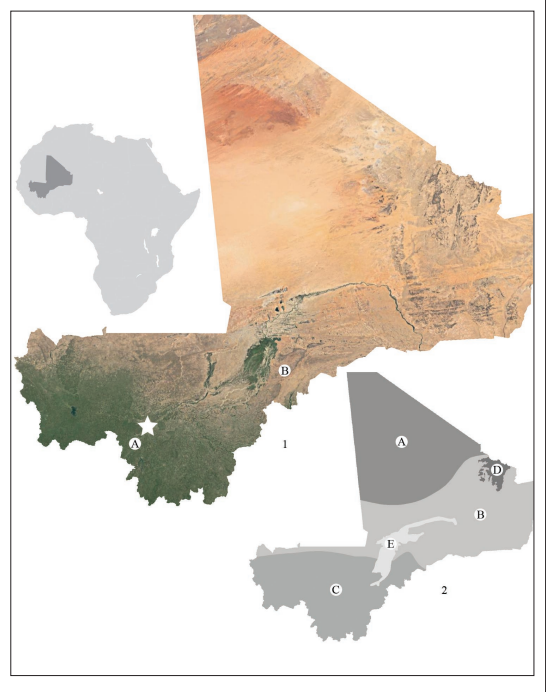
The Republic of Mali (Figure 1), with an area of 1.2 million square kilometers, is the second largest country in West Africa after Niger (UN, 2022). The territory of Mali is spread over 1600 km from north to south and includes five ecoregions (Figure 2; Dinerstein et al. 2017); the vast South Sahara Desert in the northern part of the country (Figure 2A), Sahelian Acacia savanna in the central part (Figure 2B), West Sudanian savanna in the southern part (Figure 2C), smaller West Saharan montane xeric woodlands in the north-eastern Kidal Region (Figure 2D), and inner Niger Delta flooded savanna in the central Mopti Region, which is along the River Niger (Figure 2E). Three seasons are distinguished: 1) a dry season from March to June with maximum day temperatures often exceeding 40º C, relative humidity slightly above 20% and almost no rainfall; 2) a rainy season from July to September with daily maximum temperatures exceeding 30º C, relative humidity above 70% and plenty of rain; and 3) an off-season from October to February with cooler nights (Nicholson 2018). Annual precipitation varies broadly from 100 mm and less in the north to 1500 mm in the extreme south, while the overall rainfall in the whole West Africa tending to decrease (Tano et al. 2023). Annual maximum day temperatures, above 30º C, tending to grow up from decade to decade caused by climate change (Sylla et al. 2016). Reduced rainfall and growing temperatures contribute to desertification spreading southwards from the Sahara Desert resulting in the steady decrease of fertile areas (Nicholson, 2000; Nicholson, 2001; Thomas & Nigam, 2018).
Mali with a fast-growing population, above 21 million people, is the fifth most populated country in West Africa after Nigeria, Ghana, Ivory Coast, and Niger (UN, 2022). Around 65% of the population lives in the rural areas and are involved in crop and livestock production, which represents around 35% of Gross Domestic Product (Wani et al. 2018). Forests near the villages are slowly replaced with fields as the forest wood is used for charcoal production (Morton, 2007) Agriculture areas expand over time to increase the ability to produce larger amounts of crops due to worsening climate conditions (Akumaga & Tarhule, 2018; Raza et al. 2019). This leads to a decrease of natural habitats and a loss of biodiversity.
No special insect biodiversity surveys have been conducted in Mali except for those devoted to the control of human disease vectors (e.g. Goodwin, 1982). The Pan African tsetse and trypanosomiasis eradication campaign in Mali reported only an unstated number of unidentified species from three Rhopalocera genera (Colias, Lycaena, Limenetis) collected between 2005 and 2013 (DNEF, 2014). Larsen stated that documented data on the Rhopalocera fauna of the country “would be helpful in determining the northern and western limits of certain species” (Larsen, 2005). Altogether 197 taxa of Heterocera (De Prins & De Prins, 2011-2023) were recorded for the country.
Fauna of the family Pterophoridae of some West African countries have been published: Republic of Côte d’Ivoire (Bigot, 1962, 1970; Bigot & Boireau, 2002, 2006), Ghana (Ustjuzhanin & Kovtunovich, 2015), Liberia (Ustjuzhanin et al. 2017), Sierra Leone (Ustjuzhanin et al. 2020), and Republic of Guinea (Ustjuzhanin et al., 2022a). While no species except for Exelastis pumilio (Zeller, 1873) was known from Mali (Gielis, 2003). Eight out of the nine forementioned species are reported for the first time for the fauna of Mali, none of them is new to science.
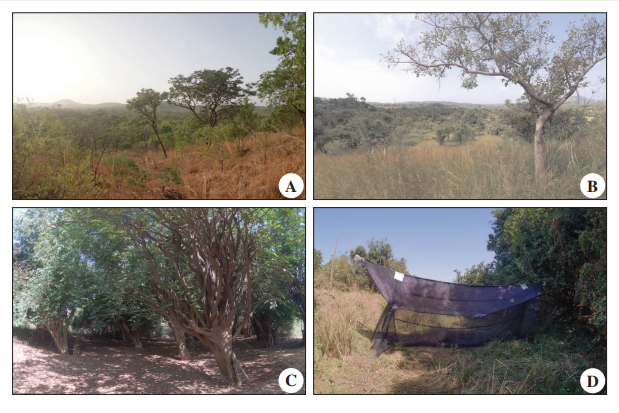
The material of the present study was obtained from by-catches from long-term malaria research conducted from 2008 to 2023 by the University of Sciences, Techniques, and Technologies of Bamako, Mali (USTTB). Adults were collected with Malaise traps, UV-CDC traps, and different types of larger UV traps (Kline et al. 2011; Sheikh et al. 2016) around the following localities: Kenieroba and Ouronina in the Koulikoro Region (Figures 1A, 3A-D), and Bandiagara on the Dogon Plateau (Figure 1B). The collected material was identified and stored partially in the first author’s collection and collection of the USTTB.
Deuterocopus socotranus Rebel, 190.
Deuterocopus socotranus Rebel, 1907. Lep. Sokotr., 85, fig. 3.
Type locality: W Socotra [YEMEN].
Material examined Mali, 80 km SW of Bamako, near Ouronina, N 12º6’, W 8º24’, 1 ♂, 1-5-IX2021, R. and L. Yakovlev, A. Prozorov leg.
Distribution: Yemen, Rep. S. Africa, Somalia, Malawi, Zambia, Zimbabwe, Mozambique, Ivory Coast, Democratic Republic of Congo, Ghana, Kenya, Namibia, Nigeria, Tanzania, Uganda (De Prins & De Prins, 2023), Ethiopia (Ustjuzhanin et al. 2022b); Oman, Japan, India, Sri Lanka, Thailand, Taiwan, Myanmar, Indonesia, New Guinea, Australia (De Prins & De Prins, 2023), Mali. New record for Mali.
Titanoptilus serrulatus Meyrick, 193.
Titanoptilus serrulatus Meyrick, 1935. Ex. Micr., 4, 55.
Type locality: Nigeria N, Azare.
Material examined: Mali, Ouronina Camp, N 12º6’, W 8º24’, 1 ♂, 10-30-IX-2015, Sáfián Sz. leg.; Mali, 80 km SW of Bamako, near Ouronina, N 12º6’, W 8º24’, 1 ♂, X-2022, the USTTB field team leg.
Distribution. Nigeria, Malawi (De Prins & De Prins, 2023), Mali. New record for Mali.
Stenoptilodes taprobanes (Felder & Rogenhofer, 1875.
Amblyptilia taprobanes Felder & Rogenhofer, 1875. Reise Novara, pl. 140, fig. 5.
Type locality: CEYLON, [SRI LANKA].
= Platyptilia brachymorpha Meyrick, 1888. Trans. ent. Soc. London, 1888(2), 24.
Type locality: Hawaii, [USA].
= Amblyptilia seeboldi Hofmann, 1898. D. ent. Zeit. Iris, 11(1), 3.
Type locality: Akbès, Syri.
= Platyptilia terlizzii Turati, 1926. Atti della Società Italiana di Scienze Naturali e del Museo Civico di Storia Naturale di Milano, 65(1), 6.
Type locality: Derna, Cyrenaica, [Libya].
= Amblyptilia zavatterii Hartig, 1953. Bollettino della Società entomologica italiana, 83, 6.
Type locality: Zannone Island, Italy.
= Platyptilia legrandi Bigot, 1962. Bull. Soc. ent. Fr., 67, 8.
Type locality: Mahé, Beau Vallo, SEYCHELLES.
= Stenoptilodes vittata Service, 1966. Proc. R. ent. Soc. Lond. (B), 35, 13.
Type locality: Anara, ca 14 miles NNE of Kaduna, N NIGERIA.
Material examined: Mali, Dogon Plateau, at light, 9 ex. XI-2010, V. Kravchenko leg; 80 km SW of Bamako, near Ouronina, N 12º6’, W 8º24’, 1 ♂, 01–05-IX-2021, R. & L. Yakovlev, A. Prozorov leg.; 80 km SW of Bamako, near Ouronina, N 12º6’, W 8º24’, 1 ♀, 18-IX-2021, the USTTB field team leg.; 80 km SW of Bamako, near Ouronina, N 12º6’, W 8º24’, 4 ex, X-2022, the USTTB field team leg.; Kangaba Distr., 25 km NW Kangaba, 100 km W Bamako, Mature deciduous Forest Savanah Mosaic, 1 ♀, IX-2012, the USTTB field team leg.
Distribution. Widespread throughout tropical and subtropical regions (Ustjuzhanin et al. 2022b). New species for Mali.
Megalorhipida leucodactylus (Fabricius, 1794.
Pterophorus leucodactylus Fabricius, 1794. Ent. syst., 3(2), 34.
Type locality: Americae meridionalis [VIRGIN ISLANDS].
= Pterophorus defectalis Walker, 1864. Cat. Lep. Het. B. M., 30, 94.
Type locality: SIERRA LEONE.
= Pterophorus congrualis Walker, 1864. Cat. Lep. Het. B. M., 30, 94.
Type locality: South Hindostan [INDIA].
= Pterophorus oxydactylus Walker, 1864. Cat. Lep. Het. B. M., 30, 94.
Type locality: Ceylon [SRI LANKA].
= Aciptilia hawaiiensis Butler, 1881. Ann. Mag. nat. Hist., (5)7, 40.
Type locality: Uoluolu, Maui, Hawaii Islands [USA].
= Trichoptilus ochrodactylus Fish, 1881. Can. Ent., 13, 14.
Type locality: Texas, USA.
= Trichoptilus centetes Meyrick, 1886. Trans. Ent. Soc. London, 1886, 1.
Type locality: Port Moresby, NEW GUINEA.
= Trichoptilus compsochares Meyrick, 1886. Trans. Ent. Soc. London, 1886, 1.
Type locality: St. Vicent, CAPE VERDE ISLANDS.
= Trichoptilus adelphodes Meyrick, 1887. Trans. Ent. Soc. London, 1887(3), 26.
Type locality: Carnarvon, AUSTRALIA.
= Trichoptilus ralumensis Pagenstecher, 1900. Zoologica, 29, 23.
Type locality: Ralum, BISMARCK ISLANDS.
= Trichoptilus derelictus Meyrick, 1926. Trans. Ent. Soc. London, 74, 27.
Type locality: Galapagos Islands ECUADOR.
= Megalorhipida palaestinensis Amsel, 1935. Mitt. Zool. Mus. Berlin, 20, 293, pl. 10, fig. 2.
Type locality: Palestine, Jerusalem [ISRAEL].
Material examined: Mali, Dogon Plateau, at light, 2 ♀, XI-2010, V. Kravchenko leg; Ouronina Camp, N 12º6’, W 8º24’, 1 ♂, 10-30-IX-2015, Sáfián Sz. leg.; 80 km SW of Bamako, near Ouronina, N 12º6’, W 8º24’, 1 ♂, 1 ♀, X-2022, the USTTB field team leg.
Distribution. Widespread throughout tropical and subtropical regions. (Ustjuzhanin et al. 2022). New species for Mali.
Prichotilus tara Ustjuzhanin & Kovtunovich, 201.
Prichotilus tara Ustjuzhanin & Kovtunovich, 2011. Amurian Zool. J., 3(4), 358-359, pl. .
Type locality: Uzuzu Hill, Manizimu Forest Reserve, 25 km E of Mangochi, Mangochi District, MALAWI.
=Prichotilus tanzanicus Gielis, 2011. Bol. Soc. Entom. Aragon., 49, 33-63, 49-50, figs 23, 4.
Type locality: Kibirizi, Kigoma District, TANZANIA.
Material examined: Mali, 80 km SW of Bamako, near Ouronina, N 12º6’, W 8º24’, 1 ♂, 18- IX2022, R. and L. Yakovlev, A. Prozorov leg.; Kangaba Distr., 25 km NW Kangaba, 100 km W Bamako, Mature deciduous Forest Savanah Mosaic, 1 ♂, IX-2012, the USTTB field team leg.; 80 km SW of Bamako, near Ouronina, N 12º6’, W 8º24’, 1 ♂, X-2022, the USTTB field team leg.
Distribution: Malawi, Tanzania (Kovtunovich et al. 2014), Mali. New species for Mali.
Sphenarches anisodactylus (Walker, 1864.
Oxyptilus anisodactylus Walker, 1864. Cat. Lep. Het. B. M., 30, 93.
Type locality: SRI LANKA.
=Pterophorus diffusalis Walker, 1864. Cat. Lep. Het. B. M., 30, 94.
Type locality: AUSTRALIA.
=Sphenarches synophrys Meyrick, 1886. Trans. Ent. Soc. London, 1886(1), 2.
Type locality: NEW HEBRIDES.
Platyptilia pygmaeana Strand, 1913. Archiv für Naturgeschichte, 78(A) (1912) (12), 30-84, pls 1-.
Type locality: Benitogebiet [EQUATORIAL GUINEA].
= Sphenarches chroesus Strand, 1913. Archiv für Naturgeschichte, 78(A) (12), 6.
Type locality: Alén, Benitogebiet, [Equatorial Guinea].
= Megalorhipida rishwani Makhan, 1994. SHILAP Revista de lepidopterología, 22, 35.
Type locality: SURINAME.
Material examined: Mali, 80 km SW of Bamako, near Ouronina, N 12º6’, W 8º24’, 1 ♂, 1 ♀, X2022, the USTTB field team leg.
Distribution: Nepal, Japan, China, Sri Lanka, India, Taiwan, Thailand, Cambodia, Vietnam, Malaysia, Indonesia, Solomon Islands, New Guinea, Bismarck Islands, Australia, Cameroun, Seychelles, Reunion Island, Madagascar, Kenya, Tanzania, Zaire, Gambia, Guinea, Nigeria, Tchad, Malawi, Swaziland, Cote d’Ivoire, Ghana, USA, Brazil, Dominica, Grenada, Panama, Virgin Islands, Bahamas, St. Thomas, Puerto Rico, Peru, Paraguay, Fiji Islands, New Hebrides, Tonga Islands, New Caledonia, Palau, Bonin Island, Guam (De Prins & De Prins, 2023), Mali. New record for Mali.
Exelastis pumilio (Zeller, 1873.
Mimeseoptilus pumilio Zeller, 1873. Verh. zool.-bot. Ges. Wien, 23, 32.
Type locality: Dallas, Texas, USA.
= Marasmarcha liophanes Meyrick, 1886. Trans. ent. Soc. Lond., 1886, 1.
Type locality: Saint-Denis, RÉUNION ISLAND [FRANCE].
= Mimaesoptilus gilvidorsis Hedemann, 1896 nec Zeller, 1877. Stettin. ent. Ztg., 57, .
Type locality: St. Croix, VIRGIN ISLANDS [USA].
Material examined: Mali, Dogon Plateau, at light, 2 ♂, 2 ♀, XI-2010, V. Kravchenko; Ouronina Camp, N 12º6’, W 8º24’, 9 ex., 10-30-IX-2015, Sáfián Sz. leg; 80 km SW of Bamako, near Ouronina, N 12º6’, W 8º24’, 9 ex., 18-IX-2021, R. and L. Yakovlev, A. Prozorov leg.; 80 km SW of Bamako, near Ouronina, N 12º6’, W 8º24’, 349 ex., IX-X-2022, the USTTB field team leg.; Kangaba Distr., 25 km NW Kangaba, 100 km W Bamako, Mature deciduous Forest Savanah Mosaic, 13 ex., IX-2012, the USTTB field team leg.
Distribution: Chad, The Gambia, Tanzania, Mali, Zimbabwe, Eswatini, Rep. S. Africa, Seychelles, Reunion Island, Madagascar, Nigeria, Kenya (DE PRINS & DE PRINS, 2020), Sierra Leone; Nepal, Cambodia, Myanmar, Philippines, New Guinea; USA, Argentina, Brazil, Ecuador, Bolivia, Colombia, Suriname, Costa Rica, Cuba, Puerto Rico, Guadeloupe, Mexico, Jamaica, Virgin Islands, Fatu-Hiva, Guam, Palau (Ustjuzhanin et al. 2019).
Hellinsia aethiopicus (Amsel, 1963.
Leioptilus aethiopicus Amsel, 1963. Stuttgart. Beitr. Naturk., 121, 6, pl. 3, fig. 4.
Type locality: Gembi, ETHIOPIA.
Material examined: MALI, Dogon Plateau, at light, 1 ♂, XI-2010, V. Kravchenko.
Distribution: Democratic Republic of the Congo, Ethiopia, Ghana, Nigeria, South Africa (De Prins & De Prins, 2023), Mali. New record for Mali.
Hellinsia namizimuKovtunovich & Ustjuzhanin, 2014
Hellinsia namizimuKovtunovich & Ustjuzhanin, 2014. Zootaxa, 3847(4), 451-494, figs 45-4.
Type locality: Mutinondo, ZAMBIA.
Material examined: Mali, 80 km SW of Bamako, near Ouronina, N 12º6’, W 8º24’, 2 ♂, 1 ♀, X2022, the USTTB field team leg.
Distribution: Zambia, Malawi (De Prins & De Prins, 2023), Mali. New species for Mali.
We are grateful to the late Prof. Dr. Vasiliy D. Kravchenko (Tel Aviv University, Israel / USTTB, Bamako, Mali) for his dedicated entomological work in Mali: operating trapping systems, training local entomologists, and taking care of the collected material in harsh conditions. We are thankful to the USTTB which allowed us to use their field station near Ouronina, numerous village councils that approved our activities, and citizens of the surrounding villages that kindly tolerated our activities in their land.
* Autor para la correspondencia / Corresponding author: petrust@mail.ru
