Artículos
Zygaena Fabricius, 1775 images in Russian masterpieces of the 19th and 20th centuries (Lepidoptera: Zygaenidae)
Imágenes de Zygaena Fabricius, 1775 en obras maestras rusas de los siglos 19 y 20 (Lepidoptera: Zygaenidae)
 Gerhard M. Tarmann g.tarmann@tiroler-landesmuseen.at
Zygaena Fabricius, 1775 images in Russian masterpieces of the 19th and 20th centuries (Lepidoptera: Zygaenidae)
Shilap Revista de Lepidopterología, vol. 52, no. 208, pp. 683-689, 2024
Sociedad Hispano-Luso-Americana de Lepidopterología
Received: 12 February 2024
Accepted: 04 March 2024
Published: 30 December 2024
Abstract: Two realistic Zygaena Fabricius, 1775 images were found by the first author in the paintings of two Russian artists Vasily D. Polenov and Arkady A. Plastov representing Zygaena lonicerae (Scheven, 1777) and Zygaena ephialtes (Linnaeus, 1767) (red peucedanoid morph) respectively. Polenov also depicted Amata nigricornis (Alphéraky, 1883) with some characters of the red ephialtoid morph of Zygaena ephialtes.
Keywords: Lepidoptera, Zygaenidae, Zygaena lonicerae, Zygaena ephialtes, Amata nigricornis, Vasily Polenov, Arkady Plastov, Russian paintings.
Resumen: El primer autor encontró dos imágenes realistas de Zygaena Fabricius, 1775 en los cuadros de dos artistas rusos, Vasily D. Polenov y Arkady A. Plastov, que representaban respectivamente a Zygaena lonicerae (Scheven, 1777) y Zygaena ephialtes (Linnaeus, 1767) (morfo peucedanoide roja). Polenov también representó a Amatanigricornis (Alphéraky, 1883) con algunos caracteres del morfo efialtoide rojo de Zygaena ephialtes.
Palabras clave: Lepidoptera, Zygaenidae, Zygaena lonicerae, Zygaena ephialtes, Amata nigricornis, Vasily Polenov, Arkady Plastov, pinturas rusas.
Introduction
The article continues the authors’ series of zygaenological publications (e.g. Can Cengiz et al. 2018; Efetov et al. 2015a, 2015b, 2018; Efetov & Tarmann, 2016; Razov et al. 2017; Subchev et al. 2016). This paper is the next step in the works dealing with Zygaenidae in art (Efetov & Tarmann, 2008, 2024; Nazari & Efetov, 2023) and is devoted to Zygaena images in two Russian masterpieces of the 19th and 20th century.
Results and discussion
Vasily Dmitrievich Polenov (1844-1927) was a famous Russian painter of the Realistic style. His contemporaries called him the “Knight of Beauty” as he combined the best traditions both of western European and Russian painting. His vision of life was that art should promote happiness and joy. In the 1870s he produced a small painting (etude, oil on canvas on cardboard, size 40.7 x 24.0 cm) entitled “Babochki” [Lepidoptera] ( Figure 1). This work was painted in the Olshanka estate, Tambov Province and shows the collection of insects that belonged to the artist’s uncle L. A. Voeykov. Now this etude is deposited in the Museum Estate of Vasily Polenov, Polenovo (Tula Region, Russia).
![A painting byVasily D. Polenov entitled “Babochki” [Lepidoptera] (1870s) from the Museum Estate of Vasily Polenov, Polenovo (Tula Region, Russia).](../0300-5267-shilap-52-208-683-gf2.png)
Figure 1.
A painting byVasily D. Polenov entitled “Babochki” [Lepidoptera] (1870s) from the Museum Estate of Vasily Polenov, Polenovo (Tula Region, Russia).
The painting ( Figure 1) shows a collection of insects mainly consisting of Lepidoptera but also Coleoptera, Hemiptera, Hymenoptera, and Diptera. The Lepidoptera are represented by 10 families, viz. Zygaenidae (one specimen), Papilionidae (two specimens), Pieridae (seven specimens), Nymphalidae (six specimens), Lycaenidae (five specimens), Sphingidae (four specimens), Erebidae (three specimens: two Arctiini, one Synthomini), Noctuidae (one specimen), Pterophoridae (one specimen), and Adelidae (one specimen).
The image of Zygaena ( Figure 2) represents undoubtedly a specimen of Zygaena lonicerae (Scheven, 1777) (Zygaenidae, Zygaeninae, Zygaenini) ( Figure 3), a species well-known from the central part of European Russia. Much more interesting is the image ( Figure 4) of Amata nigricornis (Alphéraky, 1883) (Erebidae, Arctiinae, Synthomini). This species has in nature only a yellow pattern on abdomen, but Polenov made it red in his picture. For the authors it is clear that the artist has mixed the habitus of two similar moths, viz. Amata nigricornis ( Figure 5) and the red ephialtoid morph of Zygaena ephialtes (Linnaeus, 1767) ( Figure 6).
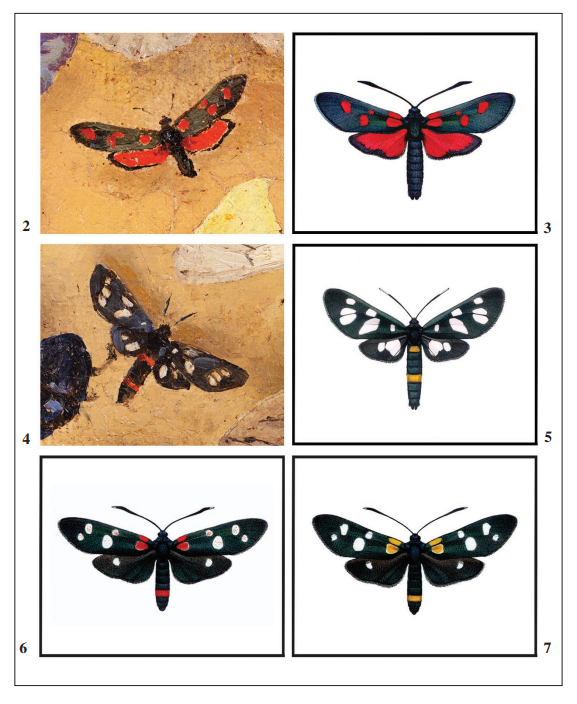
Figures 2-7.
2. A detail of the painting by Vasily D. Polenov entitled “Babochki” with the image of Zygaena lonicerae (Scheven, 1777). 3. Zygaena lonicerae (Scheven, 1777) (ex Efetov, 2005). 4. A detail of the painting be Vasily D. Polenov entitled “Babochki” with the image of Amata nigricornis (Alphéraky, 1883) demonstrating red colour on abdomen as in red, ephialtoid Zygaena ephialtes (Linnaeus, 1767). 5.Amata nigricornis (Alphéraky, 1883) (ex Efetov, 2005). 6.Zygaena ephialtes (Linnaeus, 1767) morph ephialtes (6- spotted, red, ephialtoid) (ex Efetov, 2005). 7.Zygaena ephialtes (Linnaeus, 1767) morph coronillae (6-spotted, yellow, ephialtoid) (ex Efetov, 2005).
The resemblance between the representatives of two different and phylogenetic distant families, Zygaena ephialtes (Zygaenidae) ( Figures 6-7) and Amata nigricornis (Erebidae) ( Figure 5), is the result of Müllerian mimicry. Moths of both species contain toxic compounds ( Z. ephialtes - cyanoglucosides, A. nigricornis - pyrrolizidine alkaloids). A. nigricornis begins its flight period earlier than Z. ephialtes. The latter species is not so common as the first one. Insectivorous birds that have experienced the distastefulness of A. nigricornis will not attack Z. ephialtes that is flying later in the year. That is why these two species are so similar in habitus. The artist who was not an experienced entomologist fell into the same trap as the birds. Zygaena ephialtes can have a yellow or red abdominal belt (cingulum) (Figures 6-7, 10) while in Amata nigricornis the cingulum and the dorsal abdominal spot can be only yellow ( Figure 5).
Another famous Russian and Soviet painter was Arkady Aleksandrovich Plastov (1893-1972) who worked in Socrealism (Socialist realism) style. One of his large masterpieces with the name “Haymaking” was created in 1945 (oil on canvas, size 198 x 293 cm) and is deposited now in The State Tretyakov Gallery (Moscow) under the Inv. No. 27649 ( Figure 8). This painting was made in the artist’s native village Prislonikha in the Ulyanovsk Region (approximately 60 km west of the Volga River) and very precisely shows nature from botanical and zoological points of view. Among the insects presented in the painting the first author found in 2019 five Lepidoptera images. Four butterflies, viz. Aglais urticae (Linnaeus, 1758) (Nymphalidae), Argynnis sp. (most probably A. paphia (Linnaeus, 1758)) (Nymphalidae), two males of Pieris brassicae (Linnaeus, 1758) (Pieridae), and one moth, viz. Zygaena ephialtes (Linnaeus, 1767) (Zygaenidae). This Z. ephialtes ( Figure 9) represents the red five-spotted peucedanoid morph (forma athamanthae) of this polymorphic species. Zygaena ephialtes is known from the region of Volga (Efetov, 1998a, 1998b) and the red peucedanoid morph has been reported from the middle Volga by Holik & Sheljuzkho (1958). However, Plastov also fell into the same trap as Polenov and mixed the characters of Zygaena and Amata. Zygaena ephialtes has one abdominal belt (cingulum) while in Amata there is an additional dorsal abdominal spot at the beginning of the abdomen ( Figure 5). Plastov even showed two belts and one dorsal spot on his painted specimen.
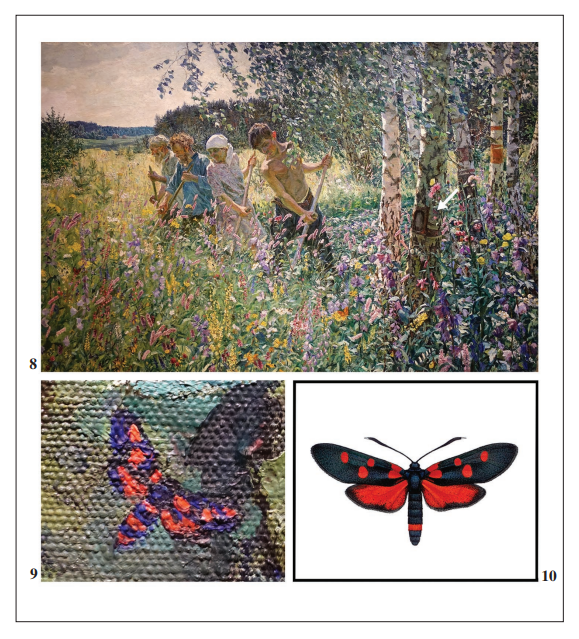
Figures 8-10.
8. A painting by Arkady A. Plastov entitled “Haymaking” (1945) from the The State Tretyakov Gallery (Moscow, Russia). Arrow shows the position of Zygaena image.9.A detail of the painting by Arkady A. Plastov entitled “Haymaking” with the image of Zygaena ephialtes (Linnaeus, 1767) having the abdomen with characters of Amata nigricornis (Alphéraky, 1883). 10.Zygaena ephialtes (Linnaeus, 1767) morph athamanthae (5-spotted, red, peucedanoid) (ex Efetov, 2005).
Conclusions
- 1. V. Polenov on his painting “Babochki” [Lepidoptera] showed a local collection of insects from the Tambov Region (Russia) with Zygaena lonicerae and Amata nigricornis (the latter with some characters of the red ephialtoid morph of Zygaena ephialtes).
- 2. A. Plastov on his painting “Haymaking” realistically showed a piece of nature from the Ulyanovsk Region (Russia) with the red peucedanoid morph of Zygaena ephialtes, which has some characters of Amata nigricornis.
Acknowledgments
The authors want to express their thanks to Mr Mikhail S. Efetov (Moscow, Russia) and Dr Sergey K. Efetov (Moscow, Russia) for their assistance in searching Lepidoptera images in The State Tretyakov Gallery (Moscow). We are also indebted to Dr Elena E. Kashtanova and Dr Nadezhda V. Petrenko (Museum Estate of Vasily Polenov, Polenovo, Tula Region, Russia) for high quality photographs of Polenov’s painting and important information, to Dr Jakov V. Bruk (Moscow, Russia) for fruitful discussions, and last but not least to Dr Adrian Spalding (Truro, Great Britain) for editing the English text.
References
Can Cengiz, F., Efetov, K. A., Kaya, K., Kucherenko, E. E., Okyar, Z., & Tarmann, G. M. (2018). Zygaenidae (Lepidoptera) of Thrace Region of Turkey. Nota lepidopterologica, 41(1), 23-36. https://doi.org/10.3897/nl.41.21065
Efetov, K. A. (1998a). A review of the Zygaenidae (Lepidoptera) of Volga region: II. Subfamily Zygaeninae. Problems of entomology in Russia (Vol. I). Zoological Institute RAS.
Efetov, K. A. (1998b). Fauna of the Zygaenidae (Lepidoptera) of Volga region. Problems of entomology of European Russia and adjacent territories. Samara University.
Efetov, K. A. (2005). The Zygaenidae (Lepidoptera) of the Crimea and other regions of Eurasia. CSMU Press.
Efetov, K. A., Koshio, C., & Kucherenko, E. E. (2018). A new synthetic sex attractant for males of Illiberis .Primilliberis. pruni Dyar, 1905 (Lepidoptera: Zygaenidae, Procridinae). S HILAP Revista de lepidopterología, 46(182), 263-270. https://doi.org/10.57065/shilap.817
Efetov, K. A., Parshkova, E. V., Tarasova, L. G., & Tarmann, G. M. (2015a). The karyotypes of Procridinae (Lepidoptera: Zygaenidae), with the first record of the karyotype of Pollanisus commoni Tarmann, 2004, a representative of the tribe Artonini. Entomologist’s Gazette, 66(2), 121-125.
Efetov, K. A., & Tarmann, G. M. (2008). Van Schrieck’s burnet moth - an image of a Zygaena species (Lepidoptera: Zygaenidae) a century before Linnaeus. Entomologist’s Gazette, 59(1), 62-64.
Efetov, K. A., & Tarmann, G. M. (2016). Pseudophacusa multidentata Efetov & Tarmann, a new genus and species of Procridini from Myanmar, China, and Laos (Lepidoptera: Zygaenidae, Procridinae). SHILAP Revista de lepidopterología, 44(173), 81-89.
Efetov, K. A., & Tarmann, G. M. (2024). The secret of ancient images of Lepidoptera in the Egyptian tomb of Nakht - Nabokov’s opinion and the contemporary view. SHILAP Revista de lepidopterología, 52(206), 389-390.
Efetov, K. A., Tarmann, G. M., Toshova, T. B., & Subchev, M. A. (2015b). Enantiomers of 2-butyl 7.-dodecenoate are sex attractants for males of Adscita mannii (Lederer, 1853), A. geryon (Hübner, 1813), and Jordanita notata (Zeller, 1847) (Lepidoptera: Zygaenidae, Procridinae) in Italy. Nota lepidopterologica, 38(2), 161-169. https://doi.org/10.3897/nl.38.6312
Holik O., & Sheljuzkho L. (1958). Über die Zygaenen-Fauna Osteuropas, Kleinasiens, Irans, Zentralasiens und Sibiriens. Mitteilungen der Münchner Entomologischen Gesellschaft, 48, 166-285.
Nazari, V., & Efetov K. A. (2023). Zygaenidae on stamps (Insecta: Lepidoptera). SHILAP Revista de lepidopterología, 51(202), 327-337. https://doi.org/10.57065/shilap.465
Razov, J., Efetov, K. A., Franin, K., Toshova, T. B., & Subchev M. A. (2017). The application of sex pheromone traps for recording the Procridinae fauna (Lepidoptera: Zygaenidae) in Croatia. Entomologist’s Gazette, 68(1), 49-53.
Subchev, M. A., Efetov, K. A., Toshova, T. B., & Koshio, C. (2016). Sex pheromones as isolating mechanisms in two closely related Illiberis species - I. .Primilliberis. rotundata Jordan, 1907, and I. .P.. pruni Dyar, 1905 (Lepidoptera: Zygaenidae, Procridinae). Entomologist’s Gazette, 67(1), 51-57.
Author notes
a Autor para correspondencia: shysh1981@mail.ru