Artículos
Molecular identification of newly recorded Lepidoptera for Cyprus and Europe (Insecta: Lepidoptera)
Identificación molecular de Lepidoptera recién registrados para Chipre y Europa (Insecta: Lepidoptera)
 Özge Özden ozge.ozden@neu.edu.tr
Molecular identification of newly recorded Lepidoptera for Cyprus and Europe (Insecta: Lepidoptera)
Shilap Revista de Lepidopterología, vol. 52, no. 208, pp. 691-700, 2024
Sociedad Hispano-Luso-Americana de Lepidopterología
Received: 20 December 2023
Accepted: 07 March 2024
Published: 30 December 2024
Abstract: As part of a comprehensive molecular inventory of Lepidoptera in Northern Cyprus, 8 species have been identified as new records for the island of Cyprus through genetic comparisons of DNA barcodes with reference sequences. The following species are formally reported for the first time in Europe: Coleophora bivittella Staudinger, 1879 (Coleophoridae) and Teliphasa lophotalis (Hampson, 1900) (Pyralidae), whereas the agriculturally significant species Spodoptera frugiperda (Smith, 1797) (Noctuidae) was only published from the Canary Islands (Spain) and from Malta so far. The possibilities and limitations of molecular-based determinations are briefly discussed using the example of the fauna of north Cyprus.
Keywords: Insecta, Lepidoptera, DNA barcoding, Coleophora bivittella, Anarsia acaciae, Teliphasa lophotalis, Spodoptera frugiperda, new records, Cyprus, Europe.
Resumen: Como parte de un inventario molecular exhaustivo de Lepidoptera en el norte de Chipre, se han identificado 8 especies como nuevos registros para la isla de Chipre mediante comparaciones genéticas de códigos de barras de ADN con secuencias de referencia. Las siguientes especies se citan oficialmente por primera vez en Europa: Coleophora bivittella Staudinger, 1879 (Coleophoridae) y Teliphasa lophotalis (Hampson, 1900) (Pyralidae), mientras que la especie de importancia agrícola Spodoptera frugiperda (Smith, 1797) (Noctuidae) sólo se había publicado de las Islas Canarias (España) y ede Malta hasta ahora. Las posibilidades y limitaciones de las determinaciones de base molecular se discuten brevemente utilizando el ejemplo de la fauna del norte de Chipre.
Palabras clave: Insecta, Lepidoptera, ADN código de barras, Coleophora bivittella, Anarsia acaciae, Teliphasa lophotalis, Spodoptera frugiperda, nuevos registros, Chipre, Europa.
Introduction
The Lepidoptera fauna of Cyprus has drawn the attention of European experts since early times ( Lederer, 1855; Rebel, 1939; Wiltshire, 1948). Even in recent history, the island has been visited by numerous lepidopterologists, and several comprehensive publications, especially on Microlepidoptera, have been released ( Arenberger, 1994; Gozmány, 2012), continually supplemented in subsequent years (Arenberger & Wimmer, 1996, 1999, 2003; Barton, 2015, 2018). However, among the so-called Macrolepidoptera, only specific groups such as butterflies ( John & Makris, 2023) or Geometridae ( Fischer & Lewandowski, 2010) have been addressed in modern faunistic studies. Nevertheless, Cyprus remains one of the few European countries without a checklist of its lepidopteran fauna. This may be due, on the one hand, to the controversial biogeographic assignment of the island to Europe and the resulting lack of consideration in major catalog works such as Karsholt & Razowski (1996) or more recently Top et al. (2023). On the other hand, it may also be attributed to the lack of local faunistic expertise. A reasonably complete online version of the Fauna Europaea with nearly 900 species is considered in need of revision ( Karsholt & Nieukerken, 2013).
While the faunistic inventory of species in the southern part of the island is now largely complete, deficiencies in northern part of Cyprus are significant. A striking example of these gaps is evident in the recent revision of the family Psychidae by Weidlich (2015), with not a single recorded location in the northern part. Especially due to the island’s division in 1974 and resulting restrictions, the northern part has been explored by very few lepidopterologists from Europe or Turkey ( Ahola, 1998; Atay & Oğur, 2011; Can Doğanlar & Arap, 2005; Fibiger, 1997), and data on illegally collected specimens remain hidden in various collections.
As part of a collaboration initiated in September 2023 between Near East University (Nicosia, north Cyprus) and the Tyrolean State Museums (Innsbruck, Austria), the significant faunistic research deficit is intended to be addressed through intensive sampling and the use of molecular identification methods (DNA barcoding). The ultimate goal is to establish a molecular reference database and based on that, create an annotated checklist of the fauna of Cyprus. New findings from an initial survey phase are presented here.
Material and Methods
Material was collected with ultraviolet light (15W/12V tubes) illuminating a gauze tower, and portable light traps or other devices in a two-week survey period lasting from 6 th to 21 st of September 2023. All samples were immediately pinned after euthanasia with ethyl acetate, spread, and dried to ensure high DNA quality. After full labelling of samples and morphology based macroscopic identification of undisputed species, object data were digitized using BioOffice2 software. A single specimen at minimum of all presumed morphospecies was selected for further molecular analysis, covering altogether 344 specimens. Tissue samples of these specimens (a single leg) were finally transferred to well plates containing 99% ethanol, with each plate holding 95 samples, and sent to the Canadian Centre for DNA Barcoding (CCDB, University of Guelph, Ontario, Canada). DNA isolation, PCR amplification, and subsequent DNA sequencing of the mitochondrial Cytochrome C Oxidase I (COI, Barcode fragment 5’) were carried out at CCDB following the standard protocols described by deWaard et al. (2008). For all samples, after successful sequencing, DNA barcodes were compared with reference sequences in BOLD (Barcode of Life Data Systems) ( Ratnasingham & Hebert, 2007). In further steps, potential new records for Cyprus were identified from the aforementioned literature sources and Lepiforum e.V. (2008-2021) and Karsholt & Nieukerken (2013). Subsequently, 8 noteworthy new records for Cyprus were selected and further analyzed. All collection data of the analyzed 78 specimens, including images, and their genetic sequences can be found in the public dataset DS-NEWLECYP “New records of Lepidoptera for Cyprus” on BOLD. Voucher material is preserved in the Natural History Collections of the Tyrolean State Museum Ferdinandeum (Austria).
For each new record a Neighbor Joining Tree was constructed based on the Kimura-2-Parameter model (K2P) and using the MEGA11 software ( Tamura et al. 2021). Focal species were compared with the most similar 2-3 congeneric species in BOLD, usually based on Barcode Index numbers (BINs) ( Ratnasingham & Hebert, 2013).
Pinned voucher specimens were photographed using a Canon 750D camera in combination with a Canon MP-E-65 mm lens. For each photograph, sets of 50-60 images were taken at different focal planes and focus-stacked using Helicon Focus 6. The final images were edited in Adobe Photoshop. attached to 188 taxa identifiable at the species level and approximately 60 barcode clusters that currently cannot be assigned to any known species.
Below, 8 selected taxa of particular faunistic significance are presented. The discussions of these species include specific collection data, DNA barcode IDs (specimen ID), and, where applicable, taxonomic and/or faunistic comments. Only specimens with DNA barcodes are taken into consideration
Cedestis civitatensisNel & Varenne, 2015 (Yponomeutidae) ( Figure 1) Records: CYPRUS, Kyrenia/Girne, Lapta, Selvili tepe, 890 m, 35.316ºN, 33.168ºE, 14-IX-2023, leg. Huemer, DNA Barcode IDs TLMF_Lep_39180, TLMF_Lep_39181.
Remarks: Two barcoded specimens from Spain, one incorrectly identified as Elachista sp. (DNA Barcode ID MM19987, BIN: BOLD:AAZ9164), cluster next to C. civitatensis at a p-distance of 3.25% and likely belong to a possibly undescribed species of Cedestis. Cedestis civitatensis was hitherto only known from two type specimens colected in France nearby Pinus halepensis ( Nel & Varenne, 2015), a tree also well present at Selvili tepe in north Cyprus and indicating a much more widespread distibution pattern. New record for Cyprus.
Coleophora bivittella Staudinger, 1879 (Coleophoridae) ( Figure 2) Record: CYPRUS, Iskele, Bafra/Vokolida, Thalassa Beach, 6 m, 35.33ºN, 34.065ºE, 6-IX-2023, leg. Huemer, DNA Barcode ID TLMF_Lep_38989.
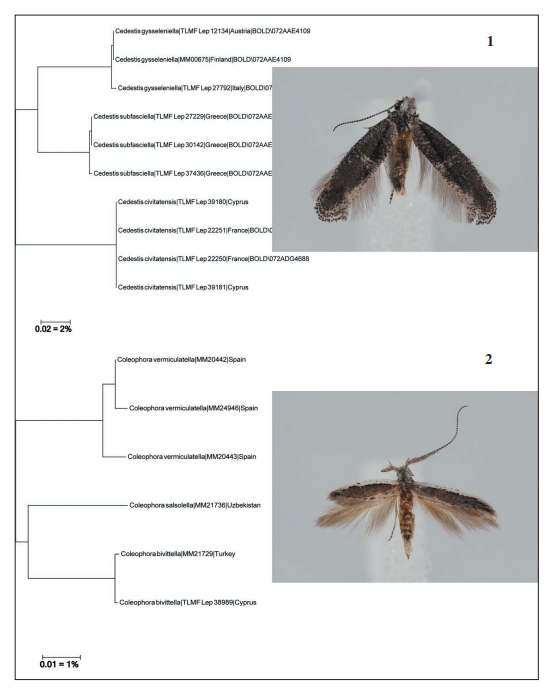
Figs 1-2.
Neighbour-Joining tree and adult. 1.Cedestis civitatensis Nel & Varenne. 2.Coleophora bivittella Staudinger
Remarks: Originally described from southern Turkey, furthermore, known from Iran ( Baldizzone, 1989). New record for Europe.
Scrobipalpa geomicta (Meyrick, 1921) (Gelechiidae) ( Figure 3) Records: CYPRUS, Iskele, Bafra/Vokolida, Thalassa Beach, 4 m, 35.331ºN, 34.068ºE, 8-IX-2023, leg. Huemer, DNA Barcode IDs TLMF_Lep_39040, TLMF_Lep_39058, TLMF_Lep_39061.
Remarks: In Europe so far only known from Spain and Greece (Crete) ( Huemer & Karsholt, 2010; Karsholt & Huemer, 2017). New record for Cyprus.
Ephysteris iberica Povolnx, 1977 (Gelechiidae) ( Figure 4) Records: CYPRUS, Iskele, Bafra/Vokolida, Thalassa Beach, 4 m, 35.331ºN, 34.068ºE, 8-IX-2023, leg. Huemer, DNA Barcode IDs TLMF_Lep_39057.
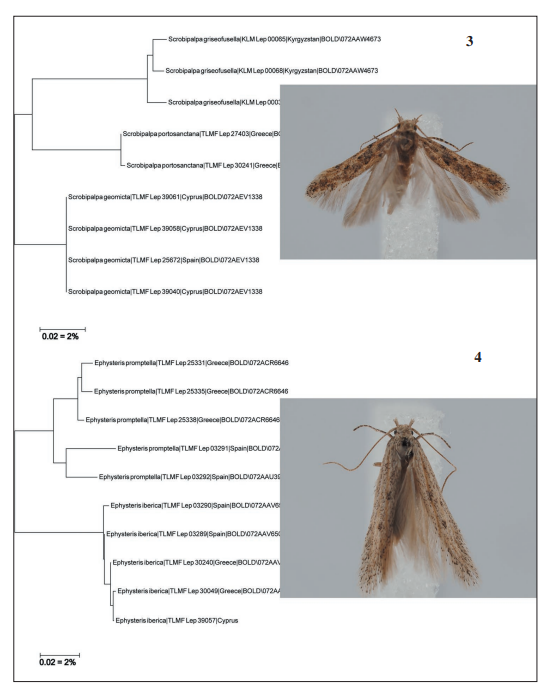
Figures 3-4.
Neighbour-Joining tree and adult. 3.Scrobipalpa geomicta (Meyrick). 4.Ephysteris iberica Povoln.
Remarks: The nearest neighbor, Ephysteris promptella (Staudinger, 1859), shows a considerable intraspecific variation of the DNA barcode which may be due to cryptic diversity. Sproadic distribution in the Mediterranean ( Huemer & Karsholt, 2010). New record for Cyprus.
Anarsia acaciae Walsingham, 1896 (Gelechiidae) ( Figure 5) Records: CYPRUS, Iskele, Bafra/Vokolida, Thalassa Beach, 6 m, 35.33ºN, 34.065ºE, 6-IX-2023, leg. Huemer, DNA Barcode ID TLMF_Lep_38961; Cyprus, Iskele, Bafra/Vokolida, Thalassa Beach, 4 m, 35.331ºN, 34.068ºE, 8-IX-2023, leg. Huemer, DNA Barcode ID TLMF_Lep_39056.
Remarks: The identification is based on a barcoded specimen from Morocco, identified by O. Karsholt. It was already collected in Cyprus and identified as Anarsia nr. acaciae by I. Barton (BOLD). Furthermore, long series of DNA barcoded specimens of a yet unidentified Anarsia sp. from Kenya and Tanzania in BOLD fully correspond with specimens from Cyprus. According to Bildzilya et al. (2019) unknown from Europe but published for the Continent by Huemer & Karsholt (2020) without any details New record for Cyprus.
Stenoptilia aridus (Zeller, 1847) (Pterophoridae) ( Figure 6) Records: CYPRUS, Kyrenia/Girne, Yilgaz E, 280 m, 35.322ºN, 33.227ºE, 11-IX-2023, leg. Huemer, DNA Barcode ID TLMF_Lep_39161.
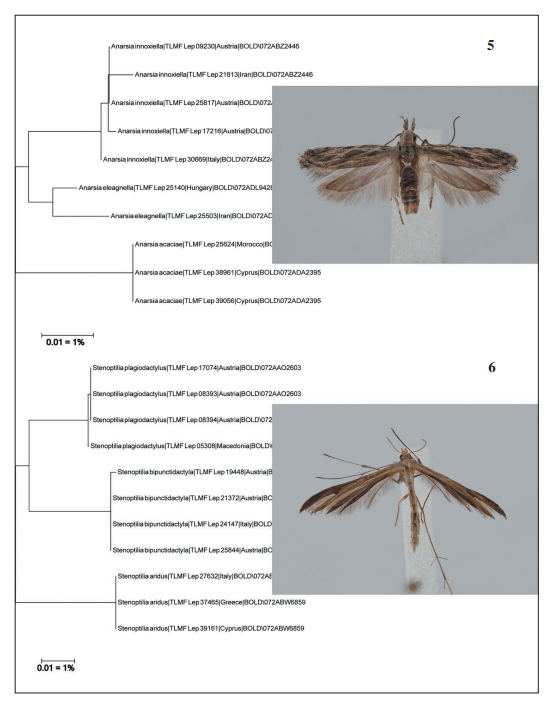
Figures 5-6.
Neighbour-Joining tree and adult. 5.Anarsia acaciae Walsingham. 6.Stenoptilia aridus (Zeller
Remarks: The species is absent from large parts of the Eastern Mediterranean but known from Turkey and Israel ( Lepiforum e.V., 2008-2021). New record for Cyprus.
Teliphasa lophotalis (Hampson, 1900) (Pyralidae) ( Figure 7) Record: CYPRUS, Kyrenia/Girne, Yilgaz, 225 m, 35.322ºN, 33.227ºE, 12-IX-2023, leg. Huemer, DNA Barcode ID TLMF_Lep_39075.
Remarks: The species was described from Turkey but is more widespread in the Middle East with records from Iran, Israel, and Lebanon ( Koçak, 1987). Unpublished records are available from Greece (Samos) ( Lepiforum e.V., 2008-2021) and a reference sequence from this country based on material collected by. D. Fritsch is used in the NJ tree. A small series of the species was collected in north Cyprus, clearly indicating a residential status. New record for Europe.
Spodoptera frugiperda (Smith, 1797) (Noctuidae) ( Figure 8) Records: CYPRUS, Iskele, Bafra/Vokolida, Thalassa Beach, 6 m, 35.33ºN, 34.065ºE, 6-IX-2023, leg. Huemer, DNA Barcode IDs TLMF_Lep_39219, TLMF_Lep_39220.
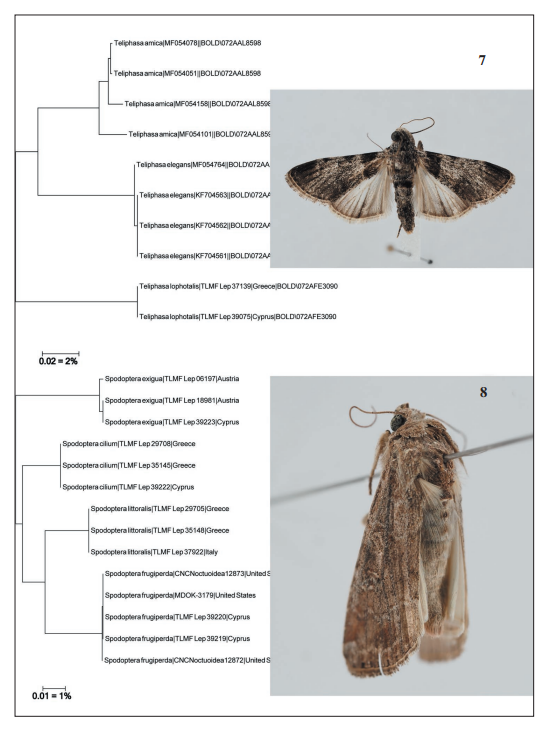
Figures 7-8.
Neighbour-Joining tree and adult. 7.Teliphasa lophotalis (Hampson). 8.Spodoptera frugiperda (Smith).
Remarks: The highly rapid spread of the fall armyworm, Spodoptera frugiperda, a species originally described in North America and introduced to West Africa in 2016, and now established in parts of Asia and Australia, is extensively documented by Lepiforum e.V. (2008-2021). In addition to a note of the discovery of the species in the Canary Islands ( Vives Moreno & Gastón, 2019), and from Malteses islands ( Seguna et al. 2024), three adult specimens from December 2022 in Cyprus (Souni Zanatzia, Limassol) are illustrated. Furthermore, EPPO (2023) reports on three additional specimens collected by a private collector in January 2023, also from the vicinity of Limassol (Pissouri village). Additional reports and measures are described as follows: “Official surveys were conducted, and the NPPO of Cyprus reported that a larva has been found in a maize ( Zea mays) crop in Larnaca district in June 2023, and multiple larvae in maize crops for animal feed in Nicosia district in July 2023. An infested area has been demarcated, as well as a buffer zone. Official measures are taken to eradicate the outbreaks. The pest status of Spodoptera frugiperda in Cyprus is officially declared as: Present, at low prevalence, only in some parts of the Member State concerned, under eradication.” However, our additional findings from Northern Cyprus suggest a significantly expanded colonisation, casting doubt on the success of measures already implemented. Confirmed record for Cyprus.
Discussion
For the first time ever, a significant number of species of Lepidoptera have been sampled in Northern Cyprus, comprising over 250 species. Equally unique is the consistent application of molecular identification methods, specifically DNA barcoding.
The success rate of approximately three-quarters of taxa identifiable at the species level may initially seem disappointing. However, it aligns with the extent of previous efforts for the complete sequencing of European Lepidoptera. Particularly from Mediterranean regions, many so-called “gap species” are known, lacking reference sequences in large databases like BOLD ( Huemer & Mutanen, 2022). Nevertheless, it is already assured that the well over 60 currently unidentified barcode clusters from Northern Cyprus include a multitude of taxonomic challenges and further faunistic discoveries for Cyprus and even Europe. Even in morphologically identified samples, remarkable findings exist, although they are here not considered due to the absence of comparative sequences. Examples include Choreutis sexfasciella (Sauber, 1902) which is a previously unpublished species in Europe.
The faunistic examples already secured and discussed here include a notable case of recent introduction with Spodoptera frugiperda, a highly invasive and agriculturally significant neozoon originated in the Neotropics. This species was first introduced to Africa in 2016 and has since spread extensively. Thanks to the molecular identification of samples from Northern Cyprus, its presence on the Island and in Europe is confirmed. In combination with few individual sightings in Cyprus from 2023, further spread on the island is already anticipated.
Acknowledgments
PH is most grateful to Dr. Paul D. N. Hebert and the entire staff at the Canadian Centre for DNA Barcoding for sequence analysis and support with BOLD. Several supplementing DNA barcodes were generously made available by various colleagues via BOLD. Dr. Antonio Vives is acknowledged for his admirable editorial tasks. PH is furthermore particularly grateful to his wife Ingrid Huemer-Plattner for ongoing support during field research.
References
Ahola, M. (1998). Noctuoidea (Lepidoptera) from Cyprus with descriptions of larvae of some species. Entomologica Fennica, 9, 19-36. https://doi.org/10.33338/ef.83963
Arenberger, E. (1994). Zusammenfassende Darstellung der Mikrolepidopterenfauna Zyperns. Annales Musei Goulandris, 9, 253-336.
Arenberger, E., & Wimmer, J. (1996). Erster Nachtrag zur Microlepidopterenfauna Zyperns. Nachrichten des Entomologischen Vereins Apollo, N. F., 17, 209-224.
Arenberger, E., & Wimmer, J. (1999). 2. Nachtrag zur Microlepidopterenfauna Zyperns. Zeitschrift der Arbeitsgemeinschaft Österreichischer Entomologen, 51, 41-46.
Arenberger, E. & Wimmer, J. (2003). Dritter Nachtrag zur Microlepidopterenfauna Zyperns. Quadrifina, 6, 43-54.
Atay, E., & Oğur, E. (2011). Occurrence of species of Pyralidae and Crambidae in Cyprus (Lepidoptera). Zoology in the Middle East, 53(1), 79-86. https://doi.org/10.1080/09397140.2011.10648864
Baldizzone, G. (1989). Contribuzioni alla conoscenza dei Coleophoridae. LVIII. Nuove sinonimie nel genere Coleophora Hübner (VII) (Lepidoptera). Rivista Piemontese di Storia Naturale, 10, 145-154.
Barton, I. (2015). Contribution to the Microlepidopteran fauna of Cyprus. Entomologist’s Record and Journal of Variation, 127, 157-167.
Barton, I. (2018). Second contribution to the Lepidoptera fauna of Cyprus, presenting records or 48 taxa from 17 families. Entomologist’s Record and Journal of Variation, London, 130, 29-39.
Bidzilya, O., Karsholt, O., Kravchenko, V., & Sumpich, J. (2019). An annotaed checklist of Gelechiidae (Lepidoptera) of Israel with description of two new species. Zootaxa, 4677(1), 001-068. https://doi.org/10.11646/Zootaxa.4677.1.1
Can Doğanlar, F., & Arap, N. (2005). On the geometrid moths (Lepidoptera) of Northern Cyprus, including three new records. Zoology in the Middle East, 35(1), 79-86. https://doi.org/10.1080/09397140.2005.10638106
De Waard, J. R., Ivanova, N. V., Hajibabaei, M., & Hebert, P. D. N. (2008). Assembling DNA Barcodes: Analytical Protocols. In Martin C. C. (Ed.) Methods in Molecular Biology: Environmental Genomics (pp. 275-293). Humana Press Inc. https://doi.org/10.1007/978-1-59745-548-0_15 PMid:18642605
EPPO (2023). Update of the situation of Spodoptera frugiperda in Cyprus. https://gd.eppo.int/reporting/article-7667
Fischer, H., & Lewandowski, S. (2010). Aktualisierte Checkliste der Geometridenarten von Zypern inkl. Der wichtigsten Literaturangaben zu dieser Familie (Lepidoptera, Geometridae). Atalanta, Würzburg, 41(1/2), 265269.
Fibiger, M. (1997). New noctuid moths from Cyprus with winter appearance (Lepidoptera, Noctuidae). Entomologiske Meddelelser, 65(1), 17-27.
Gozmány, L. (2012). The Lepidoptera of Greece and Cyprus (Vol. 1). Fauna Graeciae IX. Hellenic Zoological Society.
Huemer, P., & Karsholt, O. (2010). Gelechiidae II (Gelechiinae: Gnorimoschemini). In P. Huemer, O. Karsholt & L. Lyneborg (eds). Microlepidoptera of Europe (Vol. 6). Apollo Books. https://doi.org/10.1163/9789004260986
Huemer, P., & Karsholt, O. (2020). Commented Checklist of European Gelechiidae (Lepidoptera). ZooKeys, 921, 65-140. https://doi.org/10.3897/zookeys.921.49197
Huemer, P., & Mutanen, M. (2022). An Incomplete European Barcode Library Has a Strong Impact on the Identification Success of Lepidoptera from Greece. Diversity, 14, 118. https://doi.org/10.3390/d14020118
John, E., & Makris, C. (2023). Field Guide to the butterflies of Cyprus with distribution maps. Siri Scientific Press. https://doi.org/10.1079/9781800621275.0000
Karsholt, O., & Huemer, P. (2017). Review of Gelechiidae (Lepidoptera) from Crete. Linzer biologische Beiträge, 49(1), 159-190.
Karsholt, O., & Nieukerken, E. J. van (2013). Lepidoptera, Moths. Fauna Europaea. version 2017.06. https://faunaeu.org.
Karsholt, O., & Razowski, J. (eds) (1996). The Lepidoptera of Europe. A distributional checklist. Apollo Books. https://doi.org/10.1163/9789004631717
Koçak, A. Ö. (1987). Sultania lophotalis (Hampson) Koçak in Turkey, with a description of a new genus (Lepidoptera: Pyralidae). Priamus, 4(3), 117-120.
Lederer, J. (1855). Beitrag zur Schmetterlings-Fauna von Cypern, Beirut und einem Theile Kleinasiens. Verhandlungen der Zoologisch-botanischen Gesellschaft Wien, 5, 177-254, pls. 1-5. https://doi.org/10.5962/bhl.title.9422
Lepiforum e.V. (ed.) (2008-2021). LepiWiki. https://lepiforum.org/wiki
Nel, J., & Varenne, T. (2015). Descriptions de Phyllonorycter acericorsica sp. n. et de Cedestis civitatensis sp. n.; Bactra simpliciana Chrétien, 1915, espèce nouvelle pour l’Europe (Lepidoptera, Gracillariidae, Yponomeutidae, Tortricidae). Revue de l’Association Roussillonnaise d’Entomologie, 24(4), 162-168.
Ratnasingham, S., & Hebert, P. D. N. (2007). BOLD: The Barcode of Life Data System. Molecular Ecology Notes, 7, 355-364. https://doi.org/10.1111/j.1471-8286.2007.01678.x PMid:18784790 PMCid:PMC1890991
Ratnasingham, S., & Hebert, P. D. N. (2013). A DNA-based registry for all animal species: The Barcode Index Number (BIN) system. PLoS ONE, 8(7), e66213. https://doi.org/10.1371/journal.pone.0066213 PMid:23861743 PMCid:PMC3704603
Rebel, H. (1939). Zur Lepidopterenfauna Cyperns. Mitteilungen der Münchner Entomologischen Gesellschaft, 29, 487-564.
Seguna, A., Catania, A., Borg, J. J., & Sammut, P. (2024). Spodoptera frugiperda (Smith, 1797), an unwelcome visitor reaches the Maltese Island (Lepidoptera: Noctuidae, Xyleninae). SHILAP Revista de lepidopterología, 52(205), 29-31. https://doi.org/10.57065/shilap.844
Tamura, K., Stecher, G., & Kumar, S. (2021). MEGA11: Molecular Evolutionary Genetics Analysis version 11. Molecular Biology and Evolution, 38, 3022-3027. https://doi.org/10.1093/molbev/msab120 PMid:33892491 PMCid:PMC8233496
Top, M., Fritsch, D., & Kononenko, V. (2023). Nocutuidae Europaeae Essential. Bugbook Publishing.
Vives Moreno, A., & Gastón, J. (2019). Cinco nuevas especies para la fauna de España y otras interesantes informaciones lepidopterológicas para España y Sudán (Insecta: Lepidoptera). SHILAP Revista de lepidopterología, 48(192), 717-731. https://doi.org/10.57065/shilap.341
Weidlich, M. (2015). Die Psychidenfauna der Republik Zypern (Lepidoptera: Psychidae). Contributions to Entomology 65(1), 113-124. https://doi.org/10.21248/contrib.entomol.65.1.113-124
Wiltshire, E. P. (1948). Middle East Lepidoptera, IX: Two new forms or species and thirty- five new records from Cyprus. Entomologist’s Record and Journal of Variation, 60, 79-87.
Author notes
a Autor para correspondencia: p.huemer@tiroler-landesmuseen.at