Artículos
Recepção: 05 Janeiro 2024
Aprovação: 22 Abril 2024
Publicado: 30 Junho 2024
DOI: https://doi.org/10.57065/shilap.1029
Abstract: Huemer & Karsholt (2018) presented a comprehensive revision of the Palaearctic genus Megacraspedus Zeller, 1839, recognising four species as present in Portugal. Prior to this Corley (2015) included only two species of the genus in the Portuguese list, but neither of these species is given for Portugal by Huemer & Karsholt (2018). In this paper these differences are reconciled and four new species (M. dalei Corley, sp. nov., M. transmontanus Corley, sp. nov., M. dinensis Corley, sp. nov., and M. terryae Corley, sp. nov.) are described, that were not included in Huemer & Karsholt (2018); we also add additional DNA barcode data and female genitalia illustrations that were not available in their revision. The four new Megacraspedus species, together with one newly added to the country and four species from validated bibliographic records, bring the total of Portuguese Megacraspedus species to nine.
Keywords: Lepidoptera, Gelechiidae, Megacraspedus, new species, endemism, taxonomy, DNA barcoding, cytochrome c oxidase I (COI), Iberian Peninsula.
Resumen: Huemer & Karsholt (2018) presentaron una revisión exhaustiva del género Paleártico Megacraspedus Zeller, 1839, reconociendo cuatro especies presentes en Portugal. Anteriormente, Corley (2015) incluía solo dos especies del género en la lista portuguesa, pero Huemer & Karsholt (2018) no indican ninguna de estas especies para Portugal. En este artículo conciliamos estas discrepancias y describimos cuatro nuevas especies (M. dalei Corley, sp. nov., M. transmontanus Corley, sp. nov., M. dinensis Corley, sp. nov. y M. terryae Corley, sp. nov.), que no fueron incluidas en Huemer & Karsholt (2018). También añadimos datos adicionales de códigos de barras de ADN e ilustraciones de genitalias de las hembras que no estaban disponibles en la revisión. Las cuatro nuevas especies de Megacraspedus, junto con la recién añadida al país y cuatro especies con registros bibliográficos validados, elevan el total de especies portuguesas de Megacraspedus a nueve.
Palabras clave: Lepidoptera, Gelechiidae, Megacraspedus, nuevas especies, endemismo, taxonomía, ADN Códigos de barras, citocromo c oxidasa I (COI), Península Ibérica.
Resumo: Huemer & Karsholt (2018) apresentaram uma revisão exaustiva do género Paleártico Megacraspedus Zeller, 1839, indicando quatro espécies presentes em Portugal. Previamente, Corley (2015) incluiu apenas duas espécies do género na lista de espécies de Portugal, no entanto Huemer & Karsholt (2018) não indicam nenhuma delas como presentes em Portugal. Neste artigo conciliamos estas discrepâncias e descrevemos quatro novas espécies especies (M. dalei Corley, sp. nov., M. transmontanus Corley, sp. nov., M. dinensis Corley, sp. nov. e M. terryae Corley, sp. nov.), que não foram incluídas na revisão de Huemer & Karsholt (2018). Também apresentamos dados adicionais de códigos de barras de ADN e ilustrações de genitálias de fêmeas que não estavam disponíveis na altura da publicação da revisão. As quatro novas espécies de Megacraspedus, junto com a espécie recém-adicionada ao país e as quatro espécies com registos bibliográficos validados, elevam o total de espécies portuguesas de Megacraspedus a nove.
Palavras-chave: Lepidoptera, Gelechiidae, Megacraspedus, novas espécies, endemismo, taxonomia, códigos de barras de ADN, citocromo c oxidase I (COI), Península Ibérica.
Introduction
In this paper the current state of knowledge of the genus Megacraspedus Zeller, 1839 in Portugal is set out following the publication of the excellent revision of the genus by Huemer & Karsholt (2018). That work recognised four species as present in Portugal, but females were only described for one of them. Moreover, the authors of the revision disagreed with the identifications of the two species of the genus listed for the country in Corley (2015). Here we clarify these discrepancies, describe the female of one of these species (Megacraspedus trineaeHuemer & Karsholt, 2018), add one more species that has been recently found, and describe four new species which were only discovered when the revision was in its final stages or after the revision was published.
In Corley (2015) two species of the genus Megacraspedus were listed for Portugal: Megacraspedus subdolellus Staudinger, 1859 and Megacraspedus binotella (Duponchel, 1843) and a third, Megacraspedus dejectella (Staudinger, 1859) was mentioned but its presence in Portugal was rejected. The records of M. subdolellus and M. binotella were referred to other species by Huemer & Karsholt (2018). In this paper more detail is given for their exclusion from Portuguese list.
Huemer & Karsholt (2018) include 85 species in their revision of from Megacraspedus. The species are associated into 24 species groups varying from one to 14 species. The four species of Megacraspedus given as present in Portugal in this publication (M. trineaeHuemer & Karsholt, 2018, M. occidentellusHuemer & Karsholt, 2018, M. ibericus Huemer & Karsholt, 2018 and M. quadristictus Lhomme, 1946) fall into four different species groups, and are readily distinguished from one another by male genitalia.
Material and Methods
Specimens of Megacraspedus collected in Portugal that were not available to Huemer and Karsholt have been examined and DNA barcodes have been obtained from selected specimens. Genitalia were dissected using standard techniques (Robinson 1976), with preparations mounted in Euparal.
Abbreviations
GP, GU and gen. prep. - Genitalia preparation
INV - Reference number for invertebrate sample in InBIO Barcoding Initiative, Portugal
MFVC - Martin Corley
MNHN - Muséum National d’Histoire Naturelle, Paris, France
NHMUK - Natural History Museum, London, United Kingdom
RCJR - Research collection of Jorge Rosete, Portugal
RCMC - Research collection of Martin Corley, United Kingdom
RCRT - Research collection of Rachel Terry, United Kingdom
ZMCP - Museu de Zoologia, Universidade de Coimbra, Portugal
DNA extraction and sequencing
Specimens of each available taxon were selected for DNA barcoding. Genomic DNA was extracted from leg tissue using QIAamp DNA Micro Kit (Citomed, Lisboa, Portugal) following manufacturer’s protocol, except for the lysis period which was extended to enhance extraction success. DNA amplification was performed using two different primer pairs, that amplify partially overlapping fragments (LC + BH) of the 658 bp barcoding region of the COI mitochondrial gene. We used the primers FwhF1 (Vamos et al. 2017) + C_R (Shokralla et al. 2015) for LC and BF3 (Elbrecht et al. 2019) + BR2 (Elbrecht and Leese 2017) for BH amplification, all modified with Illumina adaptors. PCRs were performed in 10 ìl reactions, containing 5 ìl of Multiplex PCR Master Mix (Qiagen, Germany), 0.3 ìl of each 10 mM primer and 1-2 4ìl of DNA, with the remaining volume in water. PCR cycling conditions consisted of an initial denaturation at 95ºC for 15 min, followed by 45 cycles of denaturation at 95ºC for 30 sec, annealing at 45ºC for 45 sec and extension at 72ºC for 45 sec and a final elongation step at 60ºC for 10 min. The partial COI mitochondrial gene (Folmer region) was then sequenced in a MiSeq benchtop system. OBITools (https://git.metabarcoding.org/obitools/obitools) was used to process the initial sequences which were then assembled into a single 658 bp fragment using Geneious 9.1.8. (https://www.geneious.com). The sequence obtained was blasted against GenBank and BOLD databases.
Results
TAXONOMIC ACCOUNT
Megacraspedus lanceolellus species group
Megacraspedus lanceolellus (Zeller, 1850) (Figures 1-2)
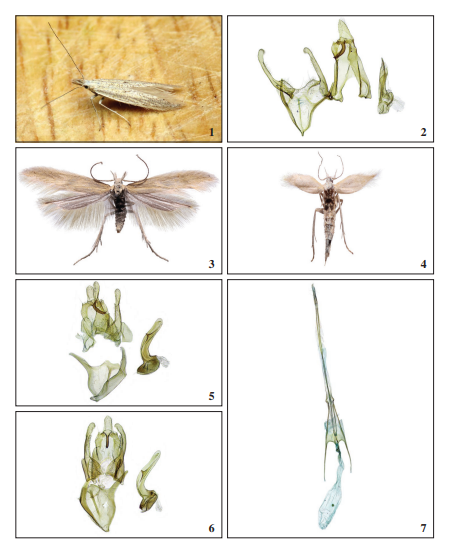
Figures 1-7.
1. M. lanceolellus (Zeller, 1850), male, Sabugal (J. Nunes). 2.M. lanceolellus male genitalia, Sabugal (M. Dale MD02829). 3.M. trineaeHuemer & Karsholt, 2018, male, Vale do Zêzere (A. Lameirinhas). 4. M. trineaeHuemer & Karsholt, 2018, female, Vale do Zêzere (A. Lameirinhas). 5.M. trineaeHuemer & Karsholt, 2018, male genitalia, Serra do Marão (Corley GP5804). 6.M. trineae Huemer & Karsholt, 2018, male genitalia, Vale do Zêzere (M. Dale MD02661). 7. M. trineaeHuemer & Karsholt, 2018, female genitalia, Vale do Zêzere ((M. Dale MD02687).
Material examined: PORTUGAL, Beira Alta, Sabugal, Aldeia de Santo António, 1 ♂ (figure 1), 13- VI-2020, leg. J. Nunes, C. Silva, E. Jesus and P. Nunes, M. Dale gen. prep. MD02829, (figure 2) confirmed O. Karsholt, in RCMC.
According to Huemer & Karsholt (2018)M. lanceolellus has a distribution extending from Spain to Germany, Italy, Croatia and Montenegro. From Spain they examined specimens from 41 localities in 14 provinces from Granada to Huesca and Gerona, extending westwards to Sierra de Gredos in Avila. It is not therefore surprising that the distribution extends into eastern central Portugal. The species shows considerable diversity in external morphology and remarkable diversity in DNA barcodes, with specimens falling into 19 BINs. Nevertheless, Huemer & Karsholt (2018) were unable to justify further taxonomic division of the species since DNA barcodes do not provide clear support for differences in external appearance and there is rather little variation in genitalia. New species for Portugal.
Megacraspedus subdolellus Staudinger, 1859 is given as a synonym of M. lanceolellus by Huemer & Karsholt (2018). As there are published Portuguese records under the name subdolellus which do not belong to M. lanceolellus, it is treated below under excluded species.
Megacraspedus dejectella species group
Megacraspedus dejectella (Staudinger, 1859) is treated below under excluded species.
Megacraspedus binotella species group
Megacraspedus binotella (Duponchel, 1843) is treated below under excluded species.
Megacraspedus cuencellus species group
Huemer & Karsholt (2018) described the new species M. trineae from Portugal and Spain, with a Portuguese holotype. Our DNA barcoding results from further specimens indicated the probability of an additional species in M. cuencellus species group. Re-examination of the eight available Portuguese male preparations that had been determined as M. trineae either by Huemer and Karsholt or by MFVC revealed a degree of diversity in some features, but sufficient differences exist to separate two species, supported by DNA barcoding, habitat preference and flight season. The second species is described as new here, after the treatment of M. trineae.
Megacraspedus trineaeHuemer & Karsholt, 2018 (Figures 3-7)
Material examined: PORTUGAL, Beira Alta, Serra da Estrela, Covão do Boi, 1 ♂, 24-VI-2010, leg. M. Corley, Corley gen. prep. 3578; Beira Alta, Serra da Estrela, Poço do Inferno, 1 ♂ paratypes, 12- VII-2009, leg. M. Corley, Corley gen. prep. 3302, both in RCMC; Beira Alta, Serra da Estrela, Vale do Zêzere, 1 ♂, 9-VII-2019, leg. J. Rosete, M. Dale gen. prep. MD02661, DNA barcoded INV09970, 1 ♀ same data, M. Dale gen. prep. MD02687, DNA barcoded INV09969, both in RCJR; Trás-os-Montes, Serra do Marão, 1 ♂, 15-VI-2019, leg. J. Nunes, Corley gen. prep. 5804, in RCMC, DNA barcoded INV09935.
Bibliographic records: The holotype and 12 paratypes are from Torre, Serra da Estrela. Other paratypes (3) are from Poço do Inferno in Serra da Estrela and one from Serra de São Mamede, Alto Alentejo. The type series comes from altitudes from 1100-1900 m. Huemer & Karsholt (2018) obtained one DNA barcode for M. trineae. The female was unknown. A single specimen from Avila, Spain shows small differences in male genitalia and a 7.4% difference in DNA barcode (PHLAI461-13; BIN: BOLD:ACZ8654) but was not described yet as a new species for want of further material.
Description Male (figure 3): Described in detail by Huemer & Karsholt (2018).
Female (figure 4): Wingspan 9 mm. Labial palp segment 2 scale brush ochreous buff, white dorsally, segment 3 white, tip not black; antenna whitish, banded deep grey on upper side; forewing smaller than in male, cream-coloured, scales not tipped brown; hindwing extremely reduced, about 1.4 mm long, narrow, whitish grey.
Male genitalia (Figures 5-6): Described in detail by Huemer & Karsholt (2018).
Female genitalia (Figure 7): Papilla analis very slender, acute; posterior apophysis a slender rod, 2.8 mm long; anterior apophysis one-quarter length of posterior apophysis, extended posteriorly as venula bordering 0.5 mm long segment VIII and continuing caudad to a small expansion at base of oviscapt, another branch forming anterior margin of segment VIII, including a subtriangular craniad bulge in middle enclosing narrow ostium bordered by sclerites tapering to slender points posteriorly; colliculum long, sclerotised including a slender sclerite forming one turn of a spiral; ductus bursae as long as anterior apophysis; corpus bursae of similar length, narrowly elliptical, signum spherical with large papillae.
Molecular data: We present three DNA barcodes for this species in addition to the one provided by Huemer & Karsholt (2018). INV09935 (IBILP3011-21), INV09969 (IBILP3014-21) and INV09970 (IBILP3015-21), all in a single BIN BOLD:ADF0469 (n = 4). The distance to the DNA barcode available is 0.46% and the distance to the nearest neighbour M. bidentatus is 7.21%.
Diagnosis: M. trineae is readily distinguished from other Megacraspedus species (apart from M. gredosensisHuemer & Karsholt, 2018, M. dalei sp. nov. and the above-mentioned Spanish specimen (PHLAI461-13)) by the aedeagus with a near right angle bend, a bulbous base and a single external carina bearing a triangular thorn. M. gredosensis has a slenderer aedeagus with thorn close to apex; the unnamed Spanish specimen has shorter aedeagus with apical part slightly expanded in middle then tapering to an apiculus and is without small thorns; differences from M. dalei are given under that species.
Biology: Based on the few specimens available, M. trineae is a mountain species found at altitudes from 1100 to 1900 metres, as stated by Huemer & Karsholt (2018). They also note that M. trineae has been collected in early May and the first half of July. The dates of specimens in the type series are from late June into August, apart from the specimen from Braçais, Serra de São Mamede, from early May, but this specimen is now transferred to M. dalei sp. nov. All the Portuguese localities are on acid substrates.
Distribution: Occurs in Portugal and Spain.
Megacraspedus dalei Corley sp. nov. (Figures 8-11)
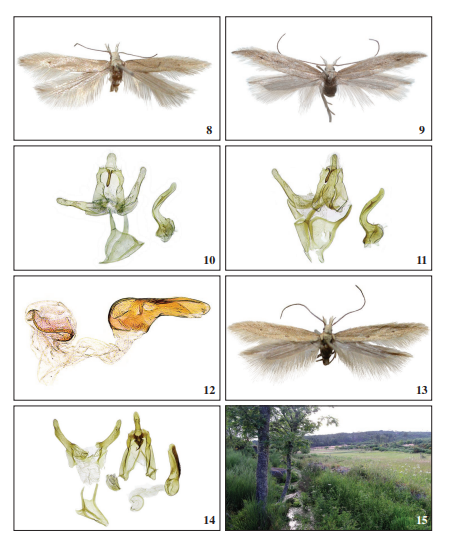
Figures 8-15.
8.M. dalei Corley, sp. nov., holotype male, Braçais (M. Corley). 9. M. dalei Corley, sp. nov., paratype male, Arzila (A. Lameirinhas). 10.M. dalei Corley, sp. nov., paratype male genitalia, Braçais (M. Corley) (Corley GP2003). 11.M. dalei Corley, sp. nov., paratype male genitalia, Buracos do Casmilo. 12.M. occidentellusHuemer & Karsholt, 2018, aedeagus, Ericeira (P. Huemer GU 13/1352). 13.M. transmontanus Corley, sp. nov., holotype male, Alijó, Carvalho (M. Corley). 14.M. transmontanus Corley, sp. nov., holotype male genitalia, Alijó, Carvalho (M. Corley GP5545). 15. Habitat of M. transmontanus Corley, sp. nov., at Carvalho (José Paulo Pires).
Material examined: Holotype ♂, “P5173 PORTUGAL Braçais Castelo de VideAlto Alentejo 9-V1999 leg. M. Corley” “♂ 2003’ TLMF Lep 21300 (pale green label)”. “PARATYPE Megacraspedus trineae Huemer & Karsholt, 2018” (red label). Holotype will be placed in NHMUK. Paratypes: Beira Litoral, Ceira, 1 ♂, 2006, leg. P. Pires, Corley gen. prep. 2667; Beira Litoral, Penela, Serra de Janeanes, Buracas de Casmilo, 1 ♂, 23-V-2006, leg. M. Corley, Corley gen. prep. 2758; Beira Litoral, Soure, Paúl da Madriz, 1 ♂, 26-VI-2015, leg. J. Rosete, Corley gen. prep. 5758, DNA barcoded INV09134.
Description male (Figures 8-9): Wingspan 14 mm. Head creamy white, side of base below antenna buff; labial palp segment 2 with scale brush slightly longer than segment, light grey-brown on outer side, inner side whitish, segment 3 whitish, ventral edge brownish buff; antenna fuscous. Thorax creamy white. Forewing pale ochreous brown, a blackish brown dot at end of cell, sometimes with a few blackish brown scales in fold at two-fifths; fringes concolorous with forewing colour. Hindwing light greyish buff, fringes concolorous.
Female unknown.
Male genitalia (Figures 10, 11): Uncus less than twice as long as wide, subrectangular with broadly rounded apex; gnathos hook strong, about length of uncus, weakly curved with pointed apex; valva straight, moderately slender, basal part wider than distal part, extending to about apex of uncus, apically rounded; short digitate sacculus at mid-point of valva, less than one-quarter length of valva; saccus massive, suboval, with abruptly tapered apex, ratio maximum width to length approaching 1, posterior margin sclerotised, arched, with shallow medial emargination, without extra thickening in medial part at junction with strongly sclerotised longitudinal ridge extending to anterior third of saccus, lateral sclerites short, about half length of maximum width of saccus; aedeagus slender, medially bent, coecum orbicular, distal three-quarters slender, rod-like, distal half with strongly sclerotised carina bearing a single postmedial thorn, without small subapical thorns, but a few small thorns adjacent to carina.
Molecular data: INV09134 (IBILP3009-21) in BIN BOLD:AEI6609, (n = 1). The distance to the nearest neighbour, a probably undescribed species from Avila, is 5.77%.
Diagnosis: Megacraspedus dalei resembles M. trineae externally and in genitalia, but there are consistent differences. The forewing of M. dalei has a distinct blackish dot at end of cell. Huemer & Karsholt (2018) mention an indistinct black dot at end of cell sometimes present in M. trineae but this probably refers to M. dalei which was included under M. trineae (e.g. paratype from Braçais, Portugal). In male genitalia: sacculus less than one-quarter length of valva (more than one-quarter in M. trineae, usually one-third in Portuguese material); sclerotisation of posterior margin of saccus not thickened in middle, unlike M. trineae which has extra thickening where longitudinal ridge meets posterior margin; aedeagus with large thorn distal to middle of carina and small thorns adjacent to carina, while in M. trineae large thorn is proximal to middle of carina and small thorns in apex of aedeagus.
Biology: The species occurs at low altitudes, the highest being at Braçais at 595 m. Habitats are varied, with both acid and limestone substrates. The few specimens known have been collected between 9 May and 26 June.
Etymology: The species is named after Michael Dale in grateful recognition of the considerable help he has given MFVC with many excellent genitalia dissections and enhanced photos of MFVC’s own preparations.
Distribution: So far known only from the central part of Portugal in Alto Alentejo and Beira Litoral.
Remarks: Based on the DNA barcode M. dalei is more closely related to the specimen from Avila figured by Huemer & Karsholt (2018, fig. 182) than to M. trineae. The Avila male has posterior margin of saccus more strongly arched and with deeper emargination and aedeagus distinctly shorter than either M. dalei or M. trineae, tapering in distal one-third to an apiculus, with the large thorn at middle of carina and apparently no small thorns. In our opinion this is sufficiently distinct to be treated as a separate species, but we refrain from describing it since it is outside the scope of this paper and we have only seen the published figures, not the actual specimen.
Megacraspedus pentheres species group
Megacraspedus quadristictus Lhomme, 1946
Material examined: In addition to Portuguese material listed by Huemer & Karsholt (2018) we have also seen specimens from three localities in Beira Litoral, Coimbra, Santa Clara, 1 ♂, 9-IX-2006, M. Corley, in RCMC; Penela, Buracas de Casmilo, 1 ♂, 22-VII-2015, J. Rosete, Corley gen. prep. 4581, in RCJR, DNA barcoded INV00708; Penela, Castelo de Rabaçal, 2 ♂, 7-IX-2017, J. Rosete in RCJC, DNA barcoded INV05895.
Bibliographic records: Huemer & Karsholt (2018) examined much material from France and Spain and four specimens from Portugal. Their material included females. They obtained DNA barcodes from five specimens from Spain.
Molecular data: INV00708 (IBILP2095-20) and INV05895 (IBILP3007-21) both in a new BIN BOLD:AEC9609 (n = 2). The distance to the Spanish specimens DNA barcoded is between 2.93 and 3.61 and the distance to the nearest neighbour M. teriolensis is 9.26%
Diagnosis: M. quadristictus can be distinguished from the other Portuguese species by the presence of four black dots on each forewing. The aedeagus gradually tapers from a bulbous base and is without spines, thorns, carina or sclerite.
Biology: Most, probably all, of the localities for this species are on limestone. Moths have been collected from end of July to late September.
Distribution: The species was described from France. Huemer & Karsholt (2018) give the distribution as France and Spain, but their list of examined material includes three Portuguese specimens from Algarve and one from Estremadura.
Remarks: Female genitalia are described by Huemer & Karsholt (2018).
Megacraspedus pusillus species group
Megacraspedus occidentellus Huemer & Karsholt, 2018 (Figure 12)
Material examined: PORTUGAL, Soalheira, 2 ♂, C. Mendes (MNHN), Corley gen. preps 1697, 1974.
Bibliographic records: The species was described from two localities on the Estremadura coast north of Lisbon (holotype and three paratypes from Ericeira, one additional paratype from near Cabo da Roca). There are two males labelled “Soalheira”, without date, in the Joannis collection (MNHN), collected by C. Mendes (Corley gen. preps. 1697 and 1974). Soalheira refers to the railway station nearest to Colegio de São Fiel near Fundão, Beira Baixa, which is where Mendes was working. Mendes sent the specimens to Joannis labelled only with a number. Any data associated with these numbers are lost. The “Soalheira” labels were added by Joannis when the specimens reached him, presumably taken from the postmark on the parcel, but the collecting locality is unknown and although most likely to refer to somewhere near São Fiel, there is a possibility that it could refer to the Torres Vedras area in Estremadura, where Mendes was based at Barro during 1906 and 1907 before returning to São Fiel. More details on Mendes and Joannis are given in Corley (2008, 179). There is no indication that Joannis attempted to name the specimens. There are no other specimens of M. occidentellus known, so the distribution may be confined to Estremadura or may extend to Beira Baixa.
Diagnosis: Males of M. occidentellus (Figure 12) can be recognised by the short stout aedeagus with relatively long basal bulge. The Soalheira specimens have a group of a few stout spines just above the bulge, but these are not clearly illustrated in the figure of the holotype (figure 191) in Huemer & Karsholt (2018), while the text (page 79) expressly excludes them. Ole Karsholt has provided a photo (figure 12) which shows a few such spines.
Distribution: The species is endemic to Portugal
Remarks: According to Huemer & Karsholt (2018) the female is unknown and attempts to obtain a DNA barcode so far failed. We have no new material of this species.
The following three species are all previously undescribed and appear to be endemic to Portugal. They are remarkable in having the basal part of the gnathos more or less clothed in crisped fibrous hairs.
Megacraspedus transmontanus Corley, sp. nov. (Figures 13-15)
Material examined: Holotype ♂, PORTUGAL Trás-os-Montes Alijó Carvalho 20-V-2018 leg. M. Corley & S. Ferreira P11563 Corley gen. prep. 5545 DNA barcoded (INV06432). Holotype will be placed in NHMUK.
Description male (Figure 13): Wingspan 15 mm. Head whitish buff. Labial palp segment 3 as long as segment 2, segment 2 with scale brush slightly longer than segment, greyish brown, upper edge whitish buff, segment 3 whitish, tip and ventral margin black; antenna without pecten, light fuscous, darker ringed in proximal half, dark fuscous in distal half. Thorax ochreous buff, slightly darker than head, tegula similar, darkest anteriorly. Forewing pale ochreous on dorsal side, darker ochreous in middle and towards costa, tinged brown near base, mainly in costal half, most scales shortly tipped light brown; slightly elongate blackish brown dots, one in fold at two-fifths and one in mid-wing at two-thirds; fringes ochreous grey. Hindwing uniform grey, fringes ochreous grey.
Female unknown.
Male genitalia (Figure 14): Uncus digitate, about three times as long as wide, apex rounded; gnathos two-thirds length of uncus, with basal half broad, appearing to be covered with fibres, distal half smooth, slender, finely pointed; anterior edge of tegumen with deep V-shaped excavation; valva slightly curved, digitate, without clearly separated sacculus, but saccular area extending to four-fifths valva length, after which valva is reduced in width; saccus subtriangular but apex obtuse, width about three-fifths of length, posterior margin with emargination between lateral humps, medial part with strongly sclerotised ridge extending from posterior edge towards apex, lateral sclerites about equal to lateral margin of saccus; aedeagus with rounded coecum, distal part two-thirds width and twice length of coecum, with a slight bend at middle of aedeagus length, distal part with strongly sclerotised longitudinal sclerite, a series of about six short stout external spines arising from sclerite around middle of aedeagus length, opposite to a group of about 12 small V-shaped thorns, a second group of similar thorns close to rounded apex.
Molecular data: INV06432 (IBILP3008-21) in BIN BOLD:AEI6610 (n = 1). The distance to the nearest neighbour M. dinensis is 7.08%.
Diagnosis: Megacraspedus transmontanus differs from all other Megacraspedus species except the two following species in the presence of fibres on the basal half of the gnathos. The two small groups of V-shaped thorns on the aedeagus are also an unusual feature and distinguish this species from the other two species described here. M. spinophallus Huemer & Karsholt, 2018 and some other species of the pusillus group have similar thorns.
Biology: The species is known only from a single specimen taken at light in the second half of May in an area of tall herbs close to a very small stream at an altitude of 700 m (Figure 15). Close to the stream on the south side is a wooded slope. On the north side, beyond a small hay field is an area of fine grasses and Cytisus shrubs among granite rocks.
Etymology: The masculine adjective transmontanus derives from Latin for “across the mountains” and is a direct translation of the Portuguese Transmontano, “one from Trás-os-Montes region” in which this species was collected.
Distribution: As yet only known from a single locality in Alijó municipality, Trás-os-Montes.
Remarks: According to DNA barcode the closest relative of this species is M. dinensis sp. nov., from Vinhais, Portugal.
Megacraspedus dinensis Corley, sp. nov. (Figures 16-17)
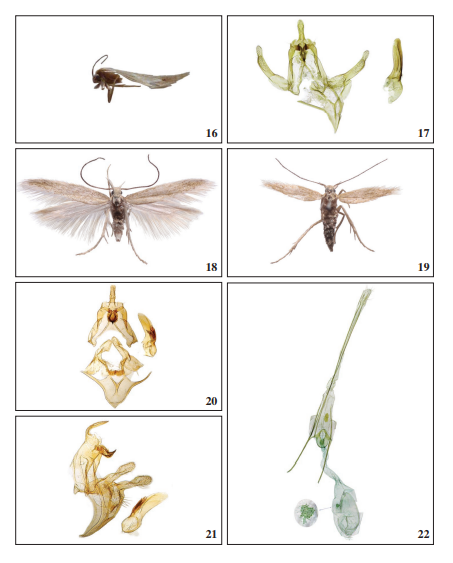
Figures 16-22.
16.M. dinensis Corley, sp. nov., holotype male, Dine, (S. Ferreira). 17.M. dinensis Corley, sp. nov., holotype male genitalia, Dine (M. Corley GP5368). 18.M. terryae Corley, sp. nov., paratype male, Alvaiázere (A. Lameirinhas). 19.M. terryae Corley, sp. nov., paratype female, Alvaiázere (A. Lameirinhas). 20. M. terryae Corley, sp. nov., holotype male genitalia – frontal view, Colos (R. Terry GP PT071). 21. M. terryae Corley, sp. nov., paratype male genitalia – lateral view, Colos (R. Terry GP PT072). 22. M. terryae Corley, sp. n., paratype female genitalia, Alvaiázere (M. Dale MD02681).
Material examined: Holotype ♂, in ethanol PORTUGAL Trás-os-Montes Vinhais Dine 19-VII2017 leg. M. Corley & S. Ferreira Corley gen. prep. 5368 DNA barcoded (INV05362). Holotype in ethanol in very poor condition, will be placed in NHMUK.
Description (Figure 16): Forewing length 6.5 mm, estimated wingspan about 14 mm. Forewing pale, with light dusting of dark scales on veins towards costa and termen and in fold; a short blackish dash in fold at two-fifths and a longer one at end of cell.
Male genitalia (Figure 17): Similar to those of M. transmontanus, but gnathos with basal twothirds slightly expanded, covered in crisped fibrous hairs, distal one-third abruptly tapering, smooth; saccus acute; aedeagus with coecum twice as wide as distal part and half as long, distal part slightly curved near middle of aedeagus, a strongly sclerotised sclerite in whole length of distal part, with a few small, stout spines arising from the sclerite just above coecum (not very evident in figure), small external thorns absent.
Molecular data: INV05362 (IBILP3005-21) in BIN BOLD:AEI4370 (n = 1). The distance to the nearest neighbour M. heckfordi is 6.3%.
Diagnosis: Megacraspedus dinensis is characterised by male genitalia with narrow gnathos with short apical sclerotised part and aedeagus with a long sclerite, but with few small spines and no thorns.
Biology: Known from a single male collected in July in an area of grass, orchard trees and hedges in the valley of the Rio Tuela below the village of Dine. There are lime kilns higher up the hill near the village suggesting that the locality has less acid substrate than most of northern Portugal.
Etymology: The species name is an adjective in genitive case derived from the nearby village of Dine.
Distribution: Known only from the type locality, Dine, Vinhais, Trás-os-Montes.
Remarks: At the time of collection, the only specimen was placed directly into ethanol for barcoding under the InBIO barcoding initiative. Its DNA barcode indicated that it was a distinct species most closely related to M. heckfordi Huemer & Karsholt, 2018, so the male genitalia were prepared. Unfortunately, the specimen in ethanol is not in a condition that allows a full description of the external appearance of the moth, but as we have details of genitalia and DNA barcode, we treat the species here for completeness of this revision. It is hoped that further material will become available in the near future.
Megacraspedus terryae Corley, sp. nov. (Figures 18-23)
Material examined: Holotype ♂, PORTUGAL Ribatejo Rio Maior Alcanede Colos leg. R. Terry 10-VI-2019 R. Terry gen prep. PT071. Holotype will be placed in NHMUK. Paratypes: 1 ♂ with same data as holotype; further males with same locality but 12-VI-2019 (5) DNA barcoded INV10437, R. Terry gen. preps PT072, PT073; 13-VI-2019 (2), all in RCRT; 1 ♂ from same locality, 14-VI-2019 in RCMC; 1 ♂, Beira Litoral, Alvaiázere, Outeiro do Gamanhos, 26-VI-2019, leg. J. Rosete; 1 ♂, same locality but 4-VII-2019, leg. J. Rosete, M. Dale gen. prep. MD02660, DNA barcoded INV09960; 1 ♀, same locality and date, leg. J. Rosete, M. Dale gen. prep. MD02681, DNA barcoded INV09961, all in RCJR.
Description male (Figure 18): Wingspan 10 mm. Head whitish buff. Labial palp segment 3 threequarters length of segment 2, segment 2 with scale brush as long as segment, grey-brown, whitish buff above, segment 3 whitish buff, tip and ventral margin black; antenna without pecten, scape whitish buff posteriorly, fuscous anteriorly, flagellum light fuscous, darker beyond middle. Thorax ochreous buff. Forewing ochreous buff, scales mostly tipped light brown, more extensively towards apex, cilia greyish ochreous. Hindwing light grey, cilia concolorous. Abdomen light ochreous.
Female (Figure 19): Resembling male but wings strongly reduced. Wingspan 6 mm. Antenna ochreous buff proximally ringed fuscous, darker fuscous distally.
Male genitalia (Figures 20-21): Uncus digitate, about four times as long as wide, apex rounded; gnathos three-quarters length of uncus, with broadly elliptic basal three-quarters appearing to be covered with fibres, distal one-quarter smooth, slender, curved, finely pointed; anterior edge of tegumen with deep V-shaped excavation; valva short, not reaching base of uncus, twisted in middle, distal part with ventral bulge, without clearly separated sacculus; saccus broad, anterior end broadly rounded with small apiculus, width about equalling length, posterior margin with emargination between lateral humps, medial part with strongly sclerotised ridge extending from posterior edge towards apex, lateral sclerites slightly shorter than lateral margin of saccus; aedeagus with rounded coecum, distal part two-thirds width and twice length of coecum, with a significant bend at middle of aedeagus length, without sclerotised longitudinal sclerite, an untidy group of approximately 12 stout external spines longer than coecum, arising at distal end of coecum.
Female genitalia (Figure 22): Papilla analis small, slender, apically rounded; posterior apophysis slender, rod-like, 2.2 mm long; an elliptical sclerite in oviscapt at level of posterior margin of 0.4 mm long, quadrate segment VIII; subgenital plate broadly ovate with triangular lateral process extending to join anterior apophysis at mid-point, other limb of apophysis extending beyond segment VIII; ostium broadly ovate, situated in posterior half of subgenital plate; ductus bursae membranous, about twice as long as segment VIII; corpus bursae elliptical, signum an irregularly shaped plate covered with strong papillae.
Molecular data: INV09960 (IBILP3012-21) and INV09961 (IBILP3013-21) both in BIN BOLD:AEI1274, (n = 2); INV10437 (IBILP3016-21) in BIN BOLD:AFR1326. The distance to the nearest neighbour M. tenuiuncus 5.5%.
Diagnosis: Megacraspedus terryae differs from all other Megacraspedus species except M. transmontanus and M. dinensis, in the presence of crisped fibres on the basal part of the gnathos. The wide basal part of the gnathos and the untidy mass of spines on the aedeagus distinguish this species from these two species.
Biology: The species is known only from two localities 57 km apart on the Jurassic limestone of central Portugal. Specimens have been collected in June and July at the end of the afternoon and also at light. Jorge Rosete (pers. comm.) has described the habitat at Alvaiázere: a small set of terraces at the base of a limestone hill with south-west aspect. The vegetation cover includes clumps of Quercus faginea Lam., Olea europaea L., Crataegus monogyna Jacq. and a shrub layer with Cistus species and Thymus and a variety of herbaceous plants including several Poaceae. At Colos, the habitat is quite similar (Figure 23).
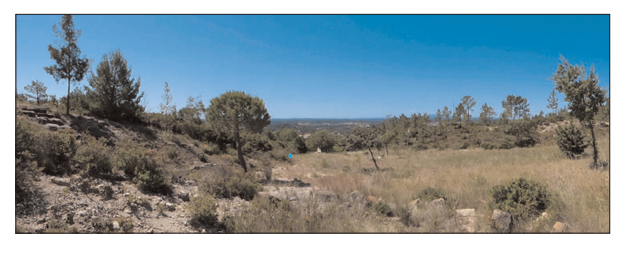
Figure 23.
Habitat of M. terryae Corley, sp. nov., at Colos (S. Barnes).
Etymology: The species is named in honour of Rachel Terry who collected the first known specimens during her first visit to Portugal.
Distribution: Jurassic limestone of central Portugal (Beira Litoral).
Remarks: Only discovered in 2019 and not immediately recognised as distinct from M. transmontanus because both species have similar conspicuous fibres on the gnathos. However, there are clear differences both externally and in male genitalia and also in DNA barcode.
M. transmontanus sp. nov., M. dinensis sp. nov. and M. terryae sp. nov., form a natural group which according to DNA barcodes is closest to M. tenuiuncusHuemer & Karsholt, 2028 and M. heckfordi Huemer & Karsholt, 2018, which both belong to the pusillus group of Huemer & Karsholt (2018). Based on most characters this appears to be the appropriate group for these three new species also. Huemer & Karsholt (2018) provide a key to species groups, based on male genitalia. However, the first couplet in the key excludes the new species from the pusillus group. Nevertheless, the shape of the uncus, small thorns on the surface of the aedeagus and DNA barcodes all point to the pusillus group being the closest species group. This can be resolved by inserting an extra couplet into the species group key:
1 Gnathos hook straight, massive and bulky, with longitudinal grooves
M. pusillus species group (part)
- Gnathos hook usually curved or bent, of various shape, without longitudinal
grooves 1A
1A Gnathos with crisped fibrous hairs on basal part
M. pusillus species group (part)
- Gnathos hook without hairs on basal part
Megacraspedus violacellum species group
Megacraspedus ibericus Huemer & Karsholt, 2018
Material examined: PORTUGAL, Trás-os-Montes, Serra do Alvão, Arnal, 1 ♂, 2-IX-2002, Corley, Corley gen. prep. 1753; Serra da Estrela, Vale Glaciar do Zêzere, Manteigas, Guarda, 1100 m, 2 ♂, 10- IX-2017, J. Rosete (RCJR), of which one is a paratype and both were DNA barcoded (INV05891, INV09135).
Bibliographic records: Huemer & Karsholt (2018) include five males from Serra do Larouco, Trás-os-Montes and one from Vale do Zêzere, Serra da Estrela as paratypes.
Molecular data: INV05891 (IBILP3006-21), and INV09135 (IBILP3010-21), both in BIN BOLD:AEI4590 (n = 2). The distance to the single Spanish specimen DNA barcoded so far is 2.14% and to the nearest neighbour M. skulei is 6.8%.
Diagnosis: Males of M. ibericus can be recognised by the straight aedeagus with slightly swollen base and a small external tooth near the middle, although in some preparations this tooth is barely discernible.
Distribution: Occurs in Spain and Portugal. The holotype and two paratypes are from Malaga, Spain. In Portugal it is known from Serra da Estrela, Serra do Alvão and Serra do Larouco.
Remarks: Females are unknown.
Key to Portuguese Megacraspedus species using male genitalia characters
1 Gnathos without fibrous hairs in basal part............................................................................................2
Gnathos with fibrous hairs in basal part .................................................................................................7
2 Aedeagus with near right-angle bend .....................................................................................................3
Aedeagus straight or only slightly curved ..............................................................................................4
3 Sacculus about one-third length of valva; aedeagus with large tooth proximal
to middle of external carina and with a group of small triangular spines near apex ...............M. trineae
Sacculus about one-quarter length of valva; aedeagus with large tooth at or distal
to middle of external carina and with a group of small triangular spines ...................................M. dalei
4 Uncus slender, hardly wider than gnathos; aedeagus with coecum as long as
distal part, with a group of stout spines laterally near middle .......................................M. occidentellus
Uncus wider than gnathos; aedeagus with longer distal part, without a group of spines.......................5
5 Uncus at least 1.5 times as long as wide..........................................................................M. lanceolellus
Uncus about as long as wide...................................................................................................................6
6 Distal part of aedeagus with a long sclerite and a small external tooth near middle ............M. ibericus
Aedeagus without sclerite or external tooth....................................................... M. quadristictus
7 Aedeagus with an untidy group of long wavy spines, without sclerite....................................M. terryae
Aedeagus with a longitudinal sclerite, without spines or with a row of straight spines .........................8
8 Gnathos with slender sclerotised apical part as long as widely expanded fibrous
basal part; aedeagus with a row of stout spines and a field of small triangular
spines............................................................................................................................M. transmontanus
Gnathos with slender sclerotised apical part shorter than slightly expanded fibrous
basal part; aedeagus with a few stout spines ..........................................................................M. dinensis
Excluded species
Megacraspedus dejectella (Staudinger, 1859)
Was recorded by Mendes (1904) from Beira Baixa. Corley (2015) found a specimen under this name in the National Collection in ZMCP which was lacking abdomen but could be identified as Ptocheuusa paupella (Zeller, 1847) from its quite different wing markings and labial palps. Huemer & Karsholt (2018) only traced three specimens of M. dejectella, all from the type series from Granada, Spain.
Megacraspedus binotella (Duponchel, 1843)
Bibliographic records: The earliest Portuguese record was from Singeverga in Douro Litoral, collected by Teodoro Monteiro in May 1953 and identified by Amsel (1959). Corley (2015) mentions the species as also present in Trás-os-Montes, but the identifications were erroneous, see below. Huemer & Karsholt (2018) considered the Iberian listings in Corley (2015) and Vives Moreno (2014) to be misidentifications, possibly of M. peslieri Huemer & Karsholt, 2018. This is not the case with Portuguese “binotella” named by MFVC which belong to M. ibericusHuemer & Karsholt, 2018 and are listed under Material Examined for that species.
Distribution: M. binotella has a central European distribution reaching only as far west as Austria and northern Italy
Remarks: The identity of the Singeverga specimen identified as binotella by Amsel has not been established but in view of the confusion that was prevalent in the taxonomy of Megacraspedus there is no reason to suppose that it was correctly named. If the specimen can be located it should be possible to identify it.
Megacraspedus subdolellus Staudinger, 1859
Bibliographic records: Huemer & Karsholt (2018) place M. subdolellus in synonymy with M. lanceolellus (Zeller, 1850). The earliest Portuguese record of M. subdolellus was from Serra da Arrábida collected by J. Passos de Carvalho on 20-VI-1979 and named by MFVC (Corley et al. 2006). Corley (2015) also mentions the species as present in Alto Alentejo and Beira Litoral based on the specimens now referred to M. dalei sp. nov. (see Material examined under that species).
Remarks: Portuguese specimens that had previously been named subdolellus by MFVC are referred to M. trineae by Huemer & Karsholt (2018) but one of these, the specimen from Braçais, Alto Alentejo belongs to M. dalei sp. nov. The Passos de Carvalho specimen from Serra da Arrábida has not been re-examined but is unlikely to be correctly named. However, in 2020 a genuine example of M. lanceolellus was found in Portugal, see the entry under that name.
Discussion
The revision of Megacraspedus by Huemer & Karsholt (2018) has provided a very sound base for further work on this genus, but in many cases information on species was incomplete. In particular females were unknown for numerous species and also DNA barcodes were not available for a number of species. Since 2018 further information has become available. Nel & Varenne (2019) described females of five species that were not described in the monograph. Huemer et al. (2020) detected an overlooked species in the Cottian Alps of Italy. Gastón & Vives Moreno (2020) added a new species from Teruel, Spain and another from Burgos, Spain (Vives Moreno & Gastón, 2020). The latter was transferred to a new genus Paramegacraspedus Gastón & Vives (Gastón & Vives Moreno, 2021) on the basis of the remarkably different female genitalia however the figured genitalia belong to Ptocheuusa paupella (Zeller, 1847).
The four new Megacraspedus species recognised in this paper, together with one newly added species, bring the total of Portuguese Megacraspedus species to nine. This is far short of the 27 species known from Spain (25 in Huemer & Karsholt (2018) and two further species added by Vives Moreno & Gastón (2020). Some of these species have been recorded close to the Portuguese border, so could also be present in Portugal. The recent discovery of four previously unrecognised species in Portugal, three of which share a character (presence of fibres on the gnathos) that occurs in no other species of the genus, suggests that there could be further species to be found in Portugal, perhaps also belonging to this subgroup of species. Huemer & Karsholt (2018, p. 16) point out that the brachyptery which is prevalent in females of the genus is a significant factor contributing to the evolution of new species with limited distribution.
Acknowledgments
We are most grateful to Rachel Terry, João Nunes and Jorge Rosete for making specimens available for study, to Mike Dale and Rachel Terry for genitalia dissections and photos, to Sarah Barnes for the habitat photo at Colos, to José Paulo Pires for the Carvalho habitat photo and to André Lameirinhas for photos of pinned specimens of M. dalei and M. terryae. Ole Karsholt kindly sent the aedeagus photo of the holotype of M. occidentellus and confirmed the identity of the M. lanceolellus. Peter Huemer provided information on the barcoding failure of the holotype of M. dalei. Javier Gastón for the photographic retouching. This project has received funding from the European Union’s Horizon 2020 Research and Innovation Programme under grant agreement No 668981 and by the project PORBIOTAPortuguese E-Infrastructure for Information and Research on Biodiversity (POCI-01-0145-FEDER022127), supported by Operational Thematic Program for Competitiveness and Internationalization (POCI), under the PORTUGAL 2020 Partnership Agreement, through the European Regional Development Fund (FEDER). SF was supported by an individual research contract (https://doi.org/10.54499/2020.03526.CEECIND/CP1601/CP1649/CT0007).
References
Amsel, H. G. (1959). Portugiesische Kleinschmetterlinge gesammelt von Teodoro Monteiro, O. S. B. Anais da Faculdade de Ciências do Porto, 41, 5-20.
Corley, M. F. V. (2008). The Lepidoptera collections of deceased Portuguese entomologists. Entomologist’s Gazette, 59, 145-171.
Corley, M. F. V. (2015). Lepidoptera of Continental Portugal. A fully revised list. Martin Corley.
Corley, M. F. V., Maravalhas, E., & Carvalho, J. Passos de (2006). Miscellaneous additions to the Lepidoptera of Portugal (Insecta: Lepidoptera). SHILAP Revista de lepidopterología, 34(136), 407-427.
Elbrecht, V., & Leese, F. (2017). Validation and development of COI metabarcoding primers for freshwater macroinvertebrate bioassessment. Frontiers in Environmental Science, 5. https://doi.org/10.3389/fenvs.2017. 00011
Elbrecht, V., Braukmann, T. W., Ivanova, N. V., Prosser, S. W., Hajibabaei, M., Wright, M., Zakharov, E. V., Hebert, P. D., & Steinke, D. (2019). Validation of COI metabarcoding primers for terrestrial arthropods. PeerJ Preprints, 7, (e27801v2). https://doi.org/10.7717/peerj.7745
Gastón, J., & Vives Moreno, A. (2020). Descripción de cuatro nuevas especies y otras citas de interés para la fauna de Lepidoptera de España (Insecta: Lepidoptera). SHILAP Revista de lepidopterología, 48(191), 545-564. https://doi.org/10.57065/shilap.376
Gastón, J., & Vives Moreno, A. (2021). Un género y tres nuevas especies para España, con otras interesantes informaciones lepidopterológicas para la fauna española. Descripción de las hembras de Paramegacraspedus sinevi (Vives & Gastón, 2020), comb. n. y Agnoea revillai Gastón & Vives, 2020 (Insecta: Lepidoptera). SHILAP Revista de lepidopterología, 49(193), 149-159. https://doi.org/10.57065/shilap.197
Huemer, P., & Karsholt, O. (2018). Revision of the genus Megacraspedus Zeller, 1839, a challenging taxonomic tightrope of species delimitation (Lepidoptera, Gelechiidae). ZooKeys, 800, 1-278. https://doi.org/10.3897/zookeys.800.26292
Huemer, P., Karsholt, O., & Wieser, C. (2020). Megacraspedus cottiensis sp. nov. (Lepidoptera, Gelechiidae) from northern Italy - a case of taxonomic confusion. ZooKeys, 963, 141-152. https://doi.org/10.3897/0zookeys.963.54842
Mendes, C. de Azevedo. (1904). Lepidoptera de Portugal II. Lepidoptera da região de S. Fiel (Beira Baixa). Brotéria, 3, 223-254.
Nel, J., & Varenne, T. (2019). A propos des femelles de cinq especes francaises du genre Megacraspedus Zeller, 1839 (Lepidoptera, Gelechiidae). Revue de l’Association Roussillonnaise d’Entomologie, 28, 110-115.
Shokralla, S., Porter, T. M., Gibson, J. F., Dobosz, R., Janzen, D. H., Hallwachs, W., Golding, G. B., & Hajibabaei, M. (2015). Massively parallel multiplex DNA sequencing for specimen identification using an Illumina MiSeq platform. Scientific Reports, 5, 9687. https://doi.org/10.1038/srep09687
Vamos, E., Elbrecht, V., & Leese, F. (2017). Short COI markers for freshwater macroinvertebrate metabarcoding. Metabarcoding and Metagenomics, 1: e14625. https://doi.org/10.3897/mbmg.1.14625
Vives Moreno, A. (2014). Catálogo sistemático y sinonímico de los Lepidoptera de la Península Ibérica, de Ceuta, de Melilla y de las Islas Azores, Baleares, Canarias, Madeira y Salvajes. (Insecta: Lepidoptera.). SHILAP Revista de lepidopterología, Supplement, 1-1184. Improitalia.
Vives Moreno, A., & Gastón, J. (2020). Cinco nuevas especies para la fauna de España y otras interesantes informaciones lepidopterológicas para España y Sudán (Insecta: Lepidoptera). SHILAP Revista de lepidopterología, 48(192), 717-731. https://doi.org/10.57065/shilap.341
Autor notes
a Autor para correspondencia: martin.corley@btinternet.com
