Artículos
New or interesting Pyraloidea for the European and Italian faunas (Insecta: Lepidoptera)
Pyraloidea nuevos o interesantes para la fauna europea e italiana (Insecta: Lepidoptera)
Pyraloidea nuovi o interessanti per la fauna Europea ed Italiana (Insecta: Lepidoptera)
 Friedmar Graf friedmargraf@gmail.com
Frantisek Slamka f.slamka@nextra.sk
Friedmar Graf friedmargraf@gmail.com
Frantisek Slamka f.slamka@nextra.sk
New or interesting Pyraloidea for the European and Italian faunas (Insecta: Lepidoptera)
Shilap Revista de Lepidopterología, vol. 53, no. 209, pp. 189-201, 2025
Sociedad Hispano-Luso-Americana de Lepidopterología
Received: 27 February 2024
Accepted: 21 April 2024
Published: 30 June 2024
Abstract: New data on European Pyraloidea are shown following the study of material present in the authors’ collections as well as well as in the Natural History Museum of Denmark (Copenhagen). Catoptria plitvicensis Bassi, sp. nov. and Catoptria velebitica Bassi, sp. nov. from Croatia, and Melathrix edmundsi Slamka, sp. nov. from Crete are described. Arsissa firusella (Amsel, 1961) (Pyralidae: Phycitinae), Euchromius subcambridgei Bleszynski, 1965 (Crambidae: Crambinae) and Crocidophora tuberculalis Lederer, 1863 (Crambidae: Pyraustinae) are new for Europe. Gymnancyla hillneriellaGastón & Vives, 2018, Pempeliella ardosiella (Ragonot, 1887), Pempeliella bulgarica Slamka & Plant, 2016, and Phycita torrenti Agenjo, 1962 (all Pyralidae: Phycitinae) are reported as new for Italy. Calamotropha paludella (Hübner, [1824]) (Crambidae: Crambinae) is reported as new for Sicily, Gymnancyla canella ([Denis & Schiffermüller], 1775) (Pyralidae: Phycitinae) is reported as new for Sardinia and South Italy. Pempelia alpigenella (Duponchel, 1836) (Pyralidae: Phycitinae) is reported as new for Northwestern Italy and Bradyrrhoa gilveolella (Treitschke, 1833) (Pyralidae: Phycitinae) is reported as new for continental Italy.
Keywords: Insecta, Lepidoptera, Pyraloidea, Crambidae, Crambinae, Phycitinae, Pyralidae, Pyraustinae, new records, new species, Europe.
Resumen: Se presentan nuevos datos sobre los Pyraloidea europeos tras el estudio del material presente en las colecciones de los autores, así como en el Museo de Historia Natural de Dinamarca (Copenhague). Se describen Catoptria plitvicensis Bassi, sp. nov. y Catoptria velebitica Bassi, sp. nov. de Croacia y Melathrix edmundsi Slamka, sp. nov. de Creta. Arsissa firusella (Amsel, 1961) (Pyralidae: Phycitinae), Euchromius subcambridgei Bleszynski, 1965 (Crambidae: Crambinae) y Crocidophora tuberculalis Lederer, 1863 (Crambidae: Pyraustinae) son nuevas para Europa. Gymnancyla hillneriellaGastón & Vives, 2018, Pempeliella ardosiella (Ragonot, 1887), Pempeliella bulgaricaSlamka & Plant, 2016 y Phycita torrenti Agenjo, 1962 (todas Pyralidae: Phycitinae) se señalan como nuevas para Italia. Calamotropha paludella (Hübner, [1824]) (Crambidae: Crambinae) se comunica como nueva para Sicilia, Gymnancyla canella ([Denis & Schiffermüller], 1775) (Pyralidae: Phycitinae) se comunica como nueva para Cerdeña y el sur de Italia. Pempelia alpigenella (Duponchel, 1836) (Pyralidae: Phycitinae) se comunica como nueva para el noroeste de Italia y Bradyrrhoa gilveolella (Treitschke, 1833) (Pyralidae: Phycitinae) se comunica como nueva para Italia continental.
Palabras clave: Insecta, Lepidoptera, Pyraloidea, Crambidae, Crambinae, Phycitinae, Pyralidae, Pyraustinae, nuevos registros, nuevas especies, Europa.
Sommario: Nuovi dati sui Pyraloidea europei vengono illustrati in seguito allo studio di materiale presente nelle collezioni degli autori e del Museo di Storia Naturale della Danimarca (Copenhagen). Vengono descritte Catoptria plitvicensis Bassi, sp. nov. e Catoptria velebitica Bassi, sp. nov. dalla Croazia, e Melathrix edmundsi Slamka, sp. nov. da Creta. Arsissa firusella (Amsel, 1961) (Pyralidae: Phycitinae), Euchromius subcambridgei Bleszynski, 1965 (Crambidae: Crambinae) e Crocidophora tuberculalisLederer, 1863 (Crambidae: Pyraustinae) sono nuovi per l’Europa. Gymnancyla hillneriellaGastón & Vives, 2018, Pempeliella ardosiella (Ragonot, 1887), Pempeliella bulgaricaSlamka & Plant, 2016 e Phycita torrentiAgenjo, 1962 (tutti Pyralidae: Phycitinae) sono segnalati come nuovi per l’Italia. Calamotropha paludella (Hübner, [1824]) (Crambidae: Crambinae) è segnalata come nuova per la Sicilia, Gymnancyla canella ([Denis & Schiffermüller], 1775) (Pyralidae: Phycitinae) è segnalata come nuova per la Sardegna e il Sud Italia. Pempelia alpigenella (Duponchel, 1836) (Pyralidae: Phycitinae) è segnalata come nuova per l’Italia nord-occidentale e Bradyrrhoa gilveolella (Treitschke, 1833) (Pyralidae: Phycitinae) è segnalata come nuova per l’Italia continentale.
Parole: Insecta, Lepidoptera, Pyraloidea, Crambidae, Crambinae, Phycitinae, Pyralidae, Pyraustinae, nuove segnalazioni, nuove specie, Europa.
Introduction
The European and Italian Pyraloidea fauna are relatively well known, especially compared to Microlepidoptera. However, extensive field research, migrations linked to climate change and the passive dispersal caused by human activities ensure that interesting novelties constantly appear. We report here data gathered from our collections and from loans of specimens from valuable European collections.
Material and Methods
Samples were collected using a 100 W mixed light lamp in combination with two 20 W UV energy-saving tubes BL 368 (Graf) and with 160 mixed light lamp or 15 W superactinic tubes (Bassi).
Genitalia preparations were made following Robinson (1976). The terminology of the genitalia follows Błeszyński (1965), Klots (1970) and Slamka (2019). Genitalia photographs were taken with a Canon S120 digital camera mounted on a Leitz Laborlux 12 (Bassi), with a Bresser Science Infinity trinocular microscope directly by its own system camera (Graf), and with Nikon D3100 digital camera mounted on a Meopta microscope (Slamka). The habitus photos were made with a A Sony system camera with a Sony SEL-30M35 macro lens, Nikon D3100 and D3300 digital cameras. The images were enhanced with Adobe Photoshop Elements (Bassi, Slamka) and ACDSee Photo Studio Ultimate 2020 (Graf). Genitalia are preserved in a glycerin vial pinned under the specimens or after maceration of abdomens in hot 10% aqueous KOH, cleaned, stained variously with Fuchsine, Orange G and/or Chlorazol black, and slide-mounted in Euparal.
Abbreviatons used
GS genitalia slide
M meter(s)
RCFG Friedmar Graf Research Collection, Bautzen, Germany
RCGB Graziano Bassi Research Collection (to be deposited in MHNG), Avigliana, Italy
RMČS Marek Dvořák, Collection I. Richter, Malá Čausa, Slovakia
SNMB Slovak National Museum Bratislava, Slovakia
ZMUC Zoological Museum collection, Natural History Museum of Denmark, Copenhagen
Results
PYRALOIDEA
CRAMBIDAE
Crambinae
Catoptria plitvicensis Bassi sp. nov. (Figures 1, 27)
![Pyraloidea spp., habitus. Scale bar = 10 mm. 1.Catoptria plitvicensis Bassi, sp. nov., holotype. 2. Catoptria velebitica
Bassi, sp. nov., holotype. 3.Euchromius subcambridgei Błeszyński, Italy,
Sicily, Palazzolo Acreide (Syracuse Province). 4. Calamotropha paludella (Hübner), Italy, Sicily, Castellammare del Golfo
(Trapani Province). 5. Crocidophora tuberculalis Lederer, Italy,
Emilia-Romagna, Lido di Volano (Ferrara Province). 6. Melathrix edmundsi
Slamka, sp. nov., holotype. 7. Gymnancyla canella ([Denis &
Schiffermüller]), Italy, Sardegna, Cabras (Oristano Province). 8.Pempeliella
ardosiella (Ragonot), Italy, Basilicata, Mount Pollino (Potenza Province).](../0300-5267-shilap-53-209-189-gf2.png)
Figures 1-8.
Pyraloidea spp., habitus. Scale bar = 10 mm. 1.Catoptria plitvicensis Bassi, sp. nov., holotype. 2. Catoptria velebitica Bassi, sp. nov., holotype. 3.Euchromius subcambridgei Błeszyński, Italy, Sicily, Palazzolo Acreide (Syracuse Province). 4. Calamotropha paludella (Hübner), Italy, Sicily, Castellammare del Golfo (Trapani Province). 5. Crocidophora tuberculalis Lederer, Italy, Emilia-Romagna, Lido di Volano (Ferrara Province). 6. Melathrix edmundsi Slamka, sp. nov., holotype. 7. Gymnancyla canella ([Denis & Schiffermüller]), Italy, Sardegna, Cabras (Oristano Province). 8.Pempeliella ardosiella (Ragonot), Italy, Basilicata, Mount Pollino (Potenza Province).
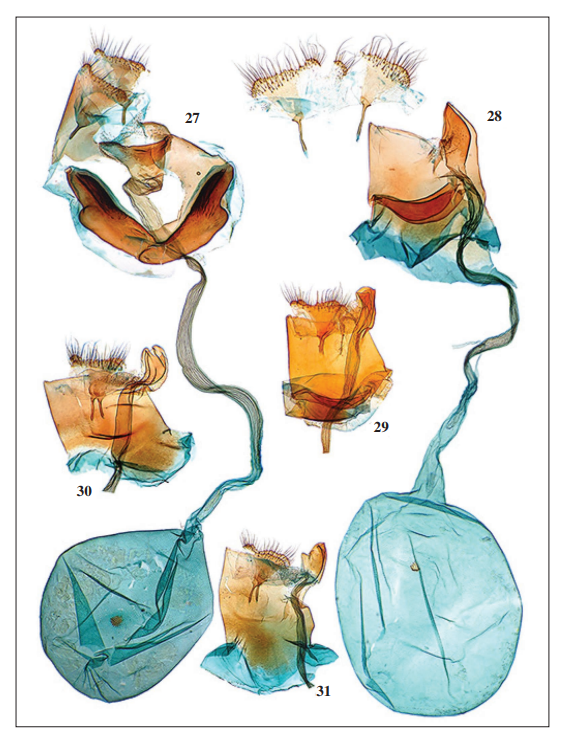
Figures 27-31.
Catoptria spp., female genitalia. 27.C. plitvicensis Bassi, sp. nov., holotype. 28. C. velebitica Bassi, sp. nov., holotype. 29. C. casperella Ganev, North Macedonia. 30.C. gozmanyi Błeszyński, paratype, Romania, Retyezát. 31.C. myella (Hübner), Slovenia.
Holotype female: CROATIA, Rastovača near Plitvice, 510 m, 44º54’N, 15º37’E, 2-3-VII-2007, G. Bassi leg., GS 4907 GB, RCGB.
Description: Wingspan 23 mm. Labial palpus 3.5 X eye diameter, downcurved distally, bronze ochre brown with inner side white. Maxillary palpus white. Antenna filiform, brown with costa bronze brown. Frons rounded, slightly produced, off-white. Chaetosemata fully developed. Ocelli small. Vertex white. Patagium white, pale brown laterally. Tegulae grey brown. Thorax white with edge brown. Wings with pattern and colours as illustrated (Figure 1). Underside of forewing brown, with subterminal area paler. Underside of hindwing off-white suffused with grey, with terminal line brown. Legs pale reddish brown, white on inner side; tibial spurs narrow, the external 0.5 as long as the internal.
Female genitalia (Figure 27): Papillae anales subtriangular, with sclerotized section narrowing dorsally. Apophyses posteriores subtriangular, 0.6 as long as papillae anales. Apophyses anteriores absent. Abdominal segment VIII large, sclerotized, with tergite higher than papilla + apophyses and sternite modified especially in the large basis and medial protuberance. Ostium bursae rounded, with sterigma only slightly produced ventrally. Ductus bursae 2.4 X as long as corpus bursae, sinuous, strongly wrinkled up to 0.8 of its length. Corpus bursae suboval, scobinate and with drop-like signum.
Male: unknown.
Diagnosis: The wing pattern is similar to that of the other species of the C. permutatella group with the medial stripe of the forewing interrupted by brown bands. However, the narrow brown bands, the single yellowish subapical dot along costa and the pale grey brown hindwing are distinctive features. The female genitalia are similar to those of C. spatulellus (Turati, 1919) (Bassi & Huemer, 2020, Figures 22-24), an Italian species with uniform white streak in the forewing, differing in having a large and rounded ostium bursae, with the sterigma only slightly produced ventrally and the basal plate of the sternite of abdominal segment VIII laterally sinuate and with strong medial protuberance as opposed to the strongly produced sterigma and the laterally stouter basal plate of the sternite of abdominal segment VIII and with lamellate medial protuberance in C. spatulellus.
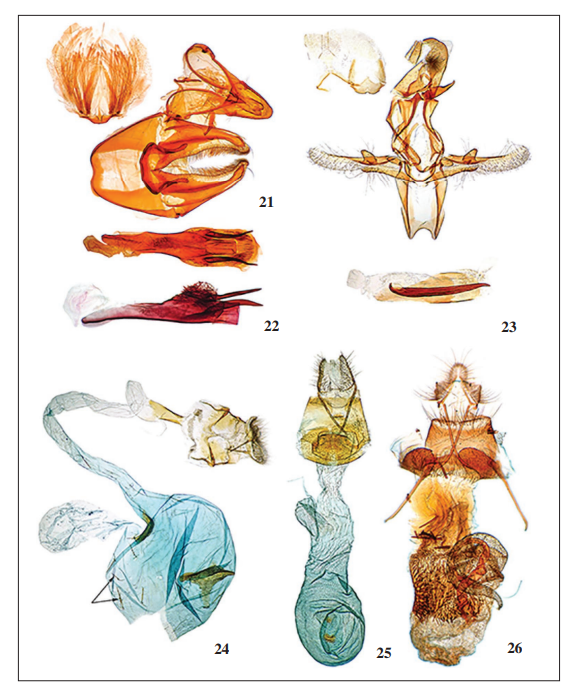
Figures 21-26.
Pyraloidea spp., male genitalia, culcita and female genitalia. 21. Pempelia alpigenella (Duponchel), male genitalia with aedeagus in dorso-ventral view, Italy, Susa Valley, Avigliana, (Torino Province). 22.Pempelia alpigenella (Duponchel), aedeagus in lateral view, Italy, Susa Valley, Mount Rocciamelone (Torino Province). 23.Bradyrrhoa gilveolella (Treitschke), male genitalia, Italy, Palanfré (Cuneo Province). 24. Crocidophora tuberculalis Lederer, female genitalia, Italy, Emilia-Romagna, Lido di Volano (Ferrara Province). 25.Euchromius subcambridgei Błeszyński, female genitalia, Italy, Sicily, Palazzolo Acreide (Syracuse Province). 26.Phycita torrenti Agenjo, female genitalia, Italy, Susa Valley, Avigliana (Torino Province).
Distribution: So far known only from the type locality
Etymology: The new species derives its name from the Plitvice lakes, which are very close to type locality
Catoptria velebitica Bassi, sp. nov. (Figures 2, 28)
Holotype ♀: CROATIA, Velebit Mts, 1 km W[est of] Brusane, 625 m, 44º30’N, 15º14’E, 27-VI2003, B. Skule & C. Hviid, GS 5526 GB, ZMUC.
Description: Wingspan 28 mm. Labial palpus 3 X eye diameter, downcurved distally, brown with inner side white. Maxillary palpus basally brown, then white. Antenna filiform, brown with costa pale bronze brown. Frons rounded, slightly produced, white. Chaetosemata pale brown, fully developed. Ocelli small. Vertex white. Tegulae pale ivory yellow. Thorax white. Wings with pattern and colours as illustrated (Figure 2). Underside of forewing bright yellow brown, with costa, apex and subterminal area off-white and with transversal bands of the upperside visible. Underside of hindwing white, with terminal line yellow brown; a large subterminal ill-defined brown band is clearly visible around apex and first part of termen, the same band hardly distinguishable on upper side of wing. Legs white with tarsi pale yellow, white on inner side; tibial spurs narrow, the external 0.7 as long as the internal.
Female genitalia (Figure 28): Papillae anales subtriangular, with sclerotized section narrowing dorsally. Apophyses posteriores slender, subtriangular, 0.8 as long as papillae anales. Apophyses anteriores absent. Abdominal segment VIII large, sclerotized, folded laterally. Ostium bursae cupshaped, sterigma pointed, strongly produced anteriorly. Ductus bursae 1.6 X as long as corpus bursae, sinuous, strongly wrinkled up to 0.7 of its length. Ductus seminalis branching at 0.7 length of ductus bursae. Corpus bursae large, suboval, scobinate and with small rounded signum.
Male: unknown.
Diagnosis: This species is distinguishable from other species of the C. permutatella group which a forewing medial stripe interrupted by brown bands in the more brown-grey ground colour of the forewing, being more reddish in the other species, for having both transverse brown bands proceeding, changing direction, beyond the medial stripe to the costa, and, in having two larger off-white spots postmedially along costa. Catoptria captiva Bassi, 1999 also has the forewing brown bands angled and traceable up to the costal edge, but it has a reddish-brown ground colour and a single subapical white dot. In the female genitalia the strongly produced sterigma and abdominal segment VIII strongly folded laterally distinguish C. velebitica from the related C. casperellaGanev, 1983, C. gozmanyiBłeszyński, 1956, and C. myella (Hübner, 1796) (Figures 29-31).
Distribution: So far known only from the type locality
Etymology: The new species derives its name from the Velebit Mountains, where the holotype was collected.
Euchromius subcambridgei Błeszyński, 1965 (Figures 3, 13, 25)
Material examined: 3 ♀, ITALY, Sicily, Caltanissetta, Umgebung [near] Gela, 37.085165, 14.192386, 30-VIII-2020, am Licht [at light], F. Graf leg., RCFG. 1 ♀, Sicily, Syracuse Province, Umg.[near] Palazzolo Acreide, 36.991583, 15.023972, 2-IX-2020 am Licht [at light], F. Graf leg., RCFG.
Distribution: Cape Verde Islands, Sudan, Tunisia (Schouten, 1992). New for Europe.
Remarks: A living specimen (Figure 13) and a pinned specimen (Figure 3), both from Palazzolo Acreide are illustrated. The female genitalia is rpresented in figure 25.
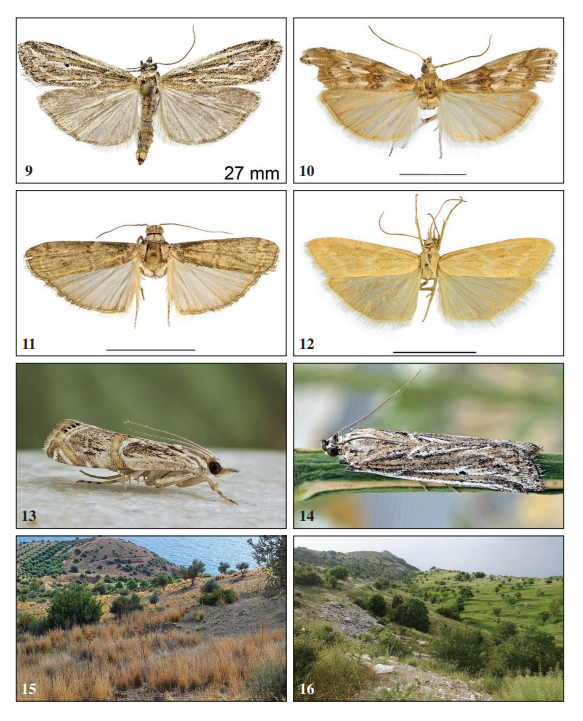
Figures 9-16.
Pyraloidea spp., habitus and habitat. Scale bar = 10 mm. 9.Arsissa firusella (Amsel), Albania, Gjirokastra District. 10. Pempelia alpigenella (Duponchel), Italy, Susa Valley, Mount Rocciamelone, (Torino Province). 11.Phycita torrenti Agenjo, Italy, Susa Valley, Avigliana, (Torino Province). 12. Bradyrrhoa gilveolella (Treitschke), Italy, Palanfré (Cuneo Province). 13. Euchromius subcambridgei Błeszyński, Italy, Sicily, Palazzolo Acreide (Syracuse Province). 14.Arsissa firusella (Amsel), Albania, Gjirokastra District. 15. Melathrix edmundsi Slamka, sp. nov., habitat. 16. Arsissa firusella (Amsel), habitat in Albania, Gjirokastra District.
Calamotropha paludella (Hübner, [1824]) (Figure 4)
Material examined: 1 ♀, ITALY, Sicily, Castellammare del Golfo (TP) [Trapani Province], Castello di Baida, 500 m, 1-5-X-2014, G. Bassi leg., RCGB.
Distribution: Cosmopolitan (except America). New for Sicily.
Remarks: The specimen is illustrated as Figure 4. This rather common moth was surprisingly not yet reported from Sicily. The examined female is a particularly small specimen with a wingspan of only 22 mm, versus females of an average wingspan of 29 mm on the Italian mainland.
Pyraustinae
Crocidophora tuberculalisLederer, 1863 (Figures 5, 24)
Material examined: 1 ♀, ITALY, Venetien, [Emilia-Romagna, Lido di Volano, Ferrara Province], Po Delta, -2 m, 44.812205, 12.252319, 2-VIII-2020, am Licht [at light], F. Graf leg., RCFG
Distribution: North America: Canada: Quebec, and U.S.A. from Eastern Texas eastwards to Atlantic coast (Moth Photographers Group, 2019). New for Europe.
Remarks: This adventive species was surely introduced by human activities, and more specimens will probably be discovered, as demonstrated by the presence of cornuti in the corpus bursae of the collected specimen (Figure 24, arrows) proves the presence of males. Also the caterpillars lives on rather ornamental bamboo plants (Arundinaria spp.).
Remarks: This specimen is illustrated as figure 5 and its female genitalia as figure 24.
Phycitinae
Gymnancyla canella ([Denis & Schiffermüller], 1775) (Figures 7, 17)
![Phycitinae spp., male genitalia and culcita.
17.Gymnancyla canella ([Denis & Schiffermüller]), Italy, Sardinia, Cabras
(Oristano Province). 18. Pempeliella ardosiella (Ragonot), Italy, Basilicata,
Mount Pollino (Potenza Province). 19. Melathrix edmundsi Slamka, sp. nov.,
holotype. 20.Arsissa firusella (Amsel), Albania, Gjirokastra District.](../0300-5267-shilap-53-209-189-gf7.png)
Figures 17-20.
Phycitinae spp., male genitalia and culcita. 17.Gymnancyla canella ([Denis & Schiffermüller]), Italy, Sardinia, Cabras (Oristano Province). 18. Pempeliella ardosiella (Ragonot), Italy, Basilicata, Mount Pollino (Potenza Province). 19. Melathrix edmundsi Slamka, sp. nov., holotype. 20.Arsissa firusella (Amsel), Albania, Gjirokastra District.
Material examined: 2 ♂, ITALY, Sardegna, Cabras [Oristano Province], lago [Lake] Mistras vicino al mare [near the sea], 1 m, 39,895º N, 8,459º E, 7-IX-2021, G. Longo Turri leg., GS 7380 GB, RCGB and Longo Turri Collection, 1 ♀, Puglia, Gargano, Capoiale [Cagnano Varano, Foggia Province], Strandnähe [near the beach], 5 m, 41.912059, 15.714298, 10-VIII-2020, am Licht [at light], F. Graf leg., RCFG.
Distribution: Europe, up to Denmark and U.K. and eastwards to the Urals. Turkey, North Africa (Roesler, 1973). In Italy previous records are from Liguria and the Po basin. New for South Italy and Sardinia.
Remarks: The male species is illustrated as figure 7; its male genitalia, culcita and sclerotization’s of abdominal segments 2-4 are illustrated as figure 17. The female specimen and its genitalia are illustrated on Lepiforum (2008-2024).
Gymnancyla hillneriellaGastón & Vives, 2018
Material examined: 1 ♂, 3 ♀: ITALY, Basilicata, Umgebung [near] Ferrandina [Matera Province], 227 m, 40.479273, 16.459486, 18-VIII-2020, am Licht [at light], F. Graf leg., RCFG.
Distribution: Spain. New for Italy.
Remarks: The adult and the male and female genitalia of these specimens are illustrated on Lepiforum (2008-2024).
Pempeliella ardosiella (Ragonot, 1887) (Figures 8, 18)
Material examined: 1 ♂, ITALY, Basilicata [Potenza Province], Mt Pollino, 1350 m, dint. [near] Rif[ugio] Pedarreto, 7-14-VII-1991, G. Bassi leg., GS 3871GB, RCGB.
Distribution: Gibraltar, Portugal, Spain, Southern France (Slamka, 2019). New for Italy.
Remarks: This specimen is illustrated as figure 8. The male and culcita in figure 18.
Pempeliella bulgarica Slamka & Plant, 2016
Material examined: 1 ♀, ITALY, Abruzzen, Umgebung [near] Menzano [L’Aquila, L’Aquila Province], 1094 m, 42.422538, 13.192740, 7-VIII-2020, am Licht, F. Graf leg., RCFG.
Distribution: Bulgaria, Albania, Hungary, Russia, Serbia, Turkey (Slamka, 2019). New for Italy.
Remarks: This specimen and its genitalia are illustrated on Lepiforum (2008-2024).
Melathrix edmundsi Slamka, sp. nov. (Figures 6, 15, 19)
Holotype ♂, Villa Xylia, 15-XI-2016, Agios Georgios, 74056, Crete [Greece]; leg[it] Henry Edmunds; GS 2161 F. Slamka, SNMB.
Description (Figure 6): Wingspan 23.9 mm. Antenna with short whitish cilia 1.2x as long as diameter of antenna. Base of flagellum with sinus surrounded by raised scales. Labial palpus about 1.5 X eye diameter. Frons, patagium, thorax, abdomen and legs ochre. Forewing ground colour ochre sprinkled with light brown along the costa, the cubital and medial veins and on the dorsum; apex darker, grey brown. Three distinct brownish spots in middle of cubital vein, and on radio-medial transverse vein (= discoidal spot), and a longitudinal fine blotch in middle of M1. Submarginal dots brown, placed in ochre-whitish fine line. Fringes brownish with two narrow logitudinal brown lines. Hindwings (quadrifid venation) off-white suffused with grey brown, more intensely along costa and termen, as a narrow line along dorsum. Fringes whitish with thin medial brownish line.
Male genitalia (Figure 19): Uncus broad, rounded. Gnathos triangular, pointed. Tegumen broad, 0.6 as long as vinculum. Vinculum U-shaped, distally concave. Transtilla well developed, narrow. Valva subtriangular, narrowing towards apex, with cucullus broadly rounded; costa basally with longitudinal cluster of well sclerotized spines (about 8-10) (Figure 19, arrow), (during dissection a separate thorn (Figure 19, arrow “?”) was found, probably broken off from this cluster of spines). Sacculus weakly sclerotized with longitudinal groves. Juxta oval, with two lateral slender lobes with delicate cilia apically. Anellus broad, slightly sclerotized. Phallus 1.5 X as long as valva, stout, with three cornuti, the first straight and short, the second longer, with the basal part broader and fusiform, the third, apically placed, strong and hooked; with several scobinations apically. Abdominal tergite VIII rounded with two paired, narrow sclerotized plates. Culcita well sclerotized with lateral pair of scale tufts. All other Melathrix spp. (M. coenulentella (Zeller, 1846), M. proteellaSlamka, 2019, M. cornutella (Amsel, 1951), M. fartakensis (Rebel, 1931), M. belutschistanella (Amsel, 1961)), known so far from the Western Palaearctic have distinctly different genitalia and forewing markings, see Slamka (2019, pp. 103-106, pls. 17, 58-60) and Amsel (1961, p. 368, fig. 87, pl. 3 fig. 171).
Female: unknown.
Diagnosis: Melathrix edmundsi sp. nov. is very similar in external characters to M. praetextella (Christoph, 1877) (Slamka, 2019, pl. 17, figs 110 a-h). Reliable identification from praetextella is possible based on the genitalia as follows: in praetextella (Slamka, 2019, pl. 58, figs110 a-c) the phallus has only two strong, slightly bent cornuti; a longitudinal cluster of sclerotized spines is absent; the sacculus has a narrow pointed tip; and the sclerotized base of the culcita is different, with a lateral pair of very long and thin scale tufts. All other Melathrix species have distincty different genitalia and forewing markings (see Slamka, 2019, pp. 103-106, pls. 17, 58-60).
Habitat and biology: Habitat (Figure 15) is xerothermic with grass and stone near the sea with mixed scrub and lentic bushes (Fabiaceae), and wild olives (H. Edmunds, pers. comm.). The specimen was collected in November. The preimaginal stages and host plant are unknown.
Distribution: So far known only from the type locality in Crete (Greece).
Etymology: The name of this species is dedicated to the English collector Henry Edmunds, who collected the new species.
Arsissa firusella (Amsel, 1961) (Figures 9, 14, 20)
Gnathomorpha firusellaAmsel, 1961. Ark. Zool., (2), 13, 373
Type locality: IRAN, Comé, Barm-i-Firus.
Material examined: 1 ♂, ALBANIEN, Qark Gjirokastra, Rruga Cajupit, 1251 m, 40.194812, 20.177663, 23-VI-2023, am Licht [at light], F. Graf leg., RCFG. 2 ♂. TURKEY, Prov. Ankara, 5 km S Sereflikochisar, 950 m, 5-V-2001, leg. Marek Dvorˇák, Collection I. RMGS.
Distribution: Iran. New for Europe and Turkey.
Remarks: Amsel (1961, p. 374) mentioned a single female paratype from a different locality (not yet traced), but it is not clear if this specimen belongs to A. firusella or to a different, similar species. Arsissa firusella should belong to the genus Pima based on morphological features, but the confirmation needs further study. This specimen is illustrated as figures 9 and 14, the male genitalia and culcita as figure 20, the habitat in Albania on figure 16.
Pempelia alpigenella (Duponchel, 1836) (Figures 10, 21, 22)
Material examined: 1 ♂, I[TALY]-Piemonte, Val Susa, Mompantero, Mt. Rocciamelone, 1100 m, 20-VI-1998, G. Bassi leg., GS 4413 GB, RCGB; 1 ♂, I[TALY]-Piemonte, Val Susa, Avigliana (TO), PNLA Sede, 340 m, 9-16-IX-2004, G. A. Bonicelli leg., GS 7285 GB, RCGB.
Distribution: South of France, Albania eastwards to Altai Mountains (Slamka, 2019). In Italy previous records are from Abruzzo and Romagna. New for Northwestern Italy.
Remarks: The specimen from Mompantero is illustrated as Figure 10, the male genitalia and culcita as Figures 21 (specimen from Avigliana) and 22 (specimen from Mompantero).
Phycita torrenti Agenjo, 1962 (Figures 11, 26)
Material examined: 1 ♀, I[TALY]-Piemonte, Val Susa, Avigliana (TO), PNLA Sede, 340 m, 9-16- IX-2004, G. A. Bonicelli leg., GS 7286 GB, RCGB.
Distribution: Spain, Southern France, Portugal and from Croatia to Turkey (Slamka, 2019). New for Italy.
Remarks: The specimen collected is illustrated as figure 11, and its female genitalia as figure 26.
Bradyrrhoa gilveolella (Treitschke, 1833) (Figures 12, 23)
Material examined: 1 ♂, I[TALY]-Piemonte, Vernante (CN), Palanfré, 1400 m, 44º11’N, 07º50’E, 16-VII-1982, G. Bassi leg., GS 864 GB, RCGB.
Distribution: Sicily (old data, not reported recently), Albania and Eastwards to Kirghizstan. (Roesler, 1993). New for continental Italy.
Remarks: The specimen collected in Western Piedmont (Figure 12) enlarges the distribution area far to the west. The male genitalia (Figure 23) slightly differ from those of eastern specimens but considering the absence of additional material and the poor nomenclatural stability, the Treitschke type being lost, we consider the differences as falling within the normal range of intraspecific variability.
Acknowledgments
The first author is grateful to Michele Ottino for issuing the necessary permits for The Cottian Alps Nature Parks (province of Torino, Italy), to Debora Barolin and especially to Gian Abele Bonicelli for the great support in the field work of research in the Avigliana Lakes Natural Park. We also want to thank O. Karsholt (ZMUC), Giuseppe Longo Turri (Verona, Italy) and Ignác Richter (Malá Gausa, Slovakia) for the loan and gift of material, and Dr. Antonio Vives for translating the abstract into Spanish.
References
Agenjo, R. (1962). Phycita torrenti nov. sp. un desconocido lepidóptero español de la encina (Q. Ilex L.). Boletín del Servicio de Plagas Forestales, 5(10), 76-86, pl. 1.
Amsel, H. G. (1951). Die Microlepidopteren der Brandt‘schen Iran-Ausbeute. 3. Teil. Arkiv för Zoologi (N.S.), 1(36) (ser. 2), 525-563.
Amsel, H. G. (1961). Die Microlepidopteren der Brandt’schen Iran-Ausbeute. 5. Teil. Arkiv för Zoologi N. S. 13(17) (ser. 2), 323-445, pls. 1-9.
Bassi, G. (1999). Note sulle Crambinae Paleartiche con la descrizione di tre nuove specie (Lepidoptera: Pyraloidea, Crambinae). SHILAP Revista de lepidopterología, 27(107), 349-360.
Bassi, G., & Huemer, P. (2020). Notes on some Catoptria Hübner, 1825 (Crambidae, Lepidoptera) from the Central Apennines (Italy), with the descriptions of Catoptria samnitica sp. nov. and the male of Catoptria apenninica Bassi, 2017. Nota lepidopterologica, 43, 253-263. https://doi.org/10.3897/nl.43.52520
Błeszynski , S. (1956). Materialen zur Kenntnis der Crambidae. Teil XIII. Über die Gattung Catoptria Hbn. und eine neue europäische Art diese Gattung. Zeitschrift der Wiener entomologischen Gesellschaft, 41, 213-218.
Błeszynski , S. (1965). Crambinae. In H. G. Amsel, F. Gregor, H. Reisser (eds). Microlepidoptera Palaearctica (Vol. 1). Georg Fromme & Co.
Christoph, H. T. (1877). Sammelergebnisse aus Nordpersien, Krasnowodsk in Turkmenien und dem Daghestan. Horae Societatis entomologicae Rossicae, 12, 181-299, pls. 5-8.
[Denis, M., & Schiffermüller, I.] (1775). Ankündung eines systematischen Werkes von den Schmetterlingen der Wienergegend herausgegeben von einigen Lehrern am k. k. Theresianum. Augustin Bernardi.
Duponchel, P.-A.-J. (1836 [1837]). Nocturnes 7. Histoire naturelle des Lépidoptères ou Papillons de France (Vol. 10). Firmin Didot Frères.
Ganev, J. (1983). Zur Systematik der Crambidae (Lepidoptera) der Balkan-Halbinsel (1). – Zeitschrift der Arbeitsgemeinschaft Österreichischer Entomologen, Vienna 34 (1982) (3-4): 123-125.
Gastón, J., & Vives Moreno, A. (2018). Revisión del género Gymnancyla Zeller, 1848 en España continental y descripción de una nueva especie (Lepidoptera: Pyralidae, Phycitinae). SHILAP Revista de lepidopterología, 46(183), 505-517. https://doi.org/10.57065/shilap.802
Hübner, J. (1796-[1836]). Sammlung europäischer Schmetterlinge. Augsburg. https://doi.org/10.5962/bhl.title.39974
Klots, A. B. (1970). Lepidoptera. In S. L. Tuxen (ed.). Taxonomist’s glossary of genitalia in insects. 2nd Revised and Enlarged Edition. Jørgensen & Co.
Lederer, J. (1863). Beitrag zur Kenntniss der Pyralidinen. Wiener Entomologische Monatschrift, 7(8), 243-280; (1012), 331-504, pls 2-18.
Lepiforum e.V. (2008-2024). E. Rennewald & J. Rodeland et al. (ed.). http://www.lepiforum.de/lepiwiki.pl? Schmetterlingsfamilien_Europa
Moth Photographers Group (2019). http://mothphotographersgroup.msstate.edu
Ragonot, E. L. (1887). Diagnoses d’espèces de Phycitidae d’Europe et des pays limitrophes. Annales de la Société Entomologique de France, (6)., 224-260.
Rebel, H. (1931). Zoologische Ergebnisse der Expedition der Kaiserlichen Akademie der Wissenschaften nach Südarabien und Sokótra im Jahre 1898/99. Lepidopteren (mit 1 Tafel und 41 Textfiguren). Denkschriften der Kaiserlichen Akademie der Wissenschaften Mathematisch-Naturwissenschaften Klasse, 71(2), 31-1
Roesler, R. U. (1973). Phycitinae. 1. Teilband: Trifine Acrobasiina. In H. G. Amsel, F. Gregor & H. Reisser. Microlepidoptera Palaearctica (Vol. 4). Verlag Georg Fromme & Co.
Roesler, R.-U. (1990). Drei neue Taxa für die quadrifinen Acrobasiina sowie die neue Check-Liste für Arsissa Ragonot 1893 (Lepidoptera: Pyraloidea: Phycitinae). Entomologische Zeitschrift, 100(3), 33-47.
Roesler, R.-U. (1993). Phycitinae. Teilband 2. Quadrifine Acrobasiina. In H. G. Amsel, F. Gregor, H. Reisser & R.U. Roesler. Microlepidoptera Palaeartica (Vol. 8). G. Braun Druckerei und Verlag.
Schouten, R. T. A. (1992). Revision of the genera Euchromius Guenée and Miyakea Marumo (Lepidoptera: Crambidae: Crambinae). Tijdschrift voor Entomologie’s, 135, 191-274.
Slamka, F. (2019). Phycitinae Part 1. Pyraloidea of Europe (Lepidoptera) (Vol. 4(1)). F. Slamka Ed.
Slamka, F., & Plant, C. W. (2016). Pempeliella bulgarica sp. nov.: A new species closely related to Pempeliella sororiella (Zeller, 1839) (Pyraloidea, Pyralidae, Phycitinae) and some new synonymies. The Entomologist’s Record and Journal of Variation, 128(2), 99-111.
Treitschke, F. (1833). Die Schmetterlinge von Europa (Fortsetzung des Ochsenheimer’schen Werks). Ernst Fleischer.
Turati, E. (1919). A 1000 metri sull’Appenino Modenese. Note di Lepidotterologia e descrizione di tre nuove specie di Micri. Atti della Società Italiana di Scienze Naturali e del Museo Civico di Storia Naturale, 58, 147-187.
Zeller, P. C. (1846). Die knotenhornigen Phyciden nach ihren Arten beschrieben. Isis von Oken, 1846(10), 729-788.
Author notes
a Autor para correspondencia: alphacrambus@gmail.com