Artículos
Platynota stultana Walsingham, 1884 a new record for Malta (/HSLGRSWHUDTortricidaeTortricinae, Sparganothini)
Platynota stultana Walsingham, 1884 nuevo para Malta (Lepidoptera: Tortricidae, 7RUWULFLQDHSparganothini)
 Anthony Seguna seguna@onvol.net
John J. Borg john.j.borg@gov.mt
Paul Sammut farfett@onvol.net
Anthony Seguna seguna@onvol.net
John J. Borg john.j.borg@gov.mt
Paul Sammut farfett@onvol.net
Platynota stultana Walsingham, 1884 a new record for Malta (/HSLGRSWHUDTortricidaeTortricinae, Sparganothini)
Shilap Revista de Lepidopterología, vol. 53, no. 209, pp. 209-211, 2025
Sociedad Hispano-Luso-Americana de Lepidopterología
Received: 26 March 2024
Accepted: 02 June 2024
Published: 30 March 2025
Abstract: Platynota stultana Walsingham, 1884 is reported for the first time from the Maltese Islands. A Maltese name is proposed for this new record.
Keywords: Lepidoptera, Tortricidae, Platynota stultana, Maltese Islands.
Resumen: Platynota stultana Walsingham,1884 se menciona por primera vez para Malta. Se propone un nombre maltés para este nuevo registro.
Palabras clave: Lepidoptera, Tortricidae, Platynota stultana, Malta.
Introduction
Platynota stultana Walsingham 1884, is a member of the family Tortricidae. It is native to the northwestern part of Mexico and the adjacent southwestern part of the USA (Powell, 1983). Since the mid-1980s, it has also established itself in Hawaii (Miller & Hodges, 1995).
Platynota stultana was initially recorded in Europe in 2009, specifically in Spain’s Murcia and Almeria provinces, through routine agricultural area monitoring conducted by pest control services. It was predominantly found infesting Capsicum sp. (Solanaceae) during this surveillance period (Groenen & Baixeras, 2013).
Although there was no published literature in entomological journals, Spanish popular electronic agricultural journals and leaflets have included information on this pest and provided details on its distribution and its potential control in Spain (Hymenoptera, 2011). Records in Spain state that it was actually discovered between 2005 and 2008 in parallel fieldworks in the provinces of Almeria, Alicante, and Granada (Groenen & Baixeras, 2013).
In the UK, a single larva of Platynota stultana was found at a plant nursery during 2004 (Korycinska & Eyre, 2013; Agassiz & Feltwell, 2020, both cited in Trematerra & Colacci, 2022). In June 2018, a pupa of Platynota stultana was discovered in Germany on Capsicum sp., imported from Spain (Lepiforum, 2024). In Italy especially in Apulia, Saline near Zapponeta, observations were made during 2020 to 2022 and recorded by Trematerra & Colacci (2022). The status of Platynota stultana in other European countries indeed remains uncertain, highlighting the need for additional research and monitoring efforts to understand its distribution and its potential impact across the continent.
This species is highly polyphagous and was reported to feed on over 100 plant species belonging to 30 different families. As Platynota stultana feeds in agricultural and horticultural settings, invading garden and ornamental plants, fruit trees and vegetables, it is recognised as an important pest of both greenhouses and fields (Trematerra & Colacci, 2022).
Material examined
MALTA, 1 ♀, Żebbuġ, 13-II-2024, 35º52’5.86”N,14º26’20.35”E [at light], A. Catania leg; (in coll. A. Catania).
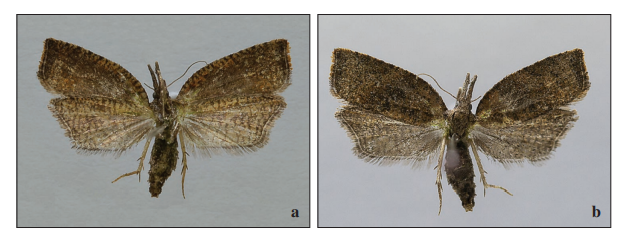
Figure 1.
a) Underside. b) Upperside of Platynota stultana Walsingham,1884 - MALTA, Żebbuġ, 1 ♀, 13-II-2024.
Discussion
From the Maltese Islands no less than 74 species of Tortricidae have been recorded (Sammut, 2020), with the latest addition being Clavigesta gerti Larsen, 2010 (Seguna et al. 2022).
The occurrence of Platynota stultana in Malta is not a surprise as many ornamental flowers and agricultural crops are imported regularly from both neighbouring countries across Europe and beyond. This small moth, which can measure between 12-25 mm, is very easily overlooked while inspecting vegetative matter, especially because its larvae form small silken tubes between leaves and folds of plants. Platynota stultana prefers to feed on certain agricultural crops, particularly grapes and greenhouse fruits and vegetables like tomatoes, and this highlights its potential impact on agricultural production. This species poses a significant threat as it targets ripening bunches of grapes, where larvae can break the skin of the berries, facilitating the initiation of rot by yeast and fungi. Furthermore, Platynota stultana demonstrates also a preference for crops belonging to the Solanaceae family, including species like capsicum and aubergines. This feeding behaviour could lead to substantial losses in yield and quality for farmers cultivating these crops (Trematerra & Colacci, 2022).
The species is new to the Maltese Lepidopterofauna, and we propose the Maltese name Platinota.
Acknowledgments
The authors are grateful to Dr. Pasquale Trematerra (University of Molise, Italy), for his support and Frantisek Slamka (Slovakia), for the identification of the species.
References
Agassiz, D. J. L. & Feltwell, J. (2020). Platynota stultana Walsingham, 1884 (Lepidoptera: Tortricidae): An adventive species newly recorded from Britain. The Entomologist’s Record Journal of Variation, 132(4), 202203.
Groenen, F. & Baixeras, J. (2013). The “Omnivorous Leafroller”, Platynota stultana Walsingham, 1884 (Tortricidae: Sparganothini), a new moth for Europe. Nota lepidopterologica, 36(1), 53-55.
Hymenoptera (2011). Platynota stultana, un nuevo lepidóptero plaga en el sudeste español. Homo agrícola, 1, 3338.
Korycinska, A., Baker, R., Eyre, D., Matthews-Berry, S., & Tuffen, M. (2015). Rapid Pest Risk Analysis (PRA) for Platynota stultana. Department for Environment, Food and Rural Affairs.
Lepiforum (2024). Bestimmung von Schmetterlingen und ihren Präimaginalstadien, 2024 - Platynota stultana Walsingham, 1884, Bestimmungshilfe für die in Europa nachgewiesenen Schmetterlingsarten. https://lepiforum.org/wiki/page/Platynota_stultana.
Miller, S. E., & Hodges, R. W. (1995). Platynota stultana, the omnivorous leafroller, established in the Hawaiian Islands (Lepidoptera: Tortricidae). Bishop Museum Occasional Papers, 42, 36-39.
Powell, J. A. (1983). Expanding geographical and ecological range of Platynota stultana in California. Pan-Pacific Entomologist, 59(1-4), 233-239.
Sammut, P. M. (2020). Systematic and Synonymic list of the Lepidoptera of the Maltese Islands. Malta.
Seguna, A., Catania, A., Borg, J. J., & Sammut, P. (2022). Note on the presence of Clavigesta gerti Larsen, 2010 in the Maltese Islands (Lepidoptera: Geometridae). SHILAP Revista de lepidopterología, 50(199), 449-441. https://doi.org/10.57065/shilap.60
Trematerra, P., & Colacci, M. (2022). Platynota stultana Walsingham, 1884 (Lepidoptera, Tortricidae) found in Italy, invasive pest in Europe. Redia, 105, 183-189. https://doi.org/10.19263/REDIA-105.22.23
Author notes
a Autor para correspondencia: aldocatania47@gmail.com