Abstract: Lampronycteris is a monotypic genus distributed throughout the Neotropical region. Brazil presents the largest number of reports of L. brachyotis, most of which occur within Amazonia, with only limited records in Cerrado and Atlantic Forest. The present report provides an updated distribution of L. brachyotis in these three biomes, including the first records for the states of Rondônia and Goiás and additional records in the states of Mato Grosso, Pará and São Paulo. We highlight that mesic areas in open formations such as Cerrado might support relictual populations of L. brachyotis, highlighting the importance of these areas for bat diversity.
Keywords:AmazonAmazon,Atlantic ForestAtlantic Forest,CerradoCerrado,ChiropteraChiroptera,DistributionDistribution,Orange-throated batOrange-throated bat.
Resumen: Lampronycteris es un género monotípico de amplia distribución en la región neotropical. Brasil tiene el mayor número de registros de L. brachyotis concentrados en la Amazonía y solo unos pocos registros en el Cerrado y Bosque Atlántico. Este artículo ofrece una actualización de la distribución de L. brachyotis en estos tres biomas, con el primer registro en Rondônia y Goiás, y registros adicionales en los estados de Mato Grosso, Pará y São Paulo. Con los registros presentados aquí, destacamos que los ambientes mésicos presentes en bosque estacional seco, como el Cerrado, pueden mantener poblaciones relictuales de L. brachyotis, destacando la importancia de estas áreas para la diversidad de murciélagos.
Palabras clave: Amazonía, Bosque Atlantico, Cerrado, Chiroptera, Distribución, Murciélago orejón de garganta amarilla.
NEW RECORDS OF Lampronycteris brachyotis IN BRAZIL
Nuevos registros de Lampronycteris brachyotis en Brasil
Sociedad Argentina para el Estudio de los Mamíferos
Received: 21 December 2015
Accepted: 07 March 2016
The orange-throated bat Lampronycteris brachyotis (Dobson, 1879), originally treated as subgenus within Micronycteris Gray, 1866 (Sanborn, 1949), is now considered the single representative of the genus Lampronycteris Sanborn, 1949 (Simmons, 2005). This decision was based on morphological data (Simmons and Voss, 1998) and later consolidated in studies using morphological, karyological, and molecular data (Wetterer et al., 2000). Therefore, nowadays, it is considered a wide distributed monotypic genus in Neotropical region (Williams and Genoways, [2008]).
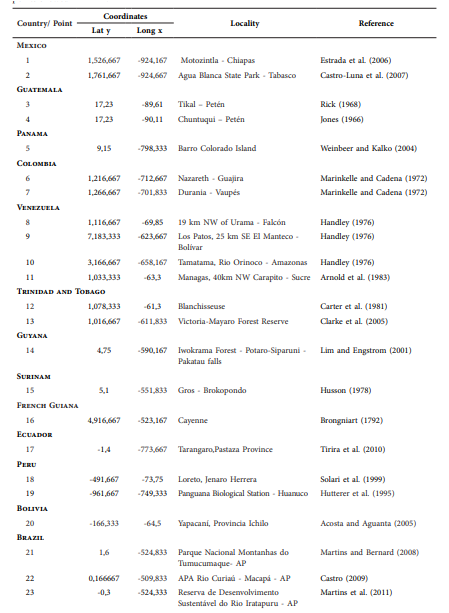
The current known distribution of L. brachyotis ranges throughout southern Mexico, Guatemala, Panama, Colombia, Venezuela, Bolivia, Trinidad and Tobago, Guyana, Suriname, Ecuador, Peru, and Brazil (Weinbeer and Kalko, 2004; Acosta and Aguanta, 2005;Simmons, 2005;Williams and Genoways, [2008]; Tirira et al., 2010). Most of the reports for the species are in Brazil, with records through the Amazon in the states of Acre, Amazonas, Amapá, Mato Grosso, and Pará (Sampaio et al., 2003;Bernard et al., 2011a;Miranda et al., 2015). There are scarce reports for the Atlantic Forest, most of them from the state of São Paulo (Taddei and Pedro, 1996; Gimenez and Ferrarezzi, 2004;Geraldes, 2005), and only one record in each of the following states: Bahia (Faria et al., 2006), Espírito Santo (Peracchi and Albuquerque, 1993), and Paraná (Scultori et al., 2009). Finally, recent reports have mentioned this species to be present in the Cerrado formations of the state of Mato Grosso (Louzada et al., 2015;Oliveira and Faria, 2015)(Fig. 1; Table 1).
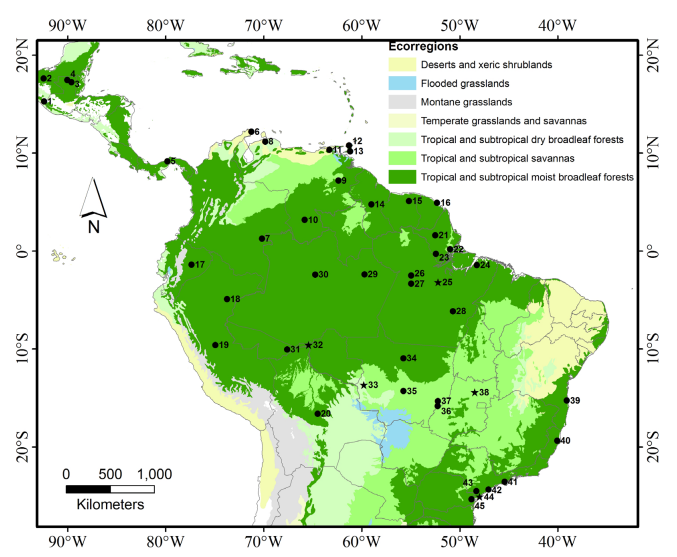
Fig. 1
Map showing the known localities for L. brachyotis. Stars represent the new records here presented and circles are records taken from literature. Localities numbered as in Table 1.
Localities at which the occurrence of the L. brachyotis has been confirmed. The code numbers refer to the points showed in Fig. 3.
Herein, we provide additional records of L. brachyotis for São Paulo, Pará and Mato Grosso, and the first record for the states of Rondônia and Goiás. All these records fill gaps in the distribution of the species in Brazil and improve the knowledge about its habitat usage.
We recorded five specimens of L. brachyotis (Fig. 1; Table 1), two from the Cerrado, two from the Amazon, and one from the Atlantic Forest (detailed information in Table 2). All individuals were netted at ground level and handled in accordance with Sikes et al. (2011), fixed in 10% formaldehyde and preserved in 70% ethanol, and the skulls were removed and cleaned (Fig. 2). External and cranial measurements are in Table 3. The specimens are housed at the zoological collections of the Museu de Zoologia da Universidade de São Paulo (MZUSP) and of the Universidade Federal de Goiás (MZUFG).
Lampronycteris brachyotis is a peculiar species of the subfamily Micronycterinae (sensu Baker et al., 2003), easily distinguished by its small (less than 16 mm) and peculiar shaped ears (short and pointed; see Fig. 3); calcar about the same length as the foot; upper incisors chisel shaped and in line with canines; second phalanx of the middle finger conspicuously longer than the first; the dorsal pelage is orange while the ventral is yellowish-orange; the lower rim of the horseshoe of the noseleaf is defined by a ridge; and the lower lip presents two smooth tubercles separated by a V-shaped groove (see Fig. 3) (Dobson, 1879;Williams and Genoways, [2008]).
Our specimens include one nonreproductive female, collected in July (from Goiás), one lactating female in October (from Rondônia), and one post-lactating female in August (from Mato Grosso) (Table 2). The literature reports lactating females in July (from Mexico; Estrada et al., 2006), and pregnant and lactating females in July (from Guatemala; Rick, 1968).
In spite of the fact that the wide distribution of L. brachyotis includes both the Atlantic Forest and the Amazon in Brazil, until recently there was a large gap of records between those areas (see Williams and Genoways, [2008]). That gap corresponds to dry/open vegetation areas, such as Caatinga and Cerrado. Recently, Rocha et al. (2015), using distribution models of forest dwelling bats, predicted a pattern of low suitability for L. brachyotis in dry seasonal forest areas, suggesting that its presence along the Cerrado and Caatinga would be associated to mesic phytophysiognomies, sparsely found within these biomes. Corroborating this statement, both recent records from Cerrado (Louzada et al., 2015; Oliveira and Faria, 2015) are from gallery forest. Furthermore, two of the new records provided here (Comodoro and Niquelandia), although coming from areas of Cerrado sensu stricto, are comprised within regions characterized by a complex of phytophysiognomies, including mesic areas.
It is possible that these mesic savanna areas may be acting as stepping-stones (i.e. discontinuous patches that connect otherwise isolated patches) between more suitable biomes to L. brachyotis, such as the Amazon and Atlantic Forest, and can explain the occurrence and persistence of this rare species in the Cerrado (see Irwin and Taylor, 2000; Loehle, 2007). Alternatively, they may represent isolated local populations. Additional sampling and markrecapture data are needed to document the distribution and understand the demography of this species in the area (see Bernard et al., 2011b). With the recent literature records and additional ones reported here, we highlight that mesic areas in semiarid vegetation such as Cerrado and Caatinga, might support peripheric and relictual populations or assist in dispersion.
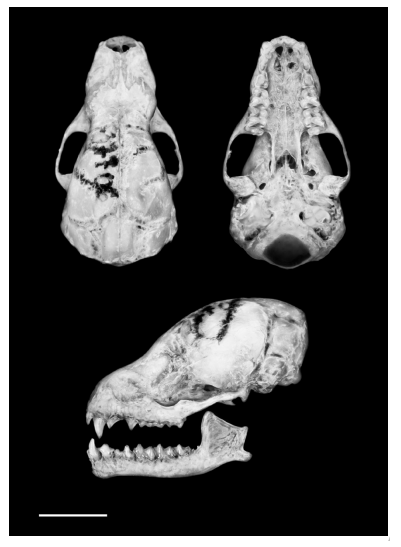
Fig. 2
Dorsal, ventral and lateral views of the skull and lateral view of the mandible of Lampronycteris brachyotis (MZUSP 27706) from Ilha do Cardoso, São Paulo, Brazil. Scale bar = 6 mm.
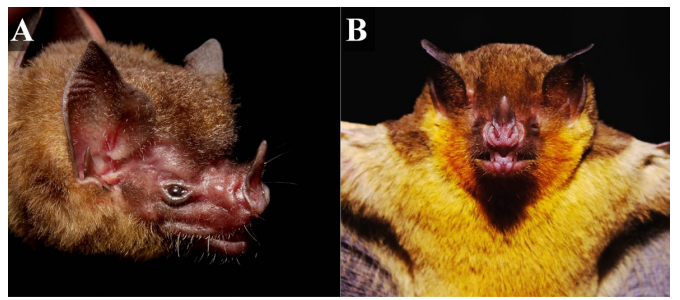
Fig. 3
Live individuals of Lampronycteris brachyotis. A – From Porto Velho, Rondônia (MZUSP 35420). B - From Comodoro, Mato Grosso. Note the peculiar shape of the ears (short and pointed), the yellowish-orange pelage, the lower rim of the horseshoe of the noseleaf defined by a ridge, and presence of two smooth tubercles separated by a V-shaped groove at the lower lip.
Information about the five specimens of Lampronycteris brachyotis reported in the present study.
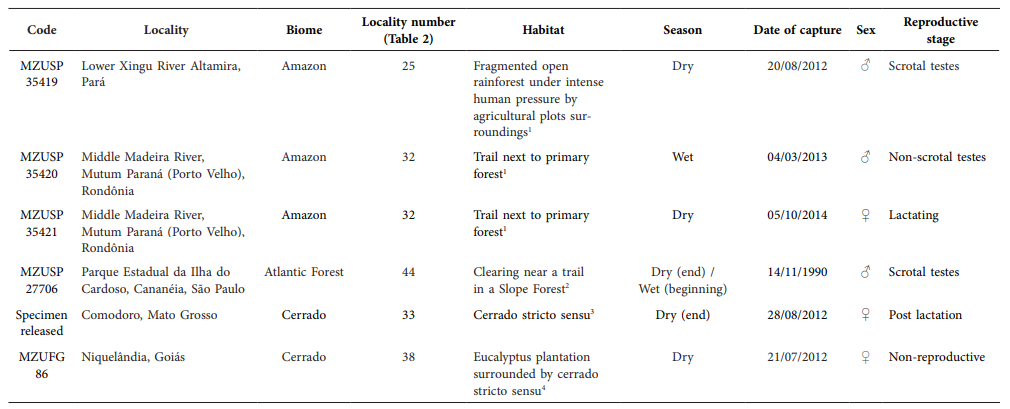
1 Original vegetation refers to Dense Alluvial Ombrophilous Forest according to Veloso et al. (1991)
2 Specimen not captured by the present authors, for details of the area see unpublished thesis of Fazzolari-Corrêa (1995).
3 Located at a transitional area between Cerrado and Amazonia, where moist and flooded vegetation predominates (see Santos et al., 2000).
4Brooks et al., (1990) characterized the region as a vegetation complex with forestry, savannah and grassland formations
Sex, external and cranial measurements of the Lampronycteris brachyotis specimens collected during the present study.
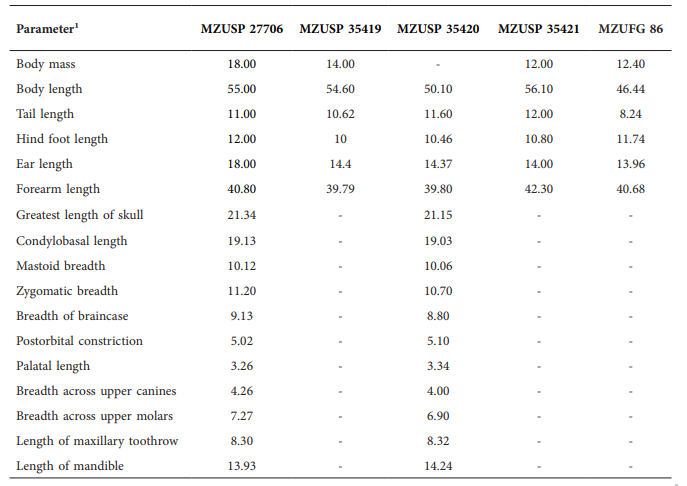
1 Based on Vizotto and Taddei (1973).
We are grateful to Arcadis Logos S/A for field campaigns, to Dr. Mario de Vivo and Juliana Gualda de Barros from MZUSP, to Paulo B. Passos Filho and Thais C. Lira for the help during fieldworks, to Anglo American pcl Company for financial support for the field work carried out in Niquelândia municipality, as well as the biodiversity project in partnership between Universidade Federal de Goiás and Anglo American. Additionally we thank Instituto Chico Mendes for the licenses provided for field works. PAR (processes 501701/2013–3 and 150407/2015–7) thanks CNPq for research stipends.
Fig. 1
Map showing the known localities for L. brachyotis. Stars represent the new records here presented and circles are records taken from literature. Localities numbered as in Table 1.
Localities at which the occurrence of the L. brachyotis has been confirmed. The code numbers refer to the points showed in Fig. 3.
Fig. 2
Dorsal, ventral and lateral views of the skull and lateral view of the mandible of Lampronycteris brachyotis (MZUSP 27706) from Ilha do Cardoso, São Paulo, Brazil. Scale bar = 6 mm.
Fig. 3
Live individuals of Lampronycteris brachyotis. A – From Porto Velho, Rondônia (MZUSP 35420). B - From Comodoro, Mato Grosso. Note the peculiar shape of the ears (short and pointed), the yellowish-orange pelage, the lower rim of the horseshoe of the noseleaf defined by a ridge, and presence of two smooth tubercles separated by a V-shaped groove at the lower lip.
Information about the five specimens of Lampronycteris brachyotis reported in the present study.
1 Original vegetation refers to Dense Alluvial Ombrophilous Forest according to Veloso et al. (1991)
2 Specimen not captured by the present authors, for details of the area see unpublished thesis of Fazzolari-Corrêa (1995).
3 Located at a transitional area between Cerrado and Amazonia, where moist and flooded vegetation predominates (see Santos et al., 2000).
4Brooks et al., (1990) characterized the region as a vegetation complex with forestry, savannah and grassland formations
Sex, external and cranial measurements of the Lampronycteris brachyotis specimens collected during the present study.
1 Based on Vizotto and Taddei (1973).
