SECCIÓN ESPECIAL - NOTA
Recepción: 20 Septiembre 2020
Aprobación: 02 Diciembre 2020
Abstract: We report the southernmost locality for the sigmodontine rodent Deltamys kempi Thomas, 1917, in Arroyo Las Tijeras (36°22’43” S, 56°50’12” W, General Lavalle county) near the coast of Buenos Aires province (Argentina), extending the range of the species ca. 150 km S. This record is a wake-up call about the presence of Brazilian fauna well beyond their southernmost suspected limit. Several lines of evidence point to considering D. kempi as a very recent immigrant in Argentina.
Keywords: Akodontini, Buenos Aires, Río de la Plata.
Resumen: Reportamos la localidad más austral para el roedor sigmodontino Deltamys kempi Thomas, 1917: Arroyo Las Tijeras (36°22’43” S, 56°50’12” W, Partido de General Lavalle), cerca de la costa de la Provincia de Buenos Aires (Argentina), extendiendo el rango geográfico de la especie ca. 150 km hacia el sur. Este registro constituye una llamada de alerta acerca de la presencia de fauna brasílica bastante más al sur que lo sospechado. Varias líneas de evidencia indican que D. kempi puede ser un inmigrante muy reciente en la fauna Argentina.
Palabras clave: Akodontini, Buenos Aires, Río de la Plata.
Deltamys is an akodontine genus endemic to the Rioplatan area (Argentina and Uruguay) and Rio Grande do Sul (Brazil; Pardiñas & Teta 2015). It was for many years subsumed under Akodon, despite its early recognition by Thomas (1917), but today is considered a distinct genus. This status is supported by several morphological, karyological, and, to a lesser extent, molecular synapomorphies (Thomas 1917; Massoia 1964; Gentile De Fronza et al. 1981; Sbalqueiro et al. 1984; Castro et al. 1991; Bianchini & Delupi 1994; González & Massoia 1995; D’Elía et al. 2003; Smith & Patton 2007; Teta et al. 2007; Quintela et al. 2017). Furthermore, a recently described Brazilian species was added to the diversity of the genus (Deltamys araucaria; see Quintela et al. 2017; Pardiñas 2018) so that it is no longer considered monotypic. Also, strong evidence suggests the existence of still undescribed species for other populations in Brazil (Montes et al. 2008; Ventura et al. 2011; Quintela 2014). Populations from Argentinean and Uruguayan territories are referred to the type species, D. kempi, applying the subspecies D. k. kempiThomas, 1917, and D. k. langguthiGonzález and Massoia, 1995, respectively (see González & Pardiñas 2002).
In Argentina, D. kempi occurs in a very narrow coastal band from approximately 34° S to 35° S, characterized by riparian vegetation and periodic flooding (Pardiñas & Teta 2015). The southernmost previously known occurrence for this mouse was described by Udrizar Sauthier et al. (2005) at Reserva El Destino (35°08’ S; 57°23’ W; Buenos Aires province, Argentina). Here we document a new locality, listed in Pardiñas and Teta (2015:220) that substantially extends (ca. 150 km S) the southern limit to the south corner of Samborombón Bay (Fig. 1).
A single collecting trip at a small creek (Arroyo las Tijeras, Province of Buenos Aires; Fig. S1) produced 12 sigmodontine rodents identified in the field as Oxymycterus rufus (1 specimen) and Akodon azarae (11). This material was initially preserved in fluid, and in a subsequent parasitological examination by Marcela Lareschi a typical Deltamys mite (see Lareschi & Gettinger 2009) was collected from a very young specimen of those which had been referred to A. azarae. A detailed inspection of this animal (housed at Colección de Mamíferos del Centro Nacional Patagónico [CNP]; Puerto Madryn, Chubut, Argentina) confirmed its identification as D. kempi, further reinforced when the skull was removed and cleaned. Here we describe molars following Reig (1977).
The specimen (CNP 2377) is preserved as a cleaned skull and the carcass in fluid. It is a male and was collected in Arroyo las Tijeras, General Lavalle, Buenos Aires (36°22’43” S, 56°50’12” W, 1 m a.s.l.) by one of the authors (MR) on 23 October, 2008. Since the CNP 2377 is a very young individual with the third upper molar lacking wear (Fig. 2A), useful external characters to distinguish D. kempi from other small akodontines (e.g., Akodon; see Massoia 1964), such as the velvety fur or the small eye are not fully expressed. However, a set of craniodental traits permits a supported identification, including very narrow zygomatic plate, narrow parapterygoid plates, and a unique configuration of the occlusal surface of the molars. The latter are characterized by a typical “bilobed” pattern in the first lower molar, clearly present from young (Fig. 2C) to old individuals (Fig. 2E), including an ephemeral metaflexid, an early fusion between procingulum and metaconid, a very shallow anteromedian flexid, and a late emerging median murid. Differences with respect the sympatric Akodon azarae are trenchant (e.g., well-developed anteromedian flexid, large anterolabial cingulum; Fig. 2D).
Misidentification of D. kempi as A. azarae and Necromys obscurus is a recurrent topic and highlights the external resemblances among these akodontines. Massoia (1961) reported N. obscurus from northeastern Buenos Aires province based on a D. kempi specimen (see Massoia 1964). The animals referred to N. obscurus by Barlow (1969) represent largely D. kempi (see Ximénez et al. 1972:24). Barlow (1969:23) tacitly advanced the synonymy between both species, indicating “I examined the types of A. obscurus [Necromys obscurus] and A. kempi [Deltamys kempi] in the British Museum (Nat. Hist.) and found the type of the latter to be a subadult specimen of obscurus.” Here, we were “rescued” from a mistake thanks to parasitological evidence.
Contrary to the widespread occurrence of D. kempi in Uruguay (see González & Martínez Lanfranco 2010; and the references cited therein), the species in Argentina is generally rare (but see below). In fact, the range of the species in the Buenos Aires province is apparently restricted to a narrow coastal fringe (Fig. 1; Table 1). Several lines of evidence concur to advance, as a working hypothesis, that the occurrence of D. kempi in Argentina, especially from Ciudad Autónoma de Buenos Aires to the south, is a very recent event (the last century?). These are (1) D. kempi has no fossil record in Argentina, despite the existence of several Holocene assemblages in appropriate areas and the verified occurrence of other rare sigmodontines such as Bibimys (e.g., López et al. 1991; Pardiñas 1999; Teta et al. 2004, 2013). Conversely, Deltamys was recorded for a Holocene sequence in Brazil (see Stutz et al. 2020); (2) D. kempi inhabits exclusively coastal plains formed during Late Holocene as a gradual process after a sea-level peak during Middle Holocene (Parker & Marcolini 1992; Cavallotto et al. 2004); (3) the single location where D. kempi is recorded with some abundance is the Reserva Ecológica Costanera Sur (Ciudad Autónoma de Buenos Aires), described as “. . . a coastal protected area, next to the La Plata River, few blocks away from the heart of the city and government buildings, and was built by gaining land to the water using demolitions debris and silts from the river. . . ” (Teta et al. 2007:44). There, the muroid community is dominated by the cricetids D. kempi and Oligoryzomys flavescens, and the introduced murids Mus domesticus and Rattus norvegicus (Teta et al. 2007); and (4) DNA sequence analysis and phylogeographic studies show that the single Argentinean population included, sister to one Uruguayan, is well nested among Brazilian haplotypes, suggesting a recent origin (Montes et al. 2008; Quintela 2014).
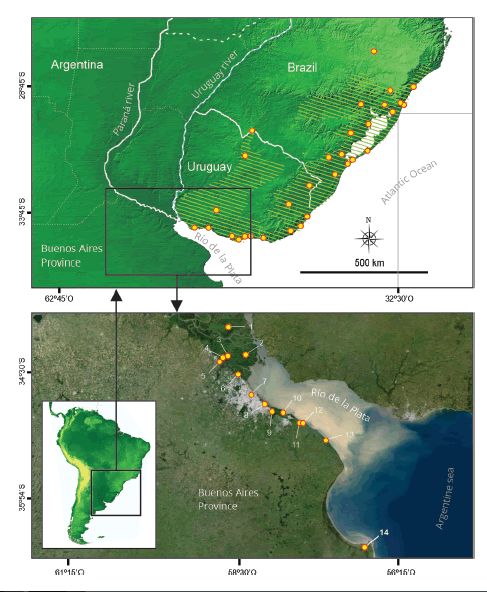
Fig. 1
Reported localities superimposed on a schematic distribution for Deltamys in Brazil and Uruguay (upper panel; based on González & Martínez Lanfranco (2010) [Uruguayan records] and Quintela et al. (2017) [Brazilian records]); and for Deltamys kempi in Argentina (lower panel), highlighting the southernmost record reported in this note (#14). For the locality reference numbers, see Table 1.
Passive dispersal of several animals as a subproduct of the movement of large masses of floating vegetation (largely composed by Eichhornia spp., Panicum spp., Polygonum spp., etc.), is a recurrent event in the Río de la Plata basin (see Guerrero et al. 2017 for a review). However, almost nothing is known about the impact of this process to produce viable populations of small mammals. Could periodical vegetation “rafts” transport D. kempi individuals to several coastal points of Río de la Plata from a potential and better established source population in the Delta del Paraná area? Or even from the Uruguayan territory? To construct a solid hypothesis, more information is needed, especially from genetic markers. In any case, the unique geographic distribution of D. kempi in Buenos Aires province points to its consideration as a very recent immigrant in a potentially dynamic southern expansion.
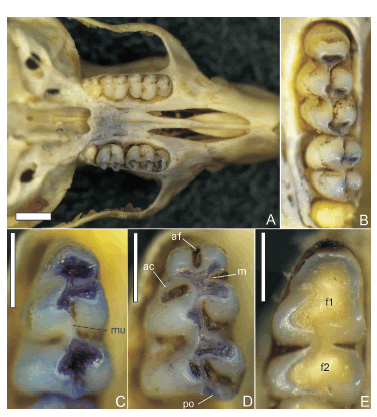
Fig. 2
Deltamys kempi (CNP 2377; Arroyo las Tijeras, General Lavalle, Buenos Aires, Argentina). A. Palatal region (scale = 2 mm). B. Left upper toothrow in occlusal view. C. First lower molar in occlusal view (scale = 1 mm). D. First lower molar of a young individual of Akodon azarae (scale = 1 mm). E. First lower molar of an adult individual of D. kempi (CNP 3086; La Balandra, Buenos Aires, Argentina; scale = 1 mm). Acronyms: ac, anterolabial cingulum; af, anteromedian flexid; f1, first lobe; f2, second lobe; m, metaflexid; mu, median murid; po, posterolophid.
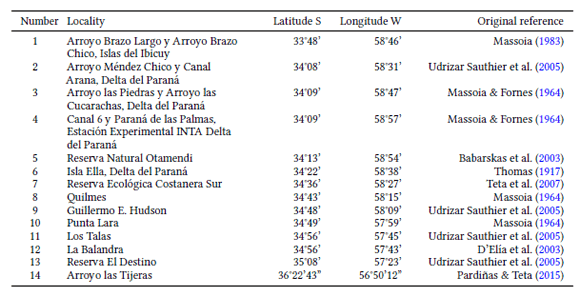
Argentinean recording localities for Deltamys kempi (arranged by increasing latitude).
Supplementary materials
ONLINE SUPPLEMENTARY MATERIAL (pdf) Supplement 1
Fig. S1. A) A close view, based on a satellite image (map data: Google, Maxar Technologies), of the general landscape where the new record (red dot) of Deltamys kempi was obtained in southern Samborombón Bay (note the extensive marshy area characterized by tidal channels); B) A view of the vegetation at the trapping site in Arroyo las Tijeras (photo: MR).
Acknowledgments
M. Lareschi kindly informed us of the occurrence of parasites typical of Deltamys from one of the specimens from Arroyo las Tijeras. A. Castillo and his family allowed field work in Arroyo las Tijeras; J. Bogan provided crucial logistic support and S. Bogan assisted in the field; E. Cuéllar improved the English and R. Owen enriched the style and content of this contribution through a meticulous critical reading. We are very grateful to all the mentioned people.
REFERENCES
Babarskas, M., E. Haene, & J. Pereira. 2003. Aves de la Reserva Natural Otamendi. Fauna de Otamendi. Inventario de los animales vertebrados de la Reserva Natural Otamendi, Campana, Buenos Aires, Argentina (E. Haene & J. Pereira, eds.). Aves Argentinas/AOP, Temas de Naturaleza y Conservación 3, Buenos Aires.
Barlow, J. C. 1969. Observations on the biology of rodents in Uruguay. Life Sciences Contributions, Royal Ontario Museum 75:1–59. https://doi.org/10.5962/bhl.title.52067
Bianchini, J. J., & L. H. Delupi. 1994. Consideraciones sobre el estado sistemático de Deltamys kempi Thomas, 1917 (Cricetidae: Sigmodontinae). Physis C 49:27–35.
Castro, E., M. S. Mattevi, S. Maluf, & L. F. B. Oliveira. 1991. Distinct centric fusions in different populations of Deltamys kempi (Rodentia: Cricetidae) from South America. Cytobios 68:153–159.
Cavallotto, J. L., R. A. Violante, & G. Parker. 2004. Sea-level fluctuations during the last 8600 years in the de la Plata river (Argentina). Quaternary International 114:155–165. https://doi.org/10.1016/s1040-6182(03)00050-8
D’Elía, G., E. González, & U. F. J. Pardiñas. 2003. Phylogenetic analysis of sigmodontine rodents (Muroidea), with especial reference to the akodont genus Deltamys. Mammalian Biology 68:351–364. https://doi.org/10.1078/1616-5047-00104
Gentile De Fronza, T. M., R. Wainberg, & G. Hurtado De Catalfo. 1981. Multiple sex chromosomes in Deltamys kempi (Rodentia: Cricetidae): Preliminary steps towards the establishment of the XY1 Y2 /X1 X1 X2 X2 system. Caryologia 34:457–466. https://doi.org/10.1080/00087114.1981.10796914
González, E. M., & E. Massoia. 1995. Revalidación del género Deltamys Thomas, 1917, con la descripción de una nueva subespecie de Uruguay y sur de Brasil (Mammalia: Rodentia: Cricetidae). Comunicaciones Zoológicas del Museo de Historia Natural de Montevideo 12:1–8. https://doi.org/10.3989/graellsia.1995.v51.i0.396
González, E. M., & J. A. Martínez Lanfranco. 2010. Mamíferos de Uruguay. Guía de campo e introducción a su estudio y conservación. Vida Silvestre, Montevideo.
González, E. M., & U. F. J. Pardiñas. 2002. Deltamys kempi. Mammalian Species 711:1–4. https://doi.org/10.1644/1545-1410(2002)711<0001:dk>2.0.co;2
Guerrero, E. L., et al. 2017. Inventario de la fauna transportada por balsas de vegetación flotante en el Sistema fluvial del Río de La Plata. Revista del Museo Argentino de Ciencias Naturales, nueva serie 19:177–183. https://doi.org/10.22179/revmacn.19.508
Lareschi, M., & D. Gettinger. 2009. A new species of Androlaelaps (Acari: Parasitiformes) from the akodontine rodent Deltamys kempi Thomas, 1919[sic], in la Plata River basin, Argentina. Journal of Parasitology 95(6):1352–1355. https://doi.org/10.1645/ge-2045.1
López, J. A., E. Massoia, & A. Morici. 1991. Fauna asociada a restos arqueológicos en el sitio “Las Vizcacheras”, costa del río Luján, partido de Escobar, provincia de Buenos Aires. Boletín Científico, Asociación para la Protección de la Naturaleza 14:2–5.
Massoia, E. 1961. Sobre la presencia de Akodon obscurus (Waterhouse) en Punta Lara. Physis 23:110.
Massoia, E. 1964. Sistemática, distribución geográfica y rasgos etoecológicos de Akodon .Deltamys. kempi (Rodentia-Cricetidae). Physis 24:299–305.
Massoia, E. 1983. La alimentación de algunas aves del orden Strigiformes en la Argentina. El Hornero (número extraordinario):125–148.
Massoia, E., & A. Fornes. 1964. Pequeños mamíferos (Marsupialia, Chiroptera y Rodentia) y aves obtenidos en regurgitaciones de lechuzas (Strigiformes) del Delta bonaerense. Delta del Paraná, Investigaciones Agrícolas 4:27–34.
Montes, M. A., L. F. B. Oliveira, S. L. Bonatto, S. M. Callegari-Jacques, & M. S. Mattevi. 2008. DNA sequence analysis and the phylogeographical history of the rodent Deltamys kempi (Sigmodontinae, Cricetidae) on the Atlantic Coastal Plain of south of Brazil. Journal of Evolutionary Biology 21:1823–1835. https://doi.org/10.1111/j.1420-101.2008.01586.x
Pardiñas, U. F. J. 1999. Los roedores muroideos del Pleistoceno tardío-Holoceno en la región pampeana (sector este) y Patagonia (República Argentina): aspectos taxonómicos, importancia bioestratigráfica y significación paleoambiental. Doctoral Dissertation. Universidad Nacional de La Plata, La Plata, Argentina.
Pardiñas, U. F. J. 2018. Corrections and emendations to the description of Deltamys araucaria Quintela et al., 2017 (Rodentia, Cricetidae). Zootaxa 4379:134–136. https://doi.org/10.11646/zootaxa.4379.1.8
Pardiñas, U. F. J., & P. Teta. 2015. Genus Deltamys Thomas, 1917. Mammals of South America, Volume 2 – Rodents (Patton, J. L., U. F. J. Pardiñas, & G. D’Elía, eds.). The University of Chicago Press, Chicago. https://doi.org/10.7208/chicago/9780226169606.001.0001
Parker, G., & S. Marcolini. 1992. Geomorfología del Delta del Paraná y su extensión hacia el Río de la Plata. Revista de la Asociación Geológica Argentina 47:243–249.
Quintela, F. M. 2014. Aspectos filogeográficos e taxonômicos de Deltamys . Scapteromys (Cricetidae: Sigmodontinae). Doctoral Dissertation. Universidade Federal do Rio Grande do Sul, Porto Alegre, Brasil. https://doi.org/10.29289/259453942018v28s1059
Quintela, F. M., F. Bertuol, E. M. González, P. Cordeiro-Estrela, T. R. O. Freitas, & G. L. Gonçalves. 2017. A new species of Deltamys Thomas, 1917 (Rodentia: Cricetidae) endemic to the southern Brazilian Araucaria Forest and notes on the expanded phylogeographic scenario of D. kempi. Zootaxa 4294:71–92. https://doi.org/10.11646/zootaxa.4294.1.3
Reig, O. A. 1977. A proposed unified nomenclature for the enamelled components of the molar teeth of the Cricetidae (Rodentia). Journal of Zoology, London 181:227–241. https://doi.org/10.1111/j.1469-7998.1977.tb03238.x
Sbalqueiro, I. J., M. S. Mattevi, & L. F. B. Oliveira. 1984. An X1 X1 X2 X2 /X1 X2 Y mechanism of sex determination in a South American rodent, Deltamys kempi (Rodentia: Cricetidae). Cytogenetics and Cell Genetics 38:50–55. https://doi.org/10.1159/000132029
Smith, M. F., & J. L. Patton. 2007. Molecular phylogenetics and diversification of South American grass mice, genus Akodon. The Quintessential Naturalist: Honoring The Life and Legacy of Oliver P. Pearson (Kelt, D. A., E. Lessa, J. Salazar-Bravo, & J. L. Patton, eds.). University of California Publications in Zoology, Davis. https://doi.org/10.1525/california/9780520098596.003.0001
Stutz, N., P. Hadler, J. J. Cherem, F. Fernández, U. F. J. Pardiñas, & A. Ribeiro. 2020. Noteworthy sigmodontine (Rodentia: Cricetidae) diversity in southern Brazil as an indication of environmental change during the Holocene. Historical Biology 32:649–670. https://doi.org/10.1080/08912963.2018.1524470
Teta, P., G. Cueto, & O. Suárez. 2007. New data on morphology and natural history of Deltamys kempi Thomas, 1919[sic] (Cricetidae, Sigmodontinae) from central-eastern Argentina. Zootaxa 1665:43–51.
Teta, P., D. Loponte, & A. Acosta. 2004. Sigmodontinos (Mammalia, Rodentia) del Holoceno Tardío del Nordeste de la Provincia de Buenos Aires (Argentina). Mastozoología Neotropical 11:69–80.
Teta, P., U. F. J. Pardiñas, M. Silveira, V. Aldazabal, & Eugenio. 2013. Roedores sigmodontinos del sitio arqueológico “el Divisadero Monte 6” (Holoceno tardío, Buenos Aires, Argentina): taxonomía y reconstrucción ambiental. Mastozoología Neotropical 20:171–177.
Thomas, O. 1917. On small mammals from the Delta of the Parana. The Annals and Magazine of Natural History 8 (20):95–100. https://doi.org/10.1080/00222931709486975
Udrizar Sauthier, D. E., A. M. Abba, L. G. Pagano, & U. J. Pardiñas. 2005. Ingreso de micromamíferos brasílicos en la provincia de Buenos Aires, Argentina. Mastozoología Neotropical 12:91–95.
Ventura, K., V. Fagundes, G. D’Elía, A. U. Christoff, & Y. Yonenaga-Yassuda. 2011. A new allopatric lineage of the rodent Deltamys (Rodentia: Sigmodontinae) and the chromosomal evolution in Deltamys kempi and Deltamys sp. Cytogenetic and Genome Research 135:126–134. https://doi.org/10.1159/000331584
Ximénez, A., A. Langguth, & R. Praderi. 1972. Lista sistemática de los mamíferos del Uruguay. Anales del Museo Nacional de Historia Natural de Montevideo, 2da. serie 7:1–49.
Información adicional
Editor asociado: M. Kittlein
Cite as: Pardiñas, U. F. J., M. de los Reyes, D. Voglino & C. A. Galliari. 2021. Southernmost occurrence of Deltamys kempi (Rodentia, Cricetidae) in Argentina: paleontological and neontological evidence to assess its current distribution. Mastozoología Neotropical, 28(1):e0525. https://doi.org/10.31687/saremMN.21.28.1.0.13
