SECCIÓN ESPECIAL - NOTA
UNUSUAL ZOOARCHAEOLOGICAL FINDINGS OF Didelphis pernigra AND Raus raus IN TWO COLONIAL MONASTEUNUSUAL ZOOARCHAEOLOGICAL FINDINGS OF Didelphis pernigra AND Raus raus IN TWO COLONIAL MONASTERIES OF ECUADORRIES OF ECUADOR
Hallazgos zooarqueológicos inusuales de Didelphis pernigra y Rattus rattus en dos monasterios coloniales del Ecuador
UNUSUAL ZOOARCHAEOLOGICAL FINDINGS OF Didelphis pernigra AND Raus raus IN TWO COLONIAL MONASTEUNUSUAL ZOOARCHAEOLOGICAL FINDINGS OF Didelphis pernigra AND Raus raus IN TWO COLONIAL MONASTERIES OF ECUADORRIES OF ECUADOR
Mastozoología Neotropical, vol. 28, núm. 1, p. 527, 2021
Sociedad Argentina para el Estudio de los Mamíferos
Recepción: 21 Septiembre 2020
Aprobación: 25 Enero 2021
Abstract: Zooarchaelogical research brings together anthropology and biology providing insights into human-animal associations through time. Here we report on two unusual zooarchaeological findings of mammals in colonial churches of Ecuador: 1) An opossum, Didelphis pernigra (Didelphidae, Didelphimorphia), found in an arrangement typical of a north Andean pre-Columbian human burial, with the body inside a clay pot and with food–a corn cob in this case. The opossum was most likely buried during the first reconstruction of the monastery del Carmen Alto, Quito, in the XVII century, around the year 1656 AD; and, 2) an introduced black rat, Rattus rattus (Rodentia, Muridae), found inside a XIX century human tomb; both bodies, human and rodent, were naturally mummified. The rat was found in the monastery de la Asunción, Guano. These findings help to understand human-mammal associations as an indigenous ritual taking place in a catholic temple, and to date the invasion of R. rattus in a small town in the Ecuadorian Andes.
Keywords: Andes, archaeology, Didelphidae, morphometrics, Muridae.
Resumen: La investigación zooarqueológica une a la antropología y a la biología brindando luces sobre la asociación humano-animal a través del tiempo. Aquí reportamos dos hallazgos zooarqueológicos inusuales de mamíferos en iglesias coloniales del Ecuador: 1) una zarigüeya, Didelphis pernigra (Didelphidae, Didelphimorphia), hallada en un arreglo típico de un entierro funerario humano pre-colombino de los Andes del Norte, con el cuerpo dentro de una vasija de barro y con comida –una mazorca de maíz en este caso. La zarigüeya muy probablemente fue colocada en este arreglo durante la primera reconstrucción del monasterio del Carmen Alto en Quito, en el siglo XVII, alrededor del año 1656 dC; y 2) una rata negra introducida, Rattus rattus (Rodentia, Muridae), encontrada dentro de una tumba humana del siglo XIX; ambos cuerpos, humano y roedor, se momificaron naturalmente. La rata fue encontrada en el monasterio de la Asunción, Guano. Estos hallazgos ayudan a comprender asociaciones humano-animal como un ritual indígena que tuvo lugar en un templo católico y a datar la invasión de R. rattus en un pueblo pequeño de los Andes ecuatorianos.
Palabras clave: Andes, arqueología, Didelphidae, morfometría, Muridae.
“Yo quiero que a mí me entierren
Como a mis antepasados
En el vientre oscuro y fresco
De una vasija de barro”
Associations of humans with wild animals are important to understand historical events (e.g., hunting practices, domestication processes, anthropic modified landscapes) (Stahl 2008). In South America, such human-animal associations have been documented mostly for pre-Columbian times, and after exploration by early naturalists (e.g., F. de Azara, A. von Humboldt; see Hershkovitz 1987; Stahl & Athens 2001). Surprisingly, there is scarce zooarchaeological information from the critical historical period between Spanish conquest (XVI century) and the consolidation of the independent South American republics (XIX century); noteworthy examples include deFrance (2003), and Kennedy & Vanvalkenburgh (2016).
Here we document two zooarchaeological findings obtained within colonial monasteries located in the Ecuadorian Andes. We report an apparent funeral arrangement of Andean white-eared opossum, Didelphis pernigra J. A. Allen, 1900, inside a clay pot, and a naturally mummified black rat, Rattus rattus Linnaeus, 1758, associated with a human burial. We discuss the cultural and biological implications of these findings.
In 2013, an archaeological excavation in the monastery del Carmen Alto in Quito, Ecuador discovered a clay pot containing the remains of a large opossum, a corn cob, and traces of vegetal fibers that possibly formed a mat known as “estera.” The clay pot was discovered in the ventilation chambers under the floor in a dorm room located in the second floor of the monastery. The clay pot was intentionally positioned up-side down (Fig. 1). The specimens are deposited in the in-situ collection of the monastery.
In the town of Guano, Province of Chimborazo, Ecuador, the mummified bodies of a human and a rat were found in 1949. Damage to the walls of the monastery de la Asunción caused by the Ambato earthquake on August 5 of that year facilitated the retrieval of the mummified bodies from a tomb placed within a wall of the monastery. These bodies became the main exhibit of the Museo de Guano. The human mummified body is colloquially known as “La Momia de Guano.” In 2019, the specimens were loaned to the Instituto Nacional de Patrimonio in Quito to conduct an examination of the mummified bodies. Afterwards, the specimens were returned to the Museo de Guano where they continue to be displayed.
Indirect dating was established from information associated with each monastery (e.g., construction and reconstruction dates; Moya & Peralta 2007), and from cultural elements associated with the specimens (e.g., clay and fabric technology; Idrovo 1990; Jamieson 2001).
The opossum remains were identified by using distinctive discrete characters (Flores 2009; Voss & Jansa 2009), and by a multivariate morphometric approach using lineal measurements (Lemos & Cerqueira 2002). For the morphometric analysis, the skull was measured following the proposed cranial measurements in Cerqueira & Lemos (2000) and Lemos & Cerqueira (2002). We were able to take only 9 measurements because of the broken skull of the specimen (Table 1). We retrieved from the literature the mean values for the same measurements of males and females from the six species of Didelphis, because a pronounced sexual dimorphism has been demonstrated in the genus, with males being consistently larger than females (Cerqueira & Lemos 2000; Lemos & Cerqueira 2002). Data for Didelphis aurita and D. marsupialis were obtained from Cerqueira & Lemos (2000), data for D. albiventris, D. imperfecta and D. pernigra were obtained from Lemos & Cerqueira (2002), and data for D. virginiana were obtained from Dias et al. (2021). We decided to analyze the mean values for the species of Didelphis as it is a valid representation of the variation of the species in this genus and has been successfully employed in other analyses (Dias et al. 2021). Each of the 9 variables was tested for normality using the Shapiro-Wilk test. All nine measurements were normally distributed, thus there was no need for data transformation (e.g., log-transformation). We conducted a principal component analysis (PCA) to compare the measurements of the Carmen sample with all species of Didelphis in order to have a quantitative criterion for the identification of this zooarqueaological specimen. All analyses were performed in R version 3.6.2 (R Core Team 2019); the univariate and multivariate analyses were performed with the R script MorphoTools version 1.1 (Koutecký 2015).
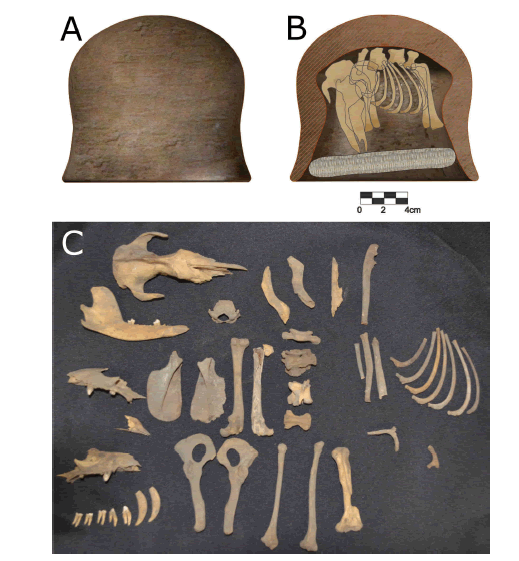
Fig. 1
Remains of Didelphis pernigra found at the monastery del Carmen Alto, Ecuador. Inverted clay pot containing the remains of an adult opossum D. pernigra in its interior: A) external view; B) cross sectional diagram depicting the opossum bones and a corn cob; C) the opossum bone fragments found inside the clay pot.
The rat remains were identified by diagnostic morphological characteristics, particularly, the presence of three rows of molar cusps, and orange coloration of incisors, to determine if the specimen is an introduced Rattus species (Hall & Kelson 1959; Yiğit et al. 1998; Pimsai et al. 2014). To discriminate between the two most widely distributed Rattus species, R. norvegicus and R. rattus, the tail length was examined: Rattus norvergicus has a short tail, shorter than head and body length, while R. rattus has a long tail, longer than head and body length (Hall & Kelson 1959; Yiğit et al. 1998). Because the mummified body is curved, the body and tail measurements of the rat specimen were taken from a photograph (Fig. 2) with scale using ImageJ version 2.1.0/1.53c (Rueden et al. 2017).
The clay pot harboring the opossum remains dates back from the XVII century, based on two lines of evidence: 1) the first reconstruction of the monastery started in 1656 AD. The dorm room where the opossum was found was probably built during this time; 2) the clay pot style where the opossum was found matches the simplistic style typical of the regressed clay technology during colonial times (Fig. 1); and 3) presence of Panamian majolica form the XVII century was also found in excavations in the monastery. The rat specimen likely corresponds to the XIX century, because the fabric structure of the human mummy’s gown corresponds to an early industrial fabric characteristic of that time.
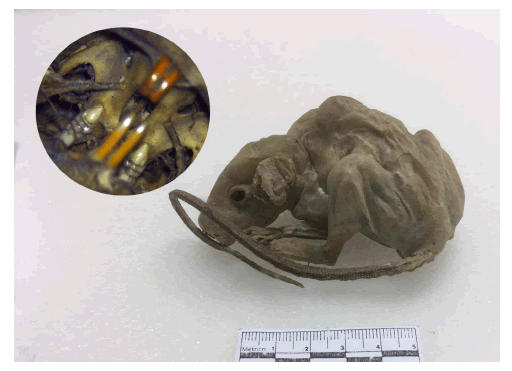
Fig. 2
Mummified specimen of Rattus rattus found at the monastery de la Asunción, Guano, Ecuador. Circular inset: anterior view of the skull depicting the molars with three rows of cusps.
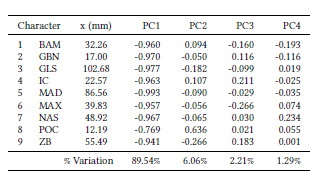
The opossum remains correspond to Didelphis because of the combination of the following characters: co-ossified frontals, well-developed sagittal crest, postorbital process present, straight caudal border of the ulna, and rounded caudal angle of the scapula (Flores 2009; Voss & Jansa 2009). In the morphometric analysis, the first two principal components of the PCA explain 95.6% of the variation (Table 1). PC1 explains size variation, with D. virginiana in one extreme and D. imperfecta and D. albiventris in the other. A large overlapping cluster contains males and females of D. aurita, D. marsupialis and D. pernigra, and females of D. virginiana. However, the Carmen specimen shows a closer proximity to D. pernigra (Fig. 3A). All variables are correlated in the same direction with PC1, with posterior orbital constriction (POC) being the most different (Fig. 3B). The rat specimen is identified as Rattus rattus for the following combination of characters: presence of molars with three rows of cusps, orange enamel of the incisors, and tail (133.46 mm) longer than combined head and body (106.03 mm) length. This individual is a young female with all molars erupted and showing no signs of wear (Fig. 2).
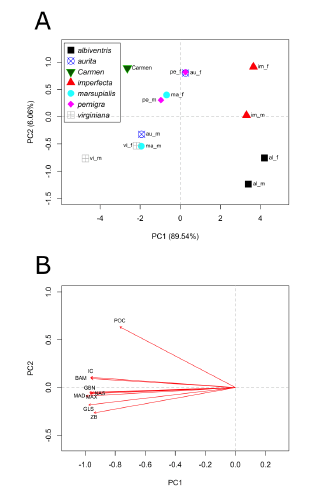
Fig. 3
PCA analysis of the genus Didelphis and the archaeological sample found in the monastery del Carmen Alto, Ecuador: A) scatter plot of the two first principal components, B) vector plot showing the loadings of each measurement within the PCA scatter plot. Females (_f), males (_m); measurement abbreviations available in legend of Table 1 .
We report two zooarchaeological findings: 1) an opossum from the XVII century; and, 2) an introduced rat from the XIX century. The opossum report is puzzling because it resembles a type of pre-Columbian human burial, with the body inside a clay pot and with food as a funerary offering (Espinoza Soriano 1999; Cabrero i Miret 2015). It has the characteristics of a votive offering, and many examples of these, including guinea pigs (Cavia porcellus) and llamas (Lama glama) are known from the pre-Columbian Andes (Sandweiss Wing 1997; Rosenfeld 2012). Votive offerings with animals commonly “were placed under floors and interpreted as dedicatory burials, related to building events” (Rosenfeld 2012:135). This finding suggests that votive offerings of animals in clay pots may have secretly continued during the colonial era despite the strong imposition of Catholicism. The opossum specimen from monastery del Carmen Alto is a large D. pernigra with worn teeth, suggesting that it was a captive animal, possibly kept by indigenous construction workers. The species D. pernigra is native of the Andes (Lemos & Cerqueira 2002), and still today inhabits Quito, so the animal could have been found in or around the premises of the monastery.
The rat found in the Andean town of Guano could have reached the tomb after the human burial and remained trapped, dying next to the human corpse. This record of R. rattus could be helpful to date the invasion of introduced rodents into Andean towns. Also, it could help to trace interactions with norvegicus, a species that is able to partially and totally displace R. rattus (Barnett & Spencer 1951; Feng & Himsworth 2014). So far, there is no evidence in continental Ecuador of such displacement, as surveys in small rural towns have found R. rattus to be more abundant than R. norvergicus (Pinto et al. 2003, 2006). However, in the Galápagos islands there is evidence of R. norvegicus displacing R. rattus (Key et al. 1994). To the best of our knowledge, there are no data from Ecuadorian Andean towns such as Guano, so studies on these invasive species will be welcome.
Zooarchaeological research is an active field with plenty of opportunities for the involvement of more mammalogists in fruitful collaborations with archaeologists. Mammalogists’ analytical (e.g., molecular biology, morphometrics, niche modelling) and practical (e.g., identification of species) skills are highly relevant in zooarchaeological research (e.g., Vigne 1992; Reitz & Ruff 1994; Pinto et al. 2016; Abbona et al. 2019). Particularly in the Neotropics, a biologically and culturally diverse region, zooarchaeological findings–as presented here–are waiting to be unveiled.
Acknowledgments
We thank Carlos Galliari and Ulyses Pardiñas for organizing this special issue honoring Elio Massoia, prolific mammalogist whose expertise also reached the field of zooarchaeology in the Neotropical region (e.g., Massoia 1987, 1991; Pérez et al. 1999). We thank the French Embassy in Ecuador for facilitating our examination of the rat specimen and the “Momia de Guano.” We thank Verónica Crespo-Pérez, and the reviewers Peter Stahl and Pablo Teta, for improving this manuscript. We thank José Luis Román for conversations about the identity of the opossum. GL thanks the Instituto Metropolitano de Patrimonio for funding. We thank Edwin Chulli, Ivan Durán, Ximena Endara, Noralma Suarez, and Madre Priora Verónica de la Santa Faz for granting us access to work in the monastery del Carmen Alto.
REFERENCES
Abbona, C. C., O. Lebrasseur, J. Johnson, M. Giardina, G. Neme, & S. Wolverton. 2019. Analysis of ancient DNA from South American rhea bones: Implications for zooarchaeology and biogeography. Journal of Archaeological Science: Reports 25:624– 631. https://doi.org/10.1016/j.jasrep.2019.05.035
Barnett, S. A, & M. M. Spencer. 1951. Feeding, social behaviour and interspecific competition in wild rats. Behaviour 3:229–242.
Cabrero i Miret, F. 2015. Omaguas, cataclismo amazónico. Tesis de Doctorado. Universitat Autònoma de Barcelona, Barcelona, España.
Carrera Andrade, J., H. Alemán, J. Valencia, J. E. Adoum, G. Benítez, & L. A. Valencia.1950. Song lyrics of “Vasija de Barro”.
Cerqueira, R., & B. Lemos. 2000. Morphometric differentiation between Neotropical black-eared opossums, Didelphis marsupialis and D. aurita (Didelphimorphia, Didelphidae). Mammalia 64:319–328. https://doi.org/10.1515/mamm.2000.64.3.319
deFrance, S. D. 2003. Diet and provisioning in the high Andes: A Spanish colonial settlement on the outskirts of Potosí, Bolivia. International Journal of Historical Archaeology 7:99–125. https://doi.org/10.1023/A:1025184117208
Dias, C. A. R., J. E. Santos Júnior, C. M. Pinto, F. R. Santos, & F. Perini. 2021. Mitogenomics of Didelphis (Didelphimorphia; Didelphidae) and insights into character evolution in the genus. Journal of Zoological Systematics and Evolutionary Research 59:498–509. https://doi.org/10.1111/jzs.12440
Espinoza Soriano, W. 1999. Etnohistoria ecuatoriana, estudios y documentos. 1st edition. Ediciones Abya-Yala, Quito.
Feng, A. Y., & C. G. Himsworth. 2014. The secret life of the city rat: a review of the ecology of urban Norway and black rats (Rattus norvegicus and Rattus rattus). Urban Ecosystems 17:149–162. https://doi.org/10.1007/s11252-013-0305-4
Flores, D. A. 2009. Phylogenetic analyses of postcranial skeletal morphology in didelphid marsupials. Bulletin of the American Museum of Natural History 320:1–81. https://doi.org/10.1206/320.1
Hall, E. R., & K. R. Kelson. 1959. The mammals of North America. 1st edition. The Ronald Press Company, New York.
Hershkovitz, P. 1987. A history of the recent mammalogy of the Neotropical region from 1492 to 1850. Studies in Neotropical mammalogy, essays in honor of Philip Hershkovitz (B. D. Patterson, R. M. Timm, eds.). Fieldiana Zoology, New Series 39. Field Museum of Natural History, Chicago.
Idrovo, J. 1990. Siglo XVI y XVII: La desarticulación del mundo andino y sus efectos en la alfarería indígena del austro ecuatoriano. Cerámica Colonial y Vida Cotidiana (J. Idrovo & A. Kennedy, eds.). Fundación Paul Rivet, Cuenca.
Jamieson, R. W. 2001. Majolica in the early colonial Andes: the role of Panamanian wares. Latin American Antiquity 12:45–58. https://doi.org/10.2307/971756
Kennedy, S. A., & P. Vanvalkenburgh. 2016. Zooarchaeology and changing food practices at Carrizales, Peru following the Spanish invasion. International Journal of Historical Archaeology 20:73– 104. https://doi.org/10.1007/s10761-015-0319-0
Key, G., E. Wilson, & J. Conner. 1994. Present status of Rattus norvegicus on Santa Cruz Island, Galapagos, Ecuador. Proceedings of the 16th Vertebrate Pest Conference 16:118–123.
Koutecky, P. 2015. MorphoTools: a set of R functions for morphometric analysis. Plant Systematics and Evolution 301:1115–1121. https://doi.org/10.1007/s00606-014-1153-2
Lemos, B., & R. Cerqueira. 2002. Morphological differentiation in the white-eared opossum group (Didelphidae: Didelphis). Journal of Mammalogy 83:354–369. https://doi.org/10.1644/1545-1542(2002)083<0354:MDITWE>2.0.CO;2
Massoia, E. 1987. Restos de mamíferos recolectados en el sitio arqueológico de Chenque Haichol, Picunches, provincia de Neuquén. Estudios de Antropología Pampeana 1:15–21.
Massoia, E. 1991. Atlas de restos de mamíferos del sitio arqueológico de Chenque Haichol, departamento Picunches, provincia de Neuquén. Boletín Científico APRONA 20:21–46.
Moya, R., & E. Peralta. 2007. Guía arquitectónica de Quito. 1st edition. FONSAL, Quito.
Pérez, A., E. Massoia, & P. Teta. 1999. La fauna del nivel de ocupación tardío del sitio arqueológico Cueva Loncomán, área Pilcaniyeu, sudoeste de Río Negro. Boletín Científico APRONA 35:1–40.
Pimsai, U., M. J. Pearch, C. Satasook, S. Bumrungsri, & P. J. Bates. 2014. Murine rodents (Rodentia: Murinae) of the Myanmar-Thai-Malaysian peninsula and Singapore: taxonomy, distribution, ecology, conservation status, and illustrated identification keys. Bonn Zoological Bulletin 63:15–114.
Pinto, C. M., M. J. Grijalva, & J. A. Costales. 2003. Prevalencia de Trypanosoma cruzi en roedores y marsupiales en dos localidades de Manabí, Ecuador. Revista de la Pontificia Universidad Católica del Ecuador 71:225–233.
Pinto, C. M., S. Ocaña-Mayorga, M. S. Lascano, & M. J. Grijalva. 2006. Infection by trypanosomes in marsupials and rodents associated with human dwellings in Ecuador. Journal of Parasitology 92:1251–1255. https://doi.org/10.1645/GE-886R.1
Pinto, C. M., et al. 2016. Archaeology, biogeography, and mammalogy do not provide evidence for tarukas (Cervidae: Hippocamelus antisensis) in Ecuador. Journal of Mammalogy 97:41–53. https://doi.org/10.1093/jmammal/gyv151
R Core Team. 2019. R: A language and environment for statistical computing. R Foundation for Statistical Computing, Vienna, Austria. URL https://www.R-project.org/
Reitz, E. J., & B. Ruff. 1994. Morphometric data for cattle from North America and the Caribbean prior to the 1850s. Journal of Archaeological Science 21:699–713. https://doi.org/10.1006/jasc.1994.1069
Rosenfeld, S. 2012. Animal wealth and local power in the Huari empire. Ñawpa Pacha 32:131–164. https://doi.org/10.1179/naw.2012.32.1.131
Rueden, C. T. et al. 2017. ImageJ2: ImageJ for the next generation of scientific image data. BMC Bioinformatics 18:529. https://doi.org/10.1186/s12859-017-1934-z
Sandweiss, D. H., & E. S. Wing. 1997. Ritual rodents: the guinea pigs of Chincha, Peru. Journal of Field Archaeology 24:47–58. https://doi.org/10.1179/jfa.1997.24.1.47
Stahl, P. W. 2008. The contributions of zooarchaeology to historical ecology in the neotropics. Quaternary International 180:5–16. https://doi.org/10.1016/j.quaint.2007.08.028
Stahl, P. W., & J. S. Athens. 2001. A high elevation zooarchaeological assemblage from the northern Andes of Ecuador. Journal of Field Archaeology 28:161–176. https://doi.org/10.1179/jfa.2001.28.1-2.161
Vigne, J. D. 1992. Zooarchaeology and the biogeographical history of the mammals of Corsica and Sardinia since the last ice age. Mammal Review 22:87–96. https://doi.org/10.1111/j.1365-2907.1992.tb00124.x
Voss, R. S., & S. A. Jansa. 2009. Phylogenetic relationships and classification of didelphid marsupials, an extant radiation of New World metatherian mammals. Bulletin of the American Museum of Natural History 322:1-177. https://doi.org/10.1206/322.1
Yiğit, N., E. Çolak, M. Sózen, & S. Özkurt. 1998. The taxonomy and karyology of Rattus norvegicus (Berkenhout, 1769) and Rattus rattus (Linnaeus, 1758) (Rodentia: Muridae) in Turkey. Turkish Journal of Zoology 22:203–212.
Información adicional
Editor asociado: U. F. J. Pardiñas & C. A. Galliari
Cite as: Pinto, C. M., G. López & M. Romero. 2021. Unusual zooarchaeological findings of Didelphis pernigra and Rattus rattus in two colonial monasteries of Ecuador. Mastozoología Neotropical, 28(1):e0527. https://doi.org/10.31687/saremMN.21.28.1.0.18