Ciencias Sociales, Humanidades y Artes
A correlational analysis of teacher content knowledge and knowing-to act of mathematics teachers in a Mexican northern borderland city
Un análisis correlacional del conocimiento del maestro y el “saber actuar” de maestros de matemáticas en una ciudad fronteriza en el norte de México
A correlational analysis of teacher content knowledge and knowing-to act of mathematics teachers in a Mexican northern borderland city
Entreciencias: Diálogos en la Sociedad del Conocimiento, vol. 3, no. 8, pp. 359-376, 2015
Universidad Nacional Autónoma de México

This work is licensed under Creative Commons Attribution-NonCommercial-NoDerivs 4.0 International.
Abstract: This research was focused on the “knowing-to act” of the teacher and his/her relationship with the specific cognitive types of the mathematics content of mathematics teacher content knowledge. These cognitive types are: Cognitive Type 1 (knowledge of facts and procedures); Cognitive Type 2 (knowledge of connections and concepts); Cognitive Type 3 (knowledge of models and mathematic generalizations.). The measurement of the mathematics’ content knowledge of the secondary/middle school teacher was determined through the analysis of the Teacher’s Content Knowledge Survey (TCKS). The “knowing-to act” refers to “a kind of knowledge which enables people to act spontaneously and creatively” (Mason, 1998, p 245). This knowledge is considered as the teacher’s intention to act in a certain way and it was examined through the teacher’s “Know to Act Survey” (KtAS).Then, a correlational analysis was developed to seek any relationship among the teacher content knowledge cognitive types and teacher “knowing-to act”.
Keywords: teacher content knowledge, cognitive type, knowing-to act, and correlational analysis.
Resumen: Este estudio se enfocó en el “saber actuar” del maestro y su relación con los tipos cognitivos específicos del conocimiento del contenido matemático del maestro de secundaria. Estos tipos cognitivos son: el tipo cognitivo 1 (conocimiento de hechos y procedimientos); el tipo cognitivo 2 (conocimiento de conceptos y generalizaciones); y el tipo cognitivo 3 (conocimiento de modelos y generalizaciones matemáticas). La medición del conocimiento del contenido matemático de maestros de secundaria fue realizada a través del análisis de la encuesta conocimiento del contenido del maestro (TCKS). El “saber actuar” se refiere a “un tipo de conocimiento que habilita a la gente a actuar espontáneamente y creativamente.” (Mason, 1998, p.245). Este conocimiento es considerado como la intención del maestro para actuar de cierta manera y se examinó por medio de la de la encuesta el “saber actuar” (KtAS) del maestro.
Palabras clave: Conocimiento del contenido del maestro, tipo cognitivo, saber actuar, y análisis correlacional.
INTRODUCTION
In the past twenty-five years, a growing number of studies focusing on teacher knowledge has been conducted (e.g. Inzunsa & Guzman, 2011; Chapman, 2013; Tchoshanov, 2011). However, teacher knowledge is very broad, and it includes different kinds of knowledge. Two types of teacher knowledge were explored in this study: mathematics teacher content knowledge and “knowing-to act”. “Knowing-to act” is the process where “knowledge [that] enables people to act creatively rather than merely react to stimuli with trained or habituated behavior” (Mason and Spence, 1999, p.136). According to Mason and Spence (1999), there is an absence of “knowing-to act”. According to Mason and Spence (1999), there is an absence of “knowing-to act” that leads mathematics teachers not to be able to respond creatively in the moment even when they possess mathematical and pedagogical content knowledge. Consequently, this absence may limit the learning opportunities that teachers can offer. Research on this kind of knowing may help teachers develop the active knowledge needed to respond creatively in the moment.
Additionally, knowing what kinds of knowledge have a direct influence on teaching practices could be used to enhance teacher education programs and teaching practices. This study aimed to provide insights that will provide awareness to teacher education programs and policy makers to make important decisions regarding what teachers need to know for teaching mathematics in an effective manner.
Mathematics teacher content knowledge is important for mathematics instruction. Due to the fact that weak mathematics teacher content knowledge primarily affects mathematical instruction, which in turn causes that students have poor opportunities to learn (Tchoshanov, 2011), student frustration and a negative perception towards mathematics (Sorto, et al. 2009). Moreover, in mathematics it is very important that teachers will be able to make connections between mathematical concepts in order to help students to make sense of mathematics.
The purpose of this study was to measure middle school mathematics teachers’ content knowledge and its relationship with teachers’ “knowing-to act” ability. This “knowing-to act” ability is self-reported by the participating teachers. In this study, we refer to “knowing-to act” as the teacher’s intention to act in certain way. Thus, a quantitative study was conducted to assess whether the mathematics teacher content knowledge was related to the teacher preference of certain action. It is critical to analyze this relationship because both types of knowledge are essential for teaching mathematics. According to Clarke and colleagues (2002), during mathematics classes, there are specific moments that are used by effective teachers to make connections of mathematical ideas from previous lessons or experiences to enhance the students’ conceptual understanding. In order to make teachers being be able to make those connections, they need to possess content knowledge about connections between different aspects of mathematics (Askew, 2005). In Muir’s study (2008), she explored the use of teachable moments and the role they play in effective teaching of mathematics. She found that the lack of content knowledge and pedagogical content knowledge influence the ability to identify teachable moments to act in a way to help students construct their knowledge. Thus, if teachers do not possess a strong content knowledge and pedagogical content knowledge, they may not recognize certain situations where there are students’ misconceptions that may not be addressed (Askew et al. 1997). Then, critical thinking cannot be promoted in these students. Therefore, this study examined if there is a relationship between teacher content knowledge and the intention that teacher has to act in certain way in particular situations.
We used the quantitative approach to look critically at the correlation of the mathematics teacher’s content knowledge and the teachers’ intention to act in certain way at the moment. In order to accomplish the purpose of the study, the following question guided the research: ‘to what extent are the mathematics cognitive types of middle school teachers’ knowledge associated with teachers’ intention to act in certain way?
CONTEXT OF THE STUDY
To contextualize the study about what Mexican middle school teachers need to know to teach mathematics, a comprehensive analysis of the mathematics curriculum in middle schools in Mexico was done. Mexican middle schools have three goals for teaching mathematics: developing skills, promoting positive attitude, and learning mathematics (Secretaría de Educación Pública (sep), 2004). Regarding the development of skills, mathematics teachers should help students to develop skills that allow them to complete mathematical operations, communication skills, and discovery skills to learn mathematics and solve mathematical problems. Learning mathematics at the middle school level implies understanding concepts and topics included in the following five mathematics areas: 1) arithmetic; 2) algebra; 3) geometry (trigonometry is added in 9th grade); 4) data representation and management; and 5) introduction to probability (sep, 2004) as shown in Table 1. In Methodology section, we will observe that topics assessed by the Teacher Content Knowledge Survey (tcks) are aligned with the topics that a Mexican teacher should know to teach mathematics at the middle school level. Table 1 shows the Mathematics curriculum in Mexico. Also we can see that Mathematics is taught during the three grades at the middle school (secundaria). In the methods section, we will elaborate about the instrument that measures the teacher content knowledge, which is related to this curriculum.
Having recognized what content Mexican teachers need to know to teach at the middle school level, we analyzed the Mexican teacher preparation. It is offered mainly by two institutions which are widely recognized by the Mexican government as highly qualified institutions and aligned to the sep interests to prepare prospective teachers: the Normal Superior and the National Pedagogical University (Universidad Pedagógica Nacional, upn). As part of their preparation in such institutions, prospective teachers must complete a four-year, content-specific program of study, which includes teaching in actual classrooms with students assigned to them.
It is estimated that 50% of middle school teachers acquired their preparation from the Normal Superior School or Pedagogical University and the other 50% hold other types of formal education, such as a bachelor’s degree in engineering, accounting, biology, administration, and other areas (Sandoval, 2009).
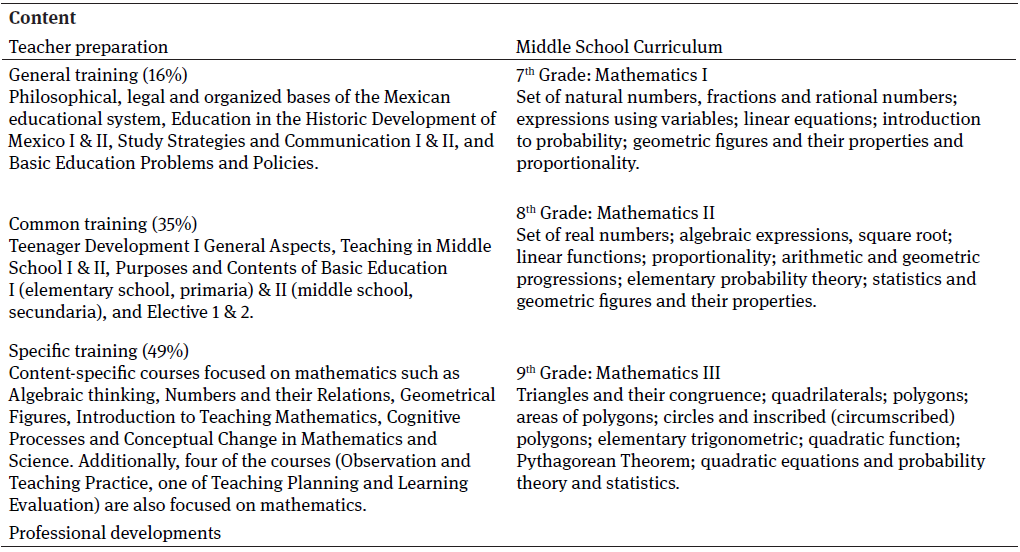
Source: own elaboration
We can summarize the main components of the middle school teacher’s preparation at the Normal Superior schools in the following way:
-
Coursework (which includes 37 courses);
-
Pre-service activities intended to support instructional practice by having pre-service teachers work in schools (preparing lessons, observing classroom instruction, and analyzing student interactions);
-
Teaching practice (which takes place during the last two semesters when pre-service teachers co-teach up to three courses at a middle school); and
-
Social service (that involves 600 hours of voluntary, unpaid teaching).
Table 1 summarized the secondary mathematics teacher preparation curriculum offered at the preparation at the Normal Superior School for middle school prospective teachers embraces three fields: General training, Common training, and Specific training (Dirección General de Educación Superior para Profesionales de la Educación - dgespe, 2010). General training represents 16% of the program and includes basic preparation that a teacher of any subject area is required to have. This kind of training focuses on the importance of understanding the Mexican educational system. Common training is unique to secondary school teacher preparation. The third field is the specific training that is the content knowledge and pedagogical knowledge required to teach the chosen subject.
LITERATURE REVIEW IN MEXICO
In Mexico, there are few studies identified that focus on mathematics teachers (Castañeda, Rosas, & Molina, 2011; Dueñas, 2009). Castañeda et al. (2011) analyzed the mathematics discourse used by teachers to formulate generalizations, synthesis and summaries of classroom activities through video recordings of mathematical instruction at the secondary level. Dueñas (2009) studied the social construction of mathematics middle school teachers. He intended to provide an understanding of the relationship between the development of skills, attitudes and mathematical content knowledge, and the historical processes that have shaped mathematics teachers.
Understanding the mathematical knowledge for teaching possessed by Mexican prospective teachers at the end of their teacher preparation was one of the purposes of the Mochon and Hernandez’s study (2011). They offered a special final course at the Normal Superior School in Mexico City for these teachers. The results of this study indicated that the recognition of the mathematics teacher knowledge was merely instrumental. However, changes on prospective teachers’ views towards mathematics and teaching mathematics occurred.
There is a dearth of studies that have focused particularly on mathematics teacher knowledge in Mexico. Inzunsa and Guzman (2011) analyzed the teachers’ understanding of concepts about probability through a questionnaire to 80 teachers of technical middle schools in Mexico. The findings indicate that probability is a difficult area for middle school teachers. Teachers have a weak reasoning; and lack of the use of diagrams was also identified. However, this study only focuses on a specific area of mathematics, probability. Further research on mathematics teacher knowledge based on the middle school curriculum taught by the teachers is needed.
The Mochon and Andrade’s study (2009) intended to explore the mathematical knowledge for teaching through the implementation of four instruments: classroom observation, an open questionnaire, a closed questionnaire, and interviews. Findings reported that elementary teachers have some shortages and conceptual difficulties concerning their content knowledge. However, the instruments were administered to elementary school teachers, and only covered a few mathematics topics such as operations with natural numbers, mental calculation and estimation, fractions and decimals, proportionally and units conversion.
We can observe the existent lack of attention on teachers such as teacher knowledge, practices, beliefs, etc. An interesting finding of this literature review of the study is that even though teachers are a fundamental part of the process of teaching and learning mathematics, and their preparation is crucial to teach effectively (Inzunsa & Guzman, 2011; Mochon & Hernandez, 2011), scholars in Mexico have not focused on them to conduct research (Pinto & Gonzalez, 2008).
THEORETICAL FRAMEWORK
In the field of mathematics education, scholars have addressed only some kinds of knowledge and their components, as it is discussed in chapter two (e.g., An, Kulm, & Wu, 2004; Davis & Simmt, 2006; Tchoshanov, 2011). Some of the categorizations of teacher knowledge in mathematics are mathematics teacher content knowledge (e.g. Tchoshanov, 2011), pedagogical content knowledge (e.g. An, Kulm, & Wu, 2004), knowledge of curriculum (e.g. Ball, Thames, and Phelps, 2008; Shulman, 1986), and “knowing-to act” (e.g. Mason, 1998), among others. The complex nature of the mathematical knowledge for teaching challenges investigators to research and define with precision each kind of teacher knowledge. In addition, interactions among these kinds of knowledge are crucial as a part of the base knowledge for teaching mathematics and, as such, some scholars have recognized and studied it (e.g. An, Kulm, & Wu, 2004; Koehler and Mishra, 2009). Therefore, further research is needed about the nature of the interaction among specific kinds of teacher knowledge. Additionally, knowing what kinds of knowledge have a direct influence on teaching practices could be used to enhance teacher education programs and teaching practices.
This paper analyzed the mathematics teacher content knowledge and teachers’ “knowing-to act” (Mason and Spence, 1999) possessed by Mexican in-service teachers in mathematics classrooms at the middle school level in Mexico. This research drew on the Shulman’s teacher knowledge model (Shulman, 1986). Shulman (1986) distinguished three categories of teacher knowledge: a) content knowledge; b) pedagogical content knowledge; and c) curricular knowledge. He defined content knowledge as “the amount of organization of knowledge per se in the mind of the teacher” (Shulman, 1986, p.9). This category of knowledge includes knowledge of facts, connections, models, generalizations and how the understanding of this content knowledge is structured and generated. This study focused on this category of content knowledge, specifically on the mathematics content that teachers need for teaching effectively. Several scholars have focused on this category in mathematics (e.g. Ball, Thames, & Phelps, 2008; Rowland, 2008).
Mathematical Content Knowledge
Shulman’s (1986) categories of teacher knowledge consider the category of teacher content knowledge defined as “the amount and organization of knowledge per se in the mind of teachers” (p. 9). Focusing on mathematics, it includes the knowledge “that allows teachers to engage in particular teaching tasks, including how to accurately represent mathematical ideas, provide mathematical explanations for common rules and procedures, and examine and understand unusual solution methods to problems” (Hill, Ball, & Schilling, 2008, p.377-378). According to Bransford, Brown, and Cocking (2000) a solid domain of this category of knowledge requires three features: 1) “a deep foundation of factual knowledge”, 2) understanding of the “facts and ideas in the context of a conceptual framework”, and 3) organization of the knowledge “in ways that facilitate retrieval and application” (p. 16). Several studies have also focused on mathematical content knowledge (e.g. Hill, Ball, & Rowan, 2005; Ball, Thames, and Phelps, 2008). Tchoshanov (2011) identified three cognitive types of mathematics teacher content knowledge: knowledge of facts and procedures, knowledge of connections and concepts, and knowledge of generalizations and models.
In past years, the indicators of teacher content knowledge considered were obtained from professional development. Also, research completed by the US Task Group on teachers and teacher education of the National Advisory Panel (2008b) shows that the manner in which teacher knowledge has been measured is through teacher certification, mathematics coursework, and a content knowledge test for teachers. Nowadays, new ways to measure teacher knowledge are emerging such as the instrument called Teacher Content Knowledge Survey (TCKS) (Tchoshanov, 2011). This was developed to assess the content knowledge of mathematics teachers at the middle school level. The data analysis could be done by a categorization of cognitive types of mathematical content knowledge included in this instrument. The main purpose to create and use this survey was for having a measure of the mathematics cognitive types of teachers’ content knowledge in order to seek for an association with student achievement and a correlation with teaching practice (Tchoshanov, 2011). Then, an emphasis is placed on the cognitive types of content knowledge.
Cognitive types of teacher content knowledge
These cognitive types of teacher content knowledge contribute to measure the specific type of mathematical knowledge that a teacher has (Tchoshanov, 2011). Cognitive type 1 is the teacher knowledge of facts and procedures. Memorization and application of basic mathematics facts, rules, and algorithms to solve routine problems is required for cognitive type 1 knowledge. This cognitive type of knowledge (Type 1) has been also analyzed in several studies (e.g., Skemp, 1978; Stein, Smith, Henningsen, & Silver, 2000).
Cognitive type 2 knowledge refers to teachers’ knowledge of concepts and connections. The quantity and quality of connections between mathematical procedures and ideas are part of the mathematics conceptual understanding in which the cognitive type 2 is focused (Tchoshanov, 2011). Finally, cognitive type 3 knowledge includes the knowledge of teachers regarding models and generalizations. Type 3 knowledge focuses on the theoretical part. This type of knowledge is about models and generalizations. It includes conjecturing, generalizing, proving theorems, etc. Cognitive type 3 and its relationship between generalizations and representations has also been explored (Doerfler, 1991; Presmeg, 1997). It is important to clarify that these types of knowledge do not follow any order; it means that it is not needed to possess the previous type of knowledge to have any type of knowledge. A teacher could possess just one type of knowledge, or two out of three, or the three cognitive types of knowledge.
Knowing-to and knowing-about: knowing-that, knowing-how, knowing-why
The other kind of knowledge that was studied in this research is identified by Mason and Spence (1999) who presented a framework in which several forms of knowing are taught in schools such as “knowing-that”, “knowing-how”, and “knowing-why”. These three forms of knowing compose the “knowing-about”. Particularly, “Knowing-that” refers to the factual, to know about facts, topics, among others. “Knowing-how” means to know how to do something, techniques or skills utilized in accomplishing a particular task. “Knowing-why” is about having an argument in order to structure actions and from which to reconstruct actions (Mason & Spence, 1999). Jong and Fegurson-Hessler (1996) categorize these kinds of knowing as: situational knowledge, conceptual knowledge, procedural knowledge, and strategic knowledge.
Mason and Spence (1999) recognize that “knowing-about” is immersed in Shulman’s categories (1987). However, they considered that more than these categories are necessary to enable a teacher to act at the moment required. “Knowing-about” is considered as static knowledge possessed by a person, but it does not mean that she/he is able to act creatively in a particular situation. Mason (1998) refers to the term of “knowing-to act” (KtA) as “the kind of knowledge which enables people to act freshly and creatively” (p. 245). “Knowing-to act” involves active knowledge “knowledge that enables people to act creatively rather than merely react to stimuli with trained or habituated behavior” (Mason and Spence, 1999, p.136).
According to Skemp (1979b), “Knowing-to act” is to be able to use the knowledge or technique in a novel situation. This type of knowing implies more than possessing the abilities or knowledge. The essence of “knowing-to act” is the use or call of the knowledge when required. In Rowland, Huckstep and Thwaites (2005) a categorization of the kinds of knowledge needed to teach mathematics is provided. This framework is called “knowledge quartet”. One of its components is contingency, which is similar to “knowing-to act”. This component is concerned about how the teachers perform when students ask questions in a particular way. Contingency encompasses two aspects, the first of which is an ability of the teacher to respond to children’s ideas. This ability requires judgment and deliberation of children’s thinking. For instance, teachers need to do or say something in order to keep their students engaged. The other aspect is about a deviation of the agenda. Several times teachers should deviate from their agenda in order to help students to construct their knowledge instead of continuing teaching without allowing students to grasp the foundations. This component takes place when unusual situations (cannot be predicted) are happening in classrooms. “The teacher’s intended actions- can be planned, but the students’ responses cannot.”(Rowland, Huckstep, & Thwaites, 2005: 263).
According to Mason and Spence (1999) the absence of “knowing-to act” blocks students and teachers to respond creatively in the moment, thus, there is a need for distinguishing “knowing-to act” from “knowing-about” and their elements. Awareness provides the occurrence of real possibilities to “knowing-to act”. Gatteno (1970, 1987) defines awareness “to refer to that, which enables powers that have been integrated into one’s functioning to be employed,” (as cited in Mason, 1998: 254). Therefore, the educating of awareness could be done through the focus on attention. The emphasis of teacher-educators in attention to develop their own awareness in order to be able to help others to become aware of their awareness in turn is critical. There is a study that shows how mathematics and science pre-service teachers struggled to act in the mathematical moment (Wilhelm, Sherrod & Walters, 2008). In this study, a project-based framework was designed to provide opportunities to pre-service teacher to act in the moment and experience mathematics and science in different ways that they had not seen. Videotaped classroom interactions in which pre-service teachers attended the course, journals, and project artifacts for mastering content serve to determine how well pre-service teachers functioned in the mathematical moment. These methods and procedures did not take place in classrooms where pre-service teachers were teaching. Therefore, studies that focus on how teachers act during their instruction in mathematical classroom is critical to promote critical thinking and lead students to learn. Having research on teachers’ “knowing-to act” could lead to find ways to improve this kind of knowing in pre-service teachers. Considering “knowing-to act” as a fundamental part of teacher knowledge, professional development activities could be implemented using activities and projects. Professional development such as this will promote and help in-service teachers to develop this kind of knowledge.
According to Mason and Spence (1999), the “knowing-to act” is emerged from the generation of awareness in specific incidents during teaching and doing mathematics. The following description of an incident can help to clarify this approach. For instance, when one student asked if the solution of one problem done by her or himself is correct, it is a situation arisen during teaching mathematics. This incident can promote the critical thinking of the student if the teacher does not answer yes or no immediately. For instance, several questions that help students to grasp the meaning could be posed in regard to his/her question. However, if the teacher says yes or no immediately after the student is asked, a limitation of the reasoning of the student about other possible procedures or about the correctness of his/her own way used to solve the problem takes place. The manner in which the teacher acts in this situation depends on the level of awareness and attention placed in this situation, and also of distinct types of knowledge.
A second approach is about how the situations or incidents during the class and the knowledge base for teaching mathematics are related. This approach is based on Ryle’s work (1949), in which different kinds of knowledge are analyzed. These kinds of knowledge are also considered part of the teacher knowledge by numerous studies (e.g. Shulman, 1986; Tchoshanov, 2011). However, the “knowing-to act” has not been analyzed when it is seen as instantaneous; it is in the moment in which one idea comes to your mind.
The following process is the relationship among the different types of knowing: when “knowing-to act” takes place in a moment, the “knowing-how” is in charge of the development of the fresh idea; “knowing-that” builds the foundation, “the base energy upon which all else depends and on which actions depends; “knowing-why” provides an overview and sense of direction that supports connection and link making and assist reconstruction and modification if difficulties arise in route” (Mason and Spence, 1999: 146). “Knowing-how” provides the procedures, manners of doing things, in order to change and transform the situation, “and providing the various knowing with fresh situations upon which to operate” (Mason and Spence, 1999: 147-148). This process occurs in a certain context and environment. The level of awareness of the teacher combined with specific elements of the situation that help to promote or come up with experience are what lead to the production of “knowing-to act” in the moment.
METHODOLOGY
Participants
The initial sample for this study consisted of 70 Mexican teachers. According to Tashakkori and Teddlie (2003), the convenience sampling strategy implies the selection of the sample that is “…both easily accessible and willing to participate in the study…” (p.170). This definition of sampling matched the process for sampling implemented in this study. The participating teachers were teaching mathematics at the middle school level at the time of the study. The teacher sample was drawn from 26 different public middle schools in Mexico. The preparation of the data for analysis allowed identifying 6 participants that should be removed for analysis. Five participants were removed because they were considered as outliers. The other participant was no considered for analysis because the last three items of the survey were not answered. This participant was not aware of these items because these unanswered items were located at the back of the last page of the survey. Thus, the final sample was of 64 teachers (N=64).
After the data cleaning process, the data analysis was done with a sample of N=64 middle school teachers. From the 64 teachers, there were 62.5% of teachers who were teaching mathematics at one particular grade level. Thus, 37.5% of the participating teachers were teaching mathematics in at least two grade levels of middle school. Regarding the years of teaching experience of the participants, there were 20.9% of teachers who had from 0 to 6 years of experience teaching mathematics. Teacher participants who had mathematics teaching experience from 7 to 13 years were 22.5% of the sample. There were 14.5% of teachers in the sample who had from 14 to 20 years of experience teaching mathematics. The rest of the teachers in the sample, 41.9%, had 21 or more years of teaching experience in mathematics.
Regarding the gender of the participants, the majority of the teachers are males (56%), and 44% of the teachers are females. The 47% of the middle school teachers in the sample are also teaching other courses different from mathematics. Some of the courses taught by these teachers are technology, civics, English, Art, visual Art, Physics, Graphic Design, Drawing, Spanish, State course, workshops, among others.
Research Design
Quantitative data was collected from the participating teachers. The sample of teachers filled out two surveys: one was the Teacher Content Knowledge Survey (TCKS), and the other one was the Knowing-to Act Survey (KtAS). These surveys assessed the content knowledge of the teachers and their “knowing-to act”. The administration of both surveys was simultaneous. In other words, teachers were provided with both surveys at the same time. Mathematics middle school teachers were allowed to complete both surveys in two hours. The implementation of the surveys was face-to-face: the researcher and the participating teachers. The application of these surveys took place during the school year 2013-2014. First, teachers filled out several questions with their demographic information such as years of teaching experience, gender, courses taught, etc. One of the instruments used, the Teacher Content Knowledge Survey (tcks) instrument, was designed by Tchoshanov (2011) to measure the cognitive types of content knowledge. tcks was translated to Spanish for the Mexican teachers. The tcks was administered and answered in 90 minutes, which was the maximum time allowed. With the administration of the tcks, an analysis about teacher content knowledge of Mexican Mathematics secondary school’s teachers (middle school) came possible.
The instrument called Knowing-to Act Survey (KtAS), was developed by the researcher and two doctoral committee members. One of the two members has expertise in mathematics, mathematics education, and instrument development. The other member of the committee has expertise in research methods, statistics, statistics education, and instrument development. The KtAS assessed the “knowing-to act” ability of the mathematics middle school teachers. The analysis of the data collected from each survey was done separately. In connection with the literature review and research question for this study, a correlation analysis was designed and implemented to seek for significant correlations among the two kinds of teacher knowledge and its components: mathematics teacher content knowledge (Type 1, 2 and 3) and teacher “knowing-to act” (teacher’s intention to act in certain way).
Instruments
Two survey instruments were used in this study. One instrument was the teacher content knowledge survey. The other one was the Knowing-to Act Survey. A Teacher Content Knowledge Survey (tcks) is the instrument designed to assess the teacher content knowledge based on the three cognitive types identified: Type 1 knowledge of facts and procedures, Type 2 knowledge of connections and concepts, and Type 3 knowledge of models and generalizations (Tchoshanov, 2011). The survey contained items that measured each of the cognitive types. Therefore, the mathematics teacher content knowledge was examined through the items that measured the cognitive types of content knowledge.
This survey consists of 33 multiple choice-items about relevant topics for secondary grades teachers’ knowledge: Number sense, Algebra, Geometry and Measurement, Probability and Statistics. The team who developed the instrument consisted of interdisciplinary faculty with expertise in the following domains: mathematics, mathematics education, statistics and statistics education and represented many institutions such as university, community college and local schools. The main steps were the selection of items for the survey, the classification of items by cognitive type, and the suitable positioning of an item in a specific cognitive type (one item can measure one or more cognitive types). The instrument was field-tested during 2005-2006 (Tchoshanov, Lesser, & Salazar, 2008). The alpha coefficient technique (Cronbach, 1951) was utilized to evaluate the reliability of the Teacher Content Knowledge Survey instrument. “The value of the coefficient of .839 suggests that the items comprising the tcks are internally consistent (standard error = .59).” (Tchoshanov, 2011: 148).
The sum of the three cognitive types of knowledge items is 33, which is the total of the items of the tcks. There are 10 items that measure the cognitive type 1. For instance, the item number 7 shown in Illustration 3.1 is an item that measures the knowledge of facts and procedures. The cognitive type 2 is measured by 13 items. The item number 8 in Figure 1 is an example of an item that measures the cognitive type 2 due to the fact than in order to answer it correctly, the teacher needs to have conceptual understanding and not only procedural knowledge. The rest of items (10) are measuring the cognitive type 3. For example, in Figure 1, the item number 9 measures the knowledge of models and generalizations. The teacher content knowledge survey does not have any division per cognitive type. All the items are located randomly throughout the survey.
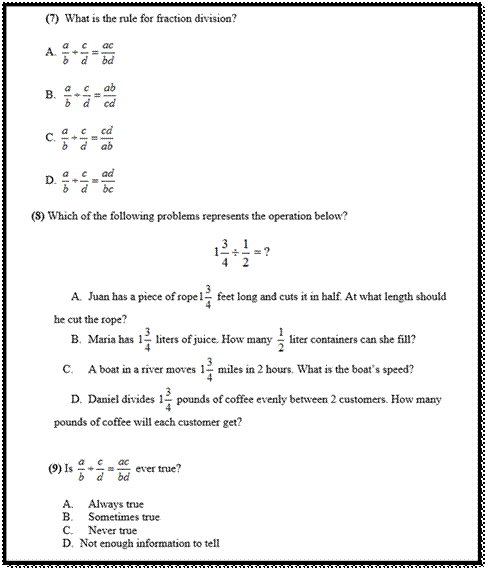
Figure 1.
Examples of tcks items
Source: own elaboration
As Figure 1 shows the items are multiple choice. Four choices are provided for each item. Only one choice is the correct answer. Items that were not answered on the tcks are considered incorrect. Several studies (e.g. Sorto et al., 2009) reported that items unanswered are considered incorrect because persons do not answer the items because of the lack of knowledge. Also, the time used to answer an item increases when there is a lack of knowledge. This leads to more unanswered items on surveys or tests. Teachers were given a score of 1 per each correctly answered item. The score of 0 was given to each item answered incorrectly. During the survey, teachers were allowed to use a calculator. Teachers answered the surveys individually. The researcher was supervising teachers while they were answering the surveys. Teachers could obtain a maximum raw score of 33 on the tcks.
The Knowing-to Act Survey (KtAS) is an instrument designed by the researcher of this study and two members of her doctoral committee. The survey evaluates the ways in how teachers recall their active knowledge to act in the moment when it is required. In other words, it measures the actions and decisions that a teacher takes during mathematics instruction. The evaluation of these actions was considered as the most desirable according to an expert analysis and the literature review of the best teaching practices of mathematics. The expert analysis was accomplished with a team of faculty professors in the area of mathematics, statistics, and mathematics education. There were four professors who were part of this expert analysis. This team analyzed and determined which choices are the most desirable in indicating the level of preparation to teach mathematics. The review of the best teaching practices in mathematics shows which primary teaching practices help to increase student learning, and which ones lead to decrease student engagement and learning (Zemelman, Daniels, and Hyde, 2005). For instance, teaching practices that increase student learning are on the KtAS are questioning and making conjectures, content integration, cooperative group work, and others. On the other hand, the teaching practices that lead to decrease learning of mathematical knowledge are: teaching by telling, repetitive written practice, single answers and single methods to find answers, among others. Following the expert analysis and the recommendations on teaching mathematics (Zemelman, Daniels, and Hyde, 2005), the assessment of the “knowing-to act” of mathematics middle school teachers was conducted through the KtAS.
The KtAS is composed of 10 items. Each item describes a classroom situation. The nature of the situation varies. Even though these situations were included because they are commonly found during mathematics instruction, they challenge the “knowing-to act” of the teachers. These situations are called “knowing-to Act” situations (KtA situations). The selection of these particular situations was done considering previous research where the implication of the challenge of the “knowing-to act” was already identified (e.g. Mason & Spence, 1998; Rowland Huckstep, and Thwaites, 2005). For instance, Mason and Spence (1998) recognized that when a student asks if the answer or steps are correct, the “knowing-to act” of the teacher can be enacted. As the previous situation described, the situations included in this survey are already identified as an opportunity where the teacher’s “knowing-to act” arises and promote the critical thinking of students. The odd and even split-half reliability coefficient (Crocker & Algina, 1986) was utilized to evaluate the reliability of the Knowing-to Act Survey instrument. The value of the coefficient of .58 suggests that the items comprising the KtAS are internally consistent.
There are four categories in which the classroom situations provided in the KtAS are classified: student misconceptions(Shulman, 1986;Kulm, Capraro, Capraro, Burghardt, & Ford, 2001; An, Kulm, and Wu, 2004); student difficulties(Fennema & Loef, 1992; Ball, Thames, and Phelps, 2008); situations that are a challenge for the teacher(Mason & Spence, 1998; Rowland, Huckstep, and Thwaites, 2005); and emerging situations (Mason & Spence, 1998; Rowland, Huckstep, and Thwaites, 2005). Each item presents five choices to be ranked. Each choice is a possible action taken by teachers. They should rank the five options listed below in each of the situations presented according to the action they are most likely to do first from 1 to 5, in which the number 1 indicates the action that they would do first in that situation and so forth. The Figure 2 shows an example of one item of this survey.
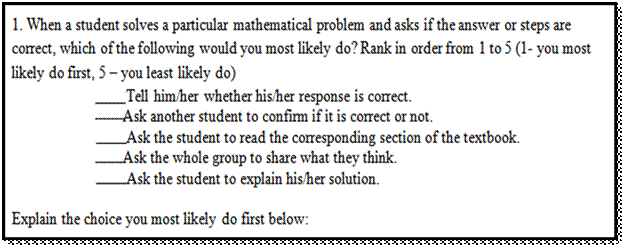
Figure 2.
Example of KtAS item and ranking format
Source: own elaboration
Teachers were asked to respond to the KtAS within the time allowed of 30 minutes. If teachers selected the choice ranked as number 1 by the expert analysis done for this survey as their number 1 choice also, they would also obtain a 1 in that item. If the teachers selected another choice, they would get a 0 in that item. Then, the total score of the KtAS is provided by the sum of all the items.
Variables
Based on the literature review, the following independent variables were considered in the analysis of this study: cognitive type 1 (T1), cognitive type 2 (T2), cognitive type 3 (T3), and the total scores of Teacher Content Knowledge Survey (tcks). The dependent variable is the “Knowing-to Act” (KtAS), which means the total scores on the survey. Cognitive types are measured through the number of correct answers of the items for each type of knowledge in the teacher content knowledge survey. The number of total scores of the tcks is calculated by adding all the correctly answered items in the survey. The “knowing-to act” was examined as the teacher’s intention to act in a desirable way, and its measurement was through the scores obtained in the Knowing-to Act Survey (KtAS).
DATA ANALYSIS
The description of the variables was done through the use of basic statistics (descriptive). Data analysis was performed using correlational analysis (Pearson coefficient) to determine how the cognitive types and teacher content knowledge total scores are related to the teacher’s selection of a desirable action. We conducted a correlational analysis due to the fact that the correlation is a statistical technique used to measure and describe the relationship between two variables. Also, the decision to select this parametric technique is based on the research question of this study: to what extent the mathematics cognitive types of middle school teachers’ knowledge are associated with teachers’ intention to act in certain way? All the procedures of this analysis were done using the data analysis tools of Microsoft Excel software.
Results
The results of the surveys applied to these 64 middle school teachers are presented in Table 2. The mean score percentages of the performance of Mexican teachers on tcks is 41% and on KtAS is 72%. Table 2 shows some more descriptive statistics.
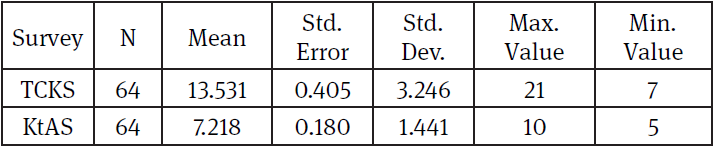
Source: own elaboration
The following result is obtained from the correlation analysis among tcks (total score) and KtAS. The analysis showed that there is no significant correlation between teacher content knowledge measured as the total score on the tcks and “knowing-to act” measured by KtAS score (Pearson’s r(64)=.17, p>.05). In other words, the teachers’ performance on the tcks is not related to their “knowing-to act” ability. As it is observed in Figure 3, scores tend to have a linear form. However, the points are not sufficiently clustered around the straight line to be a significant correlation.
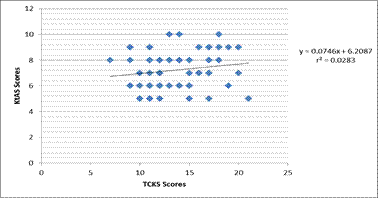
Figure 3.
Correlation between tcks and KtAS scores
Source: own elaboration
According to the data, the performance in the tcks varies by cognitive type of content knowledge. Teachers have a higher performance level on the items that measured the cognitive type 1, knowledge of facts and procedures. The mean score percentage of the cognitive type 1 is 60%. The mean score percentage of the cognitive type 2, knowledge of concepts and connections, is 36%. And the mean score percentage of the cognitive type 3, knowledge of models and generalizations, is 28%. Figure 4 illustrates the performance of Mexican teachers on the tcks by cognitive types, using the mean score percentages. This result shows that teachers possess more knowledge of fact and procedures than the other two cognitive types. It means that teachers have more procedural knowledge.
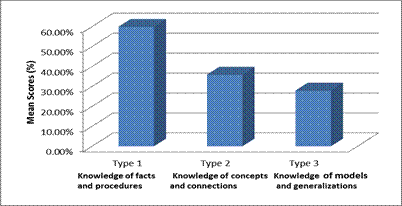
Figure 4.
tcks mean score percentages of results by cognitive type
Source: own elaboration
Table 3 presents more descriptive statistics about the scores of each of the cognitive types. Even though the sample size is small and was obtained by a convenience sampling, the standard errors are very small (see Table 3); we could deduce that the sample is representative of the population (Gravetter and Wallnau, 2013).
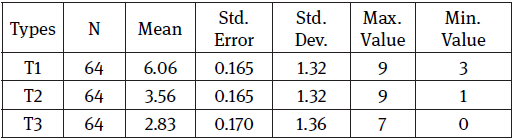
Source: own elaboration.
The following data are representative of the results obtained in this study, which examined the relationship between cognitive types of teacher content knowledge (T1, T2, T3) and KtAS. The correlational analysis between cognitive type T1 and KtAS is not significant (Pearson’s r(64)=.13, p>.05) as shown in Figure 5. In other words, the absence of relationship between T1 and KtAS adds to the discussion that the actions enacted by teachers during mathematics instruction are not related to their knowledge of facts and procedures.
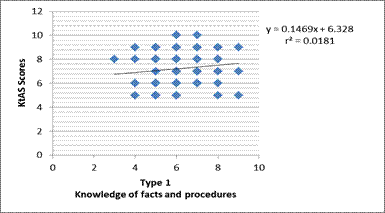
Figure 5.
Relationship between type 1 and KtAS
Source: own elaboration
With regard to the correlation analysis between cognitive type 2 and the KtAS score, the results obtained show that there is no significant correlation between T2 and KtAS (Pearson’s r(64)=.0001, p>.05). This result is illustrated in Figure 6 where it can be observed that the data is all over the graph.
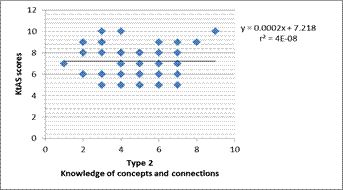
Figure 6.
Correlational analysis between type 2 and KtAS
Source: own elaboration
The last correlational analysis examined was
between T3 and KtAS. After analyzing the results of the last two correlations,
the results for this last comparison unexpectedly reported a significant
correlation between T3 and KtAS (r(64)=.27, p<.05). For evaluating
the effect size of this correlation,  is computed.
This correlation showed a medium effect size with
is computed.
This correlation showed a medium effect size with  according to
the Cohen’s (1988) standards for interpreting
according to
the Cohen’s (1988) standards for interpreting  This result showed in the correlation indicates that there is a
relationship between the knowledge of models and generalizations, and the
actions enacted by teachers during mathematics instructions. The medium effect
size indicated by is informing
us that this is a medium correlation. Figure 7 shows this significant
correlation.
This result showed in the correlation indicates that there is a
relationship between the knowledge of models and generalizations, and the
actions enacted by teachers during mathematics instructions. The medium effect
size indicated by is informing
us that this is a medium correlation. Figure 7 shows this significant
correlation.
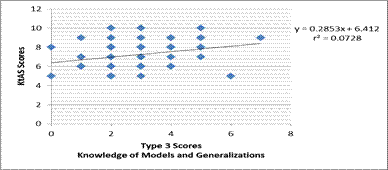
Figure 7.
Correlational analysis between type 3 and KtAS
Source: own elaboration
This result adds to the discussion that teachers who possess the mathematical knowledge that allows generating and testing conjectures, making generalizations, and proving theorems, among other aspects has more possibility of knowing-to act in the moment. It is important to highlight that in order to be able to generate conjectures and testing them, certain procedural and conceptual knowledge must be possessed. Analyzing this result, the “knowing-to act” ability appears when knowledge is called in the moment required. If there is no knowledge to be called, “knowing-to act” might not be enacted. According to Mason and Spence (1999) “knowing-to act” at the moment requires more than content knowledge, but this means that at least some content knowledge is essential. Therefore, there are more possibilities of “knowing-to act” when teachers hold knowledge of models and generalizations.
DISCUSSIONS AND CONCLUSIONS
The research question addressed in this study was as follows: to what extent the mathematics cognitive types of middle school teachers’ knowledge are associated with teachers’ intention to act in certain way? Two main results were obtained that answered this research question from the correlational analysis conducted. The data that was used for analysis of the mathematics teacher content knowledge was the total scores on the Teacher Content Knowledge Survey (TCKS). For analyzing teachers’ preference of certain actions, the scores on the Knowing-to Act Survey (KtAS) were used. The analysis showed that there is no a significant correlation between the mathematics teacher content knowledge and their “knowing-to act” during teaching mathematics. In other words, the content knowledge possessed by a teacher is not an indication of “knowing-to act” at the moment. As Mason and Spence (1999) discussed the content knowledge is part of the “knowing-about” which is accumulative knowledge that can be possessed, however, it does not imply that it can be used in a classroom situation such as the “knowing-to act” situations considered in this study. “Knowing-about” is the knowledge that includes these three types of knowing: “knowing-that” “knowing-how”, and “knowing-why”. These types of knowing refer to the factual knowledge, the knowledge of knowing how to do something such as techniques, and having an argument in order to structure actions and from which to reconstruct actions (Mason & Spence, 1999). Mason and Spence (1999) recognize that “knowing-about” is immersed in Shulman’s categories (1987).
Shulman (1986, 1987) mentioned that content knowledge is the knowledge that grows in the minds of teachers. He placed an emphasis on the content and distinguished seven categories. One of these categories is subject matter content knowledge, which involves knowledge that goes beyond just facts or concepts; it includes the understanding of structures of the subject matter (Shulman 1986). Furthermore, Tchoshanov (2011) specified that mathematical content knowledge includes knowledge of facts and procedures, knowledge of connections and concepts, and knowledge of generalizations and models. However, Mason and Spence (1999) considered that more than these categories, including the mathematics teacher content knowledge, are necessary to enable a teacher to act at the moment required. “Knowing-about” is considered as static knowledge meaning knowledge possessed by a person, but it does not indicate that she/he is able to act creatively in a particular situation. Also, Skemp (1979b) made this distinction. He distinguished between having knowledge about something and being able to use a technique in a fresh situation or at the moment. Therefore, the correlation between the mathematical content knowledge measured by the TCKS and the knowing-to act examined by the KtAS was already inferred in the literature review and conceptual framework.
In addition, correlational analyses were conducted to determine to what extent the cognitive types of mathematical content knowledge were related to the “knowing-to act” of Mexican teachers at the middle school level. The “knowing-to act” was considered and measured as the teacher’s intention to act in certain way at the situations provided. The three cognitive types of mathematical content knowledge identified by Tchoshanov (2011) were measured through the tcks. The items on this survey are categorized according to the cognitive type measured. The cognitive type 1 (T1) is the knowledge of facts and procedures. Cognitive type 2 (T2) is the knowledge of concepts and connections. And cognitive Type 3 (T3) refers to the knowledge of models and generalizations.
The examination of cognitive Type 1 and the scores on the KtAS were not correlated as reported in the dispersion diagram. In other words, the absence of a relationship between T1 and KtAS adds to the discussion the fact that the actions enacted by teachers during mathematics instruction are not related to their knowledge of facts and procedures. Moreover, the results obtained from the correlation analysis between T2 and KtAS showed that there is no significant correlation between them as identified in Results section. The fact that a teacher possesses conceptual knowledge that enables her/him to make a connection among mathematics concepts does not indicate that the teacher knows how to act in the moment. The correlation analysis of T3 and KtAS provided the second main result addressed in this research question. A significant correlation was obtained between T3 and KtAS scores. This result will be discussed and interpreted next.
Correlation Between Cognitive Type 3 and Knowing-to Act
Mason and Spence (1999) mentioned that
“knowing-to act” is less possible when there is no knowledge. Since “knowing-to
act” is the process where knowledge is called at the moment required, and if
there is no knowledge, then, it cannot be called. In this study, results
reported that teachers who possessed more knowledge of mathematics models and
generalizations (cognitive Type 3) were better able to think about how to act
desirably at the moment than teachers with a limited knowledge of models and
generalizations. In the correlational analysis conducted, a significant
correlation was found between the cognitive type 3 (T3) of mathematical content
knowledge and the scores on the Knowing-to Act Survey (KtAS). This result is
measured as a medium effect size correlation according to the interpretation of
the  recommended by
Cohen’s standards (1988). It indicates that the correlation between the scores
on the KtAS and the scores that measured only T3 is significant but with a
medium effect size as reported in the dispersion diagram.
recommended by
Cohen’s standards (1988). It indicates that the correlation between the scores
on the KtAS and the scores that measured only T3 is significant but with a
medium effect size as reported in the dispersion diagram.
The cognitive type 3 of mathematical content knowledge is more theoretical (Tchoshanov, 2011). This type of knowledge is about models and generalizations. It includes conjecturing, generalizing, proving theorems, etc. The significant correlation between T3 and KtAS obtained is a relevant result that means that there is a relationship between the knowledge of models and generalizations and the actions enacted by teachers during mathematics instruction.
This interesting result adds to the discussion that teachers who possess the mathematical knowledge that allows generating and testing conjectures, making generalizations, and proving theorems, among other abilities, have more possibilities of “knowing-to act” in the moment. It means that teachers with higher mathematics cognitive type 3 have more opportunity to have an intention to act in a desirable way. It is relevant to highlight that in order to be able to generate conjectures and test them; certain procedural and conceptual knowledge must be possessed. According to Tchoshanov (2011) cognitive type 3 of mathematical content knowledge (T3) involves teachers’ knowledge and thinking to be able to generalize mathematics statements, design mathematics models, make and test conjectures, and prove theorems. Therefore, teachers’ performance on the Knowing-to Act Survey (KtAS) was generally higher when teachers possessed higher knowledge of mathematics models and generalization (T3).
According to Mason and Spence (1999) “knowing-to act” at the moment requires more than content knowledge, but this means that at least some content knowledge is essential. The cognitive type 3 of mathematical content knowledge possessed by the Mexican teachers allowed the process in which “knowledge that enables people to act creatively rather than merely react to stimuli with trained or habituated behavior” (Mason and Spence, 1999, p.136) evolved. Therefore, teachers have more possibility of “knowing-to act” when they hold knowledge of models and generalizations. In Tchoshanov’s study (2011), two middle school teachers were interviewed to analyze their cognitive type 3 (T3) of mathematical content knowledge. One of the participants who had a higher T3 knowledge showed more confidence to develop class activities on fraction division. This teacher would have more opportunity to know how to act at the moment of implementing these activities. T3 offers possibilities for “knowing-to act” at the moment.
Furthermore, we can add to the discussion that the significant correlation between the cognitive type 3 (T3) of mathematics teacher content knowledge and their “Knowing to act” measured by KtAS might also be related to the finding that teachers with high T3 knowledge feel more comfortable and confident during their teaching as reported in Tchoshanov’s study (2011). According to Fennema and Loef (1992), they pointed out that “when a teacher has a conceptual understanding of mathematics, it influences classroom instruction in a positive way” (p. 151). Even though T3 knowledge does not refer only to the conceptual understanding of mathematics, T3 involves this conceptual understanding of mathematics in order to be able to test conjectures, theorems or make mathematics models and generalizations. This claim supports the significant correlation reported in this study between T3 and KtAS. Teachers with knowledge of models and generalizations have more possibility to provide learning opportunities during mathematics instruction that increase the possibilities that their “knowing-to act” could be enacted.
This study has several limitations. One limitation is regard of the sample size. The sample size is N=70. The computation of the standard errors shows that there is an acceptable representativeness of the population as mentioned in the results section. However, the bigger is the sample size, the smaller is the standard error and there is more accuracy of how the sample data represents the population (Gravetter & Wallnau, 2013). Thus, it is considered a limitation. Other limitation is that the sample was obtained from the voluntary participation of the teachers in one particular region in Mexico. This limitation does not allow generalizing the results in the whole country. This sample represents one borderland city in Mexico.
Several recommendations for practice/policy are provided. One recommendation is that educators should be aware of the attention that needs to be placed on the “knowing-to act” of teachers and students. Another recommendation is that we need to educate in-service or pre-service teachers about the “knowing-to act” processes that characterize their teaching in mathematics classrooms. This could be achieved through the implementation of professional development that includes activities that allow teachers to identify their “knowing-to act” and reflect about their actions enacted in “knowing-to act” situations. Teachers need to pay attention in particular situations that arise in their classroom that either limit or promote critical thinking. Another implication for policy and/or practice that arose from the implementation of this study concerns professional development and teacher preparation programs. The evaluation of teacher professional development and teacher preparation can be done by focusing on the “knowing-to act” and/or mathematical content knowledge. Using the instrument developed for this study KtAS to measure the “knowing-to act or the tcks to examine the mathematical content knowledge may be a viable way of enhancing professional development for mathematics teachers in Mexico.
References
An, S. Kulm, G., and Wu, Z. (2004). The pedagogical content knowledge of middle school, mathematics teachers in China and the U.S. Journal of Mathematics Teacher Education. 7, 145-172.
Askew, M. (2005). It ain’t (just) what you do: Effective teachers of numeracy. In I. Thompson (Ed.), Issues in teaching numeracy in primary schools (pp. 91-102). Berkshire, UK: Open University Press.
Askew, M., Brown, M., Rhodes, V., Johnson, D., & Wiliam, D. (1997). Effective teachers of numeracy. London: School of Education, King’s College.
Ball D., Thames, M., and Phelps G.(2008). Content knowledge for teaching: what makes it special? Journal of Teacher Education, 59 (5), 389-407.
Bransford, J., Brown, A. & Cocking, R. (2000). How people learn. Expanded Edition. Washington, DC: National Research Council.
Castañeda, A., Rosas, A. y Molina, J.G. (2011). Mathematics teaching, 20-26. Institutionalization of knowledge in the mathematics classroom: a study on classroom discourse. In Wiest, L. R. (Eds.). Proceedings of the 33rd Annual Meeting of the North American Chapter of the International Group for the Psychology of Mathematics Education. Reno, NV: University of Nevada, Reno.
Chapman, O.(2013). Investigating teachers’ knowledge for teaching mathematics, Journal of Mathematics Teacher Education, 16 (4), 237-243.
Clarke, D., Cheeseman, J., Gervasoni, A., Gronn, D., Horne, D., McDonough, A. (2002). Early numeracy research project final report. Melbourne: Australian Catholic University.
Cohen, J. (1988). Statistical power analysis for the behavioural sciences. Hillsdale, NJ: Lawrence Erlbaum Associates.
Crocker, L., & Algina, J. (1986). Introduction to classical and modern test theory. Philadelphia, PA: Harcourt Brace Jovanovich College Publishers.
Cronbach, L. (1951). Coefficient alpha and the internal structure of the tests. Psychometrica, 16, 297–334.
Davis, B., & Simmt, E. (2006). Mathematics-for-teaching: An ongoing investigation of the mathematics that teachers (need to) know. Educational Studies in Mathematics, 61, 293–319.
Dirección General de Educación Superior para Profesionales de la Educación (2010). Licenciatura en educación secundaria, plan 1999. Retrieved on Febrerary 10, 2012 from: http://www.dgespe.sep.gob.mx/sites/default/files/planes/les/mod_esc/matematicas.pdf
Doerfler, W. (1991). Forms and means of generalization in mathematics. In A. Bishop, S. Mellin-Olsen, & J. van Dormolen (Eds.), Mathematical knowledge: Its growth through teaching. Dordrecht: Kluwer.
Dueñas, A. (2009). La construcción social de los profesores de educación secundaria ante la enseñanza de las matemáticas (primer reporte de investigación). In X Congreso de Investigación Educativa. Veracruz, México: COMIE.
Fennema E. & Loef M. (1992). Teachers’ knowledge and its impact. Mathematics teaching. Grouws, Douglas A. (Eds). Handbook of Research on Mathematics Teaching and Learning: A Project of the National Council of Teachers of Mathematics. New York, NY: Macmillan.
Gatteno, C. (1970). What we owe children: The subordination of teaching to learning. London: Routledge and Kegan Paul.
Gatteno, C. (1987). The science of education part: Theoretical considerations. New York, NY: Educational Solutions.
Gravetter, F., and Wallnau, L. (2013). Statistics for the behavioral sciences 9th Edition. Belmont, CA: Wadsworth, Cengage Learning.
Hill, H., Ball, D., & Schilling, S.(2008). Unpacking pedagogical content knowledge: conceptualizing and measuring teachers’ topic-specific knowledge of students. Journal for Research in Mathematics Education. 39 (4), 372-400.
Inzunsa, S. & Guzman, M. (2011). Comprensión que muestran profesores de secundaria acerca de los conceptos de probabilidad: un estudio exploratorio. Revista Educación Matemática, 23 (1), 63-95.
Jong, T. and Ferguson-Hessler, M. (1996). Types and Qualities of Knowledge. Educational Psychologist, 31 (2), 105-113.
Koehler, M. J. & Mishra, P. (2009). What is technological pedagogical content knowledge? Contemporary Issues in Technology and Teacher Education, 9 (1), 60-70.
Kulm, G., Capraro, R.M., Capraro, M.M., Burghardt, R. & Ford, K. (2001). Teaching and learning mathematics with understanding in an era of accountability and high-stakes testing. Paper presented at the research pre-session of the 79th annual meeting of the National Council of Teachers of Mathematics. Orlando, FL.
Mason, J. (1998). Enabling Teachers to be Real Teachers: Necessary Levels of Awareness and Structure of Attention. Journal of Mathematics Teacher Education, 1 (3), 243-267.
Mason, J. & Spence, M. (1998). Towards a Psychology of Knowing-To, in C. Kanes, M. Goos, & E. Warren (Eds.) Teaching Mathematics in New Times: Proceedings of Mathematics Education Research Group of Australasia 21, 1, (pp. 342-349). Gold Coast, Sydney: MERGA.
Mason, J. and Spence, M.(1999). Beyond mere knowledge of mathematics: The importance of knowing-to act in the moment. Educational Studies in Mathematics, 38 (1), 135-161.
Mochon, S. & Hernandez, M. (2011). Mathematical knowledge for teaching of student teachers and its enhancement through a special final course. In Wiest, L. R. (Eds.). Proceedings of the 33rd Annual Meeting of the North American Chapter of the International Group for the Psychology of Mathematics Education. Reno, NV: University of Nevada, Reno.
Muir, T. (2008). “Zero is Not a Number”: Teachable Moments and their Role in Effective Teaching of Numeracy. In M. Goos, R. Brown, & K. Makar (Eds.), Proceedings of the 31st Annual Conference of the Mathematics Education Research Group of Australasia (pp. 361-367), Brisbane, Qld: MERGA.
National Mathematics Advisory Panel. (2008b). Foundations for success: Report of the task group on teachers and teacher education. Washington, DC: U.S. Department of Education.
Pinto, J. and González, M. (2008). El conocimiento didáctico del contenido en el profesor de matemáticas: ¿una cuestión ignorada? Educación Matemática, 20 (3), 83-100.
Presmeg, N. C. (1997). Generalization using imagery. In L. D. English (Ed.), Mathematical reasoning: Analogies, metaphors and images, 11th ed., (pp. 299–312). Mahwah, NJ: Lawrence Erlbaum Associates.
Rowland, T. (2008). Researching teachers' mathematics disciplinary knowledge. In P. Sullivan and T. Wood (Eds.) International handbook of mathematics teacher education:Vol.1. Knowledge and beliefs in mathematics teaching and teaching development (pp. 273-298). Rotterdam, the Netherlands: Sense Publishers.
Rowland, T., Huckstep, P., and Thwaites, A. (2005). Elementary teachers’ mathematics subject knowledge: the knowledge quartet and the case of Naomi. Journal of Mathematics Teacher Education. 8 (3), 255-281.
Ryle, G. (1949). The concept of mind. Hutchinson, London.
Sandoval E. (2009). La inserción a la docencia. Aprender a ser maestro de secundaria en México. Profesorado Revista de Curriculum y Formación del Profesorado, 13 (1), 182-194.
Secretaría de Educación Pública. (2004). Libro para el maestro. Matematicas secundaria. México City, México: SEP.
Shulman, L. (1986). Those who understand: Knowledge growth in teaching. Educational Researcher, 15 (2), 4-14.
Shulman, L.S. (1987). Knowledge and teaching: foundations of the new reform. Harvard Educational Rewiew, 57 (1), 1-22.
Skemp, R. (1978). Relational understanding and instrumental understanding. Arithmetic Teacher, 26 (3), 9–15.
Skemp, R. R. (1979b). Intelligence, learning and action – A foundation for theory and practice in education. New York, NY: Wiley.
Sorto, M., Marshall, J., Luschel, T., and Carnoy, M. (2009). Teacher knowledge and teaching in Panama and Costa Rica: A comparative study in primary and secondary education. Revista Latinoamerica de Investigacion en Matematica Educativa, 12 (2), 251-290.
Stein, M., Smith, M., Henningsen, M., & Silver, E. (2000). Implementing standards-based mathematics instruction: A casebook for professional development. Foreword by Deborah Ball. New York, NY: Teachers College Press.
Tashakkori, A., and Teddlie, C.(2003). Handbook of mixed methods in social and behavioral research. Thousand Oaks, CA: Sage.
Tchoshanov, M., Lesser, L., & Salazar, J. (2008). Teacher knowledge and student achievement: Reveling patters. Journal of Mathematics Education Leadership, 13, 39-49.
Tchoshanov, M. (2011). Relationship between teacher knowledge of concepts and connections, teaching practice, and student achievement in middle grades mathematics. Educational Studies in Mathematics, 76, 141-164.
Wilhelm, J., Sherrod, S., & Walters, K. (2008). Project-Based learning Environment: Challenging preservice teachers to act in the moment. The Journal of Educational Research, 101 (4), 220-233.
Zemelman, S., Daniels, H., & Hyde, A. (2005). Best practice, today's standards for teaching and learning in America's schools (3rd ed.). Portsmouth, NH: Heinemann.
Author notes