Artículos
The Brand as Value Production. From the Trademark to the Designation of Origin of Wines from the Douro Demarcated Region
La marca como producción de valor. De la marca comercial a la Denominación de Origen de los vinos de la Región Demarcada del Duero
 Carla Sequeira cferreira@letras.up.pt
Paula Montes Leal paulamontesleal@gmail.com
Carla Sequeira cferreira@letras.up.pt
Paula Montes Leal paulamontesleal@gmail.com
The Brand as Value Production. From the Trademark to the Designation of Origin of Wines from the Douro Demarcated Region
Revista Iberoamericana de Viticultura, Agroindustria y Ruralidad, vol. 7, núm. 21, pp. 136-157, 2020
Universidad de Santiago de Chile

Esta obra está bajo una Licencia Creative Commons Atribución 4.0 Internacional.
Recepción: 19 Junio 2020
Aprobación: 25 Julio 2020
Resumen: A fines del siglo XIX surgen las marcas comerciales modernas, después de la creación del marco legal para su protección y el nacimiento de grandes empresas comerciales. En el sector vitivinícola portugués hubo una fuerte adhesión de las empresas al registro de marcas como defensa contra las prácticas de “uso indebido de indicaciones de procedencia falsas”, en un contexto de conversión postfiloxérica, de un mercado inestable y la proliferación de imitaciones y falsificaciones. El sector comercial se apropiaría de la marca en su identificación con la Denominación de Origen, lo que llevó a la aparición, a principios del siglo XX, de un movimiento liderado por las élites de la Región Demarcada del Duero en el sentido del reconocimiento y defensa legal de la marca regional Porto. En este artículo nos centraremos en tres fincas históricas —Senhora da Ribeira, Bomfim y Zimbro— y en las marcas comerciales, etiquetas y marcas de fuego de Silva & Cosens, una de las compañías de comercio de vino del Duero más respetadas a principios del siglo XX. Intentaremos comprender cómo la compañía creó marcas comerciales con una fuerte identificación con la Región Duriense, la región que produce sus vinos.
Palabras clave: vino de Oporto, marca comercial, Denominación de Origen, Región Demarcada del Duero.
Abstract: At the end of the 19th century, modern commercial brands emerged after the creation of the legal framework for their protection and the birth of large commercial companies. In the Portuguese wine sector, there was a strong adhesion of companies to the registration of trademarks as a defense against practices of “abusive use of false or misleading indications of provenance”, in a context of post-phylloxera reconversion, market instability and the proliferation of imitations and counterfeits. The commercial sector took ownership of the brand in its identification with the designation of origin, leading to the emergence at the beginning of the 20th century of a movement led by prominent personalities from the Douro Region in the sense of creation of legal mechanisms to defend the regional brand of Portwine. We will analyze three historical quintas(estates) — Senhora da Ribeira, Bomfim and Zimbro — and the marks (brands, labels and fire marks) of Silva & Cosens, the “most respectable” company in the Douro wine trade in the early 20th century. We aim to undesrtand how this company created trademarks with a strongly identifying character with the Douro Demarcated Region, the producing region of its wines.
Keywords: Portwine, trademarks, designations of origin, Douro Demarcated Region.
Introduction
In the Alto Douro region, the oldest demarcated and regulated region in the world, with shale soils, vineyard cultivation dates to Roman times, having developed progressively in the following centuries. From the 11th to 13th centuries there was an expansion of the vineyard. And as soon as the 17th century, English, Flemish and Dutch traders settled in Oporto, dedicating themselves to the export of Douro wines.
While the export of wines to England increases, the first conflicts between producers and merchants erupt, leading to the Constitution of the Companhia Geral da Agricultura das Vinhas do Alto Douro by Royal Charter, in 1756, accompanied by the demarcation of the producing region (see Pereira, 1996: 180-188; Pereira, 2010b: 10-16).
The law of 7th December 1865, the result of an intense and prolonged debate between free traders and protectionists on the wine sector issue, established a regime of freedom of trade that would end only in 1907. During this period, all regulatory mechanisms were abolished: the demarcation was eliminated, as well as the restriction of the port bar of Porto for the export of Douro wines and the supervision and certification of wines.
At the end of the 19th century, modern commercial brands emerged after the creation of the legal framework for their protection and the birth of large commercial companies.
On the other hand, the commercial sector would eventually take ownership of the brand, namely in its identification with the designation of origin, leading to the emergence at the beginning of the 20th century of a movement led by prominent landowners and personalities from the Douro Region aiming to recognition and creation of legal mechanisms to defend the regional brand of Porto.
In this paper, we will analyze three historical quintas (estates) — Senhora da Ribeira, Bomfim and Zimbro, owned by Silva & Cosens. From these archives, along with specialized bibliography, we will try to understand, in a conjunctural way, the history of the company.
Considering the brand as a production of value, we will try to understand how this company, in counterpoint with the commercial sector, created trademarks with a strongly identifying character with the Douro Demarcated Region (Figure 1), in parallel with the movement that, after the Paris Convention and the Madrid Agreement in the late 19th century, led to the creation of the regional brand of Douro wines.
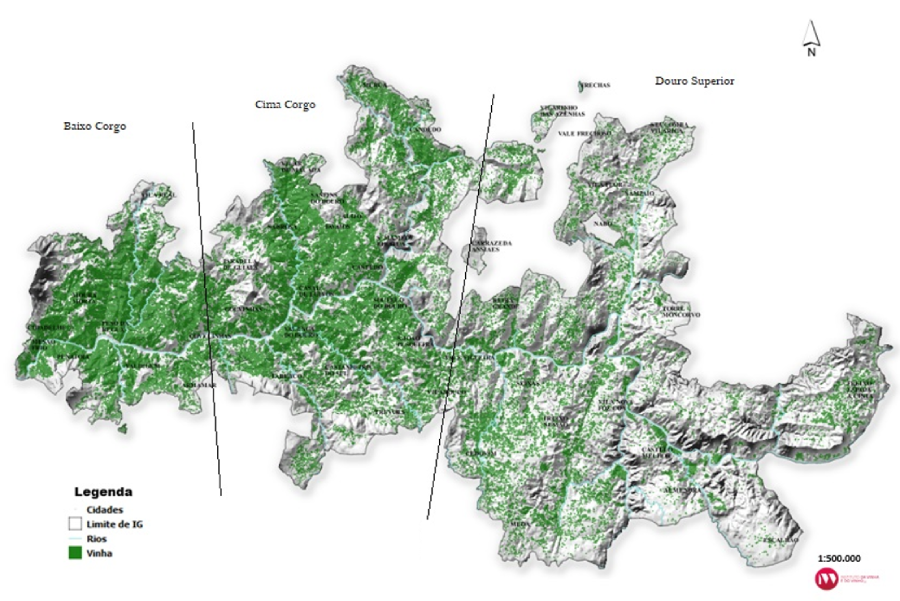
Figure 1
Map of the Douro Demarcated Region
Figura 1. Mapa de la Región Demarcada del Duero
Source/fuente: adapted from <https://www.ivv.gov.pt/np4/77/>.Trademark versus regional brand. The birth of legal framework for trademarks and designations of origin in the wine-growing sector
The invasion of phylloxera in the second half of the 19th century, led to a change in the “viticultural geography” of Portugal. With the growth of production in the southern part of the country, there would be echoes in the press defending the specialization by regional types of wine. At the same time, several initiatives would support the creation of regional brands, along with export regulations.
In the case of the Alto Douro, the death of the vineyards on the Cima Corgo led to the increment of production in the Baixo Corgo and the progression of the vineyard to the Douro Superior, due to external demand and assisted by the construction of the railroad.
In 1872, in a free-trade policy framework for the Portwine sector, the phylloxera had already spread throughout the Douro region. The central government tried to take action, namely by nominating a study committee. The first solutions to combat the plague in the Alto Douro date back to 1876, using carbon sulfide and the plantation of vineyards with American rooted cuttings. By this time, many quintas (estates) were on sale, and the crisis had settled in the sector, motivated by the abrupt decline in production quantities and by the traders growing use of wines from outside the Douro Demarcated Region as a consequence of the establishment of the freedom of trade regime in 1865, which facilitated the proliferation of fraud and falsifications.
The opposition of interests between the Douro wine growers and the Port traders as well as wine growers from other Portuguese wine-growing regions, in the short term led to successive claims for the restoration of the protectionist regime in the wine sector, particularly concerning the Douro Region.
Through the press, several personalities demanded, in presentations to the Cortes or in rallies, the legal recognition of the regional brand, i.e., the use of the designation of origin Port exclusively for wines produced in the Alto Douro. During the crisis, by guaranteeing the genuineness of the product, the regional brand was perceived as a way of economic recovery.
At first, the central government responded to the claims by approving the commerce and industry Trade Marks Act of 4 June 1883, which aimed to ensure fair competition in commercial transactions.
The factory and trademarks emerged in the context of industrial property law and following the signing of the Paris Convention on 20 March 1883, where the conflict of interest and the weight of the commercial and exporting sector lobby where also felt, obviously opposing to any provision contrary to commercial practices.1
The said Law of 4 June 1883 established that it was unlawful to indicate on the mark of a product, the name of a country or a region where it had not been produced. And, in the specific case of wines, it was required, in addition to the name of the producing country or region, the name of the estate or the parish where it was located.
In 1885, at a time of crisis in the sector, the Comissão de Defesa do Douro (the Committee for Douro Defense) would initiate a movement in favour of the historical brand of Douro wines, placing it as the order of the day in parliamentary debates. Various institutional initiatives would be by then developed, also involving the municipalities. The Douro elites would demand the regulation of the Law of 4 June 1883 in such a way that the guarantee “to the producing localities” provided for in that provision, would have practical implementation. There was an emphasis in the need to prevent the usurpation of the designation of origin by applying regional brands to all wines and the demarcation of the respective producing regions.
At the time when “the question of the brand became the center of the discussions” (Sequeira, 2011: 152), the Madrid agreement was emerging.
Signed on 14 April 1891, this agreement was the first important step towards the recognition of the designations of origin as an autonomous entity from a legal standpoint, proposing the suppression of false or fallacious indications of provenance (Almeida, 1999: 155). Article 4 referred to the provenance of wine products, establishing that the Indication of Origin given by the geographical name of the country or region of production could never be transformed into a generic denomination of a type of wine. In the Douro Wine Region, the Madrid agreement was regarded as an instrument for defending the regional brand, because it was understood that the application of the geographical name to agricultural products would designate a product that could not be obtained except in that place, requiring the transposition of this interpretation to the Portuguese legislation.
This issue would become increasingly urgent, with a clear duality of criteria and concepts. The core was the difference between agricultural product and industrial product, between regional brand and trademark.
On one hand, the export sector, represented by the Associação Comercial do Porto (Porto Trade Association), appropriating the mark in its identification with the designation of origin, argued that they owned it, denying any right to the production sector. According to the Associação Comercial do Porto, brand was not only the label, the name of the manufacturer, and the insignia, but also the practice of producing wine by blending stocks from various provenances, “a practice long followed in winemaking by Port traders” (Sequeira, 2011: 138). On the other hand, the Douro wine makers who defended the Port brand was not the designation of a type of wine but a regional brand, as established in the Madrid agreement.
At the beginning of the 20th century, the Douro elites created a commission for the study of the law of regional brands, pointing towards diversification: Port wine brand for liqueur wines, and Douro virgin wine brand for consumption wines. However, only in 1907 some of the regional claims would prevail, through the publication of the decree of 10 May, which would allow the “final legislative identification of the name Port wine with the fortified wines produced in Douro, thus becoming their protected designation of origin” (Moreira, 1998: 244).
The quintas of Bomfim, Zimbro and Senhora da Ribeira
Between 1865 and 1907, the regime of freedom of trade and the grape vine pests brought social crisis to the Douro region. The decrease of production and investment in the post-phylloxera reconversion resulted in indebtedness and misery. The properties devalued and the transfer of ownership accelerated.
It would be around this time that Silva & Cosens, a company established in 1798 by Bruno Evaristo Ferreira da Silva (a merchant from Porto who settled in London), would buy three emblematic quintas in the region. After several business and family partnerships, the company would become part of Symington in 1961, being considered as one of the most important and prestigious companies in the group.
Quinta do Zimbro (Figure 2), located in the Cima Corgo region, was the first to be acquired, in 1887 (Mayson, 1999: 33),2 followed by Quinta da Senhora da Ribeira (Figure 3), located in the Douro Superior region, in 1890 (Mayson, 1998). Located in the heart of Cima Corgo and considered to be “the origin of the best Portwines” (Pereira and Almeida, 1999: 148), Quinta do Bomfim (Figure 4) would be bought in 1896. Originally known as Quinta do Vale Bem Feito, according to Manuel Monteiro “the wine product obtained in it is, undoubtedly, superfine” (Monteiro, 1998: 80). Confirming this assertion, Quinta do Bomfim was recently distinguished as one of the best vineyards in the world, under the World’s Best Vineyards 2019 award.3

Figure 2
Quinta do Zimbro. Photo by Emilio Biel, c. 1910
Figura 2. Quinta do Zimbro. Foto de Emilio Biel, c. 1910
Source/fuente: Monteiro, 1998: 79.
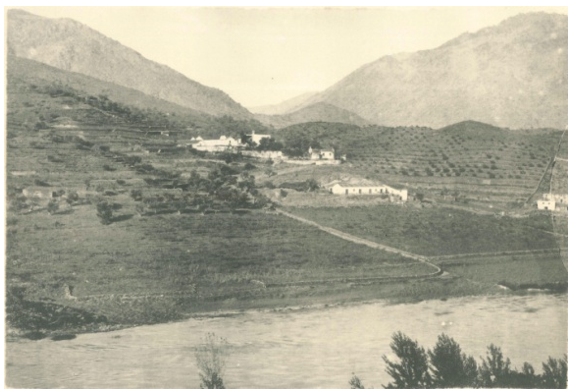
Figure 3
Quinta da Senhora da Ribeira. Photo by Emilio Biel, c. 1910
Figura 3. Quinta da Senhora da Ribeira. Foto de Emilio Biel, c. 1910
Source/fuente: Monteiro, 1998: 78.
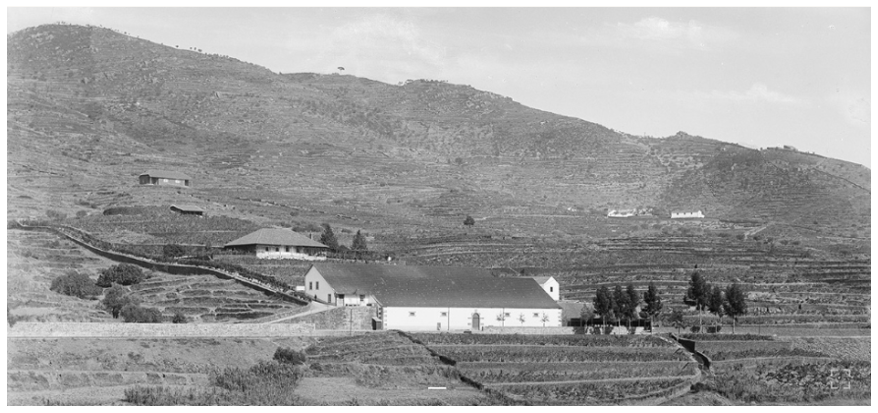
Figure 4
Quinta do Bomfim, early 20th century
Figura 4. Quinta do Bomfim, inicios del siglo XX
Source/fuente: Symington Family Archives.These three estates had been affected by phylloxera and, after the purchase, they were replanted with the use of American vine grafting in the “most prestigious Douro grape varieties” (Monteiro, 1998: 80).
At the end of the 18th century, 67 grape varieties were identified in the Lamego area (38 red and 29 white). In view of such a large number of varieties “and traditionally not making any distinction between them in the vineyards, only little by little those that experience proved having better quality were valued” (Pereira, 1991: 85) as well as “those best adapted to the production of Portwine” (Pereira, 1991: 83 and 85), “according to the types of land and wines” (Pereira, 1991: 85) to be produced.
The prohibition of mixing white and red grapes, imposed by the Companhia, and the “growing commercial dependence of fortified Douro wines on the English market”, with a preference for strong wines with a “loaded color”, led to the conversion of vineyards by Douro wine growers, “selecting the grape varieties that best guaranteed wines with those characteristics”. Until the beginning of the 19th century, there would be a “progressive devaluation of white wines, which occupied a prominent place in traditional Douro viticulture” (Pereira, 2010a: 145-146).
In the middle of the third quarter of the 19th century, there were about twenty main grape varieties in each blend of Alto Douro wines, such as the varieties alvarelhão tinta, bastardo, casculho, cornifesto (one of the good grape varieties of the Douro, quite common in the Cima Corgo and Douro Superior, and resistant to powdery mildew), the mourisco tinto, the moreto (predominant in the Alentejo but also much appreciated in the Alto Douro), the sousão, the tinta amarela, tinta carvalha, and tinta Francisca or francesa, the tinta lameira, the rufete, the tinto cão (one of the most ancient varieties in the Alto Douro; although having low yields, it’s appreciated for giving body and colour to wines) and the touriga; among the whites, the codega or malvasia grossa, the diagalves, the gouveio or verdelho, the malvasia, and the moscatel.
The most reputed was the touriga, “considered very similar to the ‘cabernet’, the great variety of the Haut Médoc”, followed by the mourisco tinto “named uva-rei (king-grape) by the Trás-os-Montes inhabitants”. The tinta Francisca, cultivated in the main estates of Cima Corgo, was equally appreciated and “considered to be similar to ‘pinot noir’ from the Côte d’Or”. The sousão, “the only remaining grape variety from Alto Douro that deserves a special reference”, was introduced in the early 18th century. Forgotten by many wine growers of Douro, this variety has been planted in several quintas owned by Symington in recent years, like Senhora da Ribeira and Bomfim (Pereira, 1947: 60-63).
According to the archives of Silva & Cosens, the three quintas were replanted using vitis from North America that was especially suitable for the development of resistant rootstocks, highlighting the varieties aramon rupestris, rupestris monticola, riparia rupestris, and riparia gloria.
In 1910, the tinta Francisca, tinta amarela, casculho, cornifesto and moreto varieties were planted in the quintas of Senhora da Ribeira, Bomfim and Zimbro. At the beginning of the 1920’s, the varieties were the same, apart from casculho that was replaced by rufete (a red variety, also known as tinta pinheira), and the addition of codega (widely cultivated in the Cima Corgo).
Nowadays, the predominant grape varieties in the Symington quintas are sousão, touriga nacional, touriga franca, tinta barroca, tinta roriz, Alicante bouschet, tinta amarela, and tinta cão.
The marks of Silva & Cosens: brands, labels and firemarks
In the early 20th century, Silva & Cosens was considered the “most respectable and strong” company in the Douro wine trade (Monteiro, 1998: 77-78). In addition to its own production from the quintas of Bomfim, Senhora da Ribeira and Zimbro, it would also buy grapes “in all areas of the Douro Wine country to complete and readily be able to satisfy any and all orders” (Monteiro, 1998: 77-78).
In 1877, Silva & Cosens merged with Dow, a company established in 1798 by Samuel Weaver, a British subject. In the 19th century, Dow goes by the name of Weaver, Dow & Co., after the marriage of James Dow with Phoebe Carrier, niece of Samuel Weaver; after his death, the firm went on as Dow & Co.
Dow & Co. was highly considered due to the quality of its Ports and, after the merger of the two companies, Silva & Cosens kept the Dow’s trademark due to its strategic importance. At that time, the Dow's brand wines were already produced with grapes from the three quintas (Senhora da Ribeira, Bomfim and Zimbro).
The brand, as a distinctive mark for goods placed on the market, is an asset of the company, “is something that provides an entity to the product and adds value to it, making it differentiated” (Aguiar and Lopes, 2000: 125); therefore, it is natural to invest in its valuation and empowerment.
Between 1883 and 1900, no brands were registered by Silva & Cosens (Pereira and Cruz, 2017: 417). The first known registration dates from 1912, being related to the “Zimbro” brand (nowadays owned by a third party).
Labels
In the wine sector, one of the visible faces of the trademark is the label, with characteristic symbols and expressions (Guichard, 1997: 151-152) “that will identify it in the consumer’s memory. The label is therefore of paramount importance in the identification and communication of wine” (Borges, 2014: 135). The first concern is to associate the brand with the name of the company, as it is noticeable in the Dow’s Four Diamonds label (Figure 5). On the other hand, there is also a clear concern in the prevention of fraud, by indicating that it is a registered trademark (e.g. Hunting Port label), and the fact that the company is the sole owner of the brand (e.g. Four Diamonds label) (Figure 6) proving the distinctive and guaranteed function of a single and constant source of origin of the products, conferred to the brand by the first laws of the 19th century.

Figure 5
Four Diamonds Port label
Figura 5. Etiqueta Four Diamonds Port
Source/fuente: Symington Family Archives.
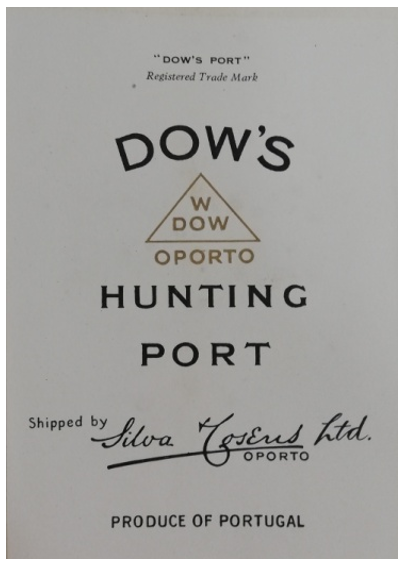
Figure 6
Hunting Port label
Figura 6. Etiqueta Hunting Port
Source/fuente: Symington Family Archives.Silva & Cosens labels show the symbol of the company in the foreground, which has evolved over time: the motto “owners of the finest vineyards in Portugal” or the reference to King George V, the emblem “W Dow Oporto” alternating with the mention “Silva & Cosens”, in full or in initials (e.g: the labels Silva & Cosens Specially Selected Old Port Wine and Dow’s White Port nº 1; also Dow’s 1940 Vintage Port) (Figure 7 and Figure 8).
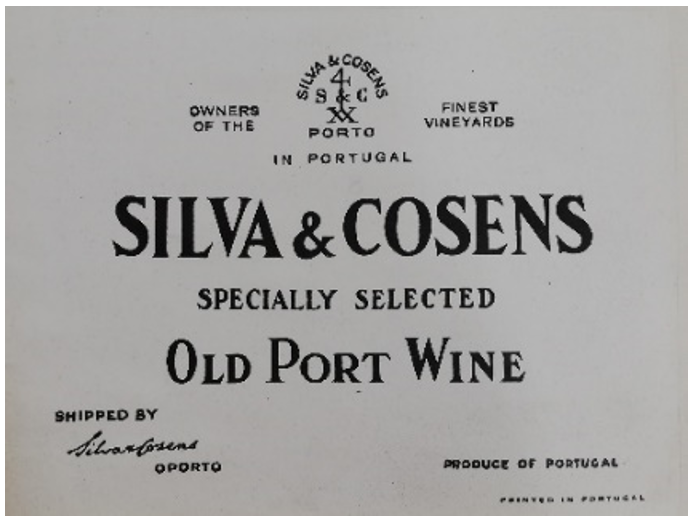
Figure 7
Silva & Cosens Specially Selected Old Port Wine label
Figura 7. Etiqueta Silva & Cosens Specially Selected Old Port Wine
Source/fuente: Symington Family Archives.

Figure 8
Dow’s White Port nº 1 label
Figura 8. Etiqueta Dow’s White Port nº 1
Source/fuente: Symington Family Archives.Along side the designation of the type of wine (Port, tawny, etc.), some labels also present elements of distinction such as commemorative medals of exhibitions (for instance, from the Universal Exhibition of Paris of 1878) (Figure 9).
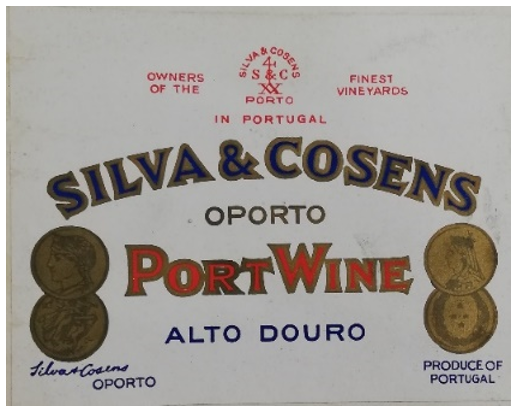
Figure 9
Medal label
Figura 9. Etiqueta con medallas
Source/fuente: Symington Family Archives.Other labels, some of simple composition, qualify the type of wine (“royal dry” or “extra dry”, for instance), adding the “indication of the harvest date, highlighting the years of exceptional quality and others, which have consecrated vintages or famous novelty wines” (Pereira and Cruz, 2017: 423). For instance, Dow’s Extra Dry White, Dow’s 1935 Vintage Port Matured in Cask, or even the Dow’s 1940 Vintage Port (Figure 10), with reference to King George V.
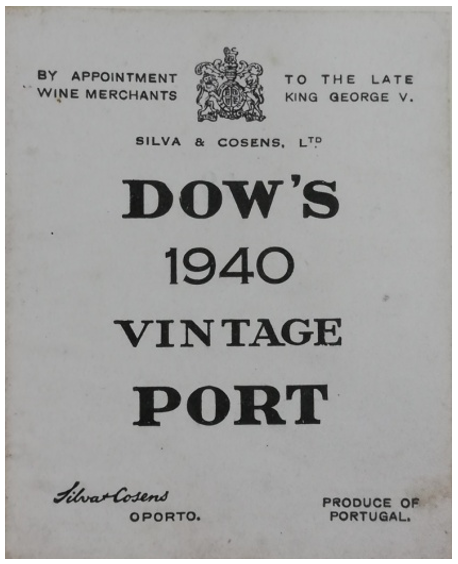
Figure 10
Dow’s 1940 Vintage Port label
Figura 10. Etiqueta Dow’s 1940 Vintage Port
Source/fuente: Symington Family Archives.Sometimes, in addition to the harvest date, the label also indicates the bottling year (e.g. the labels Dow’s Port 1929 Bottled 1932 and Dow’s 1945 Vintage Port Late Bottled 1949).
Finally, quality expressions and seniority are also used, such as “old tawny” (Dow’s label) Dow’s Very Very Old (label with initials V.V.O.) (Figure 11), or Fine old Port (Figure 12) with subtypes tawny, white and ruby (S&C Rio Douro label).

Figure 11
Dow’s Very Very Old Port label
Figura 11. Etiqueta Dow’s Very Very Old Port
Source/fuente: Symington Family Archives.

Figure 12
Fine Old Port label, with subtypes
Figura 12. Etiqueta Fine Old Port, con categorías especiales
Source/fuente: Symington Family Archives.Some labels may also present a simple mention or images related to the region of origin of the wines. In the first case, we have the Medal label, with the mention “Alto Douro” (Figure 9).
In the second case, the association with the producing region is done through the photographic representation of the Douro river (Figure 13), from the design of a typical rabelo boat inside a chalice (Figure 14) or the photograph of a rabelo boat loaded with wine barrels, accompanied by the caption “boat loading”.

Figure 13
River Douro brand label
Figura 13. Etiqueta de la marca River Douro
Source/fuente: Symington Family Archives

Figure 14
Dow’s Port label
Figura 14. Etiqueta de Dow’s Port
Source/fuente: Symington Family Archives.When the wine was destined for foreign markets, the labels could present other types of images. Thus, the wine sent to the firm Rigby & Evens Ltd. (an importer of wines and distilled beverages located in Bristol), was labelled with the brand Harbour Master Very Fine Old Tawny Port, surmounted by the image of a port featuring a vessel (Figure 15).

Figura 15
Etiqueta de marca Harbour Master
Figure 15. Harbour Master brand label
Source/fuente: Symington Family Archives.On the other hand, on labels intended for resellers there is a concern to highlight the identity between the company name and the trademark; the name of Silva & Cosens emerges prominently, like, for example, for the Marvel Père et Fils Vins Fins, from Belgium, on the labels intended for the company James Deuchar Ltd. (beer and wine and spirits merchants, based in Newcastle) (Figure 16), or for the Wine Shop Bristol (Copenhagen).

Figure 16
Label intended for the company James Deuchar Ltd.
Figura 16. Etiqueta destinada a la empresa James Deuchar Ltd.
Source/fuente: Symington Family Archives.Fire marks
In addition to the trademark, or the factory and trade marks, consideration must be given to fire marks (also called quality or batch marks), prior to the first but perpetuating over time.
The Companhia Geral da Agricultura das Vinhas do Alto Douro, a corporation created with the demarcation of 1756 for approval and control of the type, quality, transport and trade of Douro wine, imposed the generalization of the use of fire marks. These marks identify the “lot” or “number”, the quality (type/graduation of the wine), the year of production (Figure 17), the producer and sometimes the grape variety. So, these marks include elements of the designation of origin, such as the geographical indication of the production of wine, expressed in the mention to the quinta, as established in the trademark legislation of the last quarter of the 19th century. The reference to the name of the producer/quinta was made in several ways: by initials (Z, SR, BF) or by place (Tua 1907, when referring to Quinta do Zimbro) (Figure 18).
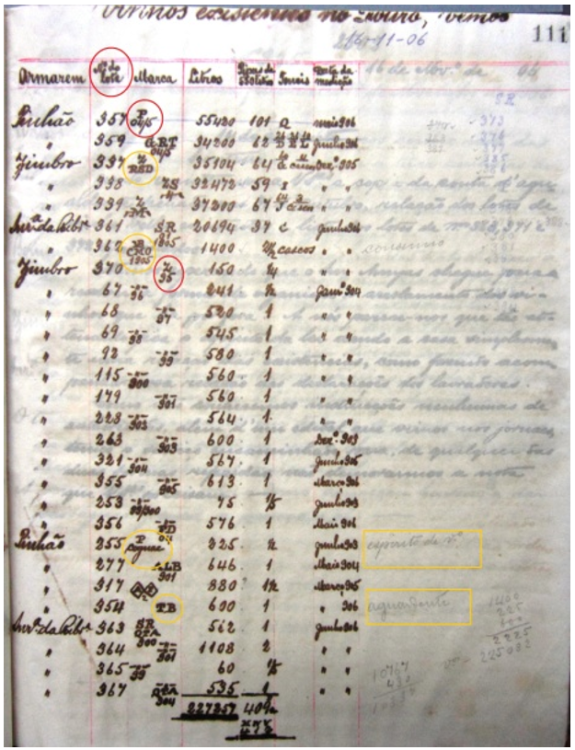
Figure 17
Fire marks of Silva & Cosens
Figura 17. Marcas de fuego de Silva & Cosens
Source/fuente: Symington Family Archives. Copiador de correspondência da firma Silva & Cosens (1906-1909), fl. 111.
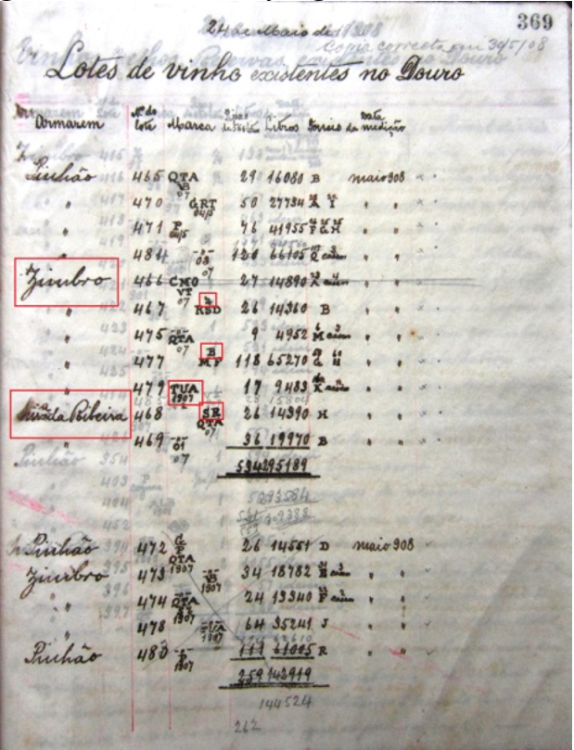
Figure 18
Fire marks of Silva & Cosens
Figura 18. Marcas de fuego de Silva & Cosens
Source/fuente: Symington Family Archives. Copiador de correspondência da firma Silva & Cosens (1906-1909), fl. 369.Besides the quinta, the fire marks could also indicate the warehouses or the destination and means of transportation: for example, CTO (Couto), Mourão (Figure 19), and Richmond (Figure 20).
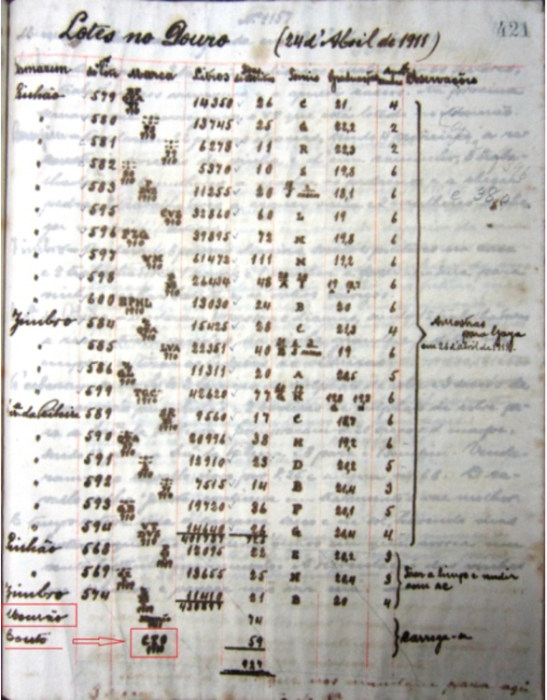
Figure 19
Fire marks of Silva & Cosens
Figura 19. Marcas de fuego de Silva & Cosens
Source/Fuente: Symington Family Archives. Copiador de correspondência da firma Silva & Cosens (1908-1919), fl. 421.

Figure 20
Fire marks of Silva & Cosens
Figura 20. Marcas de fuego de Silva & Cosens
Source/fuente: Symington Family Archives. Livro de lotes 1882, fl. 59The demarcation of 1756 enabled the consolidation of a regional brand of national importance that influenced trademarks. So, fire marks already present some of the signs and elements that later will be visible on labels. For example, the year of wine production, “its ageing in cask” (Pereira and Cruz, 2017: 423), through the mention Reserva (Figure 21), and the type, indicated by initials — CMO,[4] TB,[5] P Cognac,[6] Z RSD[7] (Figure 17), VT Dry 1929 (Figure 21) — or by symbols (Grant & Carlos) (Figure 22).
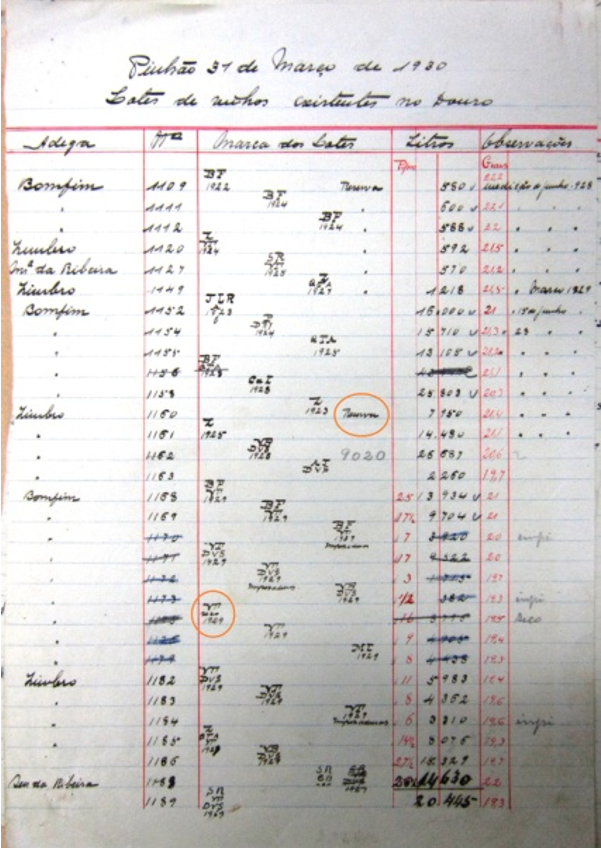
Figure 21
Fire marks of Silva & Cosens
Figura 21. Marcas de fuego de Silva & Cosens
Source/fuente: Symington Family Archives, Quinta da Senhora da Ribeira (1886-1914)
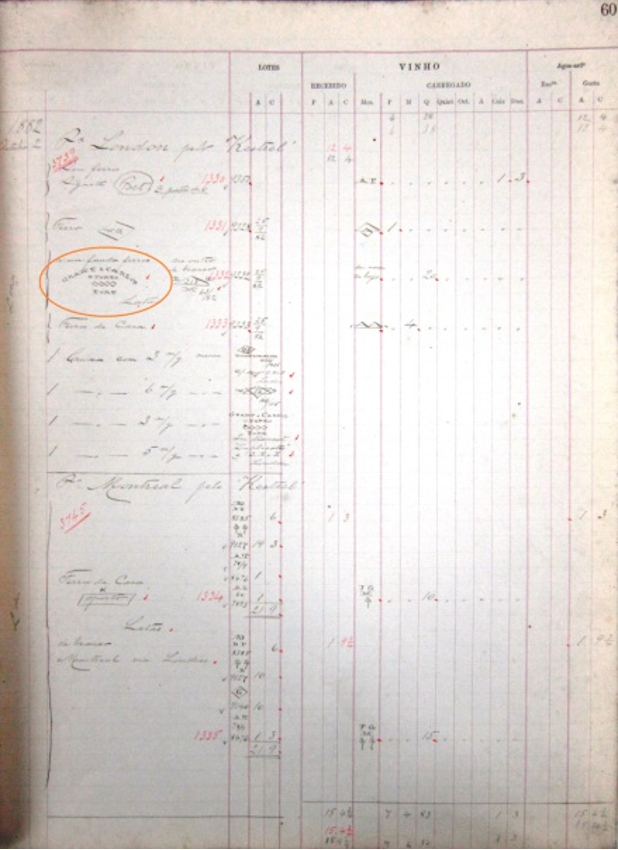
Figure 22
Fire marks of Silva & Cosens
Figura 22. Marcas de fuego de Silva & Cosens
Source/fuente: Symington Family Archives. Livro de lotes 1882, fl. 60In the decade of 1930, the marks in the livros de lotações (lot books) also mention the grape variety (Figure 23). As an example, SR VT Mourisco 1929, in this case indicating the production of a monovarietal wine.

Figure 23
Fire Marks of Silva & Cosens with indication of grape variety
Figura 23. Marcas de fuego de Silva & Cosens con indicación de variedad de uva
Source/fuente: Symington Family Archives. Quinta da Senhora da Ribeira (1886-1914).Conclusions
At the end of the 19th century, modern trademarks emerge after the creation of the legal framework for their protection and the birth of major commercial companies (Pereira and Cruz, 2017: 409-410).
In the wine sector in Portugal, there was a strong adherence of companies to the registration of trademarks as a protection against the practices of “unfair competition and misuse of indications of false or fallacious provenance”, in a context of post-phylloxera reconversion, market instability and proliferation of imitations and falsifications (Pereira and Cruz, 2017: 411).
Moreover, “the prestige of the regional brand Porto was associated with the creation of trademarks by traders long before the brand laws”.[8] Indeed, “Port wine is a remarkable example of the international projection of a designation of origin, but always associated with a set of private brands, at least since the 17th century” (Dias, 2019: 155). In the context of the debate between the trademark and the regional brand, Silva & Cosens has shown a peculiar attitude, by identifying itself with the regional brand, that is, with the regional identity of Port wine, advertising, in an early stage, the production and sale of genuine Douro wines and their international recognition, as stated in the “analytical report” to the article published in December 1907 in The Lancet Magazine (Figure 24).

Figure 24
Analytical report to The Lancet Magazine
Figura 24. Informe analítico a The Lancet Magazine
Source/fuente: Symington Family Archives. Dossier sobre a Silva & Cosens e Porto Dow’s (1864-1957)It is therefore an exemplary case in the Port wine sector of the use of the brand as value production and the enhancement of the designation of origin in the context of the development of trademarks.
References
Aguiar, A. and Lopes, T.S. (2000). “A marca e a internacionalização do vinho do Porto”. Douro – Estudos & Documentos 5(9): 121-143.
Almeida, A.R. de. (1999). “Denominação de origem e marca”. Studia Juridica – Boletim da Faculdade de Direito da Universidade de Coimbra 39: 141-175.
Borges, I.C.C. (2014). “A personalização da rotulagem do vinho Virgo: um casus na contemporaneidade”. Douro – Vinho, História & Património 3: 131-142.
Dias, J. (2019). “A situação actual do sector do vinho do Porto no plano empresarial”. In Guichard, F., Roudié, P. and Pereira, G.M. (coords.). História do Douro e do vinho do Porto. O vinho do Porto e o Douro no século XX e início do século XXI. Vol. V. Porto, Afrontamento: 143-159.
Guichard, F. (1997). “O vinho do Porto e mais alguns: gestão da imagem”. Douro – Estudos & Documentos 1(3): 145‑157.
Mayson, R. (1999). Port and the Douro. London, Faber and Faber.
____. (1998). The story of Dow’s Port, 1798-1998. S. l. London, Segrave Foulkes Publishers.
Monteiro, M. (1998). O Douro: principaes quintas, navegação, culturas, paisagens e costumes. Fac-simile da edição de 1911. Porto, Livro Branco.
Moreira, V. (1998). O Governo de Baco: a organização institucional do vinho do Porto. Porto, Afrontamento.
Pereira, G.M. (2010a). “A evolução das práticas vitícolas e de vinificação”. In Pereira, G.M. (coord.). (2010). História do Douro e do Vinho do Porto. Crise e reconstrução. O Douro e o vinho do Porto no século XIX. Vol. IV. Porto, Afrontamento: 142-215.
____. (2010b). “A evolução do espaço regional. Das demarcações pombalinas ao Douro pós-filoxérico”. In Pereira, G.M. (coord.). (2010). História do Douro e do Vinho do Porto. Crise e reconstrução. O Douro e o vinho do Porto no século XIX. Vol. IV. Porto, Afrontamento: 10-49.
____. (1996). “A região do vinho do Porto – origem e evolução de uma demarcação pioneira”. Douro – Estudos & Documentos 1(1): 177-194.
____. (1991). O Douro e o vinho do Porto. De Pombal a João Franco. Porto, Afrontamento.
Pereira, G.M. and Almeida, J.N. (1999). Porto Vintage. Porto, Instituto do Vinho do Porto and Campo das Letras.
Pereira, G.M. and Cruz, M. (2017). “Origem e distinção: as marcas de vinhos no final do séc. XIX”. CEM/Cultura Espaço & Memória 8: 409-425.
Pereira, M.B. (1947). No País do vinho do Porto. Porto, Instituto do Vinho do Porto.
Sequeira, C. (2011). O Alto Douro entre o livre-cambismo e o proteccionismo: a “questão duriense” na economia nacional. Porto, CITCEM and Afrontamento.
Notes